Grant Wexler sat across the conference table from two people who had signed his paycheck for 11 years, and neither of them could look him in the eye. A cardboard box already waited by the door, packed by someone else, sealed before he had even agreed to the meeting. Nobody explained why. Nobody needed to. He nodded once, picked up the box, and walked past the glass walls where nobody stood up to say goodbye.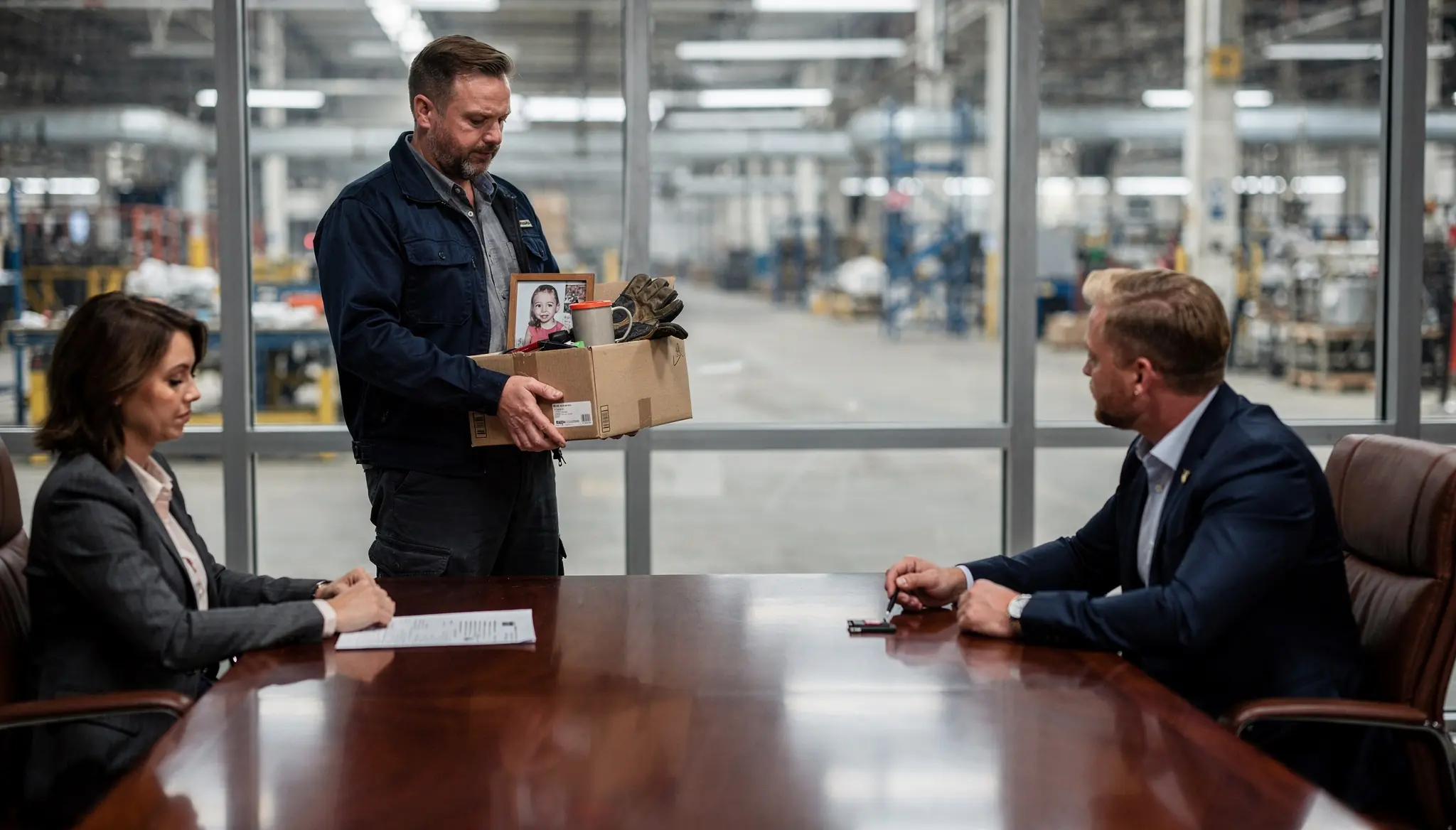
Three weeks later, the machines he had built with his own hands stopped answering to anyone who touched them. The house on Larkspur Avenue smelled like garlic bread when Grant got home, because Sadie had insisted on making dinner herself, and at 9 years old, that meant flour on the counter and a smoke detector she had already learned to silence with a dish towel before it finished its first beep. She looked up when he came in, still in his work jacket, and asked how his day was. He said it was fine.
He said it twice, actually, because the first time came out flat, and she noticed everything lately, the way kids do once they've already lost one parent and started keeping a careful eye on the other. "You look tired," she said, pulling the garlic bread out of the oven with both hands wrapped in dish towels, proud of herself and trying not to show it. "Just a long one," he said, and hung his jacket on the hook by the door. The same hook he had installed the week after Renee died, back when he needed something to do with his hands that wasn't grief.
He did not tell her he no longer had a job to be tired from. He set the table instead, asked about her science project, listened to a full explanation of why volcanoes erupt that involved more hand gestures than actual facts, and for 40 minutes he was just a father again, not a man who had spent 11 years building something that had let him go in five. He waited until she was asleep to open his laptop at the kitchen table, the house quiet except for the refrigerator humming, and somewhere outside a neighbor's sprinkler ticking against the dark. He applied to three positions that night, warehouse scheduling at a distribution center off the interstate, a maintenance coordinator role at a plastics plant on the west side, a part-time logistics clerk job that paid less than a third of what he used to make.
He did not apply to anything that used the word engineer. He had buried that word a long time ago, on purpose. Back when grief had made every reminder of what he used to be feel like something sharp left lying in the grass. The next morning, a recruiter called about the clerk position and asked, almost apologetically, why a man with his background wanted a job that basic. Grant told her he needed the flexible hours, that he had a daughter to get to school and back.
She said that made sense and moved on to salary expectations without asking anything further, though something in her pause told him she hadn't quite believed the whole answer. His phone rang once that afternoon with a Voss Industrial extension lit up on the screen. He set it face down on the counter and watched the seconds tick by without picking it up. Whatever they wanted, he was done being available for it on command, the way he had been for 11 years, always the man they called at midnight when something broke that nobody else understood.
The interview for the maintenance coordinator role came 2 days later in a windowless office at the plastics plant and across the table from a hiring manager who kept glancing between Grant's resume and Grant himself like the two didn't quite match. He asked why the gap in senior-level work, why the sudden interest in a role two pay grades below anything Grant had held before. Grant gave him the short version, family circumstances, wanting simpler hours, and watched the man nod without really hearing it, already deciding, Grant could tell, that someone this overqualified wouldn't stay long enough to be worth training. He didn't get a call back.
A scheduling conflict in the automated packaging line that the system flagged but never explained in language anyone on the current floor staff could parse. He told the supervisor to reset it. The supervisor reset it. It happened again 40 minutes later, this time pausing an entire conveyor section for 6 minutes before releasing itself for no reason the diagnostic panel would name. "It's a glitch," Tyler said, to no one in particular, the way people say things they have already decided to believe because the alternative requires more effort than they're prepared to spend.
Down in IT, Desmond Cruz pulled the maintenance history on the packaging system out of habit more than suspicion. It was a Friday afternoon task he did every few months to keep the archive clean, and he found something that stopped him mid-scroll. The core architecture documentation, the actual blueprint of how the automated lines talked to each other, station to station, from sensor to server was filed under a department code that had not existed in company records for 10 years. The lead signature at the bottom of every design revision read G. Wexler, systems architect, not operations coordinator.
Systems architect. Desmond sat back in his chair and stared at the screen long enough that his monitor dimmed to its screensaver. He had worked with Grant for 6 years and never once heard him mention designing anything. He had assumed, like everyone else on that floor, that Grant kept the line running because he was careful and reliable and methodical in a way that made people trust him without asking too many questions, not because he had built the entire system from nothing a decade earlier or back when Voss Industrial was half its current size and desperate enough to let a 28-year-old engineer redesign its whole logistics backbone from the ground up.
Somewhere along the way, after his wife died and he asked HR to cut his hours, step back from travel and take a role that let him be home by 5:00, his title had quietly downgraded and nobody had bothered to update what he actually knew how to do. The old department had been folded into a new one during a restructure 2 years later. The architecture files went into an archive nobody read because nobody remembered they were the instructions to the system that was still running exactly as designed every day. Grant became, on paper, a man who kept schedules, not the man who had written the language which the schedules were written in.
Desmond thought about saying something to Margot, then he thought about his own mortgage, his own two kids in braces, and the fact that Tyler Voss was the chairman's son standing two floors up with the authority to make anyone's job disappear the way Grant's had. He closed the file instead and told himself he would bring it up if things got worse, a promise he made to himself the way people make promises they hope circumstances will never force them to keep. He thought about calling Grant directly just to ask if he was all right, the way you'd check on any co-worker who'd been let go without warning. He got as far as pulling up the number before he set the phone down again.
It felt like the wrong kind of gesture, too small to matter, too late to help, the sort of thing a person did to ease their own conscience rather than actually fix anything. He went home that night and didn't mention any of it to his wife, though she asked twice why he seemed distracted over dinner. That night, at 11 minutes past midnight, the packaging line at Voss Industrial stopped completely for the first time in 12 years. Red lights ran the length of the floor like something out of a drill nobody had ever actually rehearsed.
Nine days had passed since Grant carried his box past the glass walls. The plant floor at 7:00 in the morning looked like a crime scene. Nobody had clocked in. Machines stood frozen mid-motion. Boxes half sealed on stalled conveyors.
Supervisors on phones pacing between stations and a night shift that had gone 11 hours without a single working line and was too tired to hide how frightened they were about what it meant for their jobs. Margot Sinclair arrived before the coffee finished brewing in her own office, still in yesterday's blazer because someone had to be the adult in the room and lately that someone was always her. She had been vice president of operations for 2 years, promoted 6 months before the termination decision that had, until this morning, felt entirely routine. One line item among dozens on a headcount memo she approved between two other meetings.
Walter Voss had wanted headcount trimmed to make room for Tyler's transition into a leadership role and Grant Wexler's name had come up on a list generated by an HR system that measured salary against current title against tenure, flagging anyone whose pay looked disproportionate to their listed responsibilities. Operations coordinator. Mid-level. Replaceable. According to the spreadsheet, he was replaceable.
She had signed it in nine minutes between a budget review and a call with a supplier in Ohio, then moved on to the next item without a second thought. Now she stood in the control room asking her lead engineer to explain a fault code and he could not. Nobody could. The system had been built by someone who documented almost nothing outside his own head, which had seemed like an acceptable risk to live with when that person was still on the payroll, still one phone call away from fixing whatever went wrong at 3:00 in the morning.
"Pull his personnel file," she said, low enough that only the engineer beside her heard it. "Wexler. I want to know what he actually did here, not what the org chart says he did." What came back an hour later was thin. A title, a start date 11 years old, a brief note about a voluntary schedule reduction 4 years earlier, no explanation attached, no cross-reference to anything technical, nothing about architecture, nothing about design, nothing that would have told her in the 9 minutes she'd had to sign his termination that she was cutting the one person who understood the plant's entire nervous system.
Tyler leaned against the doorway, unbothered, coffee in hand. "It's an old system. Old systems fail eventually. We'll patch it and move on." "You've said that for two days," Margot said.
"It hasn't been patched. We've lost 11 hours of production, and we don't even know what's actually broken." She did not raise her voice. She had learned a long time ago that the moment you raised your voice in that building, people stopped listening to what you were saying and started watching how you were saying it, filing it away as something to bring up later in a room she wasn't in, but something in her chest had gone tight and cold.
The particular feeling of realizing a decision you made without enough information was about to cost more than you understood at the time you made it. That evening, alone in her office, long after everyone else had gone home, she read the fault logs again, page by page, looking for anything that made sense of what had happened. Buried three pages down, an internal reference to legacy documentation filed under a department code she didn't recognize and couldn't find in the current directory. She wrote it down on a sticky note and pressed it to the edge of her monitor.
She would ask Desmond about it in the morning. Desmond gave her half an answer over coffee in the break room, his eyes not quite meeting hers. "Old team," he said, "restructured years ago. Records probably archived somewhere in cold storage. Could take weeks to dig up properly."
He did not say Grant's name, and she did not push. Though something in the careful way he avoided it told her the answer mattered more than he was letting on, and that he knew more than a systems administrator usually would about a file from 10 years back. She found the address herself that afternoon through an old vendor contact list that still had it listed under supplier coordination from a project years earlier. She drove out to Larkspur Avenue on a Saturday afternoon and parked across the street, engine off, telling herself she was just confirming the address, that she had no intention of getting out of the car.
Through the front window and out into the side yard, she could see him kneeling in the dirt beside a girl who had to be his daughter. The two of them planting something small along the fence line, his hands guiding hers around a trowel, patient in a way that had nothing performed about it. He laughed at something the girl said, an easy laugh, unguarded, nothing like the tight professional voice she remembered from the handful of meetings they'd shared over the years, the voice of a man who kept his head down and did his job without complaint. She did not get out of the car.
She sat there long enough to feel foolish about it, watching a stranger's ordinary Saturday like it was something she had no right to witness, then drove home and mailed a business card instead. No note, just her name and a direct number dropped through the slot in his mailbox two days later, like something she could pretend was an accident if anyone asked. Grant found the card on a Tuesday, turning it over twice before he understood what it was. Margot Sinclair, Vice President of Operations, Voss Industrial.
He knew the name. He had seen it printed under a signature on the termination letter. A signature that hadn't even looked rushed, hadn't looked like anything but routine. He set it in the kitchen drawer with the spare batteries and the takeout menus and did not call. Three days later she came in person, standing on his porch in a coat that cost more than his monthly car payment, looking less certain of herself than he had ever seen a Voss executive look in 11 years of meetings.
"I should have called first," she said. "You could have called it all," he said. "You had my number for 11 years. Nobody used it when it mattered." She didn't flinch, which he respected a little.
Even angry as he was standing there with the screen door still propped against his shoulder. "I'm not here to apologize for the meeting," she said. "I mean, I am, but that's not why I drove out here. We have a serious problem at the plant, and I think you're the only person who can explain what's actually wrong with it." "You fired the only person who could explain it."
"I know." "Then you understand why I'm not interested." She held his eyes for a moment, then nodded, accepting it the way someone accepts a verdict they expected but had hoped, for a moment, to talk their way out of. "I'd pay you directly, not through the company. A consulting rate, your terms, nothing on paper that ties you back to them if you don't want it to be tied back to them at all."
Grant looked past her toward the street, where Sadie's bike lay tipped over in the grass, one wheel still turning slowly from where she'd dropped it running inside to see who was at the door. "It's not about the money," he said. "I don't want my daughter watching her father get called back the second they need something from him." "She watched me lose that job without asking why." "Because I didn't tell her."
"I'm not going to let her watch me crawl back for it, either, no matter what it costs the two of us." "That's not what I'm asking you to do." "It's what it would look like from where she's standing." Margot nodded again, slower this time, and turned to leave, her heels loud on the porch boards. At the bottom of the steps she stopped, one hand on the railing.
"For what it's worth," she said, not turning around at first, "I didn't know who you were when I signed it. That's not an excuse. I should have asked more questions before I put my name on anything. It's just the truth, and you deserve to hear it from me instead of finding out some other way, from a headline or a stranger." He didn't answer, but he watched her drive off longer than he meant to, standing in the doorway with the card from 3 days ago still folded in his shirt pocket where he hadn't quite decided to leave it or to throw it out either.
Six days later, the plant's largest client, a national parts distributor that accounted for nearly a third of Voss Industrial's revenue, sent formal notice that if the fulfillment delays weren't resolved within 7 days, they would begin sourcing from a competitor already courting their business. 16 days had passed since Grant walked out the door with his box. The countdown that mattered now wasn't the one on the break room calendar. It was the one printed at the bottom of that letter in numbers nobody could argue with.
The letter landed on Walter Voss's desk on a Monday morning, and by 10:00 he had called an emergency session of the executive committee, the kind of meeting where people brought coffee they wouldn't drink because their hands needed something to hold that wasn't each other's stares. Margot sat across from him. Tyler sat beside his father, looking, for the first time in weeks, genuinely rattled. His jaw was tight in a way that made him look younger instead of older.
Desmond had been asked to attend as the technical lead, which meant he was the one expected to explain in front of the chairman of the company that employed him exactly how a plant that had run without failure for over a decade had come apart in 16 days. He had spent the weekend deciding whether to say what he knew, turning it over at his kitchen table, at his kids' soccer practice, in the shower where most of his real decisions got made. By Monday morning, he had decided that keeping quiet had already cost more than speaking up ever would. "There's something you should see," he said, and opened his laptop to an email dated 4 days before Grant's termination.
He read it aloud rather than paraphrase it because paraphrasing gave people room to soften what it said, and he wasn't interested in giving anyone that room anymore. In it, Grant had flagged, in plain and specific language, that any personnel change to the operations coordinator role would require a minimum 90-day technical handoff given the undocumented nature of the system's architecture tied to that position. He had sent it to Tyler directly, copying no one else, trusting the chain of command the way people do before they learn not to trust it at all. Tyler had never forwarded it.
It had sat in his inbox, read and unanswered, for 4 days until the meeting that ended Grant's employment made the whole question moot. The room went quiet in a particular way, the quiet of people recalculating who was responsible for what, doing silent math behind still faces. "You had this?" Walter said to his son, his voice low in a way that was somehow worse than shouting, "and we cut him anyway." "I didn't think it mattered," Tyler said, and even he seemed to hear how thin it sounded the second it left his mouth.
"It read like someone protecting his own job. It read like someone doing his job," Margot said. "The job none of the rest of us understood we needed him to keep doing." Walter turned to Desmond. "Why didn't this come to me directly? Why did it take a shutdown for anyone to mention an email like this exists?"
Desmond didn't look away, though every instinct told him to. "Because I had a family to think about, and Tyler had your last name," he said. "I'm not proud of that, but you asked, so that's the honest answer, and I'd rather give it to you now than keep pretending I don't know why nobody speaks up in this building until it's already too late to matter." Nobody in the room disagreed with him, which was its own kind of answer.
Walter did not answer either of them right away. He sat very still for a long moment, hands flat on the table, the stillness of a man watching a decision he'd made in 5 minutes cost him a company he'd spent 30 years building from a single leased warehouse into something with his name on the front gate. The line failed completely at 2:00 in the afternoon on a Wednesday in the middle of the plant's highest volume shift of the month. Every automated station along the packaging floor locked at once.
A cascading failure that took down inventory tracking with it, so that for 6 hours Voss Industrial did not know with any confidence what it had shipped, what it hadn't, or what was sitting mislabeled in trucks already on the highway headed to three different states. 21 days had passed since Grant carried a cardboard box past a room full of people who wouldn't meet his eyes. By evening, it was on the local news, a 2-minute segment about a Dayton manufacturer facing a full operational shutdown. Stock ticker graphic behind the anchor's shoulder showing Voss Industrial's share price down 11% since the opening bell.
By the next day, three board members had called for an emergency shareholder session, the kind that ends careers before lunch. The session was not gentle. A man in his 70s who had sat on the board since before Walter took over the company asked, without much patience left in his voice, how a routine personnel decision had been allowed to threaten the company's largest and longest standing contract. Walter did not defend himself. He had spent 2 days doing the math on what silence had cost him, and there wasn't a version of an answer that made him look better than the simple unflattering truth.
Margot stood before anyone asked her to, smoothing her jacket once, the only visible sign of how much the moment cost her. "I signed the termination," she said. "I want that on the record before anyone else speaks. I made the decision using incomplete information, and I didn't ask enough questions before I made it. That responsibility is mine, not the chairman's and not IT's."
She laid out the email Desmond had found. The department code with no current owner, the years of undocumented architecture sitting in one man's head because nobody had ever required him to write it down on paper the company could keep. She did not soften Tyler's role in it either and when she finished the room did not look at Walter. It looked at his son the way rooms do when everyone has finally arrived at the same conclusion at once.
Tyler was asked to step down from operations that afternoon effective immediately pending a full review of the decision that had brought them here. He did not argue, did not raise his voice, did not invoke his father's name the way he might have 3 weeks earlier. For the first time since Grant's box had cleared the front door, Tyler Voss looked like a 28-year-old who understood finally that consequences existed and had simply been waiting their turn to arrive. The board authorized a reinstatement offer that same day: a full return for Grant Wexler at a title and compensation that reflected what he had actually been doing for the company all along, not what an outdated file said he did on paper.
Margot was the one who delivered it because she asked to be the one and because she thought he deserved to hear it from the person who had signed the paper that started all of this, not a form letter mailed from human resources with his name spelled slightly wrong. She found him in the yard again, this time kneeling beside a young maple sapling instead of Sadie, staking it against the wind that had picked up that week with the change of season. "They want you back," she said, standing at the edge of the yard until he waved her closer. "Full title, full pay backdated to the day you left, and an apology in writing if you want it, though I doubt paper means much to you at this point."
Grant straightened up, brushing dirt from his knees, taking his time before he answered. "What do you want? Not the board. You." "I want to stop lying awake wondering how many other decisions I've made the same way, in nine minutes and with half the information," she said.
"That's mine to fix, not yours. But I do think the plant needs you, and I think you know it, or you wouldn't still be checking your phone every time it rings, even now." He almost smiled at that, caught out. "It's a hard habit to break, apparently." They sat on the porch steps for a while after that, neither of them saying much.
The kind of quiet that used to feel awkward between them across a conference table and had started somewhere in the last 3 weeks to feel like something else entirely. She asked carefully how his wife had died. He told her quickly, the way people describe things they've had to describe too many times already. An intersection 2 miles from the house, a driver who ran a light on a Tuesday morning, 4 years that felt shorter every year instead of longer the way everyone promised it would.
She didn't offer a rehearsed condolence, didn't reach for his hand, didn't fill the silence with something meant to make herself feel useful. She just sat with it, and that, more than anything she'd said about the job or the board or the apology in writing, was what made him start to believe she might actually be someone worth trusting again. He said he'd think about the offer. He didn't say yes yet, but he didn't say no either.
And for Grant Wexler, a man who had spent 4 years saying no to almost everything that asked something of him, that alone was new ground worth standing on. He called 2 nights later after Sadie was asleep and told her yes, not because of the backdated pay, not because of the title, but because he'd walked the plant floor in his head a hundred times since the collapse hit the news, running through every station, every sensor, every place a stranger's hands might make things worse before they made them better, and he couldn't stand the thought of watching it fail from the outside when he knew exactly how to fix it. Margot didn't say much on the other end of the line. She just told him what time to come in and thanked him and meant it in a way that didn't need any more words attached to it.
That night, brushing her teeth before bed, Sadie asked him, out of nowhere, the way kids do, whether the lady in the nice coat was going to come around more. "Baby?" Grant said, leaning in the bathroom doorway. "Why do you ask?" "She looked at you the way Mom used to look at you in the kitchen photo," Sadie said, matter-of-fact, and went back to brushing her teeth like she hadn't just said something that stopped her father cold in the doorway.
One hand still braced against the frame, he didn't sleep much that night. Not because of worry, because of the opposite, a kind of restlessness he hadn't felt in 4 years and had almost forgotten the shape of. Grant walked back onto the plant floor Monday morning 4 weeks after he'd walked off it, and the response was not what he expected. Machine operators who had known him for years stopped what they were doing to shake his hand, some of them holding on a beat longer than a handshake usually calls for.
A line supervisor said, half joking and half not, that the place had felt haunted without him, like a ship missing whoever actually knew how the engine worked underneath the deck. Nobody made it a production, they just made it clear in small ways, an extra cup of coffee left on his desk, a chair already pulled out at the morning meeting, that they'd known who he really was the whole time, even when the company on paper hadn't. He ran diagnostics for 6 hours straight that first day, mapping the failure points against the original architecture in his head because he had never trusted paper enough to write half of it down, and wasn't about to start apologizing for that now. By evening, the packaging line came back online in stages, first the sorting bay, then the labeling stations, then the full automated sequence humming the way it used to before anyone had decided a title on a spreadsheet meant more than the work underneath it.
Tyler found him in the control room near the end of the shift, hovering in the doorway the way a person does when they've come to say something and aren't entirely sure they'll manage to get it out. "I read your email again," Tyler said. "The one I never forwarded. I've read it about ten times this week." Grant did not look up from the monitor right away.
"And you were right about all of it." He shifted his weight from one foot to the other. "I didn't ignore it because I thought you were wrong. I ignored it because I didn't want to owe you anything, and forwarding it would have meant admitting I needed you." Grant finally turned to face him, arms crossed loosely, not unkind but not warm either.
He didn't offer forgiveness and Tyler didn't seem to be asking for it outright. "Then don't ignore the next one," Grant said. "That's all I actually want from you. Not an apology. Just don't do it again."
It wasn't warmth, but it was honest. And Tyler took it, nodding once before he left the room, and something in the set of his shoulders looked, for the first time since Grant had known him, like a man trying to learn something rather than avoid it. Within 2 weeks, the client that had threatened to walk sent formal notice that they were staying, citing the plant's transparency about what had gone wrong and the speed and clarity of what had been done to fix it. The stock recovered most of its losses within the month, climbing back in small, unremarkable increments that made no headlines at all.
None of it happened because of a single dramatic gesture. It happened in the accumulation of small things done right, day after day, mostly by a man the company had once decided on a spreadsheet that it could do without. Desmond stopped by Grant's office one afternoon during that stretch, leaning in the doorway the way half the plant seemed to do lately, like nobody had quite gotten used to seeing him back there yet. He didn't apologize exactly, not in so many words, but he told Grant about the maintenance file, the sticky note, the number he'd pulled up on his phone and never dialed.
Grant listened without interrupting, then said he understood why a man with two kids and braces didn't stick his neck out for someone else's job, and that he didn't hold it against him. Desmond looked like he'd been carrying that conversation around for a month, waiting for permission to set it down. "You could have told me sooner," Grant said. "But you told them when it counted. That's the part that mattered."
It wasn't absolution, not exactly, but it was enough for both of them to shake hands and mean it. And after that, Desmond made a point of bringing Grant coffee most mornings, an apology delivered one cup at a time instead of all at once. Margot started coming by the control room in the afternoons, ostensibly for updates, though the updates rarely took as long as the visits themselves did. They fell into an easy rhythm neither of them announced out loud: coffee left on his desk without a word some mornings, a running joke about the vending machine on the second floor that never had the flavor she wanted, and the two of them staying past six some evenings, not because the work required it, but because neither one was in a hurry to be the one who left first and made the other one leave, too.
Neither of them called it anything. It didn't need a name yet. And naming it too soon felt like it might spook something that was still finding its footing. Grant was formally named chief systems architect at the end of that month, a title that finally matched a decade of work nobody had bothered to write down on any org chart. There was a small announcement, a short paragraph in the company newsletter tucked between a safety award and a retirement notice, nothing close to the fanfare the collapse itself had gotten in the local press 3 weeks earlier.
He didn't want fanfare. He wanted his name on the door to mean what it should have meant all along, nothing more and nothing less. Sadie came to the plant for the first time on the day they hung his new title placard outside his office door, standing on her toes to read it out loud twice, like saying it made it more real, more permanent than a piece of engraved plastic screwed into drywall. Margot crouched down to her height and asked if she wanted to see the button that made the whole packaging line light up all at once, and Sadie's answer was an unhesitating yes that made both adults laugh in a way that had nothing forced in it at all.
That evening, the three of them ended up at Grant's kitchen table without either adult quite deciding it in advance. Margot stayed for dinner because Sadie had insisted on setting a third place at the table without asking anyone first. She stayed for the dishes because it felt strange to leave in the middle of them, then remained long after the dishes were dried and put away because nobody had said aloud that it was time to go. Later, after Sadie fell asleep on the couch halfway through a movie neither adult was really watching, Grant carried her to bed while Margot waited on the porch, arms wrapped around her knees against the cool evening air.
He came back out and sat beside her on the steps, close enough that their shoulders nearly touched, close enough that neither of them moved away to fix the distance. "I keep waiting for this to feel complicated," she said, looking out at the dark street instead of at him. "It doesn't, not the way I expected it to. Give it time," Grant said, but he was smiling when he said it, and the smile gave the joke away before the words could land as a warning.
The porch light buzzed faintly above them, moths circling it the way they always did in early autumn, drawn to something they couldn't quite name either. Somewhere down the street a dog barked twice and went quiet. Neither of them said anything else for a while. Neither of them needed to. His hand found hers on the step between them, not reaching for it exactly, just settling there.
Like it had been waiting for permission that neither of them had thought to ask for out loud until this exact, ordinary, unremarkable evening. Inside, the movie's end credits played on, unwatched, to an empty living room, the sound turned low. On the fridge, held up by a magnet shaped like a sunflower, a drawing Sadie had made that week showed three stick figures standing in front of a building with a smiling sun overhead. No caption, none needed.
Grant hadn't said anything about it when he found it that morning. He just left it exactly where she'd put it. Out on the steps, the conversation had wandered, the way conversations do late in the evening between two people no longer measuring their words. Margot talked about growing up two states over, a father who ran a hardware store and taught her to read a blueprint before she could read a novel, which was maybe why she'd ended up spending her life around plants, and floors, and machines, instead of anywhere quieter.
Grant talked about Renee a little more this time than he had on the porch weeks earlier, about the two of them driving out to look at this exact house before they could really afford it, about how she'd stood in the empty living room and said it needed a family loud enough to fill it. He hadn't said her name out loud that many times in the last four years combined. "She'd have liked this place better with people in it," he said. "It sounds like it has some now," Margot said, and did not take it back, and he did not ask her to. Neither of them had been looking, and that was exactly why they found it.