The slap was loud enough to stop every conversation in Harbor Square Market.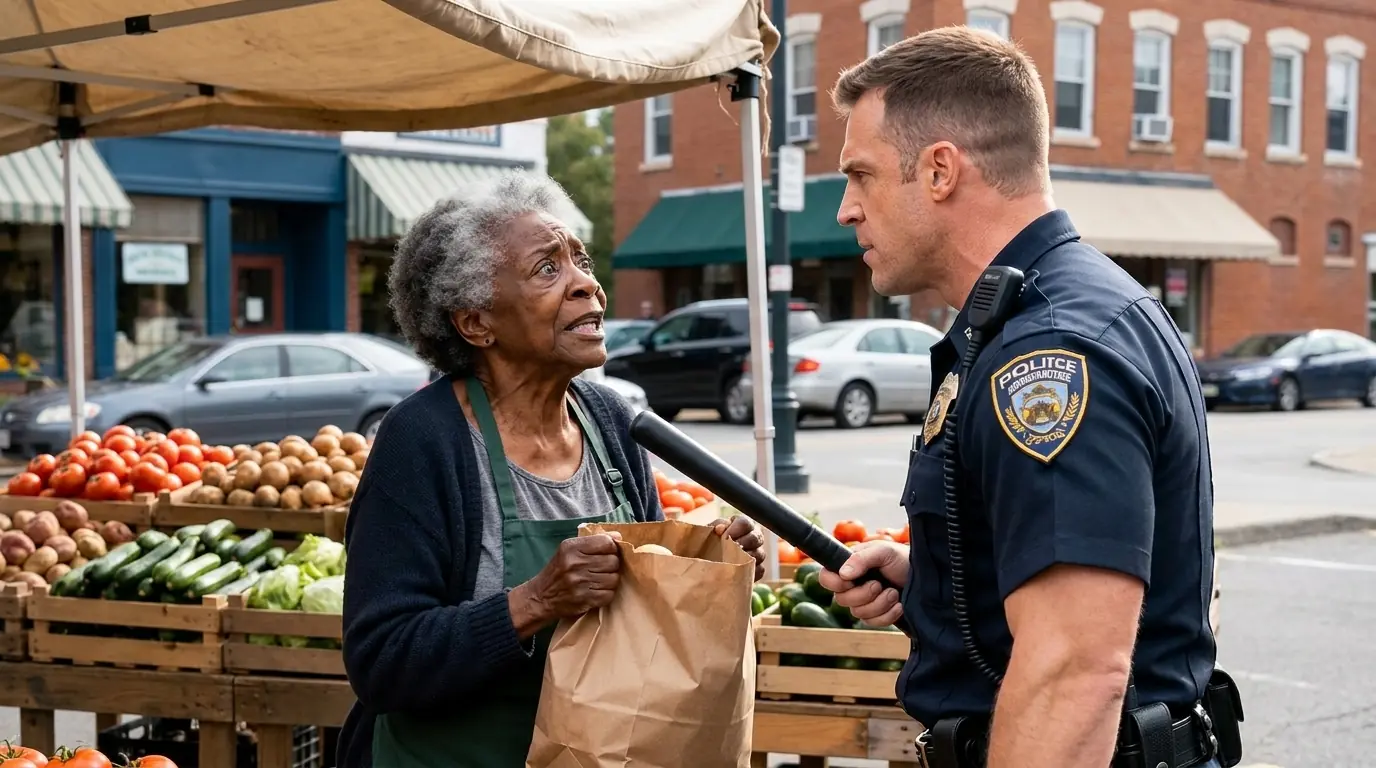
For one strange second, even the fryer behind the seafood stall seemed quiet. Seventy-four-year-old Vivian Brooks stood frozen beneath the Virginia summer sun, one hand pressed against the side of her face while a paper bag of pastries lay torn open on the pavement beside her shoes. Officer Tyler Harlan looked down at her as though he had just corrected a problem instead of striking an elderly woman in front of more than fifty witnesses.
“You remember who you’re talking to next time,” he said.
Nobody moved.
That was the part Vivian would remember longer than the pain.
Not Harlan’s hand.
Not the pastry crushed beneath his boot.
The silence.
People she had known for years suddenly found reasons to stare at vegetables, cash registers, phones, pavement, anything except the officer standing over her. They were not indifferent, Vivian realized. They were afraid.
Then a man’s voice came from behind Harlan.
“Officer.”
Harlan turned.
The man standing there was tall, broad through the shoulders, and somewhere around sixty. He wore khaki pants, a pale blue polo shirt, and sunglasses that made him look like any retired military man who might have stopped at the market for peaches. Nothing about him announced that he had spent most of his adult life inside places where bad decisions became permanent very quickly.
“Step away from Mrs. Brooks.”
Harlan stared at him.
“Mind your business.”
The man removed his sunglasses.
“I am.”
Vivian looked up.
Her breath caught.
“Elias?”
The man’s expression changed instantly.
Rear Admiral Elias Grant had not seen Vivian Brooks in nearly four years.
The last time had been at a memorial service in Norfolk, where she sat in the second row holding a folded flag that had already spent fourteen years in a cedar box inside her bedroom. Elias had stood at the podium that afternoon and spoken about Vivian’s only son, Chief Petty Officer Daniel Brooks, one of the finest men he had ever led.
Now Daniel’s mother was sitting on hot concrete with blood gathering along the inside of her lower lip.
And a municipal police officer was telling Elias to keep walking.
Harlan looked between them.
“You know her?”
Elias did not answer the question.
He stepped around the officer and crouched beside Vivian.
“Can you stand?”
“I think so.”
“Did you hit your head?”
“No.”
“Hip?”
“Sore.”
Vivian glanced toward the ruined pastries.
Then, absurdly, she said, “Those were for Jordan.”
Elias almost smiled.
Jordan was her thirteen-year-old grandson.
Daniel’s son.
“He’ll survive without a cinnamon roll.”
“He will complain like he won’t.”
That sounded like Vivian.
Good.
Elias extended one hand.
Before Vivian could take it, Harlan grabbed his shoulder.
“Back up.”
Elias looked toward the hand.
The officer removed it.
Something in Elias’s face apparently suggested that was the wise decision.
“I said this is an active police matter.”
Elias stood.
“Then state the offense.”
Harlan laughed.
“You a lawyer?”
“No.”
“Then you don’t need an explanation.”
Elias looked toward the old woman beside him.
“You struck her.”
“She resisted lawful detention.”
Vivian stared.
“I was buying bread.”
Harlan pointed at her.
“And now you’re interrupting again.”
A murmur moved through the crowd.
Harlan noticed.
His posture changed.
That was how bad authority often behaved when witnesses became inconvenient. First it performed. Then it rushed to create a record explaining the performance.
He pulled his radio.
“Dispatch, send another unit to Harbor Square. Disorderly subject, resisting, possible assault on officer.”
Vivian blinked.
“Assault?”
“You shoved my arm.”
“You hit me.”
“Because you became combative.”
Elias looked around.
“How many cameras cover this aisle?”
Harlan turned toward him.
“What?”
Elias pointed toward a seafood stall.
“Camera.”
Then the bakery.
“Camera.”
Then the pharmacy entrance.
“Another.”
Finally he nodded toward a teenage girl half-hidden behind an apple display.
“And at least one phone.”
The girl froze.
Harlan noticed her.
“You recording?”
She lowered the phone slightly.
Elias said, “Keep recording.”
Harlan’s face flushed.
“You do not give instructions at my scene.”
“No.”
Elias’s voice remained calm.
“But she does not need your permission to preserve what she witnessed.”
The girl raised the phone again.
Her name was Maya Ellis.
She was sixteen.
Her mother owned the flower stall near the market entrance, and Maya had been recording before the slap because Harlan had already started arguing with Vivian over a receipt. She had captured the bakery owner saying the pastries were paid for.
She had captured Vivian showing the receipt.
She had captured Harlan demanding that Vivian call him “sir.”
Then she captured the shove.
The crushed pastry.
The slap.
Harlan did not know any of that yet.
He only knew a teenager held a camera.
That made him angrier.
“Turn it off.”
Maya looked toward Elias.
He said nothing now.
He simply waited.
Maya swallowed.
Then answered Harlan herself.
“No.”
The word traveled through the market.
Small.
Terrified.
But audible.
Something changed after that.
The bakery owner, Mr. Benitez, stepped out from behind his counter. A woman named Rochelle Carter who sold handmade soap moved beside Maya. An elderly white farmer named Walter Ingram left his vegetable table and walked closer.
Nobody shouted.
Nobody surrounded the officer.
They simply stopped looking away.
Harlan saw it.
His confidence shifted.
Then a second patrol car entered the market parking area.
Sergeant Colin Reddick stepped out.
Reddick was forty-nine, thick around the waist, gray beginning at his temples, and carried himself with the exhausted authority of someone who had spent years deciding which complaints deserved attention and which could disappear inside paperwork. Harlan visibly relaxed when he saw him.
“Sergeant.”
Reddick approached.
“What happened?”
Harlan answered first.
“Possible theft. Subject became argumentative, resisted detention, shoved me.”
Vivian stared at him.
Elias said nothing.
Reddick looked at Vivian’s face.
Then toward Harlan.
“You strike her?”
“Control technique.”
The phrase made Elias’s jaw tighten.
Reddick noticed him.
“Who are you?”
“A witness.”
“Name?”
“Elias Grant.”
Reddick waited.
Nothing.
“Identification?”
Elias reached slowly toward his wallet.
Harlan immediately said, “Watch his hands.”
Elias stopped.
Then smiled without humor.
“Would you like me to retrieve identification or keep my hands visible?”
Reddick looked annoyed.
“Just show me.”
Elias opened the wallet.
Driver’s license first.
Then another credential.
Reddick saw it.
His expression changed so quickly that Vivian almost felt sorry for him.
Almost.
The credential identified Elias Grant as Rear Admiral, United States Navy, assigned to Naval Special Warfare command oversight in the Hampton Roads region. He was not wearing uniform because he had spent the morning at his sister’s home and stopped at Harbor Square before returning to base.
Harlan leaned over.
Read the card.
His face emptied.
“Admiral.”
Elias closed the wallet.
“That should not change what happened.”
Nobody spoke.
Elias looked directly at Reddick.
“If your first question becomes different because you know my rank, then we have another problem.”
Reddick cleared his throat.
“Of course.”
“Good.”
Elias pointed toward Maya.
“Start with her recording.”
Harlan stepped forward.
“Sergeant, that girl only caught the end.”
Maya answered:
“No, I didn’t.”
Everyone looked at her.
She held the phone against her chest.
“I started before he asked Mrs. Brooks for the receipt.”
Harlan’s face tightened.
Reddick said, “Let me see.”
Maya hesitated.
Her mother came from the flower stall.
“I want to stand with her.”
Reddick nodded.
“Fine.”
They watched.
The first forty seconds showed Vivian leaving the bakery with a receipt in one hand.
Harlan stopped her.
Asked about the bag.
Vivian explained.
Mr. Benitez called from behind the counter:
“She paid.”
Harlan ignored him.
Then:
“You say sir when you answer me.”
Vivian’s surprise.
Her apology.
Harlan’s shove.
Bag falling.
Pastries rolling.
His boot crushing one.
Vivian saying:
“I did nothing wrong.”
Then Harlan:
“You people always think the rules don’t apply to you.”
Finally the slap.
Nobody needed to discuss context.
Context had spoken.
Reddick turned off the video.
Harlan started talking immediately.
“She was escalating before the recording.”
Maya stared.
“The video starts when she came out of the bakery.”
“You don’t know what happened earlier.”
“She was inside buying bread.”
“Maya.”
Her mother touched her arm.
But Maya continued.
“I saw the whole thing.”
Mr. Benitez raised his hand.
“So did I.”