The scholarship was announced on a board outside the Kingsford assembly rooms on the first Monday in March and half the county came to read it. It was written in the copperplate hand of Mr. Peverell, the Duke of Ashford's solicitor, and it said in the dry language that solicitors use when they wish to sound generous without being warm that his grace, the Duke of Ashford would fund one place per annum at the Haversmith Academy for girls. The place would cover full fees, board, books, and clothing. It would be awarded by examination to any girl in the county between the ages of fifteen and eighteen, regardless of station. Those two words sat in the copperplate like a stone dropped into a pond, and the ripples went out through Kingsford and the villages around it, and did not stop for a week.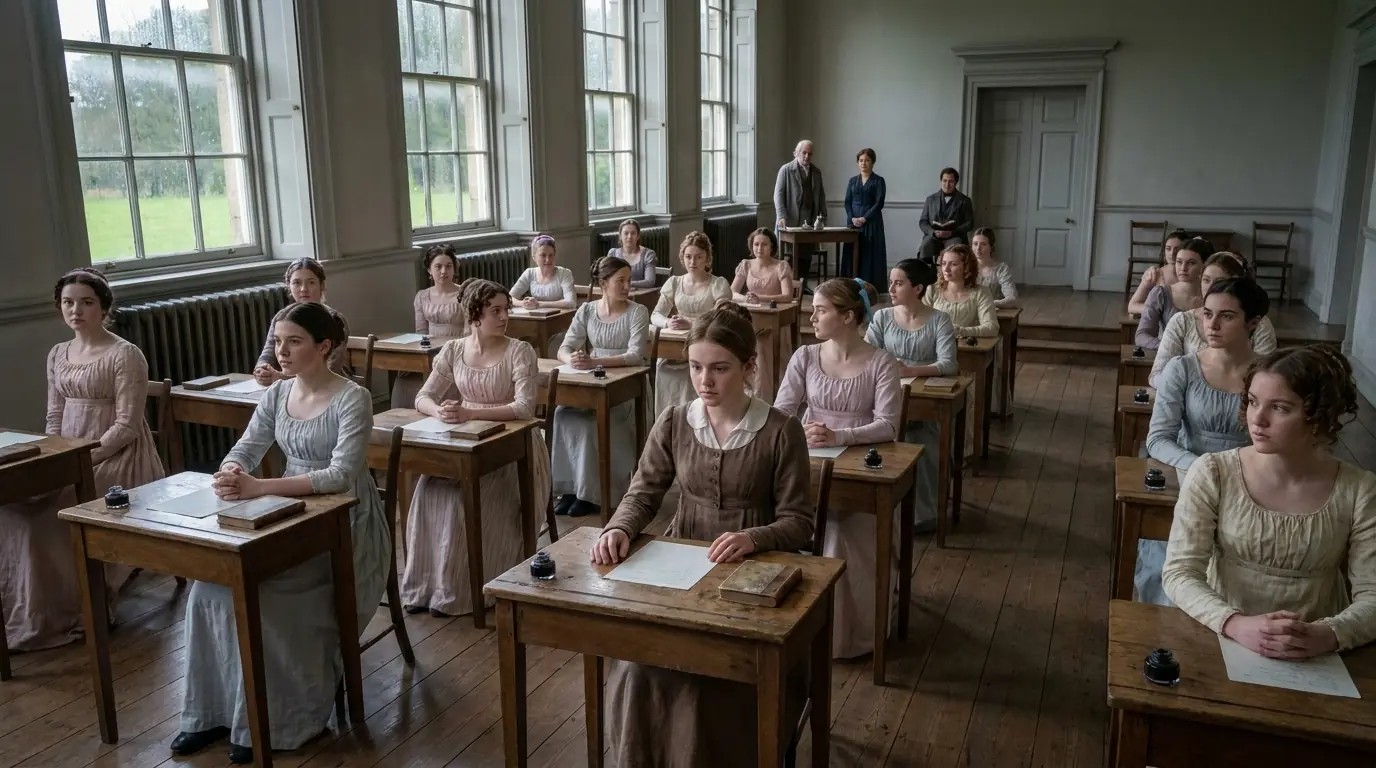
The Haversmith Academy was not an ordinary school. It was the kind of school where a baron's daughter sat beside an earl's daughter, where French was spoken at table, and Latin was offered to those who wished it, where a girl came out at eighteen with the polish and the learning and the quiet, impossible confidence of a woman who has been told since childhood that the world will make room for her. Nobody from Kingsford had ever attended Haversmith. Nobody from Kingsford could have afforded it. The fees alone were £80 a year, which was more than most families in the dale earned in twelve months.
The scholarship was to the girls of Kingsford and the villages around it, like a window opened in a wall they had never thought to look through. The examination would be held at the assembly rooms in April. Any girl might sit it; the notice said so plainly. Any girl.
Lena Burch read the notice three times. She read it standing in the rain outside the assembly rooms with a basket of eggs on her arm and her boots leaking at the sole and her heart doing a thing it had not done in a long time, which was hoping. She was seventeen. She was the eldest of four children. Her father was dead.
Her mother took in washing. They lived in a cottage at the edge of the village that was too small for six people and too cold for five, and that they kept because keeping it was cheaper than losing it, and because the alternative was the parish, and Lena's mother would have walked into the river before she walked into the parish. Lena worked. She had worked since she was twelve when her father died, and the world which had been small but manageable became small and impossible. She carried eggs to market.
She swept the floor at the Crown for a penny a day. She mended linen for the better houses in the village and delivered it clean and pressed and folded and never once late. She did all of this. And she also, in the hours between, in the thin margins of a life that had almost no margins at all, she read. She read the way a starving person eats.
Everything, anything, without preference, and without pause. She read the Bible because it was the one book the cottage owned. She read the Almanac because the schoolmaster had thrown it away, and she had taken it from the bin. She read a volume of Pope that she had found in a ditch, waterlogged and missing its cover, and she had dried it page by page on the cottage window sill, and read it in its entirety, and understood perhaps a third of it, and loved it all. She had gone to the village school until she was twelve.
The schoolmaster, Mr. Cope, had been a tired man with a large class and very little patience for anyone, but he had noticed Lena. It was difficult not to notice Lena. She sat at the front and listened with the intensity of a person who knows that every word is a coin she cannot afford to drop. And she asked questions that the other children did not ask. And the questions had a quality to them, a reaching quality that Mr. Cope had seen perhaps twice in 30 years of teaching.
He had told her mother once carefully standing at the cottage door with his hat in his hand that the girl had a mind. He had said it the way a doctor says a patient has a condition, half warning and half diagnosis. A mind like Lena's in a house like theirs was not an asset. It was an appetite that could not be fed. Her mother had thanked him and shut the door and said nothing about it to Lena because what was there to say?
A mind was a fine thing, so was a roof. The roof came first. Lena had left school at 12 and gone to work, and the mind had gone on. The way a fire goes on under a banked grate, not out, only held, only waiting for the air to reach it. She stood in the rain outside the assembly rooms and read the notice and thought about the examination and the £80 and the books and the French and the Latin.
And she thought about her mother's washing and her sister's shoes and the eggs in the basket that were worth six pence if she sold them all and three if she sold half. She thought about regardless of station.
She went home. She put the eggs in the larder. She told her mother about the scholarship. Her mother was at the copper, her hands red to the wrists, and she did not stop working while Lena spoke, because stopping meant falling behind, and falling behind meant losing a customer, and losing a customer was a thing they could not afford. "An examination," her mother said.
In April, at the assembly rooms, anyone may sit it. Anyone may sit it. Not anyone will pass it. The baron's daughters will sit it. Lena, the rector's girls, girls who have had governesses and French masters and music lessons since they were in short skirts.
Who sweeps the Crown? Who mends the linen? You are not a girl who can be spared, Lena. You are a wage. It was said without cruelty.
It was said the way a woman says a true thing about a hard life plainly because plain is the only way it can be born. "I know," Lena said again. I know all of that. I am asking anyway. Her mother stopped working.
She looked at her daughter. She looked at her the way a woman looks at a thing she recognizes and fears. A thing she once had in herself and lost and does not wish to see lost again. "You have a month," she said. You will study in the evenings after the work is done.
You will not let the work slip. If you pass, we will find a way. We always find a way. And if I don't pass, then you will have tried. And trying is worth more than the eggs, though the eggs are also needed.
Go and sell them. You are late.
Lena went and sold the eggs and came back and sat down at the kitchen table at 8:00 that evening with a stub of candle and the Bible and the waterlogged Pope and a borrowed grammar she had got from Mr. Cope who had heard about the scholarship and had given it to her without a word and without expecting it back. She studied. She studied the way she did everything with the fierce quiet concentration of a person who knows that the gap between where she is and where she needs to be is very wide and that the only way across it is work. She studied Latin from the grammar and arithmetic from the almanac and composition from the Pope, passing his sentences the way her father had once passed a piece of wood, looking for the grain and the join, and the way the parts fit together to make a thing that held. She studied by candlelight because candles were cheaper than oil.
And she studied in her coat because the cottage was cold. And she studied until her eyes blurred and the candle guttered. And her mother coming down at midnight for water found her asleep at the table with her face on the open grammar and the candle burned to a pool of wax. Her mother covered her with a blanket and did not wake her. She looked at the grammar and the Pope and the Bible and the girl asleep among them, and she thought about the mind Mr. Cope had warned her of, and she thought that a mind like that in a house like this was either a cruelty or a gift, and she did not yet know which.
The examination was on a Saturday. Lena walked to the assembly rooms in her best dress, which was her only dress, which was clean and pressed, and two inches too short at the hem, because she had grown since the autumn, and there was no cloth to let down. There were 14 girls. She counted them as she came in. 14 desks set in rows in the long room. And at 13 of them sat girls in gowns that had never been turned, and boots that did not leak, and faces that had the particular composure of people who have been prepared for this moment by people who are paid to prepare them.
Lena sat at the fourteenth desk. She folded her hands on the wood. She looked at the examination paper, which was face down, and she waited. At the front of the room stood Mr. Peverell, the solicitor, dry and gray. Beside him stood a woman Lena did not know, tall and straight, in a traveling dress of dark blue.
She had the look of a person who has come from a better room, and is not sure this one is worth the journey. And at the back of the room, in a chair set apart from the rest, sat a man. He was not introduced. He was not explained. He sat with one ankle crossed over the other knee and a book in his hand, as though he had wandered in by accident, and was merely waiting for the room to empty so he could go on reading.
He was tall, that was the first thing, dark-haired, lean-faced, dressed in a plain dark coat with no ornament. His eyes, when he glanced up from his book, were a steady gray-green, the color of deep water, and they moved across the room with the quiet attention of a man who is accustomed to seeing everything and being seen by no one. Lena did not look at him long. She had an examination to sit and no time to spend on a man in a chair. "You may begin," said Mr. Peverell.
Lena turned the paper. The examination was hard. It was harder than she had expected, and she had expected it to be hard. The Latin was beyond the grammar Mr. Cope had lent her. The arithmetic was sound, but the composition was the thing.
A long essay question that asked the candidate to discuss the nature of duty. Lena looked at the question. She looked at it for a full minute, which was a minute she could not afford, and she thought about duty, and she thought about what she knew of it. She knew that duty was rising at 5 and carrying eggs in the rain. She knew that duty was sweeping a floor for a penny and mending linen until her fingers ached and studying Latin by a candle stub while her mother slept.
She knew that duty was the thing that held a family together when everything else had been taken away and that duty was also the thing that could crush a family flat if it was never relieved by hope. She wrote she wrote for 2 hours without stopping. She wrote in the clear, steady hand her mother had taught her because her mother, who could not afford a pen, had insisted that a girl's handwriting was the one thing the world could not take from her, and Lena's handwriting was the one thing in her life that was beautiful without qualification. She wrote about duty as she knew it, which was not as the philosophers knew it, not as a principle or an abstraction, but as a daily practice, as a thing done with the hands and the back and the will, before dawn and after dark, without applause and without rest. She wrote that duty without hope is only endurance and that endurance without purpose is only suffering and that the purpose of duty is not to suffer but to build to lay down one day's work upon the last and make a thing that holds.
She wrote that a girl who carries eggs to market is performing a duty as real as any soldier's and that the world's failure to see it does not make it less real but only makes the world less seeing. She set down her pen. She folded her hands. She waited. The papers were collected.
The fourteen girls filed out. Lena walked home in the thin April sun and told her mother she had done her best and her mother said then that is enough and gave her a cup of tea and they said no more about it. Three weeks later, the letter came.
The letter was delivered by the same groom in the Duke's livery that the village had seen once before on the day of the scholarship notice. He brought it to the cottage door at 9 in the morning, and Lena's mother took it with wet hands and held it away from the washing and called Lena in from the yard. Lena opened it at the kitchen table. Her hands were steady because she had trained them to be steady and because a girl who has carried eggs in the rain does not drop things. She had won.
The letter said it plainly in Mr. Peverell's copperplate. Miss Lena Burch of Kingsford was awarded the Ashford Scholarship to the Haversmith Academy to commence in the Michaelmas term. Full fees, board, books, and dress would be provided by the estate of the Duke of Ashford. Miss Burch was requested to present herself at the academy on the 14th of September. Lena read it twice.
She set it down on the table. She looked at her mother. Her mother was standing by the copper with her hands at her sides, and her face was doing the thing that faces do. When two feelings arrive at once and neither will give way to the other. Joy and fear.
Joy that the girl had won. Fear of what the winning would cost. "You did it," her mother said. "I did it." "Then you will go." Mama, you will go. We will manage.
Your sister is nearly old enough for the eggs. The crown will find another sweeper. The linen I can take on myself. We will manage, Lena. We have always managed.
We will manage this. She turned back to the copper. Her shoulders were straight. She did not cry because she was Lena's mother, and Lena's mother did not cry where it could be seen.
Lena went to the assembly rooms that afternoon to sign the papers Mr. Peverell had left for her. She went in her work dress because she had no other, and she signed her name in the clear, steady hand her mother had given her. Mr. Peverell watched her sign. He was a dry man, not given to warmth. But he looked at the signature and said, “That is a very fine hand, Miss Burch.”
“My mother taught me. She said it was the one thing the world could not take from her.”
“Your mother is a wise woman.”
“She is a washerwoman, sir. The wisdom came free.” The man in the chair at the back of the room looked up from his book. He had been there again, the same man in the same plain coat, reading the same book, or another like it. He looked up at Lena's words, and she saw his face clearly for the first time. He was younger than she had thought, thirty, perhaps. His gray-green eyes rested on her with an expression she could not read.
“Miss Burch,” said Mr. Peverell, “may I present the patron of the scholarship?”
The man stood. He was very tall. He bowed to her correctly, the way a gentleman bows to a person he considers worth the bow: with his eyes level, his back straight, and no condescension in it.
“Miss Burch,” he said, “I read your examination paper—the essay on duty.”
She went still.
“You read it?”
“I read all fourteen. Yours was the only one that told me something I did not already know.”
“What did it tell you?”
“That duty and hope are not opposites.”
“The world has taught me they are.”
“You wrote that they are the same thing seen from different distances, and that a girl who carries eggs to market in the rain is performing a duty as real as any soldier’s. I have met a great many soldiers. I have met very few egg carriers.”
“I suspect the egg carriers have the harder commission.” She looked at him. She was not a girl who was easily impressed because she had never been in a position where being impressed was useful, but she was a girl who recognized when a person was speaking to her honestly. And this man was speaking honestly. She could hear it the way she could hear a true note in a false chord.
"What is your name, sir?" "Ashworth," he said. "Edmund Ashworth." The name meant nothing to her. She was a washerwoman's daughter in a village that did not read the society papers and did not know the names of dukes. “Thank you, Mr. Ashworth,” she said, “for the scholarship. I do not know what else to say.”
“I have not been trained in the art of thanking people who change my life. I expect they will teach me at Haversmith.”
“They will teach you a great many things at Haversmith. I hope they do not teach you out of the thing that won you the place.”
“And what is that?”
“The willingness to say exactly what a thing is. The world has a great deal of use for people who say what things are. It has a great deal less use for people who say what things ought to be. You are the first kind. Do not let Haversmith make you the second.”
She left the assembly rooms with the signed papers in her hand and the name Ashworth in her head and a feeling in her chest that she did not recognize because she had not felt it before. It was the feeling of a door opening.
She went to Haversmith in September. She went on the coach from Kingsford with her mother's trunk, which was the only trunk they had, packed with the new things the scholarship had provided. New dresses, new boots, new books, new everything, from the skin out, the uniform of a life she had never lived. She did not cry on the coach. She did not cry because her mother had not cried, and because crying was what the world expected of a poor girl leaving home, and Lena had decided at 12 not to give the world what it expected.
Haversmith was everything the notice had promised, and a great deal more that it had not. It was a tall stone building in green grounds with a library that held more books than Lena had known existed. It was staffed by women who had been to universities, actual universities, and who spoke of learning not as a luxury, but as a right, and who looked at Lena's clear handwriting and her waterlogged Pope and her borrowed grammar, and saw not poverty, but preparation. She was the poorest girl in the school. She knew this on the first day, and did not need to be told it on the second.
The other girls wore their ease the way they wore their clothes, lightly without thinking about it. The ease of people who have never had to choose between a candle and a meal. Lena wore her unease differently. She wore it the way she wore her dress, straight and clean and without apology. She did not pretend to be what she was not.
She did not hide where she came from. She said when asked that her mother took in washing and her father was dead and she had won a scholarship and she said it plainly and the plainness of it was either armor or invitation depending on who received it. Most of the girls received it well. Girls at Haversmith were taught to be generous, which is not the same as being kind, but is a reasonable substitute until kindness arrives of its own accord. A few received it badly.
There is in every school a girl who has been taught that her worth is measured by what she has and who is threatened by anyone who suggests that worth might be measured differently. This girl was Sophia Marchwell. She was the daughter of an earl. She was beautiful and sharp and frightened under the beauty in the way that girls of her station are frightened. The constant low-grade fear of falling, of losing, of being seen as less than the thing they have been raised to perform.
Sophia did not hate Lena. That would have been too simple. She watched Lena the way a cat watches a bird with a fascinated, appalled attention. A washerwoman's daughter at Haversmith was an anomaly. An anomaly that could read Latin and write like a printer and argue philosophy with the mistresses was a threat.
“You write very well,” Sophia said one afternoon, having read Lena’s composition over her shoulder in the library. “For a girl of your background.”
“I write very well for a girl of any background,” Lena said without looking up. “The background is incidental. The hand is the hand.”
Sophia went a little pale, said nothing more, and did not trouble Lena again for a fortnight, which was progress.
Lena wrote to her mother every week. She wrote about the lessons and the library and the things she was learning, French, history, natural philosophy, and music, though she was behind in music because she had never touched a pianoforte and had to learn from the beginning while the other girls played sonatas. She did not write about the loneliness. She did not write about the nights when the gap between her life and the lives of the girls around her seemed so wide that she could not see across it. She did not write about the mornings when she woke in the narrow school bed and reached for the egg basket before she remembered where she was.
She wrote instead about the books. The books were the bridge. The books were the thing that closed the gap because a book does not care who holds it. A book does not ask whether your mother takes in washing. A book asks only whether you can read and Lena could read.
And the reading was the one place in the world where she was not poor.
The scholarship was reviewed each year. That was in the small print of the papers she had signed. At the end of each year, the patron or the patron's representative would visit the academy and examine the scholar's progress and determine whether the place should be continued.
The patron came in June. Lena was in the garden when the carriage arrived. She saw it from the far end of the grounds, a plain dark carriage with no crest, which was unusual because the people who visited Haversmith usually arrived in carriages that announced them from half a mile away. She did not think about it. She went to her lessons.
She ate her dinner. She sat in the library and worked on her French, which was improving, and her music, which was not. The summons came at 4. The headmistress, Mrs. Aldridge, sent a girl to fetch her. The patron wished to see Miss Burch in the drawing room.
Lena went. She went in her school dress with her hair pinned and her hands clean and her face composed because composure was the thing she had, the thing her mother had given her, the thing the world could not take. She walked into the drawing room, and the man from the assembly rooms was standing by the window. Edmund Ashworth, the man who had read her essay on duty, the man who had told her not to let Haversmith teach her out of the thing that won her the place. Miss Burch, he said, Mr. Ashworth, how are you finding Haversmith?
I am finding it very large and very full of books and very full of girls who have never carried eggs. I am managing only managing. "Managing is what I do." It is my particular skill. When I stop managing and begin thriving, I will let you know. The almost-smile appeared.
She had seen it once before at the assembly rooms. It changed his whole face. Mrs. Aldridge tells me your Latin is excellent and your French is coming and your music is a disaster. My music is not a disaster. My music is a late start.
There is a difference. A disaster cannot be mended. A late start can be caught up. I am catching up in everything. In everything.
I am behind in music and drawing and deportment and the art of entering a room as though I own it. I am ahead in Latin and composition and mathematics and the art of entering a room as though I have work to do in it. The net position is roughly even. He looked at her. She looked back.
She was taller than she had been in April. 9 months of proper food and proper sleep had done what 9 months will do to a girl of 17 who has been underfed since she was twelve. She was still slight. She would always be slight, but the bones of her face had found their shape, and the shape was good, and the brown eyes had the particular quality they had always had, the quality that Mr. Copee had seen and her mother had feared and Edmund Ashworth had read in an essay on duty which was the quality of a mind that will not stop reaching. I should like to ask you a question, he said, and I should like you to answer it honestly, which I believe you will because I have not yet known you to answer anything otherwise. Ask, are you happy here?
She considered it. She considered it the way she considered everything honestly without rushing to the answer the questioner might prefer. I am not happy. She said I am becoming. Happiness is a thing for people who have arrived.
I have not arrived. I am on the road. The road is hard and long and I am walking it in boots that are better than the ones I came in. And the walking is good. And I can see further than I could a year ago.
And the further I see, the further I want to go. That is not happiness. It is something better. It is appetite. He was quiet a moment.
Then he said, “You will go far, Miss Burch.”
“I intend to, Mr. Ashworth. I intend to go as far as the road allows, and then a little further, because the road was laid by people who did not have me in mind when they built it. I see no reason to stop where they stopped.”
“Nor do I.” She left the drawing room. She went back to her French. She did not think about Mr. Ashworth again that evening, or rather, she thought about him once briefly, in the way that a person thinks about a thing that does not fit and cannot be filed. He was too fine for a solicitor.
He was too quiet for a patron. He had read fourteen examination papers himself, which was not a thing a man of business does, and his name, Ashworth, sat in her head, slightly wrong and slightly too plain for the man wearing it. She filed it. She was a practical girl. Practical girls do not pursue the mysteries of patrons.
She returned for the second year and the third. Each year the patron came. Each year they spoke in the drawing room. Each year the conversation was a little longer and a little less formal. And each year Lena told him the truth about how she was finding it.
And each year he listened with the quiet, grave attention of a man who is not hearing a report, but receiving a gift. She was eighteen when she discovered who he was. She discovered it by accident in the school library in a copy of Burke's Peerage that she had taken down to settle a bet with Sophia Marchwell about the proper form of address for a viscount's second son. She was flipping through the pages when the name caught her eye. Ashworth, Edmund Ashworth, Sixth Duke of Ashford.
She looked at the entry. She read it twice. She closed the book. She sat in the library for a long time with her hands flat on the table, the way she sat when she was thinking hard, and she thought about a man in a plain coat, who sat at the back of an examination room reading a book, and who had come every year to ask a washerwoman's daughter whether she was happy. The Duke of Ashford, the man who had funded her scholarship and read her essay and told her not to let Haversmith teach her out of the thing that won her the place, a duke, the richest man in the county, a man who could have sent his solicitor and never thought of her again.
He had come himself, three years running. He had sat in the drawing room and asked her questions and listened to her answers and told her she would go far. And he had not once in three years told her who he was. She understood why. She understood it the way she understood everything by thinking it through to the bottom.
He had not told her because telling her would have changed the conversation. A washerwoman's daughter does not speak to a duke the way she speaks to a man in a plain coat. A washerwoman's daughter curtsies and says your grace and arranges her face and gives the duke the answer the duke expects which is thank you. I am grateful you have changed my life. He had not wanted gratitude.
He had wanted the truth. He had wanted to know whether the scholarship was doing what he had designed it to do. And the only way to know that was to ask the scholar. And the only way to get an honest answer was to ask her as a man and not as a duke. She was angry for a day.
Then she was not angry because anger at a man who has paid for your education and come every year to ask whether it is working is an expensive anger and Lena could not afford expensive feelings. She was something else instead. She was a girl who had walked into an examination room at seventeen with a waterlogged Pope and a borrowed grammar and won a scholarship against thirteen girls with governesses and who now sat in a library at eighteen, knowing that the man who had given her the road was a duke, and that the road she had walked on was his, and that the question she now had to answer was whether the walking had been hers or his. It had been hers. She knew that no man had carried her eggs or written her essays or sat her examinations.
No man had studied by candlelight in a cold kitchen or parsed Pope by a stub or taught herself Latin from a borrowed grammar. She had done all of that. The scholarship had opened the door. She had walked through it on her own two feet. The door was his.
The walking was hers. Both things were true. Both things could be held at the same time if a person had hands big enough. She had hands big enough. Her mother had made sure of that.
He came the fourth year, the last year. She was nineteen now and finishing. She had passed everything Haversmith had put in front of her, and a great deal it had not. She had learned French and music and drawing and deportment and the art of entering a room as though she owned it. And she had not lost the art of entering a room as though she had work to do in it.
And the two arts together had made her into something the school had not seen before, and did not quite know what to make of.
She was in the drawing room when he came in. She was standing by the window the way he had stood at their first meeting and she was waiting. "Your Grace," she said. He stopped. The plain face went still.
“You know,” he said.
“I have known since October. Burke’s Peerage. I was looking up viscounts. You are the Duke of Ashford. You have been the Duke of Ashford the entire time.”
“You funded the scholarship. You read the papers. You came every year, and you did not tell me.”
“No.”
“Why?”
“Because a duke who asks a scholar how she is finding her education gets a duke’s answer. A man in a coat gets the truth. I wanted the truth.”
“You got it. Every year I told you I was managing, and then I told you I was becoming.”
“And last year I told you I was arriving. All of that was true. None of it was said to a duke. It was said to a man who listened. Now I know who you are, and I must decide whether knowing changes anything.”
She turned from the window. “It does not. You gave me a door. I walked through it. The door was yours.”
“The walking was mine. I do not owe you the walking. I owe you the door, and that is a debt I intend to pay—not to you, but forward to the next girl in Kingsford with a waterlogged Pope, no candle money, and a mind that will not stop.”
He looked at her. She was nineteen and slight and brown-eyed and standing in a drawing room at Haversmith in a school dress she would outgrow by Christmas. And she was the most formidable person he had met in four years of meeting people and he had met a great many. "What will you do now?" He said, "I will teach." I have been offered a position at a school in York. It is a good school.
It takes girls like me. I will teach there and save what I can. And one day I will open a school of my own in Kingsford for girls who have no candle money and no Pope and no one who believes the mind in them is worth the feeding. That is a very large dream for a girl of 19. I have been told my whole life that I am too poor to dream by the innkeeper, by the baron's wife, by every person who looked at my boots and my dress and my mother's washing and decided that a girl in my position should be grateful for the eggs and not reach for the Latin.
Her voice was steady and clear and carried the way her mother's handwriting carried without flourish and without apology. They were wrong. Every one of them was wrong. A dream does not cost money. A dream costs only the willingness to see further than the ground in front of you.
I have been seeing further than the ground since I was 12 years old. I will not stop now because the world thinks my boots are too muddy for the road. He was quiet. The drawing room was quiet. The June light came through the window and fell across her face.
And he saw in it the same thing he had seen in an examination room four years ago. The thing that had made him read her paper three times and fund her place without a moment's hesitation. He saw a mind that would not stop reaching. He saw a will that had been forged in a cold kitchen by candlelight. He saw a girl who had been told she was too poor to dream and had dreamed anyway.
And the dreaming had been so fierce and so patient and so entirely her own that it had carried her from a basket of eggs to the finest school in the county. And it was not finished and it would not be finished. And he understood, standing in the drawing room at Haversmith with the light on her face, that he was looking at the beginning of something, not the end. “Miss Burch,” he said, “I should like to fund your school.”
She stared at him.
“Not as a gift,” he continued. “As an investment. You are the best return I have ever had on £80 a year.”
I should like to see what you do with a building and a salary and a sign above the door. “You cannot fund a school for a girl you have known four years.” “I can fund a school for a young woman whose essay on duty taught me more about my own tenants than twenty years of estate reports.” I can fund it because you are right. A dream does not cost money, but a school does.
And a girl who has been carrying eggs since she was twelve should not have to carry the whole cost of her own vision on her back. “I will not be a charity.”
“You will not be a charity. You will be a headmistress. I will be a patron.”
The arrangement will be formal and legal and subject to your accounts, which I have no doubt will be the most honest accounts in the county, because your mother taught you to write, and your father taught you to count, and neither of them taught you to waste a single thing. She was quiet a long time. The room held its breath. “One condition,” she said.
“Name it.”
“The school takes any girl regardless of station.”
Those are the words on your scholarship notice and they are the only words that matter. Any girl from any cottage with any pair of boots, however muddy. If she has the mind and the will, she has the place. “No exceptions, no conditions, and no asking who her father was or what her mother does.”
“Agreed.”
“And you will visit every year, not as a duke, but as a man in a coat. You will sit in a chair and ask the girls how they are finding it, and they will tell you the truth, because truth is the only currency worth earning, and I will raise girls who spend it freely.”
“Agreed. Every word.”
“Then yes, I accept.” She opened the school in Kingsford the following year. It was a small stone building at the end of the high street, two rooms and a yard with a sign above the door that read “Burch School for Girls,” and beneath it, in smaller letters, “Regardless of station.” She taught there for forty years.
She taught Latin and arithmetic and composition and the particular art of saying exactly what a thing is. She taught girls who carried eggs and girls who carried books and girls who had been told their whole lives that the thing inside them, the reaching thing, the hungry thing, was too expensive for their station. She taught them that it was not.
The Duke came every year. He came in a plain coat. He sat in a chair. He asked the girls how they were finding it. And they told him the truth because their headmistress had told them that the truth was the one thing in the world that did not care whether your boots leaked.
And they believed her because she was Lena Burch. And Lena Burch had never in her life said a thing she did not mean.
They said she was too poor to dream. She had dreamed anyway. She had dreamed in a cold kitchen by a candle stub with a waterlogged Pope and a borrowed grammar. She had dreamed past the eggs and the sweeping and the mending. She had dreamed past the baron's daughters and the earl's daughter and the whole bright machinery of a world that measures worth in pounds and finds the poor wanting.
The Duke thought otherwise. He had thought otherwise since the morning he read an essay by a girl who said that duty and hope are the same thing seen from different distances and he had spent the rest of his life proving her right. The school still stands, with the sign above the door reading, “Regardless of station.” That was her dream. It did not cost money.
It cost only the willingness to see further than the ground. She had always seen further. It was the one thing poverty could not take from her. It was the one thing the Duke had recognized in an examination room on a rainy Saturday in April when a girl in a short dress and leaking boots sat down at the fourteenth desk and wrote the truest sentence he had ever read. They were wrong.
Every one of them was wrong. And they were. And she proved it. And the proving was the whole of her life. And the whole of her life was enough.