“You will be seated behind the pillar.” Lady Beatrice did not look at me as she said it, her attention fixed on the diamond clasp of my stepsister Rosamund’s necklace. The words were not a suggestion. They were a sentence. “The Doric one, near the east terrace. It is substantial enough to obscure you.”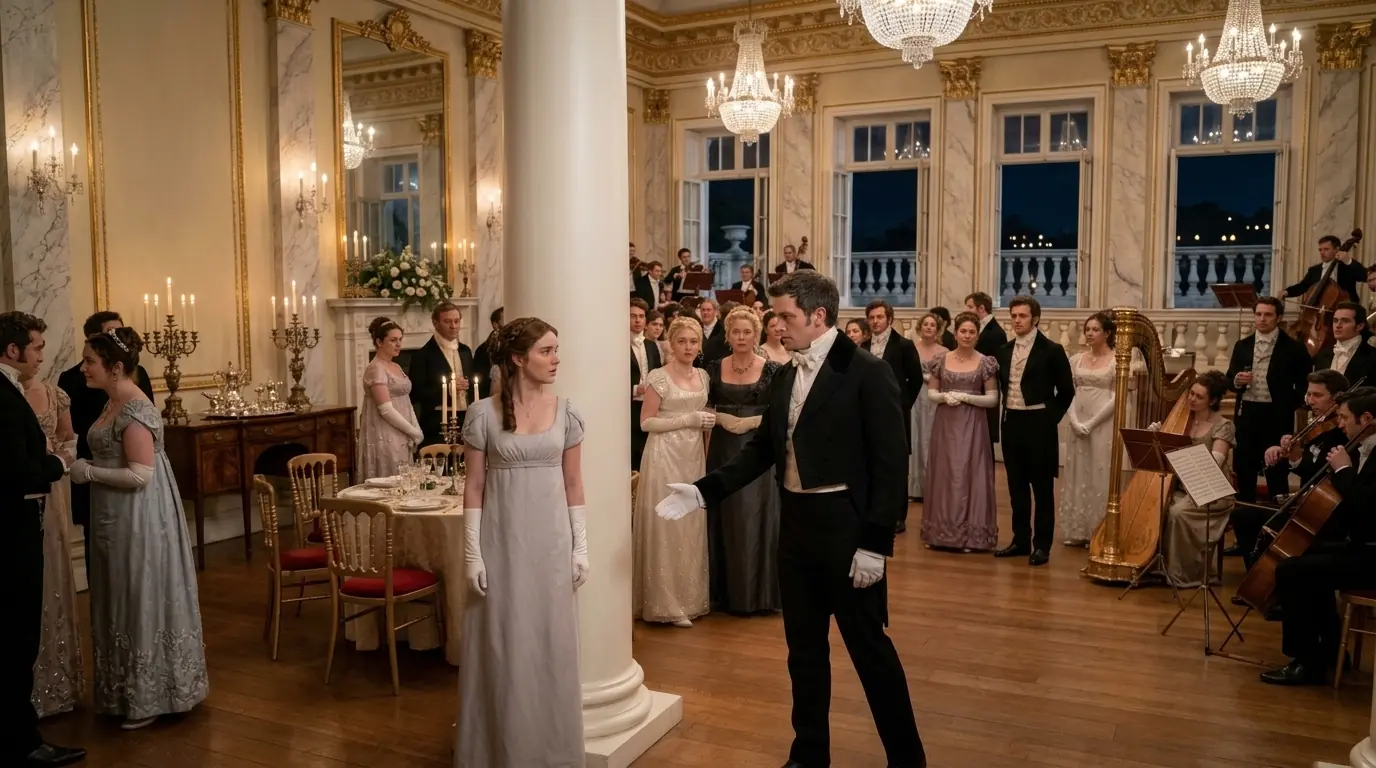
To obscure me—that was its purpose. I was a smudge on the otherwise perfect portrait of her family, a detail to be edited out. I said nothing. For years my silence had been my only armor, a thin cloak against the chilling winds of her disapproval. To argue would be to invite a storm, a tempest of carefully chosen cruelties that would leave me bruised for days.
So, I simply nodded, my gaze falling to the worn floral pattern of the carpet. I had learned to find fascination in the inanimate. Carpets and cornices could not judge. “And for heaven’s sake, Elara, try not to look so morose,” she continued, finally turning her sharp, bird-like eyes on me. “It draws attention. The entire point is for you not to draw attention.”
She smoothed the stray golden hair on Rosamund’s head, her touch impossibly gentle, a tenderness she had never once shown me. Rosamund, bless her beautiful and oblivious heart, simply beamed her reflection, a constellation of youth and privilege, in the grand hallway mirror. She was the sun, I was the shadow it cast. My father, Lord Ashworth, hovered near the doorway, a ghost in his own home. He cleared his throat, a faint, papery sound.
“Perhaps, my dear,” he began, his voice wavering, “Elara could sit with the chaperones.” Lady Beatrice’s smile was a weapon, all sharp edges and cold glitter. “And have people ask why? Have them pity us for the plain, silent daughter we cannot marry off? No, it is better she is simply absent. The pillar is a kindness, Thomas. It protects her from scrutiny.”
She said it as if she were shielding me, not caging me. My father wilted as he always did. His desire for a quiet life was a chasm into which my own small happiness had long ago fallen and vanished. The Ashworth ball was the pinnacle of the social season, an event my stepmother orchestrated with the precision of a general planning a campaign. Tonight’s objective was Rosamund’s glorious engagement to some vapid but wealthy viscount.
I was collateral, a logistical problem to be managed. A piece of furniture to be placed where it would be least obtrusive, behind a pillar.
As I stood in my designated prison of marble, the sounds of the ball washed over me. The swell of the orchestra, the chime of crystal, the bright meaningless laughter of the city’s elite. The pillar was cool and solid against my back. It was, as my stepmother had promised, substantial. From my vantage point, I could see slivers of the grand ballroom, fragments of a world to which I did not belong.
I saw Rosamund, a vision in shimmering silk, surrounded by admirers. I saw my father looking lost. I saw my stepmother, triumphant and terrible in her emeralds, her eyes scanning the room, ensuring every piece was in its place. Every piece but me. I was successfully obscured.
I had long since made a kind of peace with my invisibility. It had its advantages. No one expected me to be charming or witty. No one noticed if I slipped away to the library, my true sanctuary, where the voices of dead philosophers and forgotten architects were more real to me than the living. I had built a small quiet world for myself within the pages of books, a fortress of knowledge where my worth was not measured by the curve of my smile or the sparkle in my eye.
In my world, I was not plain or silent. I was a scholar. I was a mind. But tonight, that fortress felt like a ruin. The loneliness was a physical ache, a cold stone in my chest.
Acknowledged as a person occupying space in the world. The thought was so audacious, so impossible, it was almost painful. I pressed my palm against the cold marble, grounding myself in its unfeeling solidity. This was my place. This was my reality.
Then, the music seemed to hesitate. A ripple of silence, collective intake of breath, spread from the grand entrance across the ballroom floor. Heads turned. Conversations faltered. A path cleared through the glittering throng as if by an invisible force.
He had arrived, the Duke of Stone. Alister Vance. He was a legend, a myth made of granite and grief. Impossibly wealthy, impossibly powerful, and utterly reclusive since the tragedy that had claimed his family years ago. He never attended social events.
His presence here was like a king visiting a provincial town, an event that defied all expectation. He stood at the entrance, tall and severe in his black evening attire. His face was a mask of cold indifference. His eyes, the color of a winter storm, swept the room with an unnerving stillness. They saw everything and revealed nothing.
Lady Beatrice practically vibrated with ambition. I could see her from my sliver of a view, her posture straightening, her smile becoming a predatory thing. This was an opportunity beyond her wildest dreams. The Duke of Stone here at her ball. She began to move toward him, a galleon in full sail with Rosamund, her precious cargo in tow.
Every hopeful mother and daughter in the room began the same slow gravitational pull in his direction, but the Duke did not move to meet them. His gaze continued its slow deliberate sweep of the room. It passed over the glittering chandeliers, the hopeful debutantes, the powerful lords. It passed over my stepmother’s eager face without a flicker of interest. It passed over Rosamund’s breathtaking beauty as if she were no more than a portrait on the wall.
His eyes kept moving, searching. And then they stopped. They stopped on the pillar. They stopped on me. For a heartbeat, the world ceased to exist.
There was only the unnerving intensity of that gaze, a force that seemed to pin me to the marble. He was looking at me, not past me, not through me, at me. I felt a hot flush of panic. I must have been doing something wrong, looking morose as my stepmother had warned. I tried to shrink further into the shadows, to will myself into complete nonexistence.
But he began to walk. He did not walk toward the center of the floor. He did not walk toward the receiving line. He walked in a straight unwavering line directly toward the East Terrace, directly toward my pillar. The crowd parted before him, a sea of silks and jewels, their faces a mixture of shock and confusion.
He walked past my stepmother, who had frozen mid-step, her smile faltering. He walked past Rosamund, whose perfect brow was furrowed in bewilderment. He walked past everyone. He stopped less than a foot from me. The entire ballroom had fallen into a hush.
The orchestra had trailed off into a confused silence. There was only the sound of my own heart, a frantic drum against my ribs. He was so tall, he blocked out what little light reached my corner. His shadow fell over me, a sudden, encompassing darkness. “Miss Ashworth,” he said.
His voice was low and resonant, like stones shifting deep underground. It was not cold, as I had expected. It was precise. “I was hoping to find you.” The world tilted on its axis.
He knew my name. He had been looking for me. The absurdity of it was so immense, I felt a dizzying sense of unreality, as if I had fallen into a dream. I could feel hundreds of pairs of eyes on me, on this forgotten corner of the room. For the first time in my life, I was the center of attention.
And it was terrifying. I could not find my voice. I could only stare up at him, at his severe, unreadable face.
My stepmother recovered first. She surged forward, her laughter a brittle, jarring sound in the silence. “Your Grace, how kind of you to seek out my quiet little Elara. She is so shy. She hides herself away.”
She tried to position herself between us to reclaim control of the situation, but the Duke did not so much as glance at her. His focus remained entirely on me. “I read your treatise on the resonant frequencies of pre-Roman aqueducts,” he said, his voice quiet but carrying in the stillness. “The one published in the Architectural Quarterly under the pseudonym A. Owl. It was brilliant.”
The blood drained from my face, my secret, my small, fiercely guarded world of scholarship, the only thing that was truly mine, had been discovered. The treatise was the culmination of two years of clandestine research, smuggled books, and late nights spent writing by candlelight. I had sent it off under a man’s name, convinced it was the only way it would be taken seriously. How could he possibly know? “The analysis of structural harmonics was particularly insightful,” he continued, as if we were alone in his study rather than the focus of all of London society.
“You proposed a theory of acoustic leveling that no one has considered in a century. I had to know who A. Owl was.” I finally found a sliver of my voice. “How did you know?” I whispered, the words catching in my throat.
A flicker of something, not quite a smile, but a lessening of his severity, touched his lips. “The publisher is an old acquaintance. It took some persuasion, but he revealed the manuscript was delivered by a junior footman from the Ashworth residence. There is only one Miss Ashworth with the intellectual curiosity to write such a paper.” He held out his arm.
“I believe this is my dance.” It was not a question. It was a statement of fact as definitive as the pillar at my back. To refuse would be unthinkable. To accept felt like stepping off a cliff.
Numbly, I placed my trembling hand on his arm. His touch was firm, steadying. He led me from the shadows and onto the dance floor. The orchestra, taking its cue from his decisive movement, hesitantly began a waltz. As he guided me into the steps of the dance, I felt like a marionette.
My limbs moved by his will. The faces of the crowd blurred into a kaleidoscope of shock, envy, and disbelief. I could feel my stepmother’s glare like a physical burn on my back, but the Duke’s attention was a shield. He held me at a proper distance, yet his presence was all-encompassing. He moved with a stark, commanding grace, his steps sure and certain.
“You seem surprised, Miss Ashworth,” he murmured, his gaze never leaving mine. “I am invisible, Your Grace,” I managed to say, the admission tasting of years of bitter acceptance. “Only to the blind,” he replied, his voice a low counterpoint to the music. “I have no interest in polished surfaces. I am interested in foundations, in what is built to last.”
The dance ended, but he did not release me. He led me toward the terrace, away from the prying eyes and whispers that had already begun to swell like a tide. The cool night air was a relief against my heated skin. For a long moment, we stood in silence, looking out at the manicured gardens below. My mind was a whirlwind of confusion and a terrifying, unfamiliar flicker of hope.
I extinguished it ruthlessly. This had to be a mistake, a whim. Men like him did not notice women like me. “Why?” I asked abruptly.
“Why do this publicly?” He turned to face me, his expression serious. “Because I wish to speak with the author of that treatise, and I suspected, given the pseudonym, that the author did not have a habit of announcing herself.” He paused. “I also saw where they had you standing. I do not abide bullies.”
The simple, direct statement struck me with more force than any compliment. He had seen it all, my humiliation, my isolation, my stepmother’s casual cruelty, and he had acted not out of pity, but out of a sense of justice. It was so unexpected, so entirely outside my realm of experience, that I felt a sudden, sharp sting behind my eyes. I turned away, blinking back the tears. I would not weep.
Not now.
The days that followed were a study in surrealism. The Duke’s public acknowledgement of me had shattered the social landscape of my family. My stepmother was caught in a trap of her own making. She could not punish me or hide me away without offending the most powerful man in the country. Instead, she was forced to endure his presence, her face a mask of saccharine welcome that barely concealed her seething rage.
Two days after the ball, a formal invitation arrived. The Duke of Stone requested my presence at his residence, Vance House, to discuss matters of architectural significance. It was, of course, properly arranged. Rosamund was invited as my chaperone. Lady Beatrice had no choice but to agree.
Vance House was not a home. It was a fortress, a monolithic statement of power and permanence on the most prestigious square in London. As the carriage pulled up, I felt a familiar sense of intimidation. But as we were led inside, I saw that the severe exterior hid a different world. The grand hall was not filled with frivolous art, but with maps, astronomical charts, and display cases holding geological specimens.
It was a museum of a single brilliant mind. We were shown to the library. The room stole my breath. It was two stories high, a cathedral of books with shelves stretching up into the shadows accessible by a spiraling iron staircase. A massive table in the center was covered in blueprints and half-open volumes.
The air smelled of old paper and lemon polish. It was the most beautiful room I had ever seen. The Duke was waiting for us. He dismissed Rosamund with polite efficiency, suggesting she might enjoy the gardens, an offer she readily accepted, eager to escape the suffocating silence of the books. A stern-looking housekeeper, Mrs. Gable, appeared as if from nowhere to act as the official chaperone, seating herself in a distant corner, her knitting needles the only sound in the vast room.
Then, we were alone. Or, as alone as we could be. I still suspected this was all some elaborate game, a curiosity he would soon tire of. I clutched my reticule, my knuckles white, waiting for the illusion to break. “Please,” he said, gesturing to a chair opposite him at the great table.
He did not sit at the head of the table asserting his dominance, but took the chair next to mine, transforming the vast piece of furniture into a shared workspace. He unrolled a large, yellowed parchment. It was a detailed drawing of a Roman viaduct. “This is what I wanted to show you. Look at the foundation work here. It contradicts your theory about acoustic leveling—or so I thought.”
And just like that, we were not a duke and a wallflower, we were two scholars, two minds engaged in a shared passion. The nervousness fell away, replaced by a fierce, joyful excitement. I leaned over the parchment, my fingers tracing the lines drawn by a hand two thousand years dead. “But it doesn’t contradict it,” I said, my voice gaining confidence. “They used a different aggregate in the concrete for the pylons that stood in moving water. It dampened the resonance. It proves the theory. It doesn’t disprove it.”
“They were adapting the principle to the terrain.” He listened, his eyes fixed on my face with an intensity that was both unnerving and exhilarating. He did not patronize me. He did not compliment my cleverness for a woman. He debated me.
He challenged my assumptions and forced me to defend my conclusions. He treated my ideas with the weight and respect I had never dared to dream of. For two hours we spoke of load-bearing walls and stress fractures, of Vitruvius and the lost art of pozzolanic concrete. It was the most alive I had ever felt. As our meeting drew to a close, he offered me a small practical kindness that meant more than any flowery praise.
“My library is at your disposal, Miss Ashworth,” he said simply. “There are several volumes here I think you would find useful. You are welcome to keep them.” I left Vance House in a daze. The world outside seemed faded and unreal compared to the vibrant intellectual life within that library.
Hope, that treacherous emotion, had begun to sprout like a stubborn weed in the barren ground of my heart. I tried to crush it, to remind myself of my place, but the seed had been planted. The Duke of Stone had seen me, and he had shown me a world where I was not invisible.
We met several more times over the next few weeks, always under the guise of scholarly pursuit, always impeccably chaperoned. We visited the architectural collection at the museum, our heads bent close together over display cases of ancient artifacts. We walked in the park, our conversation not of weather or gossip, but of the mathematical principles of cathedral arches. I learned that his severe exterior was a kind of armor protecting a quiet, fiercely intelligent mind. He learned, I think, that my silence was not a sign of emptiness, but of a mind too full to waste words on trivialities.
One cool afternoon, as we sat on a bench overlooking the Serpentine, he spoke of the event that had shaped him. “They call me the Duke of Stone,” he said, his gaze distant, “because I deal in things that last: buildings, foundations, contracts. It is a reaction, I suppose.” He paused, and for the first time I saw a crack in his granite composure. “My younger brother, Thomas, was an architect—brilliant, far more creative than I. He saw beauty in the world. I only ever saw structure.”
His voice grew rough. “He was inspecting the construction of a new concert hall. There was a flaw in the design, a weakness in a load-bearing beam. The roof collapsed. He was killed instantly.”
Alister fell silent, but I could feel the weight of his unspoken grief, a palpable thing in the air between us. “I inherited everything—the title, the fortune, the responsibility. But all I could think about was the flaw, the miscalculation. I became obsessed with understanding why things break, why people break.” In that moment, he was not the powerful duke, but a man haunted by loss.
His reclusiveness, his severity, it was not coldness, but a profound and lasting pain. Without thinking, I reached out and laid my hand over his on the cold iron of the bench. It was a small, impulsive gesture, a breach of all propriety. He stiffened for a second, then turned his hand over and curled his fingers around mine. His grip was strong, his skin warm.
It was not a lover’s touch, not yet. It was a connection, a silent acknowledgement of shared sorrow, a foundation being laid. “Your work,” he said, his voice low, “is not about ruins. It is about permanence, about what endures. That is why it spoke to me.”
We held hands for a moment longer, a silent pact in the bustling park. A near smile touched his lips, a rare and startling event that transformed his face, chasing the shadows from his eyes. I felt my own lips curve in response. It was a beginning.
But every beginning invites an end. My stepmother had been watching our growing association with a tightening coil of fury. This was not part of her plan. I was supposed to be a gray, silent fixture, a problem to be ignored until I could be married off to some distant, undesirable cousin to secure a minor land deal. My association with the Duke was a threat to her absolute control.
It gave me a status, a voice that she could not tolerate. She decided to act.
It began subtly. Whispers spread through the drawing rooms of London that poor Miss Ashworth, so plain and bookish, had developed an unhealthy obsession with the Duke. She was throwing herself at him, using her strange, unfeminine interest to trap him. It was pitiful, really. Tragic.
My stepmother’s friends, bearers of her poison, delivered the gossip with sympathetic smiles and pitying glances.
Then came the direct attack. I was in the morning room reading a book Alister had sent over, a rare text on Byzantine vaulting techniques, when Lady Beatrice entered. She was holding a letter. Her smile was triumphant. “Good news, Elara,” she said, her voice dripping with false sweetness.
“I have secured a most suitable match for you: Mr. Finch, your father’s third cousin. He has a respectable estate in the north. He is a widower, of course, and a bit older, but he is willing to overlook your peculiarities. The wedding will be at the end of the month.” The book slipped from my fingers.
Mr. Finch was a boorish, cruel man nearly three times my age, known for his temper and his love of drink. It was a life sentence. “No,” I whispered, the word feeling foreign on my tongue. “No.” Her sweetness vanished, replaced by cold steel.
“You are in no position to say no. You will do as you are told. This fixation on the Duke is an embarrassment. He is toying with you, a novelty he will soon discard. I am saving you from utter humiliation.”
“He is not toying with me,” I said, my voice shaking but firm. For the first time, I did not retreat into silence. “He respects me.” She laughed, a sharp, ugly sound. “Respects you? My dear, delusional child, men like the Duke do not respect women like you. They use them. I have already written to him explaining the situation. I told him of your fragile nerves, your tendency toward fantasy. I explained that this marriage to Mr. Finch is for your own good, a way to calm your excitable nature. I urged him, for your sake, to cease all contact.”
The cruelty of it was breathtaking. She had not only sentenced me to a miserable marriage, but she had also painted me as a mad woman to the one person who saw me as sane. She was destroying my reputation, my future, and my one fledgling hope, all in a single, calculated move. Despair, cold, and absolute washed over me. She had won.
She always won. I wept. For the first time in years, I allowed the tears to fall. Locked in my room, my small world shattered. The letter was a masterpiece of manipulation, full of feigned concern and vicious lies.
Alister would read it and see me as a pathetic, grasping creature. He would retreat back into his fortress of stone, and I would be sent north to mine. The brief, sunlit interlude was over. Winter had returned.
Two days passed in a haze of misery. Preparations for my departure began. My father avoided my eyes, his guilt a palpable presence in every room. Rosamund, for the first time, seemed to see past her own reflection. She came to my room, her expression troubled.
“Is this truly what you want, Elara?” she asked, her voice soft. I just shook my head, unable to speak past the lump in my throat.
On the third day, a carriage arrived. Not the shabby carriage of Mr. Finch, but the gleaming black coach of the Duke of Stone, his crest emblazoned on the door. A footman delivered a single, heavy envelope. It was addressed to my father.
Lord Ashworth read the letter, his face growing pale. “He has requested our presence at his home—immediately.” “Refuse him,” my stepmother snapped. “I cannot,” my father whispered, holding up the letter. “It is not a request.”
We were escorted once more into the lion's den, but this time the atmosphere was different. The air in Vance House was thick with tension. We were shown not to the library, but to the grand drawing room, a formal, imposing space I had never seen. Alister was standing by the fireplace, his back to us. He did not turn as we entered.
Mrs. Gable stood like a statue by the door. “Your Grace,” my stepmother began, her voice a perfect blend of deference and concern. “I am so glad you understood the delicate nature of the situation. My poor Elara.” “Be silent,” Alister said without turning around.
The command was spoken quietly, yet it cracked through the room like a whip. Lady Beatrice fell silent, her mouth opening and closing like a fish. He turned then. His face was carved from granite, his eyes chips of ice. He held a letter in his hand.
Her letter. “I received this piece of fiction two days ago,” he said, his voice dangerously calm. “It is a work of impressive cruelty. My compliments on your imagination, Lady Beatrice.” “I don’t know what you mean,” she stammered.
“I was only thinking of Elara's welfare.” “You were thinking of control,” he interrupted, taking a step forward. “You have systematically undermined, isolated, and emotionally abused your stepdaughter for years. You have tried to convince her and the world that she is worthless.” He looked at me then, and his expression softened for a fraction of a second.
“You failed.” He turned his attention to my father. “Lord Ashworth, did you know that your late wife, Eleanor, left a separate inheritance for her daughter? A portfolio of investments to be managed by you and given to Elara upon her marriage or her twenty-fifth birthday.” My father stared, dumbfounded.
“No. There was nothing.” “Oh, but there was,” Alister said, his voice dropping lower. “My lawyers have been busy these past two days. The documents were quite clear. Documents which, it seems, have been misplaced. And the funds? They have been systematically diverted over the last ten years into accounts controlled by your current wife.”
He placed a ledger on the table. The proof was undeniable. A meticulous record of theft and deception. Lady Beatrice let out a strangled gasp. The mask of civility shattered, revealing the raw, desperate greed beneath.
“Lies! It’s all lies! She has poisoned you against me.” “She has never spoken a single word against you,” Alister stated coldly. “Unlike you, she possesses integrity. You, madam, possess a talent for forgery and a profound lack of foresight. Did you truly believe you could slander a woman I hold in the highest esteem and orchestrate a forced marriage without my notice? Did you think my resources were so limited, my intelligence so slight?”
He moved to stand beside me, a silent, unshakable declaration of alliance. He was my shield. He was my fortress. And in the shelter he provided, I found my voice. All the years of silent pain, of swallowed words and stifled grief, rose up in me not as a torrent of rage, but as a tide of calm, clear certainty.
I looked at my stepmother, truly looked at her for the first time, not as a figure of terror, but as a small, pathetic woman terrified of losing her grip. “You were wrong,” I said, my voice steady and clear, ringing with an authority I did not know I possessed. “My entire life, you have tried to make me believe that I am nothing, a plain, quiet, worthless girl who should be grateful for any scrap of attention. You hid me behind pillars. You dressed me in gray. You silenced me with your disapproval. You did it because you were afraid. You were afraid that if anyone looked closely, they would see that my mother’s daughter was not worthless at all.”
I took a step forward. “You were afraid of my mind because yours is occupied only with jewels and status. You were afraid of my silence because you could not stand a single moment of quiet introspection. You tried to make my world small, but you only succeeded in making yours smaller. My world is filled with history and knowledge and beauty you cannot even comprehend. Your world is this room and the opinions of people you despise.”
I turned to my father. “And you, you let it happen. Your weakness was her greatest weapon. I do not hate you. I pity you.”
I looked back at the woman who had caused me so much pain. “I am not invisible. I am not worthless. And I will not be marrying Mr. Finch. I will not be doing anything you tell me to do, ever again.”
The silence that followed was absolute. Lady Beatrice stared at me, her face a mask of disbelief and fury. She had been so thoroughly, so completely defeated. Rosamund was weeping silently, her hand covering her mouth as the full scope of her mother’s cruelty was laid bare. My father simply slumped in his chair, a broken man.
Alister placed a hand on my arm. “Come, Elara,” he said softly. “Let’s leave them to their ruin.”
He led me from the room, through the grand hall, and out onto a quiet balcony that overlooked the city. The sun was setting, painting the sky in shades of rose and gold. I leaned against the stone balustrade, my body trembling with the aftermath of the confrontation. I had done it. I had spoken my truth.
I was free. Alister stood beside me, not speaking, giving me the space to breathe. The silence between us was comfortable, a shared understanding that needed no words. After a long time, he spoke, his voice gentle. “I admire your foundations, Elara Ashworth,” he said.
“They are stronger than any I have ever studied.” I turned to him, a real, genuine smile spreading across my face. “They were tested.” “They held,” he replied. He took my hand, his thumb stroking my knuckles.
His gaze was intense, all armor gone, leaving only a profound and startling vulnerability. “I told you I became obsessed with why things break, and then I met you, and I found myself studying what holds, what endures.” “Integrity, intelligence, courage, you.” He took a step closer, his other hand coming up to gently cup my jaw. “I am not rescuing you, Elara. You have just rescued yourself. I am asking to be your partner, your equal. I have spent my life in a fortress of my own making, and it has been a cold and empty place. You’ve shown me that the strongest structures are not built of stone, but of connection, of being truly seen.”
My heart felt as if it would burst. All the dreams I had never dared to dream were coalescing in this one, perfect, impossible moment. “Elara,” he said, his voice growing thick with an emotion I never thought to hear from him. “I have spent my life studying permanence. You are the only thing that feels permanent. Will you marry me?”
Tears welled in my eyes, but this time they were tears of joy, of catharsis, of a long and bitter winter finally giving way to spring. “Yes,” I whispered. “Yes, Alister. I will.” He lowered his head and kissed me.
It was not a hesitant questioning kiss. It was a kiss of certainty, of arrival. It was deep and sure and tasted of promises kept and futures beginning. It was the end of silence. It was the end of invisibility.
It was the feeling of being found.
One year later, I stood on a balcony again, but it was not in London. It was at Ravenswood, the duke’s sprawling country estate, a place of ancient stones and windswept moors. My home. Alister came to stand behind me, wrapping his arms around my waist and resting his chin on my shoulder. The heavy gold of my wedding band was a warm constant presence on my finger.
“What is the Duchess of Stone thinking so intently about?” he murmured into my hair. I smiled and leaned back against him, his presence a solid comforting reality. “I was thinking about a girl who used to live behind a pillar.” He was quiet for a moment. “I see her sometimes,” he said softly.
“When I look at the brilliant woman who is currently redesigning the West Wing, who argues with me about Roman history until dawn, and who has filled this quiet stone house with laughter.” He turned me in his arms to face him. “But I do not see a girl in the shadows. I see the woman who was always there, waiting for the light.” Down below in the garden, Rosamund was playing with our newborn son.
After the confrontation, she had broken completely with her mother, who now lived in disgraced exile in Bath. Rosamund and I had, to my surprise, forged a real and loving sisterhood from the ashes of our family. She had apologized with genuine remorse for her years of blindness. My father, living quietly on a reduced income, wrote to me often, his letters filled with a sad, belated pride. Alister and I had recovered my mother’s inheritance.
We had used a portion of it to establish a foundation that granted scholarships to women in the sciences and arts, the Eleanor Ashworth Foundation. Her legacy and mine would not be one of silence, but of opportunity. My husband, my partner—my Alister—brushed a stray curl from my forehead. His eyes, once the color of a winter storm, were now the warm, clear gray of a morning sky. In his gaze, I saw my reflection.
I was not plain. I was not invisible. I was Elara Vance, Duchess of Stone. I was a scholar, a wife, a mother. I was seen.
I was valued. I was home.