The Arizona sun in 1885 did not shine so much as punish.
It beat down on Mercy Crossing until the dust turned white, the water barrels grew warm, and every shadow looked too tired to move. Men stood with hats pulled low over their brows, women hid behind parasols and gloved hands, and children climbed wagon wheels to see over the shoulders of adults who should have known better than to bring them. At the center of town, beneath a hard blue sky, the gallows stood like a warning nailed together from bad timber.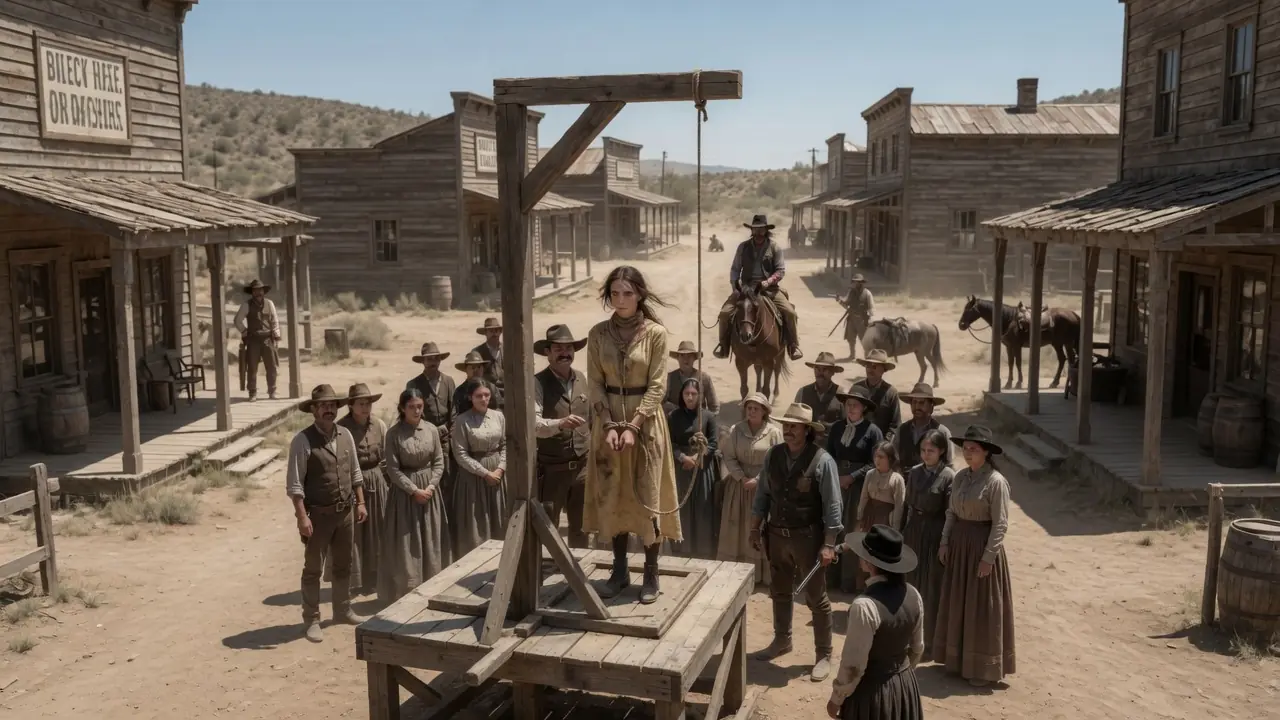
On the platform stood a young woman named Evelyn Mercer.
Her hands were tied in front of her. Her dress, once pale yellow, had been dirtied by three nights in the town jail. A rough rope hung around her neck, scratching the skin just below her jaw whenever the hot wind shifted. She did not cry, though half the town had come hoping she would.
Evelyn was twenty-three years old, the daughter of a dead schoolteacher and a mother who had spent the last year coughing blood into handkerchiefs before the desert finally took her. She had grown up in Mercy Crossing reading books by lamplight, teaching younger children their letters, and carrying baskets of food to miners, widows, and ranch hands who had no one else to remember them. Before that week, no one had called her dangerous.
Then she loved the wrong man.
His name was Tomas Redfeather.
He was a Native American cowboy of Diné and Mexican blood, born near the Little Colorado, raised between sheep camps, cattle trails, and trading posts where men judged him before he opened his mouth. He could break a wild horse without cruelty, track water across stone, and rope cattle in wind so hard most men could barely keep their hats. He wore a black hat, a faded blue shirt, a leather vest patched at the shoulder, and a silver bracelet his mother had given him before fever took her.
The white men in Mercy Crossing called him an outlaw because it was easier than calling him what he was.
A man who would not bow.
Tomas had worked for ranchers who paid him late, cursed him early, and still sent for him when their cattle vanished into bad country. He had guided army scouts through canyons they could not read, then watched them ride back to town and pretend they never needed him. He had slept under stars, eaten dust, dodged bullets, buried friends, and learned young that the law in Arizona Territory had different weights depending on whose skin stood before it.
But when he met Evelyn Mercer, something in him softened without becoming weak.
It happened at a dry creek crossing six months before the hanging.
Evelyn’s wagon wheel had split on the road outside town, leaving her stranded with two sacks of flour, a crate of schoolbooks, and a sky threatening storm. Three riders passed without stopping. Tomas did. He stepped down from his bay mare, tipped his hat politely, and fixed the wheel with rawhide, a spare iron pin, and more patience than any man had offered Evelyn in years.
“You always carry wagon parts?” she asked.
Tomas smiled. “No, ma’am. Just enough hope to get stranded people home.”
She laughed before she meant to.
That laugh started everything.
After that, she saw him everywhere.
At the well before sunrise.
At the general store buying coffee and salt.
Outside the livery, speaking softly to horses no one else could calm.
Sometimes he tipped his hat and kept walking. Sometimes she asked a question about the trail, the weather, or whether a book could teach a person to read stars. He answered carefully at first, then more fully, then with a warmth he seemed almost embarrassed to show.
Mercy Crossing noticed.
Mercy Crossing always noticed.
The town had only one church, two saloons, one jail, and more gossip than water. A woman could not step out after dark without someone inventing a reason. A Native cowboy could not speak to a white woman twice without someone sharpening the story into sin. By the time Evelyn and Tomas began meeting near the cottonwoods south of town, half the people of Mercy Crossing had already decided what they were.
She was foolish.
He was dangerous.
Their love, to the town, was not love at all.
It was betrayal.
The sheriff, Amos Creed, hated Tomas long before Evelyn ever smiled at him.
Creed was a thick-necked man with a sunburned face, a curled mustache, and a badge he wore like a license to confuse fear with justice. He had wanted Evelyn once, though wanted was too gentle a word for the way he looked at her. He brought firewood after her mother died. He lingered too long at her porch. He spoke as if widowhood and loneliness had left her available for claiming.
Evelyn had thanked him for the firewood and refused everything else.
That refusal stayed in him like a thorn.
When Creed learned Tomas had been seen leaving the cottonwoods near Evelyn’s house, he turned his private humiliation into public duty. He told the town Tomas was linked to stolen horses from the Black Mesa ranch. He claimed Tomas had been seen speaking with raiders near the river. He said Evelyn had been passing him information, sheltering him, and helping him evade arrest.
None of it was true.
But truth was a small thing in a town already hungry for a hanging.
Sheriff Creed did the rest.
He found a saddle blanket outside Evelyn’s shed, planted there by one of Harlan’s riders. He found a silver button in Tomas’s campsite, cut from a jacket Tomas had never owned. He found a witness in a drunk named Silas Boone, who swore he had seen Evelyn handing Tomas a map beneath the cottonwoods, though Silas could not read a map if it were nailed to his forehead.
The trial lasted less than an hour.
Judge Mallory Finch sat behind a wooden table in the church hall, sweating through his collar and pretending the proceedings carried dignity. Tomas was not there to defend himself. He had escaped after two deputies tried to shoot him in a canyon before any warrant had been read. Evelyn stood alone in a room full of people who had already rehearsed her guilt in their kitchens.
“You aided an outlaw,” Judge Finch said.
“I helped an innocent man,” Evelyn replied.
The room stirred.
Sheriff Creed leaned against the wall, arms folded, smiling without kindness.
“You admit you met with him?” the judge asked.
“I admit I loved him.”
That was when Mercy Crossing truly condemned her.
Not for theft.
Not for treason.
Not for any crime that could be weighed under law.
They condemned her because she had said the quiet thing aloud.
A white woman loved a Native man, and she refused to lower her eyes while saying it.
Judge Finch sentenced her to hang at noon the following day.
The town gathered early.
Some came from curiosity. Some from cruelty. Some because they believed attendance made them righteous. Harlan arrived on a black horse, silver spurs shining, his face hidden beneath a cream hat. Sheriff Creed stood beside the gallows with two deputies and a shotgun held loosely in his hands.
Evelyn walked from the jail without stumbling.
Her hair had come loose from its pins, falling in dark strands around her face. Someone in the crowd whispered that she looked like a ghost. Someone else said she looked proud. Evelyn heard both and cared for neither.
She searched the horizon once.
Only once.
The desert beyond town shimmered in the heat.
No rider appeared.
Deputy Cole Mercer, no relation to Evelyn, looked away as he tightened the rope. He was young, barely twenty, and his hands shook badly enough that Creed snapped at him to hurry. Cole had delivered water to Evelyn the night before and heard her praying not for rescue, but for Tomas to live.
That had troubled him more than any screaming would have.
Now he could not meet her eyes.
Sheriff Creed climbed the platform and faced the crowd.
“For betraying her people,” he announced, his voice booming across the dust, “for aiding the outlaw Tomas Redfeather, and for bringing shame upon this town, Evelyn Mercer is sentenced to death by hanging.”
A few men cheered.
Most remained silent.
Creed turned to Evelyn.
“Last words?”
The rope brushed her throat when she lifted her chin.
“Yes.”
The crowd leaned closer.
Evelyn’s voice was not loud, but it carried in the noon heat.
“I did not betray my people. I learned who they were.”
A hush fell.
Creed’s smile vanished.
She continued, “If this town calls love a crime, then I am guilty. If it calls lies justice, then the law here is already dead.”
Someone gasped.
Judge Finch looked down at his boots.
Victor Harlan spat into the dust.
Creed stepped close enough that only Evelyn heard his next words.
“You should have married decency when it asked.”
Evelyn looked at him.
“Decency never did.”
His face tightened.
In the far distance, beyond the last buildings of Mercy Crossing, Tomas Redfeather lay flat against a ridge with a rifle in his hands and blood dried on his sleeve.
He had ridden through the night.
His bay mare, Solana, stood behind the rocks, lathered and trembling but ready. Tomas had crossed badland washes, skirted Harlan’s riders, and followed a dry creek bed under starlight to reach town by noon. Twice he had nearly fallen from the saddle from exhaustion. Once a bullet from a deputy’s rifle had cut across his left arm, leaving a dark stain down his sleeve.
He ignored it.
Through the rifle sight, he saw Evelyn on the platform.
He saw the rope.
He saw Creed standing too close.
His jaw clenched until pain shot through his teeth.
Tomas had lived enough years in the territory to know one man with one rifle did not defeat a town. Not cleanly. Not without cost. But he had not come to defeat Mercy Crossing. He had come to take Evelyn from it.
Beside him crouched Jonah Pike, an old Black scout who had once ridden with the army and later swore he would rather herd rattlesnakes than help another officer lie on a report. Jonah had found Tomas half-dead near the wash at dawn, listened to his plan, cursed it thoroughly, then helped anyway.
“You miss that rope,” Jonah muttered, “and we are both ghosts by sundown.”
“I won’t miss.”
“You better love her with both eyes open, then.”
Tomas steadied his breathing.
The gallows stood more than two hundred yards away.
The rope swayed slightly in the hot wind.
Deputy Mercer moved toward the lever.
Tomas placed his finger on the trigger.
For one second, the whole world narrowed.
No crowd.
No town.
No sheriff.
Only rope.
Wind.
Breath.
Evelyn closed her eyes.
The deputy pulled.
The rifle cracked.
The rope snapped clean above her head.
Evelyn dropped through the trapdoor, but not far enough to die. The severed rope slid past her shoulder as she fell onto the loose boards beneath the platform, hard enough to knock the breath from her chest. The crowd exploded.
Someone screamed.
Someone shouted, “Ambush!”
Horses reared. Women scattered. Men dove behind wagons. Sheriff Creed raised his shotgun toward the ridge, but Tomas had already fired again. The second shot blew the shotgun from Creed’s hands and sent it spinning into the dust.
Then Tomas came riding.
Solana thundered down the slope, mane flying, hooves striking sparks from stone. Tomas leaned low in the saddle, rifle across his arm, dark hair whipping beneath his hat. Dust rose behind him like a storm had chosen a rider.
Jonah fired from the ridge, not at hearts, but at hats, boots, wagon wheels, anything that made armed men duck instead of aim. A barrel exploded near the trough. A window shattered above the saloon. Harlan’s riders scattered, swearing, suddenly less brave with bullets cutting the air around them.
Tomas rode straight for the gallows.
Evelyn crawled from beneath the platform, coughing, one hand pressed to her bruised throat. Deputy Mercer stood frozen near her, lever still in hand, his face white with terror. Sheriff Creed staggered toward his fallen shotgun, blood running down one hand where splinters had cut him.
“Shoot him!” Creed roared.
But the town had become chaos.
Men were firing in every direction and hitting nothing but dust, signs, and each other’s courage. Tomas reached the platform, swung down halfway from the saddle, and extended one arm toward Evelyn.
“Evelyn!”
She looked up.
For one impossible second, they saw each other clearly through smoke and dust.
Then she ran.
A bullet struck the post beside her head. Another tore through the hem of her dress. Tomas leaned low, caught her by the waist, and pulled her across the saddle in front of him with a strength born of panic, love, and the refusal to arrive too late.
Solana reared as Creed lunged for them.
Tomas kicked him hard in the chest.
The sheriff fell backward into the dust.
Evelyn clung to Tomas’s vest, gasping. “You came.”
His voice broke. “Did you think I wouldn’t?”
“I hoped you wouldn’t die trying.”
“Still working on that part.”
He wheeled Solana toward the south road.
Creed struggled to his feet and drew a revolver from his boot.
He aimed at Tomas’s back.
Deputy Mercer saw it.
Maybe it was the water he had carried to Evelyn. Maybe it was her last words. Maybe it was the sight of a town calling murder lawful and courage criminal. Whatever moved in him, it finally moved.
He shoved Creed’s arm aside.
The shot went wide.
Creed turned on him with fury. “You fool!”
Deputy Mercer backed away, hands shaking but eyes clear. “No more.”
Tomas did not see the exchange.
He was already riding.
Solana tore through Mercy Crossing as bullets followed. Evelyn pressed herself against Tomas, the broken rope still hanging loose around her shoulders like a dead snake. They passed the church, the general store, the well where they had once spoken at sunrise. At the edge of town, Harlan and two riders tried to block the road.
Jonah’s rifle cracked from the ridge.
One rider’s hat flew off.
The second man dropped his reins and cursed.
Harlan drew his pistol, but Evelyn moved before Tomas could. She grabbed the small revolver tucked in Tomas’s belt, aimed with both hands, and fired once.
The bullet struck the dust at Harlan’s horse’s feet.
The animal reared, and Harlan fell hard into the road, landing on his pride more than his back.
Tomas glanced down at her.
Evelyn looked back, breathing hard.
“I was aiming for the ground.”
“I know,” he said.
“Mostly.”
Despite everything, he laughed once.
Then the desert took them.
They rode south until Mercy Crossing became a stain behind them. The land opened wide and merciless, all red stone, thornbrush, dry washes, and sky too large for fear to fill. Tomas knew the old trails, the hidden water, the places where rock swallowed hoofprints. He guided Solana through gullies, over hardpan, and beneath ledges where the sun could not easily find them.
At dusk, they reached a narrow canyon where cottonwoods grew along a ribbon of water.
Jonah was waiting there with a spare horse and two canteens.
He had taken the long route, circling wide after giving the town enough noise to chase. His horse stood in the shade, tail flicking at flies. His face was serious, but his eyes softened when he saw Evelyn alive.
“Well,” Jonah said. “That was almost the worst plan I ever helped with.”
Evelyn slid from the saddle, legs shaking.
Tomas caught her before she fell.
Jonah looked at the rope burn around her neck and the blood on Tomas’s sleeve. “You both look like trouble that learned to stand upright.”
Evelyn touched her throat. “Thank you.”
“Don’t thank me yet. Creed will come.”
Tomas nodded. “I know.”
“He’ll bring Harlan’s men, maybe a marshal if he can lie well enough.”
“He lies better than he shoots.”
Jonah snorted. “Most cowards do.”
They camped without fire.
Evelyn slept only in pieces, waking at every sound. Twice she reached for the rope that was no longer around her neck. Tomas sat beside her through the night, back against a cottonwood, rifle across his knees, watching the canyon mouth while the stars sharpened overhead.
Near dawn, she woke and found him still awake.
“You should sleep,” she whispered.
“So should you.”
“I keep feeling the boards drop.”
His face tightened.
“I keep seeing them.”
She looked at him in the dim blue morning. “You saved me.”
“Not soon enough.”
“I’m alive.”
His eyes moved to the bruise at her throat. “Barely.”
Evelyn reached for his hand.
For a moment, he hesitated, as if the touch might undo whatever strength he had left. Then he let her take it.
“They would have killed you too,” she said.
“They’ve tried before.”
“That is not a comfort.”
“I wasn’t offering it as one.”
She almost smiled, then looked toward the canyon wall where the first light was touching stone.
“What happens now?”
Tomas exhaled slowly. “We run until running stops making sense.”
“And after that?”
He looked at her then.
The question had lived between them for months, but never under such a sky, never with a town behind them calling them criminals and a future ahead with no map.
“After that,” he said, “we build something no sheriff can name.”
Creed came by noon.
Six riders entered the canyon from the north, moving slow enough to seem cautious and fast enough to show anger. Sheriff Creed rode at the front with his hand bandaged and his face dark from humiliation. Victor Harlan rode beside him, jaw swollen from the fall, hatred sitting stiff in his shoulders.
Tomas had expected them.
Jonah had too.
The canyon narrowed near the water, creating a place where six riders could not spread out. Tomas and Jonah took positions above the trail before the posse arrived. Evelyn waited below behind a stand of cottonwoods with the spare horse, a rifle in her hands and fear in her stomach.
Not fear of shooting.
Fear of what survival might require.
Creed rode into the narrow pass and stopped.
“Tomas Redfeather!” he shouted. “You are harboring a condemned woman and resisting lawful authority.”
Tomas’s voice came from above. “No lawful authority followed us here.”
The riders shifted nervously.
Creed looked up, trying to place him. “Give her up, and I might let you hang quick.”
Evelyn stepped from the trees before Tomas could answer.
Her dress was torn. Her throat bruised. Her hair loose around her shoulders. But she held the rifle steady enough to make Harlan’s horse sidestep.
“I am not yours to give,” she said.
Creed stared at her. “You should have died when the law told you to.”
“The law did not speak,” Evelyn said. “You did.”
Harlan raised his pistol toward her.
Tomas fired.
The bullet struck the pistol from Harlan’s hand and sent him screaming backward in the saddle.
Jonah’s rifle cracked next, cutting a branch above Creed’s head. Leaves rained down over the sheriff’s hat.
“You get one warning,” Jonah called. “That was it.”
The posse did not need a second.
Two riders turned immediately. One cursed Creed for not mentioning the high ground. Another dropped his rifle and raised both hands. Harlan, cradling his bleeding fingers, shouted that they should burn the canyon, but no one seemed eager to die for his pride.
Creed remained mounted, shaking with fury.
“This is not over,” he called.
Tomas appeared on the ridge above him. “It never was.”
Creed looked at Evelyn. “The territory will never let you live in peace.”
Evelyn lifted her chin. “Then the territory will have to learn disappointment.”
Jonah laughed from somewhere unseen.
Creed’s face twisted, but he turned his horse.
The posse withdrew.
They did not return.
Not because they forgave.
Because fear had finally found the right side of the canyon.
For three weeks, Tomas, Evelyn, and Jonah moved through hidden country. They traded at night with people who asked fewer questions than towns did. A widow near the San Pedro gave Evelyn a blue dress and burned the yellow one in her stove. An old Mexican vaquero removed the bullet from Tomas’s arm with a knife, whiskey, and language too colorful for Evelyn to translate politely.
Jonah left them near a bend in the river where cottonwoods leaned low over clear water.
“There’s an old cabin half a mile east,” he said. “Roof leaks in two places. Chimney smokes if the wind is wrong. Better than a jail.”
Tomas shook his hand.
Evelyn hugged him.
Jonah stiffened, then patted her shoulder awkwardly. “Don’t make me sentimental. I hate that.”
“Will we see you again?” she asked.
“Depends how foolish you both get.”
Tomas smiled. “Then soon.”
Jonah rode away laughing.
The cabin was exactly as promised.
Small, crooked, and stubborn.
It had one room, a stone hearth, a sagging porch, and a view of the river through cottonwood branches. The door groaned like an old man. Dust covered the floor. A raccoon had claimed one corner and left angrily when Tomas arrived with a broom.
Evelyn stood in the doorway and looked around.
“It’s beautiful,” she said.
Tomas glanced at the leaking roof. “You sure that rope didn’t damage your thinking?”
She stepped inside. “No. It clarified it.”
They cleaned for two days.
They patched the roof with canvas and cedar shakes. They repaired the porch. Tomas built a table from scrap boards while Evelyn stitched curtains from the blue dress’s torn hem. At night, they lay on blankets near the hearth and listened to the river speak against the stones.
No church blessed them.
No judge signed a paper.
No town gave permission.
Still, they became husband and wife under the cottonwoods one evening at sunset, with the river carrying their vows and the sky turning copper above them. Tomas tied a strip of blue cloth around Evelyn’s wrist. Evelyn tied a strip of leather around his.
“I choose you,” she said.
“Even with all this trouble?”
“Especially with all this trouble.”
He touched the bruise fading at her throat with the back of his fingers.
“I choose you,” he said. “In this life and whatever country comes after it.”
They kissed while the river moved beside them, indifferent to the laws of Mercy Crossing.
Seasons passed.
The legend grew faster than the truth.
In saloons from Tucson to Prescott, men told the story of Tomas Redfeather shooting a hanging rope from impossible distance. Some said he had ridden through fifty armed men. Some said Evelyn had shot Sheriff Creed herself. Some said Jonah Pike was not a man at all but a ghost scout who appeared wherever injustice got too proud.
The truth was smaller.
And greater.
Tomas and Evelyn lived in the cabin by the river. They raised goats, kept horses, grew beans, mended clothes, and learned each other’s silences. Evelyn taught Tomas to read poetry from her mother’s books. Tomas taught Evelyn how to read weather in clouds, tracks in dust, and fear in a horse’s ears.
Sometimes travelers came.
A wounded Apache boy hiding from soldiers.
A Mexican mother with two children and no food.
A Black cowboy with a bullet in his thigh and a story he did not want to tell.
A white girl running from a man twice her age who called himself her fiancé.
Evelyn never asked whether they deserved help.
Tomas never asked who might punish them for giving it.
The cabin became a place known by whispers.
Not on maps.
Not in law.
A place beside the river where people running from cruelty might find water, bread, a clean bandage, and a night without questions.
Years later, Deputy Cole Mercer rode alone to the river bend.
He was no longer a deputy.
He had left Mercy Crossing two months after the hanging, unable to keep wearing a badge that smelled like cowardice. He found the cabin near sunset and approached with both hands visible, older in the face than years should have made him.
Tomas met him at the porch with a rifle lowered but ready.
Evelyn stepped into the doorway behind him.
Cole removed his hat.
“Sheriff Creed is dead,” he said.
No one spoke.
“Shot in a card room in Yuma. Harlan lost most of his land after the drought. Judge Finch drinks himself half blind most afternoons.”
Evelyn looked toward the river.
Cole swallowed. “I came to say I’m sorry.”
Tomas’s grip tightened on the rifle.
Cole looked at him. “I should have stopped it sooner.”
“Yes,” Tomas said.
Cole nodded. “I know.”
Evelyn studied the man who had once held the lever beneath her feet.
“Why come now?” she asked.
“Because I kept seeing your face every time I tried to sleep,” Cole said. “And because I wanted you to know someone from that town remembers the truth.”
Evelyn was quiet for a long time.
Then she stepped down from the porch.
“I don’t forgive the town,” she said.
Cole lowered his eyes.
“But I believe you are trying not to be it anymore.”
That was all she gave him.
For Cole, it was enough to begin again.
By the time Arizona moved closer to statehood, the story had become folklore.
Children repeated it in schoolyards when teachers were not listening. Cowboys told it near campfires, making Tomas taller and the shot longer each time. Women whispered Evelyn’s name when fathers, sheriffs, preachers, and judges spoke of obedience as if it were a virtue. Some called her shameless. Others called her brave.
Evelyn did not care much for either word.
She lived.
That mattered more.
She grew older by the river, lines deepening around her eyes, hair silvering at her temples. Tomas grew older beside her, slower in the saddle but still able to quiet a nervous horse with one hand. They never returned to Mercy Crossing. They did not need to. The town had been a sentence, and they had outlived it.
One evening, many years after the gallows, Evelyn found Tomas sitting beneath the cottonwoods with his old rifle across his knees.
The river was low.
The sunset burned red along the canyon walls.
She sat beside him carefully, her joints not as forgiving as they once had been.
“Thinking about that day?” she asked.
He ran one hand along the rifle stock. “Sometimes I wonder what would have happened if I missed.”
“You didn’t.”
“That isn’t an answer.”
She leaned against his shoulder. “It is the only one that matters.”
He smiled faintly.
After a while, he said, “I was afraid.”
“I know.”
“You looked so calm up there.”
“I was terrified.”
“You fooled everyone.”
She took his hand. “Not everyone.”
He looked at her.
She touched the faded scar on his arm where the deputy’s bullet had cut him during his ride to town. Then she touched her own throat, where the rope had once left a mark no one else could see anymore.
“They wanted our fear to be the last thing we remembered,” she said.
Tomas looked toward the river.
“It wasn’t.”
“No,” Evelyn said. “It wasn’t.”
The next morning, a young couple arrived at the cabin near dawn.
He was a Mexican horse wrangler accused of stealing wages he had earned. She was the daughter of the rancher who had refused to pay him. They were dirty, hungry, frightened, and holding hands as if letting go would make the whole world collapse.
Evelyn opened the door before they knocked.
Tomas stood behind her, older now, but still with steel in his eyes.
The girl looked at them and whispered, “They said you might help us.”
Evelyn smiled.
“Come in,” she said. “You found the right river.”
And so the legend lived.
Not because of a rifle shot, though the shot had been true.
Not because of the gallows, though the gallows had failed.
The legend lived because two people marked for punishment built a home where punishment did not rule. Because a condemned woman refused to call love a crime. Because a Native cowboy rode through bullets, dust, and hatred rather than let a town decide who deserved to live.
Mercy Crossing wanted obedience.
The desert gave them freedom.
The law wanted a hanging.
The river gave them a home.
And long after the rope snapped in the Arizona sun, people still spoke of Tomas Redfeather and Evelyn Mercer whenever love needed courage, whenever power called cruelty justice, and whenever someone had to be reminded that a single shot, fired at the right moment, could cut more than rope.
It could cut a path out of fear.