By eight-thirty on a Saturday morning in June 1986, the gravel lot behind Peterson Implement Auction outside Hastings, Nebraska, was already covered in dust, pickup trucks, cigarette smoke, and men who believed they knew exactly what every machine was worth.
Caleb Turner was fifteen years old and knew enough to understand that most of them were probably right.
That was what made the one tractor interesting.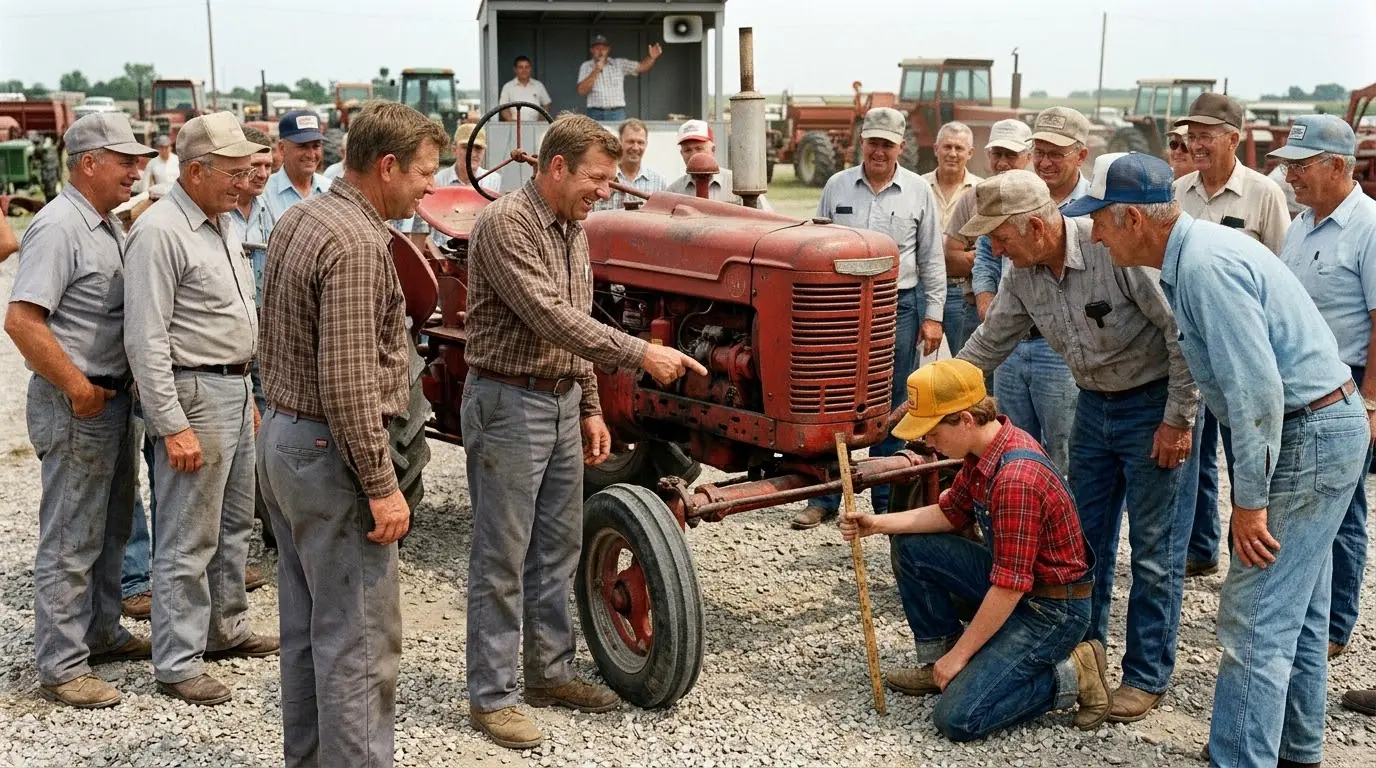
He saw it before his father did.
A faded red row-crop tractor sat near the far fence between a rusted manure spreader and a John Deere cultivator missing half its shovels.
Nobody had bothered washing it.
The hood had faded almost pink.
Rust mottled the frame.
One grille bar was bent.
The narrow front wheels appeared crooked.
A side panel had been removed, exposing an engine stained black by decades of dust and oil.
Someone had chalked a number across the rear fender.
73
Lot number.
Caleb stopped.
His father, Thomas Turner, continued walking another six steps before noticing.
“Caleb.”
No answer.
Thomas turned.
His son was staring at the tractor.
Thomas sighed.
“Absolutely not.”
Caleb finally looked at him.
“I didn't say anything.”
“You didn't have to.”
Thomas Turner was forty-four but looked older that summer.
Everybody did.
The farm crisis had aged men faster than weather.
Interest rates had bitten through operations that had survived drought, hail, and generations of bad decisions.
Land values had fallen.
Commodity prices remained weak.
Farm auctions had become as common as weddings had once been.
Thomas had lost eighty rented acres the previous spring when the owner sold.
His operating note was barely current.
The Turners still owned their home quarter, but the bank held enough paper on it to make ownership feel theoretical.
They had come to Peterson Auction because Thomas needed a used hydraulic cylinder and possibly a small grain auger if prices stayed low.
They had not come to buy tractors.
Especially not strange tractors.
Thomas nodded toward lot 73.
“That thing belongs in a fence row.”
Caleb looked back.
“Maybe.”
“No maybe.”
“Front axle’s wrong.”
Thomas rubbed his forehead.
“It is broken.”
“I don't think so.”
“Caleb.”
The boy walked toward it.
Thomas remained where he was for a moment.
Then followed.
There was no point pretending otherwise.
Caleb had been fascinated by machinery since he could reach a wrench.
Not in the usual way.
He liked tractors.
Combines.
Engines.
But what interested him most was why somebody had chosen to build something one way instead of another.
He read parts catalogs like other boys read baseball magazines.
When neighbors threw away broken components, Caleb asked for them.
His bedroom shelves held bearings, carburetor jets, injector nozzles, worn bushings, and fragments of machines most adults considered junk.
His mother called it a museum.
Thomas called it a fire hazard.
Caleb called it useful.
He crouched beside the tractor’s left front wheel.
The hub leaned slightly inward.
Thomas pointed.
“There.”
“Bent spindle.”
Caleb shook his head.
“Look at the other side.”
Thomas did.
The right wheel sat wider.
“Impact damage.”
“Maybe.”
Caleb ran one finger along a heavy casting behind the axle support.
Grease buried everything.
He looked underneath.
Then toward the steering linkage.
Thomas watched his face change.
“What?”
“The tie rods don't match the parts book.”
“What parts book?”
“Farmall series.”
Thomas frowned.
“You know what every Farmall tie rod looks like?”
“No.”
“Good.”
Caleb smiled faintly.
“But this isn't standard.”
Thomas looked toward the tractor.
“It's sixty dollars worth of tires wrapped around scrap.”
“Rear tires are decent.”
“Caleb.”
“I’m just saying.”
Thomas walked away.
“Five minutes.”
Caleb barely heard him.
He pulled a folding wooden ruler from the side pocket of his overalls.
He carried it almost everywhere.
His grandfather’s.
Old.
Paint worn at the hinges.
He measured from hub center to frame.
Then the opposite side.
Then wheel spacing.
The measurements made no sense if the axle were bent.
They made more sense if it were adjustable.
But not like the usual adjustable front end.
This one appeared to shift asymmetrically.
Caleb wiped grime with his thumb.
Nothing.
He removed the red shop rag from his back pocket.
Scrubbed harder.
A casting number emerged.
Not fully.
A-17…
He wiped again.
A-1734-X
Caleb stopped.
The X mattered.
Maybe.
In factory parts systems, X could mean many things.
Replacement.
Revision.
Experimental.
Internal series.
It could also mean nothing.
But Caleb had seen similar notation.
Not on tractors.
In an old International Harvester engineering bulletin his grandfather kept.
Experimental field parts sometimes carried odd suffixes.
Caleb stood.
Looked around.
Men were inspecting larger tractors nearby.
Nobody cared about lot 73.
Then a voice came from behind.
“You planning to measure that thing back to life?”
Laughter.
Caleb turned.
Vernon Pike stood there.
Fifty-two.
Farm machinery dealer from Grand Island.
Brown plaid shirt.
Gray trousers.
Hair slicked back despite the dust.
Vernon bought equipment at auctions, repaired enough to make it presentable, then resold.
He had a good eye.
Usually.
He also enjoyed reminding people of that.
Three older farmers stood with him.
One of them, Ed Lawson, laughed.
“Boy's building a coffin.”
Caleb folded the ruler.
Vernon nodded toward the tractor.
“You know what happened to it?”
“No.”
“Front-end collision.”
Caleb looked again.
“You sure?”
Vernon grinned.
“Been buying tractors since before your daddy learned to shave.”
“That wasn't my question.”
The farmers laughed.
Not at Caleb this time.
Vernon’s smile tightened.
“You think I'm wrong?”
“I think the spindle isn't bent.”
Vernon pointed toward the wheel.
“Then your eyes need fixing.”
Caleb crouched again.
“The hub angle changes because the entire carrier is offset.”
“Carrier’s twisted.”
“Casting doesn't look fractured.”
“Could be sprung.”
“Then why is the steering linkage drilled for two positions?”
Vernon paused.
Caleb pointed.
Two holes.
One used.
One empty.
Vernon looked.
Then shrugged.
“Farmer modification.”
Caleb wiped more grease.
“What about this number?”
Vernon did not bend down.
“Casting number.”
“Do you recognize it?”
“No need.”
Caleb stood.
“Then how do you know what it is?”
That produced another laugh.
Vernon stepped closer.
“Listen, farm boy.”
His tone changed.
“You can measure wheels all morning if it makes you feel clever.”
“But that tractor is salvage.”
“Three hundred dollars if anybody is foolish.”
“Maybe five hundred if the rear rubber's better than it looks.”
“Don't confuse grease with mystery.”
Caleb glanced toward the farmers gathering now.
More people had noticed the conversation.
That embarrassed him.
He disliked crowds.
He disliked being stared at.
But he disliked being dismissed more.
Vernon pointed toward the ruler.
“Put that away before somebody hires you to measure fence posts.”
Several men laughed.
Caleb’s cheeks reddened.
Then he looked at the casting number.
And something clicked.
Not memory exactly.
A shape.
He had seen a diagram.
Months earlier.
At his grandfather’s workbench.
Old agricultural magazines from the 1950s.
Experimental adjustable row spacing.
Corn and sugar beet applications.
Caleb tried remembering.
The company had tested a front axle allowing rapid offset changes without replacing the entire bolster assembly.
It was supposed to accommodate unusual row configurations.
The project disappeared.
Maybe cost.
Maybe steering geometry.
Maybe nobody wanted it.
He looked at Vernon.
“You ever seen an A-1734-X?”
Vernon laughed.
“Kid, I don't memorize junk numbers.”
“Maybe you should.”
The crowd reacted.
Vernon’s face hardened.
“Watch your mouth.”
Caleb pointed toward the casting.
“I think that's a factory experimental axle.”
Silence.
Then explosive laughter.
A farmer slapped another on the shoulder.
Somebody shouted:
“Prototype!”
Another:
“Call the Smithsonian!”
Vernon laughed hardest.
“There it is.”
“What?”
“The story.”
“Every auction needs one.”
“Somebody finds a rare option.”
“A secret factory machine.”
“Government test tractor.”
“Prototype.”
He leaned closer.
“This one's usually worth a million dollars by lunch.”
Caleb stayed still.
Vernon continued:
“That tractor is ordinary scrap.”
Caleb looked toward the auction building.
Then back.
“Then you won't mind if I ask them to stop before lot seventy-three.”
Vernon’s smile vanished.
“Stop what?”
“The auction.”
“Why?”
“So they can inspect the number.”
“You're serious.”
“Yes.”
Vernon shook his head.
“You'll embarrass yourself.”
“Maybe.”
Caleb folded the ruler and walked away.
Vernon called after him.
“Farm boy!”
Caleb turned.
Vernon pointed toward the tractor.
“I know exactly what I'm looking at.”
Caleb stared.
“Then tell everybody why your three-hundred-dollar scrap tractor has a casting number you didn't know existed.”
The men around them stopped laughing.
That line traveled faster than Caleb expected.
By the time he reached the auction office, three farmers were following.
Then six.
Auctioneer Ray Peterson was drinking coffee.
Fifty-nine.
Blue shirt.
White cowboy hat.