Rain had been hitting the windows of Saltbrook General Hospital for six hours before anyone realized the storm had stopped moving.
That was the problem.
A hurricane that moved inland was dangerous.
A hurricane that parked itself over the North Carolina coast became something else entirely.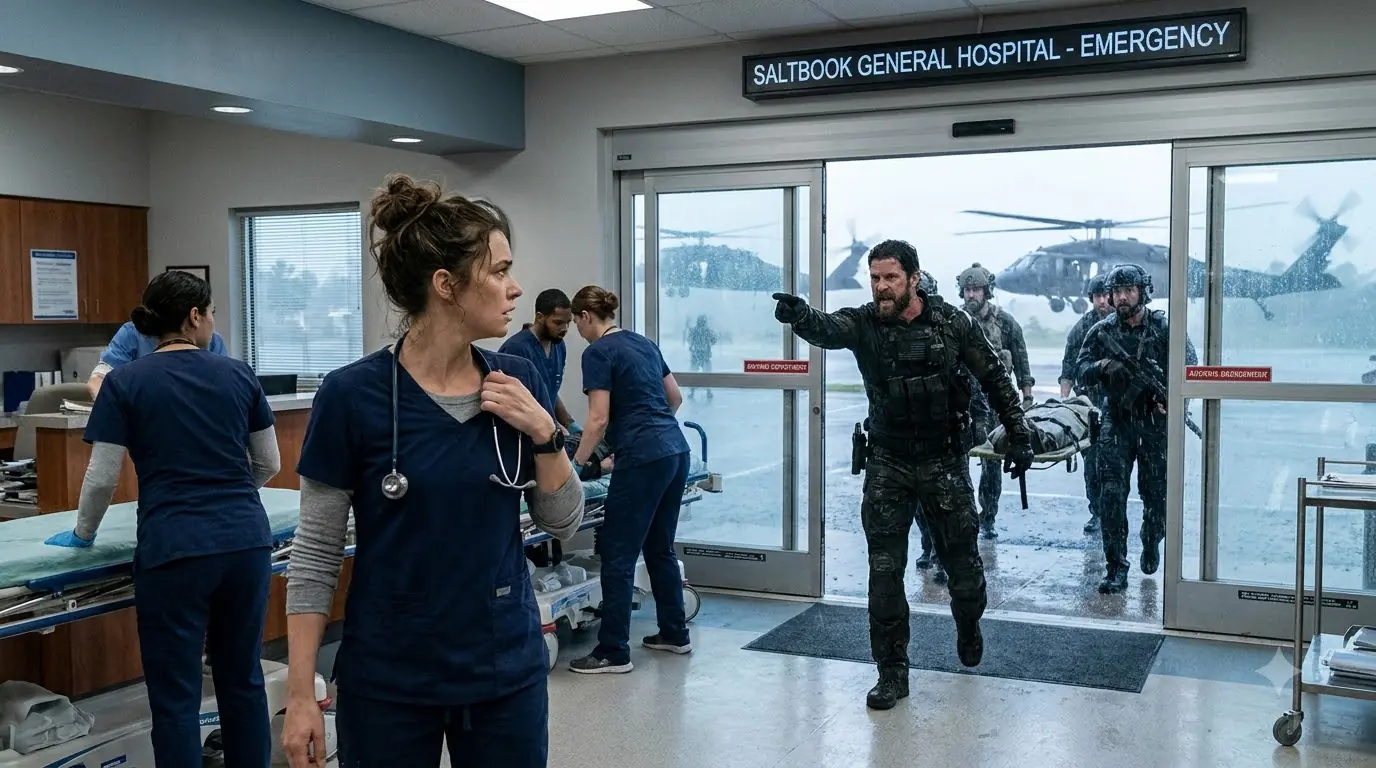
By ten that night, roads outside Wilmington had begun disappearing beneath brown water. Power lines were down throughout the county. Two smaller hospitals had switched to generators. The regional trauma center farther south had temporarily lost access to its landing area after wind tore loose sections of roofing.
Saltbrook remained open.
Barely.
Inside the emergency department, night nurse Mara Ellison stood behind the medication station counting saline bags for the third time.
She did not need to count them again.
She knew exactly how many remained.
Thirty-four standard bags.
Eight larger-volume bags.
Eleven pressure sleeves.
Two warming units.
Six trauma carts.
One portable ventilator that had been making an unpleasant clicking sound since Tuesday.
Counting helped.
It gave her hands something ordinary to do.
Mara was thirty-four, though most people guessed younger until they looked closely at her eyes.
Fair skin.
Sharp hazel-green eyes.
Dark-brown hair twisted into a loose bun that became messier as every shift progressed.
Navy-blue scrubs.
Gray long-sleeve undershirt despite the humid August air.
Always long sleeves.
Nobody had ever seen her right forearm.
Nobody at Saltbrook had ever asked why.
That suited Mara perfectly.
“Nurse Ellison.”
The voice behind her changed her posture before she could stop it.
Shoulders inward.
Eyes down slightly.
Small.
Three years of practice.
Dr. Colin Ashworth stood beside the desk holding a patient chart.
Mid-forties.
Silver beginning at his temples.
Expensive watch.
Immaculate white coat.
The kind of handsome that had been reinforced by decades of people telling him so.
Colin had been Saltbrook's star emergency physician for almost ten years.
He brought in donors.
Appeared on local television.
Spoke at conferences.
Had his photograph in the hospital lobby beside a plaque about clinical excellence.
He also knew exactly which employees were too powerless to challenge him.
Mara had been one of his favorites.
He tapped the chart.
“Bed nine.”
“Yes?”
“You logged potassium at 7:05.”
“Correct.”
“The order was 6:30.”
“Pharmacy released it at seven.”
“I did not ask about pharmacy.”
Mara looked at him.
“The delay is documented.”
Colin gave a small smile.
There were six people within earshot.
A unit clerk.
Two nurses.
A respiratory therapist.
A resident.
Charge nurse Renata Cole.
Colin knew that.
He always knew his audience.
“You documented the delay.”
“Yes.”
He leaned closer.
“Do you understand how little comfort documentation provides when a patient deteriorates?”
Mara's voice stayed quiet.
“It was oral replacement. Five minutes after pharmacy release. The patient's values remained stable.”
Colin’s smile disappeared.
“Do not argue medicine with me.”
Mara said nothing.
He lowered his voice enough to make cruelty sound private while remaining loud enough for everyone around them to hear.
“Some people are built to give orders, Ellison.”
Pause.
“Others are built to follow them.”
His eyes dropped toward her badge.
“Try to remember which one you are.”
Then he walked away.
Nobody spoke.
That was Saltbrook's rhythm.
Colin struck.
Everyone pretended not to see.
The water closed over the stone.
Renata eventually approached.
She was forty-one, tired-eyed, competent, and one of the few people Mara trusted.
“You okay?”
“Yes.”
“He's wrong.”
“I know.”
“You should file again.”
Mara almost smiled.
“Again?”
Renata looked away.
They both knew what had happened to the first complaint.
Professional communication disagreement.
Closed.
Mara resumed counting supplies.
Renata studied her.
“You know what bothers me about you?”
Mara raised an eyebrow.
“You let everyone think you're weak.”
“Useful misconception.”
“That is a strange answer.”
Mara looked toward the storm outside.
“Not always.”
The truth sat beneath her sleeve.
Black ink.
Two folded wings.
A short sequence of numbers.
Seven names encoded in a pattern nobody at Saltbrook would understand.
And one word.
WREN.
Four years earlier, Mara Ellison had not existed.
Not legally.
Not professionally.
The woman who became Mara had another name, another employment record, another posture.
She worked for a civilian disaster-response program so specialized that most emergency professionals only knew rumors about it.
The National Crisis Medical Response Group.
NCMR.
A federally funded interagency unit created for disasters ordinary response systems could not handle.
Collapsed industrial plants.
Remote wildfires.
Offshore accidents.
Flooded infrastructure.
Earthquakes.
Mass-casualty events in places where hospitals either did not exist or could not function.
Its teams included trauma clinicians, rescue divers, aviation crews, structural specialists, hazardous-material experts, communications technicians, and logistics operators.
They were not soldiers.
They were disaster responders.
But when ordinary systems broke, NCMR teams were often sent where nobody else could reach.
Mara had served as a senior field trauma specialist.
Call sign:
Wren.
Nobody had chosen it for symbolism.
Her first team leader simply complained that she was too small, too loud on the radio, and impossible to get rid of.
“Like a wren nesting in somebody's toolbox.”
The name stayed.
Then came Greyhaven.
Officially, Greyhaven was an industrial disaster.
A privately operated coastal chemical-storage complex suffered a chain explosion during a severe storm.
Seven responders died.
Mara survived.
That part was true.
Everything afterward became complicated.
Greyhaven's ownership group had falsified safety reports for years.
Emergency shutoff systems had failed.
Inspection records were altered.
Several state officials had accepted favors to ignore violations.
Mara had seen documents proving it.
So had two investigators.
One died in a suspicious vehicle crash three weeks after Greyhaven.
The other disappeared.
Then someone offered Mara a choice.
Public testimony.
Or protection.
She initially chose testimony.
Then threatening photographs arrived at her mother's house.
No message.
Just photographs.
Her mother buying groceries.
Her nephew leaving school.
The gate outside her sister's apartment.
Mara understood.
The federal investigation had developed a leak.
Someone knew every witness move almost immediately.
So the response service did something radical.
Officially, Mara Ellison's predecessor died from injuries sustained during Greyhaven.
The public record closed.
A small funeral happened with an empty casket.
A private relocation began.
Mara received a new name.
A reconstructed nursing credential built around legitimate training she had already completed.
A quiet hospital placement.
No public decoration.
No interviews.
No contact with old teammates.
She became ordinary.
For three years, ordinary saved her life.
That night, the hurricane ended it.
At 10:14 p.m., Mara heard rotor blades.
She stopped counting saline.
The sound lived below the thunder at first.
Low.
Heavy.
Rhythmic.
Her body recognized it before her conscious mind did.
Renata looked toward the ceiling.
“What is that?”
Mara stared at the emergency doors.
“Aircraft.”
“In this?”
“Two.”
Renata frowned.
“How can you tell?”
Mara did not answer.
The windows began vibrating.
People moved toward the glass.
Outside, through sheets of rain, a large black civilian rescue helicopter descended over the visitor parking lot.
Not the hospital landing pad.
The pad was too exposed to crosswinds.
The pilot placed the aircraft between rows of abandoned vehicles.
Rotor wash exploded water across the pavement.
A second helicopter circled above.
The first side door opened.
Six people jumped out.
Black weather gear.
Rescue harnesses.
Helmets.
No uniforms anybody at Saltbrook recognized.
Two carried a litter.
One ran ahead clearing the path.
Another held an IV bag above the wounded man beneath a rain cover.
At their center moved a tall man with wet dark hair and a short beard streaked with early gray.
Ronan Mercer.
Everyone called him Roan.
He was forty-three and led one of NCMR's coastal aviation rescue teams.
Mara had not seen him in four years.
She did not know that yet.
The emergency doors opened.
Wind threw rain halfway across the lobby.
“Trauma incoming!”