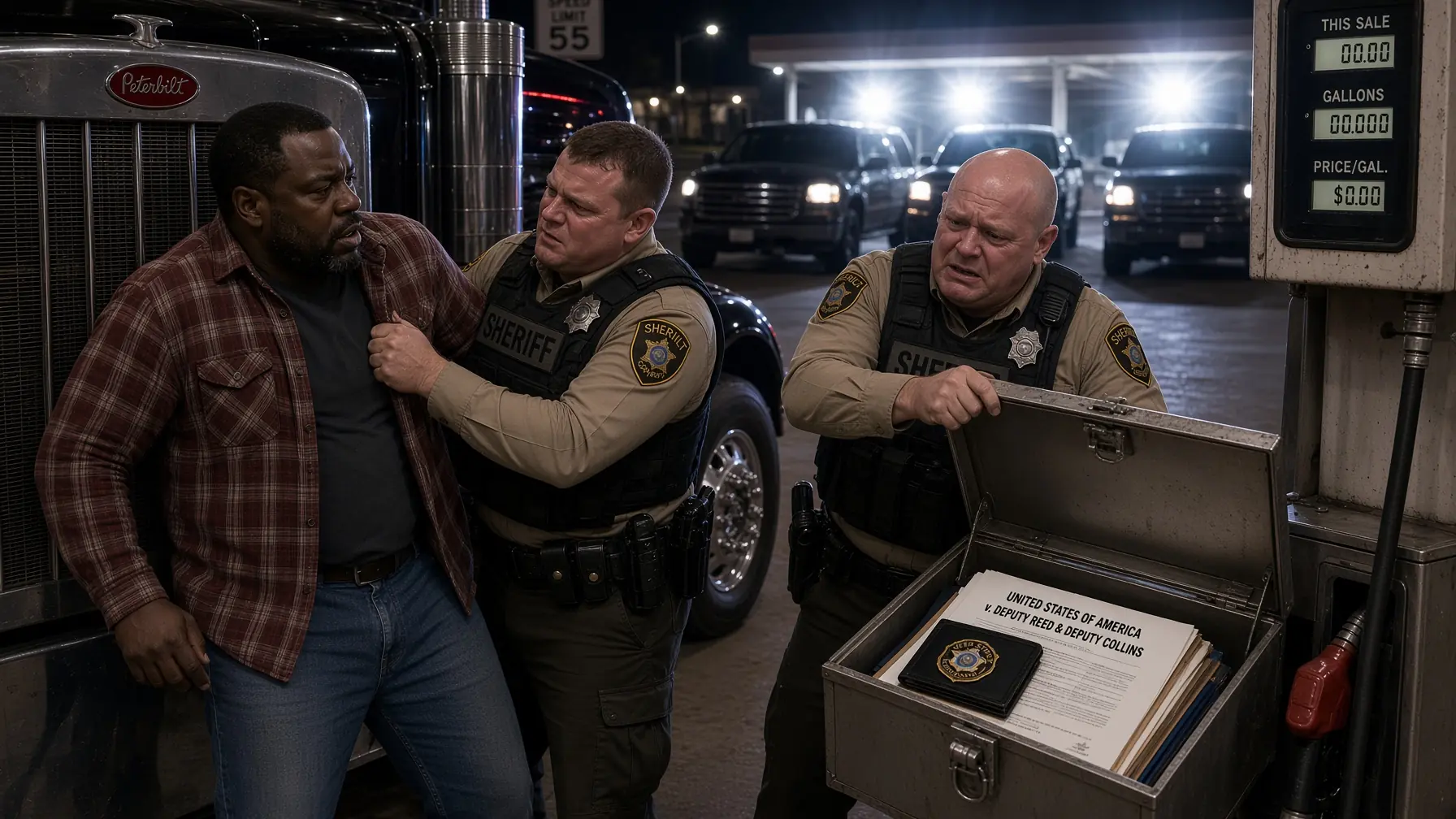
 The first strike of Bradley Collins’s pry bar rang through the abandoned gas station like a rifle shot.
I kept my face against the side of the Peterbilt and counted.
One.
The steel box shifted but did not open.
Collins cursed and repositioned the bar beneath the reinforced lip.
Mitchell Reed stood behind me with one hand wrapped around the chain connecting my cuffs, pulling my shoulders backward whenever I tried to straighten.
“Should’ve just opened it when we asked,” Reed said.
“I told you I don’t consent to a search.”
He laughed.
“Still saying that?”
“Yes.”
“Anybody ever tell you when to shut up?”
“Several times.”
He pulled harder.
Pain moved through my wrists.
“Guess you’re a slow learner.”
I said nothing.
That was safer.
Not for me.
For the operation.
Twenty miles away, the federal command vehicle was hearing everything through the transmitter sewn into the inside seam of my collar. A second microphone sat beneath the dashboard. Two cameras covered the cab. Another watched the side compartment where Collins was now committing exactly the act we had spent three years waiting to document.
No warrant.
No consent.
No probable cause.
No real equipment violation.
And, most importantly, no fear that anybody would challenge them.
The taillight Reed claimed was defective had been inspected by our evidence team forty minutes earlier.
It worked perfectly.
We had even installed a second concealed camera inside the housing so investigators could prove when the light was functioning.
They did not know that.
They did not know the diesel fuel receipt in my cup holder was timestamped.
They did not know the trailer seal number had been photographed by federal agents before I entered Ridgefield County.
They did not know the truck itself belonged to a cooperating freight company whose owner had spent eighteen months helping us build the case.
They only knew what had worked on dozens of other drivers.
Find something.
Make it sound serious.
Search.
Discover cash or something valuable.
Then offer a choice.
Lose the money.
Or spend the night—or longer—in jail.
The second strike hit the lock.
Metal bent.
Collins smiled.
“There we go.”
Reed leaned closer to my ear.
“Last chance, driver. Tell us what’s inside.”
I turned my head as far as the position allowed.
“Property you don’t have permission to open.”
He hit the side of my head with his palm.
Not hard enough to knock me down.
Hard enough to make the message clear.
“You’re not in a courtroom.”
“No.”
I tasted blood where my cheek had caught a sharp edge on the truck.
“But you may wish you were.”
Reed froze.
Only for a fraction of a second.
Then he laughed again.
Collins drove the pry bar down.
The lock snapped.
The lid lifted.
For three years I had imagined that moment.
Not because of what was inside.
Because of what I thought Reed’s face might look like when the world he understood stopped making sense.
Reality was quieter.
Collins opened the lid.
He expected cash.
We knew that because previous victims described the same sequence.
A truck driver from Louisiana said Reed had found $6,400 in emergency operating cash and accused him of drug trafficking until the driver signed a handwritten “property abandonment” form.
A retired couple from Arizona lost nearly $11,000 after being told their cash could be seized as suspected narcotics proceeds.
A flooring contractor from Oklahoma had a deposit envelope containing $18,500 taken from his van.
The department later described several of those seizures as voluntary forfeitures.
Our investigation suggested some were anything but voluntary.
So we gave Reed and Collins a lockbox.
Inside was no cash.
The first thing Collins saw was a black leather credential case.
He picked it up.
Opened it.
His smile disappeared.
The gold shield reflected the gas station lights.
FEDERAL BUREAU OF INVESTIGATION
Below it was my photograph.
My real name.
DAVID ELIAS HAYES
SPECIAL AGENT
Not a Special Agent in Charge.
Not some movie version of the FBI director.
Just a field agent assigned to a federal public corruption task force and trusted with an undercover role because I had spent enough years working financial crimes to know that the men who loved easy victims rarely studied them very carefully.
Collins stared at the credential.
Then at me.
Then back at it.
Reed stepped away from the truck.
“What?”
Collins did not answer.
“What is it?”
Collins turned the wallet.
Reed’s face changed.
“No.”
That was all he said.
One word.
Then he moved toward the lockbox.
Underneath my credentials lay a sealed brown envelope.
Not the original indictment.
Those remained with the federal court under seal.
Inside the box were certified execution copies prepared for the arrest teams that had been positioned outside Ridgefield before I entered town.
The grand jury had returned the indictment that morning after nearly three years of evidence.
Tonight’s operation was not designed to create the case.
It was designed to document whether Reed and Collins would repeat the conduct already described by victims and, if they did, to preserve one final unambiguous sequence before arrests.
The envelope bore a federal case number.
Reed picked it up.
His hands were suddenly less certain.
Collins said, “Don’t.”
Reed tore the edge anyway.
He pulled out the first page.
I could not see it from where I stood.
I did not need to.
I had read it six hours earlier.
UNITED STATES OF AMERICA
v.
MITCHELL REED
BRADLEY COLLINS
HARLAN VOSS
and three others.
Conspiracy against rights.
Extortion under color of official right.
Obstruction and falsification-related counts.
Financial offenses tied to seized property.
Not every allegation against every defendant was identical.
And indictment was not conviction.
That mattered.
Even with my cheek against my own truck, I was not going to pretend the piece of paper in Reed’s hand had already proved guilt.
It meant a federal grand jury had found probable cause to charge them.
That was enough to change the next few minutes.
Reed read his name.
Then Collins’s.
His lips moved once.
“What the hell is this?”
I looked over my shoulder.
“Now would be a good time to take the cuffs off.”
Collins dropped the credential case back into the box.
“You’re a fed?”
“Yes.”
Reed stepped toward me.
“No.”
I almost smiled.
“You just read the card.”
“You’re lying.”
“About which part?”
He looked toward the road.
Nothing.
The highway beyond the gas station remained empty.
The command team had not moved yet.
That was deliberate.
The contingency signal was not my credentials being exposed.
The signal was whether Reed and Collins escalated after learning who I was.
Their conduct after discovery mattered too.
Would they release me?
Try to bargain?
Attempt to destroy evidence?
Call accomplices?
Or do something worse?
Reed looked at Collins.
“Kill the bodycam.”
My stomach tightened.
Neither deputy’s department-issued camera had been activated when they stopped me.
That was already documented.
Apparently Reed was thinking of a different device—the dash camera in his cruiser.
Collins looked confused.
“What?”
“Turn off the unit cam.”
There it was.
Twenty miles away, Richard Langden was hearing every word.
Collins hurried toward the cruiser.
I raised my voice.
“Deputy Collins, do not alter or disable recording equipment.”
He stopped.
Reed spun toward me.
“Shut up.”
“You’re standing beside a federal evidence operation.”
That was not exactly how I would phrase it in court later.
But Reed needed to understand one thing.
The moment for improvisation was over.
He did not.
He grabbed my collar and slammed me back against the trailer.
“You think that paper means anything out here?”
“Yes.”
He leaned close.