“Service hallways are that way.”
The young man said it with a smile polished enough to fool anyone who had never been insulted politely.
Dr. Alana Cross stood beneath the gold chandeliers of the Bellweather Grand Ballroom, one hand resting at her side, the other still holding the small evening clutch that carried the future of her company. Her deep emerald gown caught the light every time she breathed. Her hair was swept back, her posture quiet, her face calm enough to make the cruelty around her feel louder.
The boy in front of her was nineteen, maybe twenty, with soft hands, expensive cufflinks, and the lazy confidence of someone who had never paid for his own mistake.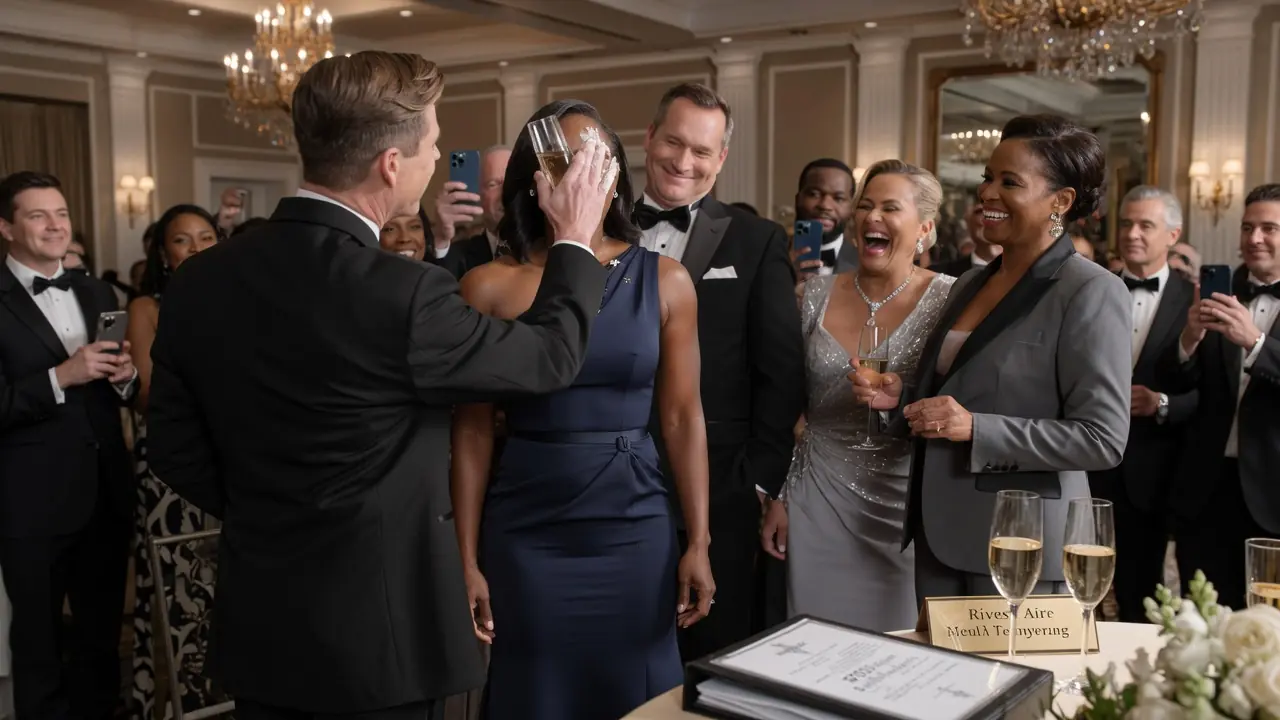
His name was Camden Harrow.
His father owned half the room.
His mother controlled the other half.
“You heard me,” Camden said, stepping closer with a dessert plate in his hand. “Move, or security can help you remember where you belong.”
Before Alana could answer, he shoved a fistful of cake into her face.
The frosting struck cold across her cheek, lashes, lips, and jaw. His hand dragged sideways, smearing chocolate and cream across her skin like he was wiping dirt from a counter. A gasp rippled through the ballroom, but it was quickly swallowed by laughter from the Harrow table.
Camden’s mother, Vivienne Harrow, laughed first.
Bright.
Elegant.
Approving.
His father, Sterling Harrow, leaned back in his chair, lifted his champagne glass, and chuckled like his son had just performed a clever party trick.
“Look at her,” Camden announced to the donors. “All that polish, and she still can’t act grateful.”
Alana did not flinch.
She did not wipe her face.
She did not slap him.
She did not give the room the kind of anger it had been trained to expect from a Black woman humiliated in public.
She simply looked at Camden Harrow through a smear of frosting and breathed slowly.
No one in that room knew the $700 million deal they had gathered to celebrate was already dying.
No one knew section 8.3 of the partnership agreement had been written for exactly this kind of moment.
And no one knew Alana’s next word would cost the Harrows more than their reputation.
Three hours earlier, Alana had paused at the entrance of the Bellweather Grand Ballroom and taken in the wealth arranged like theater.
Crystal chandeliers hung over marble floors. Antique mirrors reflected black tuxedos, silk gowns, donor smiles, and photographers moving carefully between tables like they were part of the waitstaff. The whole place smelled faintly of roses, champagne, expensive perfume, and old money trying very hard to look charitable.
Beside her stood her closest adviser, Mara Bell, sharp-eyed and elegant in a charcoal suit.
Mara had negotiated wars in boardrooms with less tension than this gala.
“Remember the conduct clause,” Mara murmured. “Section 8.3. You were right to make them keep it.”
“I’m usually right,” Alana replied quietly.
Her smile was ready for the cameras, but her eyes were already reading the room.
Seven hundred million dollars.
That was the public number.
The partnership between Crossline Systems and Harrow Consolidated would fund a national apprenticeship network, community-based tech hubs, and workforce pipelines in cities where corporations loved to hold press conferences but rarely stayed long enough to change anything. It meant jobs with benefits. It meant training that led somewhere. It meant young people who had been promised opportunity finally getting doors that opened.
That was why Alana had walked into the room.
Not because she trusted the Harrows.
She did not.
Sterling Harrow came toward her across the marble floor with both arms slightly open, as if the evening itself belonged to him and she was one of many objects placed inside it. He was tall, silver-haired, and tailored within an inch of human warmth. His wife Vivienne glided beside him in pale silk and diamonds large enough to shame a chandelier.
“Dr. Cross,” Sterling said, his voice booming. “We are honored you could join us.”
“The honor is mutual,” Alana said smoothly, extending her hand.
Sterling took it for exactly one second too short.
Vivienne’s fingers touched Alana’s sleeve. “Oh, dear, while you’re nearby, would you mind asking the kitchen about the champagne at table nine? They seem terribly behind.”
Mara’s eyes sharpened.
Alana’s smile stayed still. “I’m here for the partnership announcement, Mrs. Harrow. But I’m sure the event staff can assist you.”
Vivienne’s laugh was delicate and cold. “Of course. Silly me. It’s just so busy tonight, and you looked so capable.”
“That happens,” Alana said.
“The guest list is handled by your coordinator,” Mara said. “Dr. Cross is seated at the head table.”
Sterling’s expression flickered.
Only for a moment.
Then the mask returned.
“Of course,” he said. “Wouldn’t want any confusion.”
They moved through the ballroom with cameras flashing around them.
Alana noticed the glances.
Some were curious.
Some admiring.
Some confused in that familiar way people became confused when a Black woman walked into a room not to serve it, but to sign papers that would change it.
At the head table, a gold placard marked her seat.
Dr. Alana Cross.
Founder and CEO, Crossline Systems.
Before she could sit, a hostess hurried forward with a strained smile.
“Oh, I’m so sorry,” the woman said. “There must be some confusion. This section is for principal partners.”
Mara removed a printed seating chart from her clutch without looking at the woman twice. “Then Dr. Cross is in the correct chair.”
The hostess looked from the paper to Alana, then back again.
“I’ll just double-check.”
“You can do that after she sits,” Mara replied.
A few guests nearby laughed softly.
Not kindly.
Not openly.
Just enough to make the message clear.
Alana sat anyway.
She had been sitting in rooms that expected her to stand somewhere else since graduate school.
By the second course, the pattern had sharpened.
A donor on her left described Crossline’s apprenticeship program as “almost like charity,” and looked surprised when Alana explained its profit model, its ninety-four percent placement rate, and the annual return on investment through talent retention. A foundation trustee asked whether she found it “challenging” to lead engineers who were “more technical.” A venture partner complimented her “poise,” then asked Mara whether Alana had written her own remarks.
Every comment wore perfume over rot.
Alana answered each one with a calm precision that made people smile less.
Across the ballroom, Camden Harrow watched her.
He swirled scotch in a crystal glass, leaning back in his chair like the gala had been organized for his boredom. He had his father’s arrogance and his mother’s delight in subtle harm, but none of their discipline. He looked at Alana the way spoiled boys look at things they want to break just to prove they can.
When dessert carts rolled in, Vivienne Harrow made a small gesture with two fingers.
A photographer shifted closer to the head table.
Mara noticed.
Alana noticed too.
Sterling Harrow raised his glass. “Before the official announcement, I believe my son has a few words.”
Camden rose to easy applause.
He walked toward the center of the room with the swagger of someone taught that charm could cover any vulgarity. The dessert cart stopped beside the stage, silver domes gleaming beneath the chandeliers.
“Friends,” Camden began. “Partners. Generous people with generous wallets.”
Laughter rolled through the room.
He smiled wider.
“Tonight is about new ventures, new alliances, and new lessons in how things work around here.”
His eyes settled on Alana.
Mara leaned slightly toward her. “Careful.”
“I know,” Alana whispered.
A server lifted the silver dome.
Beneath it sat a dark chocolate torte decorated with spun sugar and white roses. Beautiful. Precise. Too perfect to be accidental.
Camden picked up a piece with his bare hand.
Not a fork.
Not a plate.
His hand.
“Dr. Cross,” he said loudly. “You should have the first taste.”
Alana looked at the cake, then at him. “Thank you, but perhaps we should wait until everyone is served.”
“Oh, no,” Camden said. “This is special.”
Mara started to rise, but two private security men moved into her path. Not touching her. Not yet. Just creating enough obstruction to make intention visible.
Their leader, Bryce Callow, stood near the stage.
Former law enforcement. Thick neck. Calm eyes. The kind of man who knew how to make intimidation look like protocol.
Camden stepped closer.
“You know,” he said, lowering his voice just enough that the front tables still heard, “my father says partnerships only work when everybody understands their proper place.”
Alana held his gaze. “Does he?”
Camden smiled.
Then he hit her with the cake.
The room gasped.
Then the Harrows laughed.
And when old money laughs first, hungry people often join before asking what the joke costs.
Frosting slid down Alana’s cheek. Chocolate caught in her lashes. Cream touched the corner of her mouth, sweet and sickening. Her neck felt cold where the cake had dragged beneath her jaw.
Camden stood close enough for her to smell the scotch on his breath.
“There,” he said softly. “Now you look less confused.”
A woman at the next table gave Alana a pitying smile. “Don’t make it worse, dear. Boys do silly things.”
Sterling chuckled. “High spirits.”
Vivienne dabbed beneath one eye as if she had laughed herself into tears. “Camden has always been theatrical.”
Alana reached for the linen napkin beside her plate.
She wiped her face slowly.
One careful stroke.
Then another.
She kept her eyes on Camden the entire time.
His smile began to weaken because he had wanted rage. He had wanted tears, trembling, one sharp word he could turn into proof. Instead, he received silence, and silence in the wrong woman’s hands can become a blade.
Alana stood.
The ballroom quieted.
“Microphone,” she said.
A server hesitated.
Mara, still blocked by security, looked past the guard and said, “Give her the microphone.”
The server obeyed.
Alana took it, frosting still clinging to one cheekbone like pale war paint under the lights.
The sound system hummed.
Every camera in the room turned toward her.
“I want to thank the Harrow Foundation,” Alana began, “for this extremely useful demonstration.”
Sterling’s smile froze.
Vivienne’s hand stopped halfway to her glass.
Camden shifted.
“Not for the cake,” Alana said. “Though I’m sure the pastry chef deserved better than having it used as a weapon. I mean the behavior. The laughter. The silence. The people in this room who watched a grown man smear food across my face and then advised me not to make a scene.”
Someone lowered their eyes.
Then someone else.
Alana continued. “Public humiliation is not humor. It is a test. It asks who will laugh, who will look away, who will tell the person harmed to be graceful, and who will mistake cruelty for class because the person doing it has money.”
Sterling stood. “Dr. Cross, surely we can discuss this privately.”
“No,” Alana said. “We cannot.”
Mara had made it past security and now stood beside her with a tablet in hand. Behind them, Alana’s general counsel, Priya Sloane, appeared from the second row carrying the partnership binder.
She had been waiting for this.
Priya opened the binder with surgical calm.
“The partnership agreement between Crossline Systems and Harrow Consolidated includes a professional conduct and morality clause,” Priya announced. “Section 8.3 allows immediate termination if either party engages in conduct inconsistent with basic human dignity, professional ethics, or public trust.”
Sterling tried to laugh. “My dear, this is a gala. Not a courtroom.”
Alana looked at him. “You should have remembered that before treating it like a plantation porch.”
The room went still.
Even Camden stopped moving.
Alana lifted the microphone. “Crossline Systems is terminating the $700 million partnership with Harrow Consolidated effective immediately.”
Gasps moved through the ballroom.
Phones rose.
A donor whispered, “Can she do that?”
Priya answered without being asked. “Yes.”
Vivienne stepped toward Alana, her expression softening into practiced emergency charm. “Darling, you are understandably upset. Why don’t we move somewhere quieter and smooth this over?”
“There is nothing to smooth over,” Alana said. “Your son’s behavior was deliberate. Your laughter was deliberate. My response is deliberate.”
Camden tried to recover his swagger. “Seven hundred million over a little frosting? That’s quite a tantrum.”
Alana turned to him fully. “No, Camden. That is quite a price for assuming my dignity came bundled with the deal.”
The first half of the room went silent.
The second half began making phone calls.
As Alana walked toward the exit with Mara and Priya, Sterling moved fast from table to table, smiling too hard. Vivienne was already on her phone, whispering to someone with the icy urgency of a woman accustomed to servants cleaning up blood before guests noticed. Camden stood near the cake cart, no longer laughing, but still wearing something close to satisfaction.
That was the first thing that bothered Alana.
He did not look defeated.
He looked like a boy watching a trap close.
Outside, the night air hit her damp skin.
For three seconds, there was quiet.
Then all three phones began buzzing.
Mara looked down first.
Her face changed.
“Alana.”
A video had gone live across half a dozen platforms.
The thumbnail showed Alana’s face twisted in apparent rage, an expression she knew she had never made. The caption read: Tech CEO Melts Down At Charity Gala After Harmless Joke.
Priya took Mara’s phone and played it.
The video skipped.
Cut.
Jumped.
Camden’s hand moving toward her face was missing.
The frosting appeared to land after a splice that made it seem like Alana lunged first.
The audio had been altered, inserting a sharp female voice that sounded close enough to hers to fool strangers in poor headphones.
Then came the hashtags.
#CrosslineCollapse.
#AlanaRage.
#CancelCross.
#HarrowWasRight.
Mara swore softly.
“This was ready before the cake hit you,” Priya said.
Alana looked back through the ballroom doors.
Camden was standing near the entrance now, phone in hand.
He saw her looking.
Then he waved.
Small.
Smirking.
Victorious.
They got into the waiting car as notifications multiplied.
Influencers with polished outrage posted within minutes of each other. Donors expressed disappointment in nearly identical language. Anonymous former employees appeared from nowhere, claiming Alana was unstable, abusive, difficult, dangerous to work with. News alerts picked up the edited clip before any reporter asked for the original.
“This isn’t damage control,” Mara said, scrolling fast. “This is a campaign.”
Alana’s phone buzzed with a message from a board member.
Emergency meeting tonight. Leadership stability must be discussed.
Priya’s phone rang next.
She listened for ten seconds, then closed her eyes.
“What?” Alana asked.
“They’re invoking the continuity addendum.”
Mara looked up. “What continuity addendum?”
Priya’s face had gone hard. “The one that should not exist.”
Back at Crossline headquarters, on the forty-seventh floor, the conference room lights stayed on past midnight.
Contract drafts covered the table. Mara searched version histories. Priya reviewed every page of the final agreement with the focus of someone cutting through wire. Alana sat at the head of the table, freshly washed, face bare, hair pulled back, the ghost of frosting still alive in her memory.
“There,” Priya said finally.
She turned the binder toward Alana.
Subsection 12D.
Continuity Protection Addendum.
The language looked harmless at first glance. Public disruption. Reputational instability. Emergency continuity rights. Temporary operational oversight in the event of leadership actions causing material market harm.
But underneath the corporate fog was a trapdoor.
“If your cancellation is framed as an emotional public disruption,” Priya said, “they can argue emergency voting rights. Temporary control. Arbitration in a forum they influence. Asset freeze connected to the rollout funds.”
Mara looked sick. “They needed her to cancel publicly.”
“Or explode publicly,” Priya said. “Either would work.”
Alana leaned back slowly.
“So the cake wasn’t the attack,” she said. “It was the match.”
At 12:37 a.m., Noah Ellery entered the conference room.
He was Crossline’s chief operating officer, polished even at midnight, tie loosened just enough to signal urgency without sacrificing control. He had been with Alana for three years, always steady, always useful, always one step ahead of problems.
That used to comfort her.
Now it did not.
“I came as soon as I heard,” Noah said. “I’ve already drafted a statement that might calm investors.”
“Already?” Mara asked.
Noah gave her a tired smile. “That is my job.”
Alana looked at him. “Did you review the final contract?”
“Of course.”
“Did you see subsection 12D?”
His face did not change quickly enough.
“I’d have to check.”
Mara turned her laptop toward him. “You commented twice in the email chain where that language first appeared.”
Noah glanced at the screen.
Then back at Alana.
“It looked standard.”
Priya’s voice chilled. “It is not standard.”
Noah lowered himself into a chair. “We should focus on market stability. If you step back temporarily, the board can reassure investors and prevent further losses.”
There it was.
Temporary.
Stability.
Step back.
The same words already appearing in donor statements, board texts, and social posts written by people pretending not to be coordinated.
Alana studied him.
“Noah,” she said softly, “how long have they owned you?”
His face hardened for half a breath.
Then the helpful mask returned.
“I’m trying to save the company.”
“No,” Alana said. “You’re trying to deliver it.”
He stood.
“I think everyone is exhausted.”
“Not exhausted enough to stop seeing you.”
By dawn, the siege had widened.
Protesters gathered outside Crossline headquarters with signs printed in identical fonts. No More Toxic Leadership. Protect Community Jobs. Alana Must Go. Some were real people swept up by outrage. Others moved like paid extras, checking phones between chants, waiting for cues.
At 9:00 a.m., a major investor requested a leadership review.
At 10:15, a fake employee letter circulated online.
At 11:00, a federal complaint was filed alleging data privacy violations inside Crossline.
At 11:07, company accounts began freezing.
Priya read the complaint and went pale.
“It uses your emergency authorization token.”
Alana’s eyes moved to Noah’s empty chair.
“He staged my digital signature.”
Mara slammed her palm onto the table. “We need proof before the board vote.”
“We need more than proof,” Alana said. “We need the whole machine.”
That night, they met Reverend Elise Warren at a community center on the south side of the city.
The building was old brick, warm inside, and full of students doing coding assignments at donated computers. It was one of the tech hubs the $700 million partnership was supposed to expand. Outside, black SUVs idled under broken streetlights. Harrow private security stood near the entrance, pretending to protect a building they were clearly trying to intimidate.
A young apprentice named Darius Cole was stopped on the sidewalk.
One guard demanded to search his bag.
Darius held up his badge. “I come here every Tuesday and Thursday.”
“Bag on the ground,” the guard said.
Reverend Warren stepped outside before Alana could move. She was sixty-five, silver-haired, and carried herself like a woman who had stared down landlords, mayors, school boards, and men with guns long before private security became fashionable.
“You will not search my students,” she said.
The guard smirked. “Safety protocol.”
“In whose building?”
The guard looked toward Bryce Callow, who stood near an SUV with his arms folded.
Alana started recording.
Bryce noticed.
His smile disappeared.
“Dr. Cross,” he said, “this area is tense. We’re trying to prevent escalation.”
“No,” Alana said. “You’re trying to create it.”
Inside, Reverend Warren led them to a back office lined with old photographs, protest flyers, church bulletins, land maps, and newspaper clippings that told the story of a neighborhood everyone claimed to love right before trying to buy it.
She placed a worn leather folder on the desk.
“The Harrows don’t just buy companies,” she said. “They buy the story around them.”
Inside the folder were twelve years of notes.
Donations followed by evictions.
Security contracts followed by property sales.
Edited videos followed by leadership resignations.
Community organizers discredited.
Minority-owned firms destabilized, devalued, then acquired through shell companies tied back to Harrow Consolidated.
Mara turned the pages slowly.
“This is a pattern.”
“It is a playbook,” Reverend Warren said.
Then she opened a drawer and removed a USB drive.
“A man brought me this six years ago. He worked in what they called reputation architecture. Three weeks after he recorded it, he died in a one-car accident.”
Priya plugged in the drive.
The video showed a man in his fifties speaking into a camera with shaking hands.
He named shell companies.
Influencer networks.
Private security firms.
Fake protest vendors.
Board placement programs.
The Harrows identified companies or neighborhoods they wanted, engineered public crises, manipulated perception, placed insiders, froze assets, forced panic, and acquired what remained at a discount.
“Placement programs,” the man said on video. “They groom executives, insert them into target companies, and let them build trust for years. When the crisis comes, the insider opens the gate.”
Alana closed her eyes.
Noah.
Mara whispered, “Three years.”
Priya’s jaw tightened. “Long enough.”
The next morning, they went to federal investigators.
By noon, the evidence was structured.
By two, the board meeting began.
Leonard Vale, Crossline’s board chair, sat at the center with a grave expression that looked rehearsed. Board members appeared in person and by video. Noah sat two seats down from Alana, hands folded, face composed into sorrowful concern.
A camera stood in the corner.
Leonard frowned. “This meeting cannot be streamed.”
Priya slid a filing across the table. “Due to active allegations of market manipulation and fraudulent board interference, transparency is now a fiduciary protection. The temporary restraining order request has already been filed. This meeting is being recorded through compliant channels.”
Noah shifted.
Alana stood.
“Before anyone votes on my leadership,” she said, “you will see what actually happened.”
The unedited gala footage played.
No jump cuts.
No fake audio.
No manufactured rage.
Camden’s approach.
The cake.
The laughter.
Sterling and Vivienne watching.
The room’s silence.
Then the edited clip played beside it, frame by frame.
Mara followed with bot-network analysis, payment trails, shell company receipts, timestamps showing posts scheduled before the incident had even occurred. Priya played excerpts from the reputation consultant’s deposition. Then came Reverend Warren’s records. Then the security harassment footage from the community center.
Noah’s face had lost color.
Alana turned to him last.
“And now,” she said, “we discuss the insider.”
Mara pulled up server logs.
Emergency authorization token.
3:47 a.m.
Federal complaint filed from an IP address tied to Noah Ellery’s home network.
External transfers made to servers registered under Harrow-linked shell entities.
Contract version history showing Noah approving insertion of subsection 12D.
Leonard stared at the screen.
“Noah,” he said slowly, “is this accurate?”
Noah’s mouth opened.
No words came.
Then he broke.
“You don’t understand what they can do,” he said. “They were going to take the company anyway. I was trying to keep it from getting worse.”
Alana looked at him. “You helped them humiliate me.”
“No,” he said quickly. “That was Camden. I didn’t know about the cake.”
“But you knew about the trap.”
Silence.
That was answer enough.
Priya stood. “I move to terminate Noah Ellery for cause, revoke all access, and refer evidence to federal authorities.”
Mara seconded it.
The vote was unanimous.
Security escorted Noah out without drama.
That somehow made it worse.
A man who had spent three years smiling in Alana’s office left with his badge deactivated, his laptop seized, and his carefully built usefulness reduced to evidence.
Then Alana faced the board.
“I do not need an apology for believing the edited video,” she said. “I need you to understand why you were willing to believe it so quickly.”
No one spoke.
“That is where the danger lives,” she continued. “Not in one racist boy with cake in his hand. In the room that laughed. In the board that hesitated. In the investors who saw a Black woman humiliated and asked whether she handled it professionally enough.”
Leonard lowered his eyes.
The following morning, federal agents entered Harrow Tower during a donor luncheon.
The cameras were already there because Vivienne Harrow had planned a recovery event. White flowers. Soft lighting. Scripted remarks. Camden in a navy suit prepared to discuss growth, maturity, and regret without admitting anything useful.
Instead, agents walked in through the side doors.
Sterling’s smile collapsed first.
Then Vivienne’s.
Camden tried to keep smirking until one agent placed a warrant on the podium and asked him to step away from his phone.
Accounts froze.
Servers were seized.
Shell companies were raided.
Private security contracts were subpoenaed.
By afternoon, the same donors who had laughed at Alana’s humiliation were deleting photographs with the Harrows, resigning from advisory boards, and issuing statements about being “deeply troubled by recent revelations.”
Reverend Warren watched the coverage from the community center with a cup of black coffee in hand.
“Funny,” she said. “Folks always discover morals when the cameras turn.”
Alana stood beside her.
Across the room, Darius Cole helped a younger student debug a line of code.
The tech hub was still open.
That mattered more than the headlines.
A week later, Crossline announced a new partnership.
No Harrows.
No old-money strings.
No secret continuity trap.
The new consortium included Meridian Capital, three labor funds, two community development banks, and local governance boards with real voting authority. The $700 million rollout survived, but its structure changed. More transparency. More community ownership. Stronger protections against predatory investors.
At the press conference, Alana stood in the community center instead of a ballroom.
No chandeliers.
No gold leaf.
No dessert carts.
Just folding chairs, students, parents, reporters, and walls covered in flyers for tutoring, coding classes, tenants’ rights workshops, and Saturday breakfast programs.
“This partnership was never supposed to be about charity,” Alana said. “It was supposed to be about access, ownership, and the right to build futures without surrendering dignity to people who think money makes cruelty sophisticated.”
Darius stood near the front row, nervous and proud.
Alana looked toward him.
“Today, Crossline Systems is also establishing the Cole Innovation Fellowship. Twenty students a year. Full tuition support. Paid internships. Mentorship. Job placement. And community oversight from day one.”
Darius’s face changed slowly, like joy had to fight its way through disbelief first.
Then the room erupted.
This applause was different from the ballroom’s laughter.
No performance.
No calculation.
Just people understanding that something meant to destroy had been turned into a door.
After the announcement, a reporter asked Alana whether she felt vindicated.
She thought of the cake.
The laughter.
The edited video.
Noah’s betrayal.
The boardroom silence.
The students walking past private security to get to class.
“I feel responsible,” she said. “Vindication is too small for what happened. Responsibility asks what we do with the truth once we have it.”
Months later, the Bellweather Grand Ballroom became infamous.
People replayed the unedited footage in ethics trainings, business schools, investor panels, and corporate governance seminars. Camden Harrow’s smirk became the face of entitlement that forgot cameras existed. Sterling and Vivienne’s laughter became a case study in how power reveals itself when it believes consequences are impossible.
The Harrow empire did not collapse in one day.
Empires rarely do.
It bled through indictments, lawsuits, frozen assets, lost board seats, severed donor relationships, and the public exhaustion of people who had finally found the words for what the Harrows had done to them for years.
But Crossline grew.
The apprenticeship network launched in six cities.
Students filled classrooms.
New hires entered jobs that actually paid enough to change family trajectories.
The community center expanded into the building next door, one the Harrows had once tried to acquire through a shell nonprofit.
Reverend Warren kept the first framed dollar from the new lease above her desk.
Mara wanted to burn a copy of the Harrow contract.
Priya insisted on archiving it instead.
“Never destroy evidence,” she said.
Alana agreed.
On the first anniversary of the gala, Crossline held no party.
Instead, Alana returned to the community center on a rainy evening and sat in the back of a classroom while Darius taught younger students how to build a basic app. He was patient. Funny. Serious when he needed to be. The kind of teacher who knew what it meant to be underestimated and had no intention of passing that wound down.
Reverend Warren sat beside Alana with two paper cups of coffee.
“You ever think about that night?” she asked.
“Every time someone offers me dessert.”
The Reverend laughed.
Then her smile softened. “They thought humiliation was a leash.”
Alana watched Darius lean over a student’s laptop, helping without taking over.
“They were wrong,” she said.
Outside, rain tapped against the windows.
Inside, screens glowed, students argued, keyboards clicked, and futures took shape in a room no billionaire family controlled.
Alana touched her cheek briefly.
There was no frosting there anymore.
No mark.
No stain.
But she remembered exactly how it felt.
Cold.
Sticky.
Intentional.
A room full of powerful people had watched her be degraded and waited to see whether she would break.
She had not.
She had stood still long enough for cruelty to reveal itself.
Then she had followed the evidence until the whole rotten structure came into the light.
That was the lesson Camden Harrow never understood.
Dignity is not proven by never being touched by humiliation.
Dignity is what remains standing after humiliation fails.
And power, real power, does not smear cake on someone’s face and call it a joke.
Real power wipes it away slowly, lifts the microphone, and makes the entire room answer for laughing.