Rural Missouri, autumn 1990.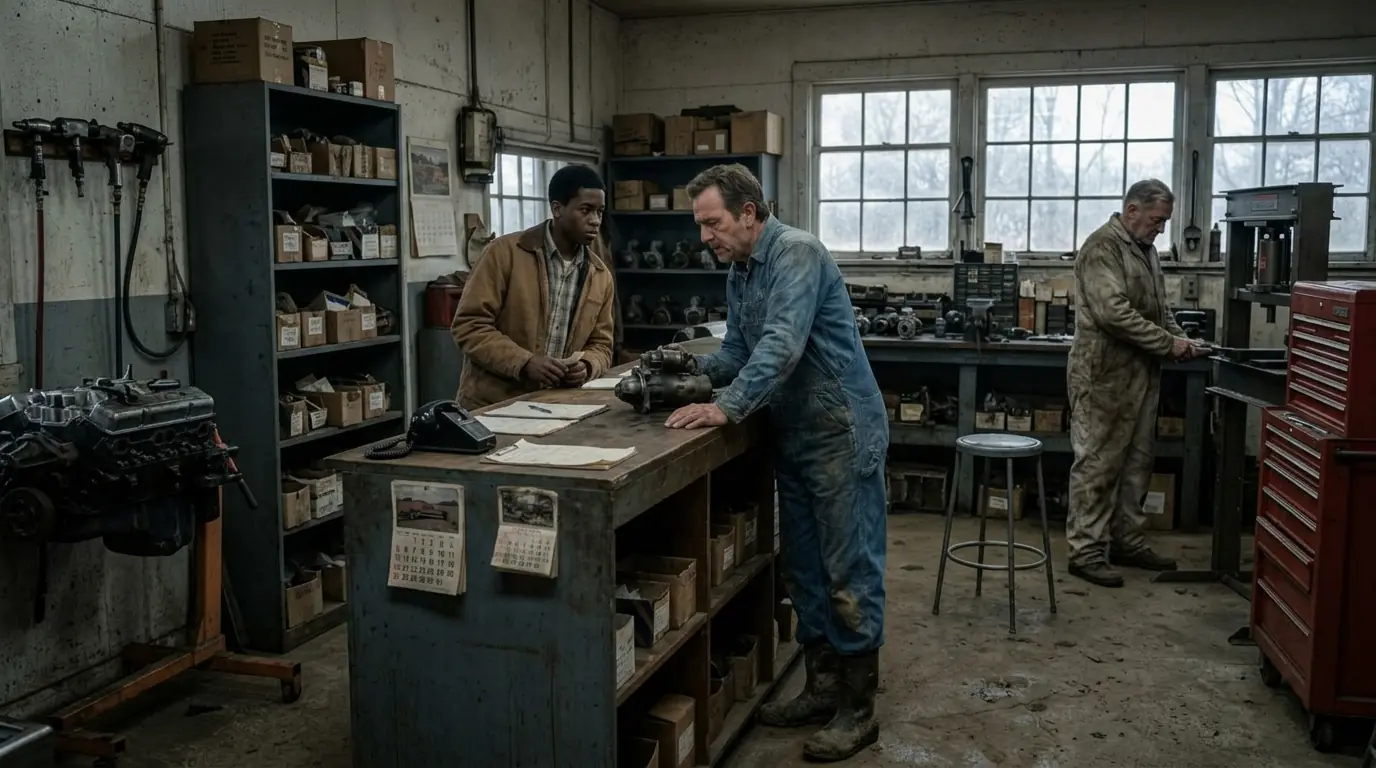
A regional tractor dealership was clearing out the storage shed behind its service department—the kind of cleanup that happened once every few years when nobody could find room to walk between the shelves anymore. Inside, stacked on pallets and crammed into wooden bins, sat roughly 180 starter motors pulled off tractors and combines over more years than anybody at the dealership could say for certain: John Deere, International Harvester, Massey Ferguson, Ford.
Most of them carried a grease pencil label from whoever had pulled them: Bad, core, no good, replace. Burned armatures, worn brushes, failed solenoids, cracked nose housings. A fair number had been pulled during a busy stretch by a mechanic who didn't have time to diagnose them properly and just swapped in a new one to keep a customer's tractor running. The dealership planned to sell the whole pile for scrap copper and call it done.
Malik Carter was 16 that fall, living with his mother and grandmother on their modest 70-acre farm, and working most afternoons after school for 68-year-old Otis Bell at the only independent repair shop for ten miles around. Money was never so tight that the family went without, but it was tight enough that a broken piece of machinery, a late seed bill, or an unexpected property tax notice mattered. And Malik had learned early on to notice value where other people saw junk.
Malik had made a habit the past couple of years of buying up exactly the kind of inventory nobody else wanted. And this pile sitting there, labeled dead in every direction, caught his attention the way it might not have caught anybody else's.
He bought all 180 starters for $65, the dealership glad to be rid of the scrap weight and not particularly curious what a 16-year-old planned to do with a truckload of motors mechanics had already given up on. A couple of the dealership's own mechanics laughed about it, not unkindly, one of them telling Malik as they loaded the truck that he was buying 180 problems other people had already solved by replacing them.
Malik didn't argue. He just figured a starter labeled bad by a busy mechanic with a tractor waiting and no time to diagnose it properly wasn't the same thing as a starter that was actually beyond saving. Some of them, he suspected, might just need brushes.
He hauled the pile home in Mr. Bell's truck and spent the better part of two weeks sorting through it on folding tables in the barn, the small magnifying loupe Mr. Bell had given him hanging from a string around his neck, useful for reading worn stampings and manufacturer numbers on housings that had spent years collecting dust.
His first plan seemed simple enough: clean up the good cores, replace whatever brushes and solenoids needed replacing, test them on Bell's bench, and sell the ones that worked.
He got a handful running that first month. One in particular spun clean and strong on the test bench: current draw normal, no hesitation, exactly the kind of result Malik had been hoping for. A farmer bought it that week for a tractor that needed a starter, and Malik felt, for a few days, like he'd figured the whole thing out.
Then, the farmer brought it back.
The starter bolted onto the mounting pattern just fine. But once it was in place, the drive gear didn't engage the flywheel the way it needed to. The nose housing on that particular model positioned the pinion just slightly differently than the tractor required—close enough to look right sitting on a bench, wrong enough that it wouldn't actually crank the engine once it was installed.
Malik refunded the farmer's money that same afternoon.
Mr. Bell didn't scold him for it, but he made the lesson clear enough at the shop counter that evening: a starter that spins freely on a test bench is not automatically a starter that belongs on any given tractor. Spinning proved the motor worked; it proved nothing about whether it was the right motor for that machine.
Malik took that seriously. He spent the next several weeks building an actual classification system instead of just testing whatever came off the shelf first: recording voltage, rotation direction, mounting bolt pattern, nose housing type, pinion tooth count, pinion diameter, shaft length, solenoid position, and the manufacturer part number wherever it was still legible, cross-checking all of it against tractor application charts pulled from old Delco and Prestolite service books Mr. Bell kept in a back cabinet.
He made handwritten index cards for each family of starters—one card per application—calling dealerships two counties over when a number he found didn't match anything in the books they already had. Some calls led nowhere, the part number too old for anyone to place; others turned up exactly what he needed from a parts counter clerk two hours away. He learned to check brush wear under the loupe, to look at a commutator for scoring, to test bushings for play, to inspect field coils and armature windings for the telltale discoloration of a unit that had actually burned rather than just worn out.
Mr. Bell helped him rig a proper bench test setup, checking current draw, free-running speed, and voltage drop under load, so a starter wasn't just judged on whether it spun, but on whether it spun the way it was supposed to.
One afternoon that October, Malik pulled two starters off the shelf that looked, at a glance, almost identical: same manufacturer, same rough size, mounting bolts in what looked like the same pattern. He assumed for a few minutes that one could stand in for the other if he ever ran short, and he was ready to write both onto the same index card as interchangeable.
Mr. Bell stopped him before he got that far, had him lay the drive ends side by side, and count the teeth on each pinion gear under the loupe. They weren't the same. Close, but different enough that swapping one for the other would have left a farmer with the same problem Malik had already refunded once.
Mr. Bell reminded him, not unkindly, that this was exactly the kind of mistake that could put a customer's tractor back on Bell's counter a second time. And a shop only got so many chances before farmers stopped trusting the work.
"Bolting on and working correctly," Malik wrote in his notebook that night, "are not the same thing." And he underlined it twice.