The auction bell rang three times in the middle of Dry Creek, and every man in town turned toward the wooden platform.
It was the kind of town that had learned to dress cruelty in ordinary clothes. A dusty main street, a crooked church, a jail with two cells, a saloon with cracked windows, and a trading post where men bought flour, bullets, tobacco, rope, and sometimes things no decent soul should ever be allowed to buy. The platform beside the livery had been used for horses, mules, land notices, and once, shamefully, a man accused of stealing cattle.
That morning, a young Apache woman stood on it with iron around her wrists.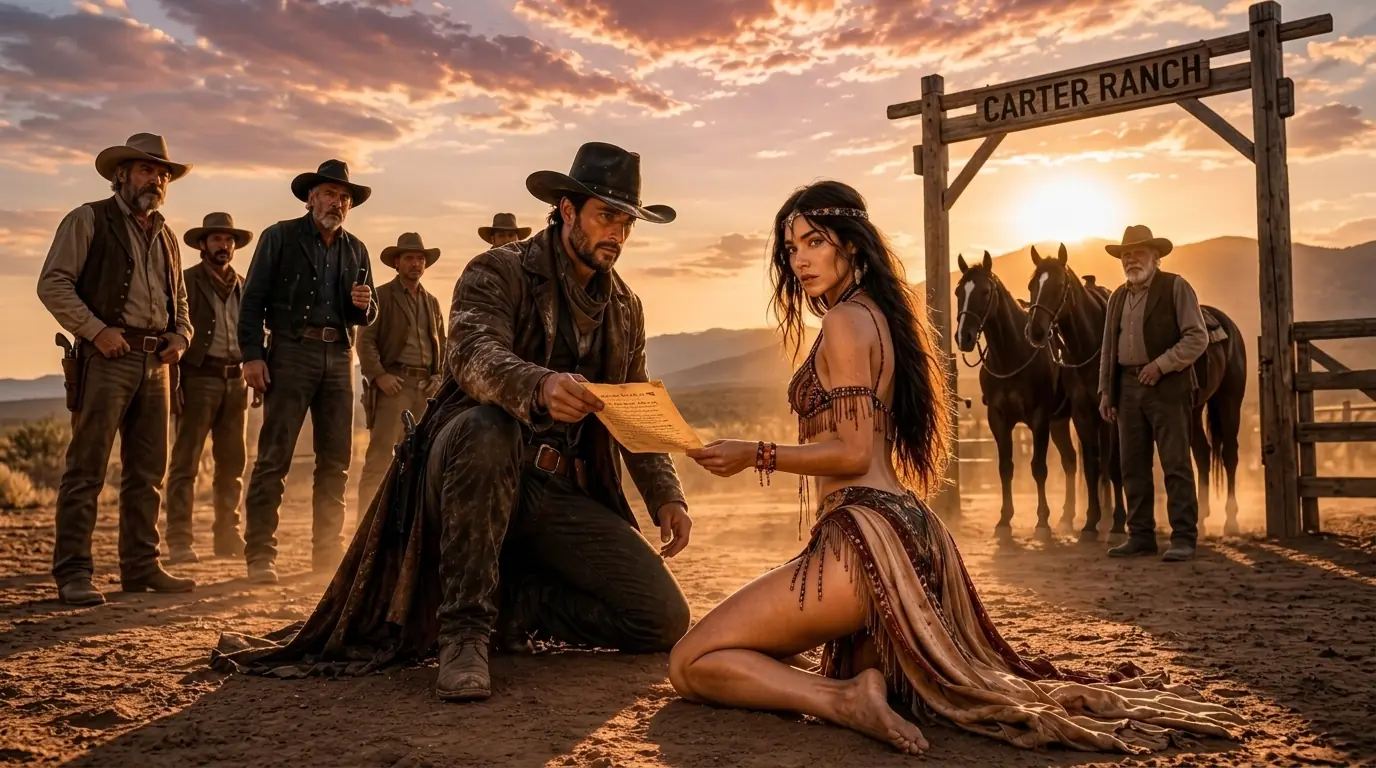
Her name was Naya Red Willow, though the man selling her did not use it. He called her “the girl,” as if taking her name helped turn her into something easier to price. Her dress was worn from travel, her hair fell loose over one shoulder, and there was a bruise along her cheekbone that had already begun to darken.
She stood straight anyway.
That bothered the crowd.
People in Dry Creek liked their victims bent. A bowed head made cruelty feel cleaner. A person who stood upright while being humiliated forced the room to remember she was still human, and most of the men gathered there did not want that kind of inconvenience.
The auctioneer, Morris Vale, smiled with yellow teeth and spread his arms.
“Strong, quiet, and useful,” he called. “That is what I was promised, and that is what I brought. Housework, fieldwork, kitchen work, whatever a man requires.”
Naya did not look at him.
She stared beyond the crowd toward the red hills.
A few men laughed.
A ranch hand near the hitching rail said something about breaking wild things. His friend slapped him on the shoulder and laughed harder. Naya’s face did not change, but her fingers closed around something hidden beneath the torn sleeve near her wrist.
No one noticed except Caleb Rowan.
He stood at the back of the crowd, hat low, shoulders broad, beard rough, and one hand resting near the belt he wore more from habit than vanity. He had ridden into Dry Creek for salt, coffee, nails, and horseshoe blanks. He had not come to buy a woman. He had not come to join a crowd.
But once he saw her, leaving became impossible.
Caleb was thirty-eight years old, though grief had carved him older in places. He owned a small ranch east of the San Pedro, a place called Juniper Bend, where the land was stubborn, the well was honest, and the house had too many empty rooms. Five years earlier, fever had taken his wife, Lydia, and the child she had carried almost to term.
After that, Caleb stopped expecting gentleness from the world.
He worked.
He repaired fences.
He broke horses without cruelty and spoke to people only when necessary.
Folks in Dry Creek called him decent, which usually meant he paid his debts, did not cheat at cards, and minded his own business. They did not know that decency, if it is real, does not always mind its own business. Sometimes it sees a wrong thing happening in public and understands that silence is how wrong things learn to grow bold.
The first bid came from a man in a gray coat.
Then another.
Then a third.
Naya stood on the platform with the sun in her eyes while strangers priced her life. Morris Vale called numbers like he was selling a saddle. Men nodded, raised fingers, spat tobacco, and pretended none of this would stain them later.
Then Silas Creed stepped forward.
The crowd shifted for him.
Creed was not the richest cattleman in Arizona Territory, but he was trying to become so, which made him more dangerous than the men who had already succeeded. He owned three ranches, controlled two water crossings, had money in the sheriff’s office, and wore a silver watch chain thick enough to prove he had never worked for anything with his hands. His eyes were pale, cold, and restless.
He looked at Naya as if she were not a woman but a locked box.
“I’ll pay seventy,” he said.
The crowd quieted.
Morris Vale’s smile widened.
“Seventy dollars from Mr. Creed.”
Naya’s fingers tightened again around the hidden object at her wrist.
Caleb saw it.
He also saw Creed watching that same hand.
This was not only about cruelty.
There was purpose in Creed’s gaze.
Caleb stepped forward before he had fully decided to do it.
“One hundred.”
The crowd turned.
Morris Vale blinked.
Silas Creed looked back slowly, his expression flat with disbelief.
“Rowan,” he said. “I did not know you were in the market.”
“I wasn’t.”
“Then ride home.”
“No.”
The word moved through the crowd like a match struck in dry grass.
Creed smiled without warmth. “One hundred and twenty.”
Caleb had brought one hundred and forty-three dollars to town. Most of it was meant for repairs, supplies, and a new plow blade he had put off buying for two seasons. He thought of the broken plow. He thought of winter. He thought of the woman on the platform with iron on her wrists and a man like Creed measuring her.
“One hundred and forty.”
Morris Vale’s mouth opened.
That number changed the air.
No one paid that much unless he knew something.
Creed’s eyes narrowed. “One hundred and fifty.”
Caleb did not have it.
The crowd waited.
Naya finally looked at him.
Not pleading.
Not grateful.
Just looking, as if she wanted to know what kind of man would step forward and then fail in front of everyone.
Caleb removed his father’s gold pocket watch from his vest.
It was the only fine thing he owned. Lydia had wanted him to sell it after the fever when money got thin, but he never did. Not because it told time well, but because his father had carried it through a war and back. Caleb placed it on Morris Vale’s table.
“One hundred and forty,” he said. “And the watch.”
Morris picked it up, tested the weight, and swallowed.
“Sold.”
Silas Creed’s smile vanished.
Naya did not move.
Caleb climbed the platform, took the key from Vale, and unlocked the iron from her wrists. The marks beneath were raw. She pulled her hands back slowly, as if even freedom could be another trick if accepted too fast.
Caleb stepped down first.
“You can walk,” he said quietly. “Or ride. My horse will carry two if needed.”
She looked at him with suspicion sharp enough to cut.
“You bought me.”
“Yes.”
“For what?”
Caleb looked toward Creed, then back at her.
“To keep him from doing it.”
That was the first honest thing anyone had said to her in days.
She did not trust it.
But she followed him.
Behind them, Silas Creed spoke loudly enough for the crowd to hear.
“You just bought trouble, Rowan.”
Caleb stopped and turned.
“No,” he said. “I bought time.”
Creed’s face hardened.
“Time runs out.”
“Then I’ll use it carefully.”
Caleb lifted Naya onto his horse, then swung up behind her. The crowd parted as they rode out of Dry Creek, not out of respect, but because every person there understood that the story had changed and no one yet knew what shape it would take.
For the first mile, Naya said nothing.
Her body remained stiff in the saddle, ready to jump, run, fight, or fall rather than trust. Caleb kept the horse at a steady pace and did not crowd her with questions. The desert opened around them, wide and unforgiving, red hills rising beyond mesquite and dry grass.
Only when Dry Creek disappeared behind them did he speak.
“There is water in the canteen.”
She did not take it.
“My ranch is six miles east,” he said. “You can rest there. After that, we decide what comes next.”
“We?”
“If you are part of the decision, yes.”
She turned slightly, enough to see his face.
“You expect me to believe that?”
“No.”
That surprised her.
Caleb looked ahead.
“I expect you to watch me until belief becomes either possible or foolish.”
For a moment, the corner of her mouth moved.
Not a smile.
But something in the direction of one.
Juniper Bend sat in a shallow valley between low hills and a line of cottonwoods that marked the creek. The ranch house was plain, solid, and weathered, with a deep porch, two stone chimneys, and a barn that leaned slightly but had not yet lost the argument with gravity. A vegetable plot lay behind the house. A small corral stood beside the barn. Beyond it, cattle grazed under a hard blue sky.
Naya studied the place as they rode in.
It was not rich.
But it was not cruel.
That mattered more.
Caleb dismounted and stepped back from the horse.
“You can take the east room,” he said. “It has a door that locks from the inside.”
She looked at him sharply.
“The key is inside,” he added. “Not outside.”
He walked to the house first and left the door open behind him.
Naya sat in the saddle for a moment longer.
Then she got down.
The east room was small, but clean. A bed with a quilt. A washbasin. A wooden chair. One window facing the cottonwoods. The lock worked. Naya checked it twice after Caleb left.
On the table, he had placed a folded cloth, a cup of water, bread, beans, and a small jar of salve for her wrists.
He had not waited to watch her use any of it.
That was the first thing that made her uncertain.
Not kind words.
Space.
People who wanted power tended to stay close enough to see it working.
Caleb stayed away.
At dusk, he knocked once on the doorframe and did not enter.
“Supper is on the stove,” he said. “Eat or don’t. I’ll be in the barn.”
She listened to his boots fade down the porch steps.
Only then did she open the door.
The kitchen smelled of coffee, beans, and fried corn cakes. Two plates sat on the table, but only one chair had been pulled out. Naya ate standing at first, too alert to sit. Then hunger overruled pride, and she sat.
She had not eaten a full meal in two days.
By the time Caleb returned, one plate was empty and the other untouched.
He noticed but said nothing.
That night, Naya slept with the chair braced beneath the doorknob, the window unlatched in case she needed to escape, and the small leather pouch tucked under her palm.
Near midnight, she woke to a sound outside.
Not boots.
Not men.
A horse moving in the yard.
She crossed to the window and looked out.
Caleb stood near the corral, rifle in hand, watching the western ridge. He did not know she was watching him. His posture was still, but not peaceful. He was guarding the ranch.
Guarding her.
Naya did not know what to do with that.
By morning, Caleb found her in the kitchen, sleeves rolled up, washing the dishes she had used.
“You don’t have to do that.”
“I used them.”
“They are dishes.”
“And now they are clean.”
He nodded, accepting the logic.
“My name is Caleb Rowan,” he said.
“I know. They said it in town.”
“I would rather you heard it from me.”
She dried her hands slowly.
“Naya.”
He waited.
“Naya Red Willow.”
He repeated it once, not clumsily, not mockingly.
“Naya Red Willow.”
Something in her chest tightened.
For months, men had called her girl, savage, property, pretty thing, trouble. Hearing her own name spoken plainly almost hurt.
Caleb seemed to understand he had stepped near something tender, so he moved away from it.
“Silas Creed wanted you for a reason.”
Naya looked down.
“You saw?”
“I saw enough.”
She touched the pouch beneath her sleeve.
“He believes I carry a map.”
“Do you?”
“No.”
Caleb waited.
She looked toward the window, toward the red hills beyond the cottonwoods.
“I carry something worse for him.”
Before she could explain, a gunshot cracked across the valley.
Birds burst from the cottonwoods.
The horses lifted their heads.
Caleb moved to the window before the echo faded.
Another shot came from the western ridge.
Not aimed at the house.
A warning.
Naya’s face went pale.
“He has come.”
“Creed?”
She nodded.
“But not for money now.”
Caleb picked up the rifle from beside the door.
“For revenge.”
They moved fast.
Caleb barred the front door and pulled the shutters closed. Naya stood in the center of the room, one hand gripping the leather pouch beneath her sleeve. Her breathing was steady, but her eyes were full of old fear waking.
Outside, a voice called from the yard.
“Rowan!”
Caleb cracked one shutter just enough to see.
Silas Creed sat on a black horse beyond the well with six riders spread behind him. He had not brought the whole war yet. Just enough men to deliver a message.
“You have something that belongs to me,” Creed called.
Caleb kept the rifle low but ready.
“I have nothing of yours.”
Creed laughed.
“You are mistaken.”
Naya stepped beside Caleb.
He shook his head slightly.
She ignored him.
“I was never yours,” she called.
The riders shifted.
Creed’s face changed, not with surprise, but annoyance. He did not like her voice carrying in open air. He preferred frightened people quiet.
“You should have stayed silent,” he said.
“I did that already.”
Another shot hit the porch post, sending splinters through the window gap.
Caleb fired once.
Not at Creed.
At the hat of the man nearest him.
The hat flew clean off and landed in the dust.
Every rider went still.
Caleb’s voice carried through the shutter.
“Next one is lower.”
Creed stared at the porch for a long moment.
Then smiled.
“You think this ends with one rifle?”
“No.”
“Good. Then you understand.”
He turned his horse.
Before leaving, he looked directly toward where Naya stood behind the shutter.
“By tomorrow, every man in this valley will know you are hiding stolen property. By sunset, they will come for you.”
Then he rode out with his men.
The valley settled back into silence.
Naya opened the pouch with shaking fingers.
Caleb watched but did not move closer.
Inside lay a turquoise pendant, a folded letter, and a strip of rawhide wrapped around old paper.
“My mother gave this to the old chief before our village was attacked,” Naya said. “He hid it for years. When my father died, it came to me.”
“Your mother is alive?”
Naya’s face tightened.
“I don’t know.”
She unfolded the letter.
The paper was fragile, worn thin at the creases. The handwriting had faded, but the first line was still clear.
My daughter, if these words find you, then you were never lost to us in spirit.
Naya stopped breathing.
Caleb lowered his eyes, giving her privacy.
She read silently at first.
Then aloud, because some words are too heavy to carry alone.
The letter told her that during the raid on their camp, her mother had hidden her with relatives along the river, planning to return once the soldiers and hired riders passed. But the attackers came back. The families scattered. Naya vanished into a trade route where names were replaced by descriptions and children became labor, servants, and secrets.
Her mother had searched for years.
She had never stopped.
At the bottom of the letter, one sentence had been written darker than the rest.
Never believe anyone who tells you that you are less than what the Creator made you to be.
Naya pressed the page against her chest.
For years, she had believed she was abandoned.
For years, shame had sat inside her like a stone.
Now she understood.
She had not been unwanted.
She had been stolen.
The rawhide bundle held the reason Creed hunted her.
Not a map to gold.
Not a treasure claim.
A government agreement signed fifteen years earlier, granting protected land and water rights to Naya’s Apache family group after a peace settlement. The agreement included a spring hidden in the hills north of Juniper Bend, the same spring Creed had quietly fenced and used to control three ranches downstream.
Caleb read the signatures slowly.
Army captain.
Territorial agent.
Apache leaders.
Witnesses.
“This is why he wanted you,” Caleb said.
Naya nodded.
“If this reaches a federal judge, his water rights collapse. His cattle routes collapse. His buyers lose confidence. The land he stole returns to the people he drove away.”
Caleb folded the paper carefully.
Outside, the wind moved through the cottonwoods.
“You need more than my ranch,” he said.
“I know.”
“You need witnesses.”
“I know.”
“You need someone with authority who cannot be bought.”
Naya looked at him.
“Do you know anyone like that?”
Caleb thought of one name.
Judge Marion Bell.
Prescott.
A federal judge with a reputation so clean that powerful men called her dangerous. She had fined railroad men, jailed a corrupt marshal, and once told a banker in open court that wealth was not a character witness.
“Prescott is three days,” he said.
“Creed will watch the road.”
“Then we will not ride the road.”
Before they could leave, another rider appeared at the edge of the cottonwoods.
An older Apache man on a gray horse, followed by three warriors. Caleb lifted his rifle. Naya stepped onto the porch before he could stop her.
The old man dismounted slowly.
His hair was white, his face lined, his eyes steady.
“Naya Red Willow,” he said.
Her hand rose to her mouth.
“Grandfather Taza?”
He nodded.
She crossed the yard and fell into his arms.
For a long time, she did not speak. Neither did he. The old chief simply held her as if the years between them could not be repaired, but could at least be acknowledged by hands still living.
When they entered the house, Taza placed another packet of papers on the table.
“Your mother prepared copies,” he said. “She knew one truth could be stolen. She made another.”
Naya touched the old letter.
“She looked for me?”
“Until her last winter.”
Naya closed her eyes.
The grief came quietly.
Not like a storm.
Like water finally finding a crack.
Taza let her cry, then spoke again.
“Creed gathers men. He says the rancher bought you, and now you are being held with stolen documents.”
Caleb’s jaw tightened.
“I bought time. Not her.”
Taza looked at him.
After a long moment, he nodded.
“A man’s actions speak longer than his explanation.”
By noon, riders appeared on the ridge.
Not six this time.
Twenty.
Silas Creed came at the center of them, wearing a dark coat and the confidence of a man who believed fear had already done half his work. Behind him were hired guns, ranch hands, two crooked deputies, and men who wanted Creed’s money more than they wanted to ask what was right.
They surrounded Juniper Bend like wolves around a wounded steer.
Creed rode within shouting distance.
“You really think one old rancher and a handful of Apache men can stand against me?”
Taza stepped forward.
“You mistake numbers for strength.”
Creed laughed.
“And you mistake memory for law.”
Caleb walked onto the porch.
His voice was calm.
“No. We mistake you for a man who still has a choice.”
Creed’s smile faded.
“You should have taken my offer when it still existed.”
“I never heard one worth taking.”
“Give me the girl and the papers.”
Naya stepped beside Caleb.
The sunlight caught the turquoise pendant at her throat.
“My name is Naya Red Willow,” she said. “Not girl. Not property. Not whatever word you used to make theft sound clean.”
Creed’s mouth tightened.
“You do not understand what I can take from you.”
“I understand exactly what you take,” she said. “That is why I am still standing here.”
For the first time, Creed had no clever answer.
The first shot came from one of his men before sunset.
Maybe nerves.
Maybe stupidity.
Maybe Creed had given a signal too small for Caleb to see.
The bullet tore through the porch rail, and the fight began.
But it was not the fight Creed expected.
He expected panic.
He expected Naya to hide.
He expected Caleb to shoot wildly from anger.
He expected Taza’s men to charge with rage and give his hired guns a reason to slaughter them.
None of that happened.
Taza’s warriors moved like men who knew the ground and had nothing to prove to fools. They used the cottonwoods, the dry creek bed, the barn shadows. Caleb fired only when shots mattered. He wasted nothing. Naya stayed inside at first, carrying ammunition, water, and bandages, refusing every order to hide in the cellar.
When one of Creed’s men reached the kitchen door, she was waiting with Caleb’s old shotgun.
The man froze.
Years earlier, Naya might have lowered her eyes.
Years earlier, she might have believed fear was the same thing as truth.
Not anymore.
“You took my name once,” she said.
He stared at her.
“You will not take my voice.”
He dropped his pistol and backed out slowly.
By darkness, Creed’s men began losing nerve.
Two were wounded.
Three ran.
The crooked deputies disappeared toward the road after realizing the Apache fighters were not alone and that witnesses mattered when federal papers were involved. Creed shouted threats until his voice cracked. Money could buy men into danger, but it could not always keep them there once danger began answering back.
Near midnight, Creed found himself near the well, alone except for one rider too frightened to leave and too frightened to stay.
Caleb stepped out from behind the barn with his rifle lowered but ready.
Taza stood near the cottonwoods.
Naya came onto the porch.
Creed looked from one to the other.
His face twisted with disbelief.
“You ruined everything.”
Caleb shook his head.
“No.”
Naya answered before he could.
“You built everything on chains. We only broke them.”
The next morning, Judge Marion Bell’s marshals arrived.
Taza had sent a rider before the fighting started, carrying one copy of the agreement and a letter in Naya’s name. The judge had moved faster than anyone expected. By sunrise, Creed was in irons, his surviving men disarmed, his deputies under questioning, and his claim to the northern spring seized for federal review.
The hearing in Prescott lasted six days.
Naya testified first.
Her voice shook at the beginning, then steadied as she told the court her name, her mother’s name, her father’s name, the raid, the years of being bought and sold under other names, and the truth of the agreement her family had protected.
Caleb testified next.
He told the judge he had purchased her at auction to prevent Silas Creed from doing it, and that from the moment she entered his ranch, the door had been hers to close and hers to open.
Creed’s lawyer tried to twist that.
Judge Bell stopped him cold.
“This court understands the difference between an act committed under a corrupt system and a man’s attempt to prevent greater harm within it,” she said. “Continue carefully.”
Taza placed the duplicate documents on the court table.
The seals matched.
The signatures matched.
The boundary descriptions matched land Creed had claimed through fraud, intimidation, and falsified filings.
By the end of the week, Creed’s water rights were voided. His forged deeds were frozen. His ranch accounts were seized. The spring north of Juniper Bend was placed under federal protection and returned to Apache stewardship.
Silas Creed was convicted of kidnapping, unlawful sale of persons, land fraud, witness intimidation, attempted murder, and conspiracy with territorial officials.
When marshals led him from the courtroom, he looked at Naya.
“You were nothing when I found you.”
She held his gaze.
“No,” she said. “I was something before you ever learned my name.”
Weeks passed.
Juniper Bend changed slowly at first.
Apache families came to the protected spring to rebuild. Taza’s people camped along the creek while legal boundaries were restored. Caleb opened his barn for storage, his fields for horses, his kitchen for whoever arrived hungry enough to accept help without ceremony.
The ranch was no longer quiet.
Children laughed near the cottonwoods.
Women cooked outside under morning shade.
Men repaired fences that had once divided stolen land from stolen water.
Naya moved freely through it all, no iron on her wrists, no man deciding where she stood. Some mornings she rode with Taza to the northern spring. Some afternoons she helped Caleb in the fields. Some evenings she sat on the porch with her mother’s letter in her lap and read the final sentence until the words became less wound and more root.
Never believe anyone who tells you that you are less than what the Creator made you to be.
One morning, Caleb found her beneath the old oak tree near the lower pasture.
It was the place he had once gone when loneliness became too large for the house. He had sat there after Lydia died, after the child was buried, after every supper where one plate had been too many and still not enough. Now Naya stood beneath its branches with the turquoise pendant in her hand.
“When I first came here,” she said, “I thought this ranch was another kind of prison.”
Caleb leaned against the fence.
“I would not blame you.”
She looked across the valley.
“Now I think it was the first place where someone opened a door and did not stand in front of it.”
He swallowed.
That sentence did more to him than any thanks could have.
He reached into his coat and pulled out a small wooden box.
Naya looked at it.
“Caleb.”
He held it out but did not open it yet.
“I need to say this right.”
She waited.
“I spent years thinking love was something the Lord had given me once and then taken back. I got used to empty rooms. I got used to talking to horses because they never asked questions I could not answer.”
His voice roughened.
“Then you came here with every reason to hate the world, and somehow you still chose to stand.”
He opened the box.
Inside was a simple silver ring.
No diamond.
No rich man’s shine.
Just a clean circle of honest metal.
“I do not want to own you,” Caleb said. “I never did. I want to walk beside you, if you choose it. If you do not, this ranch is still open to you until you decide where your life should go.”
Naya looked at the ring.
Then at him.
“For years, men made choices about me,” she said. “Where I slept. What I answered to. What I was worth.”
She stepped closer.
“This choice is mine.”
She placed her hand in his.
“I choose you.”
They were married at sunrise beside the protected spring.
Not in a grand church.
Not before a crowd of wealthy men.
Taza stood with them. Judge Bell’s marshal witnessed the paper. Apache families gathered along the creek. Caleb wore his cleanest shirt. Naya wore her turquoise pendant and carried her mother’s letter folded close to her heart.
When she signed the register, she wrote her name slowly.
Naya Red Willow Rowan.
Not because she had lost the old name.
Because she had chosen to carry both.
Years later, travelers passing through that valley heard stories about Caleb Rowan.
They heard he bought the most beautiful Apache woman at auction and made her his wife by sunrise. That was how foolish people told it, because foolish people always flatten truth into something easier to repeat.
The people who knew better told it differently.
They said Caleb Rowan did not buy a woman.
He bought time.
Time for a stolen daughter to learn she had never been abandoned.
Time for a hidden agreement to reach a judge.
Time for a spring to return to the people who had protected it.
Time for one wounded man and one stolen woman to discover that kindness does not heal everything at once, but it can open the first door.
And Naya?
She was never the prize in the story.
She was the voice that named the crime.
The witness who carried the truth.
The woman who stood on a porch while twenty armed men surrounded the ranch and said she would not run anymore.
Every sunrise over Juniper Bend carried the same lesson after that.
Chains are not always made of iron.
Sometimes they are made of fear, silence, shame, and the lies powerful men tell until the world mistakes them for law.
But one act of courage can weaken them.
One voice can crack them.
And one person choosing freedom for herself can break them forever.