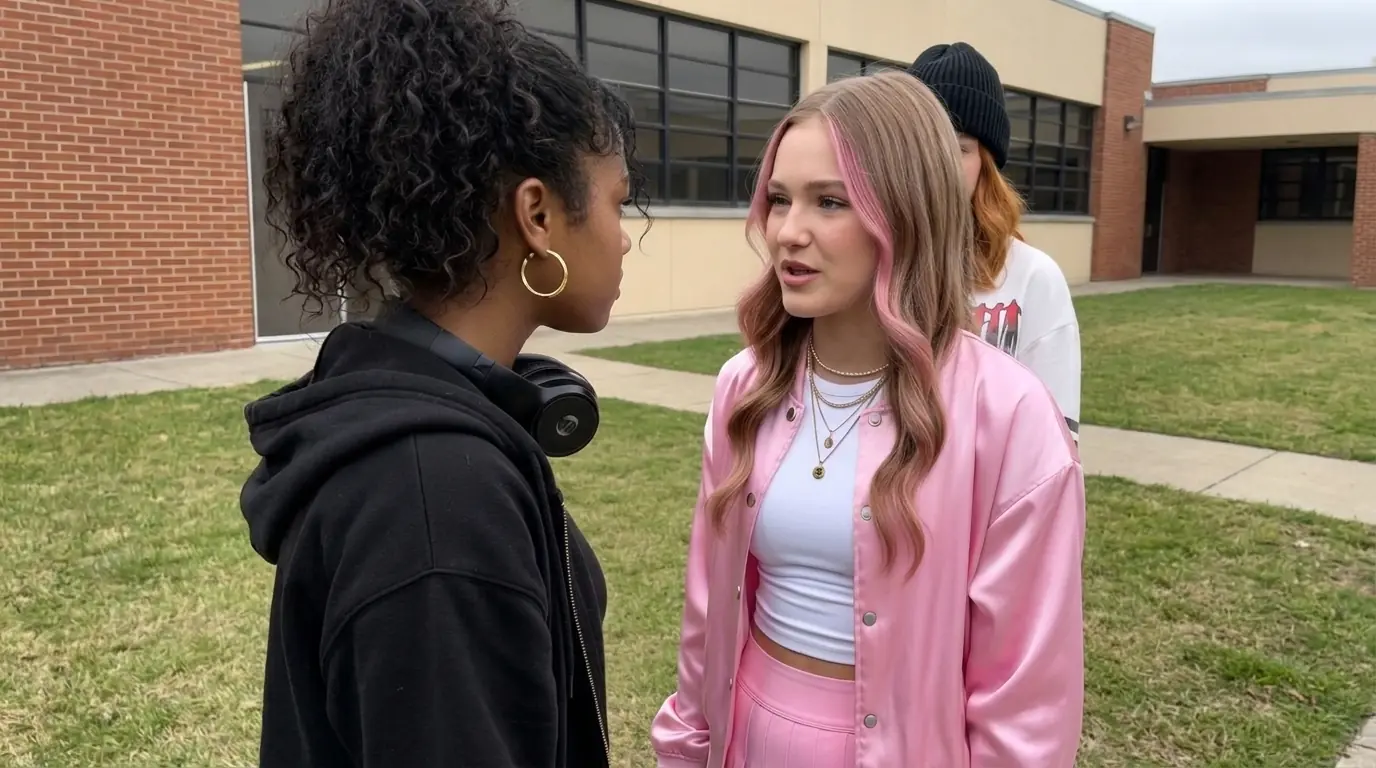
By the time the cold water hit Tiana Grant across the back of her neck, she had already been sweeping the same stretch of sidewalk for almost forty minutes. She was wearing black cargo pants, a black cropped tank beneath an oversized hoodie, and a pair of headphones resting around her neck while dozens of Rosewood High seniors cleaned the courtyard around her. Tiana gasped and tightened both hands around the wooden broom handle as water ran down her hair, across her shoulders, and into the waistband of her pants. Behind her, somebody laughed.
Tiana did not turn immediately. She looked at the puddle spreading around her sneakers, then at the broom bristles floating in dirty water, and finally toward the other students who had suddenly become very interested in what was happening. When another hard stream struck her shoulder, she knew the first one had not been an accident. Tiana slowly turned around.
Brielle Carson was standing twenty feet away with a garden hose nozzle pointed directly at her. She wore a pale pink satin jacket, matching pleated skirt, white cropped tank, and tall pink boots that looked ridiculous for a school cleanup day. Beside her stood Cassidy Doyle, a red-haired senior in a black beanie, ripped jeans, and an oversized white T-shirt, already laughing hard enough to bend at the waist. Brielle smiled and squeezed the nozzle again.
That thirty-second confrontation would eventually become the story everyone remembered. Videos would show Tiana soaked in black clothes, Brielle dressed in pink holding the hose, Cassidy rushing into the fight first, and both girls discovering that the person they had been humiliating was no longer willing to stand there and absorb it. But none of the cameras caught what had happened five months earlier. None showed the night the trouble actually began.
Rosewood High sat in a middle-class Maryland suburb about forty minutes outside Washington, D.C., surrounded by brick neighborhoods, small shopping centers, and enough trees to turn the campus orange every October. The school was known for strong academics, an excellent marching band, and a senior class that treated tradition like constitutional law. There were homecoming rituals, painted parking spaces, a spring picnic, senior skip day, and one unofficial event administrators pretended not to know about until something went wrong. That event was the senior prank.
Most years, the prank was harmless. One class filled a hallway with balloons, another covered the principal’s office in removable sticky notes, and the graduating class before Tiana’s had placed hundreds of plastic flamingos across the football field overnight. Teachers complained for an hour, students took photographs, maintenance cleaned up, and everybody moved on. It existed inside an unwritten agreement: be funny, not destructive, and give adults enough plausible ignorance to laugh later.
Brielle Carson intended to make Rosewood’s class of 2026 legendary. Her family had money, her mother chaired the parent fundraising committee, and Brielle had spent senior year behaving as though graduation were a production with her name in the credits. She served on student council, helped organize school dances, and had enough social influence that students often treated her suggestions like decisions already made. Her closest friend Cassidy followed with the loyalty of someone who enjoyed Brielle’s confidence almost as much as Brielle did.
Tiana lived in a different version of Rosewood. Her mother, Danielle Grant, worked as a payroll administrator for a construction company, and her father, Marcus, repaired municipal buses for the county. Tiana worked two evenings a week at a sporting-goods store, ran track during spring season, and spent most weekends with a small group of friends who had stopped caring about popularity sometime around sophomore year. She had no problem with Brielle because she had almost no reason to think about her.
That changed in November, when Tiana stayed late at school to finish a calculus project. Her ride had been delayed, so she left the library shortly before eight and cut through the outdoor courtyard toward the student parking lot. The campus should have been empty except for the custodian crew and a few coaches finishing practices. Instead, Tiana saw flashlight beams moving around the courtyard fountain.
At first she assumed maintenance workers were fixing something. Then she recognized Cassidy’s red hair beneath a black beanie and heard Brielle whisper, “Hurry up before somebody comes out.” Three other seniors were there too, carrying plastic containers, rolls of tape, and several bags filled with powdered color. Tiana stopped behind the covered walkway.
Rosewood’s courtyard fountain was not particularly beautiful, but it sat beside a small memorial garden planted in honor of three former students who had died in a car accident nearly fifteen years earlier. The prank plan, Tiana later learned, was supposed to be simple: turn the fountain bright pink overnight and cover the courtyard statues in washable fabric streamers. Brielle had found a dye online that she believed would disappear after a few rinses. Nobody had tested it on Rosewood’s pale stone.
Tiana watched Cassidy pour the first container into the water. Within seconds, neon pink color spread across the fountain basin, and everyone laughed. Then Brielle added another container because the first color apparently was not bright enough. Pink water overflowed onto the surrounding stone.
“Guys,” one of the boys whispered, “that looks like it’s staining.” Brielle told him to relax and reached for another bag. Cassidy was filming everything on her phone while another student wrapped pink streamers around a bronze plaque near the memorial garden. Tiana should probably have walked away.
Then one of them backed into an irrigation valve. A plastic pipe snapped beneath the shrubs, and water began spraying into the flowerbeds. Someone jumped backward, knocking over a bucket of dye concentrate that ran directly across the memorial walkway.
Everyone stopped laughing.
“Turn it off,” Brielle hissed. Nobody knew where the shutoff was, and within a minute muddy pink water was spreading through the garden. Cassidy said they should leave before security arrived. One boy argued they needed to tell somebody.
Brielle insisted maintenance would fix it in the morning. “If we stay, they’ll make this into a whole thing,” she said, already gathering empty containers. Cassidy agreed, and the group started moving toward the parking lot. That was when Brielle saw Tiana.
For several seconds, nobody spoke. Tiana stood beneath the walkway lights holding her backpack while five seniors stared at her. Brielle’s expression changed first from surprise to calculation. “How long have you been standing there?” she asked.
“Long enough.”
Cassidy laughed nervously. “It’s a senior prank.” Tiana looked toward the broken irrigation line and the pink water running over the memorial stones. “Looks more like property damage.”
Brielle stepped closer. “We’re fixing it tomorrow.” Tiana shook her head and pointed toward the spraying pipe. “Somebody needs to shut that off tonight.”
“Then call maintenance,” Brielle said.
Tiana stared at her. “You call them.”
That answer irritated Brielle immediately. She explained that if they called now, the school would know who did it and senior events could be affected. Tiana replied that water was currently pouring through a memorial garden and somebody had to know before the damage got worse.
Brielle lowered her voice. “You don’t have to be involved.” Tiana almost laughed. “I wasn’t until you broke a pipe and ran.”
“We’re not running.”
“You have bags in your hands.”
Cassidy stepped between them. “Why are you making this your problem?” Tiana looked past her at the flooded flowerbed. “Because tomorrow some maintenance worker is going to arrive and get blamed for not catching it sooner.”
That sentence mattered more than Brielle understood. Tiana’s father had spent twenty-six years working jobs where people noticed him only when something stopped working. She had grown up hearing stories about mechanics blamed for buses they had warned supervisors about, custodians blamed for messes created after their shifts, and laborers expected to quietly repair other people’s carelessness. The idea that the prank group could leave the damage for somebody invisible to fix bothered her more than the prank itself.
Tiana pulled out her phone. Brielle stepped forward. “What are you doing?”
“Calling the front office.”
Brielle stared at her. “Seriously?”
“Yes.”
“You are unbelievable.”
Tiana shrugged. “Probably.”
The night security officer arrived six minutes later. Maintenance shut the water off before nine, but the damage had already spread farther than anyone realized. The dye soaked into porous stone around the fountain, stained part of the memorial path, and killed several winter plants after the concentrated pigment entered the irrigation bed. The estimated restoration cost came to almost nine thousand dollars.
Security cameras identified two cars. Brielle’s group might have been discovered without Tiana. That did not matter to them.
By Monday morning, everybody knew Tiana had been there.
Rosewood administrators interviewed each student separately. Tiana answered what she had seen, no more and no less. She did not embellish anything, did not claim the prank had been malicious, and even told Assistant Principal Robert Keene that she believed the students expected the dye to wash away.
That fairness did not protect her from resentment.
Brielle lost her student-council position for the remainder of the semester. Cassidy was removed from the spring spirit committee, and everyone directly involved received forty hours of campus restitution work spread across winter and spring. Their families also agreed to share part of the restoration cost.
The principal decided not to cancel senior activities for the entire class. Instead, Rosewood replaced the informal prank tradition with an official Senior Campus Service Day in April. Every senior would spend one Saturday helping restore landscaping, clean outdoor spaces, repaint benches, and prepare the campus for graduation.
Brielle considered the whole thing humiliating.
Her mother appealed the punishment. She argued that Brielle had made a mistake, had not intended permanent damage, and was already helping pay for repairs. The school upheld the decision.
That was when Tiana became the easiest person to blame.
Brielle found her near the gym after school in early December. Tiana had headphones on and almost walked past before Brielle stepped directly into her path. Cassidy stood several feet behind her.
“Forty hours,” Brielle said.
Tiana removed one headphone. “What?”
“I have forty hours because of you.”
Tiana stared at her. “You poured dye into a fountain.”
“It was washable.”
“Apparently not.”
“You called security.”
“After you broke a pipe.”
Brielle’s face tightened. “You could’ve given us one night.”
“For what?”
“To fix it.”
“With what, a toothbrush?”
Cassidy laughed before she could stop herself.
Brielle turned toward her. Cassidy immediately looked away. Tiana noticed and realized something about their friendship she had never seen before.
People around Brielle laughed when Brielle wanted laughter. Not usually when Brielle herself was the joke.
Tiana started walking.
Brielle called after her, “Everybody knows what you did.”
Tiana stopped and looked back. “I told the truth when they asked me.”
“That isn’t what people are saying.”
“Then people can practice.”
She left.
The first month of retaliation was mostly words. “Security” became Brielle’s nickname for Tiana. Cassidy made fake radio noises whenever Tiana walked past. Someone taped a photocopied parking citation to Tiana’s locker with REPORT THIS written across it.
Tiana ignored all of it.
Her best friend, Layla Morgan, did not. “You know ignoring them is making them worse, right?”
“It’ll get boring.”
“It has been three weeks.”
“They’re slow learners.”
Layla shook her head. “Report it.”
Tiana refused.
She did not want every stupid joke turned into an administrative investigation. She also understood that Brielle desperately wanted evidence Tiana was offended. Giving her that satisfaction felt unnecessary.
Then the jokes started affecting Tiana’s routine.
Brielle’s friends began sitting near her usual cafeteria table. Cassidy repeatedly appeared near the track locker room even though she did not run track. Tiana started leaving through the east hallway after practice because she knew Brielle usually parked near the west entrance.
She never called it fear.
She called it convenience.
Her mother noticed anyway.
“You don’t use the front doors anymore.”
Tiana looked up from dinner. “What?”
“You used to come out by the office when I picked you up.”
“East is faster.”
Danielle watched her. “Since when?”
Tiana shrugged.
Mothers had an irritating way of hearing things people did not say.
“What’s going on?”
“Nothing.”
Danielle waited.
Tiana hated silence when her mother used it.
Finally she explained.
Not every detail. Enough.
Danielle put down her fork.
“So these girls have been bothering you for almost two months because you told the school what you saw?”
“Mostly Brielle.”
“And you changed where you leave the building.”
“It’s easier.”
“No.”
Danielle leaned back.
“It’s easier for them.”
Tiana understood the point. She did not immediately act on it.
Then Cassidy crossed a line.
During an indoor track workout in January, Tiana left her black hoodie and headphones on a bench near the gym. When she returned, the headphones were gone. She found them twenty minutes later inside a bathroom trash can with one ear cushion soaked through.
Those headphones had been a birthday gift from her father.
Tiana reported it.
Security cameras showed Cassidy entering the bathroom carrying something black beneath her arm. The image was not clear enough to prove she had the headphones, but administrators called her in because of the existing conflict.
Cassidy denied everything.
Brielle called Tiana pathetic.
Tiana finally lost patience.
“You want me to stop reporting things?”
Brielle smiled. “That would be a start.”
“Then stop giving me things to report.”
Several students heard.
The hallway became quiet.
Brielle stepped closer. “You really think you’re untouchable.”
“No.”
“You walk around like nobody can say anything to you.”
“People say things to me constantly.”
“You know what I mean.”
Tiana looked at her. “I honestly don’t.”
That response became another insult in Brielle’s mind.
Administrators issued a formal no-contact instruction. Brielle and Cassidy were told not to approach Tiana unless necessary for class. Tiana received the same instruction even though she had not initiated any confrontation.
For almost six weeks, it worked.
Winter became spring.
Track season began.
College decisions arrived.
Tiana was accepted to Towson University, where she planned to study kinesiology. Her father printed the acceptance email and taped it to the refrigerator even though everyone in the house could access the same email electronically.
Life started feeling normal again.
Then Rosewood announced the schedule for Senior Campus Service Day.
Every graduating student had to participate unless excused for work, illness, or an approved school event. Seniors would be split among landscaping, pressure washing, courtyard cleanup, painting, and sports-field maintenance. The idea was partly restorative and partly symbolic: the class that damaged part of the campus would leave it better than they found it.
Tiana volunteered for courtyard cleanup.
Not because of Brielle.
Because she liked being outdoors and did not want to paint.
Brielle and Cassidy were assigned to the same section.
When Layla saw the list, she almost laughed. “Absolutely not.”
“It’s a hundred people.”
“Two of those hundred have made hating you a hobby.”
“There’ll be teachers everywhere.”
“Tiana.”
“I’ll be fine.”
Layla frowned. “That phrase needs to be banned.”
The night before service day, Brielle and Cassidy were texting.
Those messages became evidence later.
Cassidy complained about waking up early. Brielle complained that everyone would be cleaning because Tiana “had to play hero in November.”
Cassidy wrote, Just ignore her tomorrow.
Brielle answered, I’m done ignoring her.
Cassidy asked what that meant.
Brielle sent a laughing emoji.
Then:
She wants everyone to think she’s so calm. I just want to see how calm she really is.
Saturday morning arrived warm and overcast.
Rosewood’s courtyard filled with seniors carrying brooms, hoses, trash bags, rakes, and buckets. Music played from portable speakers. Teachers moved between groups with clipboards while students complained theatrically about being forced into unpaid labor.
Tiana wore black.
Black cargo pants.
Black crop top.
Black oversized hoodie.
Black sneakers.
Her headphones rested around her neck because she was not supposed to wear them while staff gave instructions.
Brielle arrived dressed as if she had misunderstood the assignment entirely.
Pink skirt.
Pink satin jacket.
Pink boots.
White crop top.