The first car appeared just after sunrise. Then another, and another. By the time the dust settled on the narrow dirt road, fifty-three black luxury cars stretched like a silent parade outside the smallest house in the entire county. No one in the forgotten town had ever seen anything like it.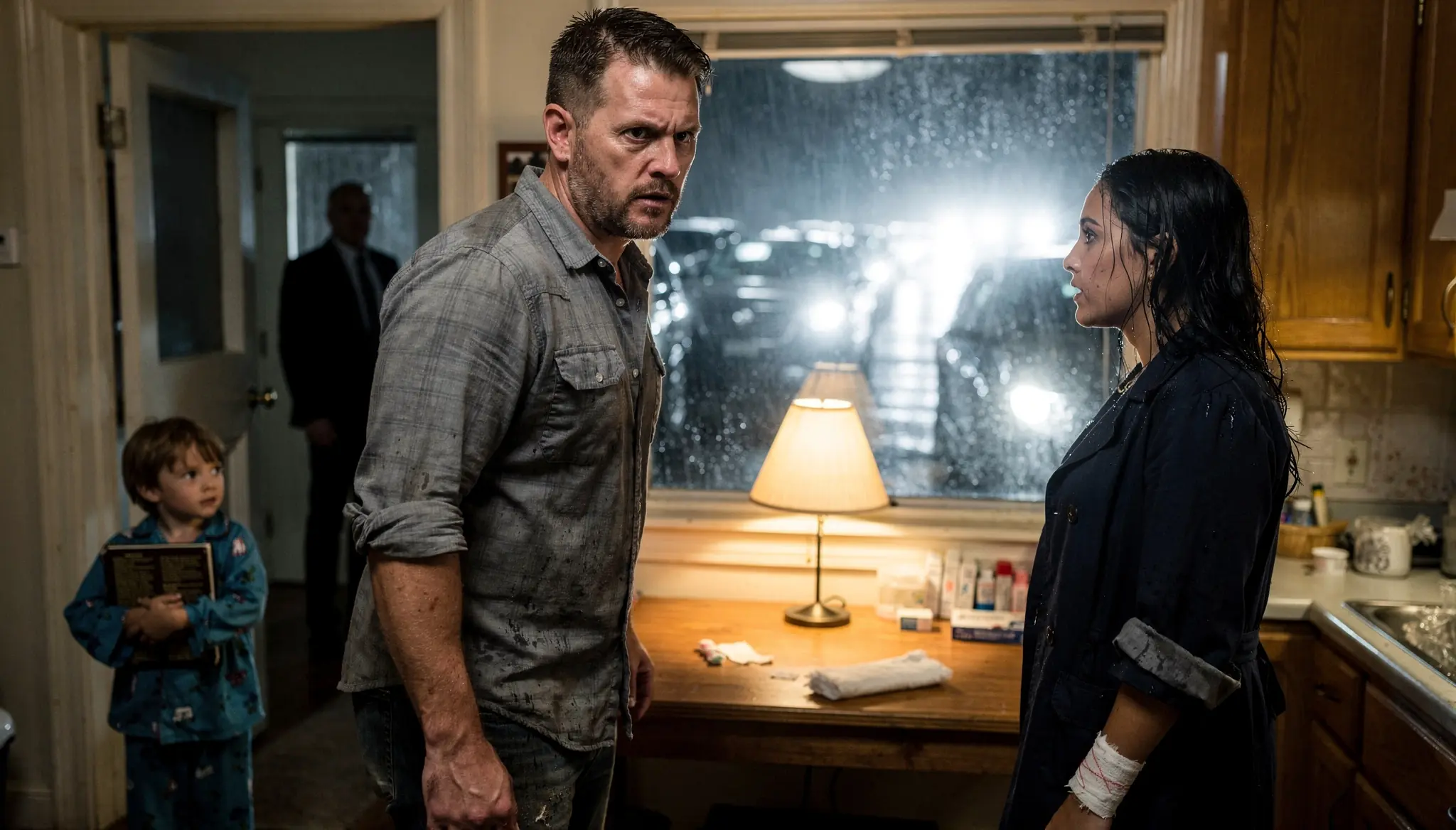
Inside the house, however, the man they had come for was simply frying eggs. He had no idea that the life he had buried six years earlier had just arrived at his front door.
The alarm clock beside Daniel Carter's bed had not worked in over a year. It did not need to. Every morning, at exactly 4:45 a.m., Daniel woke the same way: quietly and instantly, as if someone had flipped a switch inside his chest.
His eyes opened to the same cracked ceiling above him, the same thin beam of pale dawn light slipping through the worn curtain, and the same stillness wrapped around the small house like a blanket. Daniel lay there for three steady breaths. Then he got up.
The old wooden floor creaked beneath his feet as he walked down the narrow hallway toward the kitchen. The house was small, with two bedrooms, a bathroom whose faucet refused to stop dripping, and a crooked kitchen counter that leaned slightly to the left. But everything was spotless.
Every plate was washed. Every chair was pushed neatly into place. Every surface was wiped clean. It was not the order that came from money; it was the order that came from a man who needed control over the few things left in his life.
Daniel cracked two eggs into a frying pan. They sizzled softly in the quiet kitchen. He cut a slice of bread, placed it carefully into the old toaster, and poured a glass of milk, measuring it the same way he always did.
Steady hands. Careful angle. Precise movement. His hands moved like a surgeon's, but Daniel never commented on that, and he never talked about where he had learned to move that way.
Down the hallway, a small pair of feet shuffled across the floor. Seven-year-old Noah appeared in the doorway. His pajamas were two sizes too large, the sleeves covering half his hands, and he carried a heavy book that looked far too advanced for a child his age.
His hair stuck out in every direction, and his eyes were barely open. But his mouth was already moving.
"Dad, did you know the human heart beats more than one hundred thousand times a day?"
Daniel slid the eggs onto a plate and placed it in front of him. "That so?"
Noah dropped into the chair and opened the book with excitement. It was a thick medical textbook filled with diagrams of veins, bones, and organs. No child should have been reading it, but Noah had discovered it six months earlier on the top shelf of the hallway closet, hidden behind old blankets.
Daniel had told him it was only an old book. Noah had been fascinated ever since.
"And the aorta," Noah continued, holding his hands apart dramatically, "is the biggest artery in the body. It's like this big."
Daniel nodded toward the plate. "Eat your eggs."
"I'm just saying it's cool."
Daniel watched his son shovel eggs into his mouth while flipping through pages of anatomy diagrams. Something tightened in Daniel's chest. It was not pain, but something older, something he had trained himself not to look at directly, the way a person trains himself not to stare at the sun.
So he looked away.
By 6:15 a.m., they were out the door. The road in front of their house was not paved. It was hard-packed dirt that turned into mud when it rained and dust when it did not.
The houses nearby were spaced far apart, most of them worn and quiet, with rusted fences and pickup trucks parked on dead grass. It was the kind of town where nothing changed and nobody asked questions.
"You know a lot," Daniel said.
"I read a lot," Noah corrected proudly.
At the bus stop, Daniel knelt and straightened his son's collar. It was a small habit, one his late wife, Mara, used to have. Daniel did not let himself think about that, either.
"You be good today," he said.
"I'm always good."
"Then keep it up."
The school bus pulled up with a squeal of brakes. Noah climbed aboard, turned once, and waved. Then the door closed, and the bus rolled down the road until it disappeared around the corner.
Daniel stood there a moment longer. Then he walked to work.
The sawmill sat on the edge of town, a long metal building with open sides and the constant scream of spinning blades cutting through timber. Daniel had worked there for five years. His job was simple: feed rough wooden boards into the planer machine, push them through, and pull them out smooth.
Again and again and again.
The work was loud, physical, and mindless. Daniel liked it that way.
The other workers respected him, though not because he was friendly. He was not. Daniel rarely spoke more than a few words, never joined the men for drinks after work, never talked about where he came from, and never mentioned what he had done before arriving in town six years earlier.
But he showed up every day, and he never complained.
One afternoon, a worker named Frank sliced his palm open on a jagged board. Blood poured everywhere. While the others panicked, Daniel moved calmly.
He cleaned the wound, wrapped it tightly, and stopped the bleeding. By the time the paramedics arrived twenty minutes later, the bandage looked as though it had been applied by a professional.
One of the paramedics stared at it. "Who wrapped this?"
Frank pointed at Daniel.
The paramedic shook his head slowly. "Cleanest field dressing I've ever seen."
No one asked Daniel how he knew how to do it, and Daniel did not explain. That was how things worked in the town. People did not ask, and people did not tell.
That night, a storm rolled in without warning. By 9:00 p.m., thunder shook the windows. Rain hammered the tin roof so hard that it sounded like applause, and the wind bent the tall trees sideways.
The power flickered twice. Then everything went dark.
Daniel lit a kerosene lamp on the kitchen counter. He checked on Noah, who slept peacefully through the storm with the heavy medical book open on his chest. Children had a way of sleeping without fear.
Daniel closed the book and pulled the blanket over him.
At 10:30 p.m., someone knocked on the door.
Daniel froze. Nobody came down that road at night. Most people did not come down that road at all.
The knock came again, louder this time.
Daniel opened the door. A woman stood in the rain. She was soaked, with dark hair stuck to her face, a coat torn at the shoulder, and one shoe missing.
Behind her, a car sat half-crashed in the ditch, its hazard lights blinking weakly through the storm. She looked up at him with exhausted eyes.
"Please," she whispered.
Daniel stepped aside.
He handed her a towel and then a blanket. He placed a cup of hot tea on the table and sat across from her in silence. For several minutes, she only stared at him.
Then she said something that made Daniel's blood run cold.
A name.
Not Daniel Carter. The name he had buried six years earlier. The name that, by morning, would bring fifty-three black cars to his door.
Her lips trembled as she whispered, "Dr. Adrian Hale."
The room went completely silent. The storm roared against the house, rain striking the roof like thousands of tiny hammers. Lightning flashed through the window, briefly filling the kitchen with cold white light.
Daniel did not move. For a moment, he simply stared at the woman across the table. Then he slowly leaned back in his chair.
"You're mistaken," he said calmly.
The woman shook her head immediately. "No, I'm not."
Her voice was weak, but her eyes were certain. "I would recognize you anywhere."
Daniel's jaw tightened. "I think you should leave."
She let out a short, exhausted laugh. "Leave? My car is half in a ditch, I'm bleeding, and the nearest town is twenty miles away."
Daniel did not respond. Instead, he stood and walked to the kitchen sink. He rinsed the cup she had used, dried it carefully, and placed it back on the rack.
Every movement was controlled and measured, almost mechanical.
Behind him, the woman spoke again. "You disappeared six years ago."
Daniel turned. His face was still calm, but something had changed in his eyes. "I don't know who you think I am."
The woman slowly pushed back the sleeve of her coat. Blood had soaked through the fabric. A deep cut ran across her forearm.
Daniel looked at it for only a second, but that second was enough. His eyes instantly measured the depth, the angle, and the blood flow. Without thinking, he stepped forward.
"Sit still."
The woman watched carefully as he opened a drawer and pulled out a small metal box. Inside were bandages, antiseptic, and medical tape. His hands moved quickly and confidently, exactly like the hands of someone who had done this thousands of times.
He cleaned the wound with steady precision, wrapped the bandage tightly, and secured it perfectly. Not a single movement was wasted.
When he finished, he realized the woman was smiling.
"You see?" she said softly.
Daniel froze.
"That isn't something a sawmill worker learns."
He did not answer. Instead, he stood and walked to the window. Outside, the storm had grown worse. Wind howled through the trees, and lightning split the sky again.
"You should rest," he said finally. "There's a couch in the living room."
The woman did not move. "Your name is Adrian Hale."
Daniel closed his eyes for one second. Then he turned back to her.
"You're wrong."
She leaned forward. "World-famous cardiac surgeon."
He gave no reaction.
"The man who performed the first successful triple-organ emergency transplant. The youngest surgical director in the country. The doctor who could operate for twenty hours without stopping."
Daniel's fingers slowly curled into a fist.
The woman watched him. "And the man who disappeared the night his wife died."
The words landed like a stone dropped into deep water.
For the first time, Daniel's calm expression cracked, only slightly, but enough. The woman saw it.
"I knew it," she whispered.
Daniel walked back to the table slowly. His voice was quiet now, dangerously quiet.
"How do you know that name?"
The woman studied him. "My name is Elena Vargas."
Daniel's face remained blank, but something shifted inside his mind. He had heard that name years earlier in hospital corridors, emergency rooms, and research conferences.
"I was a surgical resident at St. Matthew's Hospital," Elena continued. "I assisted you twice."
Silence filled the room.
Then she said the sentence Daniel had spent six years trying to escape.
"You saved my patient."
The memories returned instantly: bright operating lights, cold surgical steel, monitors beeping in frantic rhythm, and blood. So much blood.
"You were the best surgeon in the world," Elena said quietly.
Daniel shook his head. "No."
"You were."
"No." His voice rose slightly. "I was only a man who worked too much."
She studied his face. "Then why did you disappear?"
Daniel did not answer. Instead, he looked down the hallway toward Noah's room. The door was slightly open, and a faint beam of lamplight spilled across the floor.
His son was still asleep.
Daniel turned back. "You should sleep."
Elena leaned forward. "Your wife died while you were in surgery. You were operating on someone else, and you left the hospital too late."
Daniel's eyes darkened. "You don't know what you're talking about."
"I do," Elena said, her voice softening. "The entire medical world looked for you. News channels, police, hospitals. No one could find Adrian Hale."
She gestured around the small house. "And now I know why."
Daniel said nothing. Outside, the storm slowly began to weaken. Rain softened, and the thunder faded into the distance.
For several minutes, neither of them spoke.
Finally, Elena broke the silence. "You saved thousands of lives."
Daniel stared at the floor. "And I couldn't save one."
The room fell quiet again.
Then a small voice came from the hallway.
"Dad?"
Daniel turned instantly. Noah stood in the doorway, rubbing his eyes.
"Who is she?"
Daniel walked over and gently placed a hand on his son's shoulder. "She had an accident on the road. She's staying here tonight."
Noah nodded sleepily. Then he noticed the bandage on Elena's arm.
"You wrapped that really well," he said.
Daniel froze.
Noah looked proud. "I read about that in my anatomy book. Doctors do it like that."
Elena and Daniel exchanged a look.
Then Noah asked the question neither of them expected.
"Dad, were you a doctor?"
Daniel opened his mouth, but no words came out.
Before he could answer, headlights appeared outside the house. They were bright, far too bright, multiple beams cutting through the darkness. The sound of engines filled the quiet road.
Elena stood slowly. Her face had gone pale.
"Oh, no," she whispered.
Daniel stepped toward the window.
Then he saw them.
Black cars, one after another, stretching down the dirt road like a long, silent convoy. Dozens of them, at least fifty. Every engine stopped at the same moment, and every door opened at the same time.
Men in dark suits stepped out into the night.
Daniel felt the past he had buried rise like a ghost behind him.
Elena looked at him. "They found you."
Then the first man walked to the door and knocked.
The town did not change overnight. The same dusty road still cut through the fields. The same wooden houses leaned slightly with age. The same sawmill whistle echoed every morning before sunrise.
But the people changed, because now everyone knew that the quiet man they had watched for six years was not merely a tired sawmill worker raising his son alone. The name Daniel Carter belonged to a man who had once stood at the center of operating rooms, boardrooms, and headlines.
The truth, however, had never meant less to Daniel than it did now.
The morning after the convoy arrived, Daniel sat at the small kitchen table with Noah. The boy swung his legs beneath the chair while drawing shapes on a piece of scrap paper.
"Dad," Noah said casually, without looking up, "were those people really here for you?"
Daniel took a slow breath. He had spent years running from that question, but now there was nowhere left to hide.
"Yes," he said gently. "They were."
Noah looked up. "Are you famous or something?"
Daniel almost smiled. "I used to be."
The boy considered that for a moment, then shrugged. "Okay."
He returned to his drawing.
That was the strange thing about children. They did not care about titles, wealth, or reputation. To Noah, Daniel was not a celebrated surgeon, a powerful executive, or a mystery.
He was simply Dad, and that mattered more than anything Daniel had ever owned.
Outside, the town buzzed quietly. Neighbors whispered over coffee. Workers at the sawmill talked while stacking lumber.
"Did you hear? Daniel had another name."
"The doctor? The one who built that huge company?"
"I heard he disappeared after the investigation, and he's been living here the whole time."
Rumors spread faster than wildfire. Some called him Adrian Hale. Others spoke of Daniel Carter, the surgeon-entrepreneur whose company had once been worth billions. A few people got the details completely wrong, but everyone agreed on one thing: the quiet man from the smallest house in the county had once lived a life none of them could imagine.
Daniel did not step outside to defend himself. He did not explain, and he did not deny. For six years, he had chosen silence, and he was not ready to break it for strangers.
Later that afternoon, another woman from the convoy returned. Her name was Rebecca Lawson. She had been Daniel's closest business partner before everything collapsed.
Now she stood on his porch, dressed sharply and holding a leather folder beneath one arm. Daniel stepped outside before she could knock.
"I thought you might come back," he said.
Rebecca nodded. "You knew I would."
They faced each other in the quiet afternoon air. Six years earlier, they had spoken in skyscraper offices overlooking entire cities. Now they spoke beside a crooked wooden fence.
Life had strange ways of rearranging people.
Rebecca opened the folder. "The investigation is over."
Daniel did not move.
"They cleared your name."
The words hung in the air like something fragile.
Six years earlier, Daniel Carter had vanished because of a scandal that nearly destroyed everything he had built. His company had been accused of massive financial crimes. Investors turned on him. The media tore him apart.
When the accusations began circling the people he loved most, Daniel walked away. Not because he was guilty, but because staying would have destroyed his son's life before it had truly begun.
He chose disappearance over power and fatherhood over reputation.
Now Rebecca placed the documents on the porch table. "The real criminals confessed. Two executives manipulated the system. They framed you."
Daniel stared at the papers.
Six years of silence. Six years of hiding. Six years of being forgotten. All of it erased with a few signatures.
"You can come back," Rebecca said. "The company wants you. The board wants you. The world wants to hear from you again."
Daniel looked toward the open door, where Noah's laughter echoed from inside.
He imagined the skyscrapers, private jets, boardrooms, and endless meetings. A life that had once seemed like everything.
Then he imagined the mornings in the small house: making breakfast, walking Noah to school, working honest hours at the sawmill, and sleeping without headlines chasing him.
For the first time in a long time, Daniel understood something clearly. The world he had built before was no longer the life he wanted.
"I'm not going back," he said calmly.
Rebecca blinked. "You're serious?"
Daniel nodded. "I spent half my life building something huge. When it collapsed, I thought I had lost everything."
He glanced inside the house again. "But I found something better."
Rebecca followed his gaze. Noah sat on the floor, building a crooked tower from old wooden blocks.
It was a normal moment, a small moment, but somehow larger than every boardroom Daniel had ever entered.
Rebecca sighed softly. "You know, half the world is trying to climb higher every day."
Daniel smiled faintly. "And the other half is trying to remember what really matters."
For a moment, neither of them spoke.
Then Rebecca closed the folder. "Well, the offer stands if you ever change your mind."
Daniel nodded. "Thank you."
She turned and walked back toward the waiting black car. Only one remained now. The others had left hours earlier.
The engine started, and dust rose along the road as the car disappeared beyond the trees.
Just like that, the world moved on.
Evening came quietly. The setting sun stretched across the small porch where Daniel and Noah sat side by side. Noah held a book open on his lap.
"Your turn to read," Daniel said.
The boy squinted at the page. "Okay. The explorer walked into the jungle and..."
He stumbled over the next word. Daniel helped him sound it out patiently and slowly, the way his own father had once taught him long ago.
Wind rustled the tall grass around the house. Crickets began their nighttime music.
Nothing about the town had changed. The road was still dirt. The fence still leaned slightly. The house was still small.
But something inside Daniel had finally settled.
For years, he had been running from his past. He had run from the name Adrian Hale, from the name Daniel Carter, from the surgeon he had been, from the company he had built, and from the grief he could not repair with skill, wealth, or power.
Now he understood something simple.
A name did not define a man. The choices he made did.
And the choice he made now was the one that mattered most.
Not billionaire. Not executive. Not celebrated surgeon. Not fugitive.
Just a father sitting on a porch beside his son as the sun disappeared beyond the trees.
In that quiet moment, for the first time in many years, Daniel Carter was finally at peace.