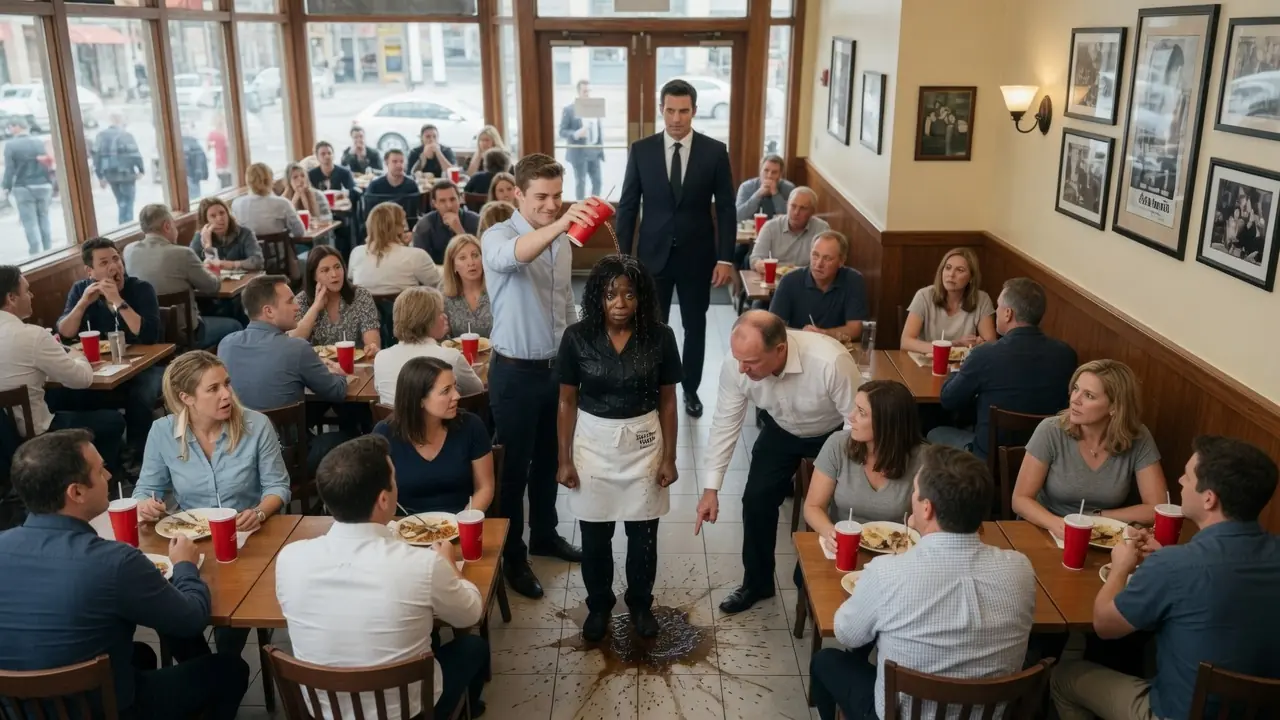
The soda struck her across the face before she even saw the cup leave his hand.
Cold, sticky liquid burst over her cheek, her neck, and the front of her uniform. It ran beneath her collar, soaked into the black apron tied around her waist, and dripped from her chin onto the polished tile floor of Harbor Table Bistro.
For one second, the lunch rush stopped breathing.
Forks hovered over plates. Conversations snapped in half. A waiter near the drink station froze with a pitcher of iced tea in his hand. Somewhere in the kitchen, a bell rang for an order no one came to pick up.
Then someone laughed.
It was not loud.
That made it worse.
A woman at the corner booth covered her mouth, but her eyes were bright with amusement. A man in a navy polo leaned back in his chair and muttered, “Maybe now she’ll remember who she works for.”
The group at table twelve snickered.
The one who had thrown the soda, a young man with too much confidence and too little shame, lifted both hands as if he had done nothing more serious than toss a napkin.
“Relax,” he said. “It was a joke.”
The woman standing in the puddle of soda did not move.
Her name was Naomi Ellis.
She was twenty-nine years old, Black, graceful even when exhausted, with deep brown skin, tired eyes, and a calmness people mistook for permission to disrespect her. She had worked at Harbor Table Bistro for four years. She knew which regulars wanted lemon in their water before they asked. She knew which cooks had peanut allergies. She knew which servers were hiding migraines, heartbreak, or unpaid bills behind forced smiles.
She was the one who covered shifts when someone’s babysitter canceled.
The one who trained new employees without being paid to train them.
The one who apologized when customers grabbed her arm, snapped their fingers, or called her “sweetheart” in a tone that made the word ugly.
But that day, standing with soda dripping from her face, Naomi did not apologize.
She did not scream.
She did not cry.
She only stood still because sometimes dignity is the last thing a person can hold when everything else has been splashed across the floor.
The manager came out from the back office too late.
His name was Paul Renner, and he had mastered the art of looking busy whenever something wrong happened in front of him. He saw the soda on Naomi’s face. He saw the laughing table. He saw the other employees staring.
Then he looked at the floor.
“Naomi,” he snapped, “clean that up before someone slips.”
The words moved through the room like a second drink thrown in her face.
Naomi blinked once.
Her mouth opened, then closed.
The young man at table twelve laughed again.
“Yeah, Naomi. Don’t want anybody slipping.”
His friends laughed with him.
Naomi reached slowly for the towel hanging from her apron.
Her fingers shook.
Not much.
Just enough for the woman at the corner booth to notice and look away.
Nobody stood up.
Nobody told the table to stop.
Nobody asked Naomi if she was okay.
That silence hurt more than the soda.
Because silence has a way of telling the truth about people who smile at you on ordinary days.
What none of them knew was that Naomi Ellis was not alone.
They did not know that the thin gold wedding band on her hand was real.
They did not know that her husband was not a bus driver, a cook, or “someone more her speed,” as one former coworker had once said when she thought Naomi could not hear.
They did not know her husband was Julian Ashford.
Billionaire.
Founder of Ashford Meridian Group.
Owner of hotels, restaurants, logistics companies, and quiet pieces of corporations most people interacted with every day without knowing his name.
They did not know he had purchased the Harbor Table restaurant chain nine months earlier through one of his holding companies.
And they definitely did not know he was walking toward the front door at that exact moment, smiling because he had planned to surprise his wife with lunch.
Julian had not come with security.
He hated that kind of theater.
He wore a charcoal suit, no tie, and the tired expression of a man who had spent the morning in meetings with people who used the word “vision” too often. In his hand was a small paper bag from Naomi’s favorite bakery.
He pushed open the glass door.
The little bell above the entrance rang.
Then he saw his wife.
Naomi stood near the center aisle, soaked in orange soda, holding a towel she had not yet used. The floor beneath her shoes was sticky. Her uniform clung to her chest and sleeves. Her face was still, but her eyes carried the stunned humiliation of someone trying very hard not to break in public.
Julian stopped.
But it felt him.
Some people carry anger loudly.
Julian Ashford carried it like a locked room.
His smile disappeared. His shoulders settled. His eyes moved once around the dining area, slow and precise, gathering facts before anyone had the sense to hide them.
He saw table twelve.
He saw the manager.
He saw the employees who had lowered their eyes.
Then he walked toward Naomi.
Paul rushed forward with a nervous smile, trying to intercept him.
“Sir, welcome to Harbor Table. I apologize for the mess. We’re handling a small situation—”
Julian did not look at him.
“Stop speaking.”
Two words.
Quiet.
Absolute.
Paul froze.
The customers at table twelve stopped laughing.
Naomi saw Julian then.
For a moment, something in her face changed. Relief almost reached her, then shame stopped it halfway. She did not want him to see her like this. She did not want anyone to know who she was married to. She had worked so hard to earn her own ground without his name smoothing the road beneath her feet.
Julian understood that.
He had always understood that.
So when he reached her, he did not announce anything first.
He took a clean linen napkin from an empty table and held it out to her.
“Are you hurt?” he asked.
His voice was low, gentle, for her alone.
Naomi swallowed.
“No.”
His jaw tightened.
“Who did this?”
She did not answer immediately.
That silence was the last mercy she offered the room.
The young man at table twelve shifted in his chair.
“Man, it wasn’t serious,” he said. “We were just playing around.”
Julian turned slowly toward him.
“Stand up.”
The young man blinked.
“What?”
“Stand up.”
Something in Julian’s voice stripped the joke from the air.
The young man stood.
So did the two friends beside him, though no one had asked them to. The woman at the booth looked down at her plate as if she could become invisible through focus alone.
Julian looked at Paul.
“Did you see what happened?”
Paul’s face went pale.
“I came out after—”
“That was not my question.”
Paul swallowed.
“I saw enough.”
“And your first instruction was for my wife to clean the floor.”
The word wife hit the room first.
Then everything else followed.
Forks lowered.
Heads turned.
Someone whispered, “His wife?”
Paul looked like the floor had dropped beneath him.
“Your wife?”
Julian finally looked at him fully.
“Yes.”
A second whisper moved through the restaurant.
Someone recognized him.
Then another.
By the time the realization spread, the entire dining room had changed shape.
Julian Ashford was not merely a rich customer.
He was the owner behind the chain.
The man whose photo had appeared in Forbes.
The man whose investment firm had acquired Harbor Table after its expansion failed.
The man now standing beside the Black woman they had watched being humiliated.
Naomi closed her eyes briefly.
This was exactly what she had never wanted.
But it was too late to put anonymity back together.
Julian faced the young man who had thrown the drink.
“You are banned from every Harbor Table property, every Ashford hotel restaurant, and every hospitality group connected to my companies.”
The young man tried to laugh.
“Come on. Over soda?”
“No,” Julian said. “Over what the soda revealed.”
The young man’s smile died.
Julian turned to his friends.
“You too.”
One of them lifted his hands.
“I didn’t throw it.”
“You laughed.”
The man opened his mouth, then shut it.
Julian looked at Paul.
“You are terminated effective immediately.”
Paul staggered verbally before his body moved.
“Sir, please, there has to be a process—”
“There was a process,” Julian said. “You failed it.”
“I’ve managed this location for six years.”
“And somehow learned nothing about leadership.”
Paul’s face flushed.
Naomi whispered, “Julian.”
He looked at her immediately.
She shook her head slightly, not to protect Paul, but to steady the storm.
Julian took one breath.
Then he addressed the room.
“Every employee who watched this happen and said nothing will leave this building today. Any employee who wants to tell the truth about what they saw may speak now.”
Silence.
Thick.
Ashamed.
Then a young dishwasher stepped out from the kitchen doorway.
His name was Mateo.
His hands were still wet from the sink.
“I saw it,” he said, voice shaking. “They were bothering her before the soda. Calling her slow. Asking if she could read the menu. Paul heard some of it.”
Paul turned on him.
“Mateo, be careful.”
Julian’s eyes moved to Paul.
“No. You be careful.”
Mateo swallowed hard.
“They asked her if she got hired for diversity points. She walked away. Then the guy threw the soda.”
The restaurant went still.
Naomi’s fingers tightened around the napkin.
Julian looked at her.
She did not deny it.
She only looked tired.
That hurt him more than anger would have.
A server named Bethany began crying near the hostess stand.
“I should have said something,” she whispered. “I wanted to, but I was scared.”
Julian turned to her.
“Did you participate?”
“No.”
“Did you laugh?”
“No.”
“Then fear is something we can train out of this place. Cruelty is not.”
He looked around the dining room.
“This location is closing immediately.”
A customer near the window spoke before thinking.
“You can’t just close a restaurant during lunch.”
Julian looked at him.
“I can.”
The customer glanced around, suddenly remembering who had the power to prove it.
Julian took out his phone and made one call.
“Close Harbor Table, Westbrook location, effective now. Staff review begins immediately. Corporate HR and legal on site within the hour. Full incident preservation. Security footage, audio if available, customer receipts, shift records.”
He paused.
“Yes. Now.”
He ended the call.
No one moved.
Then Julian turned back to Naomi.
This time, his voice softened.
“Come with me.”
She looked around the room.
At the tables she had served.
At the floor she had mopped.
At the kitchen where she had eaten quick meals standing up because breaks were never guaranteed.
At the people who now saw her because a powerful man had entered the room.
“I need a minute,” she said.
Julian nodded.
“Take all the minutes you need.”
She walked to the employee restroom, washed her face, and stared at herself in the mirror.
Orange soda had dried along her collar.
Her curls were damp at the ends.
Her eyes were red but still fierce.
For years, she had told herself that staying calm meant surviving. That ignoring insults meant strength. That she could outwork disrespect until people finally saw her.
But the truth was harder.
Some people had seen her all along.
They had simply decided her pain was affordable.
When she came back out, Julian was waiting near the front door. Mateo stood nearby with Bethany, both quiet and anxious. Paul had disappeared into the office. The customers from table twelve were being escorted out by security.
Naomi walked toward Julian.
Before they left, she stopped beside Mateo.
“Thank you,” she said.
He looked down.
“I should’ve said it sooner.”
“Yes,” she said softly. “You should have.”
He nodded, ashamed.
“But you said it.”
He looked up.
That mattered.
Julian placed his hand lightly at Naomi’s back, not pushing, only offering balance. Together they walked out of Harbor Table Bistro into the afternoon sun.
The city looked exactly the same.
That almost offended her.
After humiliation, the world should look different. The sky should crack. Cars should stop. Strangers should know something cruel happened and lower their voices.
But traffic moved.
People crossed sidewalks.
A delivery truck honked at a cyclist.
Life continued with no respect for the fact that Naomi’s hands were still shaking.
In the car, Julian did not ask questions right away.
His driver pulled from the curb.
Naomi sat beside him, staring at her stained sleeves.
The bakery bag rested unopened between them.
After several minutes, Julian said, “How long?”
She closed her eyes.
“Julian.”
“How long have they been treating you like that?”
She leaned her head back against the seat.
“Not like that.”
“How long?”
Her voice was quiet.
“Months.”
His hand curled into a fist against his knee.
“Why didn’t you tell me?”
“Because I knew what you would do.”
He looked at her.
“And what did I do?”
“You walked in and became the consequence.”
His expression softened with pain.
“Naomi, you should not have had to endure that to protect my name from being useful.”
She looked at him then.
“It wasn’t about your name. It was about mine.”
He waited.
She swallowed.
“I have spent my whole life in rooms where people assume I only got there because someone opened a door for me. I did not want to be your wife at that restaurant. I wanted to be Naomi. I wanted my work to matter because it was mine.”
“It did matter.”
“Not to them.”
“To me.”
Her eyes filled then.
She hated that.
Julian took her hand gently.
“To me, before the ring. Before the money. Before anyone knew. Your work mattered. You mattered.”
She looked out the window because if she looked at him too long, she would cry.
They went home.
Not to a mansion on a hill, though Julian owned one of those too.
Their main home was a warm brownstone in Brooklyn that Naomi had chosen because it had creaky stairs, a small garden, and neighbors who borrowed sugar without caring who Julian was. It smelled of cedar, coffee, and the vanilla candles she bought from a street vendor every winter.
Julian made her tea.
He brought towels.
He found one of his old sweatshirts and left it on the bathroom counter.
He did not hover while she showered.
When Naomi came out, clean but exhausted, he was in the living room with his sleeves rolled up, speaking to someone on the phone in a voice so controlled it frightened even her a little.
“No statements blaming a single employee culture failure,” he said. “This was a leadership failure. Use those words.”
He listened.
“No. Do not mention my wife by name.”
Another pause.
“Because she is not a headline. She is a person.”
Naomi stood in the doorway.
Julian saw her and ended the call.
“You’re already working on it,” she said.
“Yes.”
She sat on the couch.
He sat across from her, close but not crowding.
“What happens now?”
“Corporate review. Temporary closure. Terminations where appropriate. Customer bans. Legal options if you want them.”
“I don’t know what I want.”
“That’s allowed.”
She looked at him.
“I don’t want revenge.”
“I know.”
“I don’t want to be pitied.”
“I know that too.”
Her fingers twisted in the sleeve of his sweatshirt.
“I want that place to become something that would have protected me even if you never walked in.”
Julian grew very still.
Then he nodded.
“That is the right answer.”
She gave a weak laugh.
“There’s a right answer?”
“No. But there is a true one.”
The next morning, Naomi woke before sunrise.
For a few seconds, she forgot.
Then remembered everything at once.
The soda.
The laughter.
Paul’s voice.
Clean this up.
Julian’s arrival.
Wife.
The word had saved her from the room, but it also exposed her to it. She wondered how many people were already talking. How many former coworkers had searched her online. How many strangers were calling her lucky, dramatic, ungrateful, powerful, victim, queen, fraud.
She walked into the kitchen.
Julian was already there, reading from a tablet, coffee untouched beside him.
He looked up.
“Couldn’t sleep?”
“No.”
He pushed the coffee toward her.
She took it.
For a while, neither spoke.
Then Naomi said, “I want to go back.”
Julian’s eyes lifted.
“To the restaurant?”
“Yes.”
“Today?”
“Yes.”
He studied her face.
“You don’t have to prove anything.”
“I’m not proving. I’m deciding.”
That was different.
He understood.
An hour later, they drove to the closed Harbor Table location.
The sign on the door read: Temporarily Closed for Staff Training and Operational Review.
Naomi stood outside for a moment before entering.
Julian waited.
She appreciated that.
Inside, the restaurant was empty, chairs stacked, sunlight coming through the windows in pale stripes. The tile floor had been cleaned. No trace of soda remained.
That bothered her.
Evidence gone.
Memory not.
She walked to the exact place where she had been standing when the cup hit her.
Her body remembered.
Her shoulders tightened.
Her breath shortened.
Julian stood several feet away.
“What are you thinking?” he asked.
Naomi looked around.
“I’m thinking this place was never broken because one person threw soda.”
“No.”
“It was broken because everyone knew what could happen here and acted like surviving it was part of the job.”
Julian nodded.
She walked toward the counter where servers picked up orders.
“I want to rebuild it.”
He did not look surprised.
“How?”
She took a slow breath.
“Not as another polished restaurant with better PR. I mean really rebuild it. Staff training. Better pay. Clear harassment reporting. Managers who are evaluated by how their teams feel, not just revenue. A fund for employees in emergencies. A policy that customer abuse ends service immediately.”
Julian’s mouth curved slightly.
“You’ve been thinking.”
“I’ve been surviving. It turns out survival collects notes.”
He almost smiled.
Naomi turned to him.
“I don’t want to run it because I’m your wife.”
“Then don’t.”
“What does that mean?”
“It means apply.”
She stared at him.
He continued.
“Build a proposal. Interview with the hospitality board. Let them question you. Let them review your qualifications. You know operations. You know front-of-house. You know where the culture failed. And you know what kind of workplace this should become.”
Naomi folded her arms.
“And if they think I only got the chance because of you?”
“Some will.”
“That’s not comforting.”
“It’s honest.”
She looked away.
Julian stepped closer, still leaving space.
“You cannot control every weak opinion. You can only outwork the ones that matter and outgrow the ones that don’t.”
Naomi looked at the dining room again.
A strange feeling moved through her.
Not confidence exactly.
Something before confidence.
Permission.
Two days later, Naomi stood before six executives in a conference room at Ashford Meridian Hospitality.
She wore a navy suit, her hair pulled back, her hands steady despite the nerves crawling beneath her skin. Julian was not in the room. She had insisted on that. If this was going to mean anything, she needed to speak without his shadow covering the table.
Her proposal was thirty-two pages.
She had written most of it at the kitchen island between cups of tea and moments of anger.
She called it The Dignity Standard.
It included anti-harassment protocols, manager accountability metrics, anonymous reporting channels, de-escalation training, wage transparency, emergency staff support, customer conduct policies, and a leadership pipeline for employees who had been overlooked.
One executive asked, “Ms. Ellis, why should we trust someone without formal management experience to rebuild a struggling location?”
Naomi had expected that question.
She looked at him calmly.
“Because I know exactly how a struggling location hides its failures.”
The room went silent.
She continued.
“I know what employees stop reporting when managers punish honesty. I know what customers are allowed to get away with when revenue matters more than human dignity. I know what happens when good workers leave quietly and bad leaders stay because the numbers look fine.”
The executive leaned back.
Naomi did not.
“You can hire someone with ten years of management experience to reopen Harbor Table exactly as it was. Or you can let someone who survived its failures help build a model worth repeating.”
That was the moment the room changed.
Not completely.
But enough.
The board approved a six-month transformation contract.
Not ownership.
Not a gift.
A contract.
Naomi accepted it with a calm face and went to the restroom afterward to cry for four minutes.
Then she washed her hands and went back to work.
The reopening did not happen quickly.
Naomi refused quick.
She reviewed every complaint from the past two years. She interviewed former employees. She brought back some and refused others. She sat with kitchen staff, dishwashers, hosts, bussers, line cooks, and servers, asking what had been ignored.
The answers were ugly.
Paul had dismissed harassment complaints.
Certain customers were known problems but protected because they spent money.
Black and Latino employees were given worse sections.
Women were told to smile through comments that should have gotten customers removed.
Breaks were uneven.
Promotions were informal.
Punishment was personal.
Naomi wrote everything down.
The first time she led a staff meeting, her voice shook for the first thirty seconds.
Then it steadied.
“This restaurant will not ask employees to trade dignity for a paycheck,” she told them. “If a customer abuses you, we address it. If a manager ignores you, we address it. If you see harm and stay silent, that silence has consequences.”
Mateo was there.
So was Bethany.
Both had returned.
Both looked nervous.
Naomi looked at them directly.
“I am not building a place where everyone must be fearless. I am building a place where fear does not get to make the rules.”
That sentence became the first line in the employee handbook.
Julian supported from the background.
Money arrived when needed.
Contractors showed up.
Legal drafted policies.
But Naomi made the choices that gave the place its soul.
She changed the layout so servers had clear sightlines and easier exits from difficult tables. She added a staff room that did not look like a storage closet. She created a community table near the front where local artists could display work. She hired a training director named Serena Miles, a former hotel manager with a laugh like church bells and zero patience for performative diversity.
The menu changed too.
Not dramatically.
Still approachable.
Still warm.
But now it included dishes tied to the staff’s backgrounds, credited properly and paid as recipe contributions. Mateo’s grandmother’s pozole became a weekend special. Bethany’s peach cobbler sold out twice. Naomi added her mother’s lemon pepper catfish on Fridays and cried the first time someone ordered it.
Three months after the soda incident, the restaurant reopened under a new name.
Harbor Table became The Hearth Room.
Naomi chose the name because a hearth was where people gathered, warmed themselves, and told the truth.
On reopening day, she stood near the entrance in a cream blouse and dark trousers, no apron, no name tag, wedding band visible but not centered. The staff moved around her with nerves and excitement. Outside, a line had formed before noon.
Some people came because of the story.
Some because of curiosity.
Some because Julian Ashford’s name still turned heads.
But many came because they had heard the restaurant was trying to become something rare: a workplace where dignity was not a slogan taped in the break room.
Julian arrived fifteen minutes after opening.
Quietly.
No cameras.
No announcement.
He stood near the host station and watched Naomi greet guests.
She moved through the room with calm authority. Not stiff. Not pretending. She checked on tables, spoke to staff, helped clear plates when a busser got overwhelmed, and corrected a customer firmly when he snapped his fingers at a server.
“We don’t do that here,” Naomi said.
The customer looked startled.
The server looked even more startled.
Then the man apologized.
Later, Naomi found the server crying in the staff room.
“I’ve never had a manager say something like that for me,” the young woman said.
Naomi sat beside her.
“Then I’m sorry no one did before.”
That moment mattered more to her than the glowing reviews that came the next week.
The Hearth Room became successful.
Not overnight.
Not magically.
But steadily.
People liked the food. Workers stayed. Customers learned the rules or left. Other locations requested the Dignity Standard. Ashford Meridian rolled out versions of Naomi’s policy across the restaurant group, then into hotels, then into corporate offices where executives had to sit through trainings led by people who had actually worked service jobs.
Paul Renner tried to sue.
He lost.
The customers from table twelve posted apologies after the video surfaced.
Naomi did not respond.
She did not owe them a performance of forgiveness.
Six months after reopening, a journalist requested an interview.
Naomi almost said no.
Then she said yes on one condition.
The article could not be titled “Billionaire’s Wife Gets Revenge.”
The journalist blinked.
“What title would you prefer?”
Naomi thought about it.
“Try something closer to the truth.”
The article ran the following Sunday under the headline:
The Restaurant That Chose Dignity After Disgrace.
Naomi accepted that.
Mostly.
The photo showed her standing in the dining room with her staff around her. Julian stood in the back corner, slightly out of focus, smiling in a way only she recognized.
That evening, after the restaurant closed, Naomi sat alone at table twelve.
The table had been refinished.
The chairs replaced.
The floor beneath it polished clean.
Still, she remembered everything.
The soda.
The laughter.
The silence.
Julian came in from the kitchen carrying two cups of tea.
He set one before her.
“Hard day?”
“Good day,” she said. “Hard memory.”
He sat across from her.
“I can have this table removed.”
She shook her head.
“No.”
“Why?”
“Because it doesn’t get to win.”
Julian looked at her with quiet admiration.
She traced the edge of the table.
“For a long time, I thought healing meant never feeling humiliated again when I remembered it.”
“And now?”
“Now I think healing means the memory can sit in the room without owning the room.”
He nodded.
“That sounds right.”
She looked around The Hearth Room.
Soft lights.
Clean tables.
A kitchen full of laughter.
A staff board covered with birthdays, shift notes, and one handwritten quote from Serena: Respect is not a luxury item.
Naomi smiled.
“This place feels alive.”
“It does.”
She looked at Julian.
“You know what people still get wrong?”
“What?”
“They think the story is that my billionaire husband walked in and fired everyone.”
Julian’s expression softened.
“That is not the story.”
“No,” she said. “The story is that a room full of people watched a Black woman get humiliated and learned too late that she was not powerless.”
He reached across the table and took her hand.
“And then?”
“And then she built something better than revenge.”
For a while, they sat in the quiet restaurant as the city moved beyond the windows.
Naomi remembered the woman she had been in that first moment after the soda hit. Frozen. Burning with shame. Holding herself together because nobody else seemed willing to hold even a piece of her dignity.
She wished she could go back and tell that woman what was coming.
Not just Julian.
Not just consequences.
But this.
A place rebuilt in her image.
A policy that protected workers she would never meet.
A restaurant where silence was no longer allowed to pass as neutrality.
A future that grew from the exact spot where someone tried to make her feel small.
Julian lifted her hand and kissed her knuckles.
“Ready to go home?”
Naomi looked around once more.
“Yes.”
They turned off the lights together.
Outside, the sign for The Hearth Room glowed warmly against the night.
Inside, the room rested.
No soda on the floor.
No laughter at someone’s pain.
No manager telling a humiliated woman to clean up the evidence of her own disrespect.
Only tables waiting for tomorrow.
Only a workplace learning, day by day, how to be worthy of the people inside it.
And if anyone ever asked Naomi what real power looked like, she no longer thought first of Julian walking through the door in a charcoal suit.
She thought of Mateo telling the truth with shaking hands.
She thought of Bethany admitting fear without hiding behind it.
She thought of Serena rewriting training manuals with righteous fury and red ink.
She thought of herself standing in the empty dining room, choosing not to burn the place down, but to rebuild it with rules strong enough to protect the next woman who might otherwise have stood alone.
Real power did not only punish.
It transformed.
And Naomi Ellis Ashford, once soaked in soda beneath the silence of cowards, had become the woman who proved it.