Nobody thought twice about it at first.
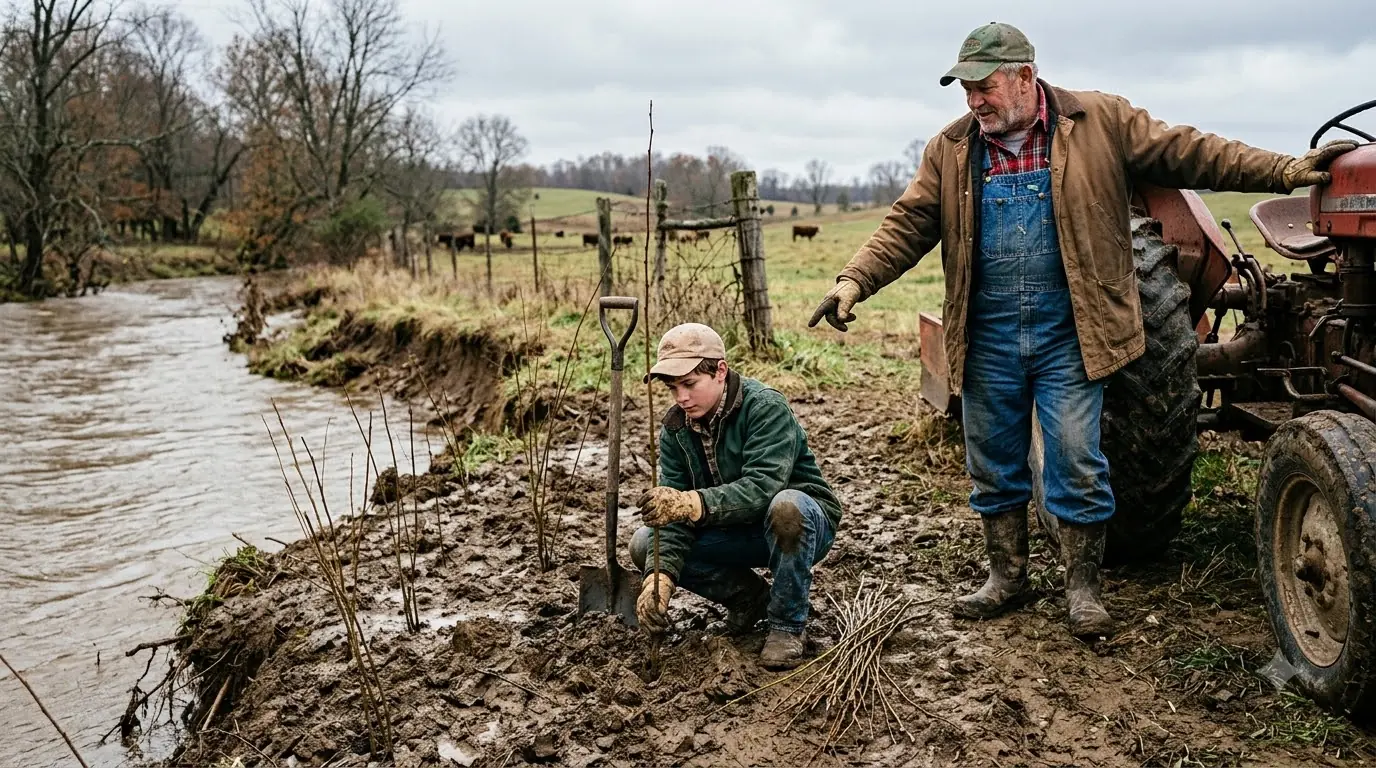
A thirteen-year-old boy digging holes along the muddy edge of Coldwater Creek before sunrise was not exactly the strangest sight anyone in Casey County, Kentucky, had ever seen.
Farm kids did strange things.
They built ramps out of scrap lumber.
They tried to raise abandoned raccoons.
They spent entire afternoons turning old tractor parts into machines that served no recognizable purpose.
So when Everett Crane appeared at the creek one Monday morning in late October with a borrowed spade over his shoulder and a bundle of thin brown sticks tied together with baling twine, nobody paid much attention.
His boots were already ruined by the time his mother called him in for breakfast.
Mud had worked its way over the leather and halfway up the legs of his jeans. His fingers were cold and red. A stripe of wet soil crossed his forehead where he had wiped away sweat with the back of his wrist.
Ruth Ann Crane stood on the back porch with both hands on her hips.
“Everett!”
He looked toward the house.
“You've got fifteen minutes before the bus.”
“I know.”
“You said that twenty minutes ago.”
He pushed the blade of the spade into the creek bank one more time.
“Coming.”
“Now.”
Everett sighed, pulled the spade free, and leaned it against a fence post.
He had managed eight holes.
Only eight.
He stared down the bank toward the wide bend where Coldwater Creek curved around the South Field.
He had a long way to go.
At the kitchen table, his older brother Micah looked down at Everett's boots and laughed.
“Mom's going to make you eat outside.”
“I've considered it,” Ruth Ann said.
Everett sat carefully.
His younger sister Lena wrinkled her nose.
“You smell like creek.”
“Creek has a smell?”
“You do.”
Their youngest brother Nathan, only six, leaned under the table to inspect Everett's boots.
“Did you fall in?”
“No.”
“Did you see a snake?”
“No.”
“Can I come tomorrow?”
“No.”
Nathan frowned.
“Why?”
Everett took a biscuit.
“Because.”
That was about as much explanation as anyone received.
The next morning, he was back out there.
By Tuesday evening, the palms of his hands had developed blisters.
By Wednesday, one blister had broken open.
Ruth Ann noticed while he was washing dishes after supper.
“Let me see.”
“It’s fine.”
“Everett.”
He held out his hand.
She turned it gently beneath the kitchen light.
“You need gloves.”
“They make it harder to feel the handle.”
“They also make it harder to bleed all over my dish towel.”
“I’m not bleeding.”
“You were.”
She went to the mudroom and returned with Dale Crane’s old leather work gloves.
“They’re too big.”
“You’ll survive.”
Everett took them.
“Thanks.”
Ruth Ann studied him.
“What exactly are you doing down there?”
“Planting.”
“I gathered that.”
She waited.
Everett dried his hands.
“I’ll explain later.”
“When?”
“When there’s something to explain.”
Ruth Ann smiled.
“You sound like your grandfather.”
Everett did not answer.
That was because his grandfather was exactly where the idea had come from.
By Thursday, the neighbors had noticed.
Harlan Beecham lived across the county road and owned sixty acres of cattle pasture that bordered one section of Coldwater Creek.
Harlan was fifty-eight, broad-shouldered, slow-speaking, and permanently suspicious of anything that required reading more than two pages of instructions.
He found Everett after school pressing one of the thin sticks into the mud.
Harlan leaned both arms across the top rail of the fence.
“What in the world are those?”
Everett didn't look up.
“Willows.”
Harlan squinted.
The stick in Everett's hand did not resemble a tree.
It looked like something that should have been thrown onto a brush pile.
“For shade?”
“Sort of.”
“There aren't any leaves.”
“Not yet.”
“Those even alive?”
“Yes.”
Harlan examined the bundle.
“Could've fooled me.”
Everett pressed another cutting into the ground.
“Where'd you get them?”
“Conservation nursery.”
“You paid money for sticks?”
“Yes.”
“How much?”
“Twenty-eight dollars with shipping.”
Harlan scratched his jaw.
For a thirteen-year-old farm boy in 1978, twenty-eight dollars was not nothing.
“That your dad's money?”
“No.”
Everett finally looked up.
“Mine.”
Harlan nodded slowly.
“Well.”
He looked at the creek.
“You're either onto something or you've found an expensive way to grow firewood.”
Everett went back to work.
That evening, Harlan told his wife that the middle Crane boy was planting sticks in the mud.
She laughed.
“That sounds like Everett.”
By Friday, Old Gus Whitfield knew.
By Saturday, half the feed store probably knew.
That was how information moved in farming communities.
Nobody made an announcement.
Someone saw something.
Mentioned it while buying mineral blocks.
Someone else repeated it at the diner.
By Sunday, the story had developed personality.
According to one version, Everett was planting an orchard.
According to another, he was trying to redirect the creek.
One man claimed Dale Crane was experimenting with a new federal soil program.
Dale heard that one while loading feed into his truck.
He laughed.
“My federal program is a thirteen-year-old with a shovel.”
The man looked confused.
Dale did not explain.
The Crane farm had been in the family since 1908.
Everett's great-grandfather, Silas Crane, had purchased the original eighty-three acres after spending seven years working timber crews and saving nearly everything he earned.
The property expanded slowly.
A neighboring pasture in 1926.
Forty acres after the war.
Another parcel when Dale's father married.
By Everett's childhood, the farm covered almost two hundred acres.
It was not rich land.
Good, but demanding.
Tobacco occupied the best fields.
Cattle grazed the rougher ground.
Hay came from the bottom land when the weather cooperated.
Coldwater Creek crossed nearly three-quarters of a mile of the property.
The creek had always been both useful and troublesome.
It watered livestock.
It drained the hills.
It carried minnows Everett caught with Nathan in summer.
It also ate land.
Not quickly enough for most people to worry about.
A few inches here.
A foot there.
One heavy rain might cut away a section beneath a fence post.
Then the next year weeds covered the exposed earth and everyone forgot.
Everett didn't.
Everett Crane was the second of Dale and Ruth Ann’s four children.
Micah, sixteen, was louder and more naturally confident.
He won ribbons for livestock judging and could talk to adults without sounding like a child.
Lena, eleven, read everything she could find and regularly corrected teachers with enough politeness to avoid punishment.
Nathan was six and still believed his brothers knew everything.
Everett occupied the space between them.
He was quiet.
Not shy exactly.
He simply did not believe every thought needed to become a sentence.
Dale sometimes joked that Everett could spend an hour repairing fence beside another person and use fewer than twelve words.
But Everett watched.
He noticed when cattle stopped drinking from one corner of a trough.
He noticed when a patch of clover disappeared earlier than the rest.
He noticed that water remained in the South Field two days longer after spring storms than it had when he was younger.
Once, when a calf died unexpectedly, Everett walked the pasture until he found a loose wire stained with hair.
The calf had likely panicked after becoming caught.
No one had seen the damaged fence.
Everett had.
Every Sunday morning, he walked the property line.
Nobody asked him to.
He simply liked knowing what had changed.
A leaning post.
Fresh deer tracks.
A fallen branch.
A wash forming beside the lane.
Dale understood that part of his son even if he did not completely understand the willows.
When Everett first asked permission to work along the creek, Dale had been replacing a belt on the square baler.
“Dad?”
“Yeah?”
“Can I plant something along Coldwater?”
Dale kept working.
“What?”
“Willows.”
Dale stopped.
“Why?”
“For the bank.”
“What about it?”
“It’s moving.”
Dale wiped grease from his fingers.