For almost four years, Isaiah Brooks cleaned the upper floors of Halcyon Meridian Partners after the people whose names appeared in financial magazines had gone home. He wiped fingerprints from conference tables where executives negotiated acquisitions worth hundreds of millions, emptied wastebaskets filled with abandoned projections, and collected half-finished glasses of eighteen-year bourbon that cost more than his weekly grocery bill. Most people on the forty-sixth floor barely looked at him, and the few who did usually saw the navy maintenance uniform before they saw the man wearing it. Isaiah had learned a long time earlier that being overlooked could hurt, but it could also teach you things visible people never noticed.
His real life waited in Queens, inside a modest two-bedroom apartment above a Dominican bakery that started making bread before sunrise. His eight-year-old son, Noah, slept in the smaller bedroom beneath glow-in-the-dark planets that Isaiah had stuck to the ceiling because Noah had once announced he planned to become an astronaut, a paleontologist, and an NBA point guard simultaneously. Isaiah’s wife, Renee, had died five years earlier after a brutal battle with leukemia that consumed savings, schedules, and almost every plan the young couple had made. By the time Isaiah buried her, he was thirty-three, deeply in debt, raising a four-year-old alone, and far more interested in stability than pride.
Before Renee became sick, Isaiah had worked daytime inventory operations for a regional shipping company and taken night classes in business management. He was good at systems, the kind of man who noticed that one loading dock always became backed up twenty minutes before anyone else understood why, and his supervisor had once told him management was the obvious next step. Then chemotherapy appointments started, followed by emergency hospital stays, insurance arguments, missed shifts, and a manager who eventually explained that compassion did not change scheduling requirements. Isaiah dropped school first, lost the warehouse job later, and took whatever work would let him keep medical coverage until there was no longer anyone left to cover.
The job at Halcyon Meridian came through a deacon at Isaiah’s church who knew a supervisor at the building-services contractor. The hours were terrible for most people but almost perfect for Isaiah because he could collect Noah from school, cook dinner, help with homework, and leave only after their upstairs neighbor Miss Gloria Ames came down around eight each evening. Gloria had been Renee’s friend for nearly twenty years and treated Noah as if some unofficial grandmotherhood contract had been signed without Isaiah’s permission. Every night, Isaiah kissed his son, promised he would be home before breakfast, and rode the E train toward Manhattan.
By nine-thirty, he was usually pushing the same battered custodial cart across Halcyon Meridian’s polished corridors. The cart’s front-left wheel squealed whenever it turned sharply, and although Isaiah had submitted three maintenance requests, nobody ever replaced it. Eventually he stopped trying because the squeak announced his presence before he entered private rooms. Executives who spoke freely when they believed service employees were invisible sometimes remembered discretion only after hearing that wheel.
Isaiah never deliberately listened to confidential conversations. He did not photograph papers, open drawers, or read documents marked restricted because he needed the job far more than he needed interesting gossip. Still, anyone who spent forty hours each week inside one building learned its habits. Isaiah knew Chief Financial Officer Adrian Cross had supposedly quit smoking but still used the eastern stairwell every Wednesday night, and he knew one senior vice president had slept in Conference Room Twelve for three months during a divorce while telling employees he had moved temporarily to Connecticut.
He also knew Evelyn Mercer, Halcyon Meridian’s forty-year-old chief executive, rarely left before eight. She was the granddaughter of the firm’s founder, which meant half the financial press described her as an heiress even though she had transformed the company more aggressively than anyone in its history. Under Evelyn, Halcyon Meridian expanded from traditional private equity into healthcare infrastructure, logistics technology, commercial banking platforms, and renewable-energy projects. Revenue more than doubled in six years, which earned Evelyn admiration from investors and resentment from relatives who believed family ownership should mean family control.
The most important of those relatives was her uncle, Philip Mercer, younger brother of Evelyn’s late father. Philip no longer held an executive role, but he controlled enough family shares and enough old friendships on the board to make his opinion dangerous. He had opposed Evelyn’s promotion to CEO privately and supported it publicly only after discovering he lacked the votes to stop her. Since then, he had behaved like a patient man waiting for gravity to do work he could not.
Halcyon Meridian celebrated its thirty-fifth anniversary on a Friday in September. The firm transformed the forty-fifth and forty-sixth floors into something between a museum, ballroom, and monument to itself, complete with champagne stations, live jazz, temporary lighting, floral arrangements flown in from California, and enormous screens displaying photographs from the company’s history. Isaiah and the custodial team were scheduled later than usual because several hundred guests would remain inside the building until close to midnight. He expected the night to involve spilled wine, abandoned glasses, and people who suddenly forgot bathrooms existed downstairs.
At dinner, Evelyn sat with directors, senior investors, and several members of the Mercer family. Philip waited until dessert before asking whether Halcyon Meridian had begun thinking seriously enough about “leadership continuity.” Evelyn assumed he meant succession planning until his second sentence made the intention obvious. He said large institutional investors liked leaders whose private lives communicated stability, then looked directly at his unmarried niece as though her personal circumstances had become a balance-sheet problem.
Evelyn smiled and asked whether Moody’s had created a marriage rating she had somehow missed. Several directors laughed, but Philip did not, and neither did Martin Vale, the seventy-one-year-old senior independent director seated beside him. Martin had been one of Evelyn’s strongest supporters when her father died and had spent years presenting himself as the calm older mentor willing to protect her from family politics. Evelyn trusted him more than she trusted Philip, which later became one of the details she hated remembering most.
She drank more wine than usual that night, though not enough to lose awareness of where she was or who was around her. Her assistant, Celia Park, offered three times to arrange a car home, but Evelyn refused and said she wanted twenty minutes alone in one of the private executive guest rooms upstairs before facing reporters outside. Celia reserved Suite 46-D through the internal scheduling system and texted Evelyn that it was ready. Evelyn put her phone into her clutch, left the party, and entered the elevator alone.
Around the same time, Isaiah’s service elevator stopped on forty-six when he had intended to go to forty-five. He rolled the cart into the executive corridor, realized the mistake, then decided cleaning an empty guest room early would save time later. As he passed Conference Room C, the squeaking wheel caught against the edge of a partially open door, and Isaiah bent down to straighten it. That was when he heard Adrian Cross speaking inside.
“The directors won’t move while she still looks untouchable,” Adrian said. Another man answered in a lower voice Isaiah did not immediately recognize, telling Adrian not to rush and saying Evelyn only needed to be distracted long enough for people to question her judgment. Adrian asked about the party, and the second man replied, “If she makes a mistake tonight, let her make it.” Isaiah freed the cart, felt the conversation stop behind the door, and kept moving without looking inside.
He cleaned Suite 46-D because the door was already unlocked and the room appeared unused. Isaiah replaced towels, emptied one trash bin, straightened the pillows, and returned two glasses to the kitchenette before pushing his cart back into the corridor. Ten minutes later, he realized the small pouch containing his utility knife, gloves, and screwdriver had fallen from the cart. He returned alone, opened the same door, and found the pouch beneath an armchair.
Isaiah was crouching when he heard the bedroom door open behind him. Evelyn Mercer stepped into the room wearing a dark green evening gown, her shoes hanging from two fingers and her hair loosened from the style she had worn downstairs. She looked at Isaiah with unfocused surprise and quietly said, “Andrew?” Isaiah stood and told her she had the wrong person.
Evelyn blinked several times, then laughed at herself. “You are definitely not Andrew,” she said, and Isaiah replied that he had been about to make the same observation. Her speech was clear, her eyes tracked him normally, and within seconds she seemed more embarrassed than intoxicated. Isaiah picked up his tool pouch and said he would leave.
“Wait,” Evelyn said. Isaiah stopped near the door, and she studied him as though trying to place a face she knew she had seen but never actually registered. “You work here,” she said, and Isaiah answered that roughly five thousand other people could say the same. When she guessed facilities, he told her night custodial, and after an awkward pause she asked his name.
“Isaiah Brooks,” he said. Evelyn repeated it carefully, not like small talk but like someone correcting herself for failing to know it already. She asked how long he had worked at Halcyon Meridian, and when he said almost four years, embarrassment crossed her face. Isaiah told her she had probably seen him many times, and Evelyn admitted that seeing someone and noticing them were apparently different things.
Isaiah again offered to call Celia, security, or a driver. Evelyn refused all three and sat down on the edge of the sofa, insisting she only needed a little time before leaving. Isaiah was halfway through the doorway when she asked why everybody around her seemed to disappear the moment she stopped being professionally useful. The question was so unexpectedly personal that he turned back.
“I don’t know you well enough to answer that,” Isaiah said. Evelyn smiled and told him it was the most honest response she had heard all night. What followed began as ten minutes of conversation and became nearly two hours, first about harmless things like the absurd flower arrangements and the noise downstairs, then about the strange loneliness of living inside responsibilities nobody could switch off. Isaiah told her about Noah, though not every painful detail, and Evelyn told him about the board without revealing information she believed confidential.
There was no fantasy in the room and no sudden transformation into different people. Isaiah remained a widowed night janitor who needed to be on a train before dawn, and Evelyn remained the CEO of a company where his employment badge could be disabled in five minutes. Both understood the imbalance between them. That was why, when Evelyn eventually asked whether he wanted to stay, Isaiah made her say clearly that she knew exactly who he was and what she was asking.
“You’re Isaiah,” she said, meeting his eyes. “You work nights here, you have a son named Noah, and tomorrow both of us are probably going to think this was an extraordinarily complicated decision.” Isaiah asked once more whether she was certain. Evelyn said yes, and Isaiah stayed.
Before sunrise, neither pretended the night had created a relationship. Isaiah dressed while Evelyn sat awake beneath the sheets, and she told him it could never happen again. He agreed because they belonged to lives that seemed impossible to combine, especially when one of them controlled the company where the other cleaned offices. At the door, Evelyn said his name once more and told him she would remember it this time.
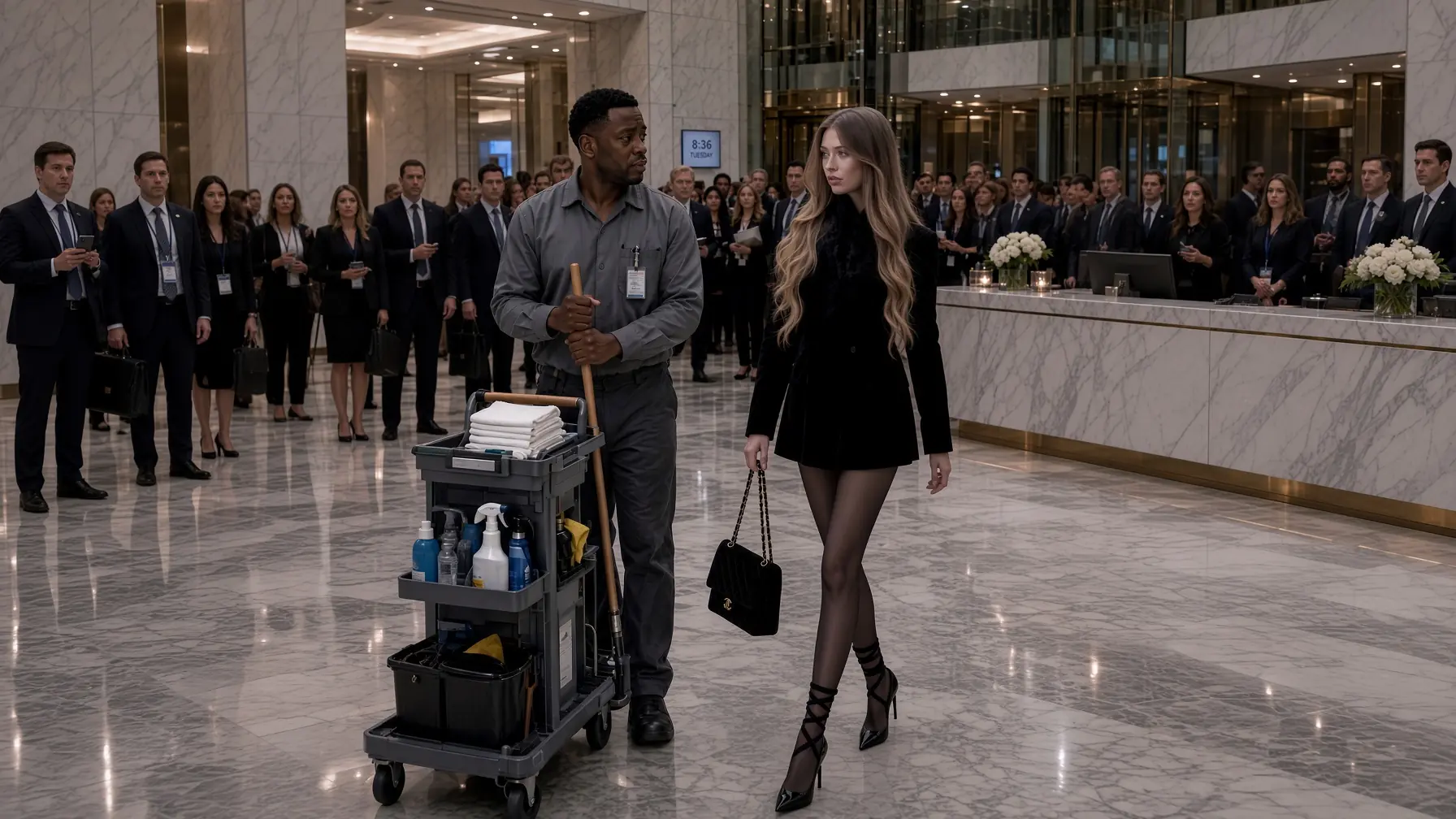
Three weeks passed with almost nothing between them. Isaiah worked his shifts, Evelyn ran Halcyon Meridian, and they crossed paths only once near a service hallway where each gave the other a short nod. Isaiah began convincing himself the night would become one of those private mistakes two adults could acknowledge without allowing it to consume anything else. Then, at 8:36 on a Tuesday morning, Evelyn entered Halcyon Meridian’s lobby while Isaiah was finishing an overtime shift.
She walked directly toward him.
Receptionists noticed first. Then security guards, administrative assistants, junior analysts waiting for elevators, and finally almost everyone close enough to understand that Halcyon Meridian’s CEO was approaching the man cleaning the marble floor. Isaiah straightened slowly and said, “Ms. Mercer,” because anything less formal in that lobby would have created its own story. Evelyn stopped in front of him and asked to speak privately.
Something in her face made Isaiah’s stomach tighten. She lowered her voice, though not enough to protect either of them from the people already listening, and said she was pregnant. Isaiah felt the lobby disappear around them. Then Evelyn said the timing indicated he was almost certainly the father.
By lunch, the story had multiplied into versions neither of them recognized. Some employees claimed Isaiah had been secretly dating Evelyn for months, while others decided he had seduced her deliberately because he wanted money. Someone said security had discovered them in a suite, someone else said Evelyn had caught Isaiah stealing and the pregnancy announcement was part of a settlement, and another version somehow involved blackmail. Facts had barely begun moving while gossip was already several floors ahead.
Isaiah finished the rest of his shift because going home early would become another story. A coworker named Terrence Boone passed his cart and joked that Isaiah had discovered the company’s most generous executive benefit. Isaiah looked at him, considered all the responses his anger offered, then pushed the cart away without giving anyone the scene they wanted. He understood that ten insulting comments could disappear while one angry reaction became evidence about his character.
At four that afternoon, Isaiah picked Noah up from school. Noah ran toward him holding a sheet of construction paper covered in something with enormous teeth, and when Isaiah asked what it was, the boy said his teacher believed it was a crocodile even though it was very obviously an allosaurus. Isaiah examined the drawing seriously and agreed the teacher’s paleontology credentials appeared questionable. They argued about dinosaurs all the way home, and for thirty minutes Isaiah’s life became normal again.
Two days later, Evelyn’s outside attorney contacted him and arranged a meeting at an independent law office in Midtown. Evelyn arrived with counsel, while Isaiah came alone in the nicest shirt he owned because he refused to let anyone later describe him as confused about the seriousness of the meeting. Medical records confirmed Evelyn was eight weeks pregnant. She told Isaiah immediately that she was not asking him to marry her.
“Good,” Isaiah replied, which startled a small laugh from Evelyn. She explained that she wanted legal certainty about paternity and clear protections before her family, the board, or the press turned the situation into something they could control. The proposed agreement provided for independent paternity testing, acknowledged Isaiah’s parental rights if confirmed, protected his employment from retaliation, and offered separate legal representation paid without requiring him to surrender any rights. Isaiah appreciated some of it and distrusted the rest.
One section discussed financial support that was far beyond anything Isaiah could imagine needing. Another addressed public statements and confidentiality, which made him feel less like an expectant father and more like a risk category. He asked what would happen if he refused to sign anything, and Evelyn took long enough answering that he knew she was deciding whether complete honesty was wise. Finally she admitted she could not guarantee what people around her might do.
“That sounds like a threat,” Isaiah said. Evelyn shook her head and told him it was an admission that she controlled less of her world than she once believed. He studied her for several seconds and decided he believed that part. Isaiah signed nothing until independent attorney Marissa Vaughn, chosen by him and paid under the agreement, reviewed every page.
Marissa removed several provisions, rewrote others, and insisted any employment protections be enforceable even if Evelyn lost control of the company. Isaiah refused a separate personal payment that would have made him financially secure immediately. Evelyn asked only once whether he was certain, and he said he did not want future decisions about his child contaminated by arguments that he had been purchased. She accepted that without trying to persuade him.
The paternity test later confirmed Isaiah was the father.
News remained private for only four days after that.
Philip Mercer called Evelyn first.
He began politely, discussing governance, investor confidence, and public narrative before finally asking whether she truly intended to attach the Mercer family to “a night employee with no meaningful standing.” Evelyn asked what meaningful standing meant. Philip responded with words like education, finances, professional compatibility, and social environment while carefully avoiding the word both of them understood was sitting underneath his argument.
Isaiah was Black.
Evelyn was white.
Philip never said race once.
He did not need to.
Instead, he kept saying “background,” “fit,” and “the world this child will enter” until Evelyn told him the child would enter a world where her mother did not ask a board for permission to give birth. Philip said she was allowing emotion to endanger the company. Evelyn answered that his panic over the father’s job said far more about Halcyon Meridian’s problem than her pregnancy did.
Three evenings later, Isaiah encountered the family’s message in a less subtle form.
A man waited beside his Honda in the employee parking garage. He introduced himself as Charles Fenwick, an attorney who represented “certain Mercer family interests,” and he carried a leather folio so immaculate Isaiah immediately disliked him. Charles opened it and placed a cashier’s check across the hood.
The amount was $1.5 million.
Isaiah stared long enough to confirm he had read the number correctly. Charles explained that the money could purchase a home, fund Noah’s education, eliminate debt, and give Isaiah a degree of stability unavailable through custodial work. In exchange, Isaiah would sign documents limiting future involvement with Evelyn and allowing the Mercer family substantial control over arrangements concerning the child.
Isaiah looked at him.
“What happens if I say no?”
Charles smiled slightly.
“Nothing immediate.”
“That is an interesting word.”
“Mr. Brooks, wealthy families prepare for complicated possibilities.”
“My son isn’t a possibility.”
“Noah is not the issue.”
Isaiah watched Charles closely.
“Then why did somebody from your office call his school yesterday?”
The attorney’s face changed for less than a second.
That was enough.
Isaiah had received a message from the school administrator asking whether anyone in the family had recently requested records. A caller claiming to represent a legal-services office had asked about attendance, emergency contacts, pickup arrangements, and whether Isaiah’s work schedule affected supervision. The school had refused to release anything without consent.
Charles recovered quickly.
“I’m not aware of that.”
“Good.”
Isaiah picked up the check.
Charles watched.
Isaiah tore it once.
Then again.
Then twice more.
He placed the pieces inside the leather folder.
“Now you have something to report.”
Charles’s expression hardened.
“You should think carefully before making enemies you cannot afford.”
Isaiah closed the folder for him.
“I clean floors for people who say things like that every night.”
He stepped closer.
“Tell whoever sent you that if they want to discuss my child, the next conversation happens through attorneys where everybody has to sign their name.”
Charles said nothing.
Isaiah drove away only after his hands stopped shaking.
The next morning, Noah’s school called again.
This time the concern was formal.
An anonymous complaint alleged instability in Isaiah’s home, financial hardship, inappropriate nighttime supervision, emotional volatility, and unspecified misconduct at work. The administrator explained that because Noah appeared healthy and there was no allegation of direct abuse, the school had not contacted child protective services, but policy required them to document the report.
Isaiah’s voice became very quiet.
“Did anybody interview my son?”
“No.”
“Do not.”
“Mr. Brooks, we have obligations—”
“My attorney will call within the hour.”
He hung up.
Then realized he did not yet have Marissa’s personal number stored.
Ten minutes later, he did.
By noon, Marissa had contacted the school.
By three, Evelyn knew.
By four, something else happened.
Human Resources summoned Isaiah upstairs.
A formal complaint alleged he had repeatedly removed company cleaning supplies, tools, and unopened inventory for personal use. The dates were specific, the quantities modest enough to sound plausible, and the inventory codes accurate.
Isaiah denied everything.
HR told him an investigation was required.
His badge was suspended.
Security escorted him out carrying a cardboard box containing his gloves, spare uniform, lunch container, and the framed photograph of Renee and Noah he kept inside the maintenance office.
He walked through the lobby without looking at anyone.
Forty-seven minutes later, Halcyon Meridian’s board announced that Evelyn Mercer would temporarily step aside from executive authority while directors reviewed “leadership judgment, conflicts, and recent governance concerns.” Her system permissions were reduced before she finished reading the announcement. By the end of the same afternoon, the CEO had lost her office access and the janitor had lost his job badge.
Isaiah made spaghetti for Noah that night.
Noah complained there were too many onions, and Isaiah responded that people who could identify a brachiosaurus from one bone should be capable of surviving vegetables. They did math homework, argued about screen time, and watched fifteen minutes of a nature documentary before bedtime. Isaiah waited until Noah was asleep before allowing the entire day to settle on him.
At 1:24 in the morning, Isaiah sat at his kitchen table with the lights off except for the stove hood.
His mind returned to the anniversary gala.
Conference Room C.
Adrian Cross saying the board would move once Evelyn appeared unstable.
The unknown older voice saying she only needed to be distracted.
The open executive suite.
Isaiah stopped.
The door.
He remembered cleaning Suite 46-D.
He remembered pulling it firmly closed.
Those doors automatically locked.
He had cleaned the executive floor long enough to know that.
Yet when he returned for his tool pouch, the door opened with almost no resistance, and Evelyn later entered the suite without using her badge.
Isaiah picked up his phone.
Evelyn answered immediately.
“You’re awake.”
“So are you.”
“What happened?”
“I think somebody wanted that room open.”
Silence.
Isaiah explained everything he remembered.
The conference-room conversation.
The second voice.
The phrase about distraction.
The guest-suite door.
The timing.
Evelyn listened without interrupting.
When he finished, she asked whether he was certain about the automatic lock.
“I’ve cleaned that room for almost four years.”
“That isn’t what I asked.”
Isaiah understood.
“Yes.”
He was certain.
Evelyn told him to come to her townhouse after dropping Noah at school.
The next morning, Isaiah saw her outside an office setting for the first time since the suite. No assistant opened the door, no executive staff waited nearby, and Evelyn wore dark trousers and a white shirt with her hair tied behind her head. Documents covered the dining table.
They began reconstructing the anniversary night.
Evelyn still possessed personal calendar backups because Celia had forwarded several records before the board restricted access. Philip had met privately with Adrian Cross, Martin Vale, and two other directors multiple times during the six weeks preceding the gala. Private meetings were not evidence of conspiracy, especially inside a family-controlled investment firm, but the timing gave them somewhere to look.
Then Evelyn found the building log.
At 10:49 p.m., Suite 46-D received a remote access override.
Not a card entry.
Not a normal reservation authorization.
A remote release from a security-administration terminal.
Evelyn stared at the screen.
“I did not request that.”
Isaiah leaned closer.
“Who could?”
“Corporate security.”
“Anyone else?”
“Facilities-security supervisors.”
They checked Celia’s text.
10:44 p.m. — Suite 46-D is prepared whenever you want it.
Five minutes later, the lock was released remotely.
Isaiah looked at Evelyn.
“Somebody knew you were coming.”
Her face changed.
“Yes.”
“Did they know I was inside?”
Neither could answer.
That became the central question.
Nobody had manufactured the choice Isaiah and Evelyn made. They both remained adults who had knowingly stayed in the suite together, and neither wanted some conspiracy theory pretending otherwise. But someone had created unusual access to the exact room Evelyn was expected to enter at the exact time Isaiah happened to be working there.
“They didn’t need to know what would happen,” Isaiah said. “They just needed something unpredictable.”
Evelyn looked toward him.
“A confrontation.”
“A photograph.”
“An employee in a private suite.”
“Anything.”
She became pale.
“And once the pregnancy happened—”
“They got something much bigger.”
Evelyn sat back.
For the first time since Isaiah had known her, she looked frightened rather than angry.
“They chose you because they thought they could erase you afterward.”
Isaiah shook his head.
“No.”
She frowned.
“They chose me because they thought nobody would bother asking what happened to me.”