The snow had been falling over Hollow Bend for three days without mercy.
By the fourth morning, the whole settlement looked buried rather than covered. Rooflines sagged beneath white weight. Fence posts disappeared up to their middles. The road beyond the flour mill had become a pale ribbon leading nowhere.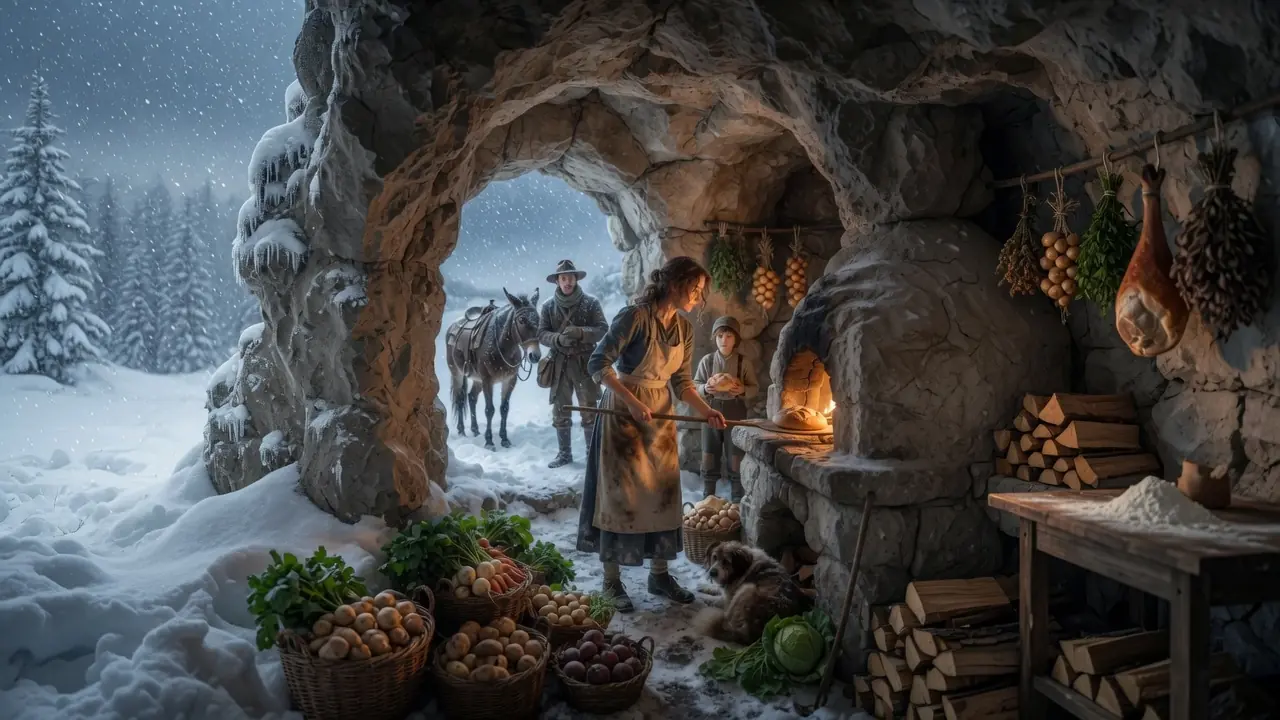
That was the morning Clara Voss was told to leave.
She stood inside Gideon Harlow’s mill with one hand wrapped around the handle of her old carpetbag and the other pressed against the shoulder of her nine-year-old son, Toby. The boy stood very still beside her, his face pale under a patched wool cap.
No one in the room looked directly at him for long.
That made the cruelty easier.
Gideon Harlow was not a large man, but he had the habit of standing as if the town belonged to him. His beard was cut neat. His vest was clean. His boots were polished even in winter, because men like Gideon had other people to step in mud for them.
“You understand the situation,” he said.
Clara did not answer at once.
She had been cleaning that mill since her husband, Elias, died of fever the previous spring. She swept flour dust from the floorboards, patched torn sacks, counted inventory, repaired ledgers when Gideon spilled ink, and slept with Toby behind a plank wall in a storage room that smelled of grain and mice.
It was not charity.
She had earned every cold inch of that space.
Outside, wind struck the mill door so hard the hinges complained.
Reverend Amos Pritch stood near the stove, hands folded, face solemn. He had the expression of a man preparing to call something cruel “necessary” and feel pious afterward.
“There is not enough food for everyone,” Reverend Pritch said softly. “Difficult choices must be made before the storm worsens.”
Toby looked up at his mother.
Clara kept her face still.
She had learned since Elias died that panic invited men to explain things to you. Calm frightened them more.
“You’re putting a widow and a child out in a blizzard,” she said.
Gideon’s jaw tightened.
“You are no longer needed here.”
“That was not what I asked.”
No one spoke.
A few townspeople stood near the wall, pretending they had come to discuss flour rations. Mrs. Daley from the boarding house. Caleb Morse, the cooper. Two farmers whose names Clara knew because she had mended their grain sacks for half price.
They looked at the floor.
They looked at the stove.
They looked anywhere except at her.
Gideon walked to a stack of damaged flour sacks and dragged one forward.
“You may take this,” he said. “And some potatoes from the back bin. Also the cracked shovel. I have been more than fair.”
The flour sack was damp along one side.
Clara could smell the sourness before she touched it.
Months earlier, she had warned Gideon that the west roof had begun to leak. The planks above the grain stores had warped, and ice gathered in the seams after every thaw. He had waved her away, told her women saw danger in everything they did not understand.
The leak had not cared what Gideon believed.
Neither had the flour.
Clara lifted the sack. It shifted heavily against her arm, clumped where moisture had found it long before that morning.
Toby clutched a small clay jar against his chest.
It held the sourdough starter Elias had carried west when they first came to Hollow Bend. He had fed it through lean winters, thunderstorms, two crop failures, and the fever that eventually took him. On the morning he died, Elias had asked for two things.
Take care of Toby.
Keep the starter alive.
The first promise had become Clara’s whole life.
The second sat now in her son’s trembling hands.
Gideon glanced at the jar.
“You can’t live on sentiment.”
Clara looked at him then.
Really looked.
“Neither can a town live on spoiled flour.”
His face changed.
Only for a second.
It was enough.
She had struck the hidden rot beneath his polished authority.
Reverend Pritch cleared his throat.
“Bitterness will not help you, Mrs. Voss.”
“No,” Clara said. “But memory might.”
She took the sack, the potatoes, the cracked shovel, and the carpetbag. Toby followed her toward the door. Their old mule, Clement, waited outside beneath the overhang, ears pinned against the wind. Beside him stood their dog, Patch, a wiry brown thing with one white foot and an opinion about nearly everything.
When Clara opened the mill door, the cold came in like a hand around the throat.
Behind her, no one said wait.
No one said this is wrong.
No one said a child should not be sent into mountain weather with a damp flour sack and a mule too old for hard travel.
That silence stayed with Clara longer than the cold.
Toby stepped into the snow first, holding the clay jar so carefully he might have been carrying a living heart.
“Ma,” he whispered, once the mill door shut behind them. “Where do we go?”
Clara looked toward the road leading back into Hollow Bend.
Then toward the northern ridge, where the land climbed into limestone, pine, and forgotten mining trails.
She thought of Elias.
Not the fever-thin version of him lying under quilts.
The earlier Elias, sitting by lamplight with old survey maps spread across his knees, reading pencil notes left by railroad men and prospectors. He had always been drawn to places other men ignored.
“There’s a ravine past Wolfglass Ridge,” he had told her once. “Old map says the ground stays warm there even in hard winter. Maybe steam below. Maybe hot stone. Could be nothing.”
Could be nothing.
Clara adjusted the damp flour sack over her shoulder.
“Not back,” she said.
Toby looked frightened.
“That’s not a place.”
“Then we’ll make one.”
They left Hollow Bend while the settlement watched from behind frosted windows.
Clement pulled the small sled Gideon had allowed them to use only because one runner was already cracked. Patch trotted ahead, nose low, disappearing and reappearing through curtains of snow. Toby walked beside the mule with the sourdough jar tucked under his coat.
The road narrowed after the last cabin.
Then it vanished beneath fresh drifts.
Wind moved across the open ground in long white sheets, wiping away tracks almost as soon as they appeared. Clara kept her eyes on the ridge. She did not know if she remembered the map correctly. She did not know if Wolfglass Ravine truly existed.
But she knew what waited behind them.
A mill with a leaking roof.
A town with lowered eyes.
A man who called abandonment fairness.
So she walked forward.
By midafternoon, Toby’s cheeks had gone white with cold. Clement stumbled twice. Once the sled slid sideways and nearly tipped the damp flour into a drift. Clara righted it, breath burning in her lungs.
“We should stop,” Toby said through chattering teeth.
“Soon.”
“You keep saying soon.”
“Because if I say now, we die here.”
He said nothing after that.
The words were too honest for a child.
Clara regretted them at once, but winter did not pause for gentle corrections.
Near dusk, Patch vanished up a slope of broken stone and began barking.
Not wildly.
Insistently.
Clara followed the sound, dragging Clement by the lead rope while Toby struggled behind her. The slope looked no different from the rest of the mountain at first. Limestone ribs. Sagebrush buried to the tips. Snow hissing against rock.
Then she noticed the first strange thing.
The snow was thinner there.
Not gone.
Just thinner.
In scattered patches, gray stone showed through where every other hillside lay buried. A faint mist rose from a crack between two boulders and disappeared into the wind.
Patch stood near the opening, tail stiff, looking proud of himself.
Clara crouched and removed one glove.
She pressed her fingers to the exposed ground.
Cold.
But not iron-hard.
The soil gave slightly beneath her touch.
Elias, she thought.
You mad, hopeful man.
“You found it,” Toby whispered.
“No,” Clara said, though her voice shook. “Your father did.”
The opening led between two limestone walls into a narrow passage. The wind weakened almost immediately. Snow still fell, but not with the same violence. Clement snorted and lowered his head as if relieved to be out of the worst of it.
The passage bent once.
Then opened into a ravine hidden behind the ridge.
Wolfglass Ravine was smaller than Clara had imagined, no grand canyon, no miracle valley. But the air inside felt different. Still cold, still winter, yet without the killing edge of the open trail.
Near the back wall, a sandstone shelf jutted over a shallow alcove.
The floor beneath it was mostly dry.
Thin vapor drifted from cracks along the limestone, not enough to warm a house, but enough to matter. Enough to keep the earth from freezing solid. Enough to give a desperate woman one more problem to solve instead of an ending to accept.
Clara stood in the alcove and listened.
Beyond the ravine mouth, the storm raged.
Inside, Patch shook snow from his coat and lay down.
That was his vote.
“We stay here?” Toby asked.
“For tonight.”
“And tomorrow?”
Clara looked at the sandstone shelf, the dry floor, the faint mist, the narrow shape of the ravine.
“For tomorrow too, if we’re clever.”
The first night was rough.
Clara built a fire near the edge of the alcove using dead brush Patch found beneath a ledge. Smoke rose, hesitated, then drifted sideways into the dark rear of the rocks instead of back into their faces. A draft existed somewhere inside the stone.
That mattered.
A fire that could breathe could become heat.
Heat could become shelter.
Shelter could become time.
They slept sitting up, wrapped in blankets, with Clement tied beneath the overhang and Patch curled against Toby’s legs. The sourdough jar stayed beneath Toby’s coat all night.
Clara woke often.
Each time, she expected to find the fire dead, the wind inside, the boy frozen.
Each time, something still held.
Morning came gray and hard, but it came.
Clara did not waste it.
For two days, she worked like a woman building against a clock no one else could hear. She hauled stone from the ravine floor and stacked it along the exposed side of the alcove. Clement dragged larger rocks on the cracked sled. Toby gathered dry twigs, bark, and dead juniper branches from beneath protected ledges.
Their wall was ugly.
That did not matter.
It cut the wind.
Clara built a raised bed from poles, brush, and flat stones, high enough to keep blankets away from the damp ground. She hung food from a rack made of forked branches so mice could not reach it. She scraped the driest part of the flour from Gideon’s sack and spread the clumped parts near the warm rock to dry.
Nothing looked like a home.
But each thing answered one question winter had asked.
Where will you sleep?
How will you keep food dry?
How will the fire breathe?
How will your child live until morning?
On the third day, Clara discovered the inner chamber.
It lay beyond a low passage behind the alcove, hidden by a curtain of hanging roots and stone. She crawled through first with a candle stub between her fingers. The chamber was small, no taller than a cellar in places, but its floor was dry.
More importantly, light entered from above.
A crack in the rock ceiling allowed a narrow beam of winter sun to strike the ground for several hours each day. The soil beneath it was dark and crumbly, warmer than it should have been.
Clara sat back on her heels.
For the first time since leaving the mill, she felt something other than survival move inside her.
Not joy.
Not yet.
A plan.
Elias had kept a leather pouch of seeds wrapped inside his coat trunk: winter rye, kale, beets, turnips, and a few hardy onions. He had dreamed of planting his own patch outside Hollow Bend after saving enough to buy land.
Then fever came.
The land never did.
Clara had packed the seed pouch without thinking, because grief makes the hand carry what the heart cannot release.
Now she opened it in the mountain dark.
Toby watched from the passage with the sourdough jar in his lap.
“Can seeds grow in a cave?”
Clara touched the warm soil.
“They can try.”
The first bread failed.
Clara built the oven from clay, ash, and a circle of stone, too thin and too hopeful. She fed the fire carefully, waited until the inside looked hot, and slid in the dough made from salvaged flour and Elias’s starter.
The smell nearly broke her.
Bread in a cave.
Bread after exile.
Bread after Gideon Harlow had handed her damp flour like a funeral token.
Toby sat beside the oven with shining eyes.
But when Clara pulled the loaf out, the crust was black in patches, the middle heavy and raw. Steam came from it, but not the right kind. She cut it open and saw the wet, collapsed heart of it.
Three days of flour.
Gone.
Toby tore off a corner and tried to chew.
“It’s good,” he lied.
Clara looked at him.
He stopped chewing.
“It’s a little bad.”
She laughed.
It surprised them both.
Then she pressed her hand against the oven wall and understood the mistake. The heat had touched the dough, but it had not stayed. The walls were too thin. The oven had no memory.
By morning, she was stacking more stone.
The first planting failed too.
Kale sprouted.
Rye pushed up thin green blades.
The turnips emerged bravely, then softened and collapsed along the northern edge of the bed. Clara found beads of water forming on the limestone above them. Warm air met cold stone, turned to moisture, then dripped where roots could not bear it.
The cave was not simply warm.
It breathed.
It sweated.
It chose where water gathered.
Clara marked damp places with pebbles. Toby helped, crawling around the bed each morning to see where droplets had fallen overnight. For two days, she planted nothing new. She watched. Measured. Waited.
That patience saved the next crop.
She dug a shallow drainage trench along the wet edge. Then she wove a lattice of willow branches several inches from the damp wall, leaving space for air to move behind it. The moisture still formed, but no longer fell directly on the seedlings.
The kale stopped yellowing.
The beets straightened.
The rye kept reaching toward the thin blade of light.
Toby knelt beside the bed one morning and whispered, “They’re not dead.”
“No.”
“Do you think Pa sees?”
Clara closed her eyes briefly.
“If he does, he’s probably telling me the rows are crooked.”
Toby smiled.
That was its own harvest.
The second bread worked.
Clara fired the new oven longer, letting sandstone drink the heat until the chamber itself seemed to glow. She raked the coals aside, waited, then slid the dough in with a flat piece of bark.
No rushing.
That was what the cave had taught her first.
The loaf came out uneven, cracked on one side, darker on the bottom than on top.
But it was bread.
Real bread.
When Clara cut it, steam rose clean and fragrant into the alcove. Toby stood from the bed as if pulled by a string. Patch lifted his head. Even Clement shifted near the entrance and brayed softly, perhaps offended no one had mentioned grain.
Clara handed the first piece to Toby.
He held it in both hands.
Not because it was hot.
Because it was proof.
He took one bite, closed his eyes, and began to cry.
Clara nearly dropped the knife.
“What is it?”
He shook his head.
“It tastes like before.”
She understood.
Before fever.
Before hunger.
Before men in warm rooms decided who deserved a roof.
She sat beside him, and they ate slowly while snow moved beyond the ravine in white sheets.
A warm loaf existed in the place they were supposed to have died.
That was not triumph.
Not yet.
It was a beginning with a crust.
Weeks passed in the language of work.
The sourdough starter weakened during a sharp cold spell, and Clara discovered the stone floor was stealing warmth at night. She moved the jar to a rear wall where limestone held steady heat and wrapped it in Elias’s old wool scarf.
Bubbles returned two mornings later.
Toby cheered as if the jar had stood up and danced.
The snares came next.
Clara twisted old wire she had salvaged from the mill and set simple loops along hare trails outside the ravine. Patch’s nose helped. Every catch meant meat for stew, bones for broth, pelts for warmth.
Nothing was wasted.
Nothing could be.
Kale thickened in the inner chamber. Beet greens grew small but steady. The second turnip planting survived. Winter rye rose in a stubborn patch of green beneath the ceiling crack.
The shelter became a system.
Bread fed bodies.
Ash fed soil.
Bones fed broth.
Pelts lined the bed.
Warm stone protected starter.
Airflow carried smoke away.
Every piece leaned on another.
Then the wind taught Clara another lesson.
One night, a storm came from the wrong direction. It fell through the upper rocks instead of pushing through the ravine mouth. Clement panicked, struck the windbreak with his shoulder, and brought half the wall down in a grinding collapse.
Clara rebuilt too quickly.
By midnight, smoke filled the alcove.
Toby coughed beneath the blanket. Patch whined. The fire burned wrong, restless and bitter.
Clara spent the night moving stones by lantern light, angry at the wall, angry at the wind, angry at the old laws of air that refused to care how tired she was.
Near dawn, she understood.
The wall was not too weak.
It was too good.
It blocked the very draft that had pulled smoke through the cave.
Sometimes the solution became the danger.
She opened a narrow channel near the base of the windbreak. The next plume of smoke rose, curled, and vanished toward the rear passage.
Toby watched from the bed, eyes red from coughing.
“You fixed it?”
“For now.”
“Was it broken because Clement knocked it down?”
“No,” Clara said, wiping soot from her face. “It was broken because I forgot the cave needs to breathe.”
Toby nodded solemnly.
Then said, “Like people.”
Clara looked at him.
“Yes,” she said. “Like people.”
On day forty-nine, Patch heard the stranger first.
The dog stood near the alcove entrance without barking, ears forward, body stiff. Clara set down the dough she was kneading and reached for the shovel with the cracked handle.
Footsteps echoed through the limestone passage.
Slow.
Careful.
Human.
A man appeared at the ravine mouth, wrapped in a snow-crusted coat, his hat pulled low against the wind. He was lean, dark-haired, and carried a mail satchel across his chest. Clara recognized him after a moment.
Nathaniel Pike.
The winter courier.
He delivered letters, repaired harnesses, and knew more trails than most men knew prayers.
He stopped when he saw the alcove.
His eyes moved from the windbreak to the stacked firewood, from the raised sleeping platform to the hanging food rack, from the oven to the green chamber beyond.
Then the smell reached him fully.
Fresh bread.
He removed his gloves slowly.
“Lord help me,” he whispered. “They said you were dead.”
Clara wiped flour from her hands.
“Did they?”
Nathaniel looked ashamed, though he had not been in the mill that morning.
“Most said it.”
“And you?”
“I came looking.”
That answer mattered.
Not enough to erase what had happened.
Enough to let him inside.
Toby emerged from the garden chamber with a basket of kale leaves, the sourdough jar tucked safely near the warm wall behind him. Nathaniel stared at the boy as if he were looking at a ghost who had learned to bake.
“You’re alive,” he said.
Toby held up the basket.
“And we have greens.”
Nathaniel laughed once, then covered his mouth.
It was not humor.
It was shock breaking into sound.
He stayed most of the afternoon.
Clara fed him bread and broth. He ate with the concentration of a man who had not tasted fresh food in weeks. Then he told her what Hollow Bend had become.
The flour stores were worse than Gideon admitted.
More sacks had spoiled from roof damp. The communal oven smoked whenever wind shifted because the chimney had cracked. Families were stretching meals with boiled roots. Children were getting thin. Old Mrs. Vane had lost two teeth trying to chew frozen hardtack.
Reverend Pritch still preached endurance.
Gideon still counted rations.
The town still pretended hunger was weather instead of consequence.
Clara listened.
She asked names.
Which families had children?
Which elders lived alone?
Who had no meat?
Who could still bake if given flour?
Nathaniel answered one by one.
Some names hurt.
Mrs. Daley, who had watched from the mill wall and said nothing.
Caleb Morse, who had looked away.
A farmer who had nodded when Gideon called the decision practical.
Toby watched his mother closely.
“You’re going to help them?” he asked.
Clara looked at the oven.
Then at the garden.
Then at the boy who had walked beside her through snow carrying his father’s living starter.
“I’m not helping Gideon,” she said. “I’m feeding hungry people.”
“That’s different?”
“Yes.”
Toby thought about it.
Then nodded.
“Good.”
Before sunset, they packed Nathaniel’s satchel with one loaf, a bundle of kale, beet greens, and three small turnips. Clara added broth bones wrapped in cloth for Mrs. Vane.
Nathaniel looked at the bundle.
“They won’t know who sent it?”
“Not yet.”
“Why not?”
Clara tied the cloth.
“Because gratitude wastes time when people are hungry.”
For three weeks, Nathaniel carried food from Wolfglass Ravine into Hollow Bend.
Always plain sacks.
Always quiet.
He delivered to back doors after dark, leaving bread still warm enough to fog cold air. Children ate. Old women softened bread in broth. Men who had begun hiding hunger behind pride found green things in stew again.
Rumors spread faster than truth.
A trapper had found a storehouse.
Railroad men were sending supplies.
God had answered prayers.
Reverend Pritch preferred the last version.
Nathaniel said nothing.
The bread kept coming.
Then the mill roof failed.
It happened during the worst wind of February. Ice cracked along the west seam, the warped boards gave way, and snowwater poured into the storage section Clara had warned about before autumn.
By dawn, a third of the flour reserve was ruined.
By noon, men stood inside the mill staring at gray clumps that smelled sour.
Gideon Harlow said nothing.
There are moments when pride does not die loudly.
It simply runs out of places to stand.
The communal oven failed the same week.
The cracked chimney widened, smoke poured back into the workroom, and no fire would hold properly. Hollow Bend called an emergency meeting in the church, because people liked to gather beneath a steeple when consequences arrived wearing boots.
Nathaniel stood at the front.
He looked at Gideon.
Then at Reverend Pritch.
Then at the townspeople who had whispered, guessed, thanked heaven, and never asked the right question.
“The food came from Clara Voss,” he said.
The room went still.
A bench creaked.
Someone coughed.
Mrs. Daley pressed both hands into her lap.
Nathaniel continued.
“She and Toby are alive in Wolfglass Ravine. They built shelter. Built an oven. Planted winter greens in warm ground. Baked bread from the starter her husband left. And while this town decided she was already buried, she has been helping keep your children fed.”
Nobody rushed to speak.
Truth has weight.
It sits on the chest first.
Gideon stood near the stove, face pale beneath his beard.
“That is impossible.”
Nathaniel’s gaze did not move.
“No. It was difficult. That’s not the same thing.”
Reverend Pritch lowered his eyes.
For once, no necessary decision came to save him.
Three days later, a group climbed to Wolfglass Ravine.
Gideon came.
So did Reverend Pritch.
Caleb Morse carried tools. Mrs. Daley brought blankets. Two farmers brought seed potatoes, late and awkward and still better than empty hands.
The ravine was smaller than they expected.
That seemed to shame them more than if it had been grand.
There was no hidden valley. No miracle barn. No secret storehouse full of food.
Only stone.
Air.
Warm ground.
And work.
Clara met them at the entrance wearing an apron dusted with flour, hair tied back, hands rough from hauling, kneading, digging, burning, correcting. Toby stood behind her with Patch, not hiding, but not offering trust cheaply either.
Gideon looked at the shelter.
The windbreak with its breathing channel.
The raised bed.
The oven made from clay and sandstone.
The hanging food racks.
The inner chamber where green rows grew under a narrow shaft of winter light.
He seemed smaller inside the place his cruelty had helped create.
Caleb Morse went first to the oven.
“How does it hold heat?”
Clara showed him.
No triumph.
No scolding.
She explained the thicker wall, the narrowed mouth, the sandstone mass, the firing time. Caleb listened like a student.
Then he asked about the draft.
She showed him the smoke path and the windbreak mistake.
He nodded slowly.
“I’ve built chimneys worse than this.”
“Yes,” Clara said.
It was not cruel.
That made it worse.
Mrs. Daley stood at the garden entrance, crying silently as she looked at the kale.
“I saw you leave,” she said.
Clara did not answer.
“I saw you,” Mrs. Daley repeated. “And I said nothing.”
Toby looked at his mother.
Clara stepped past Gideon and took a basket from the wall.
“Pick only the outer leaves,” she told Mrs. Daley. “Leave the centers or they won’t keep growing.”
Mrs. Daley stared at her.
Then nodded.
The apology had not been accepted in words.
But work had been given.
Sometimes that was where repair began.
Reverend Pritch found Clara near the flour rack.
“I called it necessary,” he said quietly.
“You did.”
“I was wrong.”
“You were.”
His face tightened.
“I don’t know how to ask forgiveness for that.”
Clara lifted a sack and checked for damp.
“Start by fixing the church oven. People still need bread.”
He bowed his head.
“Yes.”
Gideon waited longest.
He wandered toward the storage area, studying the raised sacks, the airflow channels, the dry stone beneath them. His eyes moved like a man reading his own indictment written in practical solutions.
“How did you keep the flour from turning?” he asked.
Clara explained.
Elevate it.
Keep it from walls that sweat.
Move air around it.
Sort damage early.
Never ignore a roof leak.
He flinched at the last words.
Good.
“Mara—” he began, then stopped.
Her name was not Mara.
He had used the wrong widow.
Perhaps in his mind all struggling women became one shape.
“Clara,” he corrected.
She waited.
“I should not have put you out.”
“No.”
He looked toward Toby.
“I thought—”
“No,” Clara said again.
This time, sharper.
“You did not think. You calculated. Calculation without mercy is just cowardice dressed in numbers.”
Gideon’s mouth opened.
Closed.
There was nothing in the ravine for him to hide behind.
No mill.
No reverend.
No crowd.
Only the woman he had sent into the storm, standing beside the oven that now fed his town.
“I am sorry,” he said at last.
Clara looked at him for a long time.
Then handed him a sack.
“Carry this to Mrs. Vane.”
He took it.
It was not forgiveness.
Not yet.
But it was something heavier.
Responsibility.
By sunset, the visitors had divided tasks.
Caleb would rebuild the town oven chimney using Clara’s draft design. Reverend Pritch would open the church cellar for storage and stop calling neglect providence. Mrs. Daley would coordinate meals for children and elders. The farmers would bring salvageable seed stock and help expand protected growing beds in two smaller ravines Nathaniel believed might hold similar warm ground.
Gideon would repair the mill roof.
Not supervise.
Repair.
Clara made that condition clear.
He accepted.
The walk back to Hollow Bend was quiet.
The people carried baskets of greens, loaves of bread, and the uncomfortable knowledge that the person they had abandoned had learned how to save them without asking permission.
Hollow Bend changed after that.
Not all at once.
Settlements, like people, resist admitting they have been wrong.
But the mill roof was fixed.
The communal oven was rebuilt with a proper draft. Caleb used Clara’s design and openly credited her, though his ears went red the first few times he said it. The church cellar became a food store with raised racks and airflow gaps.
People began checking roofs before storms instead of after ruin.
That alone felt like progress.
Wolfglass Ravine became more than Clara’s shelter.
It became the winter kitchen.
Families took turns hauling wood, carrying water, tending outer beds, and learning what Clara had learned the hardest way. Warm stone was not enough. Light was not enough. Bread was not flour and fire alone.
Everything depended on everything else.
Toby became guardian of the starter.
He took the role with grave seriousness.
No one touched the clay jar without his permission. Even Gideon once asked to see it, and Toby looked him up and down before saying, “Clean hands first.”
Gideon washed.
Nobody laughed until later.
Spring came slowly, as it always does in mountain country.
Snow loosened first near the ravine mouth. Then along the lower road. Then from the mill roof, which no longer leaked. Hollow Bend emerged from winter thinner, humbled, alive.
When the first wagon could pass safely, Gideon came to the ravine with a paper in his coat pocket.
Clara was kneading dough near the oven.
Toby was setting beet seedlings into a new bed.
Patch was asleep in a patch of sunlight, having appointed himself supervisor.
Gideon removed his hat.
“I brought something.”
Clara wiped her hands.
He held out the paper.
“The council agreed. The old north granary plot. It was abandoned after the fire twelve years ago. Good soil near the creek. The deed is yours if you want it.”
Clara did not take the paper immediately.
“Charity?”
“No,” Gideon said. “Back wages. Payment. Debt. Call it whatever lets you take it.”
She studied him.
He did not look away this time.
That mattered too.
Toby came to stand beside her.
“Can we plant there?” he asked.
Clara finally took the deed.
“Yes,” she said. “We can plant there.”
That summer, the north granary plot became the Voss Bakehouse and Garden.
Not grand.
Never grand.
A stone oven under a timber roof. Raised beds beside the creek. A small room in the back where Clara and Toby slept until a proper house could be built. Shelves for bread. Hooks for drying herbs. A locked cupboard for the sourdough jar at night.
People came first because they needed bread.
Then because they wanted it.
Clara’s loaves were never perfect. They cracked strangely, rose unevenly, and carried the flavor of a starter that had survived blizzard, exile, and mountain stone. Some said the bread tasted faintly of smoke, warmth, and stubbornness.
Clara accepted that as praise.
On the first anniversary of the day she was forced from the mill, snow began falling again.
Lightly.
Not like the storm.
Toby stood at the bakehouse window, watching flakes gather on the yard.
“Do you think about that day?” he asked.
Clara slid four loaves into the oven.
“Yes.”
“Do you hate them?”
She did not answer quickly.
Outside, Gideon Harlow walked past carrying a bundle of firewood toward the church cellar. Reverend Pritch followed with two sacks of turnips. Mrs. Daley stood across the road handing bread to a mother with three children.
The town was still imperfect.
People still gossiped.
Men still grew proud too easily.
Apologies still arrived late.
But late was not the same as never.
“No,” Clara said finally. “Hate takes too much flour.”
Toby grinned.
“That doesn’t make sense.”
“It will when you’re older.”
He looked at the oven.
“Do you miss the cave?”
She smiled.
“Sometimes.”
“Me too.”
“Why?”
He thought for a moment.
“Because we found out we could live.”
Clara looked at her son, at the boy who had carried a clay jar through snow and fear, who had learned that survival was built one decision at a time.
“Yes,” she said softly. “We did.”
That evening, Hollow Bend gathered in the church hall for the first shared winter meal since the bad season. There was bread from Clara’s oven, stew thick with vegetables, preserved greens from the ravine beds, and broth rich enough for old Mrs. Vane to declare she intended to live just to annoy everyone longer.
People laughed.
Clara sat near the back with Toby.
She preferred it there.
Nathaniel Pike came in late, snow on his shoulders and letters in his satchel. He set one small package in front of Toby. Inside was a new cloth wrap for the sourdough jar, embroidered with tiny green rye blades.
Toby ran his fingers over it.
“Who made this?”
Nathaniel nodded toward Mrs. Daley.
The woman looked down, embarrassed.
Toby stood, carried the cloth to her, and said thank you.
Mrs. Daley cried.
Toby looked alarmed.
Clara laughed quietly.
Near the stove, Gideon approached her.
“I checked the mill roof twice this week,” he said.
“Good.”
“And the flour racks.”
“Good.”
“And the cellar vents.”
Clara glanced at him.
“You want praise for doing what should have been done?”
A few people nearby went very still.
Then Gideon surprised them by smiling faintly.
“No. I suppose I wanted you to know the lesson held.”
Clara nodded.
“That is better than praise.”
He left her alone after that.
Which was also progress.
Later, when the meal was over and the hall had quieted, Reverend Pritch stood to speak. Clara braced herself. The old version of him would have turned the winter into a sermon about endurance and divine testing.
This time, he only looked around the room.
“We survived,” he said, “because a woman we failed chose not to fail us back.”
No one moved.
“Let that shame us where it must,” he continued. “And teach us where it can.”
Then he sat down.
No long prayer.
No polished explanation.
Just a truth left in the middle of the room like warm bread.
Years later, children in Hollow Bend would hear the story of the widow in Wolfglass Ravine.
Some versions would make it sound prettier than it was.
They would speak of warm caves, secret gardens, miraculous loaves, and a brave woman who conquered winter. They would forget the raw bread, the drowned turnips, the smoke-filled night, the cracked hands, the fear of waking to find the child beside her too cold.
Stories often sand down suffering until it shines.
But Toby remembered correctly.
He remembered his mother taking damp flour from a cruel man and making bread from it. He remembered the first failed loaf. He remembered marking cave drips with pebbles. He remembered Patch finding the ravine and Clement knocking the wall down. He remembered the first time he bit into warm bread and tasted before.
Most of all, he remembered the silence in the mill.
And the sound that replaced it months later.
People chewing.
Children laughing.
Ovens breathing.
Work shared.
Life continuing.
The clay starter jar sat for many years on a shelf in the Voss Bakehouse, wrapped in the embroidered cloth. When visitors asked about it, Clara would sometimes tell the story.
Not all of it.
Only enough.
“This kept us alive,” she would say.
People often looked at the jar with reverence.
But Toby knew better.
The jar had mattered.
The starter had mattered.
The warm ravine, the seeds, the oven, the bread, all of it had mattered.
But what truly kept them alive was not one thing.
It was attention.
His mother had paid attention when powerful men dismissed small warnings. She had remembered a note on an old map. She had watched smoke, stone, water, roots, and wind until the mountain taught her how to live inside it.
That was the lesson Hollow Bend carried forward.
Not that miracles appear in blizzards.
But that survival often begins where pride refuses to look.
A leaking roof.
A damp sack.
A forgotten ravine.
A woman no one listened to.
By the next winter, Hollow Bend had three protected growing chambers, two improved ovens, and enough raised flour storage to keep the reserves dry. The settlement still feared storms, as wise people should.
But they no longer feared them blindly.
And whenever snow fell hard against the windows, someone would always bring up Clara Voss.
The widow they expected to find frozen.
The widow they found baking bread.
The widow who built warmth out of stone, patience, and the kind of courage that does not ask permission before saving lives.