The carriage that came up the Harrogate drive at noon was the finest the household had seen in a decade. Every soul on the steps had been told the same thing: the Duke had married, and the Duke's wife was arriving today. They were to receive her as their mistress.
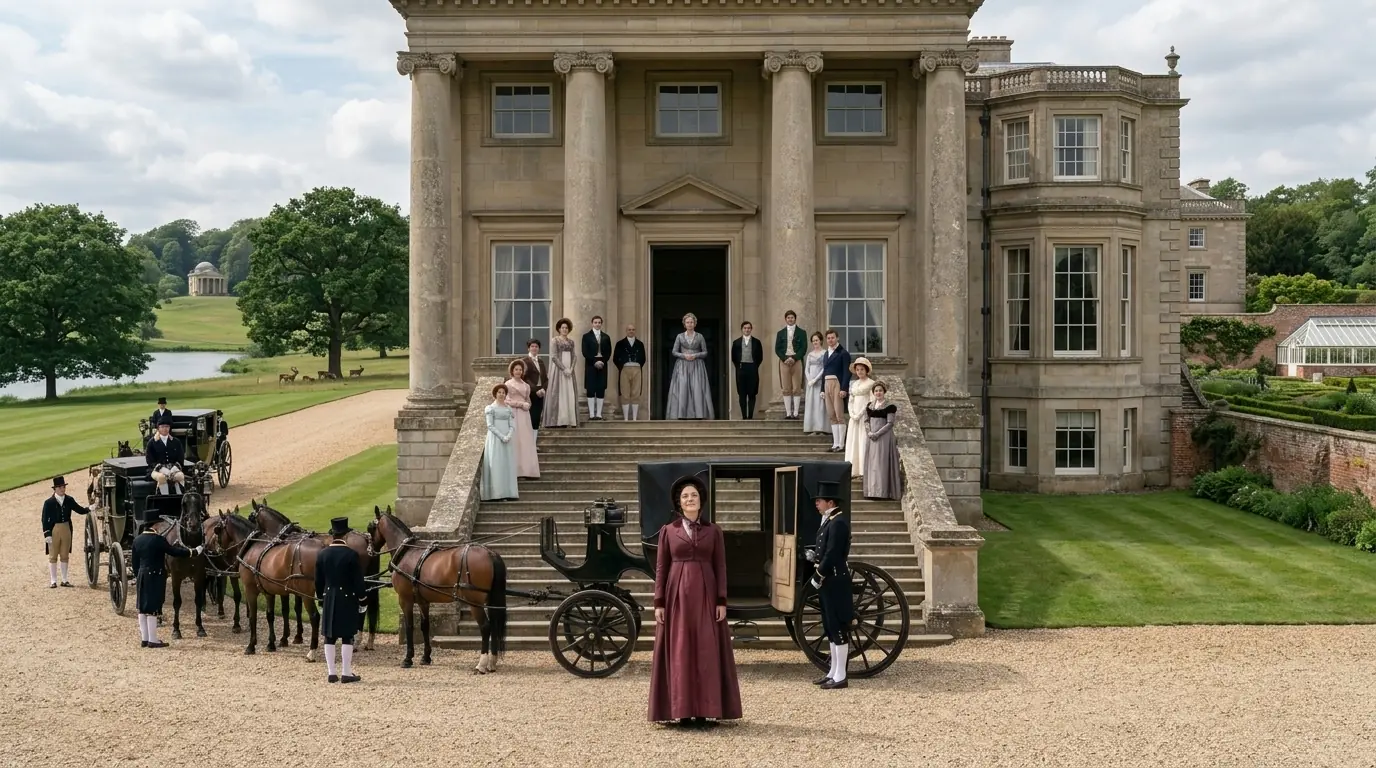
Eudora Vale, Dowager Duchess of Harrogate, stood at the top of the steps in gray silk with her chin lifted, prepared to be gracious to whatever heiress her son had finally been sensible enough to secure. The footman opened the carriage door. A gloved hand came down to the step.
The woman who descended in traveling clothes the color of claret, with her dark hair dressed simply and her gaze level and unhurried, was Clara Ashworth. Clara, the companion they had thrown out of this house at dawn fourteen months before. Clara, accused of theft, marched to the gate before the servants woke, sent into the cold with one trunk and no character.
She looked at the Dowager for the length of one breath. She did not curtsy. She did not speak. She walked up her own steps, past the woman who had ruined her, and into the house as though she had never left it.
The Dowager opened her mouth and found she had nothing to say to a woman who would not give her the courtesy of a single word.
Fourteen months earlier, that same hall had been a different country. The old Duke had been three weeks dead, and the house still moved on tiptoe. Clara Ashworth had come to Harrogate two years before that as companion to Lady Sophia, the Duke's young sister, a position arranged through a clergyman cousin because Clara's father had died, leaving debts where a dowry should have been.
She had no fortune and no rank and a great deal of spine. She had learned early to make herself useful and quiet, the way poor gentlewomen learn or starve. She had not expected to be noticed by the new Duke at all.
Adrian Vale was a man built like the winters of the north: tall, spare, dark-eyed, with a thin white scar running from his left ear down to the line of his jaw, the souvenir of a duel he would not discuss with anyone. He had bought himself a colonel's commission at twenty and come home at twenty-eight, harder than he had left. His father had spent the years between teaching him that softness was a thing other men exploited.
He spoke little. When he did, people listened and were usually sorry.
She noticed him first across the music room the evening after the funeral. He had come in expecting it to be empty and found her there, playing very softly so as not to be heard, a slow, grave piece, the one his father had liked. Most people caught would have stopped and stammered and fled.
Clara had glanced at him, recognized that he did not wish to speak, and simply kept playing to the end before she rose.
"You did not stop," he said.
"You did not ask me to, Your Grace." She gathered her music. "It was his favorite. I thought the room ought to have it once more before we all pretended he had never sat in it."
He looked at her then, the way a man looks at a door he had assumed was a wall. It was the first thing about her he noticed against his own will. Not her face, though her face was worth noticing, but that she had not flinched.
He had spent a fortnight being flinched at. He found he could not stop watching the unbothered set of her shoulders as she left.
After that, he began, without admitting it to himself, to arrange to be where she was. The library at the hour she fetched Sophia's books. The east terrace, where she walked in the gray mornings.
He told himself he was simply moving through his own house. The household, which misses nothing, began to notice that a new Duke was in a great many rooms he had never troubled to enter before.
The first crack came over a ledger. He found her in the steward's room one afternoon with the estate accounts open before her, a thing no companion had any business touching. He had come in to be angry.
"Those are not yours to read."
"No," Clara agreed, not rising, not apologizing. "But Lady Sophia asked me why the household sums had grown so strange, and a girl of seventeen ought to be told the truth about the house she lives in. So I looked."
She turned the ledger toward him and laid one finger on a column. "Someone has been moving money out of the estate and writing it back in as repairs that were never made. The carpentry here was billed three times. The roof at the south wing was billed last spring. The south wing has no roof, Your Grace. It has had no roof since the fire your grandfather never repaired."
He stared at the page. Then he stared at her.
"You see a great deal for a woman paid to read aloud and arrange flowers."
"I see a great deal because no one expects me to see anything," she said. "It is the only advantage poverty gives a woman. I have learned not to waste it."
For one moment, something in her voice slipped, a flat, weary honesty about her own smallness in the world that she had never meant to show him. He saw beneath the composure exactly how hard she worked to keep it. After that, neither of them could quite pretend they had not seen the other plainly.
He did not act on the ledger at once. He should have. The figures pointed, if a man followed them, toward a place he did not want to look: toward his mother's hand.
Instead, he carried the knowledge around like a stone in his coat and found reasons to keep being where Clara was.
The courtship, if a thing so unspoken could be called that, happened on the east terrace in the gray hour before the house woke, because it was the only hour neither of them had to account for. She walked there for the quiet. He had begun walking there because she did.
They never arranged it. They simply both came, morning after morning. At first, they did not speak at all.
Then, one morning, he did.
"My father walked here," he said. "Every day until he could not. I used to think it a waste of an hour a man might have spent doing something."
"And now?"
"Now I think he was the only honest man in the house, and this was the only place he could be it." He glanced at her sidelong. "You are not afraid of me. Everyone is afraid of me. My valet is afraid of me. I should like to know why you are not."