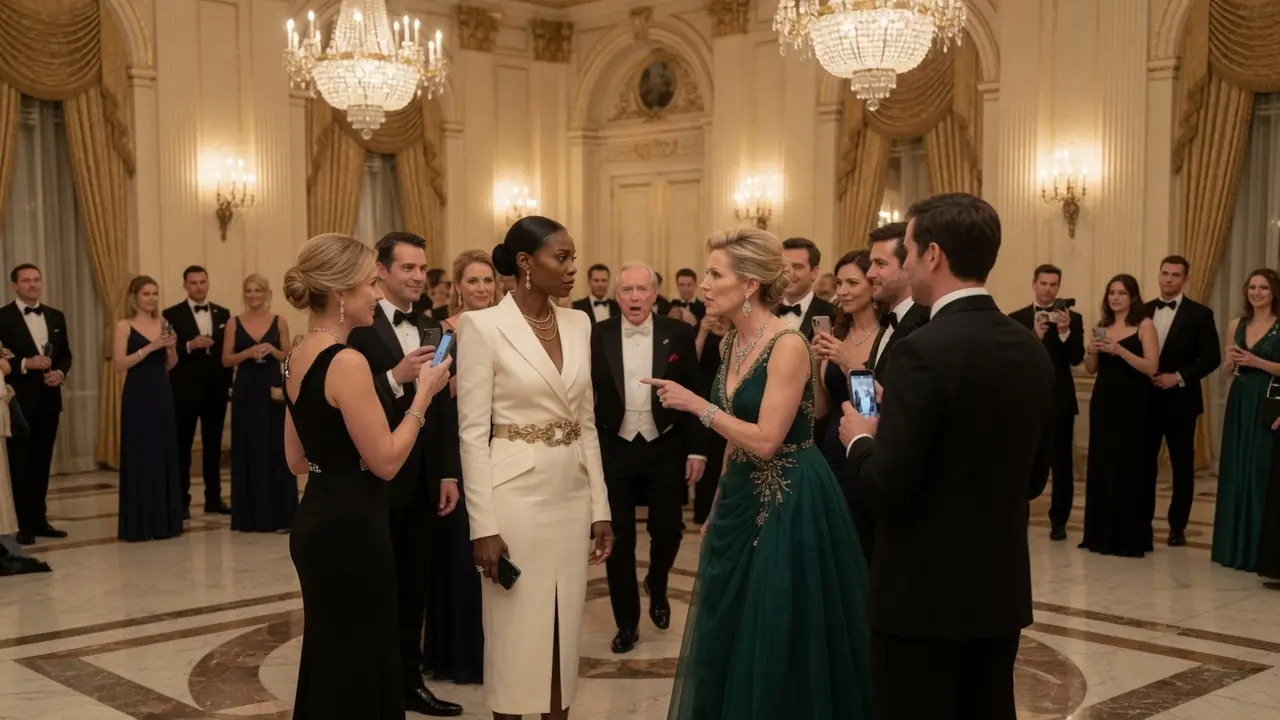
“Girl, don’t just stand there. Pick up a tray.”
The words sliced through the ballroom with the clean, ugly sharpness of crystal breaking against marble.
Every conversation near the east archway softened at once. A violinist in the string quartet missed half a note. Champagne glasses hovered near lips as guests turned toward the woman in the ivory gown who had spoken as if the room belonged to her and everyone inside it had been arranged for her comfort.
Across from her stood a Black woman in a deep emerald evening dress.
She carried no tray. She wore no apron. There was no staff badge clipped to her waist, no headset, no catering gloves, no reason at all for anyone to mistake her for service except the reason already written across the other woman’s face. She held a slim phone to her ear, listening quietly, her posture still and controlled beneath the chandelier light.
The woman in ivory lifted her chin.
“Did you hear me?” she said louder. “People are waiting.”
A ripple of laughter moved through the nearby guests.
Not full laughter. Not brave laughter. The low, nervous kind people use when they want cruelty to be entertainment but still need permission from the room to enjoy it. Several phones rose without shame, screens glowing like tiny witnesses waiting to decide whether this would become a scandal or a joke.
The woman in emerald did not turn away from her call.
She did not flinch.
She did not perform outrage for the guests already leaning in.
Instead, she listened to the voice on the other end of the line, her eyes steady, her jaw relaxed, as if the insult floating around her had not yet earned a place in the order of important things.
The woman in ivory stepped closer.
“This is not some street corner,” she said. “If you’re working this event, act like it.”
Someone behind her snorted.
A man in a midnight blue tuxedo whispered to his wife, “How did she even get past security?”
His wife gave a small shrug.
“Probably with the catering crew.”
The woman in emerald lowered the phone an inch.
Not enough to end the call.
Enough to let the room feel that she had heard everything.
Her eyes moved slowly across the faces turned toward her: amused, uncomfortable, fascinated, silent. She noticed who laughed first. She noticed who looked away. She noticed who raised a phone, who lowered one, and who waited to see where power would land before deciding what they believed.
Then she spoke into the phone.
“Yes,” she said calmly. “I understand the exposure.”
A pause.
“No. Don’t release it yet.”
The woman in ivory frowned.
“Excuse me?”
The woman in emerald held up one finger.
Not rudely.
Precisely.
The gesture was small, but it changed the air.
For the first time that evening, the woman in ivory looked less certain that she understood the scene she had created.
The ballroom belonged to the Ashbourne family, or at least it had for decades in the way old money believes rooms belong to it by inheritance. The gala was being held inside the Royal Ellington Hotel, thirty-two floors above Manhattan traffic, beneath chandeliers imported from Vienna and frescoes restored at a cost no one mentioned because mentioning cost was considered vulgar only when poor people did it.
Guests had come for charity, reputation, networking, and the announcement.
Mostly the announcement.
Ashbourne Holdings, one of the oldest private investment families in the Northeast, was supposed to unveil a “strategic recapitalization partnership” before dessert. That was how the invitation described it. The business press expected a polished statement by morning. Investors expected stability. Banks expected reassurance.
Nobody said rescue.
But everyone closest to the numbers knew better.
The Ashbourne empire was cracking.
Debt had gathered quietly under the marble. Legacy real estate had been borrowed against too many times. A failed infrastructure fund had left holes no gala could cover. Their shipping assets were aging, their media division was bleeding cash, and a private loan facility was coming due faster than their lawyers could rewrite optimism.
The family needed capital.
Not ordinary capital.
They needed money with enough weight to calm lenders, enough credibility to reset Wall Street sentiment, and enough discretion to avoid panic before the ink dried.
They needed Noelle Carter.
And almost no one in that ballroom knew what Noelle Carter looked like.
That was intentional.
Noelle had built Carter Dominion Group from a small restructuring advisory shop in Atlanta into one of the most quietly powerful private capital firms in the country. She did not give glossy magazine interviews. She did not sit on panels titled Women Who Lead. She did not attend Davos breakfasts unless she had already decided who would leave the room owing her something.
Her face was not famous.
Her decisions were.
Entire companies had survived because her signature arrived in time. Others had collapsed because she declined to answer one final call. She specialized in distressed empires whose owners still thought prestige could replace discipline.
The Ashbournes were exactly that kind of empire.
Noelle had come to the gala not to be celebrated, but to observe.
Tonight, the room had spoken quickly.
The woman in ivory was Meredith Ashbourne.
Forty-one, beautiful, polished, and born into a family that called inheritance stewardship because entitlement looked better in Latin on a foundation wall. She was the patriarch’s niece, a board member by blood, and the person most likely to say aloud what others in her family only dressed in strategy memos.
Meredith looked Noelle up and down again.
The emerald dress was expensive, but not loud. The diamonds in Noelle’s ears were small. Her hair was pulled back, her makeup understated, her clutch plain black. To a person trained to recognize power only when it announced itself, Noelle looked incorrectly placed.
That was enough for Meredith.
“Hello,” Meredith snapped. “Are you deaf?”
Noelle ended the call.
The small sound of the line disconnecting landed harder than it should have.
She slid the phone into her clutch and finally looked directly at Meredith.
“I’m not staff,” she said.
Her voice was quiet.
The kind of quiet that did not ask to be believed.
Meredith gave a bright, empty laugh.
“Everyone says that when they’re embarrassed.”
Noelle did not answer.
That unsettled people more than anger would have.
Anger gave the room a category. Silence gave it work to do. Guests shifted in their shoes, suddenly aware that they were recording a woman who did not seem afraid of being recorded.
Meredith turned slightly toward her circle, smiling as if inviting them back into safety.
“Well,” she said, “whoever you are, standing in the middle of the service lane looking confused is not a great look.”
A few people laughed.
Fewer this time.
Noelle glanced toward the service lane behind her.
It was six feet away.
She had been standing near a marble column, outside the path of the waiters, taking a private call from her general counsel in London. Meredith had not mistaken geography. She had mistaken hierarchy.
Noelle stepped aside anyway.
Not because Meredith asked.
Because she wanted to see who relaxed when she moved.
A waiter passed with a tray of champagne. He looked at Noelle, hesitated, then skipped her, uncertain now whether offering her a drink would insult her or correct the earlier insult too obviously. Noelle noticed that too.
Rooms, like markets, revealed themselves through hesitation.
Across the ballroom, Edmund Ashbourne checked his phone for the fourth time in two minutes.
Edmund was seventy-two, silver-haired, thin, and dressed in a black tuxedo that made him look more permanent than his balance sheet. He stood near the bar speaking with a senator, but his attention kept drifting toward the far side of the room. He had been told Noelle Carter had arrived. He had not been told where she was.
His counsel, Martin Bell, whispered something into his ear.
Edmund followed Martin’s gaze.
For the first time that evening, he saw the woman in emerald.
Not looked at.
Saw.
His expression tightened with the faint, sick awareness of a man realizing he might have been standing in a burning building while admiring the wallpaper.
Noelle’s phone vibrated inside her clutch.
She did not check it.
She already knew what it would say.
The recapitalization documents were sitting in escrow. The announcement language was loaded in the press queue. The bridge financing would save Ashbourne Holdings from a liquidity event that would otherwise begin before the end of the quarter. Everything was ready.
Except her consent.
Meredith took another sip of champagne.
She mistook Noelle’s stillness for defeat.
That was a common error among people who had never had to earn their power. They confused quiet with weakness because noise had always worked for them.
“You’re still here,” Meredith said.
Noelle looked at her.
“Yes.”
“Then maybe explain what you’re doing in my family’s event.”
Noelle’s eyes moved once around the ballroom.
The guests leaned in again.
Phones rose again.
Edmund began moving toward them, but too slowly, blocked by donors, cousins, bankers, and people who did not yet understand they were standing between him and the most expensive mistake of his family’s modern history.
Noelle said, “Observing.”
Meredith laughed.
“Observing? That’s adorable.”
A young woman in a black dress near the dessert table lowered her phone and whispered, “Meredith, stop.”
Meredith heard her.
That made it worse.
She turned sharply.
“Don’t be dramatic, Paige.”
Paige flushed and looked away.
Noelle remembered her.
Paige Ashbourne. Younger cousin. No board seat. No power in the family beyond the courage she could still gather in rooms designed to train it out of her.
Meredith faced Noelle again, irritation hardening.
“Look, I don’t know who invited you, but people like you don’t get to just hover in rooms like this and act mysterious.”
The sentence landed.
Not loudly.
Deeply.
The phrase people like you moved through the guests and changed them in visible ways. Some looked down at their glasses. Some watched Noelle. Some watched Meredith, already calculating distance from a remark that might cost something if the woman in emerald turned out to matter.
Noelle did not move.
“People like me,” she repeated.
Meredith’s smile flickered.
“You know what I mean.”
“Yes,” Noelle said. “I do.”
That answer did not help Meredith.
It sharpened the moment until even the string quartet stopped pretending.
Edmund finally broke through the crowd.
“Meredith,” he said.
His voice carried warning.
She turned, annoyed. “Uncle Edmund, I’m handling something.”
“No,” he said, his eyes fixed on Noelle. “You are not.”
The room cooled.
Meredith looked from Edmund to Noelle, then back again.
For the first time, uncertainty entered her face.
Edmund stepped forward and forced a smile that belonged in boardrooms and funerals.
“Ms. Carter,” he said. “We are honored you could join us.”
The silence that followed was absolute.
Phones moved higher.
One champagne glass struck the edge of a table with a small, nervous click.
Meredith stared at Noelle.
“Ms. Carter?”
Noelle looked at Edmund.
“Mr. Ashbourne.”
His smile tightened.
“I was told you had arrived, but I regret that I was not there to personally greet you.”
“No,” Noelle said. “You were not.”
The words were simple.
The room heard all of them.
Meredith looked as if the floor had shifted under her.
“You’re Noelle Carter?”
Noelle finally turned back to her.
“Yes.”
The word did not come with triumph.
That made it worse.
Meredith’s face drained slowly, color leaving in stages as memory began assembling itself: the deal, the press language, the whispered reverence around Carter Dominion, the private capital savior arriving tonight under strict discretion, the woman she had ordered to serve champagne in front of half the people her family needed to impress.
“I didn’t know,” Meredith said.
Noelle’s expression did not change.
“That is not an excuse. It is the diagnosis.”
Edmund closed his eyes for half a second.
Martin Bell stepped beside him, already sweating.
“Ms. Carter, perhaps we should move this conversation somewhere more private.”
Noelle looked around the ballroom.
“Why? The insult was public.”
Martin’s mouth closed.
Meredith tried to recover.
“I made a mistake.”
“No,” Noelle said. “A mistake is calling someone the wrong name. What you made was an assumption.”
“I was under pressure tonight.”
“So was your family’s balance sheet.”
That sentence moved through the room like a knife drawn quietly from silk.
Several people looked at Edmund.
He had been hoping no one would say the quiet part under the chandeliers.
Noelle continued.
“I came tonight to observe leadership culture before approving the final release. I wanted to see how your family operated outside the sanitized version your advisors prepared for me.”
Meredith swallowed.
“You can’t be serious.”
Noelle tilted her head slightly.
“That has been said to me in many rooms before men started asking for extensions.”
A few guests reacted before they could stop themselves.
Not laughter.
Something sharper.
Recognition.
Edmund stepped closer.
“Noelle, please. Let us repair this properly.”
“You had the opportunity.”
“We still do.”
“No,” she said. “You have the desire. Those are not the same thing.”
Martin leaned toward Edmund and whispered urgently.
Edmund’s phone buzzed.
Then Martin’s.
Then two bankers near the bar checked theirs at the same time.
Noelle had not yet canceled anything.
But she had allowed uncertainty to enter the system.
In finance, uncertainty is not air.
It is gasoline.
The host at the stage tapped the microphone.
The sound cracked through the room.
“Ladies and gentlemen,” he began, smiling too widely, “if I may have your attention, we are delighted to move toward tonight’s special announcement.”
Edmund turned so sharply he nearly bumped into Martin.
“Stop him,” he hissed.
Martin moved toward the stage.
Too late.
The host continued.
“Tonight marks a new chapter for Ashbourne Holdings, one built on partnership, trust, and enduring confidence.”
Noelle looked at Meredith.
Trust.
The word sat between them, almost funny.
Her phone vibrated again.
This time, she removed it from her clutch.
A message from her general counsel appeared.
Final approval window open. Proceed with release or pause?
Noelle read it once.
Then looked up.
Meredith’s eyes were fixed on the phone.
Edmund’s too.
The ballroom had divided itself now between those who understood the stakes and those who were still catching up. The guests nearest the stage applauded politely, unaware that the ceremony they were clapping for had become fragile enough to break under one thumb.
Meredith stepped toward Noelle.
“Ms. Carter, I am sorry.”
The apology arrived too fast, polished by panic before it touched truth.
Noelle looked at her.
“Are you sorry for what you said, or sorry you said it to me?”
Meredith opened her mouth.
Nothing came out.
That was answer enough.
Noelle typed one word.
Pause.
She sent it.
Nothing changed immediately.
That was the mercy and cruelty of consequences at this level. They did not arrive with thunder. They arrived as screens refreshing, lawyers going pale, assistants leaving ballrooms to make calls they hoped were mistakes, bankers suddenly remembering clauses they had skimmed because the deal had seemed guaranteed.
On stage, the host continued speaking.
Edmund’s phone buzzed again.
Martin returned from the stage looking bloodless.
“Sir,” he whispered, “the release has been frozen.”
Edmund stared.
“What?”
“The escrow instruction is paused. Carter Dominion has not authorized funding.”
A banker behind him muttered, “No.”
Another guest looked at his phone.
The first alert had appeared on a private terminal.
Then another.
Then a third.
Ashbourne recapitalization announcement delayed pending final review.
That was the public version.
People closest to the debt heard the real one.
The money was no longer protected.
Meredith looked around as if searching for someone who could make the room obey her again.
Noelle put the phone away.
“I came here prepared to sign,” she said.
Edmund’s voice lowered.
“And now?”
“Now I know what your family protects when it thinks no one important is listening.”
Meredith flinched.
Noelle turned slightly, addressing not only Edmund now, but the room.
“The issue is not that your niece mistook me for staff. Staff deserve dignity too. The issue is that she believed staff could be spoken to that way. The issue is that people laughed. The issue is that most of you waited to see whether I mattered before deciding whether cruelty did.”
No one spoke.
The words had nowhere soft to land.
Paige Ashbourne stepped forward from near the dessert table.
“She’s right.”
Meredith turned on her. “Be quiet.”
Paige’s voice shook, but she did not retreat.
“No. I watched it happen. We all did.”
That mattered.
Not enough to save the deal.
Enough to tell Noelle the room was not completely dead.
Edmund looked at Paige with something like fury, but he was too afraid of Noelle now to correct the wrong person publicly.
Noelle studied the younger woman.
Then she looked back at Edmund.
“The recapitalization is suspended.”
Edmund gripped his phone.
“Suspended is not withdrawn.”
“No,” Noelle said. “Not yet.”
Relief flashed across his face before she finished.
“But the terms have changed.”
Martin Bell’s shoulders sank.
He knew before Edmund did.
Noelle continued.
“Carter Dominion will not provide silent capital to preserve family control. If Ashbourne Holdings wants my liquidity, it will accept independent governance review, removal of family veto authority over operating divisions, disclosure of related-party transactions, and a revised board structure with external oversight.”
Edmund’s face hardened.
“That would effectively strip us of control.”
“No,” Noelle said. “Your debt did that. I am merely refusing to disguise it.”
Meredith’s voice came out thin.
“You’re doing all of this because of one comment?”
Noelle turned to her.
“No. I am doing this because one comment revealed the room that built the company asking me for money.”
The silence stretched.
Then phones began ringing in earnest.
Bankers stepped away.
Advisors whispered urgently.
Guests checked financial alerts, group chats, investor feeds, and private messages from people who had heard that the Ashbourne announcement had gone wrong in real time.
The gala stopped being a celebration.
It became a market event.
Noelle walked toward the exit.
No one blocked her.
Edmund followed two steps.
“Ms. Carter, please.”
She stopped with her hand near the ballroom door.
“Choose quickly,” she said. “By morning, your lenders will know the announcement failed. By noon, your competitors will know why. By tomorrow evening, your family can either be negotiating with me under revised terms or explaining to the market why you chose pride over solvency.”
Meredith whispered, “This is blackmail.”
Noelle looked at her one final time.
“No, Meredith. This is leverage. Your family should recognize it. You’ve been living on it for generations.”
Then she walked out.
The corridor outside the ballroom was quiet.
Soft carpet.
Gold sconces.
A security guard near the elevator stood straighter as she passed, finally recognizing from someone’s urgent headset whisper that the woman leaving alone was the most important person in the hotel.
Noelle did not look back.
Inside the ballroom, the collapse had begun politely.
That was always how rich panic started.
No screaming at first. No overturned tables. Just urgent whispers, forced smiles, men moving toward corners, women checking phones, lawyers disappearing behind curtains, and family members learning that public humiliation had a private cost when directed at the wrong person.
Wrong person.
Noelle disliked that phrase.
There was no right person to degrade.
Her car waited beneath the hotel awning.
The driver opened the door.
“Back to the office, Ms. Carter?”
“No.”
She looked toward the rain beginning to bead against the black car roof.
“Drive.”
“Anywhere specific?”
“South.”
He nodded.
Noelle sat in the back seat as the hotel lights receded behind her.
Manhattan moved past the window in silver streaks: wet pavement, late taxis, restaurant awnings, people crossing streets with coats pulled tight. Her phone buzzed every few seconds now. Counsel. Analysts. Her chief operating officer. A journalist who should not have had her number. Two missed calls from Edmund Ashbourne.
She answered none of them.
Not yet.
The decision had not been emotional.
Emotion was there, yes. She was human, not marble. The word girl had landed. The phrase people like you had landed harder. The laughter had landed in a place she kept carefully locked, a place built from bank lobbies, conference rooms, private clubs, and board dinners where people assumed she was the assistant until the wire transfers cleared.
But she had not paused the deal because Meredith hurt her feelings.
She paused it because Meredith revealed risk.
Culture risk. Governance risk. Judgment risk. The kind that never appears honestly in diligence packets because people who inherit power rarely write down the habits that protect them from accountability.
Noelle had saved companies run by difficult people before.
But arrogance was manageable only when attached to competence.
The Ashbournes had arrogance attached to denial.
That was different.
By 2:00 a.m., Ashbourne’s lenders had begun calling one another.
By 5:30, private market desks were trading rumors.
By 7:10, the first careful headline appeared.
Ashbourne Holdings Delays Capital Partnership Announcement Amid Governance Review.
By 8:00, the company’s bonds had widened sharply.
By 9:15, Edmund Ashbourne requested an emergency call.
Noelle accepted at 9:30.
She was in her office by then, wearing a cream blouse, no jewelry, and the calm expression of someone who had already slept enough because her decision had been clean.
Edmund appeared on screen with Martin Bell and two external advisors.
Meredith was not present.
That was wise.
“Noelle,” Edmund began.
“Ms. Carter.”
His mouth tightened.
“Ms. Carter. I want to begin with an apology.”
“No,” she said.
He blinked.
“No?”
“You want to begin with damage control. Begin with the revised terms.”
Martin glanced at Edmund.
The old man looked as if he had aged a year overnight.
“We reviewed your conditions.”
“And?”
“They are severe.”
“They are proportionate.”
“They will end Ashbourne family control.”
“They will end the illusion of Ashbourne family control,” Noelle said. “The banks ended the reality months ago.”
One advisor looked down.
Edmund heard the truth and hated that he could not afford to reject it.
“What happens to our employees?” he asked.
That was his best sentence of the call.
Noelle noticed.
“If you accept, operations continue. Debt is restructured. Nonperforming divisions are sold or recapitalized. Payroll holds. Retirement obligations are protected under supervision.”
“And if we refuse?”
“You will enter a public liquidity crisis before the end of the week, and people far less patient than I am will begin feeding on what remains.”
Edmund closed his eyes.
He had spent decades believing that the Ashbourne name would always create another exit.
Now the only exit had a woman he had failed to recognize standing beside it.
“We need time,” he said.
“You have until four.”
“That is not enough.”
“It is enough to decide whether pride is more valuable than survival.”
The call ended without warmth.
At 3:42 p.m., Ashbourne accepted.
At 4:00 p.m., Carter Dominion issued a statement.
Not long.
Not dramatic.
Carter Dominion Group has entered a revised restructuring agreement with Ashbourne Holdings, subject to enhanced governance oversight, independent board restructuring, and leadership accountability measures. The agreement prioritizes operational stability, creditor confidence, and long-term institutional discipline.
Wall Street understood immediately.
The rescue had become a takeover in everything but name.
By evening, Edmund Ashbourne resigned as executive chairman.
Meredith Ashbourne was removed from the board pending an internal culture and conduct review.
Paige Ashbourne was appointed to a transition advisory role because she had been the only family member in the ballroom willing to say the obvious while power was still uncertain.
The videos from the gala leaked anyway.
Of course they did.
The first clip showed Meredith pointing at Noelle.
The second captured the words people like you.
The third captured Noelle saying, “Staff deserve dignity too.”
By midnight, the internet had named the event Emerald Night.
Noelle hated that too.
The world liked symbolism because symbolism was easier to consume than structure.
A woman in a green dress walked out and shook Wall Street.
It made a good headline.
But the real story was not the dress.
The real story was that an old empire had been sick long before one woman insulted another beneath a chandelier. The insult did not create the crisis. It exposed the judgment that had allowed the crisis to grow.
Three weeks later, Noelle returned to Ashbourne headquarters.
Not the ballroom.
The office.
The building lobby had marble floors, a bronze family crest, and a reception desk where two guards stood as if posture could prove institutional health. Employees watched from behind glass walls as she walked in with her legal team and operating partners.
Nobody mistook her for staff this time.
That did not impress her.
Respect born from fear was still only fear in better clothes.
The restructuring was brutal but disciplined.
Three vanity divisions closed.
Two profitable units received new leadership.
Golden parachutes tied to failed performance were challenged.
Private family loans hidden inside consulting arrangements were exposed and unwound.
Employees who had been warning management for years were finally interviewed by people who did not report to Ashbourne cousins.
Noelle read every summary.
One stood out.
A facilities manager named Denise Porter had filed six complaints about Meredith Ashbourne’s behavior toward building staff. Dismissive language. Public humiliation. Threats to replace entire teams after minor mistakes. Each complaint had been marked resolved after “informal coaching.”
Denise had never been interviewed.
Noelle asked to meet her.
Denise arrived in a navy cardigan, carrying a notebook and an expression that said she had expected another trap.
Noelle stood when she entered.
“Ms. Porter, thank you for coming.”
Denise looked briefly surprised by the title.
Then cautious.
“I filed those complaints because my staff was afraid.”
“I know.”
“No one cared.”
“I know.”
Denise’s face hardened.
“Knowing after the fact doesn’t help the woman who cried in the supply closet because Meredith called her invisible.”
Noelle absorbed that.
“You’re right.”
That answer seemed to disarm Denise more than any defense would have.
Noelle continued.
“I want you to help design the new staff dignity policy.”
Denise laughed once.
“Staff dignity policy sounds like something expensive people name after getting caught.”
“It can be,” Noelle said. “Unless someone who knows the building writes it.”
Denise studied her.
“You really want my input?”
“No,” Noelle said. “I want your authority.”
That was how Ashbourne’s internal culture review began not in the boardroom, but with facilities, reception, assistants, drivers, cleaners, security guards, and junior analysts who had spent years learning where the family’s manners ended.
The report was ugly.
Noelle preferred ugly reports.
They were less expensive than beautiful lies.
Six months later, Ashbourne Holdings looked smaller.
But stronger.
The family still owned shares, but not control. The board included independent directors with actual authority. Employees had reporting channels outside family management. Executive conduct policies applied to relatives as well as hired professionals. Debt was extended. Panic faded. Investors stopped asking whether Ashbourne would collapse and began asking what it might become without the weight of pretending.
Meredith disappeared from public view.
At first, she issued a statement about misunderstanding and stress.
No one believed it.
Later, after lawyers and family pressure failed to restore her position, she wrote a private letter to Noelle.
It was three pages.
Noelle read one.
The letter said Meredith was ashamed. It said she had grown up in rooms where staff were treated like furniture and never questioned it. It said she did not expect forgiveness. It said, clumsily but not falsely, that losing the board seat was the first time she understood a title had been protecting a person she did not like very much.
Noelle did not respond.
Not every apology required participation from the person harmed.
A year after Emerald Night, Carter Dominion held its annual leadership retreat in Atlanta.
No ballroom.
No chandeliers.
No quartet.
Just a converted warehouse with exposed brick, long tables, working sessions, and coffee strong enough to make analysts honest.
During the closing discussion, a young associate asked Noelle whether she had known immediately that she would suspend the Ashbourne deal.
Noelle sat at the head of the table for a moment before answering.
“No.”
The room waited.
“I knew immediately that Meredith Ashbourne had revealed something. I did not know whether the institution had enough integrity left to correct it.”
“What decided it?”
“Silence.”
The associate frowned.
“Whose silence?”
“Everyone’s.”
Noelle looked around the room.
“When a person with status humiliates someone they believe has none, the room becomes evidence. Laughter is evidence. Silence is evidence. Intervention is evidence. The same is true inside companies. Bad cultures do not survive because one person is cruel. They survive because the room learns to adapt around cruelty.”
No one typed for a few seconds.
They just listened.
Noelle continued.
“The reason Ashbourne nearly collapsed was not Meredith’s insult. It was the ecosystem that had trained people to treat it as normal until they discovered cost attached to it.”
The associate nodded slowly.
“And the lesson?”
Noelle smiled faintly.
“Never confuse access with power. Never confuse manners with ethics. And never fund a room that only discovers dignity when capital walks out.”
That line traveled through Carter Dominion faster than any official memo.
Two years later, the Royal Ellington ballroom reopened after renovation.
New chandeliers.
New marble polish.
New staff uniforms.
The hotel invited Noelle to attend the reopening fundraiser.
She declined.
Paige Ashbourne attended instead, now serving as chair of the restructured foundation. During her speech, she did not mention Emerald Night by name. She did not need to. Everyone in that room remembered, or at least remembered that they were supposed to.
Paige stood beneath the chandelier and said, “A room reveals its values not by how it treats the powerful, but by how it behaves before power identifies itself.”
Noelle watched the clip the next morning from her office.
Then she closed the laptop and went back to work.
That was all the ceremony she needed.
Years later, people still told the story simply.
A Black woman walked into a gala.
A rich heiress mistook her for staff.
The woman turned out to be the CEO holding the billion-dollar rescue deal.
The deal vanished.
Wall Street shook.
All true.
But incomplete.
The real story was not that Meredith Ashbourne insulted the wrong Black woman.
There was no right Black woman to insult.
No right waiter.
No right cleaner.
No right assistant.
No right driver standing near a wall waiting for instruction.
No right human being to reduce in public because a room taught you that money makes your voice larger than their dignity.
Noelle Carter did not need the ballroom to know her name.
Her name had already moved through contracts, debt schedules, bridge financing, board resolutions, and quiet calls between people who understood power without needing to see its face.
But the ballroom needed to know hers.
Not because she wanted recognition.
Because the people inside it had failed a test they did not know they were taking.
That was the part Noelle remembered most clearly: not Meredith’s voice, not the laughter, not the phones, not Edmund’s face when he realized who she was.
She remembered Paige whispering, “Stop.”
Too softly.
Too late.
But still.
In every room, there is usually one person who knows the truth before it becomes safe to say it.
Noelle built her life around finding that person.
And when she found them, she gave them enough power to speak earlier next time.
Because money could restructure a company.
Governance could rescue a balance sheet.
Contracts could discipline an empire.
But only courage could change the room before cruelty finished its sentence.