“Just fix the tractor and leave,” one of the wealthy landowners scoffed, looking Caleb Morrison up and down as if the grease on his shirt made him invisible. Caleb said nothing. He had forty-three dollars in his wallet, a rent-increase notice folded inside his shirt pocket, and his seven-year-old daughter asleep in the back seat of his truck beneath a pink jacket she had been using as a blanket. His repair shop was three weeks behind on rent, his compressor had begun making a noise he could not afford to diagnose, and two customers still owed him enough money to cover half a month’s payroll if either of them ever paid. None of that belonged to the two men standing beside the broken John Deere on County Road 7. Caleb wiped his hands on a rag, crouched beside the tractor, and went back to work.
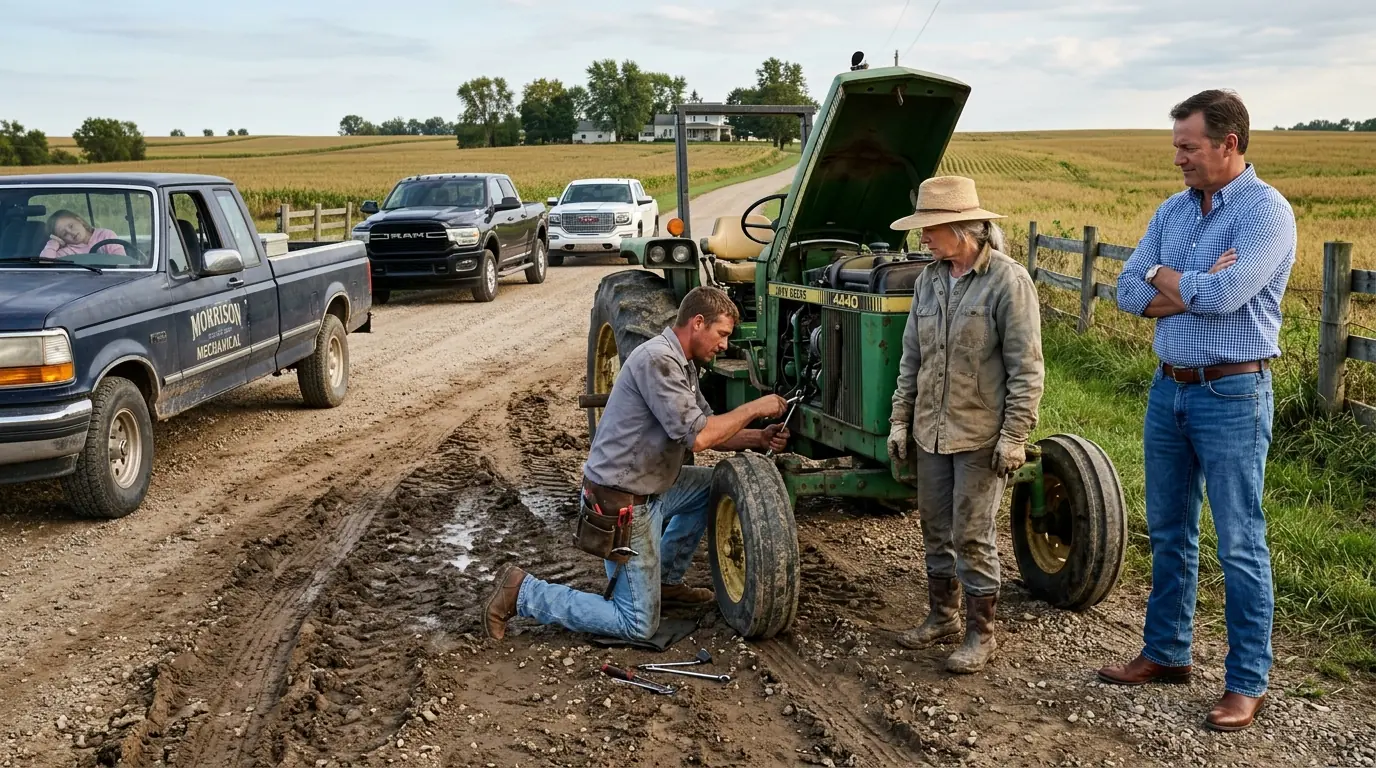
Twenty minutes earlier, he had almost driven past. The tractor was angled halfway into the ditch with its hood raised, and an older woman stood beside it in muddy boots, canvas pants, and a faded wide-brimmed hat. Caleb had been on his way nowhere in particular after leaving the county tax office with another reminder that Morrison Mechanical’s property taxes were due soon. Fuel cost money. Stopping cost time. Free work had become a luxury he could barely afford. Then he remembered something his father used to say whenever they passed a stranded farmer: If you know how to help and keep driving, make sure you’re willing to own whatever happens next. Caleb had cursed the old man quietly, slowed his truck, and pulled onto the shoulder.
The woman introduced herself simply as Elaine. Her handshake surprised Caleb because her palm was rough, her grip strong, and there was black soil beneath one thumbnail. She did not look like someone who owned a decorative hobby farm and called a dealership whenever a warning light appeared. “Started coughing under load,” she explained. “Then it lost power. I got it off the road before it died completely.” Caleb asked what the tractor had been doing. “Pulling a mower.” “Any warning lights?” “None.” “Fuel level?” “Little under half.” “Any recent service?” Elaine thought for a moment and said the fuel filters had been changed in spring. Caleb nodded and leaned beneath the hood. “Let’s not buy anything until we know what’s actually broken.”
That sentence made Elaine look at him more carefully. Caleb did not notice. He had already begun with the boring things. He checked the air intake, inspected obvious electrical connections, looked for fresh leaks, and cracked the fuel cap slowly. The tractor was not ancient, but it had enough hours on it that age-related fuel problems were believable. Elaine started it again at his request. The diesel caught, idled unevenly, then smoothed. Caleb listened for almost a minute before asking her to bring the engine gently above idle. It stumbled under increased demand. He shut it down and traced the fuel supply back toward the tank.
Elaine stood beside him without offering suggestions. “You always listen that long?” she asked. Caleb shrugged. “Cheaper than guessing.” “Dealership replaced a sensor on my neighbor’s machine last month before finding the bad connector.” Caleb glanced up. “Could happen to anybody.” Elaine smiled slightly. “You’re not going to insult the competition?” “Wouldn’t fix your tractor.” He removed a section of protective cover and found a supply hose that looked normal until he squeezed it. The inner wall had softened and partially collapsed, restricting fuel flow when demand increased. “There,” he said. “At least part of it.”
Elaine crouched beside him. “That little hose did all this?” “Maybe. We verify before celebrating.” Caleb disconnected the line, checked for contamination, inspected the filter housing, and found no sign that the injection system itself had failed. The tank vent was clear. The fuel was clean. The short section of deteriorated hose was behaving like a valve under suction, collapsing harder as the engine demanded more fuel. Caleb had a length of diesel-rated hose in his truck because an older irrigation engine had needed the same size the week before. It was not a permanent restoration of every aging line on the tractor, but it could safely replace the failed section and get Elaine home.
That was when the two pickups arrived. They were expensive enough that neither had probably carried feed in years. The first belonged to Brent Caldwell, whose family farmed nearly six thousand acres east of Grover Falls. The second belonged to Thomas Vance, who owned land, grain storage, and enough commercial property around the county that his name appeared on buildings more often than most people’s did on mailboxes. Both men knew Elaine. Neither knew Caleb. Brent climbed out, looked at the faded MORRISON MECHANICAL lettering on Caleb’s truck, and asked, “You call a roadside mechanic?”
Elaine answered, “I didn’t call anybody. He stopped.” Brent looked Caleb over slowly. The inspection began at the stained work boots, moved across the faded jeans, paused at the grease-darkened shirt, and ended at Caleb’s face. “Just fix the tractor and leave,” he said. “Elaine doesn’t need a sales pitch.” Caleb straightened. “I haven’t offered one.” Thomas laughed under his breath. “Everybody offers one eventually.” Caleb looked at him. “Then I’ll disappoint you.” He crouched again.
That irritated them more than an argument would have. Brent walked closer and asked, “What’s wrong with it, then?” Caleb pointed to the removed fuel line. “Inner liner collapsed. Restricts supply under load.” Brent looked skeptical. “That’s it?” “That’s what I’ve found.” “You sure it isn’t the injection pump?” Caleb shrugged. “Could create similar symptoms, but I don’t have evidence for that yet.” Thomas folded his arms. “Dealership would probably replace the assembly.” Caleb fitted the new hose and tightened the clamps. “Maybe if testing justified it.” “And if it doesn’t?” “Then they shouldn’t.”
Elaine watched him while the two men continued talking as though Caleb were not there. She had spent four decades around farm equipment and recognized the difference between a mechanic diagnosing a problem and a salesman building an invoice. Caleb explained nothing unless she asked. He did not invent secondary failures. He did not tell her every hose on the tractor was about to fail because one had. He recommended inspecting the remaining fuel lines at the next scheduled service, checking clamps, and replacing anything showing softening or cracks. Then he wiped the spilled diesel, inspected the connection again, and said, “Try it.”
Elaine climbed into the cab and started the tractor. The engine settled quickly. Caleb had her raise the rpm and hold it. No stumble. Then he asked her to engage the mower only after confirming everyone was clear and to load the engine briefly while stationary. The diesel note deepened but remained steady. Caleb listened, watched the line, and finally nodded. “That should get you back. I’d still have the rest of the fuel hoses inspected before putting it through a full day.” Elaine shut the machine down. “So you’re not telling me you fixed everything forever?” Caleb smiled. “I fixed what failed today.”
Brent gave a dismissive shrug. “There. Done.” Thomas glanced toward the truck. “What’s the damage?” Elaine looked at Caleb. “How much?” He thought about the forty-three dollars in his wallet. He thought about the landlord’s notice pressing against his chest. He thought about the electric bill sitting unopened on his shop desk because opening it would not make the number smaller. Then he looked at the six inches of hose he had used, the twenty-something minutes of labor, and the woman who had been stranded on a rural road. “Nothing,” he said.
Elaine’s expression changed. “Nothing?” Caleb shook his head. “It’s a piece of hose and half an hour.” “Your time has value.” “Usually.” “Today doesn’t?” Caleb glanced toward his truck. Lily was still asleep. “Today I was driving by.” Elaine studied him. “That isn’t an answer.” Caleb smiled faintly. “Then help somebody else when you get the chance.” Brent laughed as though Caleb had made the stupidest business decision he had ever witnessed. “There’s your problem right there. Running a shop like a charity.” Caleb did not look at him. “Nobody asked you to audit it.”
The rear door of Caleb’s truck opened. Lily Morrison climbed out rubbing her eyes, her curly brown hair flattened on one side from sleeping against the seat belt. “Dad?” Caleb turned immediately. “Right here, bug.” She looked at the tractor, the strangers, and the grease on his hands. “You fixing something again?” “Looks that way.” Lily climbed down carefully and walked to him carrying her backpack. Elaine smiled. “You his supervisor?” Lily nodded seriously. “Sometimes.” Caleb said, “She’s expensive management.”
Elaine’s eyes moved toward the faded logo on Caleb’s truck. Morrison Mechanical — Grover Falls — Farm & Industrial Repair. She stared at it longer than before. “Your shop is in Grover Falls?” “Yes, ma’am.” “On Mill Road?” Caleb nodded. “Old cinder-block building near the feed store.” Elaine’s expression became suddenly unreadable. “Your father was Daniel Morrison?” Caleb stopped wiping his hands. “Yes.” “Daniel Joseph Morrison?” “Yes.” Brent and Thomas exchanged a look.
Elaine asked, “He died about eight years ago?” Caleb nodded slowly. “Nine next month.” She looked toward the truck again. “And you kept the shop?” “Tried to.” Something passed across her face that Caleb could not identify. Not sympathy. Recognition. She reached into her jacket and removed an old smartphone in a thick protective case. Brent stepped toward her. “Elaine, you don’t need to—” She silenced him with one raised hand and dialed a number.
The person answered quickly. Elaine never took her eyes off Caleb. “Tom? It’s Elaine Mercer.” Caleb noticed Brent’s jaw tighten. Elaine continued, “I found him.” There was a pause on the other end. “Yes. Morrison Mechanical. Daniel’s son.” Another pause. Elaine smiled for the first time without restraint. “No. Don’t call him yet. Bring the records to the house. And tell Susan to stop the vendor meeting until tomorrow.” Brent went pale.
Caleb looked from Elaine to Brent. “Found me for what?” Elaine ended the call. “Something I should probably explain before these two explain it badly.” Thomas gave an uncomfortable laugh. “Nobody was going to explain anything.” Elaine looked at him. “That’s been part of the problem.” She turned to Caleb. “Do you have another job today?” Caleb glanced at his truck. “Not one anybody’s paying me for.” “Then come to my place. It’s eight miles north.” He hesitated. “Ms. Elaine, I appreciate whatever this is, but I need to get Lily home eventually.” Elaine looked at the girl. “Does she like horses?” Lily’s head snapped up. Caleb sighed. “That was manipulative.” Elaine smiled. “Effective, though.”
Mercer Ridge Farm began three miles beyond the next crossroads. Caleb had driven past its outer fields hundreds of times without understanding how far the property extended. There was no giant ornamental gate, only a weathered stone marker and a cattle guard. Beyond it stretched hay fields, soybean ground, pasture, grain bins, machine sheds, and a line of mature oaks leading toward a white farmhouse older than any building in Grover Falls. Caleb followed Elaine’s tractor in his pickup while Brent and Thomas drove behind. Lily pressed her face against the window when she saw horses in a pasture. “Dad, she has like a million acres.” Caleb smiled. “Probably not a million.” He was less certain five minutes later.
The main equipment yard answered the question of why Brent had gone pale. Caleb counted three combines, six large tractors, two self-propelled sprayers, grain carts, balers, skid steers, excavators, trucks, irrigation pumps, and equipment belonging to neighboring farms parked near a service building nearly twice the size of Morrison Mechanical. A sign beside the office read MERCER AGRICULTURAL COOPERATIVE — FLEET OPERATIONS. Caleb slowed. He had heard of Mercer Cooperative. Everyone in the region had. It was not a single farm but a member-owned organization coordinating storage, transportation, equipment sharing, agronomy contracts, and purchasing for dozens of independent farms across three counties.
Elaine parked and climbed down. “My father started with four hundred acres,” she explained while Caleb stared at the yard. “My husband and I expanded the operation, then helped form the cooperative twenty-six years ago. We currently have eighty-three member farms.” Caleb looked at her. “You’re Elaine Mercer.” “Unfortunately.” “Chair of Mercer Ag?” “For another six months if I’m lucky. I’m trying to retire.” Lily whispered, “Dad, you didn’t know?” Caleb looked at her. “Apparently your father misses important details.”
Brent stepped from his pickup. “Elaine, this is exactly why we should wait.” She turned. “For what?” “The vendor committee has been negotiating for months.” “I know. I chair it.” “Then you know we’re close.” Elaine’s face cooled. “We were close because the committee was told there were no qualified independent service options left within fifty miles.” Caleb looked toward Brent. The wealthy landowner no longer seemed amused.
Elaine gestured toward the equipment building. “Come inside.” Caleb followed with Lily. The office walls were covered in aerial farm photographs, old harvest pictures, and framed newspaper clippings. On one shelf sat a black-and-white photograph of a much younger Elaine standing beside an old combine with two men. Caleb stopped. One of them was his father.
Daniel Morrison could not have been more than thirty-five. He was thinner than Caleb remembered him, with dark hair, a wrench in one hand, and the same crooked smile he wore in almost every photograph taken before arthritis made standing painful. Caleb stared. “Where did you get this?” Elaine came beside him. “1989. Wheat harvest. Main bearing failed on a Saturday night.” Caleb looked closer. “That was Dad?” “Your father worked nineteen hours straight to get us running before rain.”
Caleb smiled despite himself. “Sounds like him.” Elaine nodded. “He charged us for twelve.” Caleb laughed. “Also sounds like him.” She walked to an old filing cabinet and removed a thick ledger wrapped in clear archival plastic. “My husband died last year. While settling records, I found this among his old farm books.” She opened to a page marked with a yellow tab. There were handwritten service entries from the late 1980s through the early 2000s. Beside several invoices from Morrison Mechanical, Elaine’s husband had written short notes.
Daniel found crack before gearbox failed. Saved main shaft.
Dealer estimated complete pump. Morrison replaced seal and rebuilt worn section.
Would trust this man with the last machine running before weather.
Caleb swallowed. He had not seen his father’s handwriting or name used that way in years. “Why were you looking for me?” Elaine closed the ledger. “Because the cooperative is about to sign a five-year regional maintenance agreement worth a great deal of money, and I discovered that the vendor committee never contacted Morrison Mechanical despite your shop still operating fifteen miles away.”
Caleb looked at Brent.
Elaine continued. “The committee’s report says your business lacked sufficient capacity and was presumed financially unstable.” Caleb’s expression hardened. “Presumed?” “No formal assessment. No interview. No request for qualifications.” She turned toward Brent and Thomas. “Both of these gentlemen sit on the vendor committee.”
The room went quiet.
Brent folded his arms. “Because his shop obviously cannot support cooperative fleet volume.” Caleb nodded slowly. “That part may be true.” Everyone looked at him. He continued, “I have two full-time mechanics including me, one part-time apprentice, three service trucks if you count the one with the bad transmission, and four bays. I cannot suddenly maintain everything I just saw outside.” Elaine’s eyes narrowed with interest. “Thank you.” Brent looked confused. “For what?” “For answering the actual question instead of pretending.”
Thomas stepped forward. “Elaine, that’s exactly what we’ve been saying. He’s too small.” Caleb looked toward the equipment yard. “For the whole contract? Absolutely.” Brent smiled, believing the issue settled. Caleb continued, “But that doesn’t mean I can’t handle part of it.” The smile disappeared. “Hydraulics, older tractors, irrigation engines, field diagnostics, emergency service within my radius. I’d need records to know more. Heavy combine work during harvest would overwhelm us unless capacity was scheduled carefully. Major dealership warranty work should stay with authorized dealers. Newer proprietary systems may require manufacturer tools I don’t have.”
Elaine smiled.
Brent did not.
“That,” she said, “is why I have been looking for a Morrison.”
Caleb shook his head. “If you’re looking for my father, you found the wrong one.” Elaine’s expression softened. “I know.” “He was better than me.” “Probably.” Caleb laughed unexpectedly. Elaine continued, “He was also sixty when he had thirty-five years of experience. You’re comparing your middle to his ending.” Caleb looked toward the ledger.
A woman entered carrying two binders and a laptop. She introduced herself as Susan Hale, chief operating officer of the cooperative. Behind her came Tom Mercer, Elaine’s nephew and fleet director. Tom set a stack of papers on the conference table. “These are the vendor evaluations,” Elaine said. “I want you to see something.” Caleb immediately raised a hand. “Before you show me confidential bids, I’m not signing anything today.” Susan looked surprised. Elaine smiled. “Good. You shouldn’t.”
They showed him only the cooperative’s requirements, not competitor pricing. The contract was far larger than Caleb expected. It covered preventive maintenance, emergency field response, seasonal inspection, parts coordination, repair documentation, and certain equipment categories across dozens of farms. No independent two-man shop could handle all of it. The preferred proposal came from a regional service company nearly ninety miles away with enough technicians to provide broad coverage but slower response in the southern part of the cooperative’s territory. Caleb recognized the business and had nothing bad to say about it.
“Why would you even consider me against that?” he asked. Susan answered, “We aren’t necessarily considering one vendor anymore.” Elaine looked toward Brent. “The committee structured the bid as winner-take-all.” Tom opened another document. “But the operating data doesn’t support that structure. We have roughly thirty percent of service events concentrated within twenty-five miles of Grover Falls. Smaller regional providers could reduce response time if we divide the contract by capability and geography.”
Brent shook his head. “We already negotiated volume pricing.” Susan replied, “Volume pricing matters. So does downtime.” Caleb looked at the numbers. He understood machines better than corporate procurement, but the logic was straightforward. A large distant provider could have superior parts access and staffing overall while an experienced local mechanic might arrive much faster for certain failures. Those were not mutually exclusive truths. “You shouldn’t replace them with me,” Caleb said.
Elaine looked at him.
“I didn’t say we should.”
“Good.”
Brent laughed. “This is wasting everyone’s time.”
Caleb ignored him and studied the service categories. “You could keep dealership warranty and high-complexity electronic work where it belongs. Keep major seasonal overhauls with whoever has staffing. Use regional independent shops for scheduled categories they’re qualified for, plus field response. But you’d need standardized documentation so nobody’s guessing what another shop did.”
Tom slowly sat down.
Susan looked at Elaine.
Elaine said, “That sounds familiar.”
Caleb frowned.
She opened her husband’s ledger again. Another handwritten note sat beside an invoice from Daniel Morrison dated 1997:
Never ask one shop to be good at everything. Know who can fix what.
Caleb looked away.
For a moment the conference room blurred.
He had been twenty-eight when his father died. Long enough ago that some memories had become stories he knew intellectually more than images he could still see. But the sentence sounded exactly like him. Daniel hated people claiming expertise they did not possess. When Caleb was fourteen, his father once sent a profitable transmission job twenty miles away because another mechanic had the correct tooling. Caleb asked why they gave money away. Daniel said, You’re not giving away money. You’re refusing to sell confidence you haven’t earned.
Brent broke the silence. “Sentimentality is not procurement.” Elaine looked at him. “Correct.” He seemed relieved until she continued. “Which is why nobody is awarding Morrison Mechanical anything because I knew his father.” She turned toward Caleb. “If you want to be considered, you go through qualification like everybody else.” Caleb nodded. “That’s the only way I’d want it.”
Thomas looked irritated. “This is becoming a circus because he fixed one fuel hose.” Caleb turned toward him. “You’re right about that too.” Elaine frowned. Caleb continued, “One roadside repair proves I can diagnose one roadside problem. It does not prove my shop meets your insurance requirements, response targets, recordkeeping, technician qualifications, or capacity. If you want me evaluated, evaluate me.”
Elaine looked pleased.
Brent looked trapped.
Susan closed the binder. “Then we’ll reopen the local-service portion and issue a qualification request to every eligible independent shop in the region. Same requirements. Same deadline. No preferred treatment.” Elaine nodded. “Exactly.” Brent objected. “That delays signing.” Susan answered, “By ten business days.” “Harvest preparation starts next month.” “Which is why we should correct the structure now rather than halfway through harvest.”
Caleb gathered Lily’s backpack. “If that’s all, I should go.” Elaine looked surprised. “Don’t you want the qualification packet?” “Email it to the shop.” “You’re not going to stay and lobby?” Caleb glanced toward Brent. “I thought I was supposed to fix the tractor and leave.”
Lily laughed before anyone else did.
Even Susan smiled.
Brent did not.
On the drive home, Lily asked the question Caleb had been avoiding. “Dad, are we rich now?” He laughed so hard he coughed. “No.” “But that lady has a huge farm.” “She does.” “And she likes Grandpa.” “She knew him.” “And she wants you to fix all the tractors.” “She specifically does not want me to fix all the tractors.” Lily thought about that. “Are we still poor?” Caleb looked at the fuel gauge hovering just above empty. “We’re still us.”
At Morrison Mechanical, reality remained waiting. The building had four bays, though one had become parts storage because Caleb could not afford another mechanic. The office air conditioner worked only when kicked near the lower panel. His apprentice, seventeen-year-old Marcus Lee, had taped a handwritten sign above the coffee machine that said DO NOT PLUG IN WHILE COMPRESSOR IS RUNNING UNLESS YOU HATE ELECTRICITY. Caleb’s other mechanic, Denise Harper, looked at him when he returned and said, “Landlord called.” Caleb closed his eyes. “Of course he did.”
The rent increase was thirty-two percent. The building owner had received an offer from a commercial developer and believed local industrial rents had risen enough to justify the jump. Caleb could either accept the new rate or leave in sixty days. Morrison Mechanical had survived his father’s death, a recession, Caleb’s divorce, COVID-era parts shortages, and a fire in the welding area. A rent increase might be the thing that finally killed it.
Denise saw the expression on his face. “What happened on the road?” Caleb handed her the failed hose. “Fixed a tractor.” “For money?” “No.” She stared at him. “We are going bankrupt because you were raised by a saint with terrible business instincts.” Caleb dropped into the office chair. “He wasn’t a saint.” “Fine. A stubborn man with terrible business instincts.” “More accurate.”
Then Caleb told her about Mercer Cooperative.
Denise stopped joking.
“How big a contract?”
“Too big.”
“That isn’t what I asked.”
“Potentially huge if you count the entire fleet. We would only qualify for part.”
“How much part?”
“I don’t know.”
“Could it save us?”
Caleb touched the landlord letter.
“I don’t know.”