By noon on August 16, 1988, the sky over Lowndes County had turned the color of old copper.
Walter Boone noticed it while repairing a cracked hydraulic hose beside his equipment shed.
At first he thought the strange color came from afternoon heat rising over the soybean field. August in southern Georgia had a way of bleaching everything until roads shimmered and fence posts looked soft around the edges. But then he smelled pine smoke.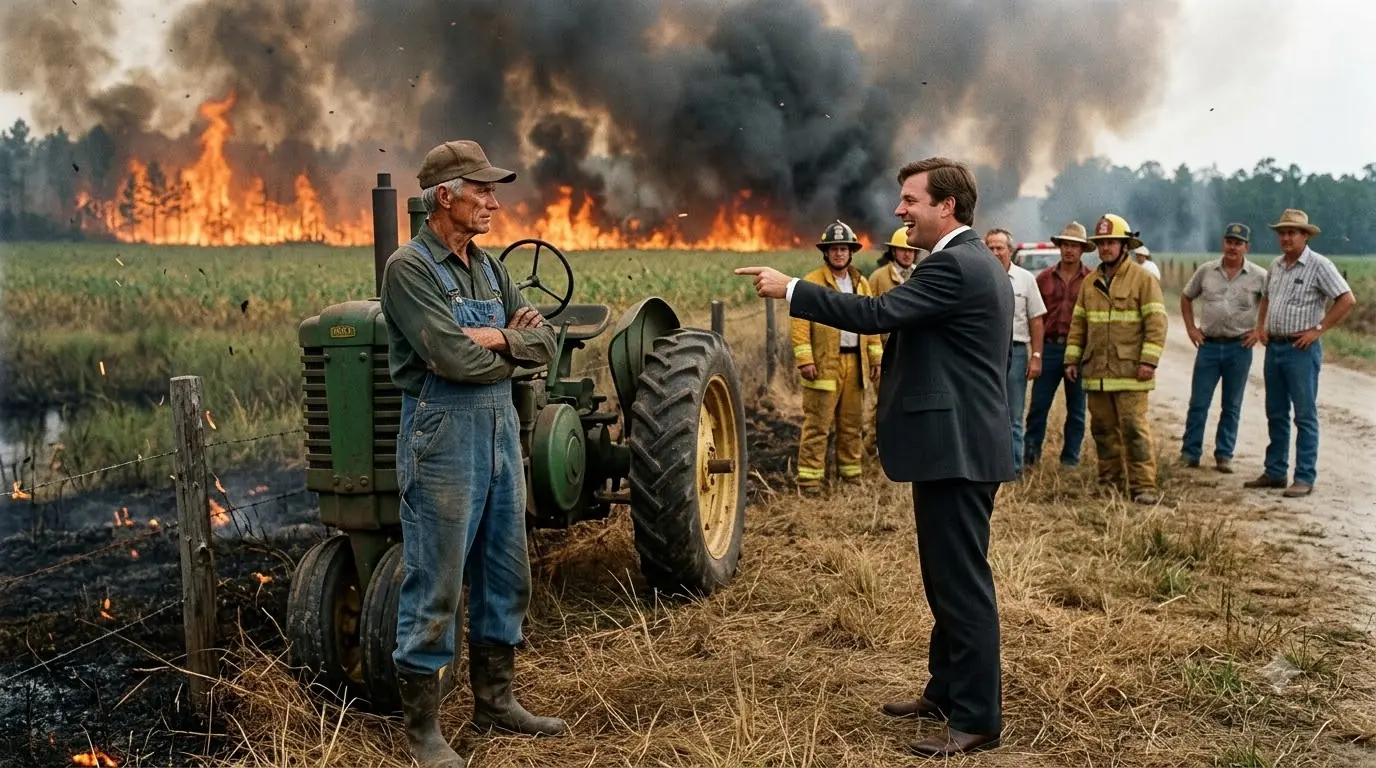
Not fireplace smoke.
Not brush-pile smoke.
Wildfire.
Walter straightened slowly, wiped both hands against his faded blue overalls, and looked north.
A column of black smoke climbed beyond the trees.
Too large.
Too dark.
Too close.
His old dog, Rusty, crawled from beneath the shade of the porch and stared in the same direction.
Walter said quietly, “That ain’t good.”
The dog apparently agreed.
Within twenty minutes, Walter heard the first sirens.
Ten minutes after that, the telephone rang inside the farmhouse.
It was his neighbor Calvin Porter, whose cattle operation sat almost six miles north.
“Walter?”
“I’m here.”
“You seeing that smoke?”
“I got eyes.”
“Forestry boys say it jumped Old Mill Road.”
Walter’s expression changed.
Old Mill Road had been part of the expected containment line.
“How?”
“Wind changed.”
Walter looked through the kitchen window toward the trees.
“How bad?”
Calvin hesitated.
“That’s why I’m calling.”
Walter waited.
“They’re evacuating folks along County 14.”
Walter’s grip tightened around the telephone.
County 14 ran toward his northern property line.
“Direction?”
“South-southeast.”
Walter closed his eyes briefly.
Toward him.
Calvin continued.
“They say if it keeps moving like this, you may have ninety minutes.”
Walter answered, “Maybe.”
Calvin almost shouted.
“Maybe?”
“Depends where it hits.”
“Walter, don’t start.”
“Start what?”
“That swamp nonsense.”
Walter looked toward the blackwater wetland beyond his north pasture.
Forty acres of cypress, dark mud, standing water, shallow channels, wax myrtle, and crooked trees that most people in the county considered wasted land.
Walter considered it something else.
A boundary.
A reservoir.
A brake.
And perhaps, if the old calculations still meant anything, a shield.
Calvin said, “Get your papers. Get Rusty. Get out.”
Walter answered, “I’ve got some work first.”
“Walter.”
“Call me in thirty minutes.”
“You’re seventy-two years old.”
“I was seventy-two yesterday too.”
“That fire don’t care.”
“Neither does the swamp.”
Calvin groaned.
Walter hung up.
Then walked outside.
Walter Boone had been hearing the same argument about the swamp since 1986.
Drain it.
Clear it.
Tile it.
Plant it.
Forty acres of potential soybeans.
Forty acres of unproductive land.
Forty acres wasting taxes, frontage, and opportunity.
The loudest voice belonged to Harold Bennett.
Harold was thirty-eight, worked agricultural lending at South Georgia Farmers Bank, and wore expensive suits into places where most people wore dust.
He was not stupid.
That mattered.
Harold had degrees.
Spreadsheets.
Commodity forecasts.
Loan models.
Yield estimates.
He understood debt service, land valuation, machinery depreciation, and how to calculate exactly how many bushels of soybeans a farmer needed before the next payment stopped being theoretical.
But Harold had one weakness.
He believed what could be measured easily mattered more than what could not.
A soybean acre could be measured.
Yield per acre.
Input per acre.
Profit per acre.
A swamp was harder.
Water storage.
Soil retention.
Wildlife.
Flood control.
Microclimate.
Fire resistance.
Those things did not fit neatly onto loan paperwork.
So Harold tended to value them at zero.
In 1986, Walter had gone to the bank seeking financing for a replacement combine.
Harold reviewed his property map and immediately noticed the wetland.
“What’s this?”
“Swamp.”
“Forty acres?”
“About.”
“Drainable?”
Walter looked at him.
“Anything’s drainable if you hate it enough.”
Harold laughed.
“I’m serious.”
“So am I.”
He ran numbers.
Forty acres multiplied by average soybean yield.
Then current prices.
Then operating margins.
“Walter, you’re leaving money underwater.”
Walter replied, “That’s generally where swamp water goes.”
Harold tapped the paper.
“You could increase productive acreage seven percent without buying land.”
“No.”
“You haven’t heard the proposal.”
“I heard drain.”
Harold leaned back.
“Why are you emotionally attached to mud?”
Walter thought about answering honestly.
Instead he said, “Because it’s mine.”
That should have ended the conversation.
It did not.
Walter’s father, Thomas Boone, had bought the property in 1946.
Back then, the northern forty acres were wetter.
Much wetter.
Seasonal floods pushed water through cypress roots and spread it shallowly across black soil before draining south through a natural depression.
Thomas could have cleared it.
Many farmers did.
Government programs and private contractors spent decades turning wetlands into cropland.
Thomas refused.
Not because he considered himself an environmentalist.
That word would have made him suspicious.
He refused because he had lived through the dry fire seasons of the 1930s.
He understood what wet ground did.
When Walter was twelve, his father walked him through the swamp carrying a shovel.
Thomas pointed toward three shallow hand-dug channels.
“See these?”
“Yes, sir.”
“Your granddaddy opened them.”
“For drainage?”
Thomas laughed.
“Opposite.”
He explained.
The channels slowed runoff.
Spread water.
Allowed the wetland to refill during heavy rains rather than cutting one deep trench that emptied everything quickly.
Thomas called it “keeping water where water already decided to stay.”
Years later, Walter improved the channels.
Not dramatically.
Never enough to turn the wetland into an artificial system.
He cleared debris where needed.
Maintained low crossings.
Allowed seasonal overflow from the creek to enter.
Protected the cypress roots.
Kept heavy equipment away.
During droughts, portions dried.
But beneath the surface, the soil often remained damp long after surrounding fields turned hard.
Walter learned that the swamp affected more than itself.
Grass along the southern edge stayed greener.
Soil temperatures shifted.
Wind near the trees felt cooler.
Fire from neighboring brush burns often weakened before reaching the pasture.
None of that made him rich.
So Harold dismissed it.
By 1988, Walter owed the bank approximately $42,000.
Not ruinous.
Enough to matter.
The combine loan.
A tractor repair note.
Seasonal operating credit.
Harold saw opportunity.
“If you drained forty acres, your collateral improves.”
Walter stared.
“The land doesn’t become bigger.”
“It becomes productive.”
“It already does something.”
Harold smiled.
“What?”
“Stores water.”
“So does a pond.”
“Then you understand the concept.”
Harold’s patience shortened.
“Walter, soybeans are paying your note.”
“The swamp is not.”
Walter replied, “Maybe that’s because you’re only asking it one question.”
Harold never understood what he meant.
Not then.
The wildfire began after weeks of brutal heat.
Rainfall had been below normal.
Pine litter turned crisp.
Grass along county roads browned.
Volunteer departments had already responded to three smaller fires that month.
The August 16 blaze started north of the Withlacoochee River, likely from equipment sparks near logging debris, though early reports were uncertain.
Wind carried it quickly.
By midday, fire had moved through dry pine stands faster than crews expected.
At first, authorities believed Old Mill Road would hold.
Then embers crossed.
A second front ignited.
Wind shifted.
Now the fire moved south.
Toward farms.
Toward Walter.
And toward forty acres Harold Bennett had spent two years calling useless.
Walter walked into the equipment shed and uncovered the old tractor.
The 1951 John Deere R had belonged to Thomas Boone.
Green paint dulled almost gray.
Rust around the rims.
Seat cracked.
Engine noisy enough to offend modern mechanics.
Walter owned better equipment.
But the old John Deere had one advantage.
He had modified it years earlier to pull a heavy homemade ditch blade and low scraper through soft ground without becoming dependent on complicated hydraulics.
He checked fuel.
Oil.
Cooling.
Then pulled the starter sequence.
The diesel coughed.
Stopped.
Walter tried again.
Rusty barked.
“Don’t judge.”
Third attempt.
The engine caught.
A deep uneven roar filled the shed.
Walter climbed aboard.
He drove toward the north pasture.
Harold Bennett arrived twenty-five minutes later.
He had not come to help Walter.
Not intentionally.
Harold was driving toward another client’s farm with emergency loan documents when a sheriff’s deputy blocked County 14 and redirected him along a smaller route.
That route passed Walter’s soybean field.
Harold saw the smoke first.
Then Walter.
The old farmer stood beside the John Deere near the swamp edge while volunteer firefighters gathered farther down the road.
Harold stopped his car.
Got out.