The day my neighbors tore down my fence without asking was the day they accidentally proved they had been living on my property for years. And the funny part is, they were absolutely convinced they were the victims.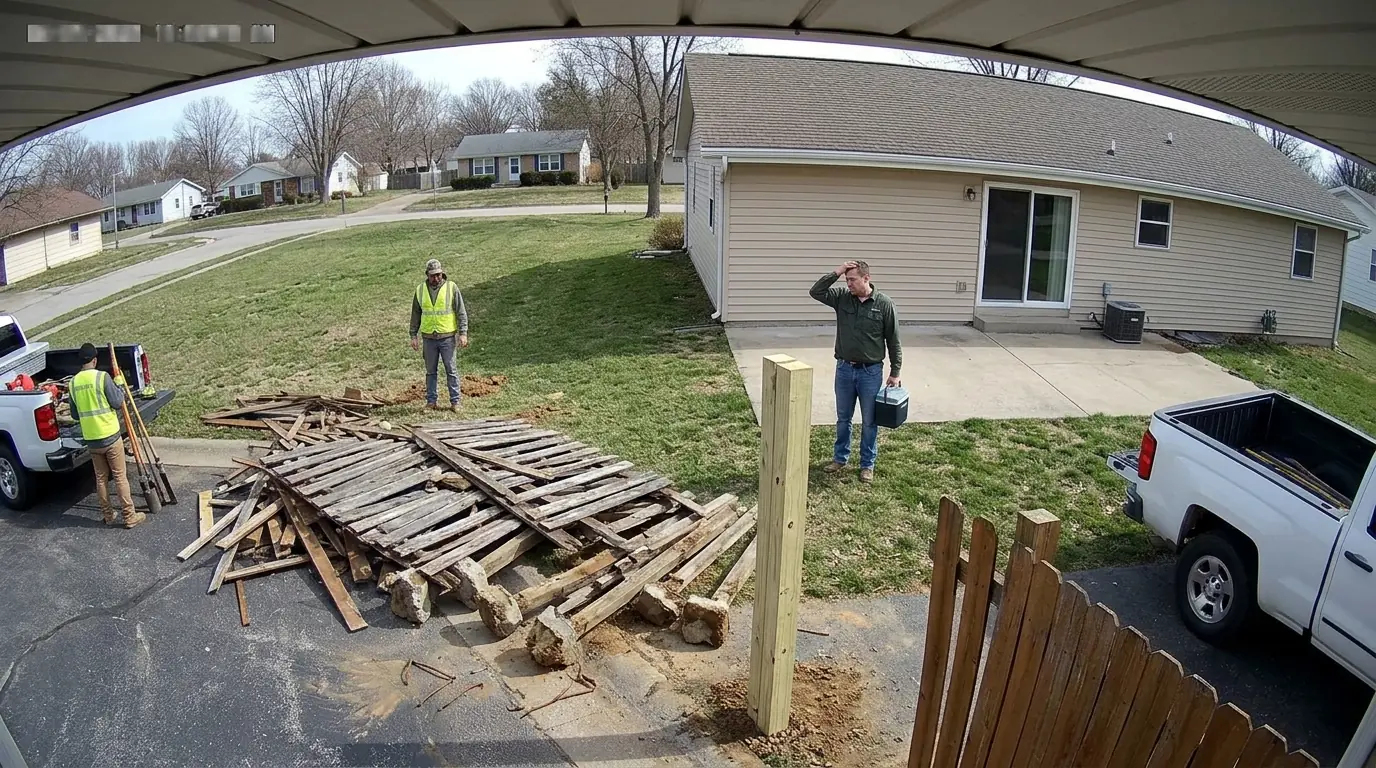
Looking back now, I can laugh about it. But at the time, I remember standing in my driveway staring at a pile of broken cedar boards, feeling that strange mix of anger and disbelief you only get when somebody crosses a line so boldly that your brain needs a minute to catch up.
My name is Ethan Mercer, and this happened just outside a small town called Hollow Creek, Missouri, where people generally wave at each other, mow their lawns on Saturdays, and try not to start neighborhood wars over property lines. At least that's how it used to be.
When I bought my house, it wasn't anything special. It was a modest ranch-style place with a decent backyard, a couple of old maple trees, and a weathered wooden fence running along the western edge of the property. The fence wasn't pretty. Half the boards leaned slightly, the stain had faded years ago, and every spring I told myself I should probably replace it. But it did its job: it marked the boundary between my yard and the neighboring lot. More importantly, nobody had ever questioned it.
For almost 3 years, life was peaceful. The previous owners next door were retirees named Frank and Linda. They kept to themselves, I kept to myself, and the closest thing we ever had to a disagreement was whether the Cardinals were going to make the playoffs.
Then they moved to Arizona.
A few months later, a younger couple bought the house. Their names were Derek and Melissa Chandler. The first time I met them, they seemed friendly enough. Derek was one of those guys who walked around with permanent confidence, like every opinion he had was automatically a fact. Melissa was quieter, but carried herself with the same certainty.
At first, I figured they were just excited about their new home. They renovated almost everything: new landscaping, new patio furniture, fresh paint, outdoor lighting, even one of those fancy fire pits people seem to buy the moment they move into a suburban neighborhood. I didn't think much of it.
Then one Saturday morning, while I was trimming branches near the fence, Derek wandered over holding a coffee mug. He stood there for a second studying the fence before saying, "You know, I think this thing is actually on our property."
I laughed a little because I assumed he was joking. He wasn't.
"What makes you think that?" I asked.
He shrugged. "Just looking at the layout. The lot doesn't seem right."
I remember staring at him for a moment. Not because the comment bothered me, but because it was such a strange way to determine a property line. "Looking at it, that's not exactly how land ownership works." I told him the fence had been there for years and suggested he check the county records if he had concerns.
He nodded. But there was something about the look on his face that told me he had already reached a conclusion.
Over the next few weeks, the comments continued. Every time we crossed paths, somehow the fence came up. Derek would mention measurements. Melissa would mention old photographs. They'd talk about how much larger their backyard should be. The word should started appearing a lot. The problem was that none of it came with actual evidence.
One evening, while I was grilling burgers, Derek walked over again. "We've been looking at this," he said. "Honestly, I think whoever built that fence stole a few feet from our lot."
"Stole?"
That word immediately changed the tone. I set down my spatula and looked at him. "Then let's get a survey done," I said. "Simple solution."
For a split second, I thought he'd agree. Instead, he frowned. "Surveys cost money."
I nodded. "Yeah, they do."
"I don't see why we should pay for something that's obvious."
That was the moment I realized this wasn't really about finding the truth. It was about validating what he already believed. Still, I wasn't interested in fighting. Life's too short. I figured eventually he'd either order a survey or forget about it.
Unfortunately, I underestimated how confident people can become when they're convinced reality agrees with them.
Through the summer, I noticed little things: Derek pacing near the fence, measuring tape appearing in his backyard, conversations stopping whenever I walked outside. Even a few neighbors quietly asked me if everything was okay because apparently the Chandlers had been telling people they were dealing with a property dispute.
I kept giving the same answer: "There isn't a dispute. There's a fence. If anyone wants to know where the line is, get a survey."
Then came the Tuesday afternoon that changed everything.
I was sitting at work finishing paperwork when my phone buzzed. The message came from an older neighbor named Carol who lived three houses down. It read: Hey Ethan, did you hire contractors to remove your fence?
I stared at the screen. Then I read it again. My stomach dropped because I hadn't hired anybody, and suddenly I had a very bad feeling about what I was about to find when I got home.
I left work early that day, and the entire drive home felt longer than usual. You know that feeling when your mind starts filling in blanks before you actually know what's happening? Every possible scenario kept running through my head: maybe a storm knocked something over; maybe a contractor had the wrong address; maybe Carol misunderstood what she saw. Deep down, though, I already suspected the truth.
The second I turned onto my street, I saw it, even before I pulled into the driveway.
The fence was gone. Not damaged. Not partially removed. Gone.
The entire structure had been torn out, stacked in pieces near the curb like garbage waiting for pickup. And about 6 feet closer to my house, fresh fence posts had already been planted into the ground.
For a few seconds, I just sat in my truck staring through the windshield. I remember gripping the steering wheel so hard my knuckles turned white. Then I got out and walked into the backyard.
A contractor crew was still there packing up equipment. One of the workers noticed me approaching and immediately looked uncomfortable.
"Can I help you?" I asked.