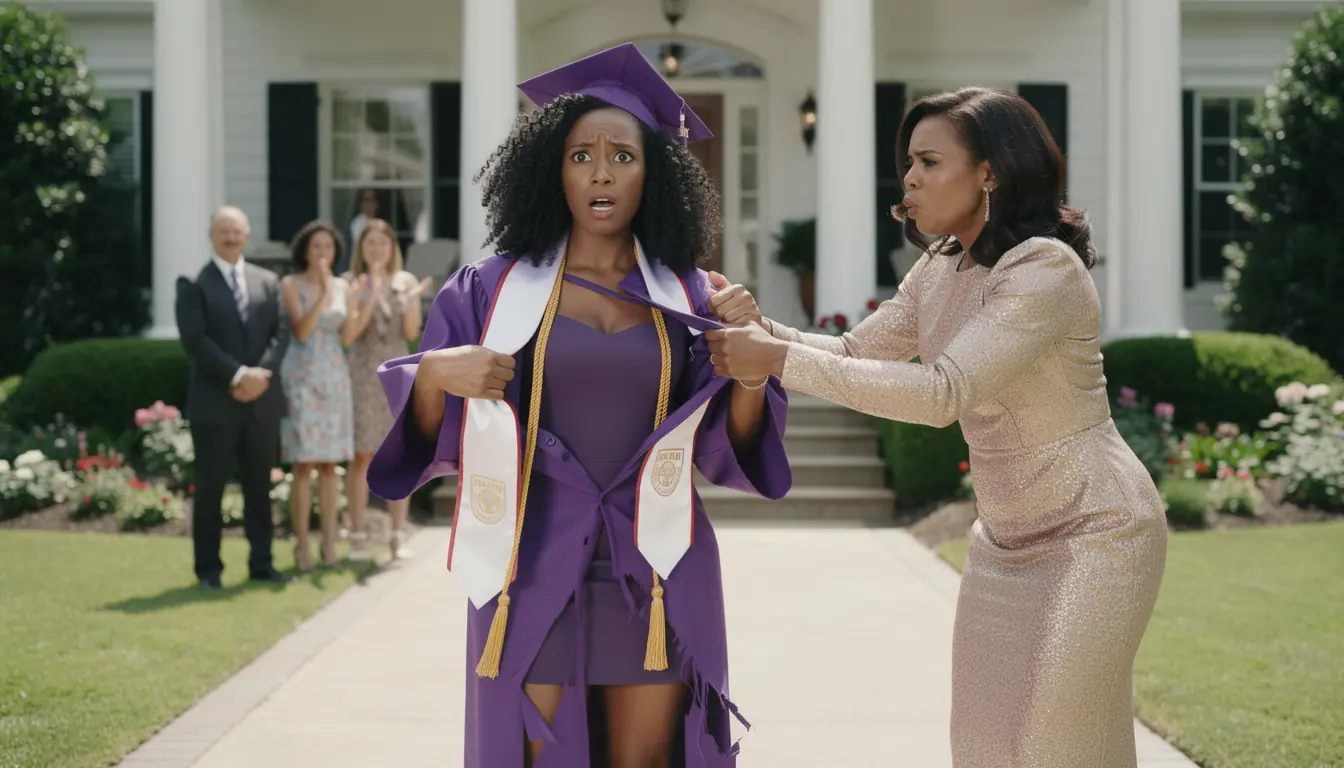
The first tear sounded like a sheet of paper being pulled in half. The second was louder, because my father had grabbed the other sleeve of my graduation gown and pulled until the seam gave way.
Thirty-seven people were standing in our backyard under strings of white lights. Someone had just raised a plastic cup to congratulate me on finishing high school, and my stepmother was smiling as though she had finally won an argument no one else understood.
“There,” Celeste said, holding the torn black fabric in front of her. “Now you can stop pretending you're leaving this family.”
I was eighteen years old. My graduation was the next morning, and the gown had been hanging over the dining-room door less than five minutes earlier.
My little brothers were watching from the steps. Seven-year-old Benji had both hands over his mouth, and Noah, who was five, was holding a paper plate with a slice of cake he had forgotten to eat.
“Dad,” I whispered. “Please give it back.”
My father, Daniel Lawson, looked at the sleeve in his hand. He seemed startled that it had come away so easily, as though he had expected a garment to surrender without consequences.
“Maybe this will make you listen,” he said.
Somebody near the picnic table asked what was happening. A neighbor lowered her phone. The playlist continued with a cheerful song that sounded suddenly ridiculous.
I could have endured the public humiliation if my father had only let me pick up the pieces. Instead Celeste shook the gown out over the patio and ripped the front panel from the neckline to the hem.
I had saved three months to buy it. Not because it was expensive, but because I wanted to pay for one thing about graduation without asking permission from anyone in that house.
“She's not going anywhere,” Celeste announced to the guests. “It's time somebody reminded Maya what family means.”
Then the side gate opened.
My grandfather Elijah Brooks stepped into the yard carrying a slim brown garment bag and an old leather briefcase. He had driven almost an hour in his faded blue sedan, and there was still road dust on the shoulders of his jacket.
He glanced at the decorations, at the silent guests, and finally at the black cloth lying at my feet.
“Who did this?” he asked.
Nobody spoke. My father opened his mouth, but Granddad lifted one hand without looking away from the ruined gown.
“I asked,” he said, his voice steady and low, “who tore up my granddaughter's graduation clothes?”
For the first time that evening, Celeste stopped smiling.
To understand why I remember that silence more clearly than the noise before it, I have to tell you what life in the Lawson house had become and why leaving for college felt less like a celebration than an escape.
We lived outside Richmond, Virginia, in a narrow two-story house with blue shutters, a sloping lawn, and a kitchen that always smelled of coffee or whatever Celeste was testing for her catering business.