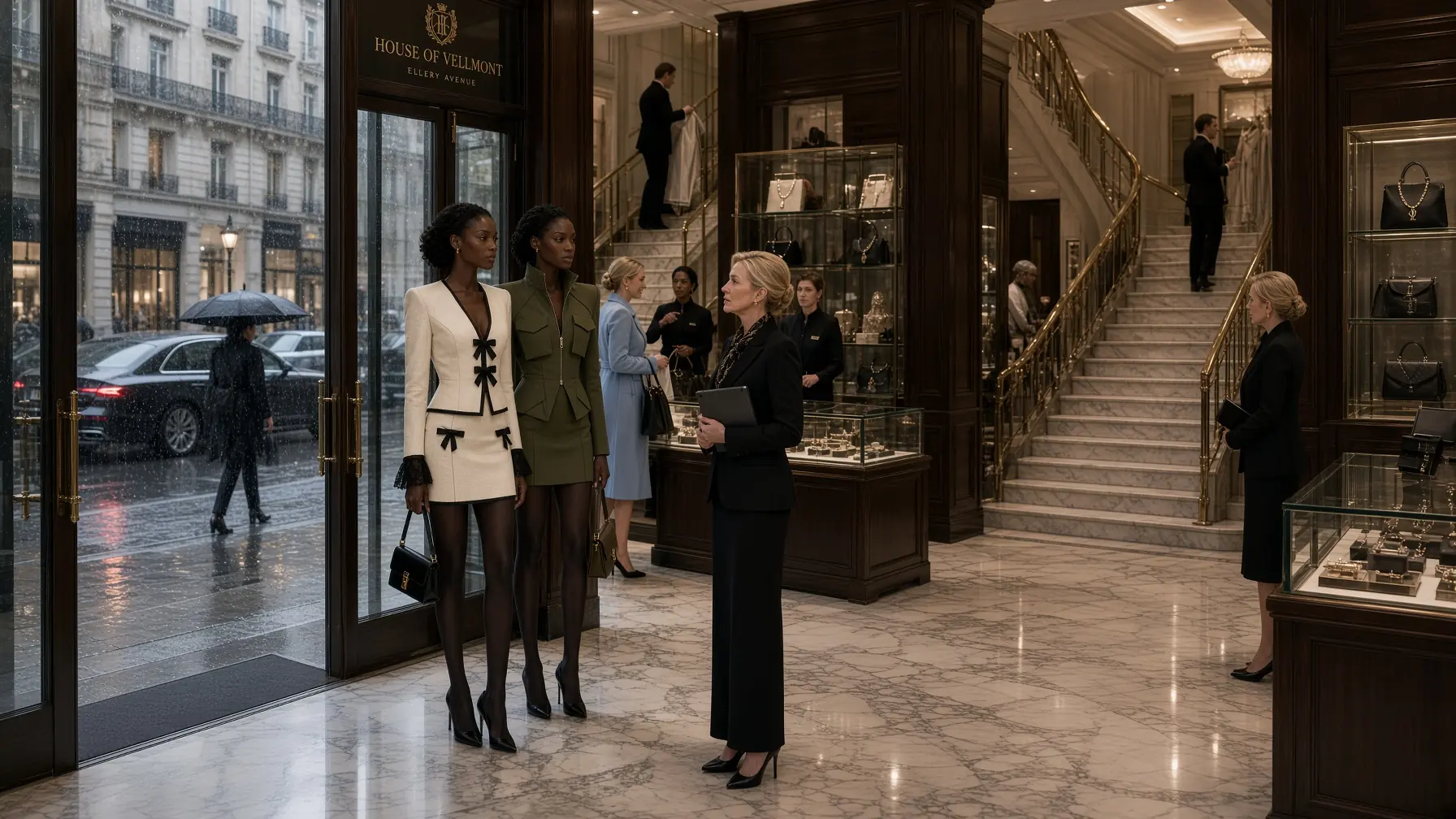
They Treated The Twin Sisters Like They Didn’t Belong — Then Learned One Of Them Owned The Brand They Wanted

They Treated The Twin Sisters Like They Didn’t Belong — Then Learned One Of Them Owned The Brand They Wanted
Reader Theme:
Font Size:
24px


My name is Lena Brooks, and I learned very early that people often decide your value before they know your name.

Sometimes it happens in one glance.

A glance at your shoes.

A glance at your skin.

A glance at the way you walk into a room they never imagined you entering with confidence.

My twin sister, Lauren, and I had lived with that kind of judgment long enough to recognize it before it spoke. We had seen it in classrooms, interviews, hotel lobbies, restaurants, and open houses where people asked if we were waiting for someone instead of asking how they could help. But what happened that rainy Friday inside one of the most expensive fashion houses in Westhaven City still stayed with me.

Not because prejudice surprised us.

It did not.

What surprised us was how easily success became invisible when people had already decided what they expected power to look like.

Lauren and I were born seven minutes apart.

She was older, and she carried that fact around like an official title.

“I arrived first,” she used to say whenever she wanted the last word.

“And I arrived prettier because I took my time,” I would answer.

That was how we were.

Same face.

Same laugh.

Same deep brown eyes and thick dark curls our mother used to braid so tightly our eyebrows practically lifted. People always stared at us because we were identical twins, and as children, we loved that. We wore matching dresses until we decided matching was boring, then argued for years about who had the better style.

The truth was, Lauren always did.

She saw clothing differently than anyone I knew. To her, a jacket was not just a jacket. It was posture. A dress was not just fabric. It was memory, courage, mood, and movement. She could look at a woman standing in front of a mirror and know exactly what she was trying to hide from herself.

I became a corporate finance advisor.

Lauren became a designer.

That surprised nobody who loved us.

By thirty-one, she had built a clothing label called Maribel Lane from nothing but sketches, fabric scraps, unpaid weekends, and a kind of stubborn faith that made failure feel temporary. She began in the second bedroom of our shared apartment, sewing until three in the morning while I worked spreadsheets at the kitchen table. Back then, she packed orders herself, printed shipping labels on a printer that jammed every third page, and cried once because a stranger in Oregon left a review saying one of her dresses made her feel beautiful after a divorce.

That review kept her going for six months.

Then came the local pop-ups.

Then online growth.

Then small boutique partnerships.

Then celebrities wearing her pieces and pretending they had discovered her before anyone else did.

Within six years, Maribel Lane had become one of the fastest-growing independent fashion brands in the region. The same people who once told Lauren that fashion was too unstable now used words like visionary, scalable, and market-defining. Funny how the world finds better vocabulary once money enters the room.

The day everything happened was supposed to be a celebration.

A luxury retailer called House of Vellmont had invited Lauren for a partnership conversation. House of Vellmont was not just a store. It was a landmark in Westhaven City. It sat on Ellery Avenue behind glass doors, brass handles, marble floors, and windows dressed so beautifully that people stopped outside just to take pictures.

The place sold handbags that cost more than most people’s rent.

Coats hung under soft lighting like artwork.

The staff whispered instead of spoke.

House of Vellmont was the kind of store where wealth felt rehearsed.

Lauren got the invitation on a Tuesday afternoon.

She called me before I even finished my lunch.

“Lena.”

I could hear it in her voice.

Something had happened.

“What?”

“House of Vellmont wants a meeting.”

I sat up straighter.

“For real?”

“For real.”

“Lauren, that is huge.”

“I know.”

She went quiet for a second, which was unusual for her. Lauren filled silence the way some people filled rooms with flowers.

Then she said, “I want you there.”

“Me?”

“Yes.”

“I don’t design anything.”

“No, but you were there when I was sewing in that apartment and eating cereal for dinner because fabric cost more than groceries.”

I smiled.

“That is painfully true.”

“You helped me build the financial plan when nobody would loan me a dime. You argued with the packaging company. You caught the first tax problem. You made me believe the business could grow without losing itself.”

Her voice softened.

“So yes, you.”

That was Lauren.

Fearless in public.

Tender in the places nobody saw.

The morning of the meeting, she arrived at my condo with two garment bags, one shoe box, and an expression that suggested my closet had personally offended her.

“You are not wearing that navy cardigan.”

I looked down.

“It’s a good cardigan.”

“It is a cardigan that says you know where the nearest printer is.”

“I do know where the nearest printer is.”

“That is exactly the problem.”

She pushed past me, hung the garment bags on the closet door, and began assembling an outfit as if preparing me for diplomatic negotiations. Black wide-leg trousers. Ivory blouse. Camel coat. Gold hoops. A pair of heels I would never have bought for myself but immediately loved once I saw them on.

When I looked in the mirror, I saw a version of myself I sometimes forgot existed.

Not better.

Just less hidden.

Lauren stood behind me, adjusting my collar.

“There,” she said. “Now you look like you know you belong.”

I met her eyes in the mirror.

“I do know.”

“Good,” she said. “Some rooms need reminding.”

House of Vellmont stood on the corner of Ellery and Ninth, glowing through the rain like a jewel box.

The front windows displayed mannequins in cream coats, black silk dresses, and one emerald gown so beautiful it made Lauren stop walking for half a second.

“That cut is clean,” she murmured.

“That’s a compliment coming from you.”

“That is a very serious compliment.”

We walked inside through tall glass doors, and the air changed immediately. The city noise disappeared. Soft music floated above polished marble. The lighting made everything look expensive and almost unreal. Employees moved quietly in tailored black suits and silk scarves, their smiles trained to appear effortless.

Then the looks began.

At first, I thought it was because we were twins.

People always noticed us.

But these looks were not curious.

They were measuring.

A woman near the jewelry counter glanced at us, then at our coats, then at our shoes. A sales associate looked from Lauren to me, then whispered something to another associate standing behind a display of handbags. The second associate looked over too quickly, then pretended to adjust a shelf that did not need adjusting.

Lauren noticed.

Of course she did.

She leaned toward me and said quietly, “Keep walking.”

So we did.

Because we had an appointment.

Because Lauren had earned that appointment.

Because I had seen her hands ache from sewing for years, and no stranger with a name tag was going to make us shrink at the entrance.

A woman approached after several minutes.

Her name tag read Vivian Cross.

She was probably in her late forties, white, elegant, and sharp in the way expensive stores often prefer. Her blonde hair was pinned into a low twist. Her suit fit perfectly. Her smile appeared professional, but it did not reach any place human.

“Can I help you ladies?”

Ladies.

The word can be respectful.

This one was not.

Lauren smiled.

“Yes. I have a two o’clock appointment with the buying team.”

Vivian glanced down at the tablet in her hand.

“Appointment?”

“Yes. Lauren Brooks. Maribel Lane.”

Vivian typed something.

Then stopped.

“Brooks?”

“That’s right.”

Her eyes flicked up again.

A small pause followed.

Not long.

Long enough.

“Oh,” Vivian said.

One word.

But it carried surprise, adjustment, and something close to disbelief.

Lauren’s smile stayed in place.

“Yes. Could you please let them know we’re here?”

Vivian looked at the tablet again.

“Maribel Lane,” she repeated.

“Yes.”

“And this meeting was confirmed?”

Lauren opened her phone and showed the email.

“Confirmed by your office on Wednesday.”

Vivian barely looked at the screen.

“I see.”

She glanced at me.

“And you are?”

“Lena Brooks,” I said. “Lauren’s sister and financial advisor.”

“Financial advisor,” Vivian repeated.

Again, not long.

Long enough.

She gave a small nod.

“Please wait here while I check.”

She gestured toward a seating area near the entrance.

Not the private waiting lounge visible behind a brass divider.

Not the velvet chairs near the consultation rooms.

The entrance area.

We sat.

Five minutes passed.

Then ten.

Then twenty.

Customers came in and were greeted instantly.

A man in a gray coat was offered sparkling water before he finished closing his umbrella. A white woman with a small dog in a carrier was welcomed by name and guided toward the handbag salon. Another customer walked in without an appointment, mentioned she wanted to see new arrivals, and two employees appeared as if summoned by money itself.

Lauren sat beside me, one leg crossed over the other, phone resting in her hand.

She was calm.

Too calm.

That was never a good sign.

I checked the time.

2:27.

“Want me to email?” I asked.

“I already did.”

A younger associate approached.

He looked maybe twenty-four, with kind eyes and nervous hands.

“Hi,” he said. “Are you waiting for someone?”

Lauren looked up.

“Yes. We have a scheduled meeting with the buying team.”

His name tag read Elliot.

He looked confused.

“I haven’t heard about a meeting.”

Lauren showed him the confirmation email.

He read it more carefully than Vivian had.

His face changed.

“Oh. I’m sorry. Let me check with the office.”

“Thank you,” Lauren said.

Elliot walked away fast.

Another fifteen minutes passed.

When Vivian returned, Elliot was not with her.

“I’m sorry,” she said. “There seems to be some confusion.”

Lauren stood.

“What kind of confusion?”

“We do not appear to have your appointment on the active calendar.”

Lauren held up her phone.

“This is the confirmation from your partnerships coordinator.”

Vivian looked at it again.

This time longer.

“Hm.”

That was it.

Hm.

“I understand that is frustrating,” she said. “Sometimes independent vendors misunderstand the location of corporate appointments. Our corporate offices are across town.”

I felt Lauren become still beside me.

“We did not misunderstand,” she said.

Vivian’s smile cooled.

“I’m simply explaining that this happens.”

“No,” Lauren said. “You’re suggesting we are in the wrong place because that is easier than admitting nobody here bothered to verify who we were.”

The music continued playing.

A customer nearby pretended not to listen.

Vivian’s eyes tightened.

“I don’t think that tone is necessary.”

Lauren gave a small nod.

“There it is.”

“Excuse me?”

“That point where the person being dismissed becomes the problem for naming it.”

Vivian crossed her arms slightly.

“Ms. Brooks, I am trying to help you.”

“No, you’re trying to manage us.”

The words landed.

Several employees looked over.

Elliot had reappeared near a display of scarves, holding his tablet like a shield. His face was tense. He knew something was wrong. More importantly, he knew it had been wrong for a while.

Then the front door opened again.

A white woman in a pale blue coat stepped inside.

Instantly, another associate moved toward her.

“Welcome back, Mrs. Alden. We have your fitting room ready.”

The woman smiled.

“Wonderful.”

A second employee appeared with a garment bag.

“Your selections are already upstairs.”

Lauren watched the entire exchange.

So did I.

So did Vivian.

Nobody had to explain the difference.

It announced itself.

Lauren turned back to Vivian.

“Can I ask you something?”

Vivian’s face went blank.

“Of course.”

“Would this have happened if we looked different?”

The question stopped the air.

Vivian blinked.

“I don’t know what you mean.”

Lauren looked around the store.

“We walked in with a confirmed appointment. We gave our names. We showed the email. We waited almost an hour by the door while other customers were welcomed, escorted, offered water, and addressed by name.”

Her voice stayed calm.

That made people listen harder.

“Would you have treated us differently if you had expected the founder of Maribel Lane to look like me?”

Vivian’s mouth tightened.

“I do not appreciate being accused of discrimination.”

Lauren nodded.

“I don’t appreciate experiencing it.”

Nobody moved.

That was the moment I understood something important about my sister.

Her power was not volume.

Her power was precision.

She did not yell because she did not need to. She simply placed the truth in the middle of the floor and let everyone decide whether to step around it.

A man came out from the back offices.

He was in his early fifties, silver-haired, dressed in a charcoal suit that probably cost more than my monthly mortgage. He had the tired calm of someone used to entering rooms after other people had made a mess.

“Is there an issue here?” he asked.

Vivian turned immediately.

“Mr. Vellmont, there appears to be a misunderstanding with these customers.”

These customers.

Not Ms. Brooks.

Not the founder with the partnership appointment.

Not the woman your company invited here.

These customers.

Small words reveal large rooms inside people.

Lauren turned toward him.

“My name is Lauren Brooks.”

His expression changed.

Just a little.

“Lauren Brooks?”

“Yes.”

“Founder of Maribel Lane?”

“That’s what I was told this meeting was about.”

He looked at Vivian.

Then at his tablet.

Then back at Lauren.

“You were scheduled for two o’clock.”

“Yes.”

He checked his watch.

“It is almost three.”

“Yes.”

The silence that followed did not need assistance.

It knew what it was doing.

Mr. Vellmont looked at Vivian.

“Why wasn’t I notified when Ms. Brooks arrived?”

Vivian hesitated.

“I believed there was confusion about the appointment.”

“What confusion?”

She had no good answer.

The store was very quiet now.

Even the woman in the blue coat had stopped pretending she was not listening.

Mr. Vellmont turned to us.

“I apologize, Ms. Brooks. Ms. Brooks.” He included me that time. “This should not have happened.”

Lauren looked at him.

“No, it should not have.”

His apology was polished.

Maybe sincere.

But apology after recognition is not the same as respect before it.

That was the part everyone wanted to skip.

The meeting happened.

Eventually.

We were taken upstairs to a private office overlooking Ellery Avenue. There were racks of curated garments, mood boards on the wall, sparkling water on the table, and linen folders prepared with Maribel Lane printed across the front. The materials had been ready all along.

That detail bothered me more than anything.

They had expected her.

They had prepared for her.

They had simply failed to see her when she arrived in brown skin and borrowed shoes beside her twin sister.

Mr. Vellmont spoke about market growth, collaboration, capsule collections, regional expansion, and the strength of Lauren’s customer base. He complimented her use of texture and structure. He said Maribel Lane represented the future of independent luxury.

Lauren listened politely.

She asked smart questions.

She took notes.

But the excitement she had carried into the city that morning was gone.

I could see it.

For years, she had imagined walking into a room like that and finally being met as an equal. But now the opportunity had a stain on it. The question was no longer whether House of Vellmont wanted her brand. The question was whether she wanted her name inside a place that had made her prove she belonged before giving her the respect already scheduled on their calendar.

At the end of the meeting, Mr. Vellmont folded his hands.

“Is there anything else I should know about what happened downstairs?”

Lauren sat back.

For a second, I thought she would say no.

Not because she was afraid.

Because she was tired.

But tired women have changed more rooms than comfortable men ever have.

“Yes,” she said.

She placed her phone on the table.

“I recorded the interaction.”

His face shifted.

Vivian, who had been asked to join the end of the meeting and looked like she wished the floor would open beneath her, went pale.

Lauren continued.

“I did not record to embarrass your company. I recorded because people like me learn early that if we describe what happened, someone calls it a misunderstanding.”

She looked at Mr. Vellmont.

“Video makes misunderstanding harder to hide behind.”

He nodded slowly.

“I would like to review it.”

“I’ll send it.”

“And the partnership?”

Lauren looked out the window for a moment.

Rain moved down the glass in thin lines.

Then she turned back.

“I need to decide whether this company wants my work or only wants the appearance of inclusion after being caught failing at it.”

Nobody answered.

That was wise.

Lauren sent the video that night.

She did not post it.

She did not write a caption.

She did not run to the press.

She sent it privately to Mr. Vellmont with one sentence.

I hope your store becomes the kind of place where people do not need recordings to be believed.

For two days, nothing happened.

Then, on Monday afternoon, Lauren received a message from a former House of Vellmont employee.

Her name was Grace Holloway.

She had worked there for four years.

“I saw your video,” Grace said when Lauren called her.

“How?” Lauren asked.

“It was shared internally. Quietly. People are talking.”

Lauren looked at me across her kitchen table.

I was sitting there with my laptop open, pretending not to be fully invested.

Grace continued.

“You need to know this was not the first time.”

She told us about customers followed through departments.

Black women asked if they needed assistance three times in five minutes, while white customers wandered freely.

Latina shoppers being asked whether they understood the return policy before buying anything.

Asian tourists redirected toward sale items before asking a single question.

Employees trained to say “loss prevention awareness” when what they meant was suspicion.

Complaints had been made.

Some verbal.

Some written.

Most disappeared into the soft machinery of reputation protection.

Lauren listened without interrupting.

When Grace finished, my sister asked, “Why didn’t anyone come forward?”

Grace was quiet for a moment.

“Because everyone thought someone else would.”

That sentence sat with us for a long time.

Because that is how so many broken systems stay standing.

Not because nobody sees them.

Because too many people wait to become the second voice instead of the first.

Three weeks later, House of Vellmont announced an internal review.

They did not deny the incident.

They could not.

The video showed enough.

Not screaming.

Not dramatic confrontation.

Just delay.

Dismissal.

Different treatment.

Language that reduced a confirmed business partner to “these customers.”

A question nobody in the room could answer cleanly.

The public statement was not perfect.

Public statements rarely are.

But this one did not use the word misunderstanding, and that mattered.

Mr. Vellmont admitted that the company had failed to provide equal respect to every guest and partner. He announced an independent audit of customer service practices, new complaint reporting systems, revised staff training, and a review of past discrimination complaints.

Some people rolled their eyes.

They said Lauren had overreacted.

They said people were too sensitive.

They said luxury stores were allowed to be cautious.

Lauren read none of the comments after the first day.

“I already know what people say when they want unfairness to sound like common sense,” she told me.

Two months later, Mr. Vellmont invited Lauren back.

Not for a contract.

For a conversation with staff.

At first, she refused.

“I don’t want to become their lesson,” she said.

“I understand.”

“I don’t want to walk into that store and perform pain so they can feel improved.”

“I understand that too.”

But after a week, she called me.

“I’m going.”

I knew better than to ask if she was sure.

“When?”

“Friday.”

“Want me there?”

She paused.

“Always.”

So we returned to House of Vellmont on another rainy day.

Same glass doors.

Same marble floors.

Same soft music.

Same impossible lighting.

But something felt different before anyone said a word.

Elliot, the young associate who had tried to check on us, greeted us at the entrance.

“Good morning, Ms. Brooks. Ms. Brooks.”

His voice was nervous but sincere.

Lauren smiled at him.

“Good morning, Elliot.”

He looked relieved that she remembered his name.

The staff meeting was held in the upstairs salon.

Maybe forty employees sat in neat rows, all too well-dressed to look comfortable. Vivian Cross sat near the back. Her face was composed, but her hands were clasped so tightly her knuckles had gone pale.

Lauren stood at the front.

No podium.

No slideshow.

Just my sister in a deep green suit she designed herself, looking at a room that had once made her wait near the door.

“I don’t believe every person who makes a harmful assumption is beyond change,” she began.

The room stayed quiet.

“But I do believe every person is responsible for what they do after the assumption is revealed.”

She let that sit.

“My sister and I did not walk into this store asking for special treatment. We came because your company invited us. We arrived on time. We gave our names. We showed confirmation. Still, we were treated like a problem to be managed instead of guests to be welcomed.”

Vivian lowered her eyes.

Lauren continued.

“That day, some of you saw two brown-skinned women and began filling in blanks with old ideas. You did not see our years of work. You did not see our education. You did not see our company. You did not see the orders packed on apartment floors, the sleepless nights, the customers who believed in us before the industry did.”

She paused.

“But even if we had none of that, we still deserved respect.”

That was the line.

I saw it move through the room.

Because success stories are comforting.

They let people believe dignity becomes obvious once achievement is large enough. Lauren refused that comfort. She did not want respect because she had built a brand. She wanted them to understand that respect should never have been waiting for proof.

“Being seen is not the same as being watched,” she said.

Several employees looked up.

“Watching is suspicion. Seeing is humanity. Learn the difference before a customer has to teach it to you with shaking hands.”

Afterward, Vivian approached us.

She looked smaller without the front-desk authority surrounding her.

“Ms. Brooks,” she said.

Lauren waited.

“I owe you an apology.”

“Yes,” Lauren said. “You do.”

Vivian swallowed.

“I made assumptions. I told myself I was being careful and professional, but I was deciding who belonged before I had the facts.”

Lauren looked at her for a long moment.

“I appreciate you saying that.”

Vivian’s eyes filled slightly.

“I’m sorry.”

Lauren nodded.

“I accept the apology. But the apology matters less than what you do when nobody is recording.”

Vivian nodded.

That was all.

It was enough for that day.

A year later, Maribel Lane officially partnered with House of Vellmont.

People were surprised.

Some said Lauren had forgiven too easily.

Others said she was smart to take the opportunity.

Both groups missed the point.

Lauren did not partner with House of Vellmont because what happened was acceptable. She partnered because the company agreed to structural changes in writing before she signed anything. Hiring review. Customer treatment standards. Complaint transparency. Anonymous reporting for employees. Annual outside audits.

My sister did not accept a seat at the table.

She made them rebuild part of the table before she sat down.

The first Maribel Lane capsule collection launched that fall.

Lauren named it “Belonging.”

Not because she needed House of Vellmont to give that word to her.

Because she wanted every woman who walked through those doors to feel the difference between being tolerated and being welcomed.

The collection sold out in four days.

The opening display featured twin mannequins dressed differently, standing side by side beneath warm light. One wore a structured black coat. The other wore a soft ivory dress under a cropped jacket. On the wall behind them, in small gold lettering, was a sentence Lauren wrote herself.

You Were Worthy Before They Knew Your Name.

I stood in front of that display longer than I expected.

Lauren came beside me.

“Too much?” she asked.

“No.”

“You’re crying.”

“I am being visually emotional.”

She laughed.

That laugh took me back to our apartment years earlier, to fabric on the floor and cheap noodles on the stove, to my sister bent over a sewing machine at midnight saying one day people would understand what she was trying to build.

They did now.

But I knew something better.

She had understood it before they did.

Years later, when people tell the story, they often focus on the twist.

The twins were not random shoppers.

One was a rising designer.

The other was her financial advisor.

The luxury store almost lost a major partnership because it judged them too quickly.

That is all true.

But it is not the whole truth.

The real story is not that House of Vellmont mistreated the wrong women.

There are no right women to mistreat.

There are no right customers to follow, dismiss, delay, doubt, shrink, or make prove their belonging at the door. There are no right sisters to leave waiting by the entrance while other people are welcomed by name. There are no right strangers to treat like a risk because their skin disrupts the picture in someone else’s head.

Lauren’s success did not create her dignity.

My job title did not create mine.

The confirmation email did not make us worthy.

The apology did not restore what should never have been taken.

We had walked in with our worth already intact.

The store simply failed to recognize it.

That rainy afternoon changed my sister’s business.

It changed House of Vellmont too, though imperfectly, as all human change is imperfect. Policies shifted. Employees left. New ones came in. Elliot eventually became client experience manager, and the first thing he changed was the greeting protocol. Everyone who entered was welcomed before being assessed.

Small thing.

Huge thing.

As for Lauren and me, we still joke about that day sometimes.

She says, “Remember when they made us wait by the door?”

I say, “Remember when you made them rewrite their company training manual?”

She smiles.

But beneath the joke is something quieter.

A memory of sitting in beautiful clothes on a velvet bench near the entrance, feeling every glance ask the same question.

Do you belong here?

Now I know the answer better than I did then.

Yes.

We belonged there.

We belonged in every room we had worked to enter, and even in rooms we entered by accident. We belonged before the appointment was verified, before the director came downstairs, before the video was reviewed, before the partnership, before the headlines, before the sales numbers, before the collection sold out.

Belonging is not something strangers grant you once they are satisfied.

It is something you carry in with you.

And if they cannot see it, that is not proof you lack it.

It is proof their eyes need changing.

News in the same category

News Post