Tessa Grant had spent Friday afternoon explaining federal indictments to a room full of cameras.
By then, she had gone four nights on bad coffee, three hours of sleep, and the kind of focus that made agents lower their voices when they came into her office. The case involved a trafficking ring hidden behind moving companies, fake payroll records, and warehouse leases that looked perfectly ordinary until you knew where to look. Reporters called the indictment historic. Defense attorneys called it aggressive. The families of the victims simply cried in the hallway and asked what happened next.
But on Saturday morning, Tessa did not want to be historic.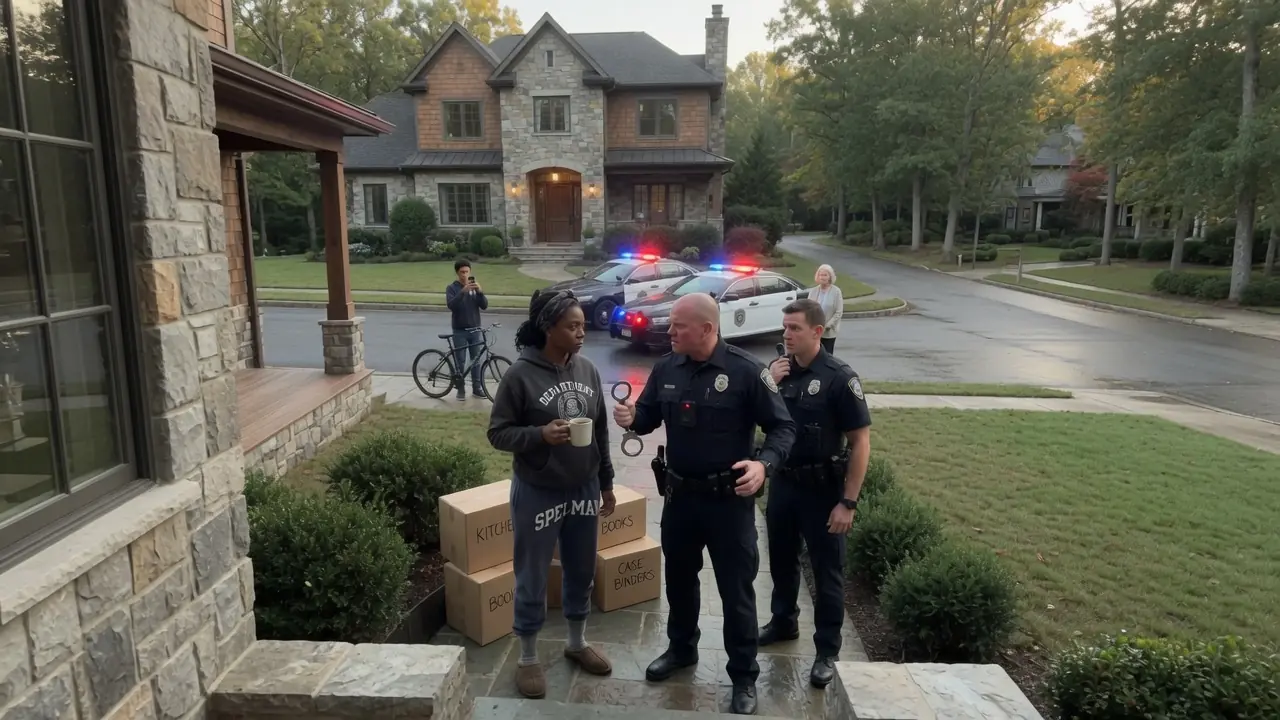
She wanted coffee.
Her new house sat on Oakmere Lane, inside a wealthy subdivision called Hawthorne Crest, where the lawns looked combed, the mailbox posts matched, and the people smiled from behind windows more often than they waved from sidewalks. The house itself was a low stone-and-cedar home with wide front steps, clean glass walls, and a porch deep enough to make a tired woman believe she might one day rest.
Tessa had bought it nineteen days earlier.
She had barely unpacked.
Boxes still lined the hallway, labeled in black marker: coats, kitchen, books, case binders, winter shoes, fragile things. One guest bedroom had become a storage room by accident. The dining table had three moving blankets draped over it because she had not yet found the time to decide where anything belonged.
That morning, she stepped onto the porch in faded Spelman sweatpants, an old Department of Justice hoodie, thick gray socks inside brown house slippers, and her hair wrapped loosely in a scarf that had started the day tidy and given up somewhere around sunrise.
She carried a white ceramic mug with both hands and let the steam rise into the cool October air.
No subpoenas.
No grand jury schedule.
No emergency call from an agent asking whether they had enough probable cause.
Just the quiet sound of maple leaves shifting at the curb and a crow standing on the streetlight like it owned the whole block.
Three houses down, behind cream-colored curtains, Eleanor Whitcomb watched her.
Eleanor considered herself a protector of Hawthorne Crest, though nobody had officially given her that title. She served on the HOA welcome committee, managed the neighborhood message board, and treated every delivery van, teenager, lawn crew, unfamiliar car, and new resident as a potential breakdown in civilization. She posted often about safety. She used the word vigilance more than anyone should before breakfast.
That week alone, she had reported two suspicious vehicles.
One was a plumber.
The other belonged to a nurse visiting her mother.
When Eleanor saw Tessa standing on the porch of the newly sold house in slippers and a hoodie, she did not wave. She did not walk over. She did not wonder whether this might be the woman whose name had appeared in the closing notice the HOA had briefly discussed and then mispronounced.
She saw a Black woman standing where Eleanor had already decided a certain kind of person lived.
And she reached for her phone.
“Yes, dispatch?” Eleanor said, already whispering as if danger were hiding in the drapes. “I need officers at 904 Oakmere Lane. There’s a suspicious woman on the front porch. She looks disoriented, maybe homeless, maybe trying to get inside.”
The dispatcher asked if the woman was forcing entry.
“She’s standing there like she belongs,” Eleanor said. “But that house just sold for over a million dollars. I know this neighborhood. She is definitely not the owner.”
Seven minutes later, Tessa bent down to move a potted fern closer to the sunlight.
That was when she heard engines.
Not the slow roll of morning traffic.
Not a neighbor leaving for tennis.
Engines moving with purpose.
Two police cruisers turned onto Oakmere Lane too fast for a residential street, tires whispering hard against the clean asphalt. No sirens, just flashing red and blue lights spilling across white garage doors, maple trunks, trimmed hedges, and the still-wet lawns of people who paid others to maintain them.
Tessa stood slowly.
The coffee remained in her hand.
The cruisers stopped at angles across her driveway. Doors opened almost before the cars settled. Two officers stepped out, and from the way the older one moved, Tessa knew exactly what kind of morning she had just been handed.
The lead officer was white, broad through the chest, with a shaved head and a jaw clenched so hard it looked practiced. His nameplate read M. Harlan. His right hand rested near his holster, not touching, not drawing, but close enough to make the point before any words arrived.
Behind him came a younger officer named Cole Mercer, taller, thinner, with nervous eyes that moved from Tessa to the house to the neighbors’ windows.
“Hey,” Officer Harlan barked. “Hands where I can see them.”
“Put the cup down and step off the porch.”
Tessa looked at the mug. “It’s coffee.”
“I didn’t ask what it was.”
“I’m standing on my own porch.”
Harlan climbed one step without permission. “We received a call about a suspicious person at this residence. Possible break-in.”
Tessa glanced at the open front door behind her, then back at him. “A break-in? Officer, I am wearing slippers.”
“Step down.”
“No.”
The word landed harder than a shout would have.
Harlan paused, blinking once, as if the answer had come from a person who was supposed to choose another one. Officer Mercer looked at him, then at Tessa, then toward the street where curtains had begun shifting in front windows.
Tessa took one calm sip of coffee.
She had questioned men who hid behind shell companies and offshore accounts. She had cross-examined witnesses who lied with tears in their eyes. She knew the look of a person trying to build authority out of intimidation instead of evidence.
Harlan’s face reddened. “Ma’am, do not make this harder than it needs to be.”
“I’m not making it hard. I’m asking you to explain the lawful basis for ordering me off my porch.”
He laughed once, short and ugly. “The lawful basis is we got a call, and you’re standing on property that may not be yours.”
“It is mine.”
“Then show ID.”
“My identification is inside.”
“Then go get it.”
Tessa’s eyes narrowed. “Are you ordering me to turn my back, enter my home, and retrieve something from inside while you stand on my porch with your hand near your firearm?”
Mercer’s gaze flicked to Harlan’s hand.
Harlan moved it away from the holster, but only slightly.
“Don’t play games,” Harlan snapped. “If you live here, prove it.”
“No.”
The street had begun collecting witnesses.
A man in golf clothes stood next to his mailbox with a travel mug frozen halfway to his lips. Two women with a tiny white dog had stopped on the sidewalk. Across the street, a teenager on a bike planted one sneaker on the curb and lifted his phone.
And three houses down, Eleanor Whitcomb stepped onto her driveway in a pale cardigan, watching with the satisfaction of a person expecting her fear to be confirmed.
Tessa saw her.
Then she looked back at Harlan.
“Officer Harlan,” she said, reading his nameplate, “under the Fourth Amendment, you may not compel identification unless you have reasonable, articulable suspicion that I committed, am committing, or am about to commit a crime. A neighbor’s discomfort with my appearance is not reasonable suspicion. Drinking coffee on my own porch is not trespass. Being Black in a wealthy subdivision is not burglary.”
Mercer went very still.
Harlan’s mouth tightened. “You a lawyer or something?”
“Yes.”
That seemed to offend him more.
“I don’t care what you are,” he said. “Out here, I give the instructions.”
“That is not how the Constitution works.”
He stepped fully onto the porch, closing the distance between them. “Let me explain how this works. You either give me ID, or I detain you for obstruction while we figure out who you are.”
Tessa did not step back.
Her voice lowered.
It became the voice judges heard when she corrected bad law without raising her volume.
“Obstruction requires a lawful underlying investigation. You do not have one. You have an unverified caller who made assumptions from a window. You are on my property without a warrant, probable cause, exigency, or consent. I suggest you step back onto the sidewalk.”
Harlan stared at her.
People like him hated being corrected most when the correction was right.
Mercer cleared his throat. “Sir, maybe we should verify the address through dispatch before—”
Harlan turned on him. “Stay out of it.”
Tessa looked at Mercer. “Your instinct is better than your courage right now.”
The younger officer flushed.
Harlan unclipped his handcuffs.
The metallic sound carried across the porch.
“Turn around.”
Tessa set her coffee on the small table beside the chair.
Not because he told her to.
Because she did not want him spilling it.
Then she looked directly into his eyes.
“If you put those cuffs on me, Marcus Harlan, this morning will become the most expensive mistake your department has made in years. You will lose more than a complaint. You will lose qualified immunity arguments, promotion prospects, pension leverage, and whatever comfort you find in pretending a badge protects ignorance.”
A hush moved through the street.
Harlan hesitated.
Only for a second.
But Tessa saw it.
Mercer saw it too.
Harlan lifted the cuffs. “Are you threatening an officer?”
“No,” Tessa said. “I’m giving legal notice.”
His jaw worked.
She raised one hand slowly and pointed toward the cruiser. “Before your ego writes a check your career cannot cash, call your watch commander. Ask for Deputy Chief Lorraine Bell. Tell her you are at 904 Oakmere Lane. Tell her you are speaking to Tessa Grant.”
Mercer’s face changed first.
He knew the name.
Of course he knew it.
The city had circulated a memo when Tessa was sworn in as United States Attorney. Federal task-force coordination. Public corruption referrals. Organized crime cooperation. Her photograph had probably appeared in a briefing email half the precinct ignored and the younger officers quietly read.
Harlan did not know.
Or pride kept him from admitting he should.
“You expect me to call command for a routine trespasser?”
Tessa’s eyes hardened. “I expect you to call command because the woman you are attempting to unlawfully detain is the chief federal prosecutor for this district.”
For a moment, even the neighborhood seemed to stop breathing.
Then Mercer moved.
He did not wait for permission. He keyed the radio on his shoulder, voice thin but steady enough.
“Dispatch, Unit 12-Boy. Requesting supervisor to 904 Oakmere Lane. Code four, but we need command notification. Possible identity issue.”
Harlan spun toward him. “What the hell are you doing?”
Mercer looked straight ahead. “Making sure.”
Tessa sat down in the porch chair and picked up her mug again.
“Good,” she said. “We can all learn together.”
The eleven minutes before Deputy Chief Lorraine Bell arrived were the longest eleven minutes of Marcus Harlan’s career.
Tessa did not yell.
She did not post.
She did not call anyone else.
She simply sat on the porch in her slippers, coffee in both hands, and watched him with the quiet patience of a prosecutor waiting for a witness to decide whether he wanted to lie under oath.
Harlan tried to regain control, though control had already moved out of reach.
“We respond to suspicious-person calls all the time,” he muttered. “You should understand that if you are who you say you are.”
“I understand police response,” Tessa said. “What I don’t understand is why you skipped observation, inquiry, verification, and basic judgment.”
“We had a call.”
“You had a racial-anxiety report.”
“That’s your interpretation.”
“No,” she said. “That is the caller’s language, your conduct, and the absence of criminal facts.”
Mercer stared at the ground.
The neighborhood had grown bolder. The teenager on the bike filmed openly. The two women with the dog whispered, then stopped when Tessa looked their way. The man in golf clothes had been joined by his wife, who stood with one hand over her mouth.
Eleanor Whitcomb remained near the edge of her driveway, no longer smiling, but still not worried enough.
She believed the police had come because she had done the responsible thing.
Then the black unmarked SUV arrived.
It turned onto Oakmere Lane without flashing lights, but urgency came with it anyway. The driver’s door opened, and Deputy Chief Lorraine Bell stepped out in a dark uniform jacket, silver hair cropped close, eyes already assessing the scene before she reached the curb.
She saw the cruisers.
The porch.
The neighbors.
Harlan standing too close to a Black woman in slippers.
Mercer looking like he wanted to disappear.
And Tessa Grant sitting calmly with a coffee mug.
Bell’s face changed.
“Officer Harlan. Officer Mercer. Step away from the property now.”
Harlan tried. “Deputy Chief, we had a possible—”
“Did I ask for a summary?”
“No, ma’am.”
“Step back.”
The command carried the weight Harlan had been pretending to own all morning.
Both officers moved.
Bell removed her cap as she approached the porch steps. She did not posture. She did not pretend confusion. She stopped at the bottom step and looked up at Tessa with real dread.
“Madam U.S. Attorney,” she said. “I am deeply sorry.”
The street heard it.
So did Harlan.
His face emptied.
Tessa stood and left her mug on the table. “Deputy Chief Bell.”
“I was at your confirmation ceremony,” Bell said. “This should never have happened.”
“No,” Tessa replied. “It should not have.”
Harlan’s lips parted, but nothing came out.
Mercer closed his eyes for one second.
Tessa turned toward both officers. “Officer Harlan threatened to arrest me for failure to identify and obstruction after I explained the lack of reasonable suspicion. He entered my porch without consent. His hand remained near his firearm during the initial contact. Officer Mercer recognized the problem but did not intervene until I named command.”
Bell’s jaw tightened.
“Both officers will be removed from duty pending internal review,” she said. “Body-camera footage will be preserved. Dispatch audio will be preserved. I will personally notify Internal Affairs.”
Harlan stepped forward. “Ma’am, the caller said—”
“The caller said a Black woman was on a porch,” Tessa cut in.
Her voice was sharper now.
Not louder.
Sharper.
“And you converted that into a crime scene because her assumption matched yours.”
Bell looked toward the street.
Tessa followed her gaze.
Eleanor Whitcomb stood stiff in her driveway, suddenly aware that the play had changed acts without asking her permission. Her cardigan fluttered in the light wind. The small white dog across the street began barking, which somehow made the silence more uncomfortable.
Tessa turned back to Bell. “Deputy Chief, I want the 911 audio pulled now.”
Bell nodded. “Of course.”
“On speaker.”
Bell made the call.
The recording arrived within minutes.
She pressed play.
Eleanor’s voice filled Oakmere Lane.
“I need officers at 904 Oakmere Lane. There’s a suspicious woman on the front porch. She looks disoriented, maybe homeless, maybe trying to get inside. The house just sold for over a million dollars. I know this neighborhood. She is definitely not the owner.”
The audio ended.
No one moved.
Tessa looked at Bell. “There she is.”
Bell nodded once.
Tessa stepped down from the porch.
Her slippers whispered against the stone walkway as she walked down the driveway. Bell walked beside her. Harlan and Mercer followed behind, no longer leading anything.
The small procession moved toward Eleanor’s house.
Neighbors watched from lawns and porches.
Some looked ashamed.
Others looked frightened that they had been witnesses to something uglier than they were prepared to name.
Eleanor tried to smile when Tessa approached.
The smile failed before it reached her eyes.
“Officers,” Eleanor said, voice fluttering. “I’m glad you responded quickly. I was only trying to protect the neighborhood. These days, you just never know who—”
“Mrs. Whitcomb,” Bell said. “Stop talking.”
Eleanor blinked.
Tessa stood in front of her, still in sweatpants and slippers, still with her scarf slightly loose, and somehow more commanding than any suit could have made her.
“My name is Tessa Grant,” she said. “I own 904 Oakmere Lane. I closed on the property nineteen days ago. I am also the United States Attorney for this district.”
Eleanor’s face went slack.
The words arrived slowly.
Own.
United States Attorney.
District.
She looked toward Harlan, then Mercer, then Bell, searching for rescue in people who now needed rescue themselves.
“I didn’t know,” Eleanor whispered.
“That is exactly the problem,” Tessa said. “You did not know, but you called 911 as if your assumptions were facts.”
“I was concerned.”
“No. You were comfortable.”
Eleanor’s mouth trembled. “That’s unfair.”
Tessa stepped a little closer. “You told dispatch I was definitely not the owner. Not maybe. Not unsure. Definitely. You looked at a Black woman in a hoodie on a porch and decided ownership had a face she did not have.”
“I wasn’t thinking about race.”
“Then what were you thinking about?”
Eleanor’s eyes filled with tears. “The house is expensive.”
“And I did not look expensive enough to stand on it?”
No answer came.
Because the answer had already been recorded.
A man near the curb whispered, “My God,” and turned away.
Tessa faced Bell. “I am filing a formal complaint for false reporting and misuse of emergency services. I want the dispatch record preserved. I want every prior call from this address reviewed for pattern.”
Eleanor let out a small sob. “You’re going to ruin me over a mistake?”
Tessa looked back at her. “A mistake is writing down the wrong house number. You sent armed officers to my home because you turned prejudice into an emergency.”
“I didn’t mean for them to be aggressive.”
“You don’t get to control what happens after you load the weapon.”
That sentence moved down Oakmere Lane like a weather front.
Harlan stared at the pavement.
Mercer looked sick.
Bell nodded. “It will be referred appropriately.”
Eleanor wiped her cheeks, but Tessa offered no comfort.
Comfort was not owed simply because consequences had frightened the person who caused harm.
Tessa turned to Harlan.
“Officer Harlan.”
He flinched.
“Your badge does not exist to enforce neighborhood imagination. It is not a tool for residents to outsource their bias. You approached me as a suspect because someone told you I did not belong, and you never paused long enough to ask whether she was wrong.”
His face tightened. “Ma’am, I apologize.”
“No,” Tessa said. “You are sorry you learned who I was.”
The street went still.
That was the kind of truth public spaces often avoided because easier lies kept everyone more comfortable.
Tessa turned to Mercer next.
“You knew.”
He nodded, eyes shining. “Yes, ma’am.”
“And you waited.”
“Yes.”
“Remember that. The badge beside you can become dangerous faster than the citizen in front of you. Your duty is not to protect another officer’s pride. It is to protect the law.”
Mercer swallowed. “I understand.”
“I hope you do.”
By noon, the story had begun spreading.
Not because Tessa leaked it. She did not need to. The teenager on the bike posted the video before the police cleared the street. It showed Harlan ordering her off the porch, Tessa citing the Fourth Amendment, Mercer calling command, Bell recognizing her, and Eleanor’s 911 call being played aloud in front of the neighborhood.
The caption was simple.
They tried to arrest the U.S. Attorney for drinking coffee on her own porch.
By Sunday morning, the clip was everywhere.
Local news.
National news.
Legal forums.
Cable panels.
Neighborhood Facebook groups suddenly filled with people discussing civil liberties as if many of them had not spent years reporting delivery drivers, contractors, Black teenagers, and unfamiliar cars.
Tessa spent Sunday reviewing the body-camera footage with her civil rights chief.
Not because she wanted personal revenge.
Because she knew what the video meant beyond her porch.
She saw Harlan’s hand near his gun. She saw Mercer understand the stop was wrong and hesitate anyway. She saw herself holding a coffee mug and understood how differently the encounter might have ended if she had been less calm, less trained, less known, less protected by a title the officers did not recognize until too late.
That thought stayed with her.
On Monday morning, she opened an inquiry.
Not into one call.
Into a pattern.
Her office requested dispatch records involving Hawthorne Crest and three nearby affluent subdivisions over the previous five years. Suspicious person. Unknown vehicle. Possible trespass. Loitering. Casing homes. The words appeared again and again, polite language wrapped around old fear.
The data told a story the homeowners would never have volunteered.
Black delivery drivers stopped.
Latino landscapers questioned.
A Nigerian physician detained outside his brother’s home.
A Black teenage girl waiting for her tutor’s mother to pick her up.
A white teenager walking the same subdivision after dark had drawn no calls at all.
Eleanor Whitcomb had made thirty-one calls in four years.
None had led to an arrest.
Eleven involved people of color who were legally present.
Four involved residents.
Two involved Black real estate agents showing homes to clients.
Tessa read the report in silence.
Then she called Deputy Chief Bell.
“We are not treating this as a single bad call,” she said.
Bell did not argue.
Two weeks later, Officer Harlan was suspended without pay pending termination proceedings. His prior complaints were reopened. There were six. Four from Black or Latino residents and visitors in wealthy neighborhoods. All had been marked unfounded.
Officer Mercer was reassigned pending review and mandatory training. His written statement admitted he knew the detention lacked legal basis before he acted. That admission did not save him from discipline, but it kept him from lying.
Eleanor Whitcomb was charged with misuse of emergency services and filing a false report.
Her attorney called it a misunderstanding.
The court did not.
Two months later, the Hawthorne Crest HOA held an emergency meeting at the clubhouse.
Tessa almost did not go.
She had indictments to prepare, witnesses to protect, and a thousand better uses of her time than sitting under recessed lighting while neighbors practiced embarrassment in public.
Then she thought of the teenager with the phone.
The delivery drivers.
The physician.
The girl waiting for her ride.
So she went.
The room was full.
Eleanor sat in the front row, smaller than Tessa remembered, a folded tissue in both hands. Some neighbors stared straight ahead. Others looked at Tessa briefly, then away. The HOA president, a man named Gerald Pike, opened with a speech about healing, confusion, and moving forward.
Tessa let him speak for ninety seconds.
Then she stood.
“Do not call what happened a confusion,” she said.
Gerald stopped mid-sentence.
Tessa walked to the front without asking permission. “Confusion is receiving someone else’s mail. What happened on my porch was assumption backed by armed power.”
No one interrupted.
“You did not know me,” Tessa continued. “That is true. But some of you believed you knew what I could not be. That belief made a coffee mug look suspicious. It made slippers look criminal. It made a homeowner look like an intruder.”
Eleanor began crying quietly.
Tessa did not look at her yet.
“The police failed that morning. But before they failed, a neighbor called them to confirm her own fear. That is how systems work. One person imagines danger. Another arrives with a gun. Everyone else watches and later says they were not involved.”
The clubhouse grew painfully quiet.
Tessa turned to Eleanor.
“You said you were protecting the neighborhood. From what?”
Eleanor’s mouth trembled.
She looked around, perhaps hoping someone else would answer for her.
No one did.
Finally, she whispered, “From what I thought didn’t fit.”
Tessa nodded once. “At least that is honest.”
The room absorbed it.
Some people looked wounded by the truth. Others looked relieved that someone else had said the ugly part first. Tessa had seen courtrooms do the same thing when evidence dragged a hidden story into daylight.
By spring, Hawthorne Crest changed.
Not completely.
No neighborhood becomes honest because one meeting bruises its pride.
But the HOA shut down its informal alert board and replaced it with a safety policy requiring behavior-based reporting instead of fear-based descriptions. Police dispatchers changed the intake questions for suspicious-person calls, requiring specific actions rather than caller feelings. Officers received new training on unlawful detentions after bias-based calls, and Tessa’s office created a referral process for repeated misuse of emergency services.
People still watched from windows.
But now some of them watched themselves watching.
That mattered.
One Saturday morning almost a year later, Tessa stood on her porch again in the same old hoodie.
Same brown slippers.
Same white mug in her hands.
The maple tree had filled out. The fern she had been moving that morning now sat in a larger pot near the steps, thriving in the exact light she had been trying to give it before the cruisers came.
Across the street, a delivery van stopped.
A young Black man stepped out carrying three packages. He checked the house numbers, scanned the labels, and walked toward Eleanor’s old house. Eleanor had moved three counties away after the case settled. The new owner, a retired librarian named Mrs. Alvarez, opened the door before he knocked.
She smiled, signed for the packages, and offered him a bottle of water.
The driver laughed, accepted it, and returned to his van.
No cruiser came.
No curtains snapped open.
No one called 911 because a stranger with brown skin stood on expensive grass.
Tessa watched longer than she meant to.
Then she took a sip of coffee.
It was hot this time.
A neighbor passed with a golden retriever and lifted a hand. “Morning, Ms. Grant.”
“Morning,” Tessa said.
No explanation.
No performance.
No demand that she prove herself before being greeted like a person.
She leaned against the porch rail and looked down Oakmere Lane, where quiet houses sat under expensive trees and every window reflected the soft morning sun. The neighborhood still looked polished enough to hide almost anything. But Tessa knew better than most that polished surfaces did not mean clean foundations.
Justice, like a home, required maintenance.
You had to inspect the structure.
Name the rot.
Refuse the lie that silence meant peace.
A year earlier, Eleanor Whitcomb had seen Tessa Grant in a hoodie and decided she could not possibly belong on that porch. Marcus Harlan had heard the call and decided force should arrive before facts. Cole Mercer had seen the wrong and waited too long to act.
Each of them had revealed something.
Not only about themselves.
About the systems that wait, ready and armed, for ordinary prejudice to make a phone call.
Tessa finished her coffee slowly.
Then she picked up the fern, moved it six inches deeper into the sunlight, and smiled at the quiet satisfaction of watching something live exactly where it belonged.