The death of my happiness arrived on a Tuesday, delivered by a mail carrier named Steve, who looked apologetic as he handed me the envelope. Steve knew. Steve delivered mail to every house in the Rolling Hills Estates, which meant Steve was the unwitting courier of misery, the herald of fines, and the courier for the petty regime that ruled our cul-de-sac. Certified, Dave, Steve said, refusing to make eye contact. Sorry, you got to sign. I signed. The pen felt heavy. The envelope was a thick, creamy beige, the color of a retired dentist's windbreaker. In the upper left corner, embossed in a font that tried to look like calligraphy, but looked more like a ransom note written by a pretentious spider, were the letters Rolling Hills Homeowners Association.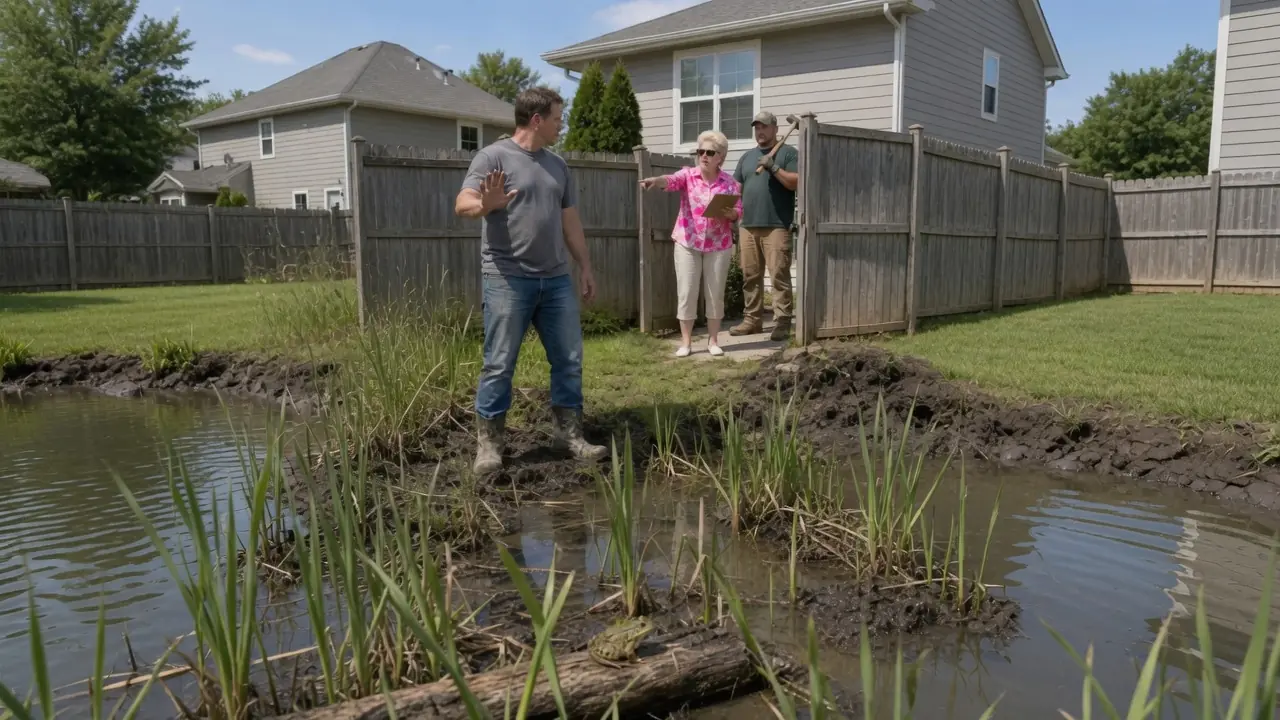
I stood in my driveway, the asphalt radiating the humid July heat through the soles of my sneakers, and stared at the letter. I didn't open it immediately. I knew what it was. It was a demolition order. I walked back up the drive past my Ford F-150, which I was required to park inside the garage because commercial-looking vehicles were considered visually aggressive, and around the side of the house. I needed to look at it one last time before I read the verdict. My pond, it wasn't just a hole in the ground. It was three months of my life. It was sweat, scraped knuckles, and a minor lower-back strain.
It was the only thing in my life that didn't involve spreadsheets, tax codes, or the soul-crushing fluorescent lights of my accounting firm. I was a forensic accountant. I spent my days looking for embezzlement and fraud. I spent my life hunting for mistakes. But this pond, this pond was perfect. I had hand selected the slate for the coping. I had installed a terrifyingly expensive three-stage biofiltration system that hummed with a quiet, reassuring vibration. The water was gin-clear, cycling through a custom waterfall that created a sound frequency specifically designed to lower cortisol levels. It was my zen. It was my church. And next Tuesday, it was supposed to be the home of six Japanese highback koi, currently swimming in a holding tank in Oregon, waiting for me to wire the final payment.
It really is a shame, a voice grated from the sidewalk. It draws so many insects. I stiffened. I knew that voice. It was a voice that could curdle milk. It was a voice that sounded like styrofoam rubbing against a window pane. I turned slowly. Linda. Linda commanded the sidewalk like a general surveying a battlefield. She was the president of the HOA, a title she treated with more gravity than the presidency of the United States. She was wearing her combat gear, a floral blouse that assaulted the eyes, khaki capris that ended at a precise regulation length, and a visor that battled her stiff, bleached hair for dominance.
She held a clipboard. She always held a clipboard. I was convinced she slept with it. Good afternoon, Linda, I said, keeping my voice level. I squeezed the certified letter in my hand. There are no insects. The water is moving at 3,000 gallons per hour. Mosquitoes can't lay eggs in moving water. It's basic biology. Biology is not in the bylaws, David, she said, stepping onto my grass. She stopped immediately, looking down at her feet, then back up at me with a smirk. Your St. Augustine looks a little parched. Are you adhering to the even odd watering schedule? I water when the law allows, Linda.
What is this? I held up the letter. That, she said, pointing a manicured finger that looked like a bird of prey's talon, is a notification of violation. Article 4, section B, paragraph 9. No permanent standing water structures exceeding 10 gallons in volume shall be erected visible from the street or neighboring properties without a unanimous vote of the aesthetic committee. It's not visible from the street, I argued, stepping between her and the pond. You have to walk halfway up my driveway to see it. I can see it from the sidewalk if I stand on my toes, she countered. And Gary can see it from his second story bedroom window.
He says the glare from the water distracts him while he's trying to read. Gary is legally blind, Linda. The only thing distracting Gary is his own reflection. She didn't laugh. Linda had had her sense of humor surgically removed in the late '90s to make room for more audacity. The board met last night, she said, checking her nails. We passed an emergency interpretation of the statute. We have classified your project as an unauthorized hazard pool. You have seven days to fill it in, resod the area, and return the grade to its original slope. If you fail to comply, the fine is $500.
500? I choked. That's standard for a shed violation. This is landscaping. $500 a day? She corrected, a cruel glint in her eyes behind her oversized sunglasses. Retroactive to the start of construction. By my calculation, you've been digging for twelve weeks. Do the math, David. You're an accountant. I did the math. My stomach dropped into my shoes. You want to fine me $40,000 for a koi pond? We want compliance, David. We want aesthetic cohesion. We do not want swamps, she said, waving one hand at my masterpiece. It's not a swamp. I snapped, my patience fracturing. It's a filtered ecosystem. It increases property value.
It attracts vermin, she said, turning on her heel. Seven days. The clock started this morning at 8:00 a.m. She walked away, her flip-flops smacking against her heels. Smack, smack, smack. It was the sound of a ticking bomb. I stood there for a long time. I looked at the water. I looked at the pump housing I had camouflaged with a fake rock. I thought about the koi in Oregon. I thought about the $40,000. I went inside, opened a beer, and sat at my kitchen table. My wife Sarah was at work. It was just me and the silence of a house that was suddenly very expensive to live in.
I wasn't a rebel. I wasn't a guy who fought the law. I paid my taxes. I drove the speed limit. I returned my shopping carts. But there was something about the way she had said swamp. There was something about the glee in her eyes. It wasn't about the rules. It was about power. It was about a woman whose children didn't call her anymore, finding a way to make someone pay attention to her. I pulled out my laptop. I downloaded the HOA covenants, conditions, and restrictions, CC&Rs. It was a 240-page PDF file that took 3 minutes to load. I spent the next 6 hours reading.
I read about fence heights. I read about approved shades of beige. There were 14. I read about the prohibition of unnatural statues. Poor Mrs. Higgins had to decapitate her garden gnome in 2019. I scoured article 4, section B. She was right. They had me. The language was intentionally vague. The board reserves the exclusive right to define hazard structures based on community safety and aesthetic harmony. It was a catch-all, a dictator's clause. They could ban my mailbox if they decided it looked too aggressive. I needed a drink, a stronger one. I didn't have any whiskey in the house, so I grabbed my keys and drove.
I didn't go to the liquor store. I went to the only place where I felt understood. Finn and Feather was a relic. It was a bait and tackle shop on the edge of town, nestled between a defunct radio shack and a vape shop. It smelled of damp earth, nightcrawlers, and old tobacco. It was the place where I had bought my pond liner. The bell above the door jingled as I walked in. The air conditioning was broken, or maybe just tired. Behind the counter sat old man Rivers. I don't know if Rivers was his real last name, but he looked like he had been eroded by water.
His skin was leather, his beard was a white thicket, and he was currently re-spooling a fishing reel with the focus of a bomb disposal expert. You look like hell, son. Rivers grunted, not looking up. HOA, I said, leaning against the counter. The glass display case beneath my elbows was full of lures that looked like angry bugs. Rivers spat into a styrofoam cup. Say no more. Those suburban warlords, what did they get you for? Grass height, improper shutter color. The pond, I said. They declared it a hazard pool. They want it filled in by next Tuesday. Five hundred dollars a day if I don't.
He pulled out a can of generic soda and cracked it open. They think they own the dirt. They think because they put a gate around the neighborhood, the Constitution don't apply. They have a loophole. I said the aesthetic harmony clause. They can ban anything. They can't ban federal law. Rivers said, What? I said, They can't ban federal law. Rivers repeated. He took a long sip of soda. You know, back in the '90s, I had a buddy, developer, bought 100 acres of prime real estate down in the valley, was going to put up condos, big money. Then one day, a surveyor found a salamander.
I frowned. A salamander? A tiger salamander? Rivers corrected. Protected, endangered. The EPA came in, dropped a hammer the size of Texas. Designated the whole 100 acres a critical habitat. My buddy couldn't move a shovel of dirt. Couldn't mow the grass. Had to let the whole thing go. Back to nature. Lost his shirt, but the salamanders were happy. I stared at him. The hum of the bait aerators in the back of the shop seemed to get louder. A thought tiny and dangerous began to form in the back of my mind. Are you saying? I started. I ain't saying nothing, Rivers said, leaning forward.
I'm just talking about the power of the Endangered Species Act. It's a powerful piece of legislation, Dave. It trumps local ordinances. It trumps city zoning. And it definitely trumps a beige loving HOA board led by a woman named Linda. I hadn't even told him her name was Linda. Rivers just knew. Hypothetically, I said, my heart starting to thump against my ribs. If a pond, a man-made pond, were to suddenly become the home of a protected species, what happens? Well, Rivers scratched his beard. If the animals are legally established and the agency recognizes the habitat, then the site becomes protected ground.
Once the agency recognizes an occupied protected habitat, Rivers explained, local officials cannot simply drain or fill it. Any alteration has to go through the U.S. Fish and Wildlife Service. I cannot just collect wildlife and put it in my yard, I said. Of course not, Rivers replied. Any animals would have to come from an authorized conservation breeder with genuine paperwork and agency oversight. He pulled a dusty binder from beneath the counter and showed me a conservation contact who worked with legally managed wetland species. The habitat would also have to suit the animals, Rivers continued. Your polished slate and sterile water are built for koi, not a wetland population.
You would need shaded water, reeds, natural substrate, and enough cover for the frogs to settle without stress. In other words, I said, I would have to turn my perfect pond into a swamp. Rivers closed the binder. Exactly. I thought about Linda. I thought about her standing on my lawn, measuring my grass. I thought about the emergency interpretation. I thought about the $500 fine. I looked at the picture of the frog. It was ugly. It was slimy. It looked like a stress ball made of hate. Do they make noise? I asked. Rivers threw his head back and laughed. It was a dry cackling sound.
Noise, son? A male in mating season sounds like a fog horn inside a dumpster. They don't croak, they bellow. I pulled out my wallet and placed my credit card on the glass counter. Put me in touch with the conservation breeder, I said, and sell me what I need to convert the pond into a proper wetland habitat. Rivers picked up the card. You sure about this? Once the agencies are involved, there is no going back. You are inviting federal oversight into your backyard. Linda wants a hazard, I said as a cold calm settled over me. I will give her a federally protected habitat.
Rivers nodded and ran the card through his ancient reader. One more thing, he said, handing it back. You will need a contractor to remove the ornamental filtration system and rebuild the pond with natural substrate and cover before any authorized transfer can occur. You got anyone who can keep his mouth shut? I smiled. I know a guy. He owes me a favor and he hates Linda almost as much as I do. The die was cast. The war had begun, and the centerpiece of my counterattack would arrive through an authorized wildlife transport. I called Vinnie at 9:45 on Wednesday night. It was late to call a contractor, but Vinnie wasn't exactly a nine-to-five kind of professional.
Vinnie operated in a time zone that existed solely within his own head, usually dictated by when the Jets game ended or when his van decided to start. Vinnie's concrete and other stuff, he answered on the fourth ring. I could hear the distinct sound of a bowling alley in the background. We pour it, you floor it. What do you need, Vinnie? It's Dave. Dave Miller, the patio guy from last year. Davey. His voice boomed. The slate guy. The guy with the fussy grout lines. How's the patio? Did that sealant hold up? I told you that German stuff is liquid gold. The patio is fine, Vinnie.
It's perfect. Listen, I have an emergency. A landscaping emergency. I need you here tomorrow morning. First light. There was a pause. I heard the crash of bowling pins. Tomorrow, Davey. I'm booked. I got a driveway in Sycamore Ridge. Mrs. Gableman, she wants exposed aggregate. It's a whole thing. I will pay you double, I said. The silence on the other end was heavy with calculation. Vinnie was a simple man, but he was a capitalist at heart. Double? What are we talking here? You want another patio? A retaining wall? I want you to destroy my pond. I said, Excuse me? I want you to take the pond, the one I spent three months building, and I want you to make it wrong.
I want you to unlandscale it. I need muck, Vinnie. I need mud. I need it to look like a place where a mafia hitman would dump a body in a movie from the '80s. Davey, Vinnie said, his voice dropping low. Are you drunk or are you in trouble? Do we need to call someone? I'm in trouble with the HOA. I said, Linda. She's trying to find me into poverty. Linda? Vinnie practically spat the name. That woman with the clipboard? The one who told me my van was visually offensive because it has rust on the bumper. That's the one. I'll be there at 6:00 a.m., Vinnie said.
I'll bring the shovel. Thursday morning arrived with a sky the color of a bruised plum. I was standing in the driveway with a pot of coffee when Vinnie's van, a white Ford E-series that had clearly survived several wars, rattled around the corner. It backfired once, a sharp crack that echoed through the sleeping neighborhood, and I winced, waiting for Linda's blinds to twitch. Vinnie hopped out. He was a fireplug of a man, 5'7 inches every direction, wearing work boots that were older than me, and a t-shirt that said, I'm not arguing. I'm just explaining why. I'm right. He had an unlit cigar clamped between his teeth.
Coffee, he grunted, accepting the mug I offered. He looked at the house across the street, Linda's house. He narrowed his eyes. She watching? She's always watching, Vinnie. She has the hearing of a bat and the visual acuity of a predator drone. We have to be fast. I led him to the backyard. The pond was shimmering in the early light. The water was crystal clear. The slate coping was perfectly level. The ferns were lush. Vinnie stood there, hands on his hips, chewing his cigar. It's beautiful, Davey. I got to be honest. You did good work. The coping is tight. The levels are perfect.
Why are we killing it? We aren't killing it, I said, handing him a shovel. We are repurposing it. Linda says it's a hazard pool. She wants it filled in, so I'm converting it into a critical wetland habitat to house a protected species of frog. Vinnie blinked. He took a sip of coffee. He looked at the pond. Then he looked at me. You're building a swamp. He summarized. Correct. To stick it to Linda. Correct. And you want me to take this $3,000 filtration system and fill it with dirt? Not just dirt, Vinnie. Specific dirt. Rivers. The guy at the bait shop gave me the recipe.
We need anorobic sludge, river mud, clay, and we need to rip out the UV sterilizer because clear water is bad for the frogs. They need gloom. Vinnie grinned. It was a slow, wide grin that revealed a gold crown on a back mer. I love it. It's malicious. It's petty. It's beautiful. Where do we start? We start with the tarp, I said, pointing to a pile of blue heavy-duty canvas. If Linda sees what we're doing, she'll call the cops for an unauthorized construction project. We need to tent the whole area, make it look like we're doing repairs. We spent the next hour rigging a massive blue tarp over the backyard, stringing it from the gutter of the house to the fence line.
It cast the entire yard in a weird smurf-like gloom. It was hot. It was stuffy. And it was perfect. We were invisible. All right, Vinnie said, rubbing his hands together. Operation swamp thing. Let's go. The first step was the hardest. I had to disconnect the UV sterilizer. This was a piece of equipment I had researched for weeks. It cost $400. It used ultraviolet light to kill algae at a cellular level. It was the heart of the system. Goodbye, old friend, I whispered, unscrewing the housing. Don't cry, Vinnie said, hacking at the perfectly manicured bank of the pond with a spade.
Think of the frogs. Think of Linda's face. I'm thinking of my bank account, I muttered. Vinnie had brought them materials in the back of his van. He had stopped by a construction site near the river where they were digging foundations. He had filled six contractor bags with what could only be described as guck. It was heavy, wet, clay-heavy mud that smelled like low tide. This is the good stuff, Vinnie said, dragging a bag over to the edge of the pristine water. Pure organic decay. You want algae? This is a starter kit for a biological crisis. Dump it, I said, turning away.
I couldn't watch. Splash. The sound was wet and heavy. The bag emptied into the water. A cloud of brown silt exploded outward, instantly turning the gin clear water into a chocolate milkshake. Splash! Splash! Oh yeah! Vinnie laughed. That's nasty. That is absolutely foul. The filter is trying to fight it, Davey. Listen to the pump. I listened. The pump, which usually purred, was now making a sound like a blender digesting a shoe. Gr urgle clunk. Kill the pump. I said we need the water still stagnant. I pulled the plug. The waterfall died. The silence that followed was heavy. The water settled, but it didn't clear.
It just sat there brown and brooding. Now the decor, Vinnie said. We had scavenged materials. I had gone to a questionable nursery on Sus the highway and bought their clearance stock. Plants that were half dead, brown and ugly. Cattails that were shedding fluff. Saw grass that cut your hands if you looked at it wrong. We waded into the muck. I was wearing waders. Vinnie just rolled up his pants. He didn't care. We wedged rotting driftwood into the corners. We planted the cattails in the center, letting them droop sadly over the surface. We threw in a handful of duckweed, which I knew would multiply and cover the entire surface in a green slime within 48 hours.
By noon, the transformation was complete. We stepped back. The tarp trapped the heat, and the smell of the river mud was starting to rise. It smelled like wet dog and sulfur. The water was opaque. The plants looked like they were dying. A single fly buzzed around Vinnie's head. It's hideous, I said, wiping sweat from my forehead. It looks like a drainage ditch in a malaria zone. It's a masterpiece, Vinnie corrected, relighting his cigar. Linda's going to vomit. I guarantee it. She's going to look at this and her brain is going to short circuit. That's the hope, I said. Here. I handed Vinnie an envelope with cash.
He counted it quickly, his fingers deft. Pleasure doing business with you, Davey. You call me when the frogs show up. I want to drive by and hear them. You won't have to drive by, I said. Rivers says you'll hear them from the highway. Vinnie packed up his tools. Hey, if she gives you trouble, I know a guy who does septic tanks. We can really escalate this if we need to. Let's hope the frogs are enough, I said. Vinnie left, his van backfiring one last time as a salute. I took down the tarp. I stood in the open air, waiting for the scream.
It didn't come. Linda wasn't home. Her car was gone. She was probably out patrolling the neighborhood, measuring other people's trash cans. I went inside to shower. I scrubbed the smell of swamp off my skin, but the anxiety remained. I had the habitat. Now I needed the tenants. Friday was a blur of nervous pacing. I checked the tracking number on my phone every 10 minutes. Overnight wildlife transport. Status out for delivery. I had told Sarah about the plan. She was skeptical. You're turning our backyard into a swamp? She had asked over dinner on Thursday, staring at me like I had announced I was joining a cult.
It's not a swamp, honey. It's a strategic ecological defense system. It smells like dirt, David. That's the smell of freedom, I had replied. And it smells better than a $40,000 fine. She had sighed, stabbed a piece of broccoli, and said, Just don't let them get in the house. If I find a frog in the shower, I'm moving to my mother's. Deal. At 10:30 a.m. On Friday, the FedEx truck pulled up. I met the driver at the curb. He was a young guy wearing headphones around his neck. He handed me a box that was surprisingly heavy. It was white styrofoam taped shut with red tape.
That read live animals. Handle with care. Reptiles, amphibians. Sign here, he said. What you got in there? Snakes. Guard dogs. I said amphibious guard dogs. He laughed, scanned the box, and handed it over. Good luck with that, man. I carried the box into the kitchen like it was the Holy Grail. I set it on the island. I cut the tape. Inside was a layer of newspaper and beneath that four plastic deli cups with perforated lids. They were packed in damp moss. I lifted the first cup. Inside sat a creature that looked less like a frog and more like a partially deflated football with eyes.
It was massive. Its skin was a mosaic of olive green, brown, and black. Its throat sack was wrinkled and loose. It stared at me with unblinking golden eyes. Attached to the side of the box was a plastic sleeve containing the paperwork. This was the most important part. I pulled it out. The paperwork identified the animals as part of a protected red-legged frog conservation program, with an authorized source and a valid permit reference. It was dense, bureaucratic, and exactly what Dave needed to prove the animals had not come from a pet shop or the nearest ditch. I took the box to the backyard.
I sat on the edge of the new swamp. The water had settled slightly, but it was still murky and brown. The duckweed had already started to spread. Creating little green islands. Okay, guys, I whispered. This is it. This is your new kingdom. It's got mud. It's got bugs. And it's got an HOA president across the street who hates your guts. Do your worst. I opened the first lid. The frog didn't move at first. It just sat there breathing, its sides heaving. Then with a sudden explosive motion, it launched itself. Plop. It hit the water. It didn't splash so much as it punched a hole in the surface.
It disappeared instantly into the muck. I released the other three. Plop. Plop. Plop. The General, the Colonel, the Major, and the Captain. I had named them. It felt appropriate. They were my soldiers. I sat there for an hour watching the water. Nothing happened. No croaking, no movement, just ripples. Panic started to set in. Had I killed them? Was the water too dirty? Was the temperature wrong? Had Vinnie's mud contained something toxic? Please, I whispered. Please be alive. Just as I was about to grab a net to check, a head broke the surface near the rotting log. It was the General.
I knew it was him because he was the biggest. He pulled himself up onto the log, his wet skin glistening in the sun. He looked around the yard. He looked at the house. He looked at the fence. He looked comfortable. He shifted his weight, settled his back legs, and closed his eyes. He was home. I went back inside and taped the laminated critical habitat sign to the inside of my sliding glass door facing outward. Now all I needed was for Linda to come home. Saturday passed in a tense silence. The frogs were quiet. They were acclimating. Rivers had told me this would happen.
Give them 24 hours to mark their territory, he had said. Once they feel safe, they'll start calling for the ladies. I spent Saturday pretending to garden, just so I could be outside. I saw Linda's car return. I saw her walking her poodle, a nervous little thing named Princess that looked like a cottonball with anxiety issues. She stopped at the end of my driveway. She peered towards the back. She couldn't see the water from there, but she could see the lack of construction activity. Seven days, David, she yelled from the sidewalk. You have until tomorrow morning. I don't see a cement mixer.
You won't need one, I yelled back, waving a trowel. I took care of it. It better be filled in, she warned. If there is one drop of standing water, I'm finding you. She walked on. I looked back at the swamp. The General was still on his log. He hadn't moved. He was like a gargoyle. Sunday morning. The deadline, 9:00 a.m. I was awake at 5:00 a.m. I couldn't sleep. I sat in the kitchen drinking coffee, watching the sun come up over the fence. The light hit the pond. The mist was rising off the water. It actually looked kind of natural in a prehistoric land before time sort of way.
At 7:00 a.m., I heard it. It started low, a vibration. I felt it in the floorboards before I heard it with my ears. Jug-o-rum. I froze. Jug-o-rum. It was deep. It was resonant. It sounded like a cello being played by a bear. Then a second voice joined in. Slightly higher pitched, but just as loud. Jugle rum. Jugle rum. I ran to the back door. The General was inflated. His throat sack was the size of a grapefruit. He was bellowing. The colonel was answering him from the cattails. Jug-o-rum. Jug-o-rum. It was loud. It was incredibly loud. It echoed off the brick siding of my house.
It bounced off the neighbor's fence. I started laughing. I couldn't help it. It was the sound of sweet, slimy victory. At 8:55 a.m., the doorbell rang. I walked to the front door. I checked the peephole. Linda, she was wearing her Sunday best. A pastel yellow pants suit that made her look like a hostile banana. She had her clipboard. She had Gary, the treasurer, and Susan, the secretary, with her. They looked like a firing squad. I opened the door. Good morning, Linda, I said. You're early. The deadline is 9:00 a.m. She said, tapping her watch. It is 8:58. We are here to inspect the remediation.
Of course, I said, stepping aside. Please come through to the back. I have the fine paperwork ready, Gary mumbled, clicking a pen. Gary was a man who enjoyed paperwork the way normal people enjoyed ice cream. You won't need the pen, Gary, I said. We'll see about that, Linda said, marching through my house. She didn't take off her shoes. I didn't care. In 10 minutes, she wasn't going to care about shoes either. We walked through the kitchen. The sound of the frogs was audible, even through the double-paned glass. Linda stopped. What is that noise? My new filtration system. I lied. It's very powerful.
I slid open the glass door. The sound hit us like a physical wave. Jug-o-rum. Jug-o-rum. Linda stepped onto the patio. She looked at the yard. She stopped dead. The tarp was gone. The pristine slate and clear water were gone. In their place was a brown, reedy, muddy lagoon. The smell of decay wafted up to greet us. David, Linda whispered, her voice trembling with rage. What? What is this? I told you, Linda, I said, leaning against the doorframe. I fixed the problem. It's no longer a hazard pool. It's a swamp, she screamed, spinning around. It's a filthy, disgusting swamp. You've made it worse.
This is This is an abomination. Actually, I said. It's a habitat. It's a sewer. She pointed at the water. Look at it. It's brown. It's gJug-o-rum. The General let out a call so loud that Susan actually jumped and dropped her clipboard. Linda stared at the log. The General stared back. He looked enormous. He looked smug. Is that a toad? Linda asked, horror dawning on her face. That I said, is a bullfrog. Specifically, a very rare, very special bullfrog. I don't care if it's the Prince of Wales, Linda shrieked. Get a net. Get a shovel. Kill it. Kill it now. I wouldn't do that if I were you, I said calmly.
Gary, she barked. Go get that thing out of there. Gary hesitated. He looked at the water. He didn't want to ruin his loafers. Linda, I do it, Gary. That is a direct order from the board. Gary sighed and stepped off the patio onto the grass. He started walking toward the water. Gary, I called out, my voice sharp. Stop. Gary stopped. I reached into my back pocket and pulled out the laminated sheet. Gary, I said, do you want to risk a federal charge? Gary turned around. What? That frog? I said, pointing to the General, is protected by the United States government.
If you disturb him, touch him, or even look at him too aggressively, you are violating the Endangered Species Act. I held up the paper. So I smiled. Who wants to go to jail first? The silence that followed was broken only by the sound of the General, who let out a long, satisfied croak. Jug-o-rum, the game was on. Linda snatched the laminated paper from my hand with a speed that defied her age. Her acrylic nails clicked against the plastic like tiny daggers. She brought it up to her face, squinting through her oversized sunglasses, scanning the text for a weakness. A typo.
Anything she could use to tear my defense apart. This is garbage. She scoffed, waving the sheet in the air. It's internet garbage. You probably printed this off Wikipedia. Critical habitat. You live in a cul-de-sac, David, not a national park. This is a residential zone zoned for single family occupancy, not amphibian occupancy. Actually, I said, keeping my voice calm. The kind of calm you use when talking to a toddler holding a knife. The Endangered Species Act doesn't care about zoning. It cares about habitat. And thanks to Vinnie's excellent landscaping work, this is now a prime wetland environment. It's a mud puddle, she screamed.
Gary, ignore him. He's bluffing. It's a frog. It probably costs $5 at a pet store. Get the shovel. Gary looked at me. He looked at the paper in Linda's hand. Then he looked at the General, who was currently watching us with the heavy-litted boredom of a creature that had survived millions of years of evolution and was unimpressed by suburban politics. Linda, Gary said, his voice wavering. It says twenty-five thousand dollars per violation. He typed it himself, Linda shrieked. It has a seal, Gary pointed out, squinting at the document. It looks like the Department of the Interior seal. The one with the buffalo.
It's a clip art buffalo. Linda was vibrating now. She turned on me, her eyes practically glowing with malice. You think you're funny? You think you can hold this neighborhood hostage with a fake document and a few slimy animals? I'm calling the police right now. I'm going to have you arrested for fraud, creating a public nuisance, and unauthorized livestock farming. Livestock. I raised an eyebrow. I'm not milking them, Linda. Shut up, she fumbled for her phone, her fingers shaking so hard she dropped it once before dialing 911. I stood there, arms crossed, and waited. This was the gamble. If the cops showed up and laughed at me, if they told me to drain the swamp, I was done.
I'd be out forty thousand dollars and I'd be the laughingstock of the Rolling Hills Estates. But if Rivers was right, if the mere threat of federal bureaucracy was enough to terrify local law enforcement, then I had a chance. Yes, Linda shouted into the phone. I need an officer at 42 Maple Drive immediately. There is a dangerous situation. A neighbor has created a biohazard. He's threatening board members. He has wild animals loose in the yard. She paused, listening to the operator. No, not a tiger, she snapped. Frogs. Giant aggressive frogs. And he's claiming they're federally protected animals. Just send someone. She hung up and glared at me.
They're coming. You better hope you look good in handcuffs, David. I didn't answer. I just walked over to the patio chair, sat down, and took a sip of my coffee. It was cold, but it tasted like victory. We waited for twenty minutes. It was the longest twenty minutes of my life. The General let out a few experimental croaks, testing the acoustics of the new swamp, but mostly he just sat there being large and illegal. Finally, a squad car rolled around the corner. It wasn't just any squad car. It was a Dodge Charger with the push bar on the front. The kind they send when they think someone might actually be dangerous.
The car stopped in front of my house. The door opened and out stepped Officer Miller. I knew Miller. He was a veteran on the force, a guy with a thick mustache and a waistline that suggested he enjoyed the local bakery a little too much. He coached the junior varsity baseball team. He was a good guy, but he also looked incredibly tired. He walked up the driveway, hitching up his duty belt, his eyes scanning the group. Linda looking like she was about to explode. Gary looking like he wanted to be abducted by aliens. And me sitting on my porch drinking cold coffee.
Morning folks, Miller said, his voice gravelly. Dispatch said something about dangerous animals and threats. Officer Miller. Linda practically lunged at him. Thank God. You have to arrest him immediately. Miller blinked. Arrest who? Dave. He looked at me. Dave, what did you do? Did you park the truck in the driveway again? I wish it were that simple, Jim, I said, standing up. It's not a truck, Linda yelled. It's an ecological nuisance. Come see. He's turned his backyard into a cesspool, and he's breeding monsters. Miller sighed. It was a long, heavy sigh that contained the weight of a thousand domestic dispute calls.
All right, let's see the monsters. We led him to the back. When Miller stepped onto the patio, he stopped. He looked at the brown water. He looked at the rotting logs. He looked at the swarm of gnats hovering over the cattails. Well, Miller said, tilting his cap back. That's certainly a landscaping choice, Dave. Last time I was here for the BBQ, didn't this used to be a nice stone pond? It's a habitat restoration project, I said. It's a hazard, Linda interrupted. It violates article 4 and the noise. Listen to it. Right on cue, the General decided to introduce himself to the law.
He inflated his throat sack, which looked alarmingly like a balloon about to pop, and let out a sound that vibrated the fillings in our teeth. Jug-o-rum. Jug-o-rum. Miller actually took a step back, his hand instinctively drifting toward his taser. Jesus, what the hell is that? That Linda shrieked, pointing a trembling finger. Is the nuisance. He put them in there on purpose to torture us. Make him kill it, officer. Shoot it. Miller looked at the frog. The frog looked at Miller. Ma'am, Miller said slowly. I am not going to shoot a frog. I have a lot of paperwork to do today and discharged weapon at amphibian is not a report I want to write.
Then cite him, Linda demanded. Noise ordinance, public nuisance, health code violation. Miller looked at me. Dave, she's got a point on the noise. That thing sounds like a cow stuck in a well. And the water. If the health inspector sees this I understand, officer, I said, stepping forward. And I would love to comply. Really, I'd love to drain it and get rid of the noise, but I can't. Why not? Because, I said, handing him a fresh copy of the laminated document I had printed five. My hands are tied by the federal government. Miller took the paper. He adjusted his glasses.
He read the header. Endangered Species Act, he muttered. Protected red-legged frog complex. Yes, sir, I said, putting on my best concerned citizen voice. The frogs are part of a documented conservation transfer, and the habitat is awaiting federal inspection. Under federal wildlife law, disturbing the animals or destroying the site before that review could bring serious consequences. Miller looked up from the paper. He looked at me. There was a glimmer of recognition in his eyes. He knew I was full of it. He knew frogs didn't just move in to a suburban New Jersey backyard overnight. But he also saw the paperwork. And he saw Linda.
So Miller said, scratching his mustache. You're telling me that if I make you turn off the water or remove the frogs, I'm ordering you to commit a crime? A federal crime, Jim, I said softly. And I think that would make you an accessory. I checked the statutes. The penalties can include major fines and criminal charges. I pointed to the swamp. There are four of them. Miller whistled low. That is far beyond anything this department should gamble with. He's lying. Linda screamed. She was pulling at her hair now. It's a trick. Frogs don't have rights. Miller turned to Linda. His face hardened.
He was tired of being yelled at. Actually, Linda, Miller said. They do. If this is a protected species, this is way above my pay grade. This is fish and wildlife territory. I'm just a local cop. I can enforce noise ordinances on stereos and barking dogs, but I can't enforce a noise ordinance on a wild animal. That's nature. It's not nature, Linda yelled. He bought them. He bought them from a guy named Rivers. Did you? Miller asked me. The animals came through a permitted conservation transfer, I said. The paperwork is inside, and the habitat is under review. Miller looked back at the document.
He handed it back to me. Look, Miller said to Linda, Here's the deal. I can't verify if these frogs are special or not. I'm not a biologist, but I also can't order a citizen to destroy a potential federal habitat based on a noise complaint. If you want this gone, you need to call the EPA or Fish and Wildlife. Until they say it's safe to remove them, this swamp stays. You're useless, Linda spat. I'll call the mayor. I'll call the governor. You do that, Miller said, turning back to his car. Dave, keep it reasonable. Maybe buy some earplugs for the neighbors.
I'll do my best, officer, I said. Miller got in his car. As he rolled up the window, I swear I saw him smiling. He drove away, leaving Linda standing on my lawn, looking like she had just swallowed a lemon whole. This isn't over, she hissed. I'm going to call every agency in the book. I'm going to have this house condemned. Be careful, Linda, I said, stepping back inside and sliding the door shut. You don't want to disturb the habitat. The General is watching. The victory was sweet, but short-lived. That night, the reality of what I had done set in. Have you ever heard a bullfrog?
I mean, really heard one. It's not a background noise. It's a physical event. At two o'clock in the morning, the quartet of frogs decided to perform an opera. Jug-o-rum. Wow. It was deafening. My bedroom window faced the backyard. Even with the windows closed, it sounded like there was a frat party happening in my garden, except the frat brothers were wet, slimy, and communicating via bass drops. Sarah rolled over in bed, pulling the pillow over her head. David, she muffled through the down feathers. Yes, honey. I hate them. I hate them so much. They're saving our savings account, I whispered, staring at the ceiling.
They sound like dying cows, she groaned. Can't we just put a muzzle on them? That would be harassment, I said. Federal crime. I'm going to harass you in a minute, she threatened. I didn't sleep that night. I lay there, listening to the General bellow his mating call into the suburban darkness. But every time I started to get annoyed, I thought of Linda across the street. I thought of her lying in her beige bedroom, staring at her beige ceiling, listening to the same sound. And I smiled. The next three days were a war of attrition. Linda didn't give up. She was a woman possessed.
She couldn't get the police to act, so she went for the throat. The HOA legal team. On Wednesday afternoon, a process server showed up at my door. He handed me a thick packet of papers. Emergency injunctive relief. Rolling Hills HOA versus David Miller motion to compel remediation of biohazard. They were suing me. Not just fine me, suing me. They were asking a judge to sign an order forcing me to hire a hazmat team to sterilize the yard. I read the lawsuit at the kitchen table. It was aggressive. They claimed the frogs had been introduced with malicious intent. That part was not entirely unfair.
And that the swamp was a breeding ground for West Nile virus. Possibly true, though I hadn't seen any mosquitoes yet. I called Rivers. They're suing me, I said. Good, Rivers said, sounding like he was eating gravel. That means they're desperate. Now you make the call. What call? The call you should have made on day one, Rivers said. Contact the agency, disclose the conservation transfer, send the permit file, and request an emergency inspection before the HOA's contractor touches the site. If the animals and habitat qualify, the agency will decide what protections apply. But what if they reject the site? I asked.
The frogs had come through a conservation breeder, and the agency had not yet inspected the finished habitat. Rivers sighed. Then tell them exactly that, he said. You have a documented conservation population, the HOA is threatening the site, and you need an emergency inspection before a contractor destroys it. Give them the truth and let the paperwork do its job. I liked that better. I hung up and dialed the regional office of the U.S. Fish and Wildlife Service. U.S. Fish and Wildlife Service, Agent Garcia, speaking. Hi, I said. My name is David Miller. I have paperwork for a protected red-legged frog conservation population in my backyard habitat, and my homeowners association has sent a contractor to destroy the site.
There was a pause. Did you say destroy the site? Agent Garcia asked. Yes, ma'am. They have a work order and a contractor on the way. Do not let anyone enter the water, Garcia said. I am sending a field team now. I hung up the phone and walked to the window. Outside, a truck was pulling up. It wasn't the police. It wasn't FedEx. It was a black pickup truck with emerald landscapes and excavation stenciled on the side. A man hopped out. He was huge. He looked like he ate rocks for breakfast. He was carrying a sledgehammer. Linda walked out to meet him.
She pointed at my house. She pointed at the backyard. She handed him a piece of paper. Probably the HOA work order. The man nodded. He spit on the ground. He started walking toward my gate. My heart hammered against my ribs. The feds were an hour away. The sledgehammer was thirty seconds away. I ran to the back door. I threw it open. Hey, I yelled. Hey, you can't come in here. The man stopped at the side gate. He looked at me. HOA order, buddy. Emergency abatement. Step aside. I'm telling you, I shouted, backing up toward the pond where the General was sunning himself.
If you come through that gate, you're breaking federal law. I don't see no feds, the man grunted. He reached for the latch. I looked at the street. Empty. I looked at the frogs. Sing you idiots, I whispered. Sing for your lives! The General just blinked. The man lifted the latch. The gate creaked open. Linda! I screamed over his shoulder. Call him off. The Fish and Wildlife Service is on their way. Linda stood on the sidewalk, arms crossed, smiling. I don't believe you, David. Destroy it, Mr. Henderson. Henderson stepped into the yard. He raised the sledgehammer. He was aiming for the camouflaged pump housing.
And then a sound cut through the air. Not a croak, not a scream. A siren. A short sharp whoop whoop that sounded like authority. A black SUV tore around the corner, jumped the curb, and screeched to a halt right on Linda's prize-winning petunias. The doors flew open. Agent Garcia didn't look like a biologist. She looked like a SWAT team member who happened to like animals. She was wearing a tactical vest that said Federal Wildlife Officer. Drop the hammer, she shouted, pointing a finger that looked more dangerous than a gun. Drop it right now. Henderson froze. The hammer hovered in the air.
Step away from the wetland, Garcia commanded, marching across the lawn with her partner right behind her. Henderson dropped the hammer. Thud! Linda's mouth fell open. Her sunglasses slipped down her nose. I slumped against the doorframe, my knees turning to jelly. Welcome to the swamp, I whispered. Silence is a rare commodity in the suburbs. Usually, there's a lawn mower humming, a dog barking, or the distant drone of a leaf blower. But in the moments after agent Garcia shouted, Step away from the wetland, the silence on Maple Drive was absolute. It was heavy. It was the kind of silence that usually precedes a crater being formed.
Mr. Henderson, the human refrigerator hired by the HOA, looked at the sledgehammer lying in the grass near his steel-toed boots. He looked at Agent Garcia, whose hand was resting casually, but intentionally near the holster on her hip. Then he looked at Linda. You didn't say nothing about Feds, Henderson said. His voice was a low rumble of betrayal. You said it was a code violation. You said it was a civil cleanup. It is, Linda shrieked, finding her voice. She marched down the driveway, her heels clicking on the asphalt like angry castanets. She pointed a finger at Agent Garcia. Who are you?
You can't just drive onto private property and start shouting orders. I am the president of the Rolling Hills Homeowners Association. And this man is under contract to perform emergency remediation on a biohazard. Agent Garcia didn't blink. She didn't even look at Linda at first. She kept her eyes locked on Henderson. Sir, Garcia said, her voice ice cold. I'm going to ask you one time. Are you a licensed contractor in the state of New Jersey? Yeah, Henderson grunted. Emerald Landscapes, licensed and bonded. Good, Garcia said. Then you are aware that destroying an occupied protected habitat can bring substantial fines and possible federal prosecution.
Henderson paled. The color drained from his face so fast he looked like he'd been bleached. I didn't know. Ignorance of the Endangered Species Act is not a defense, sir. Garcia said, Now, pick up your hammer, put it in your truck, and if I see your vehicle within 500 feet of this property again without a federal warrant, I will impound it. Am I clear? Henderson didn't look at Linda. He didn't ask for his check. He snatched the sledgehammer from the grass like it was made of radioactive lava. He sprinted to his truck and peeled out. The screech of his tires was the sound of a man realizing he almost traded his freedom for a $200 landscaping gig.
We were left with the silence again. And Linda turned to Garcia, her face a mask of indignation. You chased him away. That was HOA resources. You have no jurisdiction here. This is a private community. Agent Garcia finally turned her full attention to Linda. She stepped forward, entering Linda's personal space in a way that made Linda take a stumbling step back into her own azaleas. Ma'am, Garcia said, pulling a badge from her vest. It caught the sun, flashing gold and authoritative. My name is Special Agent Garcia, U.S. Fish and Wildlife Service. My jurisdiction is the United States of America. That includes your cul-de-sac.
He called you, didn't he? Linda spat, pointing at me. I was still huddled by the back door, trying to look like a victim. He's lying. He put those frogs there. It's a prank. We take all reports of endangered species seriously, Garcia said. Now, step aside. We are going to conduct a site survey. I'm coming with you, Linda declared, as the property representative. You are not the property owner, Garcia cut her off. And you are currently investigating a nuisance. If you interfere with a federal investigation, I will place you in the back of my unit. Do you understand? Linda's mouth opened and closed like a fish on a dock.
She looked at the neighbors who had started to gather on their porches. She looked at me. She crossed her arms and huffed. Fine, but I'm watching you. Agent Smith, Garcia said to her partner, a man who looked like he was carved out of granite and wore sunglasses that probably had x-ray vision. Secure the perimeter. No one enters the backyard. On it, Smith grunted. He moved to the side gate, standing in front of it like a bouncer at the club of legal amphibian protection. Agent Garcia looked at me. Lead the way. I swallowed hard. Yes, ma'am. Right this way. Walking into the backyard with the agents felt like walking to the gallows, except the executioner was potentially going to be a frog.
This was the moment of truth. If the breeder's documents were defective, if the animals were not what the paperwork claimed, or if the habitat failed inspection, I would lose everything and probably face consequences of my own. We stepped onto the patio. The smell hit us first, the earthy, rot-rich scent of Vinnie's imported muck. Smells active, Smith noted, pulling on latex gloves. Garcia walked to the edge of the water and studied the reeds, logs, and shaded banks. Mr. Miller, she said, how long has this water feature been managed as a wetland habitat? About a week, I answered. I had been building a koi pond, then I changed course after consulting an authorized breeder.
The transport documents and permit contacts are in the kitchen. Garcia reviewed the file before examining the animals. She checked the breeder's authorization, the transport record, and the identifying notes attached to the conservation population. Then the water rippled. A massive head broke the surface, followed by the shoulders and the rest of him. The General climbed onto the rotting log and stared at us as though the entire inspection had been arranged for his convenience. Garcia lifted her binoculars and studied him for a long time. Smith, she said quietly, check the dorsolateral folds and the red wash on the hind legs. Smith took the binoculars, compared the animal with the documents, and nodded.
The identifying features are consistent. Garcia examined the remaining three frogs as they surfaced among the reeds. She watched the General settle onto the log, his mottled skin shining in the sunlight and his golden eyes half-lidded with complete indifference to suburban law. Smith moved slowly around the buffer, photographing the pond from several angles and taking notes on the reeds, the shaded margins, and the water depth. He lowered a small probe into the water and waited for the reading while Garcia checked the transport seals against the breeder's file. The process took far longer than Linda expected. She had climbed onto a ladder behind the privacy fence and was trying to watch over the top, her visor bobbing like a signal flag.
Every time she whispered something to Gary or Susan, Agent Smith looked toward the fence until the voices stopped. The General remained on his log. The Colonel surfaced beside a clump of cattails, and two smaller heads appeared near the driftwood. For the first time since I had started this ridiculous plan, all four animals were visible at once, as though they understood that their continued residence depended on perfect attendance. Garcia asked when the filtration system had been removed, how the water had been conditioned, and whether the breeder had provided feeding and monitoring instructions. I answered from the documents rather than improvising. Rivers had warned me that federal forms were less forgiving than Linda's clipboard, and I had no intention of giving Garcia reason to doubt the legitimate parts of the arrangement.
She compared my answers with the file, then asked Smith to call the breeder and confirm the transfer. We waited in the thick smell of mud and wet plants while Smith spoke quietly into his radio. Linda's face remained just visible over the fence. Vinnie had left the pond ugly enough to offend every landscaping instinct she possessed, but the agents did not see ugliness. They saw cover, moisture, shelter, and an occupied enclosure. What Linda called a swamp, Garcia evaluated as habitat. That difference in vocabulary felt like the whole war in miniature. Smith ended the call and returned. The breeder confirmed the animals, the permit reference, and the transport date.
Garcia gave one slow nod. Only then did she look at me. The source documents are valid, she said. This is a legally managed protected red-legged frog conservation population, and the occupied enclosure qualifies for federal protection while the program remains in compliance. My knees almost gave out. What does that mean? I asked. Can the HOA still drain the pond? No, Garcia said. You are now the custodian of a monitored habitat. The site is still your property, but the protected animals and their enclosure cannot be disturbed without agency approval. She instructed Smith to establish a ten-foot buffer, post temporary signs, and document the water conditions.
Smith returned to the SUV and came back with stakes, yellow tape, metal signs, and a field case. He measured from the water's edge, drove the stakes into what had once been my carefully maintained lawn, and wrapped the tape around them until the pond looked like a miniature federal crime scene. One sign faced the house. Another faced the neighboring fence. The third faced the street, positioned so perfectly toward Linda's kitchen window that I briefly wondered whether Agent Garcia had a sense of humor after all. The warning language was blunt. No draining. No filling. No chemicals. No removal or harassment of the animals.
Any work inside the marked area required agency approval. Linda read the sign from behind the fence and made a sound that was almost a cough and almost a scream. Gary asked whether the HOA could appeal. Garcia told him the board could submit questions through the proper office, but until the review changed, the habitat stayed exactly as it was. Then Garcia handed me a carbon-copy acknowledgment form. The paper was pink, official, and more beautiful to me than any landscape plan I had ever drawn. I signed where she pointed. She reminded me that protection came with responsibility: I had to maintain the site within the approved guidelines, report any illness or escape, preserve the buffer, and allow follow-up inspections.
The federal shield I had wanted was not freedom from rules. It was a different and much larger set of rules, backed by people Linda could not intimidate. Then she stepped closer. If any part of your reporting changes or the habitat is neglected, we will come back. Understood? Completely, I said. The next hour was a flurry of official activity. Smith drove stakes into the lawn and wrapped yellow tape around the buffer. The signs warned that disturbing, harming, capturing, or removing protected wildlife could bring civil and criminal penalties. One faced the house, one faced the neighbor's fence, and one faced the street where Linda could see it from her kitchen window.
When they were done, my backyard looked like a crime scene involving a swamp monster. Garcia met me on the porch with a carbon-copy form. Sign here, she said. This acknowledges the habitat restrictions. No draining, no filling, no chemical treatment, no pesticides near the water, and no introduction of predatory fish. Your koi are out of the question. I can live with that, I said. And no artificial noise suppression, she added. If the frogs call, let them call. They call a great deal, I admitted. That is the sound of an active habitat, she said. We will return to monitor water quality and tell you what maintenance is permitted.
Congratulations, Mr. Miller. You are a conservation steward. She walked back to the SUV. Smith followed. They got in, the blue lights finally flicking off. As they backed out of the driveway, Garcia rolled down her window. Nice frogs, Dave, she said. Then she winked. They drove off. I stood there holding the pink slip. I looked at the yellow tape. I looked at the signs. I was safe. Or so I thought. The victory lap didn't last long. Linda was not the kind of woman who accepted defeat. She was the kind of woman who, when told the bridge was out, would drive her car into the ravine just to prove the map wrong.
An hour after the feds left, I saw her car backing out of her driveway. She was on the phone. She looked furious. I went inside and made a sandwich. I sat by the back door and watched the General. He was asleep or meditating or planning his next felony. At four o'clock that afternoon, my phone rang. It was an unknown number. Hello, Mr. Miller. This is Greg Patterson. I'm the attorney for the Rolling Hills Homeowners Association. Hello, Greg, I said, taking a bite of my sandwich. If you're calling to congratulate me on my new federally protected status, thank you. I am calling, Greg said, his voice dripping with billable hours to inform you that while the HOA acknowledges the unique jurisdictional issues regarding the water feature, we are not without recourse.
Recourse? I asked. Greg, I have a sign in my yard that threatens prison time if you touch my mud. What recourse do you have? The bylaws, Greg said smoothly. Cover more than just water features. I'm looking at your file. It seems you have a perimeter fence. Yes, it's standard six-foot cedar. Actually, Greg said, according to the survey on file, your fence is 6 feet 2 inches in some places due to ground settling. The maximum allowable height is 6 feet, strictly enforced. You're kidding me. We are not. Furthermore, he continued, the federal designation protects the habitat. It does not protect the rest of your property.
The HOA board, specifically Mrs. Linda Kinsky has called an emergency inspection of your roof, your siding, your driveway sealant, and your grass height. If we find a single violation, we will lien your house. This is harassment, I said. This is compliance, Greg said. We'll be there tomorrow at noon with a laser level. Have a nice day. He hung up. I stared at the phone. They were going to nickel and dime me to death. They couldn't touch the frogs, so they were going to burn down everything around the frogs. I looked at the backyard. The yellow tape fluttered in the breeze.
I needed to escalate. I had won the battle of the pond, but I was losing the war of the property line. I walked outside. The General was awake. He looked at me. They want a war? I asked him. Grump, he replied. You're right, I said. Defense is good, but offense is better. I went to the garage. I didn't have a laser level or a law degree, but I had something better. I had the contact information for the Friends of the Swamp local chapter, and I had a copy of the HOA bylaws that I had memorized. I flipped to section 12, community gatherings and educational events.
Educational events regarding local wildlife and nature conservation are permitted in residential zones between the hours of 10:00 a.m. And 6:00 p.m. Provided they are open to the community. I smiled. I went back inside and opened my laptop. I logged on to the neighborhood Facebook group. Post free educational event. Come meet the rolling hills miracle frogs. Rare and endangered species viewing tomorrow at noon right when the HOA inspection is scheduled. Kids welcome. Free popsicles. I hit post. Then I called the local elementary school science department. Hi, I said to the receptionist. How would you like a field trip to a federally designated critical habitat tomorrow?
I can guarantee giant frogs. If Linda wanted to inspect my roof, she was going to have to do it while waiting through 30 excited third graders and a local news crew. The next day came the inspection. Noon arrived. It was a hot, sticky Tuesday. Linda arrived with Greg, the lawyer, and a guy holding a laser measuring tool. They looked ready for surgery. They marched up my driveway with grim determination. Mr. Miller, Greg said, adjusting his tie. We are here to measure the fence. Come on in, I said, opening the gate. Watch your step. They stepped into the backyard and stopped.
The yard was not empty. It was packed. There were twenty-five third graders wearing neon safety vests. There was a teacher pointing at the pond. There was a reporter from the county gazette taking photos. There were three neighbors eating the popsicles I had bought in bulk. And here the teacher was saying, we see the protected red-legged frog in its natural federally protected environment. Can everyone say conservation? Conservation? The kid screamed. Linda froze. What? What is this? It's an educational event, I said, smiling like a shark. Section 12 of the bylaws. Perfectly legal. And look, Linda, the press is here. The reporter turned around.
Are you the HOA president? Is it true you tried to bulldoze this sanctuary? Linda's eyes went wide. She looked at the kids. She looked at the camera. She looked at Greg. Greg closed his folder. Linda, we're leaving. But the fence, Linda hissed. It's two inches too high. Linda, Greg whispered harsh enough for me to hear. You cannot be filmed measuring a fence while a bunch of orphans look at endangered frogs. It's PR suicide. We are leaving. They aren't orphans, she protested. Move, Greg ordered. They turned around and walked out. The reporter followed them, asking questions about their stance on wildlife preservation.
I stood there surrounded by screaming children and croaking frogs. The General let out a massive juggerum. A kid pointed. He's huge. Yeah, I said, patting the kid on the head. He's the boss. I had won the second round, but I knew Linda. She wasn't done. She was just regrouping. And I knew that eventually the kids would go home. The reporter would leave and it would just be me, the frogs, and a woman with a vengeance complex living across the street. I needed a permanent solution. I needed to make myself untouchable. I looked at the yellow tape again. US government property.
And then it hit me. If the habitat was federal, maybe, just maybe, I could get a tax break, or better yet, a grant. I pulled out my phone and searched government grants for private wetland stewardship, thousands of dollars in available funds popped up. Grants for fencing, grants for water management, grants for educational signage. I grinned. Hey, kids! I shouted. Who wants to help me build a permanent observation deck? The war wasn't over, but I was starting to enjoy the fight. The truce lasted exactly Four days. Four days of uneasy silence from across the street. Four days where Linda's blinds remained drawn.
Her car remained in the garage and the only movement on her property was the automatic sprinklers that hissed at 4:00 a.m. Like mechanical snakes. I should have known it was the calm before the storm. You don't embarrass a woman like Linda in front of the local press and a gaggle of third graders without consequences. She was regrouping. She was sharpening her knives. In the meantime, I had my own offensive strategy. The internet is a dangerous place for a bored man with a vendetta, but it is a gold mine for a man with a federally designated wetland. I had spent three nights scouring the deepest corners of the Department of the Interior's website.
I learned things about wetland stewardship that would bore a normal person to tears but made me giggle like a schoolgirl. Specifically, I found the urban habitat enrichment grant section 404C. It was a program designed to encourage private landowners to enhance and monitor critical habitats in residential zones. It offered reimbursement for necessary infrastructure. I applied on Tuesday because the government usually moves at the speed of a sloth on sedatives. I expected to hear back in 6 months, but apparently when you mention the protected red-legged frog, the celebrity of the frog world, your application gets flagged. On Friday, I got the email approved.
Funding allocation $12,500. I stared at the screen. I called Rivers. Rivers? I said, I got the grant. The hell you did? Rivers wheezed. The stewardship grant? That's for universities. And apparently, I said, leaning back in my chair, for passionate private conservationists. I have 12 grand rivers, and the grant specifically covers observation and security infrastructure. What are you going to build? I'm thinking a tower, I said. A tower? An observation deck for scientific study. It needs to be high enough to survey the entire habitat. And high enough to see into Linda's bedroom. Rivers cackled. That is merely a happy coincidence of the topography.
I hired Vinnie again. When Vinnie pulled up on Saturday morning, he looked at the yellow tape, the federal signs, and the massive frogs sunning themselves on the logs. You're a sick man, Davey, Vinnie said, shaking his head with admiration. This place smells like a boot. It's disgusting. I love it. We have a new project, Vinnie. Federal contract. Federal? Vinnie straightened up. Does that mean I got to pay taxes on this one? Let's not get crazy, but I need you to build a structure, a lifeguard chair, but bigger. I want a ten-foot-tall wooden platform right at the edge of the water with a roof and a spotlight.
A spotlight for nocturnal observation, I said. Linda is going to lose her mind. That's the goal. Can you do it by Monday? For federal money, I'll do it by tonight. We built it. It was a monstrosity. We used pressure-treated lumber that was a shade of green that didn't exist in nature. It stood 10 feet in the air, towering over the fence line. From the top platform, you could see the entire pond. You could also see directly into Linda's kitchen, her living room, and if the angle was right, her soul. We mounted a high-powered LED search light on the railing pointed directly at the habitat and incidentally at Linda's driveway.
At dusk, I climbed the ladder. I sat in the plastic lawn chair I had bolted to the platform. I cracked a beer. The General croaked below me. Jug-o-rum. I flicked on the spotlight. A beam of pure blinding white light cut through the darkness, illuminating the swamp, the frogs, and the front facade of Linda's house. It was glorious. I saw Linda's curtains twitch. Then I saw her back door fly open. She stormed out into her backyard, shielding her eyes against the glare. Turn that off, she screamed. It's brighter than the sun. You're blinding me. It's a nocturnal survey, I shouted down from my tower.
I'm counting the mating calls. Science never sleeps, Linda. It's harassment. It's grant-funded infrastructure, I yelled back. Call the Department of the Interior if you have a complaint about their equipment. She stood there for a moment, bathed in the peripheral glow of the search light, looking like a villain caught in a prison break. Then she turned around, marched back inside, and slammed the door. I took a sip of beer. Checkmate. But I was wrong. It wasn't checkmate. It was merely putting the king in danger. And Linda was about to flip the board. Then came the midnight raid. Sunday night at two o'clock in the morning The frogs were loud tonight.
The humidity had spiked and the quartet was singing a ballad of lust that was shaking the window panes. I was asleep, dreaming of a world where HOAs were illegal and grass height was a personal choice. I woke up to a sound. It wasn't a croak. It wasn't a splash. It was the hum of an electric motor. I lay there for a second listening. It sounded like a vacuum cleaner, but deeper. A rhythmic thrum, thrum, thrum. I rolled out of bed and crept to the window. I looked down at the backyard. The spotlight on the tower was off. I wasn't a total monster.
I turned it off at midnight. The yard was bathed in moonlight. There was a figure in my backyard. My heart stopped. Someone had crossed the yellow tape. The figure was dressed in dark clothing, a black tracksuit, maybe. They were hunched over the edge of the pond. They were holding a hose. The hose ran from the pond over the fence and toward the storm drain in the street. The humming sound was a sump pump. No, I whispered. The realization hit me like a physical blow. She wasn't trying to fill it in anymore. She was trying to drain it. If she drained the water, the frogs would leave or die.
The habitat would be destroyed, and the federal designation would be void. It was the nuclear option, and it was happening right now. I didn't call the police. There wasn't time. That pump sounded powerful. In twenty minutes, my swamp would be a mud pit. I grabbed my robe. I grabbed the high-powered flashlight I kept on the nightstand, and I ran. I flew down the stairs, nearly tripping over the cat. I burst out the back door barefoot into the wet grass. Hey! I screamed. Get away from there! The figure jumped. The hose jerked. I clicked on the flashlight. The beam cut through the darkness and landed squarely on the intruder.
It wasn't a hired goon. It wasn't Mr. Henderson. It was Linda. She was wearing a black velour tracksuit. She had a ski mask pulled halfway down, but it was bunched up on top of her head like a beanie, revealing her face. She looked manic. Her eyes were wide. Her hair was a mess, and she was holding the power cord of a heavy-duty submersible pump. Linda! I shouted, sprinting toward her. Stay back! She shrieked, brandishing the power cord like a whip. I'm ending this. I'm draining it. I'm draining the swamp. You're committing a felony, I yelled, stopping at the edge of the yellow tape.
Linda, put the cord down. That is a federally protected habitat. I don't care, she screamed. She looked unhinged. I can't take the noise, David. I can't take the smell. I can't take you. I'm the president. I make the rules. She kicked the pump deeper into the mud. The water level was already visibly lower. The General was sitting on a lily pad, looking confused as his swimming pool started to recede. You're killing them, I yelled. Good, she spat. Let them die. Let them all die. She reached for a bottle sitting on the grass next to her. A white jug. Bleach. My blood ran cold.
Draining it was one thing. Poisoning the habitat was another matter. Linda, don't. I said, my voice dropping. If you pour that bleach in there, you're not just killing frogs. You're poisoning the groundwater. You could face serious prison time. It's just cleaning fluid, she yelled, uncapping the bottle. I'm sanitizing the hazard. She tipped the bottle. I didn't think. I just reacted. I tackled her. I launched myself across the yellow tape, ignoring the federal warnings, and slammed into Linda. We hit the mud hard. It was wet, slimy, and smelled like rotting eggs. The bleach bottle flew out of her hand, landing harmlessly in the tall grass.
The pump cord ripped out of the extension cord socket, killing the motor instantly. Silence rushed back into the yard, broken only by our heavy breathing and the squelch of mud. Get off me, Linda screamed, clawing at my robe. Assault, assault. You're under arrest, I shouted back, though I had absolutely no authority to arrest anyone. Citizen's arrest. We were wrestling in the mud. Me, a forensic accountant in a bathrobe. Her, an HOA president in a velour tracksuit. It was the most undignified moment of my life. And then the lights came on. Not my spotlight. Red and blue lights. Lots of them.
Police. Freeze. A beam of light from the neighbor's yard hit us. Then another from the street. I looked up, panting, mud dripping from my nose. Standing at the fence line was Officer Miller. And next to him, looking like she had just won the lottery, was Agent Garcia. Agent Garcia? I wheezed. How? Motion sensors, Mr. Miller, Garcia said, stepping over the broken fence panel Linda had pried open. She was holding her weapon low, but ready. We got a tamper alert on the remote feed five minutes ago. She looked at me. She looked at Linda, who was pinned beneath me in the muck, covered in algae.
Get off her, David, Miller said, sounding exhausted. I rolled off and stood up, raising my hands. She had bleach. She was trying to poison the habitat. Garcia walked over to the white jug lying in the grass. She picked it up with a gloved hand. She sniffed it. She looked at the pump. She turned to Linda. Linda sat up. She looked like a swamp creature. Her velour tracksuit was ruined. Her hair was plastered to her skull with duckweed. Ma'am, Garcia said, her voice deadly quiet. Did you attempt to introduce a toxic chemical agent into a federally designated critical habitat? I was cleaning, Linda sobbed.
I was just cleaning. And the pump? Garcia pointed to the silence machine in the water. I wanted the noise to stop. Garcia holstered her weapon. She pulled out a pair of handcuffs. They clicked with a finality that echoed louder than any bullfrog. Linda Kinsky, Garcia said, pulling Linda to her feet. You are under arrest for violation of the Endangered Species Act, trespassing, destruction of federal property, and attempted habitat destruction. Habitat destruction? Linda wailed as the cuffs snapped shut. I'm the HOA president. Not anymore, Garcia said. Officer Miller, would you like to add the local charges? Miller stepped forward. He looked at Linda.
He looked at the mud on his boots. Breaking and entering. Miller listed. Criminal mischief. And yes, I think we can add a noise citation for the screaming. They walked her out. Linda was crying. She was covered in mud. As they led her past the pond, the General let out one sharp, perfectly timed croak. Jug-o-rum. It sounded like a verdict. The aftermath came quickly. The fall of Linda was swift and total. The legal fees alone were enough to bankrupt her, but the federal charges were the nail in the coffin. She pleaded guilty to a lesser charge of negligent habitat disturbance to avoid prison time, but the plea deal came with conditions.
She was barred from holding any position of authority in any housing association for life. She received a substantial fine and as part of her probation, she was forbidden from coming within five hundred yards of a protected wetland. Since my backyard and by extension the entire cul-de-sac was now a designated wetland zone, she had to move. She sold the house three weeks later. She didn't even put up a sign. A cash-home buyer showed up, paid cash, and she was gone in the middle of the night. The neighborhood changed after that. With the tyrant gone, the HOA board collapsed. Nobody wanted the job.
Without Linda's iron fist, the bylaws became guidelines. People started leaving their trash cans out for an extra day. Mrs. Higgins glued the head back on her garden gnome. Someone painted their front door blue. It was anarchy. It was beautiful. And the frogs, they thrived. The General and his army grew fat on mosquitoes and victory. The grant money kept coming. I used the rest of the cash to build a boardwalk over the swamp so I could feed them crickets without getting my feet wet. I became known as the Frogman of Rolling Hills. The kids in the neighborhood loved it. They'd stop by on their way home from school to look at the monsters.
Six months later, on a cool autumn evening, I was sitting on my observation tower. The spotlight was off. The sun was setting, casting a golden glow over the reeds. A moving truck pulled into Linda's old driveway. A young couple got out. They looked nice, optimistic. The husband walked over to the fence line. He saw me up in the tower. He waved. Hi there, he called out. We're the new neighbors, Mark and Jessica. Hey, Mark, I shouted down. Welcome to the neighborhood. He looked at the yellow tape. He looked at the federal signs. He looked at the swamp. So, he said, scratching his head.
The realtor mentioned something about protected wildlife. Is that really a protected site? Very real, I said. Federally protected habitat. Wow, Mark said. That is cool. We love nature. That is good, I said, because nature loves you. Just then the sun dipped below the horizon. The General woke up. Jug-o-rum. It was loud. Jug-o-rum. Wow. Mark jumped. Jessica looked concerned. What on earth is that? Jessica asked. I took a sip of my beer. I looked at the swamp. I looked at the for sale sign that was finally being taken down across the street. That, I said, smiling. That is the sound of freedom.
I raised my bottle to the frogs. Sing it, boys. I whispered, Sing it loud. And they did. They sang into the night a chorus of rebellion, slime, and triumph. The swamp had won, and I was its king.