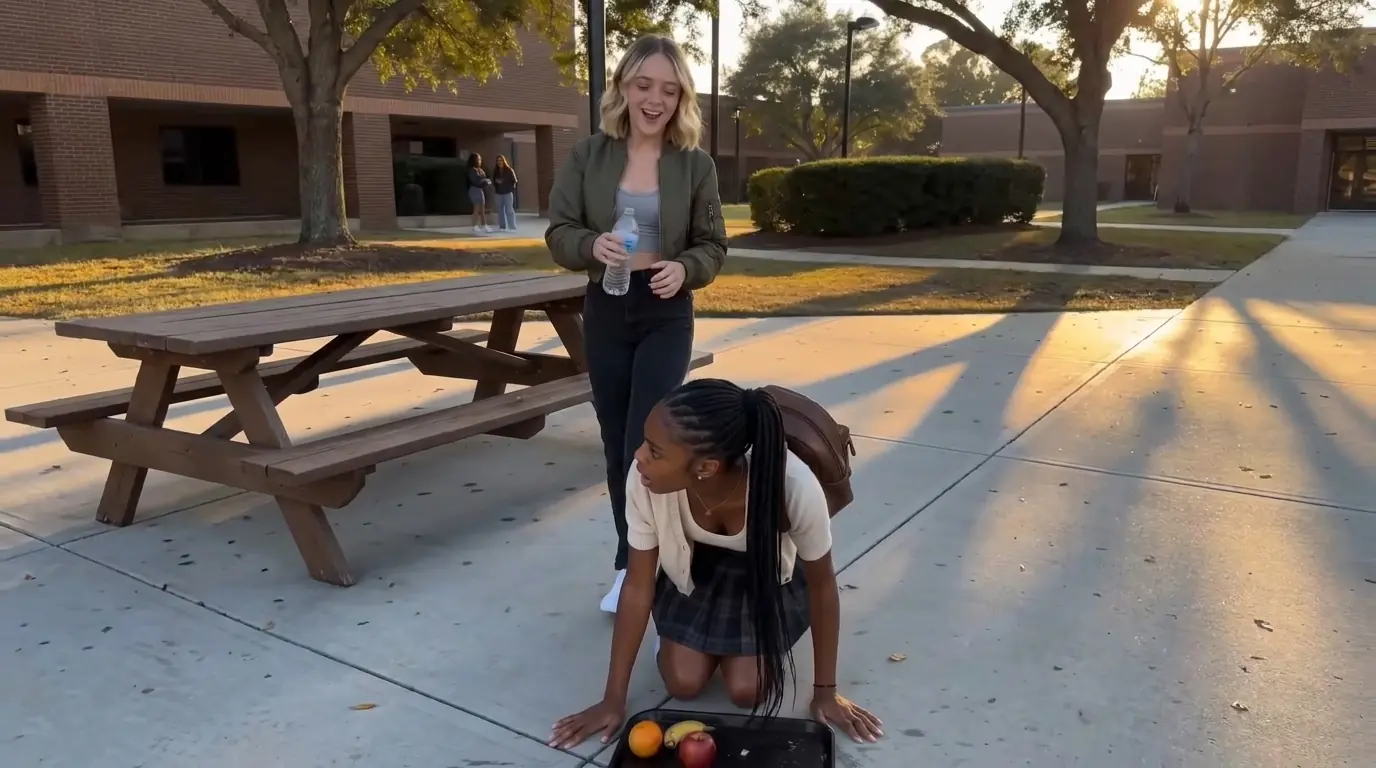
At 12:21 on a warm October afternoon, Naya Robinson was carrying a black cafeteria tray across the outdoor lunch courtyard at Briarwood High School when a white sneaker slid directly into her path. Naya was seventeen, Black, a senior, with long braids pulled into a high ponytail, wearing a cream fitted top beneath a pale beige cardigan, a dark plaid skirt, white knee-high socks, black loafers, and a brown leather school bag hanging from one shoulder. Her tray held a sandwich, fruit, a carton of milk, a blue drink cup, and the lunch she had barely had time to eat between AP Biology and yearbook committee. She never saw the foot until her shin hit it.
Naya pitched forward, the tray flew from her hands, and food scattered across the concrete beside the wooden picnic tables. An apple rolled beneath a bench, the drink cup toppled, and Naya landed painfully on both palms and one knee as students around her gasped. Behind her, Brianna Caldwell, an eighteen-year-old white senior with shoulder-length blonde hair, an olive bomber jacket, gray fitted top, dark jeans, and white sneakers, burst into laughter. Brianna slowly pulled her leg back beneath the bench as though the entire thing had been an accident.
Naya stayed on her hands and knees for a few seconds, stunned less by the fall than by the laughter. Then she heard Brianna’s friend Megan Wolfe say, “Oh my God, look at her,” followed by another burst of giggling from the table. Naya turned her head and saw at least one phone pointing toward her. That was when she understood the fall had not simply happened in front of an audience; it had been created for one.
She started gathering herself, but Brianna stood and picked up a half-full plastic water bottle from the table. “Need help cleaning up?” she asked, using the same sweet voice she had used all year whenever an insult needed plausible deniability. Before Naya could answer, Brianna tipped the bottle over her, pouring water across the back of her cardigan, braids, and shoulders while students shouted in disbelief. Brianna laughed so hard she nearly dropped the empty bottle.
Naya slowly pushed herself upright. Water ran from the ends of her braids onto her skirt, and one palm had already started bleeding from the rough concrete. She looked first at the ruined lunch, then at Brianna, then at the phones surrounding them. “You done?” she asked.
Brianna smiled. “Why are you so mad? It was a joke.” Naya stared at her for a long second and answered, “You’ve been calling everything a joke since August.” Several students at nearby tables went quiet because they knew exactly what she meant.
The argument lasted longer than the fight that followed. Brianna told Naya she was “always making everything about race,” Naya told her she had never mentioned race in that moment, and Brianna stepped closer as though merely hearing the word had made her defensive. When Naya tried to move around her, Brianna lifted one hand and slapped her across the side of the face. Naya’s braided ponytail whipped over her shoulder.
That was the moment the courtyard changed. Students who had laughed at the fall stopped laughing, several people stood from their tables, and Megan’s smile vanished completely. Naya stared at Brianna, shocked, then struck back before the blonde girl immediately swung again. Within seconds the two teenagers were fighting between the picnic benches.
Brianna threw wide punches and even tried a kick while Naya ducked, blocked, and moved backward across the wet pavement. Naya answered with short strikes whenever Brianna closed distance, eventually using a forceful front push that sent the blonde girl stumbling toward a bench. Brianna tried to come forward one more time, lost her balance, and went down beside the table. Naya stayed several feet away once she stopped advancing.
Most people who eventually watched the viral clip believed the story began with the spilled lunch. It did not. The courtyard confrontation was only the first time eight months of racial resentment, social humiliation, and carefully disguised bullying appeared together in a video too clear for anyone to explain away.
Naya had arrived at Briarwood High the previous January after her mother accepted a new job in Fairfax County, Virginia. Monica Robinson was a respiratory therapist who had spent most of Naya’s childhood working overnight shifts in Baltimore while raising two children after a divorce. The move came with better pay, shorter hours, and a chance for Naya’s younger brother to attend a stronger middle-school program. Naya agreed because she understood the practical reasons even though she hated leaving her friends halfway through junior year.
Briarwood looked impressive from the first day. The campus had redbrick academic buildings, an outdoor lunch courtyard shaded by old trees, renovated science labs, a new football field, and enough advanced-placement courses to make its promotional brochure resemble a small college catalog. Families in the district treated admission to selective universities like a community competition. Students learned very quickly which achievements received applause and which ones caused people to quietly compare résumés.
Naya had never been interested in that kind of competition. She liked biology, photography, and public health, and she had been volunteering twice a month at a community food pantry since sophomore year. Her long-term goal was to study nursing or biomedical science because she had grown up listening to Monica explain hospital stories over breakfast. She was ambitious, but not interested in turning ambition into a personality.
That made her transfer easier academically than socially. Naya entered Briarwood with strong grades, two AP credits, and an application already pending for the district’s Jefferson Scholars Initiative, a program that awarded college grants and mentoring to high-achieving students from families without generational college wealth. The initiative considered grades, service, recommendations, financial circumstances, and an interview. Only four Briarwood students would be selected.
Brianna Caldwell wanted one of those spots. Her grades were good, she served on student council, played varsity lacrosse, and had spent most of junior year assuming the scholarship would strengthen her college applications. Her father owned a chain of dental offices, and her family did not actually need the money, but the Jefferson designation carried prestige beyond the financial award. Brianna liked things that looked difficult to win.
Naya did not know any of that when they first met. They shared AP English, and Brianna was friendly during Naya’s first week, even lending her a copy of the reading calendar when the online portal failed to update. She complimented Naya’s cardigan and asked where she had transferred from. Naya initially thought she had found someone easy to talk to.
The tone changed after the Jefferson semifinalist list was released. Naya’s name appeared beside Brianna’s, along with six other Briarwood students who would move into the final interview round. Brianna stared at the list longer than necessary. At lunch she asked Naya whether she had applied “through some special transfer program.”
Naya frowned. “No, I filled out the same application.” Brianna nodded but then asked whether the scholarship had “diversity targets” because she had heard programs sometimes reserved spots for particular groups. Naya looked at her and said, “I have no idea.” Brianna smiled and answered, “I’m just curious.”
It was the first question Naya remembered later. Not because asking about scholarship criteria was automatically racist, but because Brianna seemed incapable of imagining Naya’s success without searching for another explanation. When AP English essays were returned and Naya received the highest grade in their section, Brianna asked how strict her previous school had been. When Naya scored well in chemistry, Brianna joked that Baltimore schools must have “prepared her surprisingly well.”
Each comment was small. Each could be defended individually. Together they began pointing in one direction.
The Jefferson final selections were announced in March. Naya received one of the four awards. Brianna did not.
The grant would provide Naya with ten thousand dollars toward college costs, a summer internship placement, and access to alumni mentors. Monica cried when Naya called her from the hallway, then told everyone in the hospital break room before her daughter could ask her not to. Naya spent the rest of the day embarrassed and happy.
Brianna congratulated her after class. “Guess the program got what it wanted,” she said with a smile. Naya paused.
“What does that mean?” Brianna immediately shrugged. “Nothing. You earned it.” Then she walked away before Naya could ask anything else.
That evening Naya told Monica. Her mother listened while chopping vegetables at the kitchen counter, then asked whether Brianna had ever made similar comments. Naya described the diversity question and the remarks about her old school. Monica put down the knife.
“You need to pay attention,” she said. Naya rolled her eyes and replied that one girl being bitter about a scholarship did not make her a racist. Monica nodded and said, “I didn’t tell you what to call her. I told you to pay attention.”
Naya did.
By April, Brianna had started telling friends that Jefferson had become a “quota scholarship.” She never said the phrase directly to Naya, but other students repeated it. One afternoon a sophomore Naya barely knew asked whether her scholarship was “the diversity one.” Naya asked who told him that.
He named Brianna.
Naya confronted her after English. Brianna smiled and said she had never used Naya’s name, only questioned whether the program considered demographic factors. Naya answered that Brianna seemed strangely interested in demographics only after losing. Brianna’s smile vanished.
“You think I’m jealous of you?” she asked. Naya replied, “I think you keep explaining why I won instead of accepting that I did.” A few students nearby heard the exchange, and one laughed quietly. Brianna walked away furious.
The retaliation started two days later. Someone taped a photocopy of the Jefferson announcement to Naya’s locker with DIVERSITY WINNER written across it in red marker. Naya tore it down and photographed it before throwing it away. No camera covered that section of hallway.
A week later, someone left a fake college brochure inside her backpack. Across the front, beneath a stock photo of smiling students from different backgrounds, somebody had written FREE RIDE UNIVERSITY. Naya showed it to guidance counselor Mrs. Elena Price. The counselor asked whether she knew who had placed it there.
Naya did not. Mrs. Price documented the incident but explained that discipline required some evidence identifying a student. Naya understood, although understanding did not make the situation less exhausting.
Then came the cafeteria joke. Naya used the student meal card issued to every Briarwood student, but one afternoon Brianna watched her scan it and asked loudly whether “the scholarship covered lunch too.” Megan laughed. Naya looked at her and said, “My mom pays taxes like yours.”
Several students reacted. Brianna immediately insisted she had been joking and accused Naya of making the comment “weird.” That pattern became familiar.
Brianna would say something pointed. Naya would react. Brianna would then act confused that race had entered a conversation shaped by her own assumptions.
By the end of junior year, Naya was tired enough that she considered asking to change English sections. Monica told her she would support whatever decision made school easier. Naya ultimately stayed because only six weeks remained and she refused to rearrange her schedule around one person. Summer break arrived before the situation escalated further.
For nearly two months, Brianna disappeared from Naya’s life. Naya completed her Jefferson internship at a community health clinic, worked weekends at a bookstore, and visited colleges with Monica whenever hospital schedules allowed. She began senior year believing the distance might have reset everything. That hope lasted three days.
Briarwood’s senior advisory program assigned Naya and Brianna to the same group. During the first meeting, counselor Mr. Lucas Bennett discussed college applications and reminded scholarship students to request recommendation letters early. Brianna looked toward Naya and whispered to Megan, “Some people already checked the important box.”
Naya heard her. So did a boy named Ethan Grant sitting between them. Ethan turned toward Brianna and said, “Can you not start this again?” Brianna rolled her eyes.
That was the first time another student challenged her openly. It did not improve her behavior. It simply made her more careful.
Instead of direct remarks, Brianna began using questions. Had Naya considered historically Black colleges because “they probably had amazing financial aid for her”? Did she think Jefferson winners received admissions advantages? Was it “easier” writing college essays when your background automatically gave you something interesting to discuss?
Every question arrived disguised as curiosity. Naya stopped answering them. Brianna interpreted that as attitude.
September brought a student-leadership retreat. Naya attended as a yearbook representative, while Brianna attended for student council. During a team-building exercise, students were asked to identify assumptions people made about them.
Naya wrote quiet means unfriendly.
Brianna laughed. “I would’ve guessed scholarship kid.” The room became uncomfortable.
Mr. Bennett asked what she meant. Brianna replied that everyone knew Naya because of Jefferson and insisted it was not an insult. Naya looked across the circle and asked, “Would you say scholarship kid if I were white?”
Nobody spoke.
Brianna laughed nervously. “There you go again.” Naya stared at her. “There I go doing what?”
“Making everything racial.”
Naya shook her head. “You brought up my scholarship for the fiftieth time.” Mr. Bennett ended the exchange before it became worse.
Afterward he asked Naya whether she wanted to file a formal complaint. She hesitated. Most incidents sounded ridiculous when listed individually. Brianna had never used a racial slur or explicitly said Black students did not deserve scholarships.
Naya said not yet.
Mr. Bennett told her to document everything.
She already had.