“Sir, I can’t let you through without authorization.”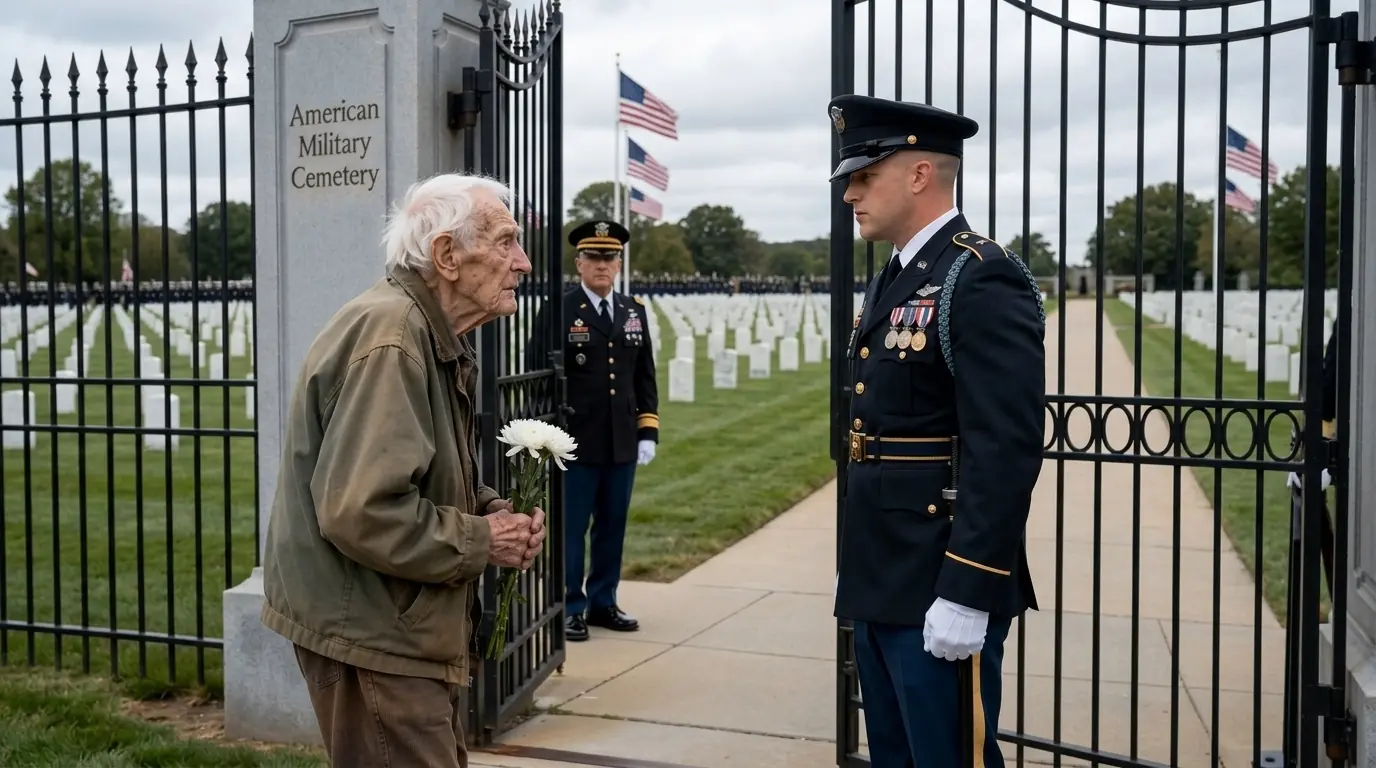
The young military security officer said it politely, but there was no curiosity in his voice. To him, the elderly man standing outside the cemetery gate was simply another visitor whose name did not appear on the electronic list. Beyond the black iron fence, one of the most important military funerals in Virginia was about to begin.
Walter Brennan stood quietly beside the gate with one white lily wrapped in brown paper. He was eighty years old, thin through the shoulders now, with silver hair showing beneath an old Army cap and a faded dress jacket that had not been officially issued to anyone in more than fifty years. The coat hung a little loosely, but he had pressed it himself the night before and polished every brass button until his fingers cramped. He had dressed for respect, not recognition.
Getting there had taken most of the morning. Walter had ridden two buses from his small apartment outside Richmond, caught a regional train, then waited nearly forty minutes for the county shuttle that stopped at the base of the cemetery hill. By the time he reached the gate, his knees were aching and the old wound beneath his left shoulder blade had started throbbing again. Still, he had arrived early.
“I came to say goodbye,” Walter said.
The guard glanced at the tablet in his hand.
“Name?”
“Walter Brennan.”
The officer typed it, waited, then shook his head.
“You’re not listed.”
“I figured I wouldn’t be.”
“Are you family?”
“No.”
“Press?”
“No.”
“Government or military detail?”
Walter looked through the bars toward the flag-draped platform.
“Not anymore.”
Behind the gate, rows of folding chairs faced a polished wooden urn resting beside a folded American flag. A military band was beginning its final sound check while officers in dress uniforms moved into position beneath a pale October sky. Reporters waited behind a rope line, lenses already pointed toward the family seating area.
The funeral belonged to General Charles Weston.
Four stars.
Former Chairman of the Joint Chiefs.
National security adviser.
Decorated commander.
For three days, television networks had run photographs of Charles standing beside presidents, foreign leaders, soldiers, and flags. Commentators called him disciplined, brilliant, decisive, and one of the most influential military leaders of his generation. Walter had watched those tributes quietly from his living-room chair.
None of them mentioned the terrified twenty-year-old lieutenant Walter remembered.
That young man had not looked like history.
He had looked like a scared kid from Indiana, lying in red mud with blood across his sleeve and both hands shaking too badly to reload his rifle. Mortar rounds were falling beyond the tree line, radio communication had collapsed, and somebody had screamed that the position would not hold another ten minutes. Walter had gone back for him anyway.
Walter never expected that story to appear in an obituary.
That was not why he came.
He lifted the lily slightly.
“I served with General Weston.”
The guard glanced at Walter’s worn boots.
Then at the flower.
“I’m sorry, sir. I still need authorization.”
Walter nodded.
“I understand.”
There had been a time when nobody would have questioned Walter’s right to cross a military checkpoint. He had once moved through jungle positions with a radio on his back and younger men watching his hands for instructions. But that man belonged to another century, and Walter had spent decades learning how easily the world forgot people who no longer wore rank on their shoulders.
He stepped away from the gate.
The security officer returned to his post.
Walter found a place beside the stone wall where he could still see part of the ceremony through the iron bars.
He did not complain.
Inside, guests continued arriving.
Cabinet officials.
Retired generals.
Active-duty commanders.
Members of Congress.
Foreign military representatives.
Charles Weston’s children and grandchildren took their seats near the front beneath the canopy. A framed photograph of the general stood beside the urn, showing him in his final official portrait, white-haired and stern beneath four silver stars.
Walter looked at the photograph for a long time.
“Charlie,” he whispered.
That was what he had always called him.
Not General Weston.
Not Chairman.
Not sir.
Charlie.
The wind picked up across the cemetery.
Walter shifted the lily from one hand to the other. His fingers had begun trembling, something that happened more often now when he was cold or tired. He tightened his grip because he did not want the flower dropping before he had a chance to leave it somewhere near the grave.
He had promised Charles he would come if he could.
The promise had arrived in a letter almost four months earlier.
Walter had read the envelope several times before opening it because he recognized the handwriting immediately. Charles had written to him throughout the years, sometimes from Europe, sometimes from Washington, sometimes from places Walter could not pronounce. Walter rarely answered more than a page.
Their lives had traveled in very different directions.
Charles became famous.
Walter disappeared.
After Vietnam, Walter returned to Ohio, worked thirty-four years repairing industrial machinery, married a school secretary named Margaret, raised two daughters, paid a mortgage, buried his wife, and quietly became one of those old men people saw at diners without wondering what had happened before he arrived. There were no medals displayed in his living room. Most of his neighbors did not even know he had served.
Charles had never completely accepted that.
Every few years, he tried to bring Walter to some ceremony.
Walter always refused.
Once Charles sent a government car.
Walter sent it back.
Another time he mailed plane tickets to Washington for an awards dinner.
Walter gave them to his daughter and told her to visit the Smithsonian.
Eventually Charles stopped trying to drag him into public recognition.
But he never stopped writing.
The final letter was different.
Walter could still feel it in the inside pocket of his jacket.
Charlie had written, If I go first, come if your body lets you. You don’t owe me anything, Walt. I’m the one who owes you.
Walter had nearly thrown the letter into a drawer.
Then he read the final line.
If they don’t know your name at the gate, stand outside anyway. I’ll know you came.
So Walter came.
He stood outside exactly as Charlie had predicted.
And strangely, he was not angry.
Age had softened certain kinds of anger and sharpened others. Walter no longer wasted much energy resenting strangers for failing to know things nobody had told them. The young guard was following a list, and lists were how large institutions kept order.
Walter understood order.
He also understood what fell through it.
Inside the cemetery, Lieutenant Colonel Nathan Cole was standing beside the front row when he happened to glance toward the gate. Nathan had served as General Weston’s senior aide for the last five years, which meant he knew the general’s schedule, family habits, medical appointments, favorite coffee, private grudges, and stories told only after midnight. One name had appeared in those private stories more than any other.
Walter Brennan.
Nathan noticed the old jacket first.
Then the shoulder patch.
Then the white lily.
His chest tightened.
Three years earlier, in a dim office in Brussels, General Weston had poured two fingers of bourbon and spoken about Vietnam in a voice Nathan had rarely heard from him. “Best soldier I ever knew disappeared into civilian life,” Charles had said. “Wouldn’t take a medal, wouldn’t take a photograph, wouldn’t let anyone make a damn hero out of him.”
Nathan had asked the man’s name.
“Walter Brennan.”
Charles stared into his drink.
“If I die before that stubborn old fool, somebody better make sure he gets through the door.”
Nathan remembered laughing.
Charles did not.
“I mean it,” the general said. “If Walter Brennan shows up wearing rags and carrying a flower, he comes in before any senator.”
Now Nathan was staring through the cemetery gate.
There he was.
He turned toward the highest-ranking officer near the platform.
General Martin Graves was sixty-seven, a four-star commander with silver hair, a straight back, and the controlled expression of a man determined not to let grief become visible before the cameras. He had served under Charles, fought beside him, and known Walter Brennan long before either one carried enough rank to make newspapers care.
“General,” Nathan said quietly.
Martin kept his eyes toward the honor guard.
“What is it?”
Nathan swallowed.
“He came.”
Martin turned.
“Who?”
Nathan nodded toward the gate.
“Brennan.”
Something changed in the general’s face.
It was small.
But soldiers notice small changes.
Martin looked past the family, beyond the rows of chairs, through the iron bars, and found the old man standing against the wall.
For several seconds, everything else seemed to disappear.
The press.
The uniforms.
The politicians.
The rehearsed order of the funeral.
Martin’s eyes narrowed as though memory had pulled him across fifty years in a single breath.
“Stop the service.”
Nathan blinked.
“Sir?”
“Stop it.”
The colonel hesitated.
“The family is seated.”
Martin began removing his gloves.
“I said hold the service.”
Nathan immediately moved toward the ceremony coordinator.
General Martin Graves stepped down from the platform.
The military band stopped playing.
Heads turned.
Members of the honor guard remained perfectly still, but even they could see the four-star general walking away from the ceremony instead of toward the podium.
Reporters lifted their cameras.
Charles Weston’s daughter looked toward Nathan in confusion.
Nobody understood what was happening.
Outside the gate, Walter was looking toward the folded flag.
He did not see Martin approaching until the gate opened.
The young security officer turned sharply.
Walter lifted his eyes.
For one second, he saw only a white-haired general in dress uniform.
Then the years disappeared.
“Martin Graves,” Walter said softly.
General Graves stopped several feet away.
His jaw tightened.
Then he came to full attention.
In front of cabinet secretaries, cameras, generals, senators, soldiers, and the entire Weston family, Martin Graves raised his right hand and saluted the old man standing outside the gate.
Walter’s eyes widened.
The young guard went pale.
“Don’t do that,” Walter murmured.
Martin held the salute.
“Yes, Sergeant.”
Walter looked uncomfortable.
“I stopped being your sergeant a long time ago.”
Martin’s voice thickened.
“Not where it matters.”
For several seconds, neither moved.
Then Martin lowered his hand.
He looked toward the guard.
“This man enters before I do.”
The officer swallowed.
“Yes, General.”
Walter shook his head.
“I don’t need all this.”
Martin looked at the lily.
“You came for Charles.”
“Yes.”
“Then you’re exactly where you need to be.”
Walter glanced toward the open gate.
“I only wanted to leave the flower.”
Martin took one step closer.
“Charlie left instructions.”
Walter’s face changed.
Not dramatically.
But the name reached someplace rank never could.
“He did?”
Martin turned.
Nathan was already approaching.
He carried a polished wooden box with both hands.
Walter understood what it was before anyone explained.
His fingers tightened around the lily.
Martin took the urn carefully from Nathan.
“Charles asked that you carry him from the gate to the platform.”
Walter stared at the box.
For a moment, the cemetery disappeared.
There was another weight in his arms.
A younger one.
A wounded lieutenant whose boots dragged through mud because he could no longer move his own legs.
Walter had carried Charlie once before.
More than fifty years earlier.
He had never imagined doing it again.
“He wrote that?”
Martin nodded.
“In his final instructions.”
Walter looked away.