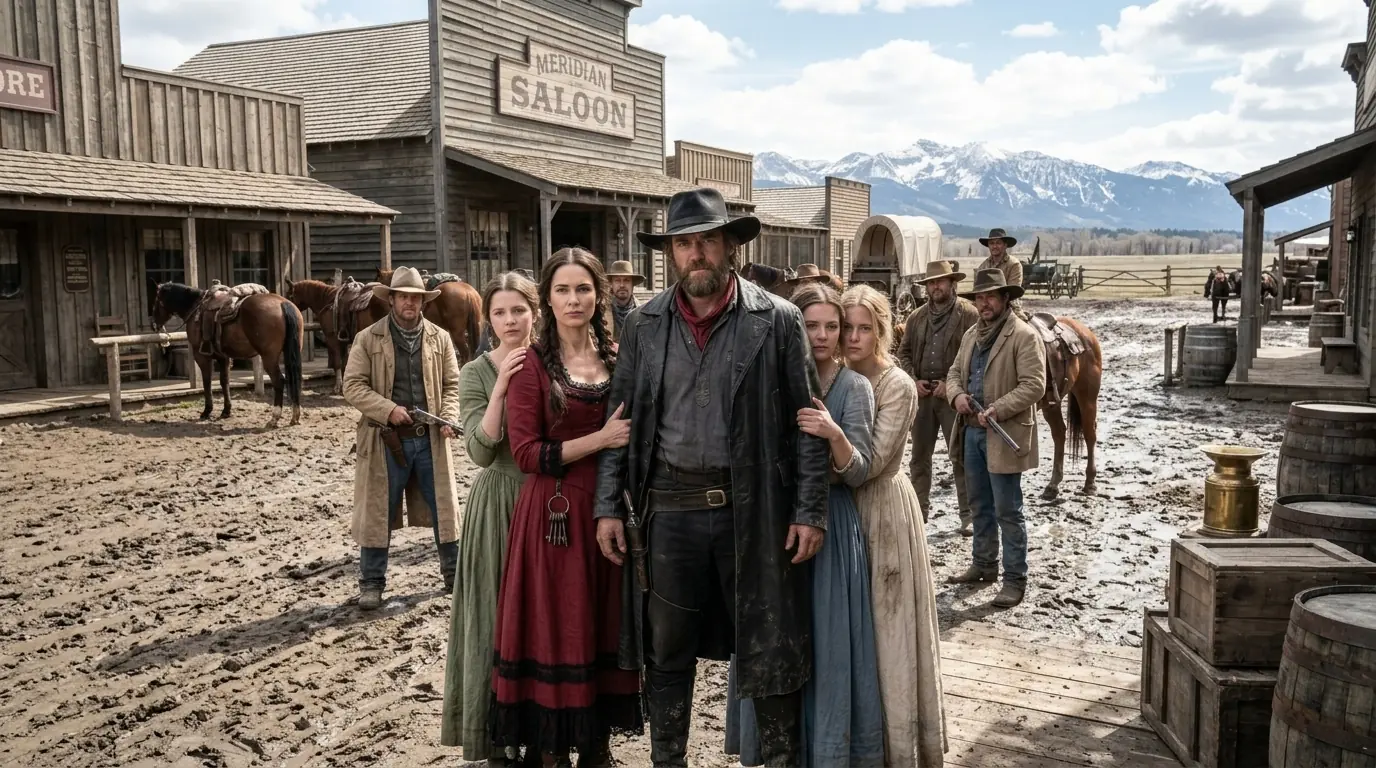
He was warned it would cost him everything. It cost him more than that. The first card I ever dealt from a crooked deck. I was 19 years old and shaking so bad the man across the table thought I had palsy. I didn't.
I was just scared. I palmed the ace anyway. Took his money anyway. Walked out of that canvas saloon in Abilene with $43 and the kind of feeling that either makes a man or kills him slow. It made me, or I thought it did.
For a long time, twenty-some years of camps and river towns and canvas saloons that had real walls by the time I was 30, I thought cards and a cool head and knowing when to leave before dawn was all a man needed. I wasn't wrong about the needing part. I was just wrong about what doing the kneading felt like. I want to tell you something before I get into it. This isn't a story about how I got good.
I was always good. Cards, I mean, reading a room, knowing which man at the table was bluffing and which one was three drinks from pulling iron. Those things I had. What I didn't have and didn't know I didn't have was the plain common sense to see when I was the one being read. Norahh saw me the first night.
I know that now. The town was called Bitterfield, which should have been warning enough, sat in a fold of land in eastern Montana, where the wind came down off the high plains in October, and turned the dust to a kind of gray paste that worked into your collar, and the crease behind your ears no matter how careful you were. There was a main street, one long muddy furrow with a hardware, a feed, two saloons, and a hotel that charged $1.50 for a room with bed bugs and a view of the livery. The Presbyterian church at the north end had a bell that was cracked and made a sound like a man striking an empty tin bucket. I know because it woke me every Sunday at 7 in the morning for 8 months.
And by the end, I had taken to leaving my window open so I could hear it and know I was still in the same place. I wasn't used to staying in the same place. I came to Bitterfield because of a man named Colley Pratt, which is not his real name, but will do. Pratt ran the better of the two saloons, the Meridian, he'd called it, though there was nothing Meridian about a plank floor and a bar top of rough-sawn pine, and he'd sent word through a freighter I knew in Miles City that there was a poker game in Bitterfield every Friday that could use a steady professional presence. What he meant was the local men had been cleaned out by each other and needed fresh blood at the table, and a professional would be bled more slowly and give them the pleasure of thinking they were taking money off a man who knew what he was doing.
I knew what I was doing, but I also knew that a Friday game in a small Montana town in October, with winter coming and nowhere particular to be, was as good a proposition as I was likely to get. So, I came. What Pratt had not mentioned in his message was that he had 3 weeks before I arrived, taken on a business partner, an arrangement for the back half of the building, which he'd partitioned off with a heavy curtain and a locked door and a new staircase to the three rooms above. The partner's name was Norahh Flood. I heard her before I saw her.
Second night I was in Bitterfield, still feeling out the room, playing careful, not winning big, not losing, just watching. And there was a voice from behind that curtain. Not loud. It wasn't raised. But it had a carry to it, a quality of being used to rooms that weren't always quiet.
And what it was saying in plain and level words was that whoever was back there needed to understand that if he put his hands on her girl again before she was ready, he could find the door and never come back through it. There was silence from behind the curtain, then a door, then footsteps on the staircase going up. I kept my eyes on my cards, but I filed it. She came through the curtain about an hour later. She was maybe 35, which put her younger than me by a handful of years.
And she had dark hair pulled back in a way that said it was pulled back for practicality, not because it was a particular style. She was not beautiful the way a woman tries to be beautiful. She was handsome the way a good piece of furniture is handsome, made right, meant to last, nothing wasted. She wore a dress that was better than anything else in Bitterfield, and she moved through the room the way a person moves through a room they own, which, as it turned out, was more or less what she did. She stopped at the bar.
Pratt poured her something. She didn't look at the card table. I watched her not look at it. That's a skill, too. Not looking at something takes practice, the deliberate kind.
And she had it. Later, when I was dealing and a man named Terhune was trying to decide whether to call my raise, a man who sweated through every bluff, but never seemed to learn that about himself. I became aware of her standing near the back wall with a glass in her hand, and I became aware that she was watching me, not the table, and that she had been doing it for some time. Tur called. I took the hand.
I didn't look up. After the game, she stopped near my chair on her way back through the curtain. You palmed something in the third hand, she said. I looked up at her then. She wasn't accusing.
Her voice was even like she was noting the weather. You're mistaken, I said. I'm not, she said, and went through the curtain. I sat there with the chips in my hands and the empty table and the smell of coal oil and old tobacco and I thought, "Well, there it is." I didn't palm anything for the next six Fridays.
It wasn't principal. It was that she'd be watching and I'd know she was watching and I was not in those days in the habit of doing things I'd have to answer for in front of a woman whose eyes on me felt like a level. We didn't speak again for 3 weeks. She'd come out from behind the curtain sometime during the evening, stand at the bar, watch the room for a while the way you watch a thing that is your responsibility, and then go back through. Sometimes she'd say something to Pratt.
Once she told a drunk man at the far table quietly that he'd had enough and should go home. And the man, who was twice her size and mean with liquor and had been ugly to the barman all evening, just looked at her for a moment and then stood up and went. I thought about that for a long time afterward. the way she'd said it. No threat in it. No sweetness either, just a plain fact delivered as though the man's compliance was already decided, and all that remained was the logistics.
I played cards. I stayed at the hotel with the bed bugs. I ate at the counter of a place run by a woman named Mrs. Selby, who cooked beans and salt pork better than anything I'd had in years. I took walks in the afternoon along the edge of the settlement where the ground was higher and you could see the plains running out flat to the east and the mountains to the west and I'd stand there in the wind and think more often than I liked about the woman behind the curtain.
There was in that October a quality to the light in Bitterfield that I have not seen reproduced anywhere else. I have been in a lot of places. I don't know what causes it. something in the elevation maybe, or the particular angle of the sun coming off the plains with nothing to obstruct it for a hundred miles. But the afternoons were the color of old brass, and the buildings on the main street cast long shadows that were almost purple, and the whole thing had a weight to it, a feeling of something about to press down or be pressed down. I walked in that light every afternoon and thought about Norahh Flood and told myself I was not thinking about Norahh Flood which amounts to the same thing.
I had been in enough towns to know what the texture of passing through felt like. That particular lightness of a man with no stake in the place. The way you could watch a fight at the bar or a horse go lame in the street or a family loading a wagon to leave and feel nothing but a mild curiosity. the way you feel about a story that has nothing to do with you. I had spent 20 years operating in that register. And I was good at it.
And I noticed walking in the brass afternoons of that October that Bitterfield was not producing that sensation in me. I kept having opinions about things, about whether the hardware was charging too much for nails, about the shortcut across behind the feed store that the boys in town used to avoid the mud on the main street. About the cracked bell, whether the congregation could hear the thinness of it, and whether it bothered them the way a wrong note in a song bothers you after you've heard the right one. None of that is the business of a man passing through. I noticed that I was noticing.
This is the part I have trouble with in the telling of it because a man who makes his living reading people ought to be able to account for his own thinking, and I can't, not fully. I knew she was sharp. I knew she was capable in ways most people in that town weren't. I knew she'd seen through me in about 40 minutes, which nobody had done in 20 years of sitting at tables. What I felt, and I will just say it plain and not make it something fancy, was that I wanted to be in a room with her.
That's it. Not to have anything from her, just to be in the same air. I didn't know how to want something that simple. That was my trouble, and I didn't know it yet. The nights were getting cold.
By the middle of November, ice was forming on the horse troughs before midnight, and the coal oil business in Bitterfield was very good. I had taken to eating supper at the meridian sometimes, not at the card table, just at the bar with whatever Pratt's cook was managing that evening, which was usually better than Mrs. Selby's beans, but not always. And it was during one of these suppers that Norahh sat down two stools from me for the first time and didn't say anything and did not say anything. Just ate her own meal and looked at the bar top. and I was aware of her three feet away with the particular awareness of a man trying to be casual about a thing that is not casual.
We ate in silence for a while. You're still here, she said. Not an accusation, just an observation. I am, I said. Most professionals move on before the weather gets like this.
I don't mind the cold, I said, which was true. I had always done better in cold weather. something about the clarity of it. In summer, everything smells the same. Dust and sweat and horse and heat. But in the cold, you could smell a pine fire from two streets over and woods from someone's kitchen.
And you always knew where the river was, even if you couldn't see it. She considered that put down her fork. You play a clean game, she said, for a man who palms cards. I only palm when I need to, I said. and you don't need to hear. Not yet, I said.
She looked at me sideways at that, not offended, more like she'd found a fact to file. She went back to eating, and I went back to eating, and outside the wind was building again the way Montana wind builds, steadily, like something making up its mind. We started eating supper near each other most evenings. Nothing declared about it. I'd come in at the same time and sit at the bar and sometimes she was there and sometimes she wasn't.
And when she wasn't, I ate my supper and noticed the absence of her without making anything of it. And when she was there, we talked some or didn't. And either way, it was all right. She told me once, without my asking, that she'd come from Denver originally, but that before Denver, there had been Kansas and before Kansas, Iowa, and that she'd been going west by stages for a long time, and had run out of West she wanted to go to. I told her I understood that.
She asked me where I was from, and I said I wasn't sure I was from anywhere in particular, which she accepted as an answer without pushing at it. She didn't push. That was one of the things about her. A lot of people when they want to know something keep coming at it from different angles until you either tell them or lock up against them. She would ask a thing once, hear what you said, and then let it rest.
Which meant you could give her the short answer and not feel like you were being stingy. But it also meant, and this took me a while to understand, that the short answer was what you'd given her, and she was filing it, and what you'd left out was filed, too, as the shape of what wasn't said. She was the sharpest person in Bitterfield, probably the sharpest person I'd met in years, which is saying something because I had spent 20 years in rooms with sharp people and considered myself one of them. In November, a man came to Bitterfield. He came with two others, which was how those men always came, and they were from a company, I won't say which one, that was moving through that part of Montana, buying up or trying to buy up concerns that were worth buying.
The man's name was Story. He was from somewhere east. You could tell by his coat and the way he talked, and he had the kind of face that was hard to fix in your memory afterward. not ugly, not handsome, just a face that went with his function, which was to make things happen on behalf of people who did not come themselves. He met with Pratt the second day. I happened to be at the bar when they came through, and Pratt looked at me with the slightly sick expression of a man who has been surprised in something he wasn't ready to be surprised in, and introduced me to Story as a professional gambler passing through.
I nodded. Story's eyes went over me once and dismissed me, which was fine. Being dismissed has always been one of my better advantages. He met with Norahh the day after. I know this because I was eating at Mrs.
Selby's counter when Norahh came in alone at midmorning and sat down two stools from me and ordered coffee and didn't say anything for a while. She had a look on her face that was the look of a person doing arithmetic they don't like the answer to. I said trouble. She looked at me. It was the first time she'd looked directly at me with any directness since the night she caught me palming.
A man named Story wants to buy my half. She said he going to? He's not offering what it's worth. They never do. She looked at her coffee.
He'll come back with a lower number and a threat attached to it, she said. That's how they go. I thought about it. Is Pratt going to sell his half? She was quiet for a moment.
Pratt is going to sell his half, she said. No judgment in it, just the fact. That puts you in a different position. Yes, she said. It does.
We sat there. Mrs. Selby brought more coffee without being asked. Outside the wind was doing what Montana wind does in November, which is to say it was working at every gap and seemed in every building in town like it had a personal grievance. What will you do?
I said. She looked at the window. I don't know yet, she said. And then she said, what do you do when someone's figured your hand and you've got nothing? I thought she was asking about cards.
Then I realized she wasn't. Mostly I said I leave. She nodded like I had confirmed something not about herself about me. I felt that land somewhere in my chest and stay there. Story came back as she'd said he would with a lower number.
The threat was not direct. It never is with company men, but it was there in the phrasing. The way certain words were put in certain places so a person with ears understood what the alternative was. I didn't hear the conversation. I heard about it from Pratt, who had the slightly flustered quality of a man who has done something he's not comfortable defending, but has done it anyway.
Pratt sold in December, first week. The papers signed in the hotel lobby with Story and a local attorney who had the sense to keep his face neutral. Norahh didn't sell. What happened next took about six weeks to build. And I want to describe it right because it's easy to make it sound like something out of a dime novel.
And it wasn't. It was just slow pressure. The way water works on stone. A supplier from Miles City who'd been delivering reliably for 8 months suddenly couldn't make the trip. The explanation given was road conditions, which was partially plausible, but not completely.
A complaint was filed with the county sheriff. I never did get clear on what it alleged that required Norah to spend two days in a back and forth with a deputy who was polite and unhelpful in equal measure, asking the same questions twice in slightly different words while his office clock ticked and his window looked out at nothing. Two of her three girls left. One went back to her family in Billings. The other one I don't know about.
The third one stayed, a woman named Cecilia, who was maybe 22 and had a stillness about her that I always respected. She and Norah had some understanding between them that didn't require spelling out, and Cecilia went about her work through all of it with a calm that was, in its own way, a kind of loyalty. A man I didn't recognize started appearing at the bar most evenings, not drinking heavily, not causing trouble, just being there. I noticed him on the third night. By the fifth night, I had his position at the bar mapped and I sat where I could see him and he could see me.
And after two more nights, he stopped coming. Sometimes all it takes is someone noticing back. Not a threat, just the acknowledgement that you've been seen, which is frequently worse. Norah did not complain about any of this to me. She didn't complain to anyone as far as I could tell.
She ran what she had to run, dealt with the deputy's questions with a patience that was not warm, but was very thorough, and kept the Meridian open and functioning with Cecilia's help, and without making a noise about the things that were pressing on it. When I asked her once how she was managing, she looked at me in the way of a person who is doing the arithmetic and does not need to narrate it and said, "Fine." She was not fine, but she was handling it, which was not the same thing, but was what she had. I watched all of this and I thought about what I told her that morning at Mrs. Selby's counter.
What I do when someone's figured my hand is leave and I was still there sitting at the bar eating supper, playing cards on Fridays. walking in the cold afternoons under the brass-colored Montana sky. I told myself I was curious how it would shake out. That was not entirely a lie, but it was not the whole truth either. The whole truth was that I had become without having the event I could point to something other than a man passing through. I was a man who lived here, which is different.
A man who lives somewhere knows where the floor creaks in the dark and what the wind sounds like when it's changing direction and which of the horses at the livery has the bad ankle and needs to be watched on ice. You accumulate these things without meaning to and one day you find that leaving would mean setting them all down and you know what that would cost and you understand that the cost has already changed what you are. There was an evening in January, the coldest stretch, where the temperature went down to something that made the timbers in every building in Bitterfield grown like old men getting out of chairs. When Norahh and I were both at the bar after closing, the barman had gone home. Pratt, who had transitioned from owner to employee of Story's company without seeming to understand what that meant for his standing, had gone to bed early.
It was just the two of us and a lamp and a bottle of the good whiskey she kept behind the bar. She poured. We drank without toasting anything, which is the right way to drink when what you're drinking about is serious. Why are you still here? She said, not aggressive, genuinely asking.
I looked at the bar top. The wood had a grain that ran in long swooping lines, and in the lamplight, it looked almost like a map of something. I told you I don't mind the cold. That's not what I asked. I turned the glass in my hand.
20 years of card rooms had given me a way of buying time with small movements that looked like casualness. She watched me do it, and I knew she was watching me do it, and I put the glass down. I don't know, I said, and that was actually true. She considered that drank. You could have gone to Billings, Miles City, any of those towns have a Friday game.
They do, I said. So I looked at her. She was looking at her glass, not at me. And her profile in the lamplight had that quality of being still in the way of a person who is being still on purpose. I had spent enough time in the same building with her by then, to know the difference between her resting still and her working not to move still.
This was the ladder. "I'm not going anywhere," I said. She looked up from her glass. "I mean that plane," I said. "Not as an offer, just as a fact.
I'm not moving on from Bitterfield." She held my look for a moment. Then she nodded once, the small business-like nod she used when she'd reached a conclusion and poured us both another inch of whiskey. That was the whole of the conversation. But something shifted in the room after it, or maybe in the two of us.
The way a door shifts when it's properly latched, nothing dramatic, just settled. In the days after that conversation, I moved my things from the hotel to the back room. Not all at once. A bag one night, the rest spread over a week. The room had a stove of its own and a window that looked out at the side street and a hook behind the door for a coat.
It wasn't large. It had everything necessary. Norahh said nothing about it, which was how she handled things she'd already decided. The room was there and had been sitting empty, and I needed a place that wasn't the hotel. And the arrangement was plain.
She didn't make it into something it wasn't yet, and I didn't. And that was its own kind of respect, the kind you have for a person whose judgment you trust well enough not to crowd them with your own. I paid her rent. She charged me a fair amount which I also respected. Some things go worse when one person is doing the other a favor and we were past that.
The thing that changed it was February. I had been feeling ragged for a week beforehand. A cough that started light and then didn't stay light. A cold that sat in my chest and wouldn't break, wouldn't move, just settled in and made itself at home the way unwanted things sometimes do. I told myself it was the tail end of the winter weather.
Told myself it would clear when the cold let up. The cold let up some and the cough got worse. And one morning in the second week of February, I woke up in the room off the back of the meridian that had become my room. I had moved out of the hotel in January. Not formally, just gradually. my things appearing in the back room one arm load at a time until the hotel was where I used to sleep and I couldn't get warm.
This is not the part of the story a man wants to tell. There is something in being down that way genuinely physically down your body doing things you can't manage or argue with that sits badly with a man who has kept himself in motion for 20 years on the strength of his own competence. I lay there under two blankets in a room where the stove was burning and couldn't get warm. And I knew something was wrong in a way that was below opinion. The kind of wrong that your body knows before your mind catches up.
Your lungs are working too hard. The air doesn't feel like enough air. You are cold at a depth that a blanket doesn't reach. Norahh found me sometime around midmorning. She said afterward that she'd knocked and I hadn't answered, which was unlike me, and she'd come in and found me with the kind of color a person has when they are not well in a serious way.
What followed, I am reconstructing partly from memory and partly from what she told me later, because my memory of those days has gaps in it, the way memory does when you've had a real fever. She sent for a doctor. This required sending Cecilia on horseback to the next settlement, 14 miles, because the closest physician to Bitterfield was in a place called Harvey's Fork, and he only made the trip to Bitterfield under specific circumstances. Illness serious enough was one of those circumstances. The doctor, a man named Breck, younger than I expected, with cold hands and a careful manner, arrived the following afternoon and examined me for about 15 minutes and told Norah I had pneumonia and what she needed to do about it.
She did those things. I know this not because I was conscious for all of it, but because I was alive afterward, which is the evidence. There was one night, the third night, I think, though I'm not certain where the fever was bad enough that I lost the thread of where I was. Not dreaming exactly. More like the room stopped making sense as a room and became a series of sensations.
Heat, then cold, then the sound of the stove, then a voice saying something too even and come to be a dream voice. Then a hand on my forehead, cool and dry and certain of itself. The kind of hand that knows what it's doing. I held on to that hand. I don't mean I grabbed it.
I mean something in me oriented to it the way a man orients to a fixed light in bad country. It was there and I knew it was there and knowing was enough. What I remember clearly comes in fragments. The lamp in the corner turned down low. Just enough to find your way if you needed to.
A cup held to my mouth and something hot in it that smelled of something dried herbs. Maybe something she had from a woman in town who knew those things. The sound of the chair in my room which had a particular creek in one leg. Her breathing measured and awake sometime in the small hours when everything else was quiet. She did not sleep in those early days.
I know that because every time I surfaced she was there and the quality of being there was alert, not drowsy. She sat in that chair and did what needed doing and did not sleep. There is one thing I remember most clearly of all. It was past midnight, the kind of past midnight that feels like the bottom of the night. I was not asleep and not fully awake.
That middle state the fever puts you in where your mind is running but slowly like water through cold ground. And I became aware that she was sitting close to the bed. She had moved the chair right up next to it at some point. And that she had my hand. Not dramatically.
Not in the way of a story that wants to be dramatic. She just had it in both of hers loosely. The way you hold something you don't want to set down but aren't clutching at. I lay there and felt that. I thought she came back.
The thought didn't make sense exactly because she hadn't gone anywhere. But something in me, something below the fever, below all of it registered her presence as a return. as if some part of me had been expecting to wake up to an empty room, expecting to be alone with it the way I'd been alone with everything else. And her being there was a surprise that my bones knew before my mind did. I didn't say anything. I just lay there with her hands around mine and the lamp burning low in the corner and felt something in my chest that was not the illness, something older, something that had been a shut room for a long time and was now quietly not shut anymore.
I was sick for 2 weeks in total. Pneumonia, Dr. Breck had said, which explained the why of it. The medicine was bitter and the instructions were strict. And Norahh enforced the instructions with the same quiet authority she used on everything else in her life.
Which is to say, she stated what needed to happen and made it very clear that the alternative was not on offer. The first day I was well enough to sit up on my own and eat without it being an act of will. She brought food and sat across from me in the chair, and we ate without much talking. There was by then something between us that didn't require talking. The kind of thing that happens when a person sees you at your worst, at the particular worst of being undone in your body and out of your head, and helpless in the way that sick really is helpless, and doesn't go anywhere.
I want to be exact about this. She didn't make a fuss over what she'd done. She didn't inventory it. She just sat there with her coffee and her characteristic stillness and watched me eat. And if there was something in her eyes, it was the look of a woman who has made a decision that she is at peace with.
That's the thing about being chosen by a woman like that. It doesn't announce itself. It's already done by the time you understand it. I thought you were going to let me die, I said. I meant it as a joke to put some lightness in the room.
She looked at me over her coffee cup. I thought about it, she said. I laughed. First time I'd laughed in 2 weeks, and it pulled at my chest where the sickness had been sitting, and I put my hand there, and she watched me do it without expression. "You stayed," I said.
"Not a joke this time." She was quiet for a moment, set down her cup. "I stayed," she said. "That was it. Two words.
They weighed more than anything I'd been told by anyone in the previous twenty-some years of my life. I had been warned in various cities, in various card rooms, by various men who thought they understood my life that my particular way of living would cost me. They were right. It had cost me. It had cost me exactly this.
20 years of empty rooms, moving on before dawn, keeping myself so loose and unattached that nothing could get a grip on me. including, as it turned out, anything worth having. She had stayed when I was down. She had watched over me when I couldn't watch over myself. She had held my hand in the dark and kept the lamp burning and done it all without making it a thing she expected to be thanked for. The gift was in the doing.
The fact of it was what I carried out of those two weeks, and I carry it now. In the days of coming back, I noticed things about her that I had not quite had the stillness before to notice. The way she made coffee strong and too hot to drink right away, and she'd hold the cup in both hands and let the heat come through the tin before she tried it. The way she moved through the back room when she thought she was alone, not with the room owning quality she had out front, but more like herself, a little easier in her shoulders, her boots making a particular soft sound on the floor that I came to know as well as the sound of the wind. She had a habit of reading in the evenings.
Not the kind of reading people do to be seen reading, but a real reader's habit where the book goes flat on the table and she puts her chin in her hand and doesn't come up from it for an hour. She read quickly and she argued with what she read, sometimes out loud in a low voice, which she didn't seem to know she was doing. I watched her from the chair while I was still too weak to be useful. And I thought I could do this. I could watch this particular person going about the business of her life for a long time and not find it tedious.
That was not a small thing for a man who had been restless since 19. She paid Dr. Breck's fee. I paid her back in March as soon as I had money in hand from the Friday game. She didn't mention that I hadn't paid it yet until I told her I was paying it.
And then she just took it and put it in the tin on her desk without counting it, which meant she trusted me to have got it right, which I had. Small things like that, the trust implicit in the not counting, are the ones that locate you, put you in a particular place and time with a particular person and make it real. Here is the part I didn't expect. I stayed all right. I stayed and it was good.
And the weeks turned and the snow melted off the plains in patches that came and went through March and then finally committed to going in April. And the grass came back pale green at first and then the full color of it by May. And I played cards on Fridays and did what needed doing around the place. And Norah and I arrived at a kind of arrangement is the wrong word. A reality.
We were in each other's orbit and both of us knew it. and neither of us made it into something it hadn't yet become, but it was moving that direction the way rivers move, which is not in a straight line and not always obvious, but always somewhere. There were arguments. Norah was not easy. She had strong opinions about how things ought to be done and was not shy about stating them, and I had spent 20 years doing things my way and was not immediately cheerful about the interference. We had in June a disagreement about the management of a supply arrangement, a matter of whether to deal direct with a man from Billings or go through a middleman in Harvey's Fork who charged more but was known that was substantial enough that she didn't talk to me for 3 days.
Not silent in the building, just not addressing the subject, which is a different and more precise kind of quiet. On the third day, I went to her office and sat down across the desk without being asked and told her she was right about the specific thing in question, which she was. And she looked at me for a long moment with that taking inventory look and said she knew and poured us both something. And that was that. I sat across from her in the office with the two glasses between us.
And I thought about how long it had been since I'd admitted a thing like that to anyone. 20 years of card tables will make you careful about ceding ground on anything because the habit of never giving an inch gets into other parts of your life before you notice. Sitting there and telling her she was right and having it be over in 20 seconds without a wound. That was something. I sat and felt the newness of it without talking about it.
And she sat and poured and also didn't talk about it. And the office was warm in the June evening, and the sound of the piano came through the wall from the front room, working at its usual ambitious imprecision. I played cards on Fridays. I was useful in other ways. I had become, without exactly planning it, the kind of presence in the Meridian that meant certain problems didn't escalate into bigger ones.
And I was good at that. always had been the reading of a room and the quiet management of its temperature before anything boiled over. Not with any drama, just knowing when to move to a certain position at the bar, when to stand up, when to catch someone's eye and hold it for a second longer than conversation required. Norahh noticed. She didn't make a ceremony of it, but I caught her watching me sometimes from across the room in the particular way she had inventory, assessment, something underneath both of those. And it was different from the way she watched anyone else in the place.
She watched the room the way a person watches a thing that is their concern and their responsibility. She watched me the way a person watches something they have decided is theirs. I knew that distinction. I had been good at reading distinctions all my life. This one I felt before I knew it.
And then I knew it, and I let it sit in me and didn't do anything about it immediately because it was one of the few things in my experience that seemed better not to rush. The summer evenings in Bitterfield had a quality I grew partial to. After closing, when it was just the two of us in the empty room and the sounds of the building settling in the heat, we'd sometimes take a walk out to the edge of town, where the ground rose a little, and you could see the plains going out in all directions. The grass was gold by July, and the sky stayed light till past 9, and the mountains to the west held color long after the plains went dark. In July, Cecilia left.
She married a man in from Nebraska, a farmer with a steady face and a good reputation, and she was happy about it. You could tell by the way she stood at the stage, upright and cert. The way people stand when they know they're going somewhere they want to go. She and Norah said goodbye in the back room, and I didn't witness that. I stayed at the bar and read the newspaper from Miles City that was 3 days old and tried to look like a man with no investment in what was happening in the next room.
I saw Norah afterward. She came out and moved behind the bar and started doing something that didn't need doing, rearranging glasses that were already in order, running a cloth across a surface that was already clean. The careful face she wore when she'd felt something and was holding it in the right place. Cecilia had been with her for 3 years, I'd learned by then, which was a long time for that kind of arrangement. Norahh had helped the girl's mother when the girl was in trouble, and they had come to Bitterfield together, and the loyalty between them was the kind that doesn't announce itself, but runs deep.
I waited until she'd finished not cleaning the bar. Walk, I said. She looked at me for a moment. Her hands were still on the bar cloth. Then she put it down and said, "Yes."
And that was the whole negotiation. We went for a walk out to the edge with the gold grass and the long sky. The summer evenings out there had a particular quality of openness that I'd come to need without realizing I was coming to need it. Something about the way the land ran out in every direction and didn't stop. After a winter in a town that size, with the cold penning everyone in, those July evenings with the horizon all the way at the end of the world felt like a door opened after a long time shut.
She put her hand through my arm, not asking anything. Just doing it, the way you do a thing when you've decided to do it and no longer need to announce it. Her hand in the crook of my arm was warm through my sleeve, and her shoulder was near mine as we walked, and neither of us said anything for a while. We had by July accumulated enough shared silence that it had its own texture, not empty, not loaded, just two people walking in the same direction. The light went the way it goes in Montana in July.
Slowly and then all at once, pink to orange to the deep blue that arrives like a door closing quietly. The cricket started up in the grass and somewhere a long way off something, a coyote maybe, made a sound that the plains swallowed immediately. A nighthawk circled over the edge of town. It called, a thin, dry sound and then it was gone too. I felt her hand in the crook of my arm and thought about 19 years old in Abilene and $43 and all the rooms between that night and this one.
All the men across all those tables, all the towns I'd passed through and been gone from before dawn, with the sky just going gray, and my coat collar turned up against the morning cold, and the town still asleep and me already at the edge of it with everything I owned. I had been very practiced at that. I had been good at it. It had never until now occurred to me to notice what it cost. And I thought about 2 weeks in a sick room with her hands around mine, and the lamp turned low.
"I should have done this sooner," I said, not specific about what. "Done what?" She said. "Stayed somewhere," I said. She was quiet for a few steps.
The grass moved around us in the small warm wind, and smelled the way summer grass smells in country that doesn't get a lot of rain, dry and sweet, and a little like something burning far off. The mountains to the west were a dark shape against what was left of the sky. "You stayed when it mattered," she said. I thought about arguing with that, pointing out that my reasons for staying had not been entirely clean, that I'd been running low on places to be, and that none of it was as uncomplicated as she was making it. But she wasn't making it anything.
She was just saying what was true. I had stayed when it mattered, and she had stayed, too, through something harder than what I'd managed. She had stayed over me when I couldn't stay in the fight myself. sat in a chair through the cold nights and kept watch and held my hand and pulled me back to the living. So I left the argument alone. We stood at the edge of Bitterfield in the dark coming on.
And she leaned against my arm a little, just a settling, the kind a person makes when they are where they mean to be. And the cracked bell at the Presbyterian church struck nine and made its tin bucket sound. And I was aware of being exactly where I was, that particular piece of ground, that particular woman's arm through mine, the smell of summer grass and old wood, and the faint coal oil smell of the town behind us. The way you are aware of a thing when some part of you understands you are going to want it later, want to be able to describe it, get it right. I need to back up to a thing I left out.
It belongs here in the telling, even if it happened earlier. In March, when I was still coming back from the sickness and not yet strong enough to sit at the card table, I handled what needed handling with the company man. I had told Norah I would, and I did. 20 years of card rooms had given me something other than a good memory for what to hold and what to let go. They had given me a collection of debts. men in various positions who owed me a favor, a silence, or an acknowledgement of something that had been done.
Two of those men were in positions useful to the situation with Story and his company. And I reached out to them by letter, and those letters reached people who had authority over Story's position in that company. And what came back was Story being reassigned to somewhere a long way from Montana and not replaced. It is not a story I tell to make myself the center of it. I'm telling it here in this order because that's closer to the truth of how it felt, not a heroic thing done for love, more like a practical obligation handled by a man who had the means to handle it.
Norahh had kept me alive. The least I could do was remove the thing that was pressing on her. When I told her it was done, she nodded once. She said, "Thank you." That was all.
She didn't build it up. We had both by then learned that the other one didn't need things built up. What was done was done. That was enough. I will tell you one more thing and then I am done.
It was October, the second October, one year from when I'd come to Bitterfield with a bag and a deck of cards and no intention of staying past Christmas. The Friday game was going the way a good game goes, slow and interesting. The men around the table settled into the particular rhythm of people who have been doing this together long enough to know each other's habits, but not so long that the knowing has taken the point out of it. Toward the end of the evening, I looked up from my hand. Norahh was standing near the back wall with a glass in her hand, watching the room.
Except she wasn't watching the room. She was watching me. The same position, the same stance, the same glass. almost exactly as she'd stood that first night when I was 19 days into Bitterfield and hadn't yet said a word to her, and she'd already seen through me. Something about it, the echo of it, the almost exact correspondence of the two pictures a year apart, sat in my chest like a note held long. The room was the same room.
The lamp was the same amber. The piano was working at something slow and slightly imprecise as it always was. And Norahh across the room held my look with the kind of steadiness she brought to everything. Nothing performed in it. Nothing asked.
Just I see you. Just this is where I am and you're what I'm watching. Just I stayed and here is what that looks like a year on. I went back to my cards. But I'll tell you this, that look, I carried it out of that room and I carry it now. twenty-some years of card tables and camp towns and not one face in all of it that I would have crossed the street to look at again.
And then this woman in a crease of Montana with a cracked church bell and bed bugs in the hotel and a curtain across the back of a saloon watching me across a room full of smoke like I was the specific thing in it that mattered. I had been warned it would cost me everything. Going my own way, staying loose, keeping my hands free. They warned me I'd end up with nothing to show. They were right about the cost.
They had the direction wrong. What it cost me was the years before Bitterfield. The 20 years I spent being careful never to want too much. Careful to be gone before anything got a grip on me. Those are the years that are spent gone.
I won't get them back. And I won't pretend I don't feel that sometimes on quiet mornings when the cracked bell wakes me and I lie there in the dark and think about all the places I moved through. But then I hear her moving in the other room and I smell the coffee she makes before anything else in the morning. And I know what I have now. A room above a saloon in a Montana town that smells like cold oil and cold air and sometimes early coffee.
A woman who read me the way I never managed to hide myself from. Who looked at everything she found in the reading and chose to stay anyway. Chose to stay over me when I was down and close to done. Held my hand in the dark. Watched over me till I came back and has been watching over me in her particular way ever since.
A cracked bell that wakes me Sundays. The whole plain fact of it, I was a man who had nothing and was going nowhere in particular. And when I was at my lowest, a strong and capable woman with her own will and her own wounds decided that I was worth her staying for and stayed. She did not cherish me. She chose me.
There is a difference and it matters. Being chosen by a woman who could choose otherwise, who has chosen wisely in hard situations all her life and who looked at me clearly and chose anyway. That is the whole of the thing.
That is what I have. That's the cost. The thing it took me everything to find was this.