The first sound Elias Boone heard when he rode into Mercy Hollow was laughter.
Not the warm kind that rolled out of a saloon after a lucky hand, and not the bright kind children made when they chased one another through dust and sunlight. This laughter was uglier. It had edges. It rose from the center of town in sharp bursts, the way coyotes sounded when they found something too weak to run.
His horse slowed before he touched the reins.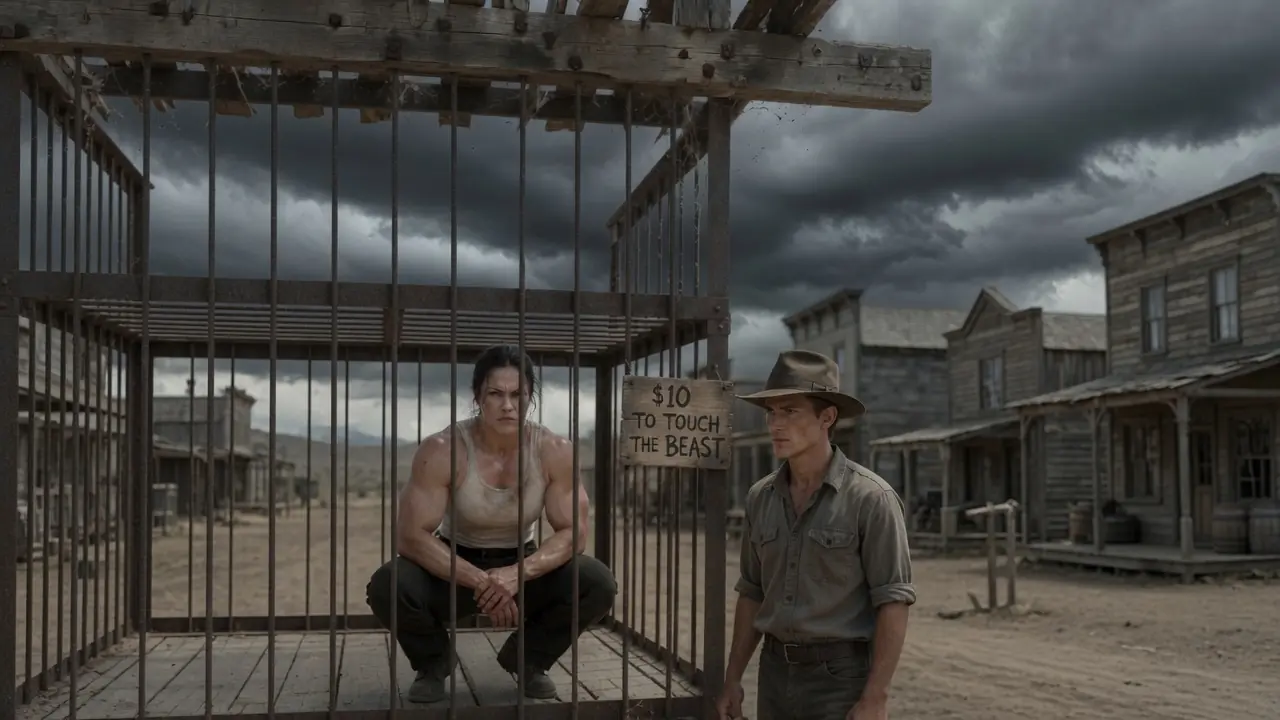
Dust hung low over the street, yellow and bitter in the afternoon heat. A mule cart creaked past the mercantile. Two women stood outside the dressmaker’s shop, whispering behind folded fans. A dog lay beneath the horse trough, ribs showing, one ear twitching at every shout from the square.
Then came the sound again.
Clang.
Metal struck metal.
The crowd roared.
Elias turned his horse toward the noise and saw the cage.
It stood in the middle of Mercy Hollow’s town square, raised on a low wooden platform where a bandstand should have been. Iron bars, black with heat and rust, boxed in a woman sitting on a rough plank bench. A crooked painted sign hung above the latch.
ONE DOLLAR TO STARE.
FIVE DOLLARS TO MOCK.
TWENTY DOLLARS TO TOUCH THE MONSTER WIDOW.
Elias felt the reins tighten in his hand.
The woman inside the cage sat very still.
She was tall, even seated. Tall enough that the top of her head nearly reached the upper bars when she straightened her back. Her shoulders were broad, her arms strong, her hands large and scarred from real work. Her brown hair had been cut unevenly, hanging in rough waves around a face marked by exhaustion, sun, and two years of being looked at by people who had forgotten she was human.
A boy stood near the platform holding a horseshoe nail in his hand.
“Hit the bars!” a man shouted. “Make her jump!”
The boy grinned.
He raised his arm.
Elias spoke before he thought.
“Don’t.”
It was not loud.
It did not need to be.
The word crossed the square like a rifle being cocked.
The boy froze. The laughter thinned. Heads turned one after another until the whole crowd was looking at the dusty stranger on the dun horse at the edge of town.
Elias swung down from the saddle.
He was thirty-eight, lean from trail miles, with a dark coat worn white at the seams and a hat pulled low over eyes that had seen enough trouble to recognize it without introduction. His beard was short, his boots caked with clay from three counties back, and a faded scar ran from his left cheekbone to the corner of his mouth.
He tied his horse near the trough and walked toward the cage.
The sheriff sat at a table beside the platform, sorting coins into little stacks with the patient concentration of a banker. He was a round man with a red face, a sweat-darkened collar, and a badge pinned so low on his vest it looked ashamed to be there.
His name, painted on a board behind him, was Sheriff Amos Cray.
He smiled when Elias approached.
“Afternoon, stranger. You want a look?”
Elias did not answer.
The sheriff tapped the sign.
“One dollar gets you close. Five if you want to say your piece. Twenty if you want to touch her hand and see whether the devil left sparks in it.”
The crowd laughed again, though not as confidently as before.
Elias looked at the woman.
She had not lifted her head.
Only her hands moved, fingers pressing once into her skirt, then releasing. It was a small motion, almost invisible, but Elias saw it. A body trying not to tremble. A soul trying not to give the crowd one more thing to enjoy.
He knew that kind of stillness.
Grief had taught it to him.
Three years earlier, a winter fever had taken his wife, Anna, and their newborn son before dawn. Elias had buried them on a ridge behind his cabin while snow fell so thick he could barely see the shovel in his own hands. After that, the house became too quiet. The bed became too wide. Every sunrise felt like a mistake God had made by letting him see it.
So he rode.
He took fence work, horse work, cattle work, anything that kept his hands busy and his mind too tired to remember. He drank when he should have slept. He fought when drinking did not work. He became the kind of man who carried his sorrow like a loaded gun and waited for somebody foolish enough to touch it.
Then he saw the woman in the cage.
And for the first time in years, his grief looked back at him from someone else’s eyes.
A man near the platform spat tobacco into the dust.
“That there is Beatrice Vale,” he said. “Killed two men and crippled a third. Strong as a bull and twice as mean.”
Another man laughed.
“She buried one husband and tried to send half the town after him.”
The woman finally lifted her eyes.
They were green.
Not soft green.
Not spring green.
The color of storm clouds over grass before hail comes.
She looked at Elias without pleading. Without hope. Without surprise. She looked like a woman who had already learned that mercy was something people talked about on Sunday and forgot by Monday morning.
Elias turned to the sheriff.
“How long has she been in there?”
Sheriff Cray shrugged.
“Long enough to pay back what she owes.”
“That wasn’t my question.”
The sheriff’s smile stiffened.
“Two years, give or take.”
A murmur moved through the crowd, as if hearing the number out loud made it heavier than they preferred.
Elias stepped closer to the table.
“How much?”
Cray leaned back.
“For what?”
“For her freedom.”
The square went quiet so quickly the blacksmith’s hammer in the distance sounded like it belonged to another world.
Sheriff Cray blinked.
“Freedom?”
“You sell looks. You sell insults. You sell the right to put hands through bars.” Elias reached into his coat and pulled out a small leather pouch. “So name your price.”
Cray stared at him.
“She’s not a horse.”
“No,” Elias said. “A horse would have been treated better.”
Somebody cursed under his breath.
The sheriff’s face darkened, but his eyes had already dropped to the pouch.
Elias loosened the drawstring and poured gold coins onto the table.
They struck the wood one by one.
Click.
Click.
Click.
The sound carried across the silent square.
Greed changed the sheriff’s face before he could hide it. Men often dressed cruelty in righteousness, law, or public safety, but greed stripped them down faster than whiskey. Cray leaned forward, counting without touching.
“One thousand dollars,” he said.
The crowd gasped.
A woman near the mercantile whispered, “Lord have mercy.”
Elias counted the coins.
All of them.
One by one.
When the last coin slid across the table, Sheriff Cray swallowed hard and swept them into his lockbox.
“She’s yours now,” he said.
Elias looked at him.
“No. She is not.”
Then he stepped toward the cage.
The woman watched him with the wary stillness of an animal that had learned every open hand could become a fist.
“What is your name?” Elias asked.
“You already heard it.”
“I heard what they call you.”
Her eyes narrowed.
After a long moment, she said, “Beatrice.”
“Beatrice Vale.”
She nodded once.
Elias reached into his vest pocket and pulled out a plain silver ring.
It was old, worn smooth, and slightly bent on one side. It had belonged to his mother, then to Anna. After Anna died, he carried it because leaving it behind felt like burying her twice.
The crowd shifted closer.
Elias knelt in the dust before the cage.
Beatrice stared at him.
“What are you doing?”
“My name is Elias Boone,” he said. “I have a place north of the San Juan road. It is not pretty. The roof leaks in two rooms. The barn door hangs crooked. The well freezes in winter. I have cattle that hate fences and a field that hates my hands.”
He held up the ring.
“I do not have much to offer besides work, land, and a door that locks from the inside.”
Her face changed at that.
Just slightly.
Elias’s voice softened.
“Beatrice Vale, will you marry me?”
The town exploded.
Men shouted.
Women cried out.
Someone laughed so hard it sounded like fear.
Sheriff Cray half rose from his chair.
“You out of your mind?”
Elias did not look away from Beatrice.
She stared at the ring like it was more dangerous than every stone ever thrown at her.
“Why?” she whispered.
The word came out raw.
Not suspicious.
Worse.
Hungry for an answer she did not trust.
Elias lowered his hand slightly.
“Because no woman should have to be bought out of a cage. Because I know what it is to wake up and wish people would stop looking at the ruin of you. Because when I rode in, I saw a town laughing at iron and calling it justice.”
His eyes held hers.
“And because I did not see a monster.”
Beatrice’s fingers curled around the edge of the bench.
The sheriff grabbed his keys, angry now that the show had slipped out of his control. He shoved one key toward the lock, but before metal touched metal, a huge man pushed through the crowd.
The blacksmith.
He wore a leather apron, and soot streaked his arms. His beard was red, his eyes wild with a grief that had hardened into something mean.
“Open that cage and you’ll answer for it,” he shouted. “She killed my brother.”
The crowd stirred.
Fear came back quickly when invited.
Beatrice rose.
The cage seemed to shrink around her as she stood to her full height. She was nearly as tall as Elias and broader than half the men in the square. The same crowd that had paid to see her suddenly remembered that bars had been protecting them too.
Her voice came rough from disuse.
“Your brother came to my cabin three days after Thomas was buried.”
The blacksmith’s mouth tightened.
“Liar.”
Beatrice stepped closer to the bars.
“He came with Harlan Pike and Jesse Ward. All three had whiskey on their breath. All three thought a widow with no family and too much height was something they could teach a lesson to.”
The square went still.
Even the children stopped moving.
“They laughed about my husband’s grave,” she said. “They said a woman my size must think she was a man. They said they could fix that.”
A woman near the dressmaker lowered her eyes.
Beatrice’s hands tightened around the bars.
“Ask Doc Emery what my throat looked like when your sheriff dragged me in. Ask him why my dress was torn. Ask him whose knife cut my arm. Ask why no one wanted to hear any of it after your brother was dead.”
Sheriff Cray snapped, “That is enough.”
“No,” Beatrice said.
The word shook.
Then steadied.
“For two years, you sold my silence. Now you can hear what it cost.”
The blacksmith lunged one step forward.
Elias moved between him and the cage.
“Careful,” Elias said.
He did not shout.
That made it worse.
The sheriff turned the key.
The lock opened with a heavy click.
Beatrice flinched.
For two years, that sound had meant another day beginning. Another coin. Another hand shoved between bars. Another drunk man leaning close enough for her to smell his breath while asking whether giants cried like ordinary women.
This time, the click opened the door.
The cage swung wide.
No one breathed.
Beatrice did not step out at first.
Freedom waited in front of her, enormous and unfamiliar.
Elias stood below the platform and offered his hand.
Not like a man claiming something he had paid for.
Not like a rescuer demanding gratitude.
Simply the way a gentleman might help a lady from a carriage.
Beatrice looked at his hand for a long time.
Then placed hers in it.
Her hand was large, callused, and cold despite the heat.
Elias helped her down.
The crowd backed away.
Some out of fear.
Some out of shame.
Some because people who enjoy cruelty often lose their courage when cruelty looks them in the eye.
Beatrice stood in the street beside him, blinking against the sunlight without bars cutting it into pieces.
“You don’t know me,” she said.
“I know enough for today.”
“They will say you made a mistake.”
“They have said many things already.”
“I killed men.”
“They came to hurt you.”
Her jaw trembled once.
“I don’t know how to be free.”
Elias looked toward the open road.
“Then we’ll start by leaving.”
Sheriff Cray moved his hand toward his gun.
Elias saw it.
So did Beatrice.
For one strange second, the whole square seemed balanced on a blade.
Then a voice came from the edge of the crowd.
“Leave her be, Amos.”
It was Doc Emery.
He stood near the apothecary steps with a black bag in one hand and shame written plainly across his thin face. He was old, stooped, with white hair and spectacles that had slid halfway down his nose.
The sheriff glared at him.
“Stay out of this.”
Doc Emery did not.
“I saw the bruises,” he said, voice shaking. “Around her throat. On her arms. I saw the split lip. I wrote it down.”
The square turned toward him.
Beatrice stared.
Cray’s face flushed deep red.
“You keep quiet.”
“I kept quiet long enough.”
Those words changed the air.
Not enough to heal anything.
Enough to crack the lie.
The blacksmith looked from Doc Emery to Beatrice, and for the first time, doubt cut through his rage. It did not make him kind. It did not undo his brother’s death. But it made the story less simple, and simple hatred does not survive complexity well.
Elias guided Beatrice toward his horse.
Someone threw a clod of dirt.
It hit the street behind them.
A man shouted, “She’ll kill you in your sleep!”
Beatrice stiffened.
Elias leaned closer.
“Stay with me.”
“I know how to run alone,” she said.
“Not today.”
At the horse, he helped her up carefully.
His hands touched her waist for one second, and her whole body locked.
Old memory flashed across her face.
Elias stepped back at once.
“I’ll ask before I touch again.”
Beatrice looked down at him.
No man had ever said that to her.
Not like he meant it.
He mounted in front, gave the reins a soft shake, and rode out of Mercy Hollow with Beatrice behind him. At first, she did not hold on. Then the horse picked up speed, and she placed both hands cautiously at his sides.
The town fell behind them.
The cage shrank in the dust.
The sign swung in the wind, useless now.
They rode hard until the sun dropped low and the land opened wide beyond the last fence line. Cottonwood shadows stretched across the road. Far off, a hawk circled over a dry creek bed. Beatrice looked back once and saw Mercy Hollow flatten into the distance, small and cruel beneath the enormous sky.
No one followed.
Not yet.
At sundown, Elias stopped beside a creek that ran shallow over red stone.
He dismounted first, then looked up at her.
“May I help you down?”
Beatrice stared at him.
Then nodded.
When her boots touched the ground, she stepped away and wrapped her arms around herself. The open land made her dizzy. There were no bars, no lock, no sheriff’s table, no faces pressed close to judge whether she was suffering enough to be entertaining.
Freedom felt too large.
Elias took a canteen from the saddle and set it on a flat rock near her.
He did not hand it to her.
He seemed to understand that taking things directly from a man might be too much right now.
“There’s a town called Red Chapel about ten miles west,” he said. “Preacher there owes me a favor. If you still want to marry me, we can do it tonight.”
Beatrice looked at him sharply.
“And if I don’t?”
“Then I give you money, food, and the horse if you want him.”
“He’s your horse.”
“I can walk.”
Her face tightened.
“You paid a thousand dollars.”
“I paid the man holding the key. Not you.”
The creek moved softly between stones.
Beatrice sat on a fallen cottonwood trunk, shoulders sagging as if strength had finally become too heavy to carry.
“Thomas was my husband,” she said.
Elias removed his hat and sat several feet away.
“He was small,” she continued, and something like a broken smile touched her mouth. “Smaller than me. Gentle hands. Used to tell me God built me tall so I could see trouble coming over the hill.”
Elias listened.
“He died of a lung sickness in winter. Before the ground thawed, men started coming by. Some asking about debts. Some asking about land. Some pretending kindness.”
Her voice darkened.
“Those three came after dark.”
Elias looked at the water.
“I believe you.”
Beatrice shook her head.
“You say that too quickly.”
“No,” he said. “The town disbelieved you too quickly. I’m only trying to balance the scale.”
She looked at him then.
Really looked.
“What did you lose?”
He took a long breath.
“My wife. Anna. And our son. Fever took them in one night.”
Beatrice’s face softened with a pain that recognized its own reflection.
“I’m sorry.”
“So am I.”
For a while, neither spoke.
The wind moved through the cottonwoods, turning the leaves silver underneath.
Then Beatrice bent forward, pressed both hands over her mouth, and began to cry.
Not pretty.
Not soft.
The kind of crying that came after years of refusal.
She had not cried for the crowd. Not when they spat. Not when they touched her hands through the bars. Not when children threw pebbles and men called her beast.
But by the creek, with no one asking to be entertained by her pain, grief finally found its way out.
Elias did not touch her.
Not until she reached for his sleeve.
Then he sat beside her, and she leaned into him like a tree finally allowed to fall somewhere safe.
They married that night in Red Chapel.
The preacher was half asleep when Elias knocked, but he woke quickly when he saw their faces. His wife brought lamplight, bread, and a clean shawl that she placed around Beatrice’s shoulders without comment.
No one asked why Beatrice was so tall.
No one asked why her wrists were bruised.
No one called her monster.
They stood in a small church that smelled of beeswax, rain-damp wood, and old hymnals. Elias gave the preacher the ring. Beatrice held out her hand, and the ring stopped at her knuckle because her hands had been made for axe handles, reins, and survival.
A nervous laugh escaped her.
Elias smiled.
“Strong hands.”
“For hard work,” she said.
“For hard days,” he answered. “And maybe some better ones.”
The preacher spoke of vows.
Not the fairy-tale kind.
The real kind.
Staying when memory turned mean.
Speaking truth when silence felt safer.
Offering shelter without calling it ownership.
Walking side by side when grief tried to pull one of them backward.
Beatrice’s voice shook when she said yes.
Elias’s did too.
When he kissed her, he did it gently, giving her time to pull away.
She did not.
By morning, they rode north.
The trail tested them quickly.
Rain caught them two days later, cold and slanted, turning the road to mud. Elias gave Beatrice the dry side of the bedroll and pretended he did not notice when she knew. She woke once in the night with a gasp, convinced she had heard the cage lock.
Elias sat up beside the dying fire.
“Just thunder,” he said.
Beatrice listened.
Thunder.
Rain.
Horse breathing.
No laughter.
No coins.
No bars.
The next night, Elias woke whispering Anna’s name.
Beatrice sat across the fire from him until his eyes found the present.
“Ghosts?” she asked.
He nodded.
“Mean ones.”
“They lie,” she said.
He almost smiled.
“I’m learning.”
They learned each other slowly after that.
Elias liked coffee black enough to scare a spoon.
Beatrice hated doors left open behind her.
Elias hummed when he repaired leather.
Beatrice could split firewood so cleanly the axe seemed grateful.
He had a scar across his shoulder from a knife fight he did not brag about. She had a pale line across her throat where fingers had once pressed hard enough to bruise bone.
Neither asked for more than the other could give.
Some stories had to be approached like frightened horses.
Sideways.
With open hands.
The ranch sat in a valley beneath dark Colorado mountains, three weeks from Mercy Hollow if weather stayed kind. Weather did not stay kind, so it took four. They reached it at dusk, when the sky was purple and the pasture grass moved in long waves under the wind.
The house leaned slightly.
The porch sagged.
The barn roof had lost several shingles.
Fence posts tilted like old men at a wake.
Beatrice sat on the horse at the ridge and stared.
“No cage,” Elias said.
Her throat worked.
“No crowd.”
“No sign.”
She looked toward the mountains.
They did not stare back.
For the first time in two years, Beatrice stepped onto land that did not ask her to explain her body, her strength, her survival, or her sorrow.
Work began the next morning.
The ranch was not romantic up close.
It was stubborn.
The well rope needed replacing. The chicken coop had a hole big enough for foxes with ambition. The north fence had collapsed in two places. The roof leaked whenever clouds got opinionated.
Beatrice worked like a storm with hands.
She carried posts on one shoulder. Drove nails true. Lifted grain sacks that made Elias pause mid-step and raise both eyebrows. The first time she split a log with one strike, she looked at him quickly, waiting for the flinch.
It did not come.
Elias only said, “Good. That saves us time.”
That sentence helped more than he knew.
For years, people had treated her strength as evidence of something unnatural.
On the ranch, strength became useful.
Necessary.
Hers.
In the evenings, they ate near the stove.
Beans, bread, coffee, sometimes stew if Elias had hunted well or Beatrice had trapped better. Coyotes sang from the hills. Wind moved along the eaves. Beatrice sat with her back to the wall at first, always watching the door.
Elias never commented.
He simply placed his chair where she could see the room.
Weeks became months.
Healing did not come like sunrise.
It came like fence work.
One post.
Then another.
Some mornings, Beatrice woke furious for no fresh reason. Some nights, a dropped pan made her heart race so hard she had to stand outside in the cold until her hands stopped shaking. Sometimes a rider passing along the ridge turned her body to ice before her mind understood he was only moving cattle.
Elias had bad days too.
He would go quiet and walk to the rise behind the house, where the wind bent the grass westward. Beatrice knew he was seeing a grave no one else could see. She did not follow at first. Later, when he allowed it, she stood beside him without speaking.
One evening before the first snow, Elias brought two wooden markers to the hill behind the house.
Beatrice carried a third.
They dug three small places into the hard ground.
Not graves.
Names.
Anna Boone.
Samuel Boone.
Thomas Vale.
Beatrice carved Thomas’s name herself, each letter slow and careful. Elias carved Anna’s. His hand shook before he carved Samuel’s, and Beatrice covered his hand with hers until the knife steadied.
They stood in the wind afterward.
Both crying.
No crowd watched.
No one charged admission.
Grief, at last, was allowed to be private.
Winter arrived hard.
Snow sealed the valley. The creek froze at the edges. They chopped wood until their palms cracked, patched drafts with old cloth, and slept beneath quilts while the stove glowed red through the night.
Sometimes Beatrice laughed in her sleep.
The first time, Elias woke and thought something was wrong.
But she was only dreaming of no bars.
Spring brought green grass, mud, calves, and trouble.
A rider came from the south one afternoon, leading a tired horse and wearing the nervous look of a man sent with news he did not fully understand.
Beatrice saw him from the porch and went still.
Elias stepped outside.
The rider stopped at the gate and raised both hands.
“I’m not here for harm,” he called. “Name’s Caleb Fitch. Doc Emery sent me.”
Beatrice gripped the porch rail.
The man pulled a folded packet from his coat.
Inside was a letter.
Doc Emery had sworn an affidavit.
So had two women from Mercy Hollow who had heard Harlan Pike and Jesse Ward bragging before they followed Beatrice that night. A territorial judge had opened the case again. Sheriff Amos Cray had been removed from office after questions surfaced about the money collected from Beatrice’s cage.
The cage had been torn down.
The platform burned.
The town council, late and ashamed, had voted to send compensation.
Beatrice sat down hard on the porch step.
Elias read the letter twice.
Then handed it to her.
She stared at the ink until the words blurred.
“Do they send back the years too?” she asked.
Caleb Fitch looked at the dirt.
“No, ma’am.”
Ma’am.
The word landed strangely.
Too late to fix anything.
Still different from monster.
That night, Beatrice walked alone to the hill where Thomas’s marker stood. Elias watched from the porch but did not follow. Some grief had to be met without witnesses, even loving ones.
When she returned, the moon was high.
Her face was wet.
Her shoulders were straight.
“I thought the truth would make me whole,” she said.
“Did it?”
“No.”
She looked toward the sleeping pasture.
“But it gave me back the part of me they stole to make their lie work.”
Elias took her hand.
She let him.
Years passed.
Travelers began to know the Boone ranch for good horses, straight fences, and the tall woman who could lift a gate off its hinges and calm a panicked mare in the same afternoon. Some people still arrived carrying rumors. Rumors have long legs. They cross states without shoes.
But rumors found little food there.
On that ranch, Beatrice was not the monster widow.
She was Mrs. Boone.
She was the woman who fixed the south fence better than any hired man. The woman who taught a neighbor’s daughter how to throw a punch after a ranch hand got too familiar. The woman who laughed so loudly from the barn that Elias sometimes smiled before he knew why.
Elias changed too.
The whiskey disappeared.
So did the bar fights.
He still missed Anna. He always would. Beatrice still missed Thomas. Love did not become false just because life continued after it.
But grief became a room in the house.
Not the whole house.
One summer evening, they sat on the porch while the mountains burned gold under the setting sun. The barn roof was straight now. The fences held. Smoke curled from the chimney of a home that no longer felt like a place waiting to be abandoned.
Beatrice turned the silver ring on her finger.
It had been widened years earlier by a patient jeweler who made no joke about the size of her hands.
“Do you ever regret it?” she asked.
Elias looked at her.
“Opening the cage?”
“Buying the key.”
He was quiet for a moment.
“I regret that I had to.”
She watched the pasture.
“And marrying me?”
“Never.”
The word came without hesitation.
Beatrice looked down at her hands.
“I said yes because I wanted out.”
“I know.”
“I did not know if I could love you.”
“I know that too.”
She turned toward him then.
“But I do.”
The words were quiet.
No preacher.
No crowd.
No iron bars.
Still, they filled the porch like church bells.
Elias took her hand and pressed it to his lips.
Below them, grass moved in the evening wind. Somewhere above the ridge, a hawk rode the last warm current of the day. The world, for once, asked nothing cruel of them.
The scars remained.
The cage had existed.
The alley had existed.
The graves had existed.
The laughter had existed.
But none of those things owned the ending.
Beatrice Vale Boone, once displayed behind iron for a town’s amusement, sat beside her husband in the open air with mountains before her, earth beneath her, and no lock between her and the sky.
Sometimes rescue looks foolish to the crowd.
Sometimes mercy looks like madness.
Sometimes a man kneels in the dust with a ring and gives a woman back the one thing no cage can legally take but cruelty tries to steal anyway.
A choice.
And once Beatrice had that choice, the whole lie of Mercy Hollow began to fall apart.
Not all at once.
Not loudly.
But the way rotten wood gives way after years of pretending to hold weight.
One crack.
Then another.
Then daylight.