They Were Supposed to Be Arguing Over Plaster and Ledgers — They Ended Up Falling in Love
In the town of Ashcombe Wells, where the mineral waters rose warm from the earth and fashionable invalids came to recover health, spirits, and sometimes husbands, the Assembly Rooms stood at the very center of consequence.
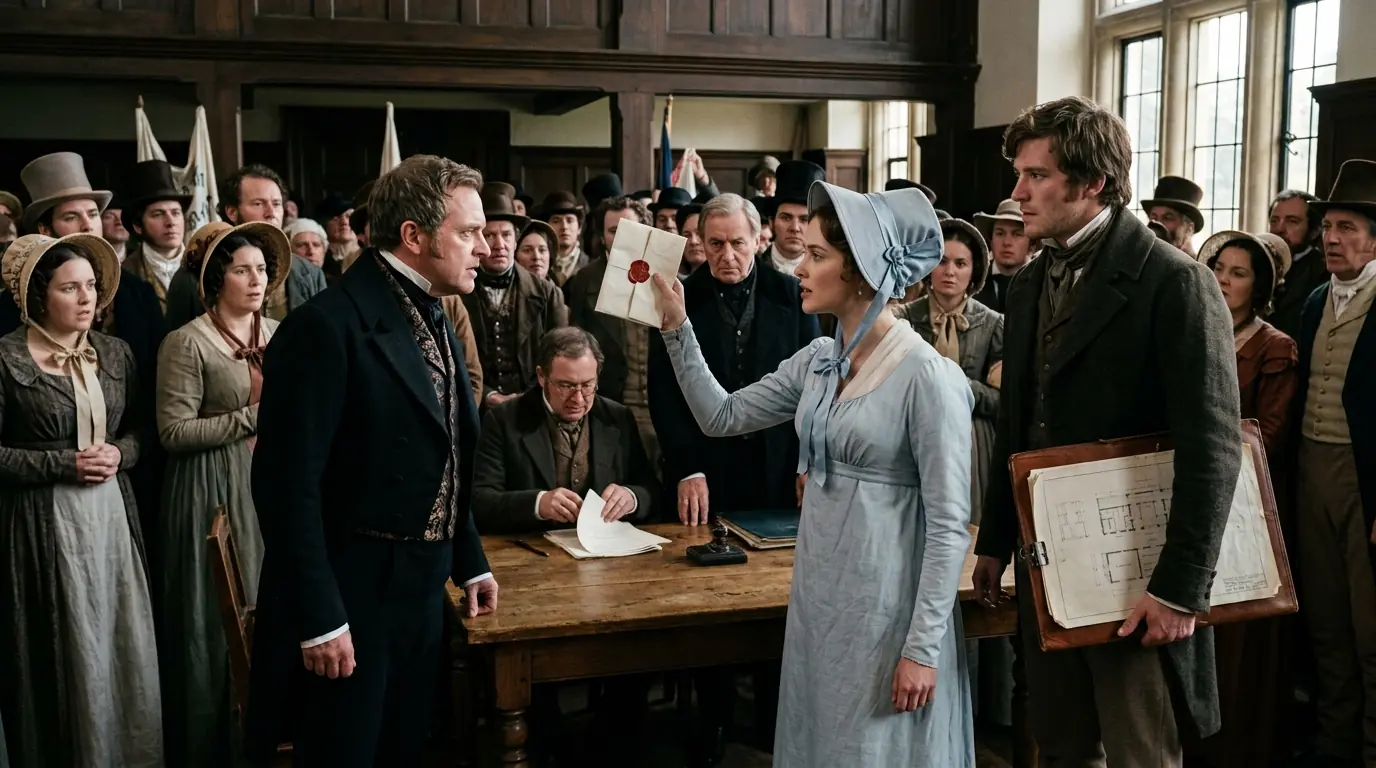
They were not the grandest rooms in England. Bath, naturally, boasted of greater splendor, and Leamington had lately taken to lifting its chin as though every stone in its pavement had been laid by royalty. Yet, Ashcombe Wells possessed a gentler charm: its streets curved around the spring gardens, its lodging houses wore white shutters and climbing roses, its shop windows displayed ribbons, gloves, books, smelling salts, and little bottles of water said to cure everything from gout to disappointment.And above all, Ashcombe Wells had its Assembly Rooms.They were built of pale stone with a handsome portico facing the square, a ballroom with tall arched windows, a card room overlooking the pump garden, and a concert chamber whose ceiling had been painted many years before with clouds, cherubs, and a scattering of golden stars.Miss Phoebe Hartwell knew every inch of the building. She knew which floorboards sighed near the musicians' gallery, which window latch stuck in damp weather, which silver sconce had to be polished twice because candle smoke gathered behind its glass. She knew which subscribers preferred the second row at concerts, which dowagers required chairs close to the fire, which young ladies pretended indifference to gentlemen they had watched all evening.She knew, too, that the Assembly Rooms were more than a place for dancing. They were where linen drapers met customers, where visiting families took lodgings because there would be society enough to tempt them, where musicians earned wages, where milliners sold feathers after every ball, where friendships were renewed, matches were made, charities were supported, and the whole town—high and humble alike—felt itself drawn into one shared rhythm of life.Her uncle, Mr. Edwin Pike, was the manager. And in truth, he had once been equal to all the duties the position required. But rheumatism had stiffened his hands, anxiety had weakened his temper, and since Phoebe had come to live with him after her mother's death, she had gradually become indispensable. She prepared subscription lists, hired musicians, soothed offended patrons, arranged rout cakes, ordered candles, received complaints, paid tradesmen when there was money, delayed them gracefully when there was not, and knew exactly how to smile when someone said, "My dear Miss Hartwell, you are very useful"—as though usefulness were a poor substitute for beauty, fortune, or marriage.At six and twenty, Phoebe had learned not to be wounded by such remarks, or at least not to show it.On the morning the trouble began, she was standing in the ballroom with a ledger under one arm and a basket of silk ribbons over the other, supervising the hanging of garlands for Lady Enderby's spring ball."Higher on the left, Tom," she called to the young footman on the ladder. "No, not so high as that. We are decorating a ballroom, not attempting to snare angels."Tom laughed, and the maid below him covered her mouth. Phoebe smiled, then looked up.For one suspended moment, the whole world narrowed to a thin black line running across the painted ceiling above the musicians' gallery. It had not been there yesterday.She set down the basket slowly. "Tom," she said in a different tone, "come down."He looked over his shoulder. "Miss?""Come down at once, if you please."Something in her voice made him obey without jesting.Phoebe walked beneath the gallery, lifted her candle, and examined the plaster. The crack stretched from the corner molding toward the center of the ceiling. It was no wider than a ribbon thread in places, but near the cornice the plaster had puckered. A small white flake fell; it landed on her sleeve.For a second, she could not move. Then she said calmly, "Fetch my uncle."Within an hour, the decorations were abandoned, the servants dismissed from the ballroom, and Mr. Pike was standing with both hands on his cane, staring upward as though the crack had personally insulted him."It is nothing," he said.Phoebe did not answer."It is old plaster, a settlement, a draft, a trick of the light.""It was not there yesterday.""Then perhaps you did not look yesterday.""I look every day."Her uncle glanced at her, irritated and afraid. "Lady Enderby's ball is tomorrow."