Don’t anybody move, or I swear to God, I will blow this whole place apart. Leo Danton’s voice cracked like a whip across the diner, and every soul inside went stone cold. If you’ve ever been in a room where the air itself seemed to stop breathing, where every heartbeat felt like a countdown to something terrible, then you already know what happened next inside O’Malley’s Diner at 2:00 in the morning on that long-forgotten stretch of Interstate 40. And if you haven’t, stay with me.
Because what those two young men were about to discover in that diner would change everything they thought they knew about fear, power, and the night they nearly didn’t survive. The Honda Civic smelled like cigarette smoke, old fast food wrappers, and desperation. That’s the only way to describe it. The kind of smell that clings to bad decisions made by people who’ve run out of good ones.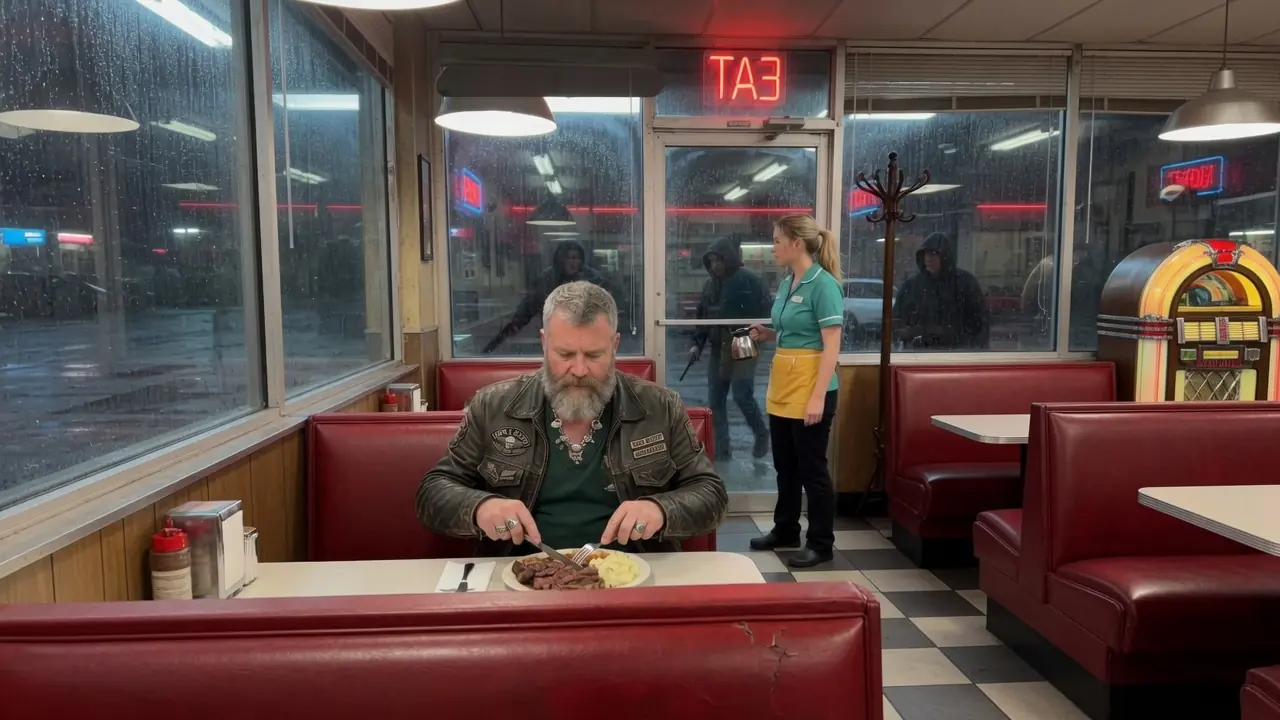
Leo Danton sat in his passenger seat, knees bouncing, jaw grinding, fingers wrapped so tight around the grip of the sawed-off shotgun that his knuckles had gone completely white. He was 26 years old, but tonight he felt about a thousand. The meth he’d taken 3 hours ago had stopped doing what meth was supposed to do. It wasn’t making him sharp anymore.
It was making him frantic, paranoid, like the world was closing in from all four sides at once, and the only way out was straight through. There, he said, pointing through the cracked windshield at the glow of a neon sign maybe 200 yards ahead. O’Malley’s. Pull in. Corey Baxter, 23, thinner than he should have been, with dark circles under his eyes that made him look like he hadn’t slept since Tuesday, gripped the steering wheel and didn’t say anything for a second. Just looked at that sign.
A tired green shamrock flickering in the desert dark. A half-lit Open 24 Hours beneath it buzzing like a dying insect. You sure about this? Corey said. His voice was quieter than he wanted it to be.
Am I sure? Leo turned to look at him, and there was something in his eyes that Corey didn’t like. Something past the point of rational. Corey, we owe Hector $12,000. 12.
You got $12,000 sitting in your back pocket I don’t know about? Corey swallowed. No. Then I’m sure. Leo clicked the safety off. Pull in slow, lights off.
The Civic rolled into the gravel lot without headlights, crunching quietly like an animal that thinks it’s being sneaky. There were maybe five vehicles in the lot, a beat-up Ford pickup, a gray minivan with a cracked bumper sticker, a mid-size sedan with a rental company sticker on the plate, and parked in a long row along the far edge of the lot, almost swallowed by the desert shadow, four motorcycles. Big ones. The kind that didn’t apologize for the space they took up. Corey noticed the bikes, he did.
He noticed them the way you notice a strange dog on a dark porch. Something in the back of your brain sending a quiet uncomfortable signal. But he didn’t say anything about them because Leo was already opening the car door, already checking the shotgun one more time, and the momentum of the night had taken on its own gravity. You get far enough down a bad road and turning back starts to feel impossible.
Like the road itself won’t let you. In and out, Leo said, pulling up his hood. Five minutes. You take the register, I control the room. Nobody gets hurt.
Corey pulled on his own hood with hands that weren’t quite steady. Right, he said. Nobody gets hurt. They walked toward the door together.
Inside O’Malley’s Diner, the world was quiet in the way that only happens after midnight in the middle of nowhere. Brenda Kowalski had worked the graveyard shift at this diner for 11 years. 11 years of burnt coffee and long silences and truckers who tipped well and truckers who didn’t tip at all and she had developed a very particular relationship with the hours between midnight and dawn. She understood them.
She respected them. Those hours had their own rules, their own rhythms and one of those rhythms was not much happens. She was refilling the sugar dispensers at the counter when the door opened. She looked up and her whole body went cold.
Two men in dark hoodies, faces half hidden, moving fast. The first one through the door was already raising something long, something that caught the overhead light in a way that made her stomach drop straight to the floor. Everybody get down. Hands where I can see them.
This is a robbery. The voice, Leo’s voice was ragged and high and absolutely certain of its own authority. For a fraction of a second the whole diner seemed to exist in a bubble. A perfect suspended moment where nothing had happened yet but everything was about to.
Then the bubble burst. The sugar dispenser slipped from Brenda’s fingers and shattered on the floor. At the counter a man named Gerald Finch, a pharmaceutical salesman, 58 on his way from Flagstaff to Bakersfield jolted awake from a half doze his coffee mug lurching off the counter and exploding on the tile. He made a sound that wasn’t quite a word just pure animal shock.
I said get down. Leo advanced toward the counter sweeping the shotgun in a wide arc and the sheer physical presence of that weapon the cold geometry of it the way it changed the air in a room did exactly what Leo needed it to do in those first seconds. It froze everyone. It pointed at almost everyone.
In the back corner booth four men didn’t flinch. They were big men not the kind of big that comes from gym memberships and protein shakes the kind that comes from years of hard living, hard riding and the particular physical confidence of people who have been in dangerous situations enough times that danger itself no longer registers as a crisis. It registers as information. They sat in the corner booth the way they always sat backs to the wall, facing the door watching.
Mike Callahan was the one closest to the aisle. A big man 52 with a gray shot beard and hands that looked like they’d been carved from something harder than wood. He’d ridden with the Hells Angels for over 20 years and in that time he had developed a stillness in moments of crisis that was almost eerie. His eyes moved to Leo, then to Corey, then back to Leo taking inventory.
Across from him Bobby Gallagher, the youngest of the four at 41 stocky and restless had gone very still in a way that was actually more dangerous than movement. His hands were flat on the table. His jaw was set. He was watching.
Next to Bobby Declan Reed put down his coffee mug with a care that was almost ceremonial. Declan was 47 and hadn’t raised his voice above a conversational tone in years because when you carry the kind of training that Declan carried 12 years in the Marine Corps, three combat deployments, you didn’t need volume. You needed precision. He looked at the two hooded men with the clinical calm of someone running a quick mental calculation.
Weight distribution, distance to target, reaction time. He did it without thinking the way some people count stairs or check locks. And Garrett Hayes seated at the outside edge closest to the wall, big quiet 49 with a face that had seen a lot and given back very little, simply set both his hands on the table in plain sight and waited. He was in many ways the most patient man in the room.
And patience in moments like this is its own kind of weapon. None of them moved. None of them spoke. They just watched. You.
Leo pointed the shotgun directly at Brenda. Open the register. Now everything in it into the bag. He threw a plastic shopping bag across the counter.
It slid to a stop in front of her, mundane and terrifying. Brenda’s hands were shaking. She was 54 years old. She had grandchildren.
She had a sister in Phoenix she talked to every Sunday. In this moment all of that felt very far away. The only thing that was real was the trembling in her fingers in the barrel of that gun pointing at her face. Okay, she said.
Her voice was barely a whisper. Okay, I’m opening it. Please don’t. Just open it. Leo’s voice dropped something slightly sour in it now.
Something that might have been guilt if he’d had the bandwidth for guilt. But the meth and the fear and the $12,000 and the image of Hector Velasquez’s cold flat eyes had burned out a lot of what guilt needed to survive. I don’t want to hurt you. Just open the register.
At the counter Gerald Finch had slid off his stool and was pressed against the base of the counter. Hands clasped together in front of his chest, eyes squeezed shut. He was whispering something under his breath. Maybe a prayer.
Maybe just his wife’s name over and over. Hard to tell. Corey had moved to the other side of the room covering the space near the restrooms. The gun, actually a 9 mm pistol, he’d lifted from someone he owed a favor to, held out in front of him in both hands the way he’d seen in movies.
He was sweating heavily now. The plan had seemed so clean 3 hours ago outlined in the front seat of the Civic while they ate gas station burritos and told each other it would be simple. Fast. Painless. But standing in the actual room with the actual fluorescent lights and the actual sound of a woman’s hand shaking against the cash register and an old man praying on the floor, it wasn’t clean at all. It was the most uncomfortable Corey had ever felt in his life.
And he’d felt some pretty uncomfortable things. His eyes drifted almost involuntarily to the back corner of the room. Four big men in a booth not moving, not talking, not doing anything except sitting there watching him with expressions he couldn’t quite read. Not fear, not panic, something else, something measured, something patient, something that if Corey had been thinking clearly would have told him everything he needed to know.
He looked away, looked back at the restroom hallway, looked back at Leo. Leo wasn’t looking at the corner booth at all. That was Leo’s first mistake, and it was a catastrophic one. The register opened with a mechanical click, and Brenda began pulling out bills with hands that couldn’t seem to work fast enough.
twenties, tens, fives, tucking them into the bag with movements that were mechanical and horrified her whole nervous system, trying to do two things at once, comply completely and hold herself together. Faster, Leo said. I’m going as fast as I can. I said faster.
Leo, Corey’s voice low and sharp from across the room. Leo, hey. Something in Corey’s voice made Leo turn. Not the word itself, just the tone. That particular frequency of someone saying a word that means something else entirely.
Leo looked at his partner. Corey was looking at the corner booth. Leo followed his gaze, and for the first time since he’d walked through that door, Leo Danton actually looked at the four men in the corner. Really looked, took them in, registered what he was actually seeing, the size of them, the stillness of them, and then as his eyes adjusted and his brain processed what they were wearing, the detail that changed everything.
Heavy leather, cut-off vests over long sleeves, and on the backs of those vests, even from across the diner, even through the noise in his own head, he could see them. Red and white, a death’s head, grinning, two words beneath it that Leo Danton recognized way most people recognize the shape of a rattlesnake or the sound of a smoke alarm in the visceral, preverbal part of the brain that exists for exactly this purpose. Hells Angels. The shotgun in Leo’s hands suddenly felt both heavier and more fragile than it had a moment before. The math of the situation shifted in an instant like a floor giving way beneath him.
He’d walked in here calculating against one waitress and some sleeping nobody. He had not calculated this. This was not part of the plan. There was no plan for this.
Hey, Mike Callahan said from the corner booth. His voice was low, conversational. The voice of someone who has had this kind of conversation before and found each time that there was no reason to raise it. You might want to think about your next move very carefully, son.
The word son, not said with warmth, said with a particular weight of someone reminding you of exactly where you rank in the order of things. Leo’s jaw tightened. He swung the shotgun toward the booth. You stay out of this, all four of you. Don’t move.
Mike Callahan didn’t move. He tilted his head slightly the way a man does when someone says something that interests him without surprising him. His hands remained on the table, flat and open, but something in his posture changed. A kind of coiling and alignment of weight and intention that was almost invisible unless you were trained to read it.
Declan Reed sitting in next to Bobby was reading it. He was reading everything in the room simultaneously. You come in here and put a gun in that woman’s face. Mike said, still in that same low voice.
That’s one thing. That’s your business. But you’re pointing that weapon at us now. That’s a different thing.
You understand the distinction? I understand you need to shut up and stay in that booth. Leo said. His voice had climbed a half octave without his permission. How old are you? Mike asked.
The question was so unexpected that Leo actually paused. What? How old are you? You and your partner?
Leo’s hand was visibly trembling now. Not from fear exactly, or not only from fear, but from the meth, from the exhaustion, from 26 years of bad choices compressing into this single fluorescent moment in the middle of the California desert. Bobby, Mike said in exactly the same tone he’d been using all along, not even looking at Bobby, keeping his eyes on Leo. Show him. Bobby Gallagher reached up slowly, deliberately with both hands visible, and peeled back the front of his leather jacket.
Just far enough, just enough to make certain things plain. Leo Danton stopped breathing for a moment. Corey from across the room made a sound like someone had taken the air out of him. Because what Bobby revealed wasn’t just a weapon, though.
There was that. It was the jacket itself, fully open now, and on the inside lining the colors, the pins, the patches that told a story 20 years long, a story of roads traveled and lines crossed, and an entire ecosystem of loyalty and consequence that existed completely outside the world Leo and Corey had grown up in. And the center patch, that red and white death’s head grinning its permanent cheerful grin, seemed in that moment less like a symbol than like an answer. An answer to the question Leo had been too stupid to ask before he walked through the door.
Now, Mike said, let’s all just slow down. Oh, but Leo didn’t slow down. That was the problem. That had always been Leo’s problem.
Some people, when confronted with information that should change their behavior, integrate it and adapt. They process, they recalibrate, they do the sensible thing. Leo had never been one of those people. It was why he was here.
It was why he owed $12,000 to a cartel associate named Hector. It was why he’d had three separate chances over the past 4 years to change the direction of his life and had failed all three of them. Not because he was stupid exactly, but because there was something in Leo Danton that responded to walls by running harder at them. You think I’m scared of your patches?
Leo’s voice had gone to a strange place, too high, too tight, too fast. I’ve got a shotgun. You’ve got what? A reputation?
We’re past reputations tonight, old man. We’re past all that. Mike Callahan looked at him for a long moment and something shifted behind his eyes. Not anger precisely.
Something quieter than anger. Something more deliberate. All right, Mike said. Just that. All right. Two words that somehow contained an entire decision.
And then everything happened very fast. What Leo had failed to account for, and this was in retrospect the detail that sealed the entire outcome of the evening, was that while he’d been having his conversation with Mike Callahan pointing the shotgun at the booth and feeling the adrenaline feedback loop of his own fear and aggression, he had stopped tracking the room. He had stopped tracking Declan Reed. Declan hadn’t stood up.
He hadn’t rushed anyone. He hadn’t done anything dramatic. What he had done with the patience of someone who has spent years understanding that the most important moves happen before anyone is watching for them was shift his position incrementally, naturally, the way water finds level ground. By the time Leo noticed him, really noticed him, registered him as a variable that required immediate attention, Declan was no longer in the booth.
He was 3 ft away. Hey, Leo began. The thing about shotguns is that they require distance to be effective. Up close, a shotgun is unwieldy, heavy.
It has a barrel that needs to be pointed and pointing requires space and space is something that disappears the moment someone with Declan Reed’s particular set of skills decides to close it. Leo didn’t fully understand what happened next. The sequence of it was too fast, too precise, too completely unlike anything that had happened in any of the scenarios he’d run in his head. There was a moment of contact, Declan’s hand on the barrel, a motion that was almost gentle in its economy, a redirection rather than a fight.
And then Leo’s world rotated 90° and the floor came up and the shotgun was somewhere that was not in his hands anymore, and his shoulder was screaming and his cheek was against the tile, and he genuinely could not process how he had gotten there. From across the room, Corey shouted something, his own name or Leo’s name or just a raw sound, and turned the 9 mm toward Declan. Garrett Hayes was already there. Garrett didn’t make speeches.
He wasn’t a speeches kind of person. He crossed the distance between the booth and Corey in about the time it takes to blink, and his hand closed over Corey’s gun hand with a grip that felt to Corey like a hydraulic press. Not a person, a mechanism. Something that didn’t negotiate with the small bones in your wrist, just applied force until the math changed.
The 9 mm hit the floor with a sound like punctuation. Corey’s legs stopped working, and he sat down against the wall because they simply wouldn’t hold him anymore. The entire thing had taken 11 seconds. Leo lay on the floor face against the tile trying to remember how to breathe.
The side of his face hurt. His shoulder hurt. But more than any of that, what hurt, what actually ached down in some place deeper than bone, was the realization, finally complete and inescapable, that he had walked into the wrong diner on the wrong night and made the worst miscalculation of his life. Mike Callahan stood up from the booth.
He buttoned the middle button of his jacket with unhurried hands. He looked down at Leo and then across at Corey propped against the wall and then back at Leo. That, he said quietly, is what too much confidence and not enough sense looks like. Leo couldn’t find any words.
Now, Mike said, and his voice had settled back into that low conversational register that was somehow more terrifying than shouting would have been. I think it’s time you and I had a real conversation about your evening. He pulled a chair from the nearest table, turned it backward, and sat down a few feet from Leo. Not looming, not threatening, just present.
The way a mountain is present without effort, without drama, without any need to announce itself. Bobby and Declan took positions near the door. Not blocking it, not yet, but present. Watching. Garrett stood between Corey and the door with his arms crossed.
Brenda behind the counter had pressed herself against the back wall. She was still shaking, but she was watching, too. And there was something new in her face now. Something that hadn’t been there 30 seconds ago, when all she’d had was fear.
Something that looked cautiously like the very early stages of relief. Gerald Finch on the floor by the counter had opened his eyes. He was watching the corner of the room with an expression of pure uncomprehending wonder. The way a person looks when the universe reveals something to them that doesn’t fit any of their existing categories.
And Leo Danton, lying on the tile with his cheek against the cold floor of a nowhere diner at 2:00 in the morning on Interstate 40, looked up at Mike Callahan and understood with a clarity that felt almost like being sober for the first time in years, that the night was far from over. It had, in fact, barely begun. Start talking, Mike said, and I’d strongly recommend the truth. Leo’s mouth opened.
He looked at this man, this calm, gray-bearded, utterly unhurried man sitting backward in a diner chair like he had all the time in the world, and something happened inside him that he hadn’t expected. He started talking. Not because he wanted to, not because it was smart, but because in the presence of a certain kind of authority, the real kind, the kind that doesn’t need to be performed, the kind that has been earned through years of consequence and decision, some part of you, the part that has been exhausted for a very long time, just gives in. We owe money, Leo said.
His voice was flat, wrung out. To a guy named Hector. Hector Velasquez. Something changed in Mike Callahan’s eyes. Very slight, almost imperceptible, but there.
How much? Mike asked. 12,000. A pause. Bobby by the door exchanged a look with Declan. Neither of them said anything. And Hector sent you to rob a diner on Interstate 40, Mike said.
Not a question, something more like reading a sentence aloud to make sure he’s understood it correctly. Hector didn’t send us, Leo said. This was. He stopped. This was our idea. Your idea?
Mike looked at him for a long moment. Son, I want you to hear this in the spirit in which it’s intended. This is possibly the worst idea I have ever encountered in person, and I have encountered some ideas. From across the room against the wall, Corey made a sound that might in a different context have been a laugh.
A short, broken, completely involuntary sound. He covered his mouth immediately, but it was there. And somehow in the wreckage of everything, the shattered sugar dispenser, the cold coffee, the two guns on the floor, the $12,000 owed to a cartel associate in the California desert at 2:00 in the morning, that small, fractured, almost laugh marked the first moment where something other than pure catastrophe seemed possible. Just barely. Just the thinnest edge of something.
Mike Callahan heard it. He glanced at Corey, then back at Leo, and he sighed. All right, he said, let me think. Brenda had stopped shaking.
She noticed this from somewhere outside herself, the way you sometimes notice small things in the middle of large things, and it surprised her. She was still afraid. Anyone would be. But the fear had changed its shape.
It was no longer that flat white obliterating terror of the shotgun in her face and no way out. It had become something she could breathe around, something with edges and a shape she could orient herself against. She watched Mike Callahan sit in that backward chair and look at the two young men on the floor, and she felt something that she would spend a long time afterward trying to name accurately. Not gratitude exactly, though there was that.
Not safety, though there was something close to that, too. What Brenda Kowalski felt in that moment was witnessed, seen. Like someone had come in and said without using those words, You matter. This matters. What was done to you here accounts for something.
She didn’t know these men. She didn’t know their history or their world or what they would do when they walked out that door. But she knew that they had done something tonight, something she would think about for the rest of her life in the small hours when the desert was quiet and the coffee was brewing and the night had that particular way it gets after 2:00 a.m. She straightened up behind the counter. She picked up the coffee pot.
Anyone need a refill? she said. Her voice was steady. Mike Callahan looked over at her. And for the first time that night, something shifted in his face.
Something that, if you caught it at exactly the right angle, in exactly the right light, looked a great deal like respect. I’ll take a cup, he said. Thank you, ma’am. And so in a diner on Interstate 40 at 2:00 in the morning with two young men on the floor and the desert pressing quietly against the windows on all four sides, Brenda Kowalski poured coffee.
And the night continued darker and stranger and more human than anyone in that room could have imagined when it began. The coffee Brenda poured was hot and black and nobody said anything for a moment after she set the cup down in front of Mike Callahan. That kind of silence has its own texture. It’s not empty.
It’s full of things that haven’t been decided yet. Mike wrapped both hands around the mug and looked down at it. Then he looked back at Leo still on the floor propped up now on one elbow. The side of his face carrying the early red bloom of a bruise that was going to be impressive by morning.
Corey had pulled his knees up against his chest against the wall and was staring at nothing in particular with the expression of someone trying to calculate how many bad decisions it took to arrive at this exact moment. Hector Velasquez. Mike said. He said the name the way you say the name of something familiar. Not like a question. Like a recognition.
Which operation? Leo blinked. What? Hector runs different operations in different corridors. Interstate 40, I-15, the 395.
Which one are you tied to? A beat. Leo’s eyes narrowed slightly. The meth fog gears turning. You know him?
I know of him. Mike said. The distinction was deliberate. Answer the question. Interstate 40. Leo said. Barstow to Needles.
Mike nodded slowly. He took a sip of coffee, set the mug down and looked at Bobby by the door. Bobby gave a small, almost imperceptible nod. The kind of nod that means, Yeah, I know exactly what we’re dealing with.
How’d you get into Hector for 12,000? Mike asked. Leo was quiet for a second. Not because he was deciding whether to answer, but because the answer required going back to a place he’d been avoiding for months. Started as four.
He finally admitted. Moving product. Small runs, Barstow to Victorville. Then I skimmed. Not much. Just enough to. He stopped.
Just enough to think you wouldn’t get caught, Mike finished. Leo didn’t say anything. And then interest, Mike said. And then you skimmed again to cover the interest.
And then it was eight, and then it was 12. He paused. How long ago was four? Eight months? Mike looked at him for a long moment.
Son, you didn’t make a bad decision eight months ago. You made a bad decision eight months ago, and then every single morning for eight months you woke up and made it again. He wasn’t cruel about it. That was the thing that got to Leo more than anything else could have.
He wasn’t mean, wasn’t twisting the knife. He was just precise. And precision, when it’s aimed at the truth, hits harder than cruelty ever could. Leo’s jaw tightened.
He looked at the floor. What about you? Mike looked over at Corey. Corey’s head came up.
He looked startled, like he’d been hoping to be invisible. What about me? How deep are you in with Hector? I’m not, Corey said.
I’m not in with Hector. I just He stopped, ran a hand over his face. Leo called me, said he needed help. I said yes.
The silence that followed that sentence was a particular kind of silence. The kind that sits around the word loyalty. When loyalty has been applied to something that didn’t deserve it. You said yes, Mike repeated.
He’s my cousin, Corey said. Quietly, like that explained everything. And somehow in the way only family can it did. It explained all of it.
Every stupid, avoidable, catastrophic thing that had happened since the moment Corey answered that phone call. Mike looked at Corey for a moment. Then something in his face changed. Not softening exactly, more like adjusting, recalibrating what kind of problem this actually was.
All right, he said. He put both palms flat on his thighs and stood up, the chair scraping back. Get up, both of you, off the floor. Leo and Corey looked at each other, then slowly, carefully, like men who understood that every movement was still conditional, they got to their feet.
Gerald Finch at the base of the counter had cautiously returned to his bar stool. He was gripping the edge of the counter with both hands, and his eyes were tracking everything in the room with a wide, slightly glazed expression of a man whose night had departed so far from his expectations that his brain was still running about 45 seconds behind real time. He said nothing. He was wise enough for that.
Brenda stayed behind the counter, coffee pot in hand, and watched. Leo stood unsteadily, one hand going briefly to his shoulder. He didn’t complain about it. He had enough self-awareness left to understand that complaining would not go well.
Corey stood beside him, and they both faced Mike Callahan, and the geometry of the room made it very clear, without anyone needing to state it, that this was a proceeding of some kind, that something was going to be decided here in this diner tonight, and that Mike Callahan was the one who would decide it. Declan Reed picked up the shotgun from the floor and held it loosely in one hand. He ejected the shells with the automatic competence of someone who has handled weapons their entire adult life, pocketed them, and leaned the empty gun against the wall. Then he picked up the 9 mm dropped the magazine, cleared the chamber, and set both pieces on a table near the door.
Not making a show of it, just handling it the way you handle things that need handling. Leo watched this happen and felt something cold move through him. Not because of the guns, specifically, but because of how routine it was, how completely and utterly routine. That was the moment Leo Danton fully understood, in his bones rather than just in his head, what kind of men were in this room.
You stole from the people sitting in this diner, Mike said, addressing both of them now. From this woman here who has been working this counter since before either of you were old enough to have any business making the kind of choices you’ve been making. He gestured toward Brenda without looking at her. You put a gun in her face.
You terrorized this man. A gesture toward Gerald. You came in here with nothing but desperation and bad planning and you got very lucky tonight. You understand that lucky?
Because if Declan there had decided to handle this differently, we wouldn’t be having this conversation. There would just be the aftermath of it. Leo swallowed. I understand. Do you? Mike stepped closer.
Not close enough to crowd. Just close enough to make it personal. Because understanding and knowing are different things. You can know something and still not understand it.
I need you to understand it. Yes, Leo said. The word came out stripped of everything except sincerity. I understand. Mike held his gaze for 3 full seconds.
Then he nodded. Okay? He turned to Corey. You, what’s your name?
Your real name. Corey. Corey Baxter. Corey Baxter. Mike said the name like he was filing it somewhere. Here’s what’s going to happen, Corey. You’re going to empty your pockets onto that table.
Everything you took from anyone in this room tonight. Every dollar, every wallet, every item. And then you’re going to hand it back to the people it belongs to. Personally, with a direct apology.
Are we clear? Corey nodded immediately. Yes. Yeah, clear. Mike looked at Leo. Same goes for you. Leo nodded. Say it.
Yes, Leo said. Clear. Good, Mike said. And then he did something that neither Leo nor Corey expected. He pulled out his own wallet and from it he took several bills and he walked to the counter and set them in front of Brenda.
Not a small amount. Enough to matter. Enough to cover the broken sugar dispenser and the spilled coffee and then some. Brenda looked at the money and then up at him.
You don’t have to. I know I don’t, Mike said. That’s not why I’m doing it. Brenda pressed her lips together, nodded.
Thank you, she said, and the word carried weight that had nothing to do with the money. Bobby and Declan had moved away from the door, now returning to somewhere in the middle ground of the room, present but not blocking. Garrett remained near Corey with his arms crossed, steady as furniture. Leo reached into his jacket and pulled out the cash he’d forced Brenda to put in the bag, $230, a night’s register, and walked it to the counter.
He stood in front of Brenda, and he looked at her, and his face did something complicated, something that moved through several stages quickly like weather. I’m sorry, he said. I’m He stopped, started again. There’s no version of this where that means enough.
I know that, but I’m sorry. Brenda looked at him. She was quiet for a moment. When she spoke, her voice was even.
I’ve got a granddaughter who’s nine years old, she said. She’s the best thing in my life. Tonight, I didn’t know if I was going to see her again because of you. A pause. So, I hear your apology, and I hope you understand what that means, not for me. For yourself.
Leo’s throat worked. He nodded. He couldn’t find any more words, and for once, that was the right response. He stepped back. Then Corey stepped up, and he gave Gerald Finch his wallet back, cash untouched, and said the words, and Gerald Finch, pharmaceutical salesman from Flagstaff, 58 years old, a man who had lived an ordinary and unremarkable life, and expected to continue doing so, looked at this young man standing in front of him and said very quietly, Son, whatever road you’re on, you need to find a different one before it’s too late to choose.
Corey didn’t say anything, but something moved behind his eyes, something that looked for just a moment like a door cracking open. Then Mike Callahan’s phone rang, not a ringtone, just a vibration, one sharp. Mike glanced at the screen and the room which had been settling into something approaching order shifted again. The way a compass shifts near magnetic interference.
Subtle but unmistakable. Mike looked at Leo. Did you tell Hector’s people where you were going tonight? Leo’s face went pale.
What? Did you tell anyone in Hector’s network where you were planning to pull this job? Leo’s mouth opened. Closed. His eyes went somewhere private and horrified.
My contact, he said. I called my contact 2 hours ago to tell him. I told him we had a plan. I said we were going to get the money tonight.
I didn’t say where but He stopped. But Hector’s people know this stretch of Interstate 40. Mike said. Leo said nothing. He didn’t need to.
Mike looked at Bobby. Timer just started. Bobby was already moving pulling out his own phone stepping toward the door. Declan and Garrett exchanged a look that communicated an entire operational reassessment in less than 2 seconds.
The atmosphere in the room didn’t explode. It compressed. The way air compresses before a storm everything getting tighter, denser, more charged. What’s happening? Corey asked. His voice had gone small.
What’s happening? Mike said sliding his phone into his jacket pocket. Is that you two didn’t just rob a diner tonight? You left a trail and the people at the other end of that trail will be very interested in knowing why you haven’t checked in.
He looked at Leo directly. When were you supposed to call Hector’s contact with the money? 3:00 a.m. Mike checked his watch. It’s 2:47. 13 minutes. The number landed in the room like a stone in still water.
Okay, Mike said. He said it the way generals say it or surgeons or anyone who has learned that the moment a situation becomes urgent is precisely the moment when calm becomes non-negotiable. Then we have 13 minutes to handle this right. Handle it how? Leo asked.
What does that mean? You can’t He stopped himself. Can’t what? Mike looked at him.
Leo pressed his lips together. You can’t fix this. You don’t know Hector. Nobody fixes things with Hector.
Everybody thinks nobody can fix things with their particular problem, Mike said. It’s rarely as true as they think. He paused. I told you I know a Hector Velasquez. That means I know who he respects.
And more importantly, I know who he doesn’t want problems with. A beat. You got lucky twice tonight, Leo. Once because Declan is a measured man, and once because the four of us didn’t ride through Barstow just to keep our own schedule. Leo stared at him.
What does that mean? Mike didn’t answer that directly. Bobby, he said. Bobby near the door phone already at his ear raised one hand in acknowledgement.
He was speaking quietly into the phone, turned slightly away, his body language carrying the particular tension of a man making a call that requires precise words in a precise order. Gerald Finch on his bar stool had been completely still for the past 3 minutes. Now he cleared his throat. Should I He gestured vaguely toward the door.
Should I just Stay where you are, Declan said not unkindly. For a few more minutes. Gerald nodded vigorously. He was in his heart a deeply reasonable man, and he recognized reasonable instruction when he received it.
He folded his hands on the counter and stayed exactly where he was. Corey had drifted incrementally toward Leo. They were shoulder-to-shoulder now, the way they’d been when they were kids, when the world was smaller and the consequences were smaller, and being cousins meant something uncomplicated. Leo didn’t acknowledge it directly, but he didn’t step away either.
What’s he doing? Corey said very quietly, nodding toward Bobby. I don’t know. Leo said, which was the truth.
Who does he know that I don’t know, Corey? He paused. Are we going to be okay? Leo looked at his cousin, and for the first time all night, Leo Danton didn’t have an answer that he delivered with false certainty. He looked at Corey who had driven the car and said, Yes.
because he was his cousin, and that was the whole of his reason, and he said the only true thing left in him. I don’t know, but we’ve got a better shot than we did 10 minutes ago. Corey nodded. That was enough. Bobby came back from the door.
He looked at Mike and gave him two pieces of information simultaneously through nothing more than expression and posture. Something was possible, but not easy, and Mike received both pieces and nodded once. Leo. Mike said, Your contact’s name, the one you called 2 hours ago. Leo hesitated for half a second.
Danny Ruiz, Danny Ruiz. He report directly to Hector? Yeah, mid-level. Hector trust him. Mike took his phone out again.
He looked at it, then he looked at Leo with an expression that was almost not quite, but almost a form of sympathy. Here’s something I need you to understand before I make this call. What I’m about to do, I’m not doing for you. I want to be clear about that.
I’m doing it because there’s a woman behind that counter who has had enough happen to her tonight, and I’m not going to let her diner become a problem site for Hector Velasquez’s network at 3:00 in the morning. I’m doing it because your cousin didn’t choose this and doesn’t deserve the fallout from it, and I’m doing it because I’m tired and I’d like to finish my coffee and get back on the road before dawn. He paused. You’re a beneficiary of those reasons. That’s different from being the reason.
Leo absorbed this. He nodded. Understood. After this call. Mike continued, you’re going to have a window, small one. You’re going to use it to get as far from Hector’s operation as you can get.
Not Barstow, not Victorville. As far. You understand what I mean by far. Leave. Leo said. Leave everything. Mike said. The car, yes, I know it is stolen, which is its own issue, the contacts, the operation, all of it. You walk away from that life tonight or the window closes and the next people you talk to won’t be sitting in a diner having a conversation.
The room was very quiet. What about the debt? Leo asked. The 12,000. That’s what the call is for. Mike said. He scrolled to a number in his phone, one he clearly already had, one he didn’t need to look up.
Corey looked at Leo. Leo looked at Mike. You’re going to call Hector. Leo said slowly, and tell him to forgive the debt.
No. Mike said. I’m going to call someone who will communicate to Hector that this debt has become more trouble than it’s worth. There’s a difference. He held the phone up and looked at both of them.
Last chance to complicate this. Either of you holding anything back I should know before I dial? Neither of them spoke. Mike nodded. He pressed call.
The phone rang twice. And then someone answered. And Mike Callahan, in a voice that had not changed its temperature or its tone through any part of this extraordinary evening, began to speak. Brenda listened from behind the counter, not to the words, she couldn’t hear them clearly, but to the sound of it. The rhythm.
The way a man sounds when he has a certain kind of authority that he doesn’t need to explain or perform. When every person on the other end of the line already knows who they’re talking to and what it means that he’s calling. Gerald Finch sat on his bar stool and held his coffee mug and decided that in the morning he was going to call his daughter and tell her he loved her and that he should have called more more often and he was going to mean it more than he had ever meant anything. Declan stood near the wall, arms crossed, watching the door.
Not because he expected trouble anymore. More like a habit. The professional courtesy of staying alert. Garrett sat back down at the booth.
He picked up his own coffee mug, took a sip. The gesture was so normal, so entirely ordinary that it somehow underlined everything that had just happened in this room. The distance between catastrophe and a man drinking coffee was smaller than anyone wanted to admit. And the difference was almost always people.
The right ones in the right place making the right calls. Bobby leaned against the counter a few feet from Brenda, and after a moment he said quietly, You okay? Brenda looked at him. She thought about the question seriously, the way a person does when they have learned not to answer it automatically.
I think so, she said. I will be. Bobby nodded. You handled yourself tonight. I want you to know that.
A lot of people would have He stopped, reconsidered. You didn’t fall apart. That matters. Brenda looked at him with eyes that had been carrying a lot longer than tonight. I’ve got three grandkids, as she said.
You want to know what teaches you not to fall apart? Three grandkids and an ex-husband who tried every possible way to make you believe you were smaller than you are. A pause. After that, two young men with guns are a problem, not a definition. Bobby looked at her for a moment.
That’s one of the best things I’ve ever heard anyone say. Brenda almost smiled. 11 years of graveyard shifts, she said. You get philosophical or you get broken.
I chose philosophical. Across the room, Mike Callahan lowered his phone. He stood still for a moment. The particular stillness of a man reviewing what was just said and confirming it against what was expected.
Then he turned to Leo. It’s handled, he said. Leo’s mouth opened. What does that mean?
Exactly, what does handled mean? It means Danny Ruiz is going to receive a message in the next hour that your debt has been absorbed, dissolved. The language will be business language, not personal. Hector doesn’t do personal accommodations that would set a precedent, but he does recognize when an arrangement has become operationally inconvenient.
A pause, which this one now has. Just like that? Corey said. He couldn’t help it. The disbelief was plain on his face.
It’s not just like them at Mike said. A note of something entering his voice that was the closest he’d come all evening to sounding tired. It costs something. It always costs something.
But that’s not your concern tonight. Tonight, your concern is the window I just bought you. He looked at both of them in turn. Are you going to use it?
Leo looked at Corey. Corey looked at Leo, and something passed between them. Not words, not a plan, but the particular understanding of two people who have shared enough of their lives that some conversations happen entirely without language. Yeah, Leo said.
We’re going to use it. Good, Mike said. He turned back to the counter. He picked up his coffee mug.
It had gone cold. Brenda, without a word, took it from him, poured it out, and refilled it from the fresh pot. Mike looked at her. Thank you. You’re welcome, she said.
And that was its own kind of ending. Not dramatic, not announced, just a small ceremony of a cup of hot coffee offered freely in a diner on Interstate 40 at 2:53 in the morning while the desert held its breath outside and two young men stood in the ruins of their worst night and tried to figure out what came next. Leo Danton reached up and touched the bruise forming along his cheekbone. It hurt. It was going to hurt more tomorrow.
He thought that was probably appropriate. Some lessons needed to leave a mark you could feel for a while. Something to press against when you were tempted. Something to remind you.
He looked at Mike Callahan one more time. What? Ty he said. The word was simple and stripped of everything except the question itself.
Mike looked at him over the rim of the coffee mug. Because somebody did it for me once, he said, a long time ago, in a situation that had no business turning out the way it did. He took a sip. Now, I’m not that man anymore, and neither are you going to be the man you were 2 hours ago.
That’s how it works if you let it. He set the mug down. Don’t waste it. Leo nodded. He didn’t trust his voice.
Corey put his hand on Leo’s arm, not dramatically, just set it there, and Leo let him. Outside the desert was still and dark and enormous, and Interstate 40 ran through it like a sentence that never ended, carrying people toward things they needed and away from things they couldn’t afford anymore. And in the parking lot, a stolen Honda Civic sat under the cold stars waiting for a decision that for once was going to be the right one. Mike Callahan set his coffee mug down and looked at the door for a long moment, the way a man looks at something when he’s thinking about something else entirely.
Then he looked back at Leo and Corey still standing in the middle of the diner like they hadn’t quite gotten the message that the worst part was over. Or maybe they had gotten it and just didn’t know what to do with their bodies now that the adrenaline had nowhere left to go. Sit down, Mike said, not a command, more like advice from someone who had seen what unspent adrenaline does to people when they stay on their feet too long. Both of you. They sat.
Leo took the nearest chair like his legs had been waiting for permission. Corey slid into the booth across from him, and for a moment they just looked at each other with the hollow, wrung-out expressions of people who have been through something that doesn’t have a clean name yet. Declan had moved to the counter and was sitting two stools down from Gerald Finch. Gerald had stopped gripping the counter edge.
His hands were flat on the surface now, and he was looking at his coffee mug with the concentration of a man who has decided that focusing on small, stable objects is the most rational response to an irrational evening. Declan didn’t speak to him, just sat nearby, which was its own kind of communication. You’re fine. It’s over. Drink your coffee. Bobby pulled a chair from the nearest table and turned it around and sat backward on it, the way Mike had earlier, arms crossed over the top rail, watching the room with the relaxed alertness of someone who was off duty, but will never fully be off duty.
It was in the posture, the way the eyes kept moving without urgency, the way the body stayed loose but coiled, always just slightly more ready than it appeared. Garrett had not moved from the booth. He’d finished his coffee. He was working on a piece of pie that Brenda had quietly set in front of him at some point in the last few minutes, the timing of which nobody had quite noticed because Brenda Kowalski had spent 11 years learning how to move through crisis the way water moves through rock, not by force but by finding the path that was already there.
The diner breathed. That’s the only way to describe what happened in those minutes. The whole room just breathed. The collective exhale of people who had been holding everything tight and were now carefully letting some of it go.
And then Leo said something that cracked the quiet open again. There’s something I didn’t tell you. Mike looked at him. Leo’s jaw was working.
His hands were flat on the table in front of him and he was staring at them like they belonged to someone he didn’t entirely trust. When I called Danny Ruiz 2 hours ago, I didn’t just tell him we had a plan. A pause. He pressed his lips together. I told him where we were, the stretch of Interstate 40.
I said we were going to hit something between Barstow and Ludlow. His eyes came up. I was specific. The room changed temperature, not dramatically, not with any visible signal, but something shifted in the air the way it shifts just before weather arrives, a density, a pressure change that the body registers before the mind catches up.
Mike didn’t move, but his stillness became a different kind of stillness. How specific? he said. I said the diner at the 22-mile marker. Leo said. I was trying to I thought if I gave him details, it would buy me time.
Make it seem like I had things more under control than I did. He exhaled. I was wrong. Bobby was already off the chair. He was at the window in three strides.
Not running, not panicked, but moving with the economical urgency of someone switching from one gear to another without any wasted motion in between. He looked out at the parking lot, looked at the road, looked at the darkness beyond the road. How long ago did you call? Mike asked. His voice had not changed.
This was impressive and to Leo somehow more frightening than if he’d raised it. Two hours and Leo checked his own watch with shaking hands. Maybe 2:15. And Ruiz knew you were targeting this stretch specifically? Yes. Mike. Bobby’s voice from the window.
Quiet, flat, carrying the particular note that means I see something. Mike was already moving. He crossed to the window and stood beside Bobby and both men looked out at the road for a moment without speaking. Reading whatever it was that Bobby had seen, a light, a vehicle, a movement, a particular way headlights behave when they slow down without stopping, the way a car looks when it is deciding something.
Declan was on his feet. Garrett had set down his fork. Leo watched all of this happen and felt his stomach drop straight through the floor. You ought to say that. Quiet. Mike said.
Not harsh, just firm. The kind of firm that means right now information is more important than your question. 20 seconds of silence. The headlights on the road slowed, almost stopped, then continued past.
Bobby let out a breath through his nose. Probably nothing. Rubbernecker. Speed trap psychology. Probably? Mike agreed. He stepped back from the window, but he didn’t return to his coffee.
He stood in the middle of the room and looked at Leo with an expression that had left behind the patience it had been caring for the past hour. Something more direct had replaced it. Leo, I handled the debt. I told you that was done.
But I handled it based on incomplete information, which means I handled the wrong problem. He let that land. You understand what I’m saying? Leo’s voice came out smaller than he intended.
You thought it was just about the money. It’s not just about the money, Mike said. No. No, Leo admitted. Hector’s people know this location, Mike said.
And Hector’s people, when they come to collect on something, don’t come to have a conversation. He looked at Bobby. Time? 3:04, Bobby said.
3:00 in the morning. The hour when the Interstate 40 corridor was as close to empty as it ever got. The hour when, if you were planning to move on something, you moved. All right, Mike said.
And this all right was different from the others. This one had edges. We need to change the shape of this situation. Fast. Corey stood up so quickly his chair nearly fell backward.
What does that mean? What shape? What are we? He stopped, steadied himself, looked at Mike.
Are they coming here? I don’t know, Mike said. But I arranged a debt resolution based on a phone call, and phone calls can be reversed or ignored when the person who took them decides the situation has changed. Hector agreed to dissolve the debt because it became inconvenient.
If Ruiz already had people en route to this location, Hector might decide that since they’re already here, they might as well finish the original transaction. He paused. Loose ends bother people in Hector’s business. You two are a loose end. Gerald Finch on his barstool made a small involuntary sound.
Declan looked at him. Sir, I’m going to ask you to step back behind the counter with Brenda, away from the windows. Gerald Finch did not argue. He slid off the stool, picked up his coffee mug with both hands, and walked behind the counter with the careful, deliberate movements of a man who has decided that following instructions from competent people is the single best thing he can do with himself right now.
Brenda put her hand on his arm briefly when he reached her. The gesture was purely instinctual and entirely human, and Gerald felt it anchor him in a way that nothing else in the past hour had. It’s okay, she said. She said it quietly, and she said it like she meant it, which she did, because Brenda had made a decision somewhere in the past 40 minutes that she was going to be the stable thing in this room, no matter what else happened.
Not because she wasn’t afraid, but because she had learned through 11 years and three grandchildren and one ex-husband and a lot of graveyard shifts that being the stable thing was itself a form of courage, maybe the most important form. Mike turned to Leo. The Civic in the lot, stolen? Yes. Plates switched?
We used plates off a junker in a lot in Victorville. So it runs clean for now, Mike said. For now. He thought for a moment. Where were you planning to go after this?
Leo and Corey looked at each other, and the look that passed between them said everything they hadn’t planned that far. The plan had ended at getting the money. Everything after was a blank they hadn’t wanted to look at directly. We didn’t, Corey started.
You didn’t plan past the diner, Mike said. No, Leo admitted. Mike looked at them both for a long moment. Something moved across his face.
Not disbelief, he was past that. More like a man recalibrating again the depth of the hole these two had dug themselves into without ever really understanding they were digging. Bobby, he said, Bobby came over. The two men stepped a few feet away and spoke quietly to each other for about 30 seconds.
Corey couldn’t hear the words. Leo caught fragments of place name a number, something that sounded like a question and something that sounded like a decision. Whatever it was, Bobby nodded at the end of it and pulled out his phone again. Mike came back.
He looked at Leo and then at Corey and what he said next was not what either of them expected. There is a man named Cal Dempsey who runs a mechanic operation in Needles. He owes me a favor of considerable size. I’m going to call him and tell him two people are coming.
He will give you cash enough to get you out of the state, not enough to get you into new trouble, and he will take the Civic off your hands without questions. You will not have the Civic registered to whatever name you give him. You will have nothing. He paused. From Needles you go east, not north, east.
Nevada is not far enough. Get to Arizona and then keep going. Leo stared at him. The generosity of it, not just in the practical sense, but in the sheer unreasonable human weight of it was almost too much to process.
Why, he said again. The same word he’d asked before in a different register now. Not hostile, not disbelieving, just genuinely, profoundly bewildered. Mike looked at him steadily.
Because the call I made fixed your debt, but it didn’t fix your location. And right now, your location is a problem. For you, for these people, and for me. He let a beat pass.
And because you told me the truth when you didn’t have to. About Ruiz, about the location. You could have stayed quiet and let me think it was handled. You didn’t. Another beat. That counts for something.
Leo felt something shift in his chest. Not gratitude exactly. Something older and less comfortable than gratitude. The feeling you get when someone holds you accountable to your own best moment, and it turns out your best moment was better than you thought you were capable of.
He looked at Corey. Corey was looking at the floor. His jaw was tight. His eyes were bright in a way that had nothing to do with the fluorescent lights.
Corey, Leo said quietly. Corey looked up. We’re going east, Leo said. Corey nodded once, firm like a decision that had been building for years had finally found the exact moment it needed.
And then the door opened. Not violently, not dramatically, just opened the small bell above it giving its ordinary small hours chime, and a man walked in. Alone. Mid-40s, medium build, wearing a jacket too heavy for the weather. He stopped just inside the doorway and looked at the room.
His eyes went to Leo first, then Corey, then moved with the trained and deliberateness of someone doing a professional assessment to the four men in the room. He stopped on Mike Callahan, and Mike Callahan looked back at him. The recognition was mutual, and immediate, and complicated. It moved across both of their faces in different ways.
Mike’s face going still and careful. The other man’s going through something that started as confidence and ended somewhere closer to recalculation. Callahan, the man said. His voice was flat, professionally flat, the voice of someone who has spent years making their reactions impossible to read.
Ruiz, Mike said. Danny Ruiz, mid-level. Hector trusts him. The contact Leo had called 2 hours ago.
The room did not move. Everyone in it understood, with the particular clarity that only genuine danger provides, that the next 30 seconds were going to determine a great many things. Leo had gone completely rigid. His hands gripped the edge of the table.
His eyes were locked on Ruiz and the word he was thinking, the word burning through the meth fog and the exhaustion and the fear was set up. Had Ruiz followed their trail deliberately? Had he been on the road already en route when Mike’s call came through? Had he ignored the call?
Or taken it and come anyway? Corey had not moved a muscle. Brenda behind the counter pressed herself back against the wall again. But she didn’t take her eyes off what was happening.
Gerald Finch beside her closed his eyes. Ruiz looked at Mike for a long moment. Then he looked at Leo, then back at Mike. You called in the debt, he said.
I did, Mike said. Hector agreed. He did. I was already on the road, Ruiz said. I figured, Mike said. A pause. Long enough to be significant.
These two made a mess, Ruiz said. His voice had something in it now, not anger exactly, more like a professional’s distaste for work that has been done badly. Hector doesn’t like mess. Hector agreed to dissolve the debt, Mike said.
That takes care of the mess. The debt, yeah. Ruiz’s eyes moved back to Leo. But you understand my problem here.
I drove 2 hours. I got a call telling me to stand down. I’m standing in a diner at 3:00 in the morning with the two people who put me on the road in the first place, and I need to go back to Hector with something. Not money. Not the satisfaction. He paused. Something.
What something? Mike said. Ruiz looked at him. The look was a negotiation opener. You know how this works.
I know how your version of this works, Mike said. I’m asking you to tell me what you want. Accountability, Ruiz said. I need these two to understand that what they did, the skimming the debt and then this, he gestured at the room, has consequences.
They can’t just walk away from because someone made a phone call. Hector’s operation runs on people understanding that there are consequences. Bobby Gallagher made a quiet sound. Not a word, just a sound.
The kind of person makes when they have been patient for a very long time and the reserves of that patience are getting close to their floor. Mike heard it. He held up one hand, the smallest of gestures, without looking at Bobby, and Bobby stopped. Then Mike looked at Ruiz.
And what Mike said next was not a speech. It wasn’t a threat. It wasn’t a negotiation in the traditional sense. It was a statement of fact delivered in the same even unhurried voice he’d used all night with the same total absence of performance.
Danny, you drove 2 hours because these two made a mess. I hear that. But you also got a call from a number you recognized asking you to stand down and you kept driving anyway. Which means this isn’t about Hector’s operation anymore.
This is about you. He let that land. Which means we’ve moved into a different kind of conversation. Ruiz’s jaw tightened, almost imperceptibly.
But Declan Reed saw it, and Declan shifted his weight very slightly toward the left. The consequences these two face, Mike continued, are real and they’re already in motion. They’ve lost the money, the plan, and the protection of Hector’s network. They’re leaving the state tonight with whatever fits in their pockets. That’s consequence.
That’s not nothing. A pause. What I won’t agree to is you adding to it. Not tonight. Not in this room. Ruiz looked at him.
The silence stretched, and in that silence Ruiz was doing the same calculation that Leo had failed to do when he first walked into the diner looking at the room, reading the four men in it, understanding what he was actually standing in front of. He was good at his job. That was the truth. Danny Ruiz had survived in Hector’s network for 6 years because he was good at reading rooms and cutting losses before they became disasters.
He knew when a situation had tipped past the point where pushing it further was profitable. He knew the math of confrontation. He looked at Declan Reed standing with his arms loose at his sides and his weight distributed in a way that communicated an entire biography in a single posture. He looked at Garrett Hayes who had not moved from the booth and was looking at him with an expression of absolute comfortable patience that was somehow the most unsettling thing in the room.
He looked at Mike Callahan and Danny Ruiz, professional mid-level trusted by Hector Velasquez, made the rational decision. Fine, he said. The word was clipped and unhappy, but it was a word of agreement. Danny, Mike said.
Ruiz looked at him. The call I made tonight, remember who made it. Not a threat, a reminder. The kind you give a person so they can take it back to whoever they report to and make sure the story is told right.
Ruiz nodded once. Then he looked at Leo, just looked at him for a moment with an expression that was almost impossible to read, and then he turned and walked back out the door. The bell above the door chimed again. Small, ordinary, unchanged.
The room exhaled. Leo’s hands were shaking so hard he had to press them flat against the table. Corey had his face in both hands. Bobby turned away from the door and blew out a long, slow breath toward the ceiling.
Garrett Hayes picked up his fork and finished the last bite of his pie. Declan looked at Mike. That was close, he said. It was managed, Mike said.
Close and managed aren’t mutually exclusive, Declan said. Mike almost smiled. It was the closest he’d come to it all night. Brenda came out from behind the counter.
She walked to Leo’s table and she stood there until he looked up at her. His face was raw and exhausted and young. In a way it hadn’t looked before, like the hard outer layer of it had been worn away by the night. And what was underneath was something that hadn’t finished forming yet.
Hey, Brenda said. Hey, Leo said. You’re going to be okay, she said. She said it simply, not as consolation and not as prediction, but as something she had decided to believe and was choosing to say out loud because she understood in the way people understand things after years of 3:00 a.m. shifts that sometimes someone saying a thing plainly and meaning it is the most powerful force in the room.
Leo looked at her. His eyes were wet. He didn’t try to hide it and he didn’t apologize for it. I’m sorry, he said, for what I did to you tonight.
I’m going to be His voice broke and he found it again. I’m going to be different. I know that’s something people say, but I’m going to be different. Brenda put her hand on his shoulder, one brief deliberate moment of contact.
Then be different, she said. That’s all. Just be it. She went back behind the counter. Mike looked at Bobby and nodded.
Bobby pulled out his phone and stepped away making the call to Cal Dempsey and Needles. Declan walked back to the booth. The diner settled back into something that was not quite normal, would not be normal again tonight, but was something adjacent to it. Something functional. Something that could be moved through.
Leo looked at Corey. We should go, Corey said. Yeah, Leo said. They stood up.
Leo picked up his jacket from the floor where it had landed when Declan put him there, and he held it in his hands for a moment before putting it on, looking at it like it belonged to someone he used to be. Then he put it on. He walked to Mike Callahan and stood in front of him and he didn’t say anything right away because the thing he wanted to say was larger than the words he had for it. Mike looked back at him and waited with the patience of a man who has learned that some moments need room.
I don’t know your history, Leo finally said. I don’t know what you’ve been through or who you were or what somebody did for you once, but I want you to know that I heard it, what you said, and I’m going to carry it. Mike looked at him. See that you do, he said, because the next person in front of you might not be in a position to make phone calls. Leo nodded.
He and Corey walked toward the door. At the door, Leo stopped and looked back at the room one more time at Brenda behind the counter, at Gerald Finch who had returned to his bar stool and was looking at them with something that wasn’t quite forgiveness, but was moving in that direction at the four men who had through no arrangement of their own become the thing that stood between this night and something irreversible. He raised his hand, not a wave exactly, more like an acknowledgement, something between salute and apology and gratitude and all the other things that were no clean words for. Then he pushed the door open and walked out into the desert night, Corey at his shoulder, the cold air hitting them both like a physical thing, like the world resetting itself.
And the door swung shut behind them and the bell chimed one more time and then the only sound left was the highway in the dark and the particular silence of a diner at 3:15 in the morning that has been through something and is still standing. The bell above the door was still settling into silence when Bobby Gallagher ended his call and looked at Mike. Cal’s in, he said. Said they can be there by 5:00, 5:30.
He’ll have the cash ready. Mike nodded. He stood in the middle of the diner with his hands in his jacket pockets and said nothing for a moment. The kind of nothing that has a lot going on inside it. Declan was looking at him from the booth.
You good? Thinking, Mike said. About Ruiz, Declan said, not a question. About what Ruiz goes back and tells Hector, Mike said.
And about whether what I said to him lands the way I meant it to land or whether it lands a different way entirely once he’s had an hour on the road to reconsider. He took his hands out of his pockets. Hector’s agreeable when something is inconvenient. He’s less agreeable when he feels like he’s been managed.
Bobby set his phone on the table. You think Ruiz tells him he got managed? I think Ruiz is smart enough not to, Mike said. But smart enough not to and actually not to are two different things, especially at 3:00 in the morning when your pride is still warm from taking a step back in front of people who were watching.
Garrett put both elbows on the table. So, what do we do? We stay, Mike said. For now. Garrett looked at him.
Stay? Until I’m satisfied the road outside this diner is clear and the two people we just sent toward Needles have enough of a head start that Ruiz’s mood doesn’t become their problem. He looked at Brenda. If that’s all right with you.
Brenda, who had been wiping the counter in the steady methodical way of someone who cleans when they need to do something with their hands, stopped wiping and looked at him. You want to stay, she said. We want to stay, Mike confirmed. She set the rag down.
Then stay, she said. Coffee’s hot, pie’s still good, and she paused and something moved in her face that was private and real and not dressed up for anyone’s benefit. I’d rather not be here alone right now if I’m honest. Then we stay, Mike said, and it was settled.
Gerald Finch back on his barstool had been very quiet since Ruiz walked back out the door. He’d been quiet in the way a person is quiet when they’re processing something that doesn’t fit neatly into the life they’d been living up to that point. He was 58. He sold pharmaceuticals.
He had a daughter in Sacramento and an ex-wife in Tucson and a commute that took him across the desert several times a month. His life was calendars and sales quotas and hotel rewards points in the particular mild loneliness of a man who had been competent at things that didn’t ultimately satisfy him. None of that had prepared him for tonight. He looked at Mike Callahan who had sat back down in the booth across from Garrett and was drinking his third cup of coffee with the ease of a man who has spent so much of his life awake past midnight that the hour itself had stopped meaning anything unusual.
And Gerald Finch decided to do something he almost never did, which was say exactly what was on his mind to someone he’d never met. I need to ask you something, Gerald said. Mike looked up. That man who just walked out, Ruiz.
Gerald’s voice was careful, measured, like a man choosing his footing on uncertain ground. He could have, I mean, he came here to He stopped, started again. You talked him down just by talking. Mostly, Mike said.
How do you do that? Gerald asked. How do you know what to say? How do you know how far to push and when to stop? He shook his head slowly.
I’ve been in conference rooms my whole life. I’ve done negotiations, but I’ve never seen anything like what you just did. Mike was quiet for a moment. Conference rooms have rules, he said.
Everybody in them agreed to be there. They agreed to the process before they walked in. What you saw tonight wasn’t a negotiation. It was a reading.
He looked at his mug. You have to read what a person actually wants, not what they say they want. Ruiz said he wanted accountability. What he actually wanted was to not feel like he lost.
Those are different problems with different solutions. Gerald absorbed this. And you knew that. I’ve had a lot of practice reading people in situations where getting it wrong has immediate consequences, Mike said.
The evenness in his voice carried something under it, not pride, not bitterness, just the flat weight of a long history being summarized in a single sentence. Gerald nodded slowly. He looked at his coffee mug, then he looked back up. Thank you, he said.
For all of it. I know you didn’t do any of this for me, but thank you. Mike looked at him for a moment with an expression that softened just slightly at the edges. You handled yourself fine, he said.
You stayed out of it. You followed instruction. That’s not nothing. A lot of people make bad situations worse by trying to be a hero at the wrong moment.
Gerald gave a short, self-deprecating breath. I was on the floor praying. You were on the floor not getting in the way, Mike said. That’s the same thing in a different outfit.
Bobby from his chair made a sound that was definitively a laugh, short and genuine. Brenda heard it from behind the counter and despite everything, despite the entire weight of the night, the corner of her mouth moved upward. The diner breathed again. Steadier now, the kind of breathing that starts to feel like it might actually last.
And that was the moment Mike Callahan’s phone rang. Not a text, not a vibration, a call. Full ring. He looked at the screen and everything that had softened in his face in the past 90 seconds went back to where it had been. He stood up from the booth.
Bobby, he said, just the name. But Bobby was already reading the room. Already reading Mike’s posture, the set of his shoulders, the way he’d stood without looking at anyone, and was on his feet. Mike walked to the far end of the diner, away from the counter, away from Gerald and Brenda, and answered.
The conversation lasted 4 minutes. Nobody in the room could hear the words. What they could hear was the rhythm of Mike’s side of it, short responses, long silences on his end. One moment where he said something sharply and then went quiet again for a long time.
Declan and Bobby exchanged a look. Garrett set down his coffee. 4 minutes is a long time when you’re watching someone’s back and trying to read a conversation from posture alone. Brenda found herself counting the tiles on the floor.
Gerald had stopped breathing normally somewhere around minute two. Mike ended the call. He stood with his back to the room for just a moment. One moment. Then he turned around and walked back to the booth and sat down. Everyone waited.
That was a man named Carver, Mike said. He runs the corridor between Needles and Kingman for Hector. He looked at Bobby. Ruiz called him.
Bobby’s expression didn’t change, but something behind it did. When? From the road, right after he left here. Mike put his phone face down on the table.
Carver says Ruiz told him the debt dissolution was coerced, that I put pressure on the call to Hector that went beyond a legitimate favor and into something that was going to require a response. Declan said quietly, That’s not what happened. No, Mike said, it’s not, but it’s what Ruiz told him. The room sat with this for a moment.
So Ruiz lied to Carver, Bobby said. The the D to restart something he agreed to let go. Ruiz lied to Carver, Mike confirmed, because Ruiz’s pride on the road between here and wherever he’s going outgrew his better judgment. He picked up his coffee mug and then set it back down without drinking from it.
Carver wanted to know if I was willing to discuss the terms of the debt resolution, whether there was, room for, as he put it, a more balanced arrangement. And you said? Declan asked. I said I’d call him back in 20 minutes, Mike said. Bobby leaned forward.
Mike, if Carver’s involved now, this is a different conversation than Ruiz. Carver doesn’t negotiate the way Ruiz negotiates. I know, Mike said. Carver will come here, Bobby said, not to talk.
I know that, too, Mike said. The silence that followed was not comfortable. It was working. Everyone in it was doing something with it.
Brenda had stopped moving entirely behind the counter. She was standing very still with both hands on the counter surface and her eyes on Mike Callahan. Gerald Finch had gone pale in a specific bloodless way that suggested his body had decided all available resources needed to be redirected toward core functions. What does this mean? Brenda said.
Her voice was steady, more steady than it had any right to be. Mike looked at her directly. He didn’t soften it, and he didn’t inflate it. It means the situation has a second layer that we need to address, and it means I owe you a more complete picture than I gave you an hour ago.
Then give it to me, Brenda said. Mike looked at her for a moment, then he nodded. I told you the debt was handled, and the call to Hector was legitimate. Hector agreed, but the call went through channels that involve people like Ruiz and Carver, and those people have their own interests that don’t always align with what Hector decides.
Ruiz felt diminished tonight, and diminished people in volatile networks sometimes cause more trouble than the original problem. So, this isn’t over, Brenda said. Not yet, Mike said, but it can be. How else? She said.
I make a second call, Mike said. Not to Carver, above Carver. Bobby stood up. Mike. I know, Mike said.
That’s a card you’ve been holding for 3 years, Bobby said. That’s not a favor. That’s a I know what it is, Bobby. Mike’s voice had not risen, but it had acquired a weight that ended the sentence.
Bobby closed his mouth. Declan looked at Mike steadily. You sure? Mike looked at him.
Then he looked at Brenda, then at Gerald Finch on his bar stool, then out at the diner, the broken sugar dispenser still on the floor by the counter, the cold coffee, the late hour, the particular weight of everything that had happened in this room in the past 90 minutes, and everything that was still balanced on a razor edge. Yeah, he said. I’m sure. He picked up his phone. And Bobby Gallagher, who had ridden with Mike Callahan for 22 years, and knew the full history of the card Mike was about to play, sat back down in his chair and said nothing.
Because there was nothing to say. Some decisions, once made, only need to be witnessed. Mike dialed. It rang three times. Then a voice, older, rougher, carrying the particular texture of someone who has not needed to raise it in a very long time because everyone already knows to listen.
It’s Callahan, Mike said. I need 60 seconds. He listened. Then I know the hour. I wouldn’t call if it wasn’t necessary. Another pause.
I have a situation on the 40. Hector agreed to a debt dissolution tonight. His mid-level Ruiz went around the agreement to Carver and is trying to restart something that was already closed. I need the closure to hold.
He listened for a long time. His face was absolutely neutral. Then I’m not asking for intervention. I’m asking for a word to Hector that the agreement stands and that Ruiz’s revision of it doesn’t. Shorter pause. I understand. I won’t.
He listened again, then simply, Thank you. He ended the call. The room waited. Well, Bobby said, it’s done.
Mike said, Just like that? Bobby said, the same phrase Corey had used an hour ago. But from Bobby it carried different weight, not disbelief, but the weight of knowing exactly what just like that had actually cost. He’ll call Hector in the next 10 minutes, Mike said.
By the time Carver gets any kind of response from the network, it’ll be a different message than Ruiz gave him. He set the phone on the table. Ruiz burned himself tonight, not us. Declan exhaled through his nose.
3 years, he said quietly. It was the right use for it, Mike said. Bobby looked at him for a long moment. Then he nodded. Once.
The nod of a man who trusts a decision even when he’s not certain he would have made it the same way. Garrett picked up his coffee mug, drank, set it down. Good, he said, which was the most Garrett had said in the past 40 minutes and carried from him the weight of a full speech. Brenda let out a breath she had been holding for longer than she realized.
She pressed both hands flat on the counter and just breathed for a moment, feeling the cool surface under her palms, feeling the solidity of it. She had worked this counter for 11 years. The familiar pressure of it against her hands was in this moment one of the best things she had ever felt. Is it over? she said.
This time actually over? This time actually over. Mike said. He looked at her and said it the way people say things when they mean them without qualification. You have my word.
Gerald Finch put both hands over his face and made a sound that was part breath and part something more than breath. He held that position for 3 seconds. Then he put his hands down and picked up his coffee mug and drank from it even though it had been cold for an hour and he didn’t care at all. I need to tell you something. Gerald said.
He was looking at the counter in front of him. His voice had the unsteady quality of a man who has decided to say something true and is working through the mechanics of it. My daughter in Sacramento. He stopped. We haven’t spoken in 8 months.
We had an argument about it doesn’t matter what it was about. Looking back it was it was nothing. It was the kind of thing that seems large in the moment and then the moment stretches into weeks and months and you keep thinking you’ll call tomorrow and tomorrow becomes He stopped again. Tonight I thought I wasn’t going to see her again.
I thought that right there on that floor. I thought the last thing I said to her was during an argument about something I can’t even fully remember anymore. Nobody spoke. I’m going to call her tomorrow. Gerald said. First thing. Mike looked at him.
Call her tonight. he said. It’s not that late in Sacramento. Gerald blinked, looked at his watch, looked at his phone, looked back at Mike. It’s 3:30 in the morning.
She’ll want to hear from you. Mike said simply. Gerald sat with this for a moment. Then he reached into his jacket pocket and took out his phone.
He looked at his daughter’s name in his contacts for a long time the way you look at something familiar that has suddenly become extraordinary and then he pressed call. He slid off his barstool and walked toward the door for privacy. And as he pushed it open, before it swung shut behind him, everyone in the diner heard the brief sleepy hello of a woman in Sacramento who had just been woken up at 3:30 in the morning and was about to have a conversation that neither she nor her father would forget for the rest of their lives. The door closed.
Brenda looked at Mike. Something in her expression had changed over the course of the night in a way that was difficult to quantify but impossible to miss. She had started the evening as a woman with a job to do and a night to get through. She had moved through terror and then something close to awe and then something quieter and more lasting than either.
She was looking at this man, this complicated gray-bearded, leather-jacketed man who had come into her diner exhausted from a long ride and ended up changing the shape of the night entirely without once raising his voice. And she was trying to reconcile him with every idea she’d ever had about what the Hells Angels were and what they meant and what they did. Can I ask you something? she said. Go ahead. Mike said. Do you do this a lot?
She gestured vaguely at the room, at the night, at all of it. This, what you did tonight. Mike thought about the question seriously. No. he said.
Most nights are just riding. He paused. But some nights aren’t. And those nights, Brenda said carefully, do they always end this way with things resolved? Mike looked at her with an expression that was honest in a way that was slightly uncomfortable.
No. he said. They don’t. Brenda nodded. She appreciated the honesty more than she would have appreciated a reassuring lie. What made tonight different? she asked. Mike was quiet for a moment, then Tonight had the right ingredients.
Two people who made bad choices but weren’t bad people. A problem that was about money and pride more than it was about anything permanent. And he glanced at Brenda without ceremony, someone in the middle of it who kept her head and held herself together and didn’t give in to any of the moments when she could have made it worse. Brenda felt something land in her chest.
She didn’t speak for a moment. That’s you, Mike said, in case I wasn’t clear. I know who you meant, Brenda said. Her voice came out a little rougher than she intended.
I just she stopped, picked up the coffee pot, put it back down. Nobody said anything like that to me in a long time. Then the people in your life have been inattentive, Mike said. Bobby from his chair said nothing, but he was smiling.
It was small and private, and he was looking at the table when it happened, but it was there. Declan Reed, sitting in the booth, had been quiet for a while. He was the kind of quiet that thinks rather than broods, productive quiet, the kind that comes from a mind that processes laterally rather than linearly. He looked at Mike now.
Two kids, he said, Leo and Corey. Mike looked at him. They’re going to make it, Declan said. It wasn’t a question.
It was the thing he’d been working out quietly while everyone else talked, and he’d arrived at a conclusion. What makes you say that? Mike said. Corey, Declan said. He’s got the thing.
The thing that makes a person capable of changing. He paused. He came in here for his cousin. He didn’t come in here for money or math or fear. He came in here because someone called him and he couldn’t say no.
That’s a problem, but it’s a human problem. The fixable kind. He looked at the door where they had exited. And Leo. Leo told you the truth about Ruiz when he didn’t have to.
After everything, he told you, that’s not nothing. No, Mike agreed, it’s not. People who tell the truth when it costs them something tend to keep doing it, Declan said, once they start. He picked up his coffee mug, I think they’re going to be okay.
Mike looked at the door for a moment. Just the door, ordinary, closed, the small bell above it. Still the desert on the other side of it, cold and dark and enormous and full of road. He thought about a night a long time ago on a different road in a different state when he had been approximately the sum of his worst decisions and someone he hadn’t expected had stood between him and the permanent consequences of those decisions and said without any particular drama, Go east.
Don’t look back. Use the window. He had used it. Not immediately, not cleanly, but eventually and in the ways that mattered.
He thought about this and then he picked up his coffee mug and drank the last of it. Yeah, he said, I think they’re going to be okay. Garrett Hayes stretched his arms above his head with a long unhurried crack of joints and looked at the ceiling. It’s almost 4:00, he said.
We’ve been in this diner for 2 hours. We’ve been in this diner for a year, Bobby said. Feels like it, Declan agreed. Brenda began clearing the table nearest to her.
Not because it needed urgent clearing, but because her hands needed something to do and the familiar choreography of the work was comforting in the way that routines are comforting after rupture. She gathered cups and plates and stacked them with the practiced efficiency of someone who had done it 10,000 times and in the doing of it, she felt herself coming back together. Not all at once, in pieces, the way things come back together after something has shaken them loose. She stopped. She had the stack of dishes in both arms and she stopped in the middle of the floor and she just stood there for a moment, eyes closed, breathing.
Not falling apart, not crying, just stopping. Just being in the fact of still being here. Still standing in her diner at 4:00 in the morning, dishes in her arms, coffee on the desert outside, her grandchildren asleep somewhere 60 miles away, all of it intact, all of it continuing. When she opened her eyes, Mike Callahan was watching her with an expression that asked nothing and offered everything, the quiet company of a person who understands that some moments are private even when they happen in public, and who knows how to be present for them without intruding.
She nodded at him just once. He nodded back. The outside door opened and Gerald Finch came back and his face transformed in a way that went beyond any of the specific lines of it. He was crying quietly and without any apparent embarrassment, and there was a brightness in his expression that sat oddly but genuinely alongside the tears, the particular brightness of someone who has just been relieved of a weight they’d been carrying so long they’d forgotten it was there.
She answered, he said. He said it to the room, to nobody specific, to everyone. She was awake. She said she’d been thinking about calling me for 3 weeks.
He put his phone in his pocket. His hands were shaking but not from fear. We talked for It was only 15 minutes, but we we said the things. He looked at Mike.
She wants me to come to Sacramento next month. She’s got a birthday party for her daughter. My granddaughter. He stopped. His voice had reached the end of its capacity for additional weight. I didn’t know she had a granddaughter.
The room held this. She just turned 2, Gerald said. Her name is Clara. Brenda set the dishes down on the counter and pressed both hands over her mouth.
Her eyes were bright. She didn’t say anything. She didn’t need to. Bobby Gallagher, who was not by any measure a sentimental man, looked at the surface of the table in front of him for a long moment and cleared his throat.
Declan Reed looked at his coffee mug and smiled slowly at it like an old joke he’d finally gotten the punch line to. Garrett Hayes said, Clara’s a good name, and nodded once with the finality of a man issuing a verdict. And Mike Callahan, who had spent the last 2 hours managing threats and making calls and spending favors he’d been holding for 3 years and holding together a room full of people at the outer edge of their various capacities, Mike Callahan looked at this pharmaceutical salesman from Flagstaff with a granddaughter named Clara and a daughter he hadn’t spoken to in 8 months standing in the middle of a nowhere diner on Interstate 40 at 4:00 in the morning with tears on his face and the best expression any of them had seen all night. And Mike Callahan felt something shift in his chest that was not professional and not strategic and had absolutely nothing to do with managing the situation.
It was just the simple, stubborn, unreasonable goodness of the thing, of people, of the way a night can start at its absolute worst and somehow through a combination of things you couldn’t plan and people you didn’t expect arrive somewhere it never should have been able to reach. Buy you all a piece of pie. Brenda said her voice not quite steady. On the house.
I thought you’d never ask. Garrett said. And so at 4:00 in the morning in Interstate 40 in a diner that still had a broken sugar dispenser on the floor and cold coffee at the counter and the particular atmosphere of a room that has been through something and hasn’t entirely processed it yet, four Hells Angels and a pharmaceutical salesman named Gerald Finch ate pie. And Brenda Kowalski stood behind her counter and watched them and felt in the marrow of her tired bones something she would spend a long time afterwards trying to name. Not safety exactly, not gratitude though both of those were present.
Something more like evidence. Evidence that the night could be held. That even at its most chaotic and most frightening, there were people in it who chose to hold it. Who made the choice again and again without announcement, without reward, just because it was the choice that needed making.
Outside the desert was beginning to do the thing it did in the last hour before The desert before dawn has a particular kind of silence that is different from all other silences. It is not empty. It is full of everything that has already happened, holding it the way dry ground holds heat invisibly, completely, long after the source of it is gone. Mike Callahan felt it through the wall of the diner, not literally, but in the way that people who have spent years moving through the night develop a physical sensitivity to its moods, its pressures, its shifts.
The night was changing. Not over yet, but changed, moving from one thing toward another. He looked at his watch. 4:17. Bobby was finishing his pie with the focused attention of a man who takes food seriously, regardless of context.
Declan had pushed his plate aside and was sitting with both arms on the table looking at nothing specific, the working quiet back in him. Garrett had somehow, without anyone quite noticing the transition, fallen half asleep in the booth, with his arms crossed and his chin down to particular gift of a man who can find rest in the margins of almost any situation. Gerald Finch had stopped crying and started glowing. There was no other word for it.
He sat at the counter eating his pie with the unhurried contentment of someone who has just had something restored to them that they’d given up expecting to get back. He ate slowly. He looked at things, the counter, the window, the room, with the attention of a man recalibrating what matters. Brenda refilled his coffee and he said, Thank you.
the way people say it when they mean the full weight of the word. Brenda herself was leaning against the back counter, arms crossed, watching the room in a way she hadn’t been able to do all night openly, without calculation, without the constant readiness for the next thing. Just watching, taking it in, storing it somewhere she’d be able to find it later when she needed it. Mike put his coffee mug down.
He looked at Bobby. Leo and Corey should be close to Needles by now Bobby said reading the look. He checked his phone. Cal texted 20 minutes ago and said the road was clear between here and there. No company. Mike nodded. Good.
You think they’ll actually go east? Declan said coming back from wherever his thinking had taken him. Corey will Mike said Corey was done before he walked through that door. He just needed the night to confirm it. He paused.
Leo he considered this. Leo’s going to fight it for a while. He’s going to feel the pull of everything familiar. Even though familiar is what almost killed him.
That’s how it works. He looked at his hands. But he’ll get there. The conversation with Brenda got to him in a way that surprised him.
Surprised me too if I’m being honest. Why? Brenda said from across the counter. She had heard her name.
Mike looked at her. Because he expected anger from you. He came in with a gun. He put it in your face.
He expected deserved anger. And you gave him something harder to carry than anger. A pause. You gave him a clear picture of what he actually did. Not what it cost you what it almost cost you.
There’s a difference and Leo felt it. Brenda was quiet for a moment. I wasn’t performing she said I just said what was true. That’s exactly why it worked Mike said.
She looked at him. You’ve done this before. What you did tonight. Not the specifics but the shape of it.
Talking people down managing situations finding the thing underneath the surface problem. She wasn’t accusing she was identifying. This isn’t new for you. Mike was quiet.
You don’t have to answer that Brenda said. I know he said and then after a moment I’ve been in rooms where things went the other direction where I didn’t read it right or read it right and didn’t act fast enough or where there was nothing to read because the person on the other end had already made a decision that was past talking. He set his hands flat on the table. Those rooms stay with you.
They’re the reason you get better at it. And they’re also the reason sometimes at 3:00 in the morning in a diner in the middle of nowhere, you stay when you could leave. Brenda absorbed this. She looked at him with the particular attention of a woman who has spent years reading people across a counter.
People at their most tired, their most honest, their most stripped down. You learn things about human beings from 11 years of graveyard shifts. You learn that everyone is carrying something. And you learn to tell the difference between people who carry their weight and people who wear it as armor.
Mike Callahan wore his light clothes like it had just always been there and he’d forgotten it it was on. How long have you been riding? she asked. Since I was 19. he said. What drew you to it?
He considered the question with genuine seriousness, the way he treated all her questions. Like they deserved actual answers. Structure. he said finally. Which probably sounds strange from the outside.
But I grew up in a house that didn’t have any. Rules that changed depending on what day it was and who was drinking and what mood walked through the door. When I found the road, when I found men who had a code, even if the code looked different from the outside than what people assumed it was the first time anything felt stable. He paused. Brotherhood’s real. Loyalty’s real. The version people think they know is about a third of the actual thing.
What’s the other two-thirds? Brenda said. Accountability. Mike said. Showing up. Being the person who stays when things get difficult. He looked around the room at his brothers, at Gerald, at the diner itself, and something moved in his face. Nights like tonight are rare, but they’re also the point.
You spend years building the capacity for something and then a night comes along that either confirms the capacity is there or shows you where the gaps are. He looked back at Brenda. Tonight confirmed it. Bobby looked up from his plate.
That’s the most I’ve heard you say about any of that in 22 years. The hour warrants it, Mike said. Bobby looked at Brenda. He’s not a talker, he said, in case you hadn’t gathered.
I gathered, Brenda said. This is genuinely historic, Bobby said. He was almost smiling. Someone mark the date, Declan said without looking up.
October 17th, 4:23 a.m. Mike Callahan explained himself voluntarily to someone who didn’t have a weapon. Garrett from his half sleep said, write it down without opening his eyes. And the laughter that came then quiet real surprise out of people by the absurdity of the hour and the weight of the night, and the strange mercy of finding something funny at the far end of something that had been for a long stretch of it genuinely terrifying. That laughter was its own kind of resolution.
Not the end of anything, just a sound of people discovering they were still themselves on the other side of something hard. Brenda laughed. She hadn’t expected to, which made it land harder, and she pressed her hand over her mouth, and her eyes went bright, and she shook her head slowly at the ceiling, and let it out. Gerald Finch laughed, too, a warm and startled sound, and the two of them behind the counter laughed together like people who have just survived something and need to let the survival out in a form the body can process. Mike Callahan smiled, full and real.
It changed his face completely. Made him look younger, and simultaneously made the years in him more visible, the way certain lights do illuminating texture rather than hiding it. Bobby saw it and looked away quickly with a deliberate casualness of someone who has just witnessed something private and is choosing to respect that. The moment passed, the room resettled, but something in it had shifted again, softer now, warmer the atmosphere of people who have moved together through something difficult and found themselves on the other side in unexpected company that they didn’t choose and couldn’t have predicted and wouldn’t trade.
Then Mike’s phone buzzed, one vibration, a text. He looked at it. His expression didn’t collapse or spike. It just went still in a way that was slightly different from his usual stillness.
The stillness of information being received and assessed. He looked up at Bobby. Bobby read him immediately. What?
Cal Dempsey, Mike said. In needles. Bobby straightened. Leo and Corey? They arrived, Mike said, but they weren’t alone. The warmth in the room didn’t vanish, but it compressed.
Everyone felt it simultaneously, the contraction, the readjustment, the return of something with edges. Ruiz, Declan said. Not Ruiz, Mike said. He set the phone on the table screen up.
Two men Cal didn’t recognize arrived about 20 minutes after Leo and Corey. Parked outside. Cal says they haven’t moved, just watching. Carver, Bobby said. The word was flat and certain.
Has to be, Mike said. Carver got Ruiz’s version of events before my second call reached Hector. He had people already positioned. He looked at Bobby. He’s smart.
Carver always was. Your call went through, Bobby said. Hector’s going to correct it. Hector’s going to correct it in the next hour, Mike said.
Carver’s people are there now. The distinction was not subtle, and everyone in the room felt it. Declan had both hands on the table. Cal can handle two people outside his lot.
Cal’s 63, and he’s done with that kind of handling, Mike said. I called him in a favor tonight. I’m not calling in another one that asks him to put himself in a physical situation. He picked up his phone.
I need to reach Carver directly. You said yourself Carver doesn’t negotiate the way Ruiz does, Bobby said. He doesn’t, Mike said. But Carver’s also not stupid.
He knows my second call went through. He’s waiting to see if it holds before he moves. His people being there is insurance, not action. He looked at Bobby.
He’s giving me a window to confirm the hold. How small is the window, Declan said? Mike looked at his watch. Small, he said. He dialed.
The call connected on the second ring. Carver, Mike said. I know you’ve got people in the needles. He listened. His face gave nothing.
Then we understand each other’s position. Good. Here’s mine. A pause. The call I made earlier tonight holds. I had it confirmed within the hour. The debt dissolution stands.
Ruiz’s revision of it is his personal problem and not a network position. And the two individuals at Cal Dempsey’s location are not a loose end. They’re a closed file. He listened again.
His jaw was very slightly tighter than usual. I hear that. And I’m telling you that the cost of opening the file is higher than anything those two people represent. Another pause, longer this time.
Carver, I just spent something I’ve been holding for 3 years to close this tonight. I spent it on two people I met 2 hours ago in a diner on the 40. I spent it because it was right and because the situation called for it. I am telling you now, man to man, that if your people in Needles do anything other than get back in their vehicle and drive that thing, I just spent will be the smallest cost of the evening for everyone involved.
The silence on his end stretched for a long time. Then very quietly, Good. I appreciate that. He ended the call.
Nobody in the diner breathed. Mike set the phone down. Good, Bobby said. He’s pulling them back, Mike said.
The exhale that went around the room was collective and audible and unashamed. Lord, Gerald said from his barstool. It was barely a word, more like the last of his air finding a form. Brenda had both hands pressed flat on the counter and her head slightly bowed and she stayed in that position for a moment in a way that was very close to prayer without being exactly that, just a person making physical contact with something solid and being grateful it was still there.
Declan said, That’s twice in one night you’ve gone to the wall for two strangers. Three, Bobby said. He held up fingers. Hector, the second call, Carver.
He looked at Mike. Three times. They weren’t strangers by the third one, Mike said simply. Nobody argued with this because it was true in the way that some things become true over the course of a night, not because they were always true, but because the night made them true, shaped them true, earned the truth out of raw material that had no reason at the start to amount to anything. Garrett Hayes opened his eyes fully and looked at Mike across the table.
You know what I think? he said. No, Mike said. Man, I think you’ve been waiting for a night like this for a while, Garrett said. Not wanting it, not planning for it, just carrying the capacity for it and waiting for the moment it was needed.
He looked at him steadily. I think tonight needed you specifically and I think you knew that the second those two kids walked through the door. Mike looked at him for a long moment. Don’t get philosophical, Garrett.
It doesn’t suit you. Everything suits me, Garrett said and picked up his coffee. Bobby’s phone buzzed. He looked at it, read it, looked up.
Cal says they’re gone. The two vehicles just left the lot. The last held breath in the room released. It was 4:41 in the morning.
The night had 43 minutes of darkness left before the first gray came. Mike Callahan stood up. He buttoned the middle button of his jacket. He looked at Bobby who nodded, at Declan who stood and stretched and was already himself again, settled and present.
At Garrett who finished his coffee and set the mug down with the quiet ceremony of a man completing something. Then he looked at Brenda. She was watching him. She had been watching him for most of the night and the watching had changed along the way from terror to assessment to something more genuine and less easily categorized.
She looked at him now and she didn’t try to name what she felt because some things resist naming and are truer for it. You’re leaving. she said. We’ve got road to make before it gets hot. Mike said. She nodded. She reached under the counter and pulled out a white paper bag, the kind she used for takeout orders. The creased familiar kind that smelled like warmth and she had it filled already.
She set it on the counter. For the road. she said. There’s enough for four. Mike looked at the bag, then at her.
You didn’t have to do that. I know. she said. That’s not why I did it. She leaned on the counter. I need you to know something.
What happened here tonight, I’m not going to pretend it was simple or that I understand all of it. But I know what it felt like when you all stood up. I know what it felt like when you sat down with Leo on the floor and talked to him like he was a person who still had a future worth considering. Her voice was steady and full at the same time.
I’ve worked this counter for 11 years and I’ve seen a lot of people pass through. Most of them are passing through. You know, they’re between things. This place is just the pause.
She paused herself. Tonight wasn’t a pause. Tonight mattered and you She looked at all four of them. You made it matter differently than it would have.
Mike held her gaze for a long moment. You’ve got people out here. he said. On the 40, people who will stop for you if something happens. I’m going to make sure of that.
He said it plainly without drama. Not a promise in the performative sense, a statement of something he had already decided to do. You won’t see it happening, but it’ll be there. Brenda blinked. You don’t have to.
I know, Mike said. She understood then that she was not going to change his mind and she didn’t try. She nodded. Thank you, she said. Thank you, he said, for the coffee.
He picked up the paper bag. Bobby picked up his jacket from the booth. Declan rolled his neck once both directions. Garrett stood and in standing seemed to fill the room with the quiet solidity he’d been providing all night without announcement.
Gerald Finch slid off his barstool. He walked to Mike and put out his hand and Mike shook it firmly, directly the handshake of two people who have been through something together that they will both carry differently and with equal permanence. Safe travels, Gerald said. Drive careful, Mike said, and next month in Sacramento be early.
Don’t let yourself be late to that birthday party. Gerald’s face did something complicated and honest and beautiful. I won’t be late, he said. Bobby shook Gerald’s hand.
Declan clapped him once on the shoulder with the warm solidity of a man who respects people who hold their ground. Garrett nodded at him, which from Garrett was the equivalent of a standing ovation. They moved toward the door. Mike was last.
He stopped with his hand on the frame and looked back at the diner one final time at Brenda behind her counter, at Gerald back on his stool, at the room that was still carrying the night in every surface and corner and would for a long time invisibly the way rooms carry the things that have happened in them. Lock up properly after we’re gone, Mike said to Brenda, and call someone. Don’t be alone with this tonight. My sister’s in Phoenix, Brenda said.
I’ll call her. Good, Mike said. He pushed the door open. The cold desert air came through.
The bell chimed. They walked out. Brenda stood behind her counter and listened to the sound of it. The parking lot, the low voices, the particular mechanical conversation of four bikes coming to life one after another, each with its own voice, its own tone, building into something that was more than the sum of the parts.
It moved through the walls of the diner. It moved through her. And then it pulled away gradually down the ramp onto Interstate 40 headed west. And then the sound of it shrank and thinned and finally became part of the highway noise and then became indistinguishable from the night itself and then was gone.
Gerald Finch sat at the counter and looked at his coffee mug. Well, he said. Well, Brenda said. They sat in the silence for a moment.
The comfortable kind, the earned kind. You going to be okay? Gerald asked. Yeah, Brenda said. She poured herself a cup of coffee, the first one she’d poured for herself all night, and held it in both hands and looked at the door.
You? Better than I’ve been in a long time, Gerald said. And he meant it in a way that had nothing to do with the night being over. He meant it in the way of a man who has discovered something has been returned to him that he didn’t know he’d lost.
Brenda lifted her mug in a small gesture. Gerald lifted his. They touched them together with a soft ceramic sound that nobody heard but them. Outside Leo Danton and Corey Baxter were somewhere on the road between Needles and the Arizona border in a car that wasn’t stolen anymore and with cash that wasn’t earned by anything that needed to be hidden.
Leo’s cheek was bruised and his shoulder ached and he was more sober than he’d been in months. Sober in every sense, not just the chemical one. He was looking at the road ahead of him through the windshield the way you look at something you’re deciding to take seriously. The way you look at a second chance when you have understood for the first time in your life that second chances are not renewable resources. Corey drove.
He had both hands on the wheel and he was quiet in the way that isn’t absence, the way that is presence, full and deliberate, like he was holding the wheel with everything in him, not just his hands. They didn’t talk for a long time. The road did what roads do. It came and it passed and it came again, unending and patient and entirely indifferent to the weight of the people moving across it, which was in its way a comfort.
The road didn’t need them to be anything. It just needed them to drive. After a while, Corey said, What are we going to do? Leo looked at the road.
I don’t know yet, he said, but we’re going to do it east. Corey nodded. A mile passed. Leo. Yeah. That man, Corey paused, Callahan, who was he really? I mean, who is he?
Leo thought about this for a long time, long enough that several miles went by and the sky ahead of them had begun to shift in the earliest, most tentative way, not light yet, not dawn, but the very first suggestion that light was coming. That somewhere under the edge of the world the sun was beginning the work of getting there. I don’t know, Leo said finally. I don’t know who he is in the world.
I just know what he was tonight. What was he tonight? Corey said. Leo looked at the road. He thought about the floor of the diner.
He thought about the conversation. He thought about Brenda and what she said and the particular way a woman looks at you when she has decided you are still worth the trouble of honesty. He thought about $12,000 and Danny Ruiz and a phone call made on his behalf by a man who owed him nothing and had been through things Leo would never fully know. And he thought about being told to go east, to use the window to be different.
The right person, Leo said, in the right place at the right time. Corey nodded. He drove. The sky ahead of them continued its slow, certain, undramatic work of becoming morning. And Interstate 40 ran east as it always had, as it always would, carrying people between what they were leaving and what they were moving toward, indifferent and essential and endless. While behind them a diner on the 22-mile marker sat with all its lights on in the last of the dark, holding the night it had been through, the way a person holds a scar, not with shame, not with pride, just with the quiet knowledge that it happened, that it was survived, and that it left something permanent and real behind.