"Everybody down, hands on your heads now." The shotgun barrel swung across the diner like a scythe. Leo Danton's voice cracked with desperation, meth sweat glistening on his forehead under fluorescent light. He thought this was going to be easy. He thought the diner was empty. He thought tonight was his night.
He was wrong about all three. Because in booth 9, four men in leather slowly set down their coffee cups. No panic, no screaming, just four pairs of eyes, cold patient, and absolutely certain of what came next. Leo Danton had been making bad decisions his entire life, but he had a talent, a genuine God-given talent for convincing himself that the next one was going to be different. That's the thing about men like Leo.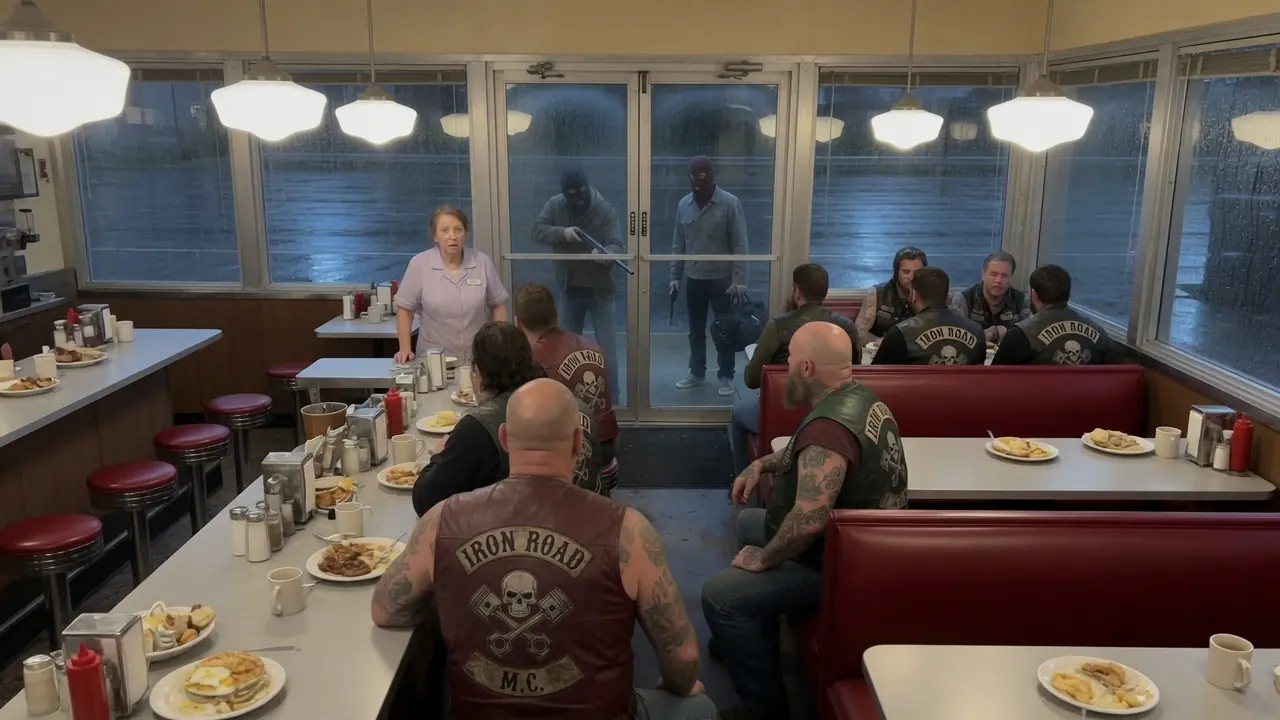
They don't think of themselves as desperate. They think of themselves as resourceful. They don't see a robbery. They see a solution. And at 2:09 in the morning, sitting in a stolen Honda Civic on the shoulder of Interstate 40 outside Barstow, California, Leo Danton looked at that flickering diner sign and saw the most elegant solution he had come across in weeks.
Ali's 24/7. The sign read half the letters buzzing like they were arguing with a bad electrical connection. A roadside diner that had probably been serving truck drivers and insomniacs since before Leo was born. Concrete parking lot. One security camera mounted above the entrance that Leo clocked immediately.
Old model probably recording to a VHS somewhere in a back closet. Probably hadn't been checked since the Clinton administration. Two cars in the lot. A beat up Chevy pickup that likely belonged to whoever was working the overnight shift. A sensible Toyota sedan that screamed insurance salesman or some guy driving through to Vegas.
And that was it. That was the whole threat assessment Leo Danton performed before deciding to rob the place. Cory Baxter sat in the passenger seat, his knee bouncing like a piston, his jaw working side to side the way it did when he hadn't slept, and the meth was still burning through his bloodstream. Cory was 26 years old, but looked 40 in the wrong light. He had a rusty .38 revolver tucked into the waistband of his jeans, a gun that Leo privately wasn't sure actually fired anymore, and the kind of eyes that hadn't been calm in so long that calm had become a foreign concept.
"How many inside did you think?" Cory asked, not looking away from the diner. "Two, maybe three," Leo said. "It's 2:00 in the morning on a Tuesday. Could be just the waitress." "And if there are more?" Leo picked up the Mossberg from the back seat and laid it across his lap. Sawed-off.
Illegal. Absolutely terrifying to anyone who didn't know guns well enough to know that at close range it was less precise than people assumed. "Doesn't matter how many," Leo said. "Nobody argues with this." Cory exhaled through his nose a long shuddering breath. "Toad's going to want the money by Friday." "I know." Cory said, "If we don't pay—" Leo's voice went flat.
"I know what Toad said. That's why we're here." Hector 'Toad' Velasquez wasn't the kind of man you owed money to. He was connected to a distribution network that ran product from the border up through the Inland Empire. And he operated with a particular philosophy. Debts were sacred.
Not in the religious sense, in the territorial sense. The kind of sacred that meant someone showed up at your door or your mother's door or wherever you happen to be sleeping if you stop showing up at doors. Leo and Cory owed Toad $6,000. They had at last count $240 between them. "In and out in five minutes," Leo said, and he almost believed it.
He pulled the ski mask over his face. Inside Ali's, Brenda Kowalski was on hour 7 of a 12-hour shift, and her feet were reminding her of that fact in explicit anatomical detail. Brenda was 60 years old, had worked the overnight shift at Ali's for going on 11 years, and had long ago made peace with the particular loneliness of that shift, the way time moved differently at 2 a.m. Slower, and somehow heavier, like the darkness outside had weight to it. She'd raised two kids on this shift, paid off a car, survived a divorce. The overnight diner shift, she always said, taught you more about human nature than any university course ever could.
Because the people who came in at 2:00 in the morning, weren't performing for anybody. They were just exactly who they were. She refilled the coffee for the man in booth 3, Dennis Parish, a medical equipment salesman out of Phoenix, who had checked in 40 minutes ago and fallen asleep over his eggs within 15 minutes of sitting down. His head was tipped back, his snoring rhythmic and unapologetic. Brenda had let him sleep.
He looked like he needed it. She carried the coffee pot back to the counter, humming something to herself that she couldn't quite name, and glanced at the clock above the piecase. 2:13 a.m., 47 more minutes until she could take her break. She didn't look toward booth 9, not because she was ignoring the four men seated there, but because in 11 years of overnight shifts, Brenda Kowalski had developed an instinct for which customers wanted engagement and which ones wanted to be left alone. The four men in booth 9 had walked in at 1:47 a.m., ordered coffee and food with the economy of people who knew exactly what they wanted and didn't need to discuss it and had been eating in a silence so complete and so comfortable that Brenda had recognized immediately these were men who had known each other a long time.
You didn't get that kind of silence with strangers. That kind of silence was earned. She hadn't looked too closely at the patches on their leather. She didn't need to. In 11 years on Interstate 40, you learn to treat everyone with the same professional courtesy.
That was the job. In booth 9, Mike Callahan heard it before he saw it. He'd been a patchholder for 22 years and president of his chapter for nine. And in that time, he had developed certain senses that weren't listed in any medical textbook. The way a room changed when something was about to happen.
A shift in air pressure almost. A particular quality of silence that was different from ordinary silence. Not peaceful, but coiled, loaded. He heard the engine outside cut off at the wrong moment, not the gradual wind-down of someone parking and taking their time. An abrupt kill like someone trying not to be heard.
He set his coffee cup down. Across from him, Bobby Gallagher, sergeant-at-arms, built like something that had been quarried rather than born with a beard that had gone gray at the edges, and eyes that missed approximately nothing, had already gone still. Bobby's stillness was different from relaxation. It was the stillness of a mechanism that had finished loading. Next to Bobby Declan Reed was wiping his mouth with a paper napkin and his hand paused midway through the motion.
Declan had done two tours in Iraq before he'd found his way to the club. And he carried that experience the way some men carried old injuries invisibly until the weather changed. Garrett Hayes, the youngest at 31, had been mid-sentence about something when the change in the room hit him. He stopped talking. The four of them sat in a silence that was nothing like the comfortable silence of a moment ago.
"Engine," Mike said quietly. Just that one word. Bobby nodded once, barely perceptibly. They didn't reach for anything. They didn't move dramatically.
They simply became more present the way a predator becomes more present when something changes in the underbrush. Full attention, complete stillness, and beneath that stillness, absolute readiness. The front doors of Ali's burst open at 2:14 a.m. Leo came through first, the Mossberg leveled, his voice cracking the quiet like a bat against glass. Everybody down, hands on your heads now. Brenda dropped the coffee pot.
It hit the linoleum and shattered, and the sound of breaking ceramic was somehow more shocking than the shouting because it was so ordinary and so wrong at the same time. She pressed herself back against the counter, both hands going up immediately, her heart slamming so hard she could feel it in her throat. In booth 3, Dennis Parish snapped awake from his dead sleep and looked around with the wild, uncomprehending eyes of a man who could not immediately locate reality. He saw the shotgun. Reality located him.
He dove sideways off the booth seat and compressed himself under the table with a speed that was impressive for a man who'd been unconscious 12 seconds earlier. Cory came in behind Leo, the revolver up, scanning the diner with jerking meth-accelerated movements. His eyes were too wide and moving too fast. "Register," he barked at Brenda. "Open it now.
Open it right now." "Okay," Brenda said. Her voice was shaking, but she was already moving. 11 years of overnight shifts. She'd been trained for this, not officially, not with any real preparation, but in the way that people who work alone at night for long enough create their own protocols. Don't argue.
Don't be a hero. Give them what they want and let them leave. "Okay, just be calm. I'm opening it." "Faster." Cory's voice went up an octave, and that was the moment Leo registered something he hadn't accounted for in his calculation. The diner wasn't as empty as he'd thought.
He'd clocked the parking lot. Two cars. But what he hadn't seen, couldn't have seen from the road were four motorcycles parked in the strip of shadow along the eastern wall out of the direct sight line from the highway. Custom Road Glides blacked out with particular customization choices that didn't come from any dealership. Leo hadn't seen them.
His eyes found booth 9 at 2:14:23 a.m. Approximately 23 seconds after he'd walked through the door. And what he saw there stopped his forward momentum in a way that had nothing to do with physical obstruction and everything to do with something that short-circuited in his brain. Four men sitting exactly where they'd been sitting. Not on the floor, not with their hands on their heads, not complying with a single syllable of his commands, just sitting there looking at him. "Hey." Leo swung the Mossberg toward the booth.
His voice tried to be authoritative and came out with a tremor he hadn't authorized. "Hey, I said hands. Hands on your heads right now, all four of you." Mike Callahan looked at the shotgun. Then he looked at Leo and something in that look, something patient and absolutely unafraid and almost pitying sent a coal wire of wrongness straight down Leo's spine. "Son," Mike said, and his voice was calm and conversational in a way that was more frightening than any shouting could have been.
"Why don't you put that down before you do something you genuinely cannot take back?" Leo's grip tightened on the Mossberg. "Shut up, everybody. Shut up. You get on the floor right now or I will—" "You'll what?" Bobby Gallagher's voice came out like gravel in a cement mixer. He hadn't moved.
He was looking at Leo with an expression that Leo's brain was struggling to categorize because it wasn't fear, wasn't anger, wasn't the kind of offended shock that civilians usually showed when someone pointed a weapon at them. It was something else, something evaluative. Like Leo was a math problem Bobby was solving in his head and the answer was coming out very small. Cory at the register had gone stiff. He could feel it too.
Something wrong. Something his meth blurred instincts were trying to flag but couldn't quite assemble into a coherent warning. "Leo," he said. "Leo, just get the money and let's go, Leo said, not taking his eyes off the booth. But the command in his voice was losing altitude fast.
Declan Reed had set his fork down at some point in the last 30 seconds. He was sitting with his hands flat on the table and he was watching Leo with the focused attention of someone running calculations. Not threatening calculations, tactical ones. There was a difference and Leo could feel it even if he couldn't have articulated it. Garrett Hayes hadn't moved either, but Garrett was watching Cory, not Leo.
The patches on his cut were illuminated by the fluorescent overhead light with the absolute clarity of something that was meant to be seen. The death head, the bottom rocker, the 1% diamond. And above the left breast, the word that had meant something specific on every highway in every roadhouse in every law enforcement database on the West Coast for six decades, president. "Oh God," Cory whispered from the register, and the sound that came out of his throat wasn't really words anymore. Leo Danton stared at the patches and every piece of intelligence his brain had been assembling for the last 90 seconds.
The motorcycles he hadn't seen the calm that didn't make sense. The look in Bobby's eyes, the way these four men had simply refused to react. The way victims were supposed to react. Every piece of that intelligence arrived simultaneously. And the total was not good.
He was standing in Ali's 24/7 Diner at 2:14 in the morning with a sawed-off Mossberg pointed at a table full of Hells Angels. And they had not moved. They had not scrambled. They had not reached for phones or thrown up their hands or done any of the things that normal people did when confronted with armed men. They had just sat there looking at him, waiting.
"Now," Mike said, still conversational, still patient. I'm going to say this one more time and I want you to hear the kindness in it because I am genuinely trying to do you a favor. He leaned forward very slightly, his elbows going to the table, his eyes steady on Leo's. "Put the gun down." The Mossberg was shaking, not because Leo had decided to let it shake, because his hands had made a unilateral decision that his brain was only now catching up to. Brenda behind the counter had her hands still raised, her eyes moving between Leo and the booth.
And in 11 years, she had never once imagined a night like this, but she was also in some part of herself that existed beneath the terror. Watching Mike Callahan was something that was almost gratitude because the man had not moved, had not escalated, had not introduced a single new variable into a situation that was already a hair's breath from catastrophe. He was keeping the room from exploding. That was what he was doing. And Leo, for all his bad decisions and all his meth-scorched reasoning, could feel it too that Mike Callahan was the only thing standing between this moment and something that nobody in this building would walk away from unchanged.
Cory had completely forgotten about the register. He was standing with his back against the counter, the revolver hanging from his hand rather than raised his eyes locked on the booth with the expression of a man who has just stepped off what he thought was solid ground and discovered a drop below it. "Leo," Cory said, and his voice had gone very quiet. Leo, I think we need to shut up, Leo said, but there was no force in it anymore. Just a reflex, a man trying to hold a shape that was already collapsing.
Declan Reed tilted his head to the side slightly, the way someone does when they're timing something. And the movement, small as it was, casual as it was, made Leo's finger do something. It had no business doing, made it start to tighten on the trigger out of pure animal panic. Don't. Mike's voice didn't rise, didn't But it hit Leo like a wall.
Son, don't. Leo's finger stopped. The room held its breath and Mike Callahan looked at Leo Danton across the narrow length of that diner with something in his expression that was not quite compassion but was not cruelty either. And he said, "You came in here tonight because you're desperate. I can see that a desperate man and a stupid man look different." And I'm looking at desperate.
A pause. But desperate men do stupid things when they're scared. So I need you to take a breath and understand something very clearly. He gestured almost lazily with one hand toward his three companions. These three men between them they have done things in service of survival that you and your friend have not dreamed of.
And they are sitting here right now completely relaxed because this Mike's eyes moved over Leo with a calm, comprehensive assessment. 'This is not a threat.' You are not a threat. What you are is a man who made a wrong turn. And there is still time for that to be the whole story. Leo Danton's throat worked. His arm was burning from holding the Mossberg extended.
His mind was running five different exits simultaneously and finding that none of them led anywhere good. In the corner of his eye, he saw Garrett Hayes shift in the booth just slightly, just a weight transfer from one hip to the other. And somehow that small movement communicated more tactical information than a speech could have. Garrett was not nervous. Garrett was ready.
Garrett had been ready since Leo walked through the door, and the only reason he hadn't moved was because Mike hadn't told him to. That was the moment Leo truly understood what he had walked into. This wasn't four bikers having their coffee. This wasn't a lucky break or an unlucky break or any kind of break at all. This was a chain of command, discipline, men who moved as a unit and stopped as a unit and waited as a unit.
And the only reason Leo was still standing with both his wrists intact was because their president had decided so far that restraint was the appropriate response. "Leo," Cory's voice was barely audible. "Please, Leo, man." The Mossberg lowered. Not all at once. Incrementally, the way something surrenders, not dramatically, but in the slow defeat of degrees.
Leo's arm dropped until the barrel was pointing at the floor. And he stood there with his chest heaving and his eyes bright and terrible with the particular humiliation of a man who has just seen the distance between what he thought he was and what he actually is. Nobody spoke for three full seconds. Then Bobby Gallagher picked up his coffee cup, took a sip, and set it back on the table. "Smart," he said simply.
Brenda let out a breath she'd been holding so long. She'd forgotten she was holding it. Her hands were still up, her legs were shaking, but she was looking at Mike Callahan with the kind of look that crosses all social lines and all categories. The look that one human being gives another when they have just been protected. Mike didn't look back at her.
He was still watching Leo. "Here's what's going to happen," Mike said. You're going to set that shotgun on the table in front of me. Your friend is going to set his piece next to it. Then the two of you are going to sit down in that booth over there.
He pointed to booth two across the diner. "And we're going to have a conversation." Leo's mouth opened. Not a negotiation, Mike said, reading the movement. A conversation. There's a difference.
You'll understand it shortly. And Leo Danton, who had spent his entire adult life being the most dangerous man in any given room, set the Mossberg on the edge of the table in front of Mike Callahan and discovered that there were rooms he should never have entered. Cory crossed the diner like a man walking to his own sentencing and placed the revolver next to the shotgun with hands that wouldn't stop trembling. Mike looked at the weapons. Then he looked at the two men standing in front of him.
"Sit," he said. They sat. Brenda slowly lowered her hands. From under booth 3, Dennis Parish made a small uncertain sound and Brenda said without taking her eyes off the main floor, "Dennis, honey, you can come out now. It's okay." It was 2:19 a.m. 5 minutes since Leo and Cory had walked through those doors, convinced they were about to have the easiest payday of their lives.
Five minutes and the entire architecture of the night had shifted, had collapsed, and rebuilt itself around a single table in a roadside diner around four men in leather who had not hurried, had not panicked, had not once raised their voices beyond what was necessary. From his seat in booth 2, Leo looked at the patches on Mike Callahan's jacket, and he thought about Toad Velasquez and the $6,000 and the Honda Civic outside and the whole long chain of decisions that had deposited him here in this specific catastrophe at 2:19 in the morning on the edge of the Mojave. He thought about all of that and then he thought about the way Mike had looked at him when the gun was raised, not with fear, not with anger, but with that terrible patience. And Leo understood in the deep cold clarity that comes only in moments like this that he had never once in his life understood what danger actually looked like. He was looking at it now and it was having coffee.
Mike Callahan lifted his cup, took a slow sip, and set it down. Then he looked at Leo across the table with the steady, untroubled eyes of a man who has all the time in the world. "Start from the beginning," Mike said. "Tell me about Toad." Leo didn't answer right away. He sat there in booth two with his hands flat on the table.
Mike had told him to keep them flat, and Leo had obeyed without a single syllable of argument, which told you everything about how completely the night had rearranged itself. And he stared at the surface of the table like it might open up and offer him an exit. It didn't. Start from the beginning, Mike had said. Tell me about Toad.
Cory made a small sound next to Leo. Not quite a word, more like the idea of a word that had lost its nerve halfway out of his throat. His knee was still bouncing. The meth was still in his system, and it had nowhere to go now except to vibrate through him with nowhere productive to point itself all that chemical urgency and no outlet for it. He looked like a man trying to outrun something that was running inside him.
Leo pressed both palms harder against the table. It was a grounding gesture, the kind you make when the room is threatening to tilt. He exhaled long and slow. "Hector Velasquez," he said. "Goes by Toad, runs product out of San Bernardino and moves it up through Barstow and into Nevada.
We were movers for him three months ago. "Movers?" Bobby repeated from across the booth. He said the word with the careful neutrality of a man who knew exactly what it meant and wanted to hear Leo say it clearly. We ran packages, Leo said. Didn't ask what was in them.
Didn't need to. A pause. One of the runs went bad. We got hit outside of Victorville. Guys in a black SUV.
I don't know who they were. I still don't know who they were. They took the product and they took the cash we were carrying and they left us on the side of the 15 with Cory bleeding from where one of them had pistol-whipped him. Leo's jaw tightened. Toad said the loss was on us.
Said we were responsible for the product from pickup to delivery and anything that happened in-between was our liability. How much? Declan asked. He'd been quiet since the guns came off the table, the sitting with that focused stillness of his. But now he was watching Leo with the precise attention of someone reconstructing a sequence of events. "$6,000 to Toad," Leo said.
Street value of what we lost was more like 14, but Toad's people handled that calculation and came back with six. Said they were being generous. Bobby made a sound in his throat that wasn't quite a laugh. "Generous." "We tried to get it," Cory said suddenly. His voice came out louder than he intended.
Cracking slightly. He looked at Mike like it mattered to him. Genuinely mattered, not as a performance that someone understood they tried. We tried everything. Leo sold his truck.
I sold everything I had in my apartment. We came up with $2,200. Toad's guy came to collect and we gave him the $2,200. And the guy just he looked at it. He looked at us and he said, "Toad says the number is 6 and the number doesn't change." Cory swallowed hard.
And then he said, "We had until Friday." "Tonight is Tuesday," Garrett said. He wasn't asking. He was noting it the way you note something that tells you the whole shape of a situation in one detail. "Was Tuesday?" Leo said quietly. "It's Wednesday now." Nobody said anything for a moment.
Brenda was behind the counter very still. Her hands wrapped around her own coffee mug now in the way people hold something warm when they're shaken and can't admit it. Dennis Parish had come out from under the table and was sitting on the edge of booth 3 with his coat half on looking at the main floor with the expression of a man who has not yet decided whether to stay or run and is managing his indecision by remaining extremely still. Mike Callahan looked at Leo for a long moment, not with sympathy exactly, with something more considered than sympathy. Something that took the whole picture into account before it arrived at any feeling about it.
"So, you drove out to the middle of the desert," Mike said. "Found the quietest, most isolated diner you could, and decided that Brenda here," he gestured toward the counter without looking away from Leo, "was your solution to a $6,000 debt to a cartel distributor." "Leo heard how it sounded. He'd known how it would sound, but hearing it laid out in someone else's voice flat and clear and without any of the internal justifications Leo had been running for the past 3 hours was something different from knowing. Yes, he said. How much did you think was in that register?
Bobby asked. Leo hesitated. Go ahead, Bobby said. We figured a roadside diner overnight. Maybe $800, maybe a thousand if we were lucky.
And there's usually a floor safe in the back. So, your plan, Bobby said, was to terrorize a 60-year-old woman and whoever else happened to be in here at 2 in the morning to get maybe $1,000, which is still 5,000 short of what Toad needs by Friday. Leo said nothing because there was nothing to say to that. The math had always been the math. He'd known it before he pulled the ski mask on.
The plan had never been a real plan. It had been the shape of a plan, the feeling of doing something, of moving, of not just sitting in that Honda Civic and waiting for Friday to arrive and bring with it whatever Toad's version of consequences looked like. "He wasn't thinking about the math," Declan said, and his voice wasn't cruel. It was analytical. He was thinking about the problem.
And when you're on stimulants and running on no sleep, and you owe money to someone who hurts people, you stop thinking about the math and you start thinking about the action. The action feels like control. Leo looked at Declan sharply. "You've been awake for how long?" Declan asked. A beat.
31 hours maybe. Declan nodded once like that confirmed a calculation. Yeah. "Doesn't excuse it," Mike said, and his voice came down on that sentence with a weight that reset the room. Not harshly, just clearly.
The way you close a door that needs to be closed. Understanding why someone does something stupid doesn't make it less stupid, and it definitely doesn't make it less dangerous to the people in the room. He let that sit. Then he said, "Brenda." She looked up from her coffee mug. "Are you okay?" The question was so ordinary, so direct that it seemed to surprise her.
She blinked, considered the question as though it were more complicated than it sounded. "I've had better nights," she said finally. I bet. Mike's expression shifted into something that was almost not quite a smile. You've got a hell of a lot of composure for someone who just had a gun waved at her.
11 years of overnight, she said. You develop a relationship with adrenaline. Bobby made that not quite laugh sound again. And this time there was actual warmth in it. Mike turned back to Leo and the warmth went away.
Not replaced by coldness, replaced by that patience again. That absolute immovable patience that was somehow more demanding than anger. Here's where we are. Mike said, "You walked in here and you terrorized people who did nothing to you. That woman's going to have to drive home at sunrise with what happened tonight in her head and she's going to have to come back tomorrow night and stand behind that counter and wonder every time that door opens if it's going to be someone like you again.
You did that to her. That's a real thing." Leo's eyes went to Brenda. She didn't look at him. She was looking at her mug. He looked away first.
"Dennis," Mike said, raising his voice slightly toward Booth 3. Dennis Parish, startled. Yes. Yeah, I'm Yes. "You hurt?" "No.
No, I'm I dove under the table pretty fast. Good instinct, Mike said. You can leave if you want. You don't have to be here for this part. Dennis looked at his car keys on the table, looked at the door, looked at Mike.
I'll I think I'll stay, he said. And he said it with the sheepish honesty of a man admitting he is too curious and too shaken to move just yet. Mike nodded, didn't comment on it, turned back to Leo. Now, he said, "We're going to talk about what happens next." Leo felt the phrase land in his chest with a specific kind of dread that was different from the terror of the last twenty minutes. The terror of the last twenty minutes had been immediate shotguns violence.
The physical reality of what four men in that booth could do to him. This was different. This was the dread of consequence, of reckoning, of the thing that came after the moment of maximum stupidity when you were still alive enough to have to face it. There are two versions of what happens next, Mike said. He held up one finger.
Version one is that Bobby calls the county sheriff's department, which he doesn't love doing, but he'll do it. And you two wait here for them to arrive, and then you spend the next several years of your life in a California correctional facility while Toad's people figure out how to interpret that particular development. He held up a second finger. Version two involves a conversation, some decisions on your part, and the distinct possibility that you walk out of here tonight with your bones intact in your freedom in your pocket. Cory grabbed Leo's offs arm hard, the grip of someone who has just heard the only word that mattered.
"Let him think," Mike said to Cory, not unkindly. Leo didn't need to think. He already knew. But he hated that he already knew. Hated how quickly and completely the room had rearranged his options into a single real choice and the illusion of a different one.
"Version two," Leo said. Mike nodded. Then let's start with the truth. All of it. No edits.
What followed was twenty minutes of Leo Danton talking in a way he hadn't talked to anyone in years, maybe ever. Without strategy, without self-protection, without the constant background calculation of what to admit and what to keep. Mike listened without interrupting. Bobby listened. Declan and Garrett listened.
And something about the quality of their attention, not judgment exactly, but not the absence of it either. More like the attention of people who needed accurate information and weren't interested in anything else made it easier to be accurate. Leo told them about the run that went bad. The black SUV, the ambush, the way Cory had gone down and Leo had just stood there because there were three of them and he had about four seconds to decide whether he was going to do something heroic or something that kept him alive and he had chosen the latter. He told them about Toad's people showing up at his apartment, about the 48 hour deadline that had somehow already become 72 hours the way time collapsed when you were running out of it.
About the afternoon 2 days ago when he'd been sitting in a McDonald's parking lot with Cory and they'd looked at each other and had the specific conversation that two men have when they have run out of legitimate options and are trying to decide how much they're willing to become. He told them about driving out to I-40, about choosing Ali's because the lights were on and the parking lot looked empty, and because at a certain point in the spiral, your threat assessment goes from comprehensive to wishful. When he finished, the diner was quiet enough that you could hear the highway outside the occasional truck passing the low constant of desert wind against the windows. Mike had his hands folded on the table. He looked at Leo for a long moment after the talking stopped.
"The men who hit you outside Victorville," he said. "Describe them." Leo blinked. Of all the things he'd expected to follow the confession, this wasn't it. What? The men in the black SUV.
Describe them. I three guys, Hispanic, late 20s, early 30s. One of them had a tattoo on his neck here. Leo touched the left side of his own neck like a playing card. King of spades, we're think.
Something moved across Declan's face. Fast. It was there and gone before Leo could read it, but it had been there. How many vehicles? Mike asked.
Just the one. The SUV. Black Suburban. Mike looked at Declan. Declan looked back at him.
One of those looks that contained a full conversation that nobody else was invited to hear. "What?" Leo said. "What is it?" "Keep your voice down," Bobby said. And his voice was not unkind, but it was absolute. Leo kept his voice down.
Mike unfolded his hands and sat back. He looked at the ceiling for a moment, not frustrated, just processing the look of a man running a map in his head. Then he looked at Leo again. "That tattoo," Mike said. "King of spades on the left neck.
That's not random ink. "You know who they are," Leo said, and he leaned forward before he caught himself and stopped. I know what that mark means, Mike said. And it means your situation with Toad is more complicated than a bad delivery gone wrong. A pause.
It means you were set up. The word landed in the booth like a stone into water, and the ripples went out in every direction at once. Cory's knee stopped bouncing. In the sudden stillness of that suspended disbelieving moment, it was the most telling detail in the room. Cory's knee, which had been going non-stop for over an hour, just stopped.
"Set up," Leo repeated. The word felt foreign. He turned it over. "Set up." "By who?" "That's the better question," Mike said. "The one before it, whether I'm fairly certain about who is a different conversation." He looked at Bobby.
"You know the name that goes with that, Mark." "I know two names," Bobby said. And if either of them is who sent those three guys, then the $6,000 is the wrong number to be fixated on. What's the right number? Leo said the right question, Mike said, is whether Toad knows whether he's in on it or whether he's also been played. He tapped one finger on the table once, twice.
Because if Toad knows your debt is a fiction and Friday doesn't matter. And if Toad doesn't know if someone used his operation to move pieces around without his knowledge, then you and your friend here might actually be useful to someone. "Useful to whom?" Cory asked, and his voice had changed. The meth-addled edge was still there, but underneath it, something else had surfaced. Something that sounded like a man who had just been told that the story he thought he was living was not the actual story.
Toad, Declan said, "If someone's running operations through his network without his sign off, he'd want to know. Men like Toad, the functional ones, the ones who've lasted, they don't stay in business by letting freelancers use their infrastructure. It's an insult more than an insult. It's a threat, Garrett said. He'd been so quiet for so long that the word came out with a particular weight.
Leo looked around the table at the four men and felt something shifting in the structure of the night, some fundamental reorganization of what this was and what it meant and where it was going. He'd walked in here an hour ago as the most dangerous thing in the room, and now he was sitting across from a Hells Angels president being told that the robbery he'd attempted was the smallest and least consequential thing about his evening. "You're saying someone used Toad's wrote to run their own product?" Leo said slowly and pinned the hit on us to cover it. "I'm saying it's possible," Mike said. I'm saying the men who hit you had a specific marking that connects to a specific organization and that organization doesn't freelance.
They're contracted. Someone hired them to take that product and someone needed a reason for the product to go missing that would land on someone else. He looked at Leo steadily. You and your friend were convenient. We were set up, Cory said, and it wasn't a question this time.
His voice had gone flat with the particular flatness of a man absorbing something that explains everything he's been unable to understand for three months. The silence that followed was the kind that has mass to it. Then Leo said, "What do we do?" and Mike Callahan, president of a Hells Angels chapter on the West Coast, sitting in a fluorescent lit roadside diner at 2:30 in the morning with two failed criminals across from him and a 60-year-old waitress behind the counter and a medical salesman in a booth trying to pretend he wasn't listening to every word reached into his jacket pocket and set a phone on the table between them. "First," Mike said, "you're going to give me Toad's direct number." Leo stared at the phone. And then Mike said, "We're going to figure out how to make sure Friday doesn't happen the way you've been imagining it." Brenda refilled her own coffee without being asked by anyone.
She stood at the counter mug in both hands and watched the four men in the corner booth with the two terrified ones across from them. And she thought, not for the first time that night, not for the last, that 11 years of overnight shifts had genuinely not prepared her for this specific Tuesday, Wednesday, whatever it was now. She thought about the shotgun sitting on the edge of Mike Callahan's table, broken and quiet and irrelevant. And she thought about the moment Leo's arm had dropped. And she thought about Mike's voice saying, "Put the gun down, son." And the way the room had obeyed him as though he were a law of physics rather than a man.
She thought about all of that. And then she thought, "I need to make fresh coffee." The pot I dropped is all over the floor and these people look like they're going to be here a while. She started a new pot at the table. Leo picked up Mike's phone and began scrolling through his contacts for Toad's number, and his hands were still shaking, but now they were shaking for a completely different reason. Leo's thumb hovered over the contact.
The name on the screen was saved simply as T. No last name, no identifier, the way you saved numbers when you weren't supposed to have them, and needed plausible distance if a phone was ever searched. He typed it in three months ago, standing outside a warehouse in San Bernardino with Cory beside him and the feeling that they just made a deal that was going to change things. They had been right about that part. "That's him?" Mike asked.
"That's him." Mike looked at the number for a moment. Then he took the phone back, studied the screen, and handed it to Declan. Something passed between them. A look efficient and wordless, the kind that required years of shared history to be that compact. Declan took the phone and stood up from the booth. ""I need two minutes"," he said to nobody in particular, and walked toward the far end of the diner, away from the tables, his voice already dropping to something inaudible before he'd taken five steps.
Leo watched him go. "What's he doing?" "Making sure we know who we're calling before we call them," Bobby said. "You don't just dial Toad cold," Garrett added. "You don't dial anyone cold when the conversation matters. You know what you're walking into first." Leo thought about all the phone calls he'd made in his life without knowing what he was walking into and thought that explained a significant portion of how he'd ended up here.
Cory leaned close to Leo, his voice barely above a breath. "You trust these guys?" Leo looked at him. It was a fair question and a strange one simultaneously because trust wasn't exactly the framework for what was happening. You didn't trust gravity. You didn't trust a current.
You recognized it and you moved accordingly. I trust that they haven't hurt us when they could have," Leo said quietly. "That's enough for right now." Cory sat back. His knee started bouncing again. It was the only answer he had.
Brenda set two mugs of fresh coffee on the edge of their table without a word. She didn't make eye contact with Leo. She didn't make eye contact with Cory. She set the mugs down and moved back to the counter with the economy of someone who has decided that normalcy or the performance of it is the only sensible response to an impossible situation. The coffee was hot and it smelled right and Leo wrapped both hands around his mug because his hands were still shaking and the warmth gave them something to do.
"Thank you," he said to her back. She didn't answer, but she did not answer either. It was somewhere in-between an acknowledgement that the words had landed and a withholding of more than that. He'd earned that much. Declan came back in 3 minutes, not two.
He set the phone face down on the table and looked at Mike. "Talk to me," Mike said. "The King of Spades mark," Declan said and his voice had a careful measured quality that Leo was already learning to pay attention to because careful and measured from Declan meant the information was significant and the delivery of it needed to be controlled. Belongs to a crew that runs enforcement for a man named Felix Aranda. Aranda operates out of Fontana.
He's been encroaching on Toad's distribution corridor for 8 months. The Victorville hit wasn't random product theft. It was a message to Toad. Mike said to Toad that his corridor isn't as secure as he thinks it is. That Aranda can move through his territory whenever he wants, take what he wants, and walk away clean.
Declan sat back down. The message was never meant to land on Leo and Cory. They were the delivery mechanism. Toad was supposed to read it and understand it was Aranda. But he didn't, Garrett said.
But he didn't, Declan confirmed. He read it as his own guys losing his product through incompetence or theft. So instead of pointing his anger at Aranda, he pointed it at the two men who were actually standing in the road when the Suburban drove away. The table absorbed this. Leo felt something cold and very specific moving through him.
Not fear exactly because fear required uncertainty and this was the opposite. This was the terrible clarity of understanding. The last three months of his life, the debt, the countdown, the nights lying awake doing math that never came out right, the afternoon in the McDonald's parking lot when he and Cory had looked at each other and had the conversation, all of it, every minute of it, had been built on a misreading. Toad hadn't been punishing them for a failure. Toad had been punishing them for something they hadn't done, something that had been done to him through them, and nobody in that chain had ever told him the difference.
"He thinks we stole from him," Leo said. His voice came out flat. Or lost his product through negligence. Declan said. Either way, in his accounting, you owe him.
We didn't lose it. It was taken from us. I know that, Declan said. You know that. Toad doesn't know that.
And Aranda is counting on the fact that Toad never finds out. Cory set his coffee mug down hard enough that it rang against the table. "So, we've been running from a debt that isn't ours for three months, he said. And his voice had shed all of the meth jittered fraying and had come down to something raw and tight and genuinely furious. We've been Leo.
We robbed a diner tonight because of a debt that isn't even ours. Cy. Leo's voice was quiet and hard. I'm just saying. I know what you're saying.
Saying it louder doesn't change where we are. Cory pressed both fists against the edge of the table and breathed through his nose hard and fast the way someone breathes when they are trying to hold something in that wants very badly to come out. Mike watched him do it and said nothing. He gave the man his moment. Bobby was looking at the phone on the table.
"The question is whether Toad's reachable by reason," he said. Some men in his position, you show them the real picture and they recalibrate. Other men they've already committed to a version of events and the truth is just an obstacle. Which kind is Toad? Garrett asked.
Bobby looked at Mike. I've heard the name and Mike said. Never dealt with him directly. What I know is that he's been operational for 11 years, which means he's functional enough to survive. Functional men tend to be reachable by logic when the logic is presented right.
He picked up the phone. The presentation matters. Let me do it, Bobby said. "I'm the sergeant-at-arms." Mike looked at him. You're the president, Bobby said simply.
You don't make the first call. I do. It was said without any inflation, without any drama, just the clear statement of a protocol that both of them understood and had followed for years. Mike considered it for exactly 2 seconds and then set the phone in front of Bobby. Bobby Gallagher picked up the phone pressed call on the contact marked T and set it on the table between them on speaker.
The sound of it ringing at 2:40 in the morning filled the booth with a particular tension, that specific suspended quality of waiting for a voice you don't know to answer and define everything that follows. It rang four times. Five. On the sixth ring, someone picked up. There was a sound of movement cloth against cloth.
The small adjustments of a man who had been asleep and was now deciding how to present himself. "Who is this?" Not a question, a challenge, flat and immediate, with the hoarse edge of someone pulled from sleep by a number they didn't recognize. My name is Bobby Gallagher, Bobby said. I'm calling from Ali's Diner on I-40 outside Barstow. I'm sitting across from two men I think belong to you.
A silence, the kind of silence that has texture attention moving through it. I don't know what you're talking about, Toad said. "Leo Danton and Cory Baxter", Bobby said. Take your time. Another silence shorter this time.
Where'd you get this number? Toad said. From Leo's phone. He's sitting next to me. Put him on.
Bobby looked at Leo. Leo looked at the phone on the table and felt his whole body contract around a single point of dread. He leaned toward the phone. Toad, he said. It is Leo.
The silence that came back was different from the previous ones. It was the silence of a man reorganizing his entire orientation to a phone call he hadn't expected. "Leo Danton," Toad said, and the name had edges to it. You have some stones calling me from a number I don't know at 3:00 in the morning. I didn't dial you, Leo said.
The man sitting across from me did. And who the hell is the man sitting across from you? Bobby leaned toward the phone. "Bobby Gallagher, sergeant-at-arms, West Coast chapter." The silence this time was the longest yet. And in that silence, Leo heard something shift on the other end of the line.
A small involuntary recalibration. The sound of a man who has just received information that changes the geometry of his situation. What do you want? Toad said. The belligerence was still there, but it had been restructured, organized around something more careful.
To give you information, Bobby said. Information that concerns your operation, your corridor, and a man named "Felix Aranda." Three seconds of silence. I'm listening, Toad said. Bobby laid it out. He did it the way Declan had done it.
Measured, controlled, without editorializing or inflation. The facts in sequence, and the connections between them made explicit. The Victorville hit, the black suburban, the King of Spades mark on the neck of one of the men who'd conducted it. The connection between that mark and Aranda's enforcement crew. The logical conclusion that the product hadn't been lost by Leo and Cory, but had been taken by men working for someone who wanted Toad to know his corridor had holes in it, and who had been content to let two small-time runners absorb the blame while the real message went unread.
Bobby talked for four minutes without stopping. When he finished, the line was completely silent. Then Toad said very quietly, "Say that name again." "Felix Aranda." Bobby said. Something happened on the other end of the phone that wasn't quite a sound, more like the absence of sound in a new configuration. The held breath of a man whose understanding of the last three months has just been demolished and rebuilt in a different shape.
"The King of Spades?" Toad said. "Left side of the neck. Leo saw it himself. Leo. Toad's voice changed register.
Something had gone out of it. Not the authority, not the danger, but the specific anger that had been pointed at Leo for three months. Like a gun being moved off target, not lowered, but redirected. Leo, you saw this. Leo leaned toward the phone again.
I saw it clear. I told you after I told your guy when he came to collect, I told him we got hit. I told him they came out of nowhere in a suburban and took everything. My guy said, "You sounded like you were making excuses." Toad said, "I was telling you what happened," Leo said in the evenness in his own voice surprised him. "Three months of fear, and he was too emptied out now to dress it up any differently." "I don't know what else I could have told you." Another silence.
Bobby, Mike, Declan, and Garrett sat around the table and let the silence happen. They didn't rush it, didn't fill it. They understood all four of them in the bone deep way that men understand who have conducted negotiations in difficult circumstances that what was happening on the other end of that phone right now needed room to complete itself. Toad was thinking really thinking reassembling three months of certainty around a new center and that was not a fast process and rushing it was the worst thing you could do. Aranda Toad said finally and the word came out with a weight that was nothing like the word had carried 60 seconds earlier.
That's the name the mark points to. Bobby said he's been pushing into the 15 corridor. Toad said more to himself than to anyone on the phone. I knew he was pushing. I didn't know he'd run product through my routes.
He didn't run product. Bobby said he took yours. The message was that he could get into your corridor anytime he wanted, take what he wanted, and you'd spend your energy going after your own people while he walked away clean. The sound from the other end of the phone was low and very specific. Not a word, not quite a sound.
The vocalization of a man who has just understood that he has been made to look foolish by someone who calculated exactly how to do it. And that the foolishness has been running for three months without his knowledge. That was the sound. Leo heard it and felt something strange. Not relief, not quite.
Something more complicated. He'd spent three months being terrified of this man running the math on a debt that the math never resolved losing sleep and selling everything he owned and finally at the end of it pulling on a ski mask in a diner parking lot. And now the debt was changing shape in real time right in front of him because a man he'd never met a phone call and told the truth. "The debt?" Toad said. "That's for you to consider." Bobby said, "We're not negotiating on their behalf.
We're giving you accurate information. What you do with it is your business. A pause. "The debt is cleared," Toad said. As of right now.
Cory made a sound next to Leo sharp and involuntary like something that had been wound too tight and had just snapped. He pressed the back of his hand against his mouth. There's something else, Bobby said. What? These two men came into a diner tonight with guns, Bobby said.
And his voice didn't soften for the delivery because softening it would have been dishonest and Bobby Gallagher was many things but he was not dishonest. They scared people civilians. People who had nothing to do with any of this. I understand that Toad said we're handling it on our end. Bobby said but I want you to know the full picture of how far your situation pushed two men who owed you a debt they couldn't pay.
The silence from Toad's end was different now. It had a different texture. Something that might have been discomfort or something adjacent to it. The feeling of a man absorbing responsibility that is indirect but not absent. Noted, Toad said quietly.
Bobby picked up the phone and took it off speaker. He said two more sentences into it that nobody else at the table could hear and then he set it face down on the table and looked at Mike. Mike looked back at him. "Done?" Mike asked. "Done," Bobby said.
Leo sat in the booth and tried to locate what he was feeling and couldn't because it was too many things at once and they were all arriving simultaneously without any of the sequencing that feeling usually had. The debt was gone. Three months gone because a man he'd pointed a gun at twenty minutes ago had picked up a phone and told the truth to the person Leo had been running from. He thought about the McDonald's parking lot. He and Cory two days ago sitting across from each other with almost no money and the clear knowledge that Friday was coming and that they had run out of every other option.
He thought about how solid that knowledge had felt. The absolute bone certain knowledge that there was no exit that didn't go through something terrible. He'd believed it, had staked everything on it being true. It hadn't been true. It had never been true.
It had been a lie that a man named Felix Aranda had constructed with a single coordinated hit and then let sit for three months undisturbed while two men ran themselves into the ground trying to resolve a debt that had been manufactured to hide a different crime entirely. "Aranda," Leo said the name just came out. He hadn't planned to say it out loud. It arrived on its own because his mind had arrived at the center of it. Mike looked at him.
He did this. Leo said. He set us up. He used us to send a message to Toad and Toad almost. He stopped.
Looked at the table. We almost He stopped again. Brenda almost. He couldn't finish any of the sentences because they all ended in places he couldn't look at directly. Mike waited.
"What happens to Aranda?" Leo asked. The table was very quiet. Bobby, Declan, and Garrett all looked at Mike. It was the look they'd been giving him all night. Not waiting for permission exactly, but deferring to something.
The precedence of experience, the authority of someone who had seen more versions of this kind of night than they had and knew which question opened doors and which one closed them. Mike looked at Leo for a long moment. "Not your concern," he said. Not harshly, just with the finality of a sentence that is both true and protective. True because Leo genuinely had no role in what came next.
And protective because understanding what came next was not something Leo needed to carry. Leo nodded. He understood the answer, maybe more than Mike had expected him to. Garrett had been watching the door for the last several minutes with a particular quality of attention that was different from before. He said without turning his head, "We've got company." The table went still.
"How many?" Mike asked. "Two vehicles," Garrett said. Pulled in without headlights. Bobby was already standing. And Brenda behind the counter, who had been listening to all of it with the practiced quiet of a woman who has spent 11 years hearing things people say, "When they think they're not being observed, set down her coffee mug and said in a voice that was remarkably steady for someone who had already survived more than enough for one night, "Is this about to get worse?" Mike stood up from the booth and straightened his jacket, the patches catching the light.
"Stay behind the counter," he said to her. "And stay down." Brenda didn't argue. She dropped below the counter line in one smooth motion. The way someone moves when they've decided that the person giving instructions has earned the right to give them. 11 years of overnight shifts had taught her many things, and one of them was the difference between authority that demanded and authority that protected.
Mike Callahan protected. She'd known it from the moment he'd said, "Put the gun down, son." And the room had listened. She stayed down. Dennis Parish in booth 3 had heard Garrett's words and had gone the color of old paper. He looked at Mike with the eyes of a man who had already survived more of this night than he'd signed up for and was now being asked to absorb an additional chapter.
What do I, he started. "Floor," Declan said, already moving. "Now, face down, hands over your head, don't move until someone tells you to. Dennis went to the floor with impressive speed for a man his age. Whatever he sold for a living, he had good survival instincts.
Leo and Cory sat frozen in booth 2. Leo's mind was running fast, cataloging exits and angles with the sudden sharp clarity that adrenaline produces when it overrides everything else in the system. He looked at Bobby who was standing and watching the door with a complete stillness of someone who has stopped managing the situation and started inhabiting it. "Who is it?" Leo said. Nobody answered him because nobody knew yet.
And in the company of men like these, you didn't speculate out loud. You waited for information and you moved on information and you didn't fill the silence with noise that served no purpose. Garrett was at the window just to the side, not visible from outside. Two vehicles, he said again. Dark SUVs.
They've been sitting there 40 seconds without anyone getting out. Watching, Mike said. Watching, Garrett confirmed. Bobby looked at Mike. "Aranda." Mike's jaw was set.
If Toad made a call after Bobby hung up, he wouldn't, Bobby said. CC certain. Not after what we told him. He might not have needed to, Declan said. And his voice had that careful measured quality again.
The one that meant the information coming next was going to reorient everything. If Aranda has eyes on Toad's contacts, if he's been monitoring who Toad talks to, tracking numbers that come in, then the call we just made flagged us. The booth absorbed that in silence. Leo felt it land in his stomach. "We brought them here," he said.
The call. The call brought them here. You didn't bring anything, Mike said, and his voice was flat indecisive. I made the call. I knew the risks.
You didn't know was Leo. Mike's voice didn't rise, but it stopped the sentence cold. "Sit down. Stay quiet. Let us work." Leo sat.
He hated sitting. Every instinct he had was firing, telling him to move, to act, to do something with the fear that was building in him. Because fear that had nowhere to go turned toxic fast. But he sat because Mike Callahan had told him to and because in the last hour he had learned in the most direct way possible what happened when you acted on fear without discipline. Garrett said very quietly, "Door on the left vehicle just opened." One person, then A pause.
The hesitation of someone stepping out into a parking lot at 2:45 in the morning at a diner on Interstate 40 and taking a moment to read the environment before committing to direction. "He's looking at the bikes," Garrett said. "Of course he is," Bobby said. "The motorcycles." Four Custom Road Glides sitting in the shadow along the eastern wall, invisible from the highway, but visible from the parking lot. Whoever had just stepped out of that SUV had walked into a diner robbery and found Hells Angel's hardware instead.
That was information that changed the calculus. He's going back to the vehicle, Garrett said. They're conferring, Declan said. They weren't expecting this. Nobody ever expects this, Bobby said.
And there was something in it that was almost dry, almost like satisfaction, except it was too controlled to be satisfaction. Mike stood in the middle of the diner floor, completely still, his jacket open and the patches visible and his hands loose at his sides. He was positioning himself deliberately centered, unhurried, completely readable from the window if anyone cared to look. He was making himself the most visible thing in the room, the thing that whoever was outside needed to account for before they decided what to do next. Leo understood what Mike was doing.
He was the statement. The patches, the posture, the absolute absence of alarm, all of it was communication directed outward through the glass saying, "You know what this is. You know what these patches mean. Do your math accordingly." Second vehicle, Garrett said. Two more getting out.
Three people total, then, outside in a parking lot in the dark. Cory's knee had stopped bouncing entirely. He was holding himself with both arms, not hugging himself exactly, but holding himself together. With a physical expression of someone trying to contain something that wants to expand in all directions. His eyes were on Leo.
Leo put his hand on Cory's arm, didn't say anything, just put his hand there and left it. The diner door opened. The man who came through first was compact late30s wearing a dark jacket with the collar up. He moved with the careful confidence of someone who has walked into uncertain situations before and has developed a specific protocol for it. Visible hands, measured pace eyes that moved around the room in a quick professional sweep before settling.
He clocked Brenda behind the counter or where Brenda had been because the counter was now empty and he clocked Dennis on the floor and he clocked Leo and Cory in the booth and then his eyes found Mike standing in the center of the room and stayed there. Behind him, two more men came through. Neither of them was carrying anything visible, which meant nothing because visible was a choice, not a fact. The man in front looked at Mike for a long moment. Then he looked at the patches.
Something moved in his face. Not fear. Recalculation. The look of a man who has arrived at a location expecting one set of variables and has found a different set entirely and is now running the new numbers in real time. "I'm looking for two men," the compact man said.
His accent was slight, the kind kind that had been worked on but not entirely erased. "Lot of men in here tonight," Mike said pleasantly. "These two came from San Bernardino," the compact man said. "Driving a Honda Civic. The plate.
I know what car they came in. Mike said, "Question is what you want with them." The compact man's eyes moved to Leo and Cory in booth 2. Leo felt the look land on him like something physical. He didn't look away. He held the eye contact because looking away felt like the wrong move.
And Mike was standing 10 feet in front of him. And he was not going to be the thing that made Mike's position harder to hold. "That's a private matter," the compact man said. "Between you and them?" Mike said. That's right.
H Mike tilted his head slightly. Problem is, right now they're sitting in my diner having coffee with me, which makes it a little less private than you might prefer. The compact man looked at the patches again. I don't want trouble with your people. Nobody ever does, Mike said.
That's a real consistent theme in my experience. One of the men behind the compact man shifted his weight. Bobby, who had not moved from his position since standing, turned his head exactly far enough to put that man in his direct line of sight. Just that, just a turn of the head. The man stopped shifting.
"What's your name?" Mike asked the compact man. A pause. Rivera. Rivera? Mike repeated.
You work for Aranda. The name hit Rivera like a mild electric current. Not a flinch because Rivera was too controlled for flinching, but a microtightening around the eyes that was the equivalent of one in someone with more restraint. "I don't know that name," Rivera said. Sure, Mike said.
Rivera hears the situation. Those two men drove out here tonight because they were running from a debt. The debt is gone. As of about twenty minutes ago, the debt has been resolved. The man it was owed to has been informed of the relevant facts and the matter is closed.
He paused. Which means whatever instructions you were given before you drove out here are operating on outdated information. Rivera's eyes moved, calculating. Who resolved the debt? I did, Mike said simply.
Which brings us to a second conversation, which is about why your employer chose to use those two men to send a message to Toad Velasquez instead of sending the message directly. Mike's voice remained completely level. That's a conversation about how someone runs their operation and how that operation affects people who have nothing to do with it. That's a conversation about a man named Felix Aranda and his habit of using innocent bystanders as instruments. Rivera said nothing.
I'm not going to have that conversation with you tonight, Mike said, because you're not the right audience for it. But I am going to to tell you that the conversation is going to happen and it's going to happen with someone who can actually respond to it meaningfully. The diner was so quiet that Leo could hear his own heartbeat. He could hear Cory breathing next to him shallow and fast. He could hear from somewhere under the counter the smallest possible sound of Brenda shifting her weight.
Still there, still down, still holding. Rivera looked at Mike for a long moment. Then he looked at the three men arranged around the room. Bobby near the counter. Declan near the far wall Garrett positioned at the window.
All of them still. All of them watching. None of them threatening in the sense that none of them had made a move, said a word, touched anything. All of them completely absolutely ready. Rivera understood what he was looking at.
Leo could see the understanding move through Rivera's face in real time. The assessment, the calculation, the arrival at an answer that Rivera didn't love but could not argue with. Three men outside in two vehicles. Four men in leather inside on their own ground who had been in this room for an hour and knew every angle of it. The math was not complicated.
The dead is gone, Rivera said, and it was not quite a question. Cleared by Toad himself, Mike said. Call him if you need to verify. Rivera's jaw moved. And these two men are going to walk out of here tonight, Mike said.
And that's the end of it. Mr. Aranda is going to have a different set of concerns very shortly, Mike said. And something moved in the sentence, something beneath the words that Rivera felt because Leo felt it and he was farther from Mike than Rivera was. I'd suggest focusing on that when it happens. Rivera stood in the center of the diner and held Mike Callahan's eyes and did the kind of math that men like Rivera did when they found themselves in rooms that didn't match their instructions.
He was not a coward. Leo could see that. He was operational discipline. The kind of man who carried out directions with competence and professionalism. But competence and professionalism also meant recognizing when the operational parameters had shifted past the point drama where the original mission made sense.
"All right," Rivera said. Two words just that. All right. The surrender of a professional who has made a rational decision not an emotional one. He turned to the two men behind him and said something brief and low.
And the three of them walked back out through the diner door sa and into the parking lot. The sound of two SUV engines starting came through the walls. The sound of tires on asphalt. The sound of vehicles pulling out without hurrying because hurrying would have been an admission and Rivera was too good at his job to leave that behind. Then silence.
The diner breathed. Bobby sat back down on the edge of the booth. Declan moved away from the wall. Garrett turned from the window. Mike stood in the center of the room for another 5 seconds, completely still, making sure the departure was real and not a repositioning.
Then he turned around. "Brenda," he said. She appeared above the counter line, her hair slightly displaced her eyes sharp and present. "Still here," she said. "Good," Mike said.
Dennis, Bobby said toward booth 3. "Still alive," Dennis said from the floor. And there was something in his voice, a shakiness with genuine humor inside it that broke the tension in the room in exactly the way that needed breaking. Garrett almost smiled. Almost.
Leo released a breath that felt like it had been in his lungs since before Rivera walked through the door. Next to him, Cory uncrossed his arms and pressed both palms flat on the table and stared at them like they belonged to someone else. "It's over," Cory said. His voice was very small. Not diminished, reduced.
Reduced to the core of a man who has been running on chemical energy in sheer terror for so long that the absence of something to run from left nothing but the honest truth of exhaustion. "The immediate part," Mike said. He walked back to booth 9 and sat down. He picked up his coffee cup, looked at it, set it down. There are longer arcs to this.
A Leo said. Mike looked at him. You said a conversation was going to happen, Leo said. With someone who could respond to it meaningfully. That's right, Mike said.
What does that mean? Mike was quiet for a moment, not avoiding the question, choosing the answer with the care that the question deserved. It means that a man who uses innocent bystanders as instruments who moves people around like pieces without caring what happens to them when the pieces land, that man creates a specific kind of debt. Not a money debt, a different kind. Leo thought about three months, about the McDonald's parking lot, about Cory's face when the Mossberg went up.
And Leo had thought just for a second that he'd made a calculation that was going to work. He thought about Brenda dropping the coffee pot and the sound it made when it hit the floor and how that sound was going to live in him for a long time. He used us, Leo said. He did, Mike said. And we never even knew his name until tonight.
That's how men like prefer it. Mike said, "Anonymous leverage. You're not a person to him. You're a variable, a piece of the message." Cory looked up from his hands. His eyes were red at the edges, not from crying, but from 31 hours without sleep and the long sustained burn of fear burning off.
"And now," he said, "what happens to us now." Mike looked at the two men across from him, looked at them with the kind of attention that sees the actual person rather than the category that takes in the specific human truth of who is sitting there. And he said something that Leo had not expected. Something that landed differently from everything else that had been said in this diner in the last hour and a half. "That depends on you," Mike said. Not on me, not on Toad.
Not on you. Leo frowned. What do you mean? I mean, the debt is gone, Mike said. The men outside are gone.
Nobody is coming for you after tonight. You have something you haven't had in three months. He paused. A clean start. The phrase sat between them.
Clean start. Leo turned it over. It had the quality of something from a language he'd once spoken and had mostly forgotten familiar in shape, but strange in application, like a tool he hadn't picked up in so long, he'd have to relearn how to hold it. "What do we do with that?" Leo said, and he said it like a genuine question, not a rhetorical one. He wasn't performing humility.
He was actually asking. Mike Callahan looked at him for a long moment. "First," Mike said, "you're going to go over to that counter and you're going to apologize to Brenda. Not because I'm telling you to, because she deserves it and you know she deserves it. And doing it anyway when you know you deserve nothing back from her is the first step toward being a different kind of man than you've been.
Leo looked at the counter. Brenda was standing behind it now, upright, her arms crossed at her waist, watching them with the level gaze of a woman who has decided to see what happens next before she decides what she feels about it. Leo slid out of the booth. His legs felt strange under him, not weak exactly, but unfamiliar, as though the ground had a different texture than it had had an hour ago. He walked to the counter.
He stood in front of Brenda Kowalski, 60 years old, 11 years of overnight shifts, a woman who had been doing her job in peace at 2:00 in the morning, and had had that piece shattered by a man who had pointed a gun at her because he had run out of ideas. He stood there and he looked at her. "I'm sorry," he said. He didn't dress it up, didn't explain it, didn't give her the context about Toad or Aranda or the Victorville hit or any of it because she didn't need context. She needed accountability.
And those were different things. I'm sorry for what I did tonight. You didn't deserve any of it. Brenda looked at him for a moment that stretched long enough that Leo didn't know what was coming at the end of it. Then she said, "No, I didn't." And she turned around and got two more mugs from the shelf and poured coffee into both of them and set them on the counter.
And she said, "Your friend looks like he's about to fall over. Get him some coffee." Leo picked up both mugs. "Thank you," he said. Don't thank me, Brenda said. And she said it in the way that someone says don't thank me when they mean I'm not sure you have earned thanks yet.
But I'm not withholding the coffee either, which was its own complicated kind of grace. Leo carried both mugs back to the booth and set one in front of Cory, and Cory wrapped his hands around it the way Leo had wrapped his hands around his first cup for the warmth for the solid, ordinary reality of a hot mug in shaking hands. Bobby looked at the two men from across the table with the calm evaluating eyes he'd had all night. "You two have people," he said. Leo looked up. ""What people?
Family? Someone who's been waiting to hear from you." Leo thought about his sister in Rialto, who hadn't heard from him in 6 weeks because he hadn't known what to tell her. He thought about what she would say if he called her at 3:00 in the morning. He thought about what it would feel like to call her at 3:00 in the morning and have something honest to say. Yeah, he said.
I've got people. "Then that's what comes next." Bobby said simply as though it were the most obvious thing in the world, which it was in which Leo had somehow lost sight of somewhere along the highway between Rialto and Barstow. Declan had his phone out and was typing something. And Leo didn't ask what because he'd learned by now that when Declan was doing something quietly, it was something that needed doing. And would be explained if explanation was warranted.
Garrett was watching the window again, but differently now, not with the tactical attention of before, but with the easy vigilance of someone keeping a general eye on things. The way you keep an eye on things when the danger has passed and you're staying alert out of habit rather than necessity. Mike sat in his booth and drank his coffee and said nothing. And in his silence, there was something that Leo identified slowly turning it over before he found the word for it. Satisfaction.
Not the satisfaction of having won something. The satisfaction of having resolved something. Of having taken a night that was moving toward catastrophe and redirected it towards something that was, if not good, at least less permanently damaging than it could have been. That was what Mike Callahan looked like when he was satisfied with a night's work. It was 3:02 a.m. And outside on Interstate 40, the desert held its breath, and the occasional truck moved through the dark like a thought moving through a quiet mind.
And Ali's 24/7 Diner sat at the edge of the world with its lights on the way it always did, the way it had done for longer than most of the people inside it could remember. Brenda started a third pot of coffee. She figured they were going to need it. The third pot of coffee was half gone by the time Declan put his phone away and looked at Mike. It's done," Declan said.
Mike didn't ask what was done. He nodded once the nod of a man who sent someone to handle something and trusts completely that it has been handled. And he picked up his cup and drank and set it back down. Leo had been watching Declan's phone for the last twenty minutes. The way you watch something you know matters without knowing exactly how.
He'd learned enough about these four men tonight to know that Declan typing quietly in the corner of a diner at 3:00 in the morning was not a casual act. It was a message sent a contact reached a piece moved on a board that Leo couldn't see the full dimensions of. He didn't ask. He'd learned that too. When to ask and when to let things be what they were.
Cory had his head back against the booth and his eyes half closed. Not asleep, his body didn't know how to sleep. Yet still wired on residual adrenaline in the chemical afterburn of a night that had taken him further outside himself than any night had before, but resting in the way that a machine rests when it's been running at maximum and finally allowed to idle. His coffee sat untouched and cooling in front of him. Bobby noticed.
He reached across and pushed the mug closer to Cory's hands without a word. Cory looked at him. Bobby looked back. Something passed between them that wasn't friendship and wasn't hostility and wasn't any of the categories that Leo would have expected. It was simpler than any of those things.
It was one human being acknowledging another's exhaustion. Cory picked up the mug. Garrett came back from the window where he'd been standing for the past 10 minutes with that easy habitual vigilance. "Clear," he said simply, and sat back down in the booth. He picked up a piece of toast that had been sitting on his plate since before Leo and Cory had walked through the door and ate it with the focused appreciation of someone who believes in not wasting food regardless of what has happened around it.
The ordinariness of it, Garrett Hayes fully patched Hells Angel eating cold toast at 3:00 in the morning after everything that had moved through this diner tonight was somehow the most grounding thing Leo had witnessed in hours. "Can I ask you something?" Leo said to Mike. Mike looked at him with the patient attention that Leo had stopped being unnerved by somewhere around the second hour. It was just how Mike listened completely without the small distractions and deflections that most people use to create distance. Go ahead, Mike said.
When we came in tonight, Leo said, "When I had the gun up and you were all sitting there, you weren't scared." "No," Mike agreed. "Why not?" Leo said, not challenging it, genuinely asking. Mike was quiet for a moment. The kind of quiet that meant he was deciding not whether to answer, but how to answer truthfully without making it into a speech. "Fear is information," Mike said finally.
You were scared. I could see it. Cory was terrified. And scared men with guns are dangerous, not because they're powerful, but because they're unpredictable. Fear makes people pull triggers they didn't plan to pull.
He paused. So, I wasn't scared because being scared would have made the room more dangerous. What I was was alert. There's a difference. Leo thought about that.
"You were managing the room," he said. I was managing the room, Mike confirmed. That's what you do when you has got civilians present in two armed men who are running on panic and chemical stimulants in a debt they can't pay. You don't add to the chaos. You become the thing that the chaos organizes around.
Leo looked at him. "You've done this before." Mike didn't answer that directly. He said, "I've been in rooms where things could have gone very wrong and didn't, and the difference at every time was someone deciding to be the steadiest thing in the room rather than responding to the fear that was already there." Bobby made a sound that was approximately a snort. "He makes it sound peaceful. It's not peaceful." "No," Mike said.
"It's not peaceful. It's the hardest kind of discipline there is. Staying still when everything in you wants to move. Staying quiet when everything in the room is loud." He looked at Leo. You felt it tonight when you lowered the gun.
That wasn't weakness. That was you overriding the panic with something better. Leo hadn't thought of it that way. He thought of it as capitulation, surrender, the moment he'd lost. But Mike was presenting it as something else, a choice a correct one made under a pressure.
"I was terrified," Leo said. "I know," Mike said. "You did it anyway." The sentence landed quietly. No inflation. No encouragement speech tone, just a statement of observed fact.
Brenda had come out from behind the counter and was moving around the diner with a broom sweeping up the remnants of the coffee pot she dropped when Leo had burst through the door. She swept with the methodical efficiency of someone putting a room back in order because the act of putting a room back in order is itself a form of recovery. The sound of the broom against the linoleum was regular and ordinary and right. Dennis Parish had relocated from the floor to his booth and was sitting with both hands around a fresh mug, his coat still half-on, looking like a man who has been through something and is still in the process of deciding what it was. He'd been quiet for the last 40 minutes, which Leo respected.
Dennis had been watching. All of it had been in the room for every word, every silence, every moment of tension and release, and he'd had the sense not to inject himself into any of it. "Mr. Parish," Mike said, raising his voice enough to carry across the room without effort. Dennis looked up. "You're going to want to consider carefully who you tell about tonight," Mike said.
"Not threatening, informational. Not for our sake, for yours. People who hear a story like this one and don't have the context for it tend to make calls that complicate things for everyone involved." Dennis nodded slowly. "I'm a medical equipment salesman from Phoenix," he said. I have absolutely no desire to complicate anything.
A pause. I was barely here. Bobby looked at him. That's the right answer. Dennis picked up his mug with both hands and drank and said nothing else.
And in his silence was the wisdom of a man who has had a genuine education tonight and is smart enough to know it. Leo looked at Cory. Cory was looking back at him and something was passing between them that didn't need words because they had been in enough rooms together to have learned the vocabulary of each other's silence. Three months of running, three months of math that never came out right. Three months of the slow grinding compression of a life running out of options and it had all come to its head at 2:14 in the morning in a diner on the edge of the Mojave when Leo had kicked a door open and found out exactly what was waiting for the next bad decision he made.
We need to call your sister. Cory said Leo blinked. What? Maria, you need to call her. Cory's voice was tired and completely certain.
She's been calling you for 6 weeks. I know because you showed me the missed calls every time she called and you didn't answer because you didn't know what to say. He looked at Leo with the directness that only genuine exhaustion permits all the social calculations stripped away just the plain truth sitting there. You know what to say now. Leo looked at his hands.
They weren't shaking anymore. Somewhere in the last hour, they'd stopped so gradually he hadn't noticed the moment happened. Yeah, he said. Yeah, I'll call her. "Good," Mike said.
And he said it with the same finality he put on everything. Not like a period at the end of a sentence, but like a door closing on the correct side of a decision. Good. That's that. Move forward.
Garrett finished his toast, dusted his hands together over the plate with a matter-of-factness that made the gesture almost comic after everything. "What time is sunrise out here?" Bobby checked his watch. About 2 hours. We should be moving soon, Garrett said. Mike nodded.
He looked around the diner at Brenda with her broom at Dennis nursing his coffee at Leo and Cory across the booth and he took in the room with the thoughtful encompassing attention of someone doing a final accounting making sure everything was in the state it needed to be in before he walked away from it. Brenda, he said. She stopped sweeping and looked at him. Mike reached into his jacket and set something on the counter. Leo couldn't see it from the booth, but he saw Brenda's expression change when she looked at it.
Not surprise exactly, but something more complicated. A brief struggle with whether to accept something followed by the quiet resolution of deciding yes. "That's too much," she said., "It's for the pot you dropped and the inconvenience and the 11 years of overnight shifts that should have been more peaceful than tonight was." Mike said, "Take it." Brenda looked at it for another moment. Then she picked it up and put it in her apron pocket without another word. She was practical enough not to argue with a reasonable thing.
Then she pointed at Leo. You, she said. Leo straightened in the booth. "Come here," she said. Leo got up for the second time that night and walked to the counter, and he stood in front of Brenda Kowalski again.
And she looked at him with those level, careful 11 years of overnight shifts eyes. And she said, ""I heard what those men told you tonight about the debt and the setup and all of it. I heard all of it." I know, Leo said. It doesn't change what you did, she said. I know, he said again.
But it changes what I think about who you are, she said. And I want you to know that because I think you need to hear it. She held his gaze steady and she said, ""You're not a bad man who made bad choices. You're a man who made bad choices because he ran out of road and didn't know any other way. That's different.
And it matters that it's different, but only if you act like it matters from here on." Leo stood in front of her and felt the words go into him. The way words go into you when they're the truest thing anyone has said to you in a long time. Not easily, not without resistance because true things always meet some resistance in a person who hasn't been hearing them, but deeply into the place where you keep the things you actually carry. Yes, ma'am, he said. She nodded once.
Decisive. Done. "Now sit down and finish your coffee." He sat down. Bobby looked at Mike with an expression that said without any words at all that Brenda Kowalski was something. Mike's expression said back, "Yes, she is." At 10 minutes to four, Declan's phone buzzed once.
He looked at it. His expression did not change, but something behind his eyes did a settling, a completion. He put the phone back in his pocket. "Aranda," Leo said, not a question. A guess based on watching Declan's face.
Declan looked at him. "You're perceptive," he said. "What happened?" Declan looked at Mike. Mike looked at Declan. The same compact, efficient, wordless exchange.
Felix Aranda, Declan said, has been made aware that his operation in the I-15 corridor has come to the attention of people whose attention he would prefer not to have. He has also been made aware that the use of uninvolved third parties as instruments in territorial messaging is frowned upon by those same people and that the next time uninvolved third parties absorb consequences intended for someone else, the response will be direct and personal. Leo stared at him. "That's it?" "That's the opening," Declan said. What he does with it determines what comes after.
But as of tonight, he has been informed clearly through channels that he understands carry weight. A pause. Men like respond to weight. They've built their operations on it. So when they feel it applied from a direction they didn't expect, they recalibrate.
They have to. The alternative is unsustainable. "And Toad?" Cory said, speaking from his half rest with his eyes still partially closed. Toad has information he didn't have yesterday. Bobby said about his own corridor, about who's been moving through it, about why two men he was holding responsible for a loss were not in fact responsible for it.
He looked at Cory directly. He'll do what he does with that information. That part's out of our hands. But he said the debt was cleared. Cory said, "He said it, Bobby confirmed on a recorded call." Cory opened his eyes fully at that.
"Recorded?" "We didn't call Toad on speaker in the middle of a diner at 3:00 in the morning by accident, Bobby said, and there was something in the way he said it that was not quite humor, but was in the same neighborhood. Leo looked at the table. The geometry of the night was fully visible to him now in a way it hadn't been while he was inside it. The way Mike had asked for Toad's number, the way Bobby had made the call, the speaker phone, the deliberate laying out of facts in sequence, the documentation of Toad's verbal confirmation that the debt was gone, all of it structured, none of it accidental. "You planned all of it," Leo said.
"We responded to what was in front of us," Mike said. Planning is a different thing. Planning is what you do before. Responding is what you do during. What matters is that you do both well.
"You did both well," Leo said. Mike picked up his coffee, looked at it. We've had practice, he said, and drank. Garrett stood up, stretched. The movement was so natural and unself-conscious that it pulled the room's attention briefly and then released it.
He looked at Mike. "I'll get the bikes started." Give them a minute to warm up. Mike nodded. Garrett put on his jacket, walked to the door, and went out into the predawn dark. A minute later, the sound came through the walls, the deep particular rumble of a Road Glide engine turning over.
Then another, then a third, a fourth. Four engines finding their rhythm settling into a low, collective roar that Leo felt more in his chest than heard with his ears. Bobby stood, Declan stood. They put on their jackets with the ease of men doing a thing they'd done 10,000 times. And the patches caught the light the same way they had when Mike had unzipped his jacket four hours ago when Leo had looked at them and understood what he'd walked into.
Looking at them now felt completely different, not because the patches had changed, because Leo had changed in the reading of them. Mike stood last. He picked up his jacket from the seat of the booth and put it on without rushing, and he zipped it and straightened it with the automatic movements of habit. And then he looked across at Leo and Cory in booth 2 with those steady, patient eyes that had been the center of gravity of this entire night. "You're going to be all right," he said.
And he said it the way you say something that is true, not to comfort, not to encourage, but because it is the accurate assessment, and accuracy is the most respectful thing you can offer a person." Leo looked at him. "You don't know that." "No," Mike agreed. "But I know what I saw tonight. Man lowers a gun because the right person asks him to in the right way. At the right moment, that man has more in him than he's been using.
He paused. "Use it." Two words. Leo held them. Cory had both feet on the floor now fully upright. All the artificial energy of the night burned completely away and replaced with something that was quieter and in some ways more solid.
He looked at Mike with the expression of a man who was storing something carefully, not in his memory, but somewhere deeper. The way you store things you don't want to lose. "Why did you do all this?" Cory said, you could have let us go. You could have called the cops. You could have, he paused, done other things.
Why go through all of it? Mike looked at him for a moment. Because you were in my diner," he said simply. "And that makes it my problem. And I don't leave problems halfresolved." Bobby made the not quite laugh sound for the third time that night, and this time there was warmth in it and no edge at all.
Mike turned to Brenda. She was leaning against the counter with her arms crossed, and her expression was the expression of a woman who has seen the whole thing and is not going to inflate it with sentiment, but is not going to dismiss it either. You're going to lock the door after us, Mike said. Give it an hour before you open back up. I was planning to, she said.
Good. He looked at her with something that went past the transaction of the night, something that recognized her specifically, not as a civilian he'd protected, but as a person who had held herself together through something genuinely frightening, and had done it with more grace than most people managed in comfortable circumstances. "You did well tonight," he said. Brenda looked back at him. "I made coffee," she said.
Yes, you did, Mike said. And in my experience, that's often exactly what the situation calls for. She pressed her lips together and nodded once, and that was the end of that, and it was enough. Mike walked to the door. Bobby followed.
Declan followed. At the door, Mike stopped. He looked back at Leo one final time across the length of the diner. "The Honda Civic," he said. Leo stiffened slightly.
"What about it?" "Leave it," Mike said. "Walk away from it. Everything in your life that puts you behind that wheel tonight, leave it with the car." He held Leo's eyes. "You can walk a long way from a parking lot if you decide to." Then he went through the door, and the night took him, and Bobby and Declan went through after him, and the door swung shut with the ordinary sound of a door closing, the most normal sound in the world. Leo and Cory sat in booth 2 and listened to the engines build, the four of them together, now rising through a register that moved from rumble to roar.
And then the sound of them moving, pulling away from the diner in the direction of the highway. The pitch shifting as they accelerated, and then the sound traveling, moving out across the desert floor, diminishing without disappearing the way a sound does in open country where there's nothing to stop it. It got smaller and smaller and smaller, and then it was just the desert. Dennis Parish cleared his throat. He stood up, picked up his keys and his coat, and looked at Leo and Cory with the expression of a man who has processed something and arrived at an uncomplicated conclusion about it.
"I'm going to finish driving to Vegas," he said, and I'm going to check in somewhere and sleep for about 12 hours. He buttoned his coat. I want you both to know that I am genuinely glad everyone is alive. Yeah, Leo said. Me, too.
Dennis nodded, looked at Brenda. Ma'am, best eggs I've had in this highway. Good night. He put money on the table, picked up his bag from under the seat, and walked out the door with the purposeful movement of someone who has made a decision and is executing it cleanly. The door closed behind him, and then it was just Leo and Cory and Brenda.
Brenda came around the counter and sat down in the booth across from them. Not booth 9, not the Angel's booth, but the booth directly across from Leo and Cory, close enough to be a conversation. And she set her a coffee mug on the table and looked at both of them with the direct uncomplicated attention of a woman who has decided that the professional part of this night is over. And this is the human part. "Where are you from?" she said., Leo blinked.
"What, originally?" she said. Before all this. Where are you from? Leo looked at her. The question was so ordinary, so completely outside the register of everything the night had been that for a moment he couldn't locate the answer.
Then he did. "Rialto," he said. "I grew up in Fontana," Brenda said. Twenty minutes from each other. She drank her coffee.
Small world. Yeah. Leo said something was happening in his chest that he didn't have an exact name for. Not emotion in the dramatic sense. Not tears or anything that performed itself.
Just a quiet loosening. The particular release of a person who has been holding themselves together for so long that they've forgotten what it feels like not to. "You should call your sister," Brenda said. Leo looked at her. "I heard your friend say it," she said.
"He's right. Call her." Leo reached into his pocket and took out his phone. The screen lit up with the same missed calls he'd been ignoring for 6 weeks. Maria's name there at the top of the list with a number next to it that was now large enough to constitute its own kind of accusation. He looked at it.
"It's four in the morning," he said., "Yes," Brenda said. "Call her anyway." Leo pressed call. It rang twice. Then his sister's voice came through alert and immediate in the way of someone who had not been deeply asleep, who had perhaps never fully stopped waiting. And she said, "Leo." And the word had 6 weeks of worry packed into it.
And underneath the worry was something that hadn't gone away even through all of it. Something that was just the irreducible fact of her being his sister and him being her brother. And that not changing regardless of what either of them did. "Hey," Leo said in his voice came out rough. "Hey, Maria, I'm okay." A pause.
"I'm sorry it took me so long to say that." Cory looked at the table. Brenda looked at her coffee mug. They gave Leo the private architecture of the moment. Outside, the sky had begun its long, slow shift from black to the particular deep blue that comes before dawn. Not light yet, not dark anymore.
The in-between hour that belongs to people who have been up all night and are still deciding who they're going to be when the sun comes up. Leo talked to his sister. Not long, not everything. Not the diner, not the gun, not the four men in leather who had taken a night that was headed toward catastrophe and turned it into something that could still be lived forward from. Not yet.
There would be time for that or there wouldn't and he would figure that out when he got there. For now, he told her he was okay. He told her he was sorry. He told her he was going to come home. She said without hesitation, without extracting anything, without making him earn it, "Okay, come home." He ended the call and set the phone on the table.
"Well," Brenda said. "She said, come home," Leo said. Brenda looked at him over the rim of her mug. "Then go home." Leo looked at Cory. Cory looked back at him with 31 hours of sleeplessness in his eyes and something else underneath it.
The beginning, just the beginning of something that might eventually become relief. "We need to figure out a ride," Cory said. "We're leaving the car." "I know someone who drives early mornings." Brenda said he runs people from Barstow to San Bernardino. I'll call him. They didn't ask why she'd do that.
They didn't have the language for it. The specific question of why a woman who had had a gun waved at her at 2 in the morning by the man she was now offering to help find a ride would do such a thing. But Leo understood it without being able to articulate it the way you understand certain things that operate below the level of language. Brenda Kowalski had decided somewhere in the last two hours who these men were not what they'd done when they walked through the door, but who they were beneath it and who they might still be when they walked out. She'd made a call about them.
And she was acting on it. That was Grace. Not the performance of it, the actual thing. She made the call. She came back to the table.
"Forty minutes," she said. He'll pull around front. Thank you, Leo said. She looked at him this time. She didn't say, "Don't thank me." She said, "Make it worth something." Leo looked at her and nodded.
And the nod was not the nod of someone agreeing to a reasonable suggestion. It was the nod of someone making a commitment to a person who has earned the right to receive one. They sat in the booth, Leo and Cory and Brenda, and they drank coffee as the sky outside shifted incrementally from deep blue toward the first gray of dawn. And the highway carried its early morning traffic and the desert did what deserts do, which is hold everything in silence and let time pass without comment. When the ride came, Leo and Cory stood up.
Leo left everything he had in his pockets on the table. Not much, but everything. An offering that was also in accounting the way you settle what you owe when what you owe isn't money. At the door, Leo turned back. Brenda was already moving toward the table to clear it, already re-entering the rhythm of the job.
The 11-year rhythm that the night had interrupted and that she was now methodically and without drama resuming. He watched her for a second, the woman who had stayed down when Mike told her to, who had made coffee when there was nothing else useful to do, who had sat across from him in a booth at 4:00 in the morning and asked him where he was from. He didn't say anything. He just looked. Then he went through the door and into the early morning air, and the sky was changing fast now, the gray becoming something warmer, and the ride was waiting.
And behind him, the door of Ali's 24/7 Diner swung shut with the same ordinary sound it always made. The same sound it had made 10,000 times before tonight and would make 10,000 times after. Some nights change everything. Some nights a man walks into a place expecting to take something and walks out having received something he didn't know he needed and couldn't have asked for something that doesn't have a clean name, but that he'll carry the rest of his life in the specific way. You carry the things that genuinely happened to you.
Not as a story, not as a lesson, but as the living memory of a night when the most dangerous room he'd ever walked into turned out to be the one that saved him. The ride pulled out onto Interstate 40. The diner got smaller in the rear window. Leo watched it until the highway curved and it disappeared. And then he turned forward and watched the road instead.
Dawn was coming hard and fast across the Mojave the way it always did out there without apology without preparation. Just the light arriving and taking the desert back from the dark. Leo Danton rode toward it with both hands in his lap and his phone in his pocket and his sister's voice still in his ear. And for the first time in three months, he was not running from anything.