The old man in the red jacket barely looked up when the biker’s shadow fell across his table. The bar went silent. Every eye in the place locked on the confrontation. The biker, six feet four inches tall and covered in leather and chains, slammed his palm onto the scarred wood.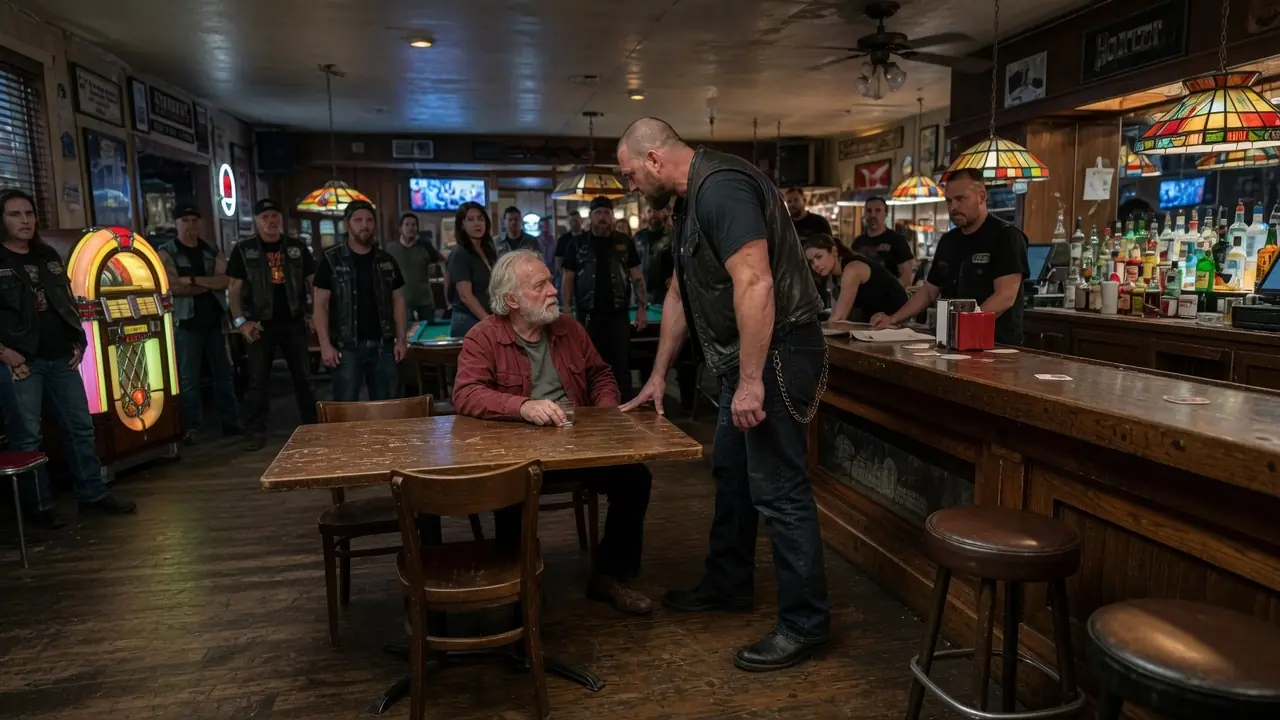
“This is my spot, old man. Move.”
The veteran with the white beard and sad eyes kept his gaze on his water glass, his weathered hand steady.
“I said, move.”
The biker’s voice rose, drawing nods from his crew near the pool tables. But the old man in the red jacket did not flinch. He did not speak. He simply sat there as though he had seen worse things than an angry man in a bar.
What happened next would leave everyone in that room speechless.
His name was Thomas Garrett. If you had seen him shuffling into Murphy’s Bar that Tuesday evening, you would not have given him a second glance. He was seventy years old, with white hair and a beard that needed a trim, wearing the same faded red jacket over a plain shirt he had worn for years. His face carried the kind of sadness that did not wash off, the kind that settled into the lines around a person’s eyes and never left.
He had been coming to Murphy’s for three years, always alone, always ordering water, always sitting at the corner table near the back. The regulars knew him as the quiet man who never caused trouble. They did not know that forty-five years earlier, Thomas Garrett had been Captain Thomas Garrett. They did not know that the things he had done in the jungles of Vietnam had earned him medals he kept in a shoebox beneath his bed because looking at them hurt too much.
The biker gang had rolled into town that afternoon, ten Harleys rumbling down Main Street like thunder. They called themselves the Iron Reapers, and they had a reputation across three counties for taking whatever they wanted. Their leader, a man named Vic Bronson, had served time for assault. He wore his criminal record like a badge of honor.
When they pushed through Murphy’s doors at seven that evening, the bartender, a young man named Danny, felt his stomach drop. But Murphy’s was a public establishment, and he could not turn them away. They took over the pool tables, ordered rounds of whiskey, and grew louder with every drink. Danny kept his head down and poured what they ordered.
Thomas had arrived at his usual time, six-thirty, and taken his usual seat. He had nodded to Danny, received his water, and settled in to watch the evening news on the television mounted in the corner. He paid little attention when the bikers arrived. He had learned long ago that the best way to avoid trouble was to become invisible.
After his fourth whiskey, Vic decided he wanted Thomas’s corner table. Maybe it was the angle. Maybe it was the proximity to the restroom. Maybe it was simply because he could take it.
He swaggered across the room, his boots striking heavily against the wooden floor. Then he stopped beside Thomas and delivered his demand.
“This is my spot, old man. Move.”
Thomas looked up slowly. His pale blue, tired eyes met Vic’s for only a moment before he lowered them to his water again.
“I’ve been sitting here,” he said quietly.
His voice was barely above a whisper, but every person in the bar heard it in the sudden silence.
Vic’s face reddened. “You think I care? You think because you’re old, I won’t drag you out of that chair?”
Thomas’s hands remained steady on the table. “I’m not looking for trouble. I just want to finish my water in peace.”
One of Vic’s men laughed harshly. “The old man thinks he can stand up to Vic. This is going to be good.”
Behind the bar, Danny reached for his phone. His hands were shaking. He had already dialed 911 when Vic grabbed Thomas’s water glass and hurled it against the wall. It shattered, sending water streaming down the faded wallpaper.
“Now you’ve got nothing to finish,” Vic snarled. “Get up and get out, or I’ll put you through that wall next.”
Thomas stood, but not in the way Vic expected. He did not scramble or cower. He rose slowly, with a deliberate movement that spoke of old discipline and old training. He was shorter than Vic by half a foot and lighter by fifty pounds, yet something in the way he stood made Vic take an involuntary step backward.
“You don’t want to do this,” Thomas said.
His voice was still quiet, but something lay beneath it now. It made the hair rise on the back of Danny’s neck.
Vic recovered his bravado quickly. “Old man, I’ve broken bigger men than you for breakfast.”
Thomas did not respond. He stood with his hands at his sides, his sad, serious expression unchanged. The tension in the room was thick enough to choke on. Vic’s crew began moving closer, forming a semicircle around them.
Danny finished the call and whispered urgently into the phone. “We need police at Murphy’s Bar right now. There’s going to be a fight.”
Before Vic could make his move, the bar door opened.
A man in a police uniform stepped inside, but he was not alone. Another figure followed him, and when the people in the bar saw who it was, several of them gasped.
Colonel James Mitchell, United States Marine Corps, retired, walked into Murphy’s Bar in full dress uniform. He was seventy-two years old, ramrod straight, with his chest covered in ribbons and medals. He had served as the town’s police chief for fifteen years before retiring, and everyone knew him. Everyone respected him.
What they did not know was why he was there, why he was wearing his uniform, or why his face looked as though he had just received the most important news of his life.
The young officer, a rookie named Peters, had been the one to take Danny’s call. When he heard the address and the description of an old veteran with a white beard and a red jacket who was about to be attacked by bikers, he made a decision that probably saved his career. He called Colonel Mitchell.
“Sir,” Peters had said, “there’s a situation at Murphy’s. An old veteran, white beard, red jacket, looks about seventy.”
Mitchell had gone silent on the other end of the line. Then he spoke three words that made Peters’s blood run cold.
“I’ll be there.”
When Peters arrived at Mitchell’s house to pick him up, the colonel was already dressed in his blues, and there were tears in his eyes.
Vic Bronson turned when the door opened, ready to tell whoever had entered to mind his own business. The words died in his throat when he saw Colonel Mitchell.
The colonel’s eyes swept across the room, taking in the shattered glass, the threatening stance of the bikers, and finally Thomas Garrett standing beside the corner table. His face transformed. Fifty years seemed to fall away.
He crossed the room in five long strides. Then, in front of everyone, Colonel James Mitchell came to attention and saluted.
“Captain Garrett, sir,” he said, his voice breaking. “It’s been too long.”
The bar erupted in confused whispers.
“Captain? That old man?”
Thomas returned the salute slowly. For the first time in three years, the people at Murphy’s saw him smile. It was a sad smile, but it was real.
“Jimmy Mitchell,” Thomas said. “The last time I saw you, you were a frightened private who had just landed in Da Nang.”
Mitchell’s eyes filled with tears. “And you were the captain who saved my life, sir. Twice. Once when you pulled me out of that river under fire, and once when you talked me down after we lost Patterson and his crew. You gave me a reason to keep going. You told me I had a future worth living for.”
The colonel turned to face the room. His voice carried the authority of four decades of service.
“This man,” he said, pointing to Thomas, “is Captain Thomas Garrett. He served three tours in Vietnam. He received two Silver Stars, a Bronze Star with a V Device, and a Purple Heart. He led a platoon through some of the worst fighting of the war and brought more of his men home alive than any other officer in the battalion.”
Mitchell paused, his gaze sweeping over the bikers.
“When he was wounded in 1972, he refused evacuation until every one of his men had been accounted for. He carried two wounded soldiers half a mile through hostile territory with a piece of shrapnel lodged in his leg. This man is a hero.”
Vic Bronson had gone pale. His crew backed away, suddenly interested in the floor.
The colonel was not finished.
“After the war, Captain Garrett came home to nothing. His wife had left. His parents had passed away. The country he had bled for treated him like garbage. He struggled for years with what we now call PTSD. He lost jobs, homes, and hope, but he never lost his dignity.”
Mitchell’s expression hardened with emotion.
“He never raised his hand in anger. He never became the monster that war could have made him. He chose peace. He chose quiet. He chose to live with his pain rather than spread it to others.”
Thomas stood silently. For the first time, the people in Murphy’s saw past the sad old man in the red jacket. They noticed the straight back, the steady hands, and the eyes that had witnessed things they could not imagine.
Danny felt ashamed that he had never asked, never wondered, and never looked deeper.
Colonel Mitchell turned toward Vic. “Now,” he said, his voice dropping to something dangerous, “what exactly were you about to do to this man?”
Vic could not meet his eyes. “I didn’t know,” he mumbled.
Mitchell stepped closer. “You didn’t know because you didn’t ask. You saw an old man and assumed weakness. You saw someone who would not fight back and decided that made him prey. That makes you a coward and a bully.”
Officer Peters stepped forward. “We can arrest them for assault, sir. We have the broken glass, the threats, and witnesses.”
Thomas raised one hand. “No,” he said quietly. “They didn’t hurt me. They were being foolish. Let them go.”
Vic looked up in shock. “You’re letting us walk?”
Thomas met his gaze. “I spent three years watching young men die. I spent forty years after that trying to understand why I lived when they did not. I am not going to add more violence to this world if I do not have to.”
His voice remained calm, but every word carried weight.
“But I will tell you this. Respect is not something you take. It is something you earn, and you do not earn it by threatening old men in bars.”
Colonel Mitchell nodded slowly. “The captain is right. But Vic, if I hear about you or your crew causing trouble in this town, if I hear about you so much as jaywalking, I will make it my personal mission to ensure you face every consequence the law allows. Do we understand each other?”
Vic nodded rapidly. “Yes, sir.”
His crew was already moving toward the door. They left their motorcycles running in their haste to leave town. The sound of the Harleys faded into the distance, and Murphy’s Bar released a collective breath.
Danny came out from behind the bar carrying a fresh glass of water. He set it in front of Thomas with trembling hands.
“On the house, sir,” he said. “Always. I’m sorry I never asked. I’m sorry I didn’t know.”
Thomas gently patted his arm. “You didn’t need to know, son. I’m only a customer.”
Danny shook his head. “No, sir. You’re a hero, and from now on, everyone in this town is going to know it.”
The other patrons had begun gathering closer, their fear replaced by curiosity and respect. An older regular named Frank stepped forward.
“I served in 1973,” he said. “Army. I never saw combat like you did, but I know what it cost. Thank you for your service, Captain.”
Colonel Mitchell stayed for an hour, sitting with Thomas at the corner table and talking about old times, the men they had served with, and the years that had followed. Mitchell told him about his career, his family, and his grandchildren. Thomas listened with that same sad smile. As they spoke, Mitchell realized that his old captain was lonely and had been lonely for a very long time.
Before he left, Mitchell wrote his personal number on a napkin.
“You call me,” he said. “Sunday dinners at my house. My wife makes a roast that will remind you there are still good things in this world. You’re family, Captain. You always were.”
After Mitchell left, the atmosphere inside Murphy’s Bar had changed forever. People approached Thomas carefully and respectfully. They thanked him, offered to buy him dinner, and asked if he would share his stories.
He declined most of the attention, uncomfortable beneath it, but accepted their gratitude with quiet grace. Danny announced that Thomas’s water would always be free and that the corner table belonged to him, reserved without question.
Three days later, a small brass plaque appeared on the table.
Reserved for Captain Thomas Garrett, American Hero.
Word spread across the small town like wildfire. The local newspaper published a story. The VFW post invited Thomas to speak, and although he declined, he began attending their monthly breakfasts.
People who had passed him on the street for years without giving him a second glance now stopped to shake his hand, thank him, and truly see him. The red jacket became a symbol throughout town. Children learned about Captain Garrett in school.
The high school history teacher brought her class to meet him. Thomas, who had remained silent for so long, found himself telling stories he had buried for decades.
He told them about fear, but also about brotherhood. He spoke of men who became closer than family under the worst circumstances imaginable. He told them about the translator who had saved their lives and whom Thomas had spent ten years trying to bring to America, finally succeeding in 1982.
He told them about the village elder who had hidden them from hostile patrols and to whom Thomas still sent money every Christmas. He spoke of the medic who sang Elvis songs while treating wounded men under fire. He remembered the young private who had died in Thomas’s arms, asking whether he had done well and whether he had made his mother proud.
Thomas had told him yes. He had held the young man and repeated it until the light left his eyes.
The stories were not all sad. There were moments of unexpected beauty: sunrises over rice paddies that took a person’s breath away, a local woman who shared her family’s dinner with hungry soldiers, and the time the entire platoon pooled their money to buy a water buffalo for a farmer whose animal had been killed in crossfire.
They were small acts of humanity in the midst of inhumanity.
These were the memories Thomas shared. In sharing them, something inside him began to heal. The sadness did not leave his eyes, but something else joined it: purpose, connection, and the knowledge that his story mattered.
Vic Bronson never returned to town. Six months later, however, a letter arrived at Murphy’s Bar addressed to Captain Thomas Garrett.
Danny brought it to Thomas at his usual table. Inside was a short note written in rough handwriting.
“Captain Garrett,
“I was the fool in the bar. I’ve thought about that night every day since. You could have had me arrested. You could have let your friend destroy me, but you didn’t. You showed me mercy I didn’t deserve.
“I’ve been thinking about what you said about respect and earning it. I’ve been thinking about many things. I’m in therapy now, trying to become better and trying to earn the respect I once tried to take.
“Thank you for the lesson. Thank you for your service. Thank you for being a better man than I was.
“Respectfully,
“Vic Bronson.”
Thomas read the letter twice. Then he folded it carefully and placed it in the pocket of his red jacket.
Danny watched him. “That’s something,” he said.
Thomas nodded. “People can change if they want to, if they are willing to do the work. I’ve seen the worst of humanity, Danny, but I’ve also seen the best. Sometimes they exist within the same person, just at different times. We all have the capacity for both. The choice is ours.”
On a sunny Tuesday morning, two years after that night at Murphy’s Bar, Thomas Garrett sat at his corner table reading the newspaper. His water glass was full. The brass plaque gleamed in the sunlight streaming through the window. Around him, the bar was filled with people who knew his name, knew his story, and treated him with the respect he had never asked for but had always deserved.
Colonel Mitchell stopped by every Sunday to take him to dinner. The VFW had made Thomas an honorary member. The high school had named its new scholarship after him.
More important than any of that, Thomas Garrett was no longer invisible.
He was seen. He was known. He was home.