They called him a failure. For three months, Boon stumbled through every drill like he was sleepwalking. Couldn't track, wouldn't sit, flinched at every loud sound. Some said he was broken.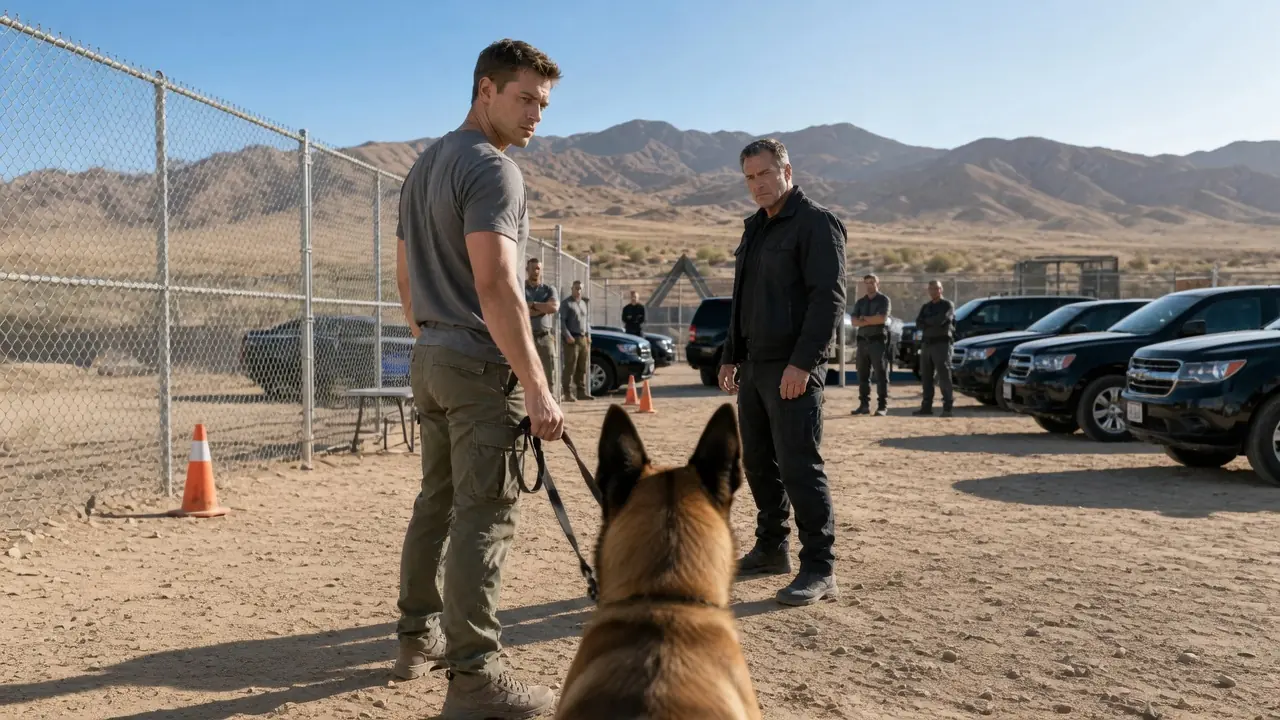
Others said he should have been put down. Until the morning a SEAL stepped onto the range and whistled once. And twenty years of training experience suddenly felt worthless. Because this dog wasn't lost.
He was just waiting for someone who spoke his language. The New Mexico sun was already brutal at 7 in the morning, turning the concrete training yard into a griddle that made your boots stick with every step. Officer Eli Harlow squinted against the glare as he pulled into the Federal K9 complex. His Honda Civic looked pitiful next to the row of tactical vehicles and armored transports that lined the lot.
Four days into the job and they were already handing him the problem case. “That one is yours,” Sergeant Dorsey had said the previous day, pointing to a kennel at the far end as though indicating a broken piece of equipment. “Boon. Belgian Malinois. Four years old. Good luck. You are going to need it.”
The file they'd given him was thinner than a traffic citation. Boon had transferred in from what they called a non-civilian program, but reading between the redacted lines felt like trying to solve a puzzle with half the pieces missing. No training logs, no certification trails—just a series of performance notes from three separate agencies that all ended the same way: “Failed pairing attempt. Dog lacks functional obedience. Consider removal.”
What caught Eli's attention was a nearly illegible handwritten note clipped to the back page: “Dog shows signs of selective response. Possibly trauma-related. Recommend patience.” It was signed by someone at the military veterinary hospital in Colorado, but the rest had been blacked out with permanent marker.
Eli had grown up around working dogs—his grandfather's German Shepherds, his uncle's hunting retrievers, even a stint helping train patrol dogs back in Phoenix before the budget cuts. But he'd never met a dog that looked at you like Boon did. Those eyes didn't blink as much as they calculated. Head low, ears forward, something unreadable simmering just beneath the surface.
He didn't growl when strangers approached his kennel. He did not bark at feeding time. He just stared with the intensity of someone trying to solve a problem you couldn't even see. “Morning, bud,” Eli said softly, clipping the lead to Boon's collar.
The dog didn't resist, but he didn't cooperate either. Just stood there like he was tolerating the whole arrangement. They walked to the training yard like strangers forced to share an elevator. The morning's first drill was basic formation.
Then something would shift behind those dark eyes, and he'd drift sideways or stop completely or just sit down in the middle of the course like he'd forgotten why he was there. It wasn't defiance. Eli had seen plenty of stubborn dogs. This was different, like Boon was waiting for a signal that never came.
The strangest part was how he moved when he thought no one was watching. During water breaks, Eli caught him naturally clearing corners, instinctively positioning himself with sight lines to multiple exits. He'd pause at doorways, scan left and right, then enter with the fluid grace of someone who'd done it a thousand times before. But the moment training resumed, that focus would evaporate.
“Focus, Boon,” Eli would say, not harshly, only encouragingly. “Come on, boy. I know you have this.” But Boon would just stare past him like he was listening for something that never came.
The scent work was worse. They set up four identical boxes, only one containing the target odor, a simple cocaine simulation that most dogs could identify. After two weeks of training, Boon approached the first box, sniffed once, then sat down and looked at Eli with an expression that seemed to say, “What's the point?” By lunch, the other handlers had started to notice.
“How's your project going?” Officer Martinez asked, not bothering to hide his smirk as he watched Boon ignore a perfectly executed hand signal. “Still thinks he's too good for police work,” added Thompson, a twenty-year veteran whose own German Shepherd could probably run drills in his sleep. “Maybe he needs a nice retirement home, somewhere he can chase tennis balls and forget about having a job.”
Officer Reeves, a newer handler with something to prove, was less diplomatic. “My dog learned basic recall in two days. How long have you been working with him—three weeks?” “Four,” Eli said quietly.
“Four weeks,” Reeves repeated loudly enough for the others to hear, “and he still cannot track a tennis ball in an empty field.” The laughter that followed was not exactly cruel, but it cut deeply enough. These guys had been doing this longer than Eli had been out of college, and they all had dogs that performed like Swiss watches. What did he know about handling a case like Boon?
But something about the way Boon carried himself during these conversations, the way his ears would flatten slightly, not in fear, but in what looked almost like shame, told Eli there was more to the story. That first week blurred together in a parade of failed exercises and mounting frustration. Boon refused scent tracking completely, stared blankly at bite training demonstrations, and actually ran away when they fired the starting pistol for agility drills. He did not merely startle; he bolted, wedging himself under a maintenance truck until Eli could coax him out twenty minutes later.
“He's cooked,” Sergeant Dorsey said after watching Boon fail his fifth consecutive recall exercise. “Whatever he had, he left behind somewhere else.” The paperwork had already started moving. Quiet conversations between supervisors, glances in Eli's direction when they thought he wasn't looking.
Some dogs, they said, just weren't meant to serve. Maybe it was kinder to admit defeat and find Boon a civilian home where the expectations weren't so high. But Friday evening, after everyone else had headed home and the desert air finally started to cool, Eli stayed behind. He sat on a bench outside Boon's kennel, not trying to train or test or prove anything, just being there.
Boon lay in the corner facing the chain-link wall like he was trying to disappear into it, not sleeping. Eli could tell from his breathing, just waiting for another day to end. “I do not know what happened to you out there,” Eli said quietly, not expecting a response. “But whatever it was, it was not your fault.”
Boon's ear twitched, the smallest movement, but Eli caught it. “My grandfather had a dog once. Old Blue came back from Vietnam with him.” Eli leaned back against the bench, voice dropping to barely above a whisper.
“Blue never barked at fireworks, never played fetch, and never did much of anything except follow my grandfather around like a shadow. Everyone said he was broken.” He paused, watching Boon's reflection in the kennel's water bowl. “But when my grandfather had his heart attack, Blue got the neighbor's attention, led them straight to where he had collapsed in the barn, and saved his life.”
Eli's voice caught slightly. “Sometimes the ones who look broken are simply carrying weight the rest of us cannot see.” Boon's ear twitched again and slowly, so slowly, Eli almost missed it. The dog turned his head.
“We will figure it out together. No rush.” For the first time all week, Boon looked at him. Really looked, and in those dark eyes, Eli saw something he'd been hoping for since day one.
A flicker of trust. Monday brought a different approach. Eli showed up an hour early before the other handlers arrived, and the yard filled with noise and pressure. He brought coffee for himself and extra patience for Boon, moving through drills at half speed, letting the dog set the pace.
Instead of forcing scent work, he scattered treats around the training area and just let Boon explore. Instead of demanding perfect heel position, he walked beside him like they were taking a stroll through the neighborhood. It was not training exactly, but trust-building. “You don't have to be perfect,” Eli told him as they meandered between orange cones that were supposed to mark an agility course.
“Just be you.” Boon didn't transform overnight. He still ignored most commands, still spooked at sudden noises, still had that distant look in his eyes like he was seeing something the rest of them couldn't. But he started staying closer to Eli during breaks.
Started meeting his eyes when his name was called. Small progress, but progress. The breakthrough came on a Tuesday that nobody saw coming. They were running environmental exposure drills.
Basic stuff designed to get dogs comfortable with urban noise. Car horns, construction sounds, crowd chatter played through speakers at gradually increasing volumes. Most dogs handled it fine after a few sessions. Boon had been doing well until Instructor Wells cranked up the speakers for a simulated gunfire sequence.
The first burst was barely ninety decibels, quieter than many motorcycles. But the moment those sharp staccato pops filled the air, Boon went rigid like he'd been struck by lightning. His ears flattened against his skull. His breathing turned shallow and rapid.
Then he started scanning. Not looking around like a confused dog, but scanning like a soldier checking for threats. His head moved in precise arcs, covering sectors, looking for something that wasn't there. “Easy, Boon,” Eli said, but his voice seemed to come from very far away.
Then Boon spun in place, growling at the empty air six feet to his left and bolted across the yard with a speed that made Eli's blood run cold. “Boon!” Eli called, sprinting after him. “Boon! Wait!”
But Boon was gone. Not just physically, but mentally. He was not merely running from the noise. He was responding to it, following some protocol burned so deep into his brain that conscious thought couldn't override it.
He crashed through an equipment gate, scattered traffic cones like they were enemy combatants, and dove under the closest vehicle he could find. Eli found him there, pressed against the rear axle, whole body trembling like he was caught in an earthquake only he could feel. His eyes were wide but unfocused, like he was seeing a different place, a different time. His breathing came in short, controlled bursts, the pattern of someone trying to stay quiet while under fire.
“Hey buddy,” Eli whispered, dropping to his knees beside the truck. “It's just me. You're safe.” Boon did not respond to his voice.
He did not even seem to hear it. Eli didn't try to pull him out. Didn't reach for the leash or give commands. He just stretched out on the gravel beside the truck and waited.
One hand extended where Boon could see it if he chose to look. After what felt like an hour, but was probably closer to fifteen minutes, Boon's breathing started to slow. His eyes gradually focused. And when they finally found Eli's face, there was something different in them.
Recognition, maybe even gratitude. “There you are,” Eli said softly. “Welcome back.” That night, Eli couldn't sleep.
He sat in his apartment replaying the incident, trying to understand what he'd witnessed. That wasn't just fear. It was something deeper, something that spoke of experiences no training manual had prepared him for. He pulled up Boon's file on his laptop, scanning the sparse information for clues he might have missed.
Under previous assignment, it just said DOD K9 program. Under reason for transfer, someone had typed administrative, but there was a notation at the bottom he hadn't noticed before, buried in the small print. Handler KIA. Subject requires specialized placement.
Handler killed in action. Eli stared at the screen until his eyes burned. Pieces of a puzzle slowly clicking into place. Boon hadn't been transferred because he was defective.
He'd been transferred because his world had been blown apart and nobody knew how to put it back together. The morning of Boon's scheduled evaluation—what everyone knew would be his last chance—started with the sound of tires on gravel that didn't belong to any vehicle Eli recognized. Two black SUVs rolled through the main gate like they owned the place. No markings, no fanfare, just the kind of quiet authority that made people step aside without being asked.
The instructors and handlers gathered near the fence line, whispering among themselves as the vehicles parked in perfect formation. The doors opened with military precision and four men stepped out who moved like they were still wearing uniforms even though they were dressed in civilian tactical gear. Quiet boots, watchful eyes, the kind of stillness that came from knowing exactly how dangerous the world could be. At the center of them was a man who didn't need an introduction.
Commander Nash looked like he'd been carved out of granite and weathered by decades of hard choices. He had broad shoulders, silver threading through dark hair, a scar along his jawline that told stories he'd probably never share. But it was his eyes that caught Eli's attention. They held the same distant, calculating quality Eli had seen in Boon.
“Can we help you, gentlemen?” Sergeant Dorsey asked, stepping forward with the careful politeness of someone dealing with people whose clearance level he couldn't guess. Nash nodded once. “I'm here for Boon.”
The training yard went dead quiet, and Eli felt his stomach drop. “Boon—the Belgian Malinois you have been working with,” Nash confirmed, his gaze finding Eli across the yard. “I understand he is having some adjustment issues.” Sergeant Dorsey looked confused.
“How did you even know about our dog?” “Word travels,” Nash said simply. Then, more loudly, he asked, “Where is he?” Eli found himself walking forward, Boon padding silently beside him on a loose lead.
The dog had been unusually calm all morning, but now his head was up, ears forward, like he was trying to solve a familiar puzzle. Nash stopped fifteen feet away and studied Boon with the intensity of someone reading a report written in a language only he understood. “Hello, ghost,” he said quietly. Boon froze.
Then Nash gave a low, sharp whistle, a specific tone that cut through the morning air like a blade. The change in Boon was instantaneous and complete. His posture straightened, his breathing steadied, and for the first time since Eli had known him, the confusion cleared from his eyes. He didn't move from Eli's side, but everything about his body language screamed recognition.
Alert, ready, home. “Jesus,” one of the instructors whispered. “Look at him.” Nash took a step forward.
Boon didn't flinch. “Another step.” The dog remained perfectly still, but now his tail was level, his weight balanced on all four paws like he was ready for whatever came next. “You know me, don't you, boy?”
Nash said, and there was something almost gentle in his voice. Boon sat clean, precise, immediate. Eli had never seen him respond to a command so quickly. Nash turned to the gathered staff, his expression serious.
“We need to talk.” The debrief room felt smaller with Nash in it, as though his presence occupied more space than his physical size should have allowed. Eli sat across from him, still processing what he had witnessed in the yard, while Sergeant Vicks stood near the door with the guarded stillness of someone protecting classified information. “Boon was not supposed to end up here,” Nash began without preamble.
“He was part of a joint special operations program called Ghost Circuit—small teams, classified missions, and surgical extractions in places that do not officially exist. The program has since been dissolved. Most of its assets were reassigned or retired through proper channels, but Boon fell through the cracks.” “What kind of cracks?”
Sergeant Vicks asked. Nash was quiet for a moment, deciding how much he could reveal. “Three years ago, we were running an extraction in eastern Turkey. We had high-value targets, hostile territory, and a structure rigged to collapse. Intelligence said we had perhaps twenty minutes before the entire block became unsafe. Boon was my partner for that operation. We worked through a full nonverbal protocol, off leash, with the kind of trust built over years in places where a single mistake could cost lives. He could clear a room faster than most human teams, identify threats by scent alone, and guide civilians through debris in complete darkness.”
Nash's hands tightened slightly. “We had extracted four civilians and were moving toward the rally point when the charges began detonating early. Someone on the inside had changed the timeline. The structure collapsed during exfiltration, and I was pinned beneath a concrete beam. My leg was broken in three places, communications were gone, and I could not move. Standard protocol required Boon to return to the rally point and guide the backup team to my location.”
He paused, his jaw tightening. “But he stayed. He refused every command to leave and held a defensive perimeter around my position for six hours while hostile forces tried to reach us. He was struck by debris from two explosions, yet he never retreated. When the rescue team finally arrived, they found him still standing guard despite three wounds, preventing anyone from reaching me.”
Nash looked down at his hands. “I carried him out myself. I thought he would die in my arms. The medic said he had lost enough blood to bring down almost any other dog, but Boon would not quit while I still needed him.”
“And he survived,” Eli said quietly. “He did,” Nash replied. “But the unit was scattered after that mission. I was medically retired and sent stateside for surgery and rehabilitation. Boon went to a military veterinary hospital and was then supposed to enter a specialized handler program. Instead, someone mishandled his paperwork, listed him as unplaceable because of trauma symptoms, and pushed him into the civilian transfer system.”
“Without his service record,” Sergeant Vicks said, understanding. “No one knew what he had been trained to do, what he had survived, or why he needed specialized care.” Nash looked directly at Eli. “For the past eighteen months, he has been moved from one facility to another, each one treating him like another failed police prospect. He was never broken. He was waiting for someone who spoke his language.”
The three of them sat in silence, absorbing the weight of what had been lost and what had finally been recovered. At last, Sergeant Vicks asked, “What happens now?” Nash stood slowly. “I would like to run one final test—something Boon will understand and something that will show you what you are truly working with.”
Eli nodded. “What did you have in mind?” Nash's smile was sharp and restrained. “A ghost run, like the old days.”
The mock village at the eastern edge of the complex looked like a movie set that had been left to weather in the desert sun. Plywood buildings had blown-out windows, and concrete barriers were arranged to simulate urban conflict. It was the kind of urban training ground that most local K9 units never needed to use. Nash had requested minimal observers, just Eli, Sergeant Vicks, and two other instructors who'd promised to keep their mouths shut about whatever they were about to witness.
The SEALs remained on the perimeter, quiet as shadows. “This is not about obedience,” Nash explained as they walked Boon to the starting position. “It is about instinct under pressure. One target is hidden somewhere in the village, with a scent signature designed to mimic human stress pheromones.”
It was the same kind they had used for live hostage scenarios overseas. He produced a training shotgun from one of the vehicles, checked it and loaded a single blank training round. “Fair warning: this is going to be loud. Very loud. If Boon is not ready, we will know immediately.”
Eli knelt beside his partner, one hand resting on the dog's shoulder. “You do not have to do this, bud. But if you want to show them who you really are, this is your chance.” Boon's eyes were locked on Nash, but there was no fear in them now.
Just focus. Nash walked twenty paces back, raised the training shotgun, and called over his shoulder, “Everyone ready?” Eli gave a thumbs up. Nash pulled the trigger.
The blast shattered the morning quiet like a sledgehammer through glass, echoing off the plywood walls and sending a flock of crows screaming into the sky. The other dogs in the distant kennels started barking. The instructors flinched despite their ear protection. Boon didn't even twitch.
Then Nash gave that same sharp whistle from before. One note clear as a bell. Boon was already moving. He flowed across the ground like liquid shadow, low and controlled, reading the terrain with an intelligence that made Eli's breath catch.
No hesitation, no confusion, just pure operational focus as he cleared the first building with movements too precise to be instinct. Watching him work was like seeing a master craftsman return to his tools after years away. He checked corners with systematic precision, dismissed decoy scents without breaking stride, navigated obstacles that would have slowed human operators. This wasn't the confused, struggling dog from the training yard.
This was something else entirely. Silence. Thirty seconds passed, then a minute. Eli found himself holding his breath.
Even the SEALs on the perimeter had gone completely still, watching with the focused attention of professionals, recognizing excellence in their field. Then Boon emerged from the third building, moving at the same controlled pace, and positioned himself beside the doorway, not sitting like a normal police dog would, standing at alert, one paw slightly forward and his weight balanced, ready to respond to whatever came next. He didn't bark or signal, just stood guard with the quiet authority of someone who'd done this in places where barking would get everyone killed. “Sweet Jesus,” one of the instructors whispered.
“He's not a police dog.” “No,” Nash said quietly, walking over to confirm what Boon had found. “He's not.” The target was exactly where Boon had indicated.
But Nash emerged from the building, shaking his head in something that looked like amazement. “He did not merely find it,” Nash called out. “He identified the most defensible position in the building, checked for secondary threats, and established overwatch on the primary approach route.” He looked at the gathered observers with something approaching awe.
“That is not ordinary search work. That is tactical work at the highest level.” Nash emerged from the building and approached Boon, who remained at his post until given a subtle hand signal to stand down. Only then did the dog relax, trotting over to Eli with something approaching pride in his posture.
“He doesn't need me anymore,” Nash said, watching the reunion. “But I think he's found someone new to trust.” Eli ran his hands through Boon's fur, feeling the steady heartbeat beneath, the controlled breathing of an operator coming down from a successful mission. For the first time since they'd been paired, Boon leaned into the contact, accepting the praise like he finally understood he'd earned it.
“What happens now?” Eli asked. Nash adjusted the training shotgun on his shoulder. “Now you stop treating him like he's broken and start treating him like the hero he is.”
There was no ceremony when Nash left, no medals or formal recognition. Just a firm handshake and a quiet word to Eli before the SEALs loaded back into their vehicles. “He picked you,” Nash said simply. “That whistle I used, it was a reset command designed to activate his training protocols under specific circumstances. But when I gave the stand-down signal, he chose to come to you instead of me.”
Eli looked down at Boon, who sat calmly at his side. “What does that mean?” “It means he is ready to move forward with a partner who sees him for what he is, not what he used to be.” The SUVs rolled out as quietly as they'd arrived, leaving behind a training facility that would never look at failure the same way again.
Within a week, Boon's status had been quietly updated: no longer a remedial case or a problem to be solved. Instead, he was designated as a specialized demonstration K9. The kind of assignment reserved for dogs whose capabilities exceeded standard protocols. The mockery stopped.
The snide comments disappeared. When Boon walked through the training yard now, the other handlers watched with something approaching reverence. Officer Reeves was the first to approach Eli directly, hat in hand and looking embarrassed. “Listen, I owe you an apology—and I owe him one too. I had no idea what we were looking at.”
Thompson, the twenty-year veteran, was more direct. “Command wants to know if you would be willing to help develop new trauma protocols for dogs coming out of military service.” He paused, studying Boon, who sat calmly beside Eli. “It turns out there are more like him in the system than anyone realized.”
Even Sergeant Dorsey pulled Eli aside that Friday. “I have been doing this for fifteen years,” he said quietly. “I have never seen anything like what that dog did in the village. The way he moved and the decisions he made—that is not ordinary training. That is operational experience.”
But the biggest change was in Boon himself. Not because he'd suddenly become perfect at traditional police work. He still struggled with routine traffic stops and standard drug detection. The gunfire simulations still made him tense, probably always would.
But now when the episodes came, Eli knew how to help him through them. More importantly, Boon had stopped waiting for signals that would never come. He'd started building new patterns, new responses, new ways of being useful that honored what he'd been while embracing what he could become. Eli found himself walking differently, too.
Prouder, more aware of the honor that came with being chosen by someone who'd already given everything for others. That evening, as the sun dropped toward the horizon and the desert air finally started to cool, Eli and Boon took one more walk around the perimeter of the complex. No leash this time. No commands, just two professionals who had found their way back to understanding.
“You know what?” Eli said as they paused to watch the sunset paint the mountains purple and gold. “I think we are going to be just fine.” Boon looked up at him with those intelligent dark eyes, and for the first time since they'd met, his tail wagged just once.
But it was enough.