"What the hell is that?"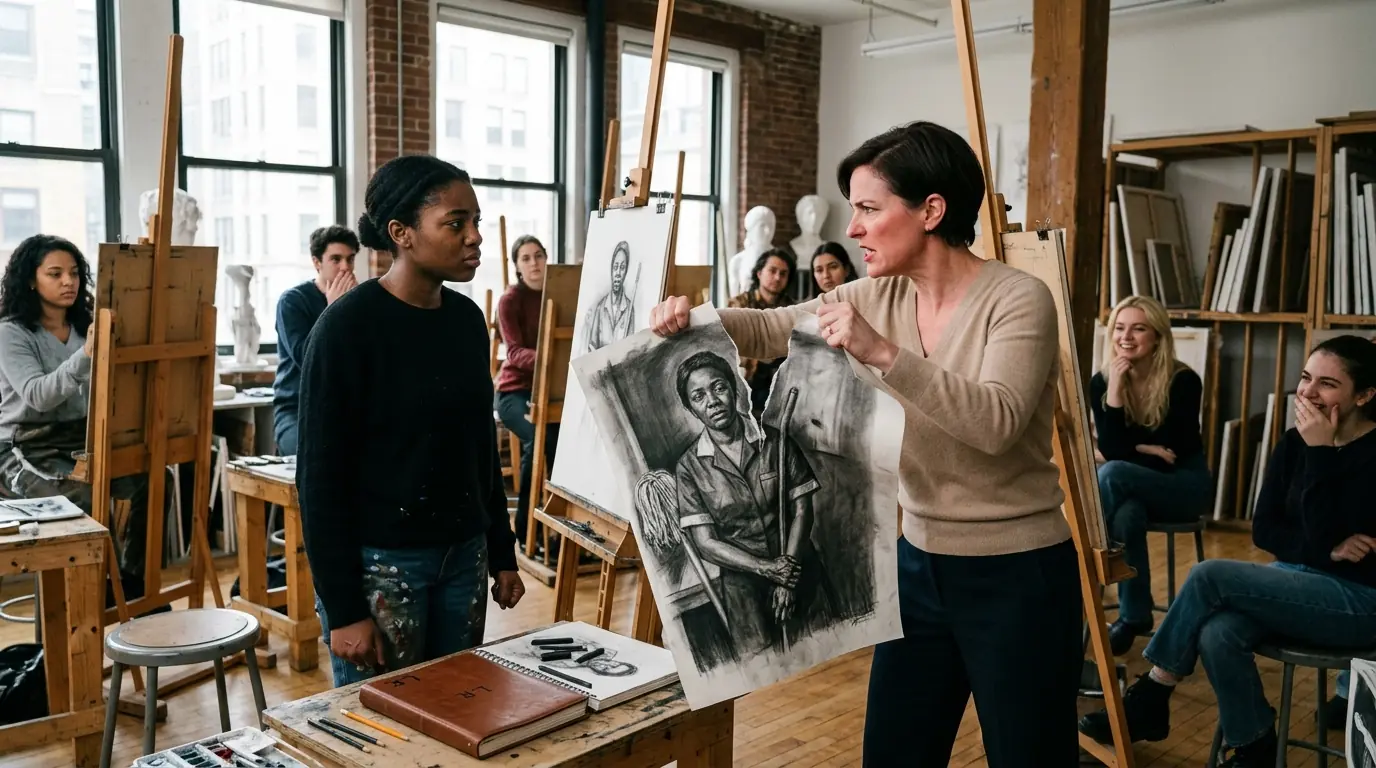
Katherine Whitmore tossed the charcoal drawing onto the table as if contaminated.
Amara Reed flinched. "Teacher, I spent three nights on it."
"Three nights wasted on trash."
For the first time in four years, Amara looked up directly at her teacher. "That drawing isn't trash."
Whitmore's smile vanished. Her face flushed. "What did you say?"
"Please give it back."
Amara stood up—eighteen years old, painfully shy, hands trembling, but voice steady for the first time.
Whitmore snatched it first. "What do garbage rats know about art?"
She walked into the middle of the class and held it up. "This trash isn't worth a dollar."
Then she tore it in half.
A girl giggled. Amara stared in stunned silence. But Ms. Whitmore had no idea how much that torn painting would soon be worth.
Carrington Institute of Fine Arts sits on Manhattan's Upper East Side, a Beaux-Arts fortress where charcoal dust drifts through tall windows, and the names of dead artists are carved into the limestone above the doors. Every spring, twelve seniors are chosen for the Cornerstone Exhibition, a gallery night so prestigious that curators from MoMA and Christie's mark their calendars for it months in advance. One spot in that show could launch a career. Twelve spots, twelve futures, and the woman who chose them was Katherine Whitmore.
Amara Reed was a fourth-year senior, the only Black student in her cohort, the only one on the Founder's Scholarship awarded once per class to a student whose family income fell below the poverty line. At 6:00 every morning, she boarded the 6 train from Hunts Point in the South Bronx. Headphones in, but no music playing. Only silence—to keep strangers from speaking to her.
In her backpack, she carried two things: a leather-bound sketchbook with the initials L.R. embossed into the spine, and a peanut butter sandwich her mother had wrapped in newspaper because they could not afford foil.
Her mother, Yolanda Reed, was thirty-eight years old and looked fifty. She worked the day shift at Bronx General Hospital scrubbing operating rooms and the night shift at a downtown law firm emptying trash bins until 2:00 in the morning. She had not slept more than five hours in a single stretch since Amara turned six. Her hands were cracked from industrial bleach. Her knees swelled every winter. The month before, the landlord had threatened eviction over $1,800 in back rent; Yolanda had paid it by selling her own mother's wedding ring, the last thing of value in their apartment.
The grandmother, Loretta Reed, had died in 2004 in a public hospital, drawing in that same leather sketchbook until the morphine took her hand. In life, she had been a painter nobody bought. In death, she had left her granddaughter one sentence written in shaky pencil on the inside cover: "Draw instead of speaking. Don't let anyone force you to talk."
So, Amara did.
She had not voluntarily raised her hand in four years at Carrington. She sat in the back right corner of every studio—near the window when allowed, and near the air conditioner when not. She had no friends. She drew.
But what no one in that building knew, not even Amara herself, was that she could look at a stranger for thirty seconds and remember the face six months later, down to the smallest tremor of grief in the corner of the mouth. She saw emotion as color, the way her grandmother had. She drew shadow like Rembrandt without ever having been taught. And she could finish a complete psychological portrait in twenty-three minutes.
The woman in charge of the Cornerstone selection was forty-five years old, daughter of Harold Whitmore, the late Madison Avenue gallerist whose 1985 roster had quietly excluded every Black female painter who walked through his doors. Katherine herself had failed as a painter in the 1990s and had reinvented herself as a gatekeeper. She wore cashmere in every season. She called her favorite student, Britney Sinclair, "my European soul." Britney's father was the largest donor to the school's endowment.
On the first day of senior portfolio class, Whitmore assigned a ninety-minute timed sketch: a live model, full body, charcoal.
Amara finished in twenty-three minutes. She put her pencil down and folded her hands in her lap.
Whitmore walked past her desk, glanced down, stopped. For four seconds, she said nothing. Then her jaw tightened. She recognized the style—the same shadow work, the same psychological cut. She had seen it once before in a slim 1983 Soho catalog her father had kept on a high shelf, the spine cracked from being thrown across a room.
"You finished early because you worked carelessly," Whitmore said at last. "Do it again."