Vanessa Whitmore stood in my driveway, pointed straight up at my roof, and raised her voice so the whole street could hear her.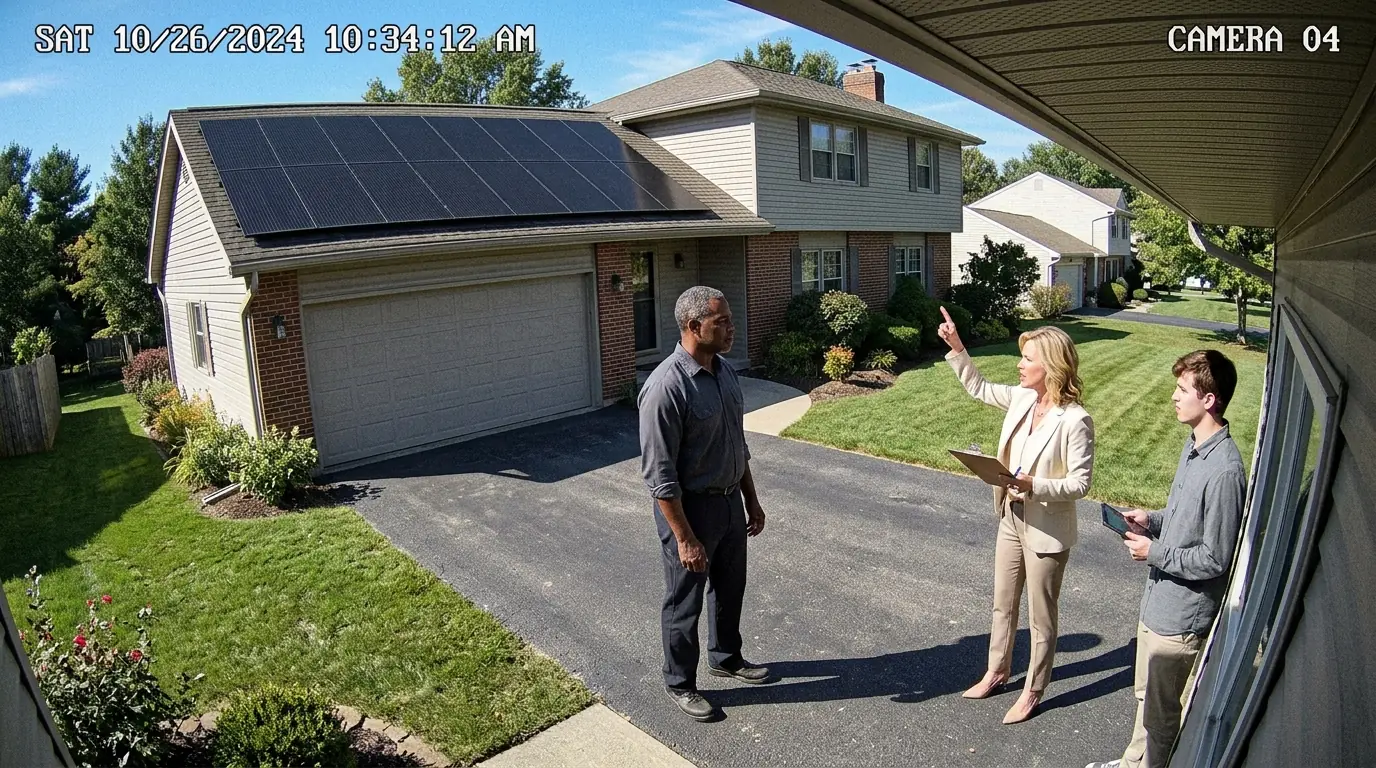
"Those solar panels come down today." She said it the way you talk to a man you think is too slow to read his own mail, then pushed a violation notice into my chest for $2,500.
I did not argue. I did not raise my hand or my voice. I opened my folder, slid out a single page that had been signed 11 months earlier, laid it on the hood of her car, and asked her one quiet question: "Vanessa, would you like to read the signature at the bottom again?"
Her smile disappeared.
My name is Darius Cole. I am 47 years old, and I have spent the last 19 years supervising electrical maintenance for a commercial property group outside the city. That means I spend my working life around load calculations, panel schedules, inspection tags, and the kind of small documentation habits that keep buildings from burning down.
I live alone in a four-bedroom house on lot 38 of a neighborhood called Brierwood Heights—the sort of place where the lawns get cut on Saturday morning and everybody waves without actually knowing each other's last name. It was a good life. It was also, as I would learn, a neighborhood where a piece of paper mattered more than a handshake.
The whole thing started 11 months before Vanessa ever pointed at my roof, and it started with something as unglamorous as a utility bill. That summer had been brutal: three straight weeks above 98°F, and my air conditioning ran so hard I could hear the compressor cycling through my pillow at night. My July statement came in at $412, which was almost double what I had paid the summer before, and the four years behind it showed a line climbing steadily upward with no sign of leveling off.
I sat at my kitchen table with a legal pad and projected 20 years forward at a modest annual rate increase, and the number at the bottom of that page was ugly. Solar was not a lifestyle statement for me; it was a load problem with a math answer.
Because I work with electrical systems, I knew enough to be dangerous and enough to know where I was not an expert. I spent six weeks reading before I called anyone. My south-facing plane turned out to be almost perfect, with a clean, unshaded run and asphalt shingles only nine years old.
I got three bids and picked the middle one: a company called Meridian Solar Works, because their project manager answered my technical questions without flinching and because they gave me a full layout drawing instead of a glossy brochure. That project manager was a man named Evan Rohr—38 years old, blunt, allergic to sales talk—and he became the second most important person in this story without ever knowing it.
Here is the part that mattered later, and I want to be clear about it because I have heard how these stories usually go: I did not install one bolt before I had written permission.
Brierwood Heights has a covenant document 41 pages long, and I read every page of it twice, including the appendices, including the fee schedule, including the section on architectural review that most people in that neighborhood have never opened. Section 11.4 required prior written approval from the Architectural Review Committee for any exterior modification visible from a street, and it laid out exactly what a complete application had to contain.
So I built the application the way I would build a submittal package at work, and I did not cut a single corner, because I have watched too many people lose arguments they should have won simply because their file was thin. I submitted a site plan showing the exact roof planes and the panel array boundaries with dimensions off the ridge and the eaves. I included the frame color specification—matte black on black, which is the least visually loud option on the market. I included the inverter model and its mounting location on the sidewall of the garage where the electrical service already sat. I included the conduit routing, the racking manufacturer's engineering letter, the contractor's license and insurance, my city permit application, and a photorealistic rendering showing my actual house with the actual array in place.
That package ran to 26 pages, and I delivered a printed copy to the management office and emailed an electronic version the same afternoon, so there would be two records instead of one.
The person who handled architectural review at that time was the chair of the architectural committee, a woman named Vanessa Whitmore—52 years old, always in a pressed blazer, always carrying a clipboard she did not appear to need. She was not the association president yet; she was simply the person whose name appeared at the bottom of the committee correspondence. At that point in my life, she was nothing more than a name in an email signature. I want that understood, because later on people asked me whether there had been bad blood between us before all of this, and the honest answer is that there was none. I did not know her. I had never spoken more than 11 words to her in my life.
She made me wait 27 days—two days past the window the covenants allow, though I never made an issue of it. Then she sent back a request for one small modification: the exterior conduit run along the garage wall had to be painted to match the wall color instead of remaining in bare gray. It was a reasonable request that cost me $140 in additional labor. I said yes the same day, revised the drawing, and resubmitted within 48 hours.
Nine days after that, the approval came. It was the association's standard architectural form, one page, and in the decision block somebody had checked the line that read "Approved as submitted with modification." Underneath, in the signature field marked "Committee Chair," was a signature in blue ink, beside it the printed name Vanessa Whitmore, and beside that a date.
I remember standing in my entryway holding it, feeling nothing more dramatic than relief, because it meant I could stop paying $400 a month to keep my house at 74°F.
Two hours later, an email arrived from her association address, and it said something I would eventually read aloud in a room full of people: "Your revised solar application has been approved. You may proceed with installation." Twelve words that a woman would later spend three weeks trying to convince everyone did not mean what they plainly say.
I forwarded that email to Evan, printed it, and dropped both the printout and the signed form into a manila folder I labeled in black marker. Then I put the folder in the second drawer of the file cabinet in my office, and I did not think about it again for almost a year.
The installation took two days. The city inspector came out on Thursday morning, walked the roof, checked my rapid shutdown device, checked the labeling on the disconnect, checked the grounding, and signed the final inspection card without a single correction. Meridian commissioned the system that afternoon, and by Friday, I was producing electricity. My first full billing cycle came back at $61, and I stood in my kitchen and laughed out loud at a piece of paper. The system ran clean through fall, through winter, and through a spring hailstorm that took shingles off two houses down the block and did not scratch a single module of mine. For 11 months, nobody said one word to me about it.
That silence ended when the association changed hands.