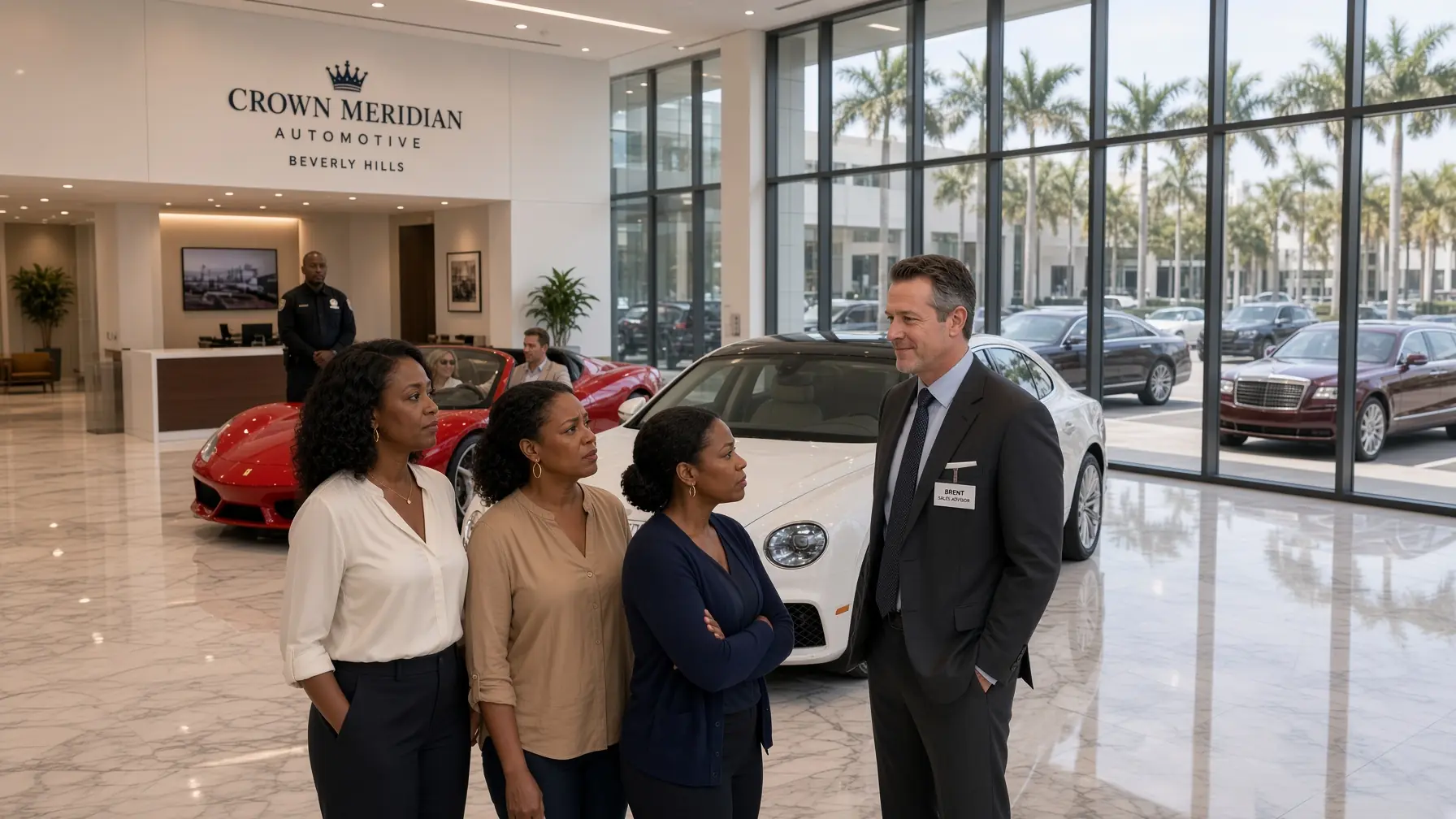
“Ladies, I’m going to need all three of you to step away from the vehicle.”
The sentence cut through the quiet Beverly Hills showroom sharply enough that several conversations stopped around it. A man near the espresso bar lowered his cup, and a woman examining a silver Aston Martin glanced toward the center of the floor. Three Black sisters stood beside a pearl-white Bentley Flying Spur, and the oldest had barely placed her fingers against the chrome door handle.
Amara Whitfield turned first. Beside her stood Celeste, forty-four, wearing dark jeans, a loose tan blouse, and the old gold hoop earrings their mother had given her for college graduation. Their youngest sister, Naomi, thirty-nine, had one hand tucked inside the pocket of her navy cardigan and was still studying the Bentley’s interior stitching through the window. None of them had touched anything beyond the handle.
The sales manager approaching them wore a charcoal suit and an expression polished enough to pass for professionalism from a distance. His name badge read Brent Halvorsen, General Sales Manager. He looked first at their clothes, then toward the glass wall where the old burgundy Lexus they had arrived in sat parked near the side lot. By the time he reached them, he had clearly decided what kind of customers they were.
“That vehicle starts north of three hundred thousand dollars,” Brent said. His smile remained in place, but there was no warmth behind it. “We try to avoid unnecessary handling unless a customer has already completed preliminary financial verification.” Amara looked at him quietly for several seconds.
Celeste turned toward the white couple near the Ferrari display. They had been sitting inside a red Roma for at least fifteen minutes while a salesperson laughed at something the husband was saying. Nobody had asked them for financial documents, and nobody appeared concerned about unnecessary handling. Naomi noticed the same thing.
“Is that your normal process?” Amara asked. Brent clasped his hands in front of him and nodded. “For this level of inventory, yes.” Naomi’s eyebrows rose because the lie was obvious enough to become almost insulting by itself.
A young associate several yards away shifted uncomfortably. Her badge read Sofia Ramirez, and she had been the first employee to greet the sisters when they walked in. Ten minutes earlier, she had offered to unlock any vehicle they wanted to see. Brent had appeared from his glass office before she could retrieve the Bentley key.
Amara remained calm. “We’re interested in this car.” Brent looked toward her shoes, then Celeste’s cardigan, then the side lot again. “I understand, but there are vehicles at our Torrance pre-owned location that may be more realistic for what you’re looking for.”
The showroom grew quieter. Celeste slowly turned her head toward Brent. “Realistic for what?”
Brent’s smile tightened. “Budget-wise.” Celeste looked at Amara, and Amara knew immediately what her sister was thinking. Their father would have hated this man within thirty seconds.
Naomi folded her arms. “You haven’t asked our budget.” Brent gave her the expression people use when they believe they are being forced to explain something obvious. “There are certain indicators we use to determine how best to serve customers.”
“Indicators.” Naomi repeated the word slowly. Brent nodded. “Experience.”
Amara looked across the polished showroom. Luxury cars rested beneath carefully positioned lights, every surface spotless enough to reflect people back at themselves. Somewhere near the entrance, soft piano music continued playing as though nobody had just been sorted into a financial category based on appearance. Amara had spent twenty-seven years learning how quickly discrimination learned respectable vocabulary.
“Would you mind telling me exactly what indicator placed us in the pre-owned category?” she asked. Brent’s expression cooled. “Ma’am, there’s no need to make this difficult.” Celeste gave a short laugh.
“We asked to look at a car.” Her voice stayed controlled. “You’re the one giving the moment a personality.” Brent looked toward her. “And I’m trying to maintain a certain environment.”
Naomi smiled then. It was not a friendly smile. “That sounds expensive.”
Brent glanced toward the nearby customers. “If this conversation becomes disruptive, I’ll have security escort you out.” Amara tilted her head slightly. “We haven’t raised our voices.” Brent replied that volume was not the only form of disruption.
The irony almost made Celeste laugh again. Their sister Amara was the least disruptive person any of them knew when angry. She did not yell, throw things, or perform outrage. She became quieter until the other person eventually realized they had been given enough room to document their own behavior.
Brent mistook the silence for uncertainty. “If you’re serious buyers, complete a credit application first.” Amara asked, “Before we sit inside the Bentley?” Brent answered yes.
Across the showroom, the salesman beside the Ferrari handed the white man a key fob. The man started the engine without producing a single sheet of financial information. Naomi looked toward Brent. “Does the credit policy start after Ferrari engines turn on?”
Brent’s face reddened slightly. “Every situation is different.” Amara nodded once. “Yes, they clearly are.”
Seven months earlier, Amara Whitfield had signed the acquisition papers that made the entire building hers.
She was founder and chief executive of Crown Meridian Automotive, a privately held dealership group operating thirty-one luxury and premium locations across nine states. Crown Meridian owned dealerships representing Bentley, Aston Martin, Porsche, Range Rover, Mercedes-Maybach, and several high-end used brands. The Beverly Hills location had been acquired precisely because the numbers were excellent and the customer complaints were not.
Brent Halvorsen did not know any of that mattered yet. He had seen the acquisition announcement, attended regional meetings, and sat through two mandatory video calls featuring Crown Meridian leadership. Apparently, Amara’s name had registered more strongly than her face. That fact was becoming useful.
To understand why Amara refused to walk away, you had to understand the car parked outside.
The burgundy 2009 Lexus ES belonged to their father, Charles Whitfield, for almost fourteen years. He had been a city bus mechanic in Oakland, a man who could identify engine problems by sound before diagnostic computers confirmed them. When he died four years earlier, Celeste took the Lexus because she could not bring herself to sell the last car he maintained with his own hands.
Amara owned more vehicles than she could comfortably list. Crown Meridian kept executive cars in Atlanta, Los Angeles, Dallas, and New York. Yet when the three sisters decided to spend the weekend together in California, Celeste insisted on driving their father’s Lexus. “Daddy would consider flying first class and renting a Rolls-Royce an obvious sign we forgot where we came from.”
Amara laughed and agreed. Naomi climbed into the back seat with snacks. Three sisters in their forties immediately became teenagers again somewhere around Santa Monica Boulevard.
Their father would have loved that. Charles raised his daughters to understand cars before he taught any of them to drive. He made them identify basic tools, check tire pressure, change oil, and explain why ignoring a strange sound usually made the eventual repair more expensive.
Amara was seventeen when she accompanied him to a dealership looking for a used Acura. Charles had saved almost a year for the down payment. The salesman took one look at his mechanic uniform and directed them toward vehicles “people with working incomes usually finance.”
Charles asked about the Acura anyway. The salesman laughed quietly. He told them it required serious credit.
Amara never forgot her father’s face. He did not look furious. He looked exhausted, which somehow hurt more.
They left. Charles bought an almost identical Acura from another dealership the next afternoon. On the drive home, he told Amara, “Never let somebody’s small imagination become your price tag.”
She carried the sentence through college. She carried it through business school. She carried it through every dealership office where men assumed she was a finance assistant rather than the person evaluating the acquisition.
At twenty-eight, Amara opened a small used-car lot outside Oakland with twelve vehicles, two employees, and a portable office trailer whose air conditioner failed every August. Celeste, already an aerospace systems engineer, inspected auction vehicles on weekends because she trusted machinery more than sales descriptions. Naomi, fresh out of graduate school and working in municipal finance, built spreadsheets that helped her sister understand whether ambition could survive cash flow.
The sisters called the business Whitfield Auto Exchange. Charles refused to let them name it after him because he said he had enough problems without customers calling him about transmissions. Their mother Denise handled the office two mornings a week and brought enough food for the entire staff.
The early years were brutal. Amara slept inside the office several nights after storms because roof leaks threatened paperwork. Celeste once spent an entire Sunday replacing a fuel pump on a vehicle a vendor promised was mechanically perfect. Naomi negotiated a banking line of credit after three lenders treated their business plan like a hobby.
They survived. Then they grew.
One used lot became three. Three became six. Amara learned the economics of manufacturer relationships and began acquiring small franchised dealerships whose owners wanted to retire.
By forty-seven, she controlled Crown Meridian Automotive. Magazines called her one of the most influential Black women in automotive retail. People who had once asked whether she was somebody’s assistant suddenly asked for introductions.
Celeste never entered the company full-time. She loved engineering too much and eventually became a senior propulsion-systems director at an aerospace manufacturer. Naomi moved into public-sector finance and became a consultant helping cities structure infrastructure bonds.
Both sisters still understood Crown Meridian better than many executives Amara paid enormous salaries. They had known the company before it had conference rooms. They remembered when the emergency corporate reserve consisted of whatever money remained in Naomi’s savings account.
That Saturday in Beverly Hills was supposed to be partly business and partly family. Crown Meridian’s compliance team had flagged the location after multiple complaints involving customer profiling, inconsistent proof-of-funds requests, and questionable trade-in practices. Amara had quietly scheduled the unannounced visit around Celeste’s forty-fifth birthday weekend. She also planned to surprise her sister by buying the pearl-white Bentley she knew Celeste had admired for years.
Celeste did not know that part. Naomi did because Amara could not keep a secret involving financial paperwork from her. Their plan had been simple: walk in, experience the dealership like ordinary customers, see the Bentley, then reveal the birthday surprise later.
Brent Halvorsen had destroyed the simplicity in less than fifteen minutes.
When the sisters arrived, the valet remained under the awning and watched Celeste park the old Lexus herself. Sofia Ramirez greeted them warmly near reception. She offered coffee, explained the showroom layout, and said she could unlock any car they wanted to inspect.
Amara immediately liked her. Respect that arrived before status always mattered more to Amara than respect after recognition. Then Brent saw the old Lexus.
He crossed the floor and told Sofia he would handle the customers. Sofia hesitated, but Brent’s title won the moment. Amara noticed both things.
Now Brent stood in front of them threatening security. Naomi watched him with the expression she normally reserved for government officials trying to hide bad numbers behind technical language. Celeste remained beside the Bentley, one hand resting near the roof without touching it.
Amara decided to give him one last clean exit. “We would like Sofia to assist us.” Brent shook his head. “That won’t be necessary.”
“She was already helping.” Brent looked toward Sofia. “I manage the floor.”
Celeste asked, “Does managing the floor include deciding who looks wealthy enough to touch the merchandise?” Brent’s jaw tightened. “I’m done debating this.”
He raised one hand toward the security desk. “Mr. Harris.” A tall Black security supervisor in his early fifties looked up.
His badge read Leon Harris. He did not move immediately. Amara saw him assess the three women, Brent, and the surrounding customers.
“Please escort these ladies out.” Brent’s voice carried farther now. Leon remained still. “For what reason?”
Brent looked irritated. “They’re refusing sales protocol and becoming disruptive.” Leon glanced toward Amara. “Have they threatened anyone?”
“No.” Brent said it reluctantly. Leon asked whether they had damaged anything. “No.”