"She really hasn't had a single offer? Not one?"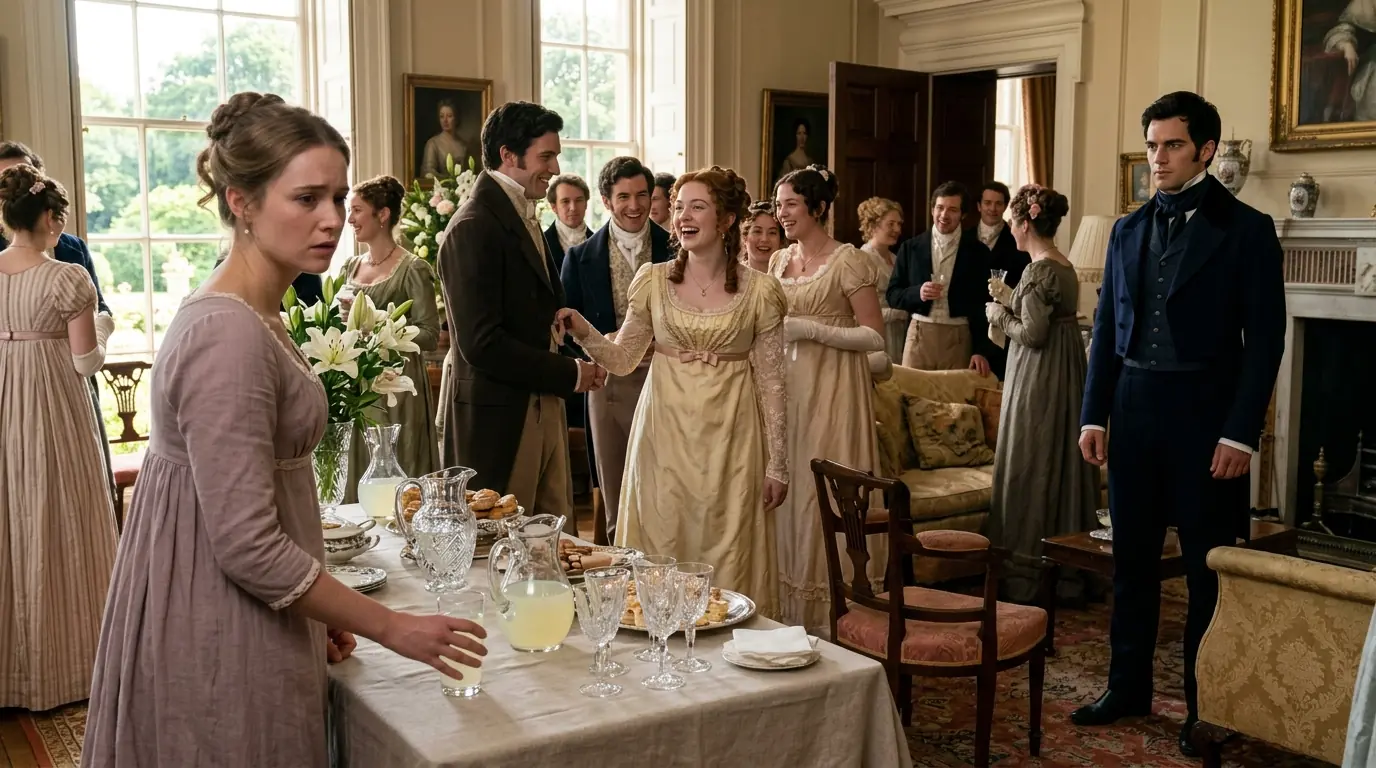
Georgiana laughed the way she laughed at everything that amused her—wide and unguarded, as though the world existed primarily to delight her. "I begin to think the poor dear actively discourages them."
Madeleine Forsyth was standing at the refreshment table, not four feet away, her back to the room, her hand wrapped around a glass of lemonade she had not yet tasted. She had heard every word.
The summer heat had arrived at Fernside Hall the same week as the guests: heavy, insistent, the kind that pressed down on old stone houses and refused to let in the breeze. Her uncle had rented the estate in Wiltshire for the month to celebrate Georgiana's engagement to Viscount Aldgate, and he had filled it with everyone who might be impressed by the gesture.
The room smelled of beeswax and cut lilies and the particular unease of people performing contentment for one another, and Madeleine had been there two days and was already exhausted in a way that had nothing to do with the heat.
She was twenty-four years old. She had completed three London seasons without receiving a single formal offer—a fact her mother mentioned with such painful regularity that Madeleine had begun to hear it in her sleep. She had learned to absorb the mentions the way limestone absorbed water: slowly, steadily, with outward stillness and interior erosion.
The drawing room was full of people she recognized and did not particularly like. Her mother sat near the window with two aunts, speaking in the low, urgent tones of women cataloging a problem. Georgiana held court at the room's center, a vision in pale yellow, one hand resting in her new fiancé's, the other gesturing to illustrate whatever story she was currently telling. Lord Aldgate laughed on cue. The other guests leaned in. It was the same performance Georgiana had been giving since she was seventeen, and it had never once failed her.
Madeleine took a sip of her lemonade. It was too sweet.
She was not beautiful in the way that mattered in rooms like this one. She was dark where Georgiana was auburn, angular where Georgiana was soft, and she had never learned—could not learn, had given up trying to learn—the art of making her face say things it did not mean. When she found a conversation tedious, she looked as though she found it tedious. When she was hurt, the hurt showed. It was, her mother said, her most significant social liability. It was, Madeleine privately thought, the only honest thing about her.
The door opened.
She felt the change before she saw it. The room's atmosphere shifted the way barometric pressure shifted before a storm: a drop, a stillness, an instinct that something large was approaching.
She turned.
The man in the doorway was not immediately recognizable as a duke. He was simply tall and dark, and contained in a way that made the room feel suddenly crowded. His jaw was sharp, his eyes the color of deep water, and he regarded the assembled guests the way a man might regard a problem he had not yet decided how to solve.
"Your Grace." Her uncle crossed the room with a speed that suggested he had been waiting. "We are honored. I confess I hardly dared hope you would accept the invitation."
"I was in the county," said the Duke of Whitmore. His voice was low, and it did not offer elaboration. "I had business with your solicitor. It seemed impolite not to call."
So, this was Alistair Cavendish, the seventh Duke of Whitmore.
Madeleine had heard of him the way one heard of distant weather—as a phenomenon that existed elsewhere and shaped conversations she was never part of. He had inherited his title at twenty-three. He had been engaged once, years ago, to a woman who had not survived the winter before their wedding. He had refused every eligible introduction since, and society had spent five years deciding whether his grief was genuine or his standards merely impossible.
Looking at him now, Madeleine thought he did not look like a man with impossible standards. He looked like a man who had decided, quietly and irrevocably, that wanting things was not safe.
"Allow me to introduce the family," her uncle was saying.
Madeleine turned back to the refreshment table. She did not need to be introduced. She was, in the precise social mathematics of these gatherings, a minor variable: present, accounted for, unlikely to affect the outcome.
"And this," Georgiana said, her bright voice carrying across the room with the ease of long practice, "is my cousin Madeleine. Three full seasons in London." She paused, letting the pause do the work she did not need to do with words. "Still unmarried. We have all quite given up speculating why."
The laughter was light, polite, the kind of laughter that agreed without committing.
Madeleine set down her lemonade glass. She set it down very carefully, so that it did not make a sound, because she knew that if she let go of the care required for small things, she would lose the care required for larger ones.
She turned to face the room. Her face was composed.
"Miss Forsyth."
The Duke was looking at her. Not at Georgiana, not at the room—at her, with the same quality of attention he had applied to the door and the assembled guests and the problem of the gathering, as though she were something worth taking seriously.
"Your Grace," she said. Her voice came out steady.
"I do not believe we have been properly introduced."
"We have not. I am, as my cousin has explained, the family's ongoing cautionary tale."
Something shifted in his expression. Not a smile, not quite, but the suggestion of one, almost surprised out of him. "That is not what she said."
"It is what she meant."
He held her gaze for a moment longer than was entirely conventional. Then her uncle was drawing him away towards the windows and the people who actually mattered, and Madeleine turned back to the refreshment table and breathed.
She had not meant to say that. She never meant to say the things she said. They simply came out, truthful and inconvenient, entirely unsuited to the occasions that prompted them. It was, she suspected, why she had received no offers. Men did not want women who told them true things in dry voices. They wanted Georgiana: golden and laughing and absolutely committed to the performance of contentment.
Madeleine picked up a different glass and drank.
That night, she could not sleep.