The Massey quit on a Wednesday morning in September of 1991, three days before Norbert Haas expected to begin cutting wheat.
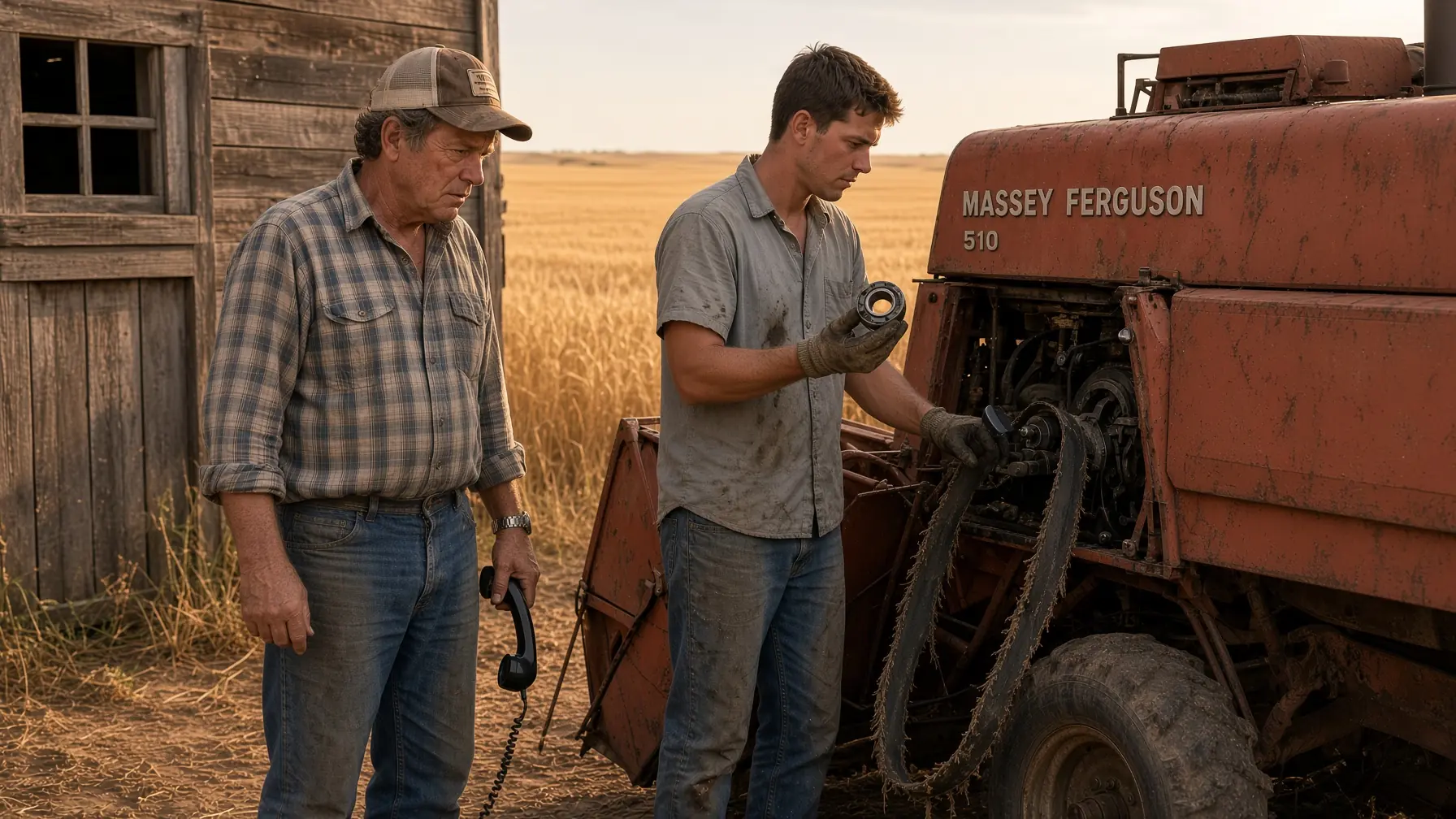
There was no bang, no cloud of smoke, no dramatic piece of iron flying across the field. The feeder house simply began slowing as Norbert crossed a short test strip along the north edge of his Reno County farm. The cylinder still sounded normal behind him, the diesel held its rpm, but the header lost speed and the crop stopped moving cleanly toward the machine. Norbert lifted the header, pulled the hydrostatic lever back, disengaged the separator, and shut the engine down before whatever was wrong had time to become something worse. At sixty-one, after more than two decades farming the same ground south of Nickerson, Kansas, he had learned that the cheapest moment to stop a machine was usually the first moment it started sounding different.
He climbed down into wheat stubble and opened the feeder-house access panel. The main drive belt hung in strips. Half of it was still wrapped around the pulley, polished nearly smooth where it had slipped before finally giving up. Norbert crouched, ran two fingers across the edge of the pulley, and immediately understood that the belt itself was not the problem. A belt could fail because it was old, misadjusted, contaminated, or simply worn beyond its service life, but this one had been tracking crooked. The outer edge was shaved. Rubber dust had collected on one side of the shield. Something had been forcing the drive out of line long before the belt broke.
By noon, Norbert was lying on his back beneath the feeder house with wheat chaff sticking to his shirt and a trouble light hanging from a wire above his shoulder. He rocked the main drive shaft by hand and felt movement where there should have been almost none. When he pulled the bearing cover, the answer appeared. The bearing itself was rough, and the race had begun to break down. The shaft had been running slightly off-center, heating the belt and eating its edge. Replacing the belt alone would get the machine moving for a short while, but Norbert knew better than to send it into harvest with the underlying problem untouched.
The trouble was getting to the bearing.
On the Massey Ferguson 510, the feeder-house drive arrangement was not impossible to service, but it was not a ten-minute field repair either. The shaft had to be freed, the feeder house partially disconnected and supported, and the bearing pressed from its seat without damaging a shaft that was already old enough to make replacement uncertain. Norbert owned wrenches, jacks, pullers, a torch, and nearly every farm improvisation a man accumulated over twenty-three years, but he did not own the hydraulic press he wanted for this job.
He wiped his hands, climbed into the pickup, and drove to Nickerson.
The farm covered 480 acres altogether, though not every acre was wheat that year. About 270 acres stood in hard red winter wheat, with the rest divided among grain sorghum, fallow ground, pasture, farmstead, and rotation acres. It was not the best wheat ground in Kansas, but Norbert’s father had called it reliable, which in that family ranked higher than beautiful. The soil varied from sandy loam on the lighter ground to heavier silt loam in the lower areas, and when September behaved itself, the farm usually produced enough to justify another year.
That September was not behaving itself.
A wet period earlier in the month had already compressed the harvest window. The wheat had dried quickly under several days of wind, and grain samples from the southern field were approaching the moisture Norbert wanted. The radio forecast called for rain late Saturday or early Sunday, followed by several unsettled days. Mature wheat could stand through rain, but every storm increased the risk of lodging, head shatter, quality loss, and another delay. Norbert did not believe one shower would destroy the crop. He had farmed too long for that kind of superstition. But he also knew that harvest was a race against accumulated risk rather than one single catastrophe.
At the grain elevator in Nickerson, he used the payphone near the office.
The first call went to Midwest Ag Equipment in Hutchinson.
The service writer listened until Norbert said “Massey 510.”
“How old?”
“Seventy-four model.”
There was a pause.
“We’re buried, Mr. Haas.”
“I figured.”
“I’ve got four combines ahead of you and three field trucks running daylight to dark. I could put you on the list, but I won’t lie about when we get there.”
“When?”
“After the main wheat rush.”
“That means?”
“Could be October.”
Norbert stared through the payphone glass at a grain truck crossing the elevator scale.
“I need it this week.”
“I understand.”
“No, I mean I need it before Saturday.”
Another silence.
The man’s voice softened. “Then I wouldn’t wait on us.”
The second shop was in Haven.
Their answer was almost identical.
The third was a dealership in Wichita. Norbert spent eleven minutes being transferred between departments before reaching a parts man who still had an old Massey book behind the counter. Norbert read the bearing number from his notebook. The parts man searched, then returned.
“I don’t have that exact number.”
“Can you cross it?”
“Probably. Need dimensions or old bearing manufacturer.”
“I can give you both.”
There was paper shuffling.
“We may have a current equivalent at our industrial supplier. But even if I get the bearing, I don’t have a mechanic to send this week.”
“What would the repair run if you did?”
The man estimated the labor.
Enough that Norbert wrote the number down slowly.
It was not outrageous. The shop had technicians, trucks, insurance, payroll, and a harvest-season schedule already full of other farmers whose problems felt just as urgent. But reasonable cost did not solve unreasonable timing.
Norbert thanked him and hung up.
He sat in his pickup afterward with his notebook resting on the steering wheel.
The wheat crop might gross something in the mid-thirty-thousand-dollar range, depending on yield and price. That was not profit. Seed, fertilizer, chemical, fuel, insurance, land expense, repairs, and every other cost came out of the same money. What concerned Norbert now was not that a six-hundred-dollar shop bill might ruin him. It was that no shop could get to the machine while his crop was ready.
There were custom harvest crews in Kansas, but the nearest available operators were already booked. Norbert called two anyway. One offered to place him on a cancellation list. Another said they might reach him in ten days.
Ten days might be fine.
Or not.
That uncertainty was the entire problem.
He drove home.
Norbert and his wife, Evelyn, had three children. Peggy was fourteen and already better with the farm checkbook than Norbert liked admitting. Dale, nineteen, had left for Wichita State that fall to study mechanical engineering. The oldest, Carl, was twenty-three. He had spent two years in the Army, returned to Kansas, and taken a job at the Hutchinson grain elevator while deciding whether he wanted to farm, repair machinery, or do something entirely different with his life.
Carl called the farmhouse shortly after supper.
Evelyn handed Norbert the receiver.
“Your mother says the combine quit.”
“It did.”
“What happened?”
Norbert explained the belt, bearing, shaft, and feeder house.
Carl asked several questions before saying anything else. “Shaft bent?”
“Don’t think so.”
“Bearing spun in the housing?”
“Doesn’t look like it.”
“Race damaged?”
“Yes.”
“How bad?”
“Enough I’m not running it.”
Carl was quiet.
“I’ll come before work tomorrow.”
“You start at nine.”
“I know.”
“You don’t have to.”
“I know that too.”
Carl’s pickup pulled into the yard at six-fifty the following morning.
He was built like Norbert had been at that age—wide shoulders, heavy hands, movements slower than his age suggested because he rarely wasted them. He drank half a cup of coffee standing in the kitchen, took a flashlight and pry bar from the machine shed, then crawled beneath the feeder house without making conversation.
Norbert waited.
Carl checked the shaft in several positions, loosened the failed bearing enough to inspect the seat, and measured visible runout as best he could before disassembly.
Thirty minutes later he slid out.
“Well?” Norbert asked.
“The shaft might be all right.”
“Might.”
“Need it on the bench to know.”
“Shop says feeder house has to come off.”
Carl nodded.
“I’d take it loose.”
“You got a press?”
“No.”
Norbert looked at him.
Carl wiped his hands on a rag.
“I know somebody who does.”
The somebody was Dennis Schuler.
Dennis operated a small machine shop behind his house on the south side of Hutchinson. Three summers earlier Carl had helped him pour a new concrete floor over two weekends, refusing payment beyond hamburgers and beer. When Carl arrived that Thursday morning and explained what he needed, Dennis walked to the back corner of his shop and pointed at a twelve-ton hydraulic press mounted on a heavy steel stand.
“You bring it back Saturday.”
“I will.”
“And don’t bend it.”
“How exactly would I bend a press?”
Dennis stared at him.
“I loan tools to people. I’ve stopped asking how.”
They loaded it with an engine hoist.
The bearing was harder.
The original number did not appear in the current agricultural listings Carl checked, so he drove to the industrial-bearing supplier near Wichita rather than assuming an online-equivalent number from an old catalog was correct. He brought the damaged bearing with him.
The counterman measured inner diameter, outer diameter, width, and shoulder arrangement, then worked through cross-reference books.
“I’ve got a current Timken assembly that'll fit the dimensions, but I want you comparing cups and cones before you leave.”
They did.
Carl bought two.
Not because the machine needed two immediately.
Because the second cost thirty-four dollars and another trip to Wichita would cost more than that in time if the first were damaged during installation or if its mate proved worse than expected.
By two-thirty Thursday afternoon, he was back at the farm.
Norbert had already removed shields and disconnected what he safely could.
They worked slowly.
The feeder house on an old combine was not something either man wanted suspended by hope. Carl used the farm loader to support the weight, supplemented with blocking and a come-along so nothing could drop if hydraulic pressure bled away. They tagged hoses, marked chain position, photographed alignment points with Peggy’s little 35mm camera because Carl did not trust memory when reassembling parts under a deadline.
Norbert watched him label a hydraulic line.
“You think I can’t remember where two hoses go?”
“I think you can remember wrong with impressive confidence.”
Norbert almost smiled.
“Army teach you that?”
“No. You did.”
The feeder house came clear late in the afternoon.
Once the shaft was accessible, the old bearing told more of the story.
The race surface had deteriorated unevenly. One side showed heavier wear. The failed belt had not been lying.
Carl cleaned the shaft carefully and measured it with a borrowed micrometer. He checked several locations, rotated it, checked again, and wrote the numbers down.
Norbert waited.
“Straight enough?”
“So far.”
“That sounds like another ‘might.’”
“It is.”
They rolled the shaft on V-blocks and checked runout with Dennis’s dial indicator.
The result was encouraging.