The first thing people remembered was not the gunshot. It was the way his voice cut through the heat. Low, calm, final. Take your hand off her. No one in that yard moved right away.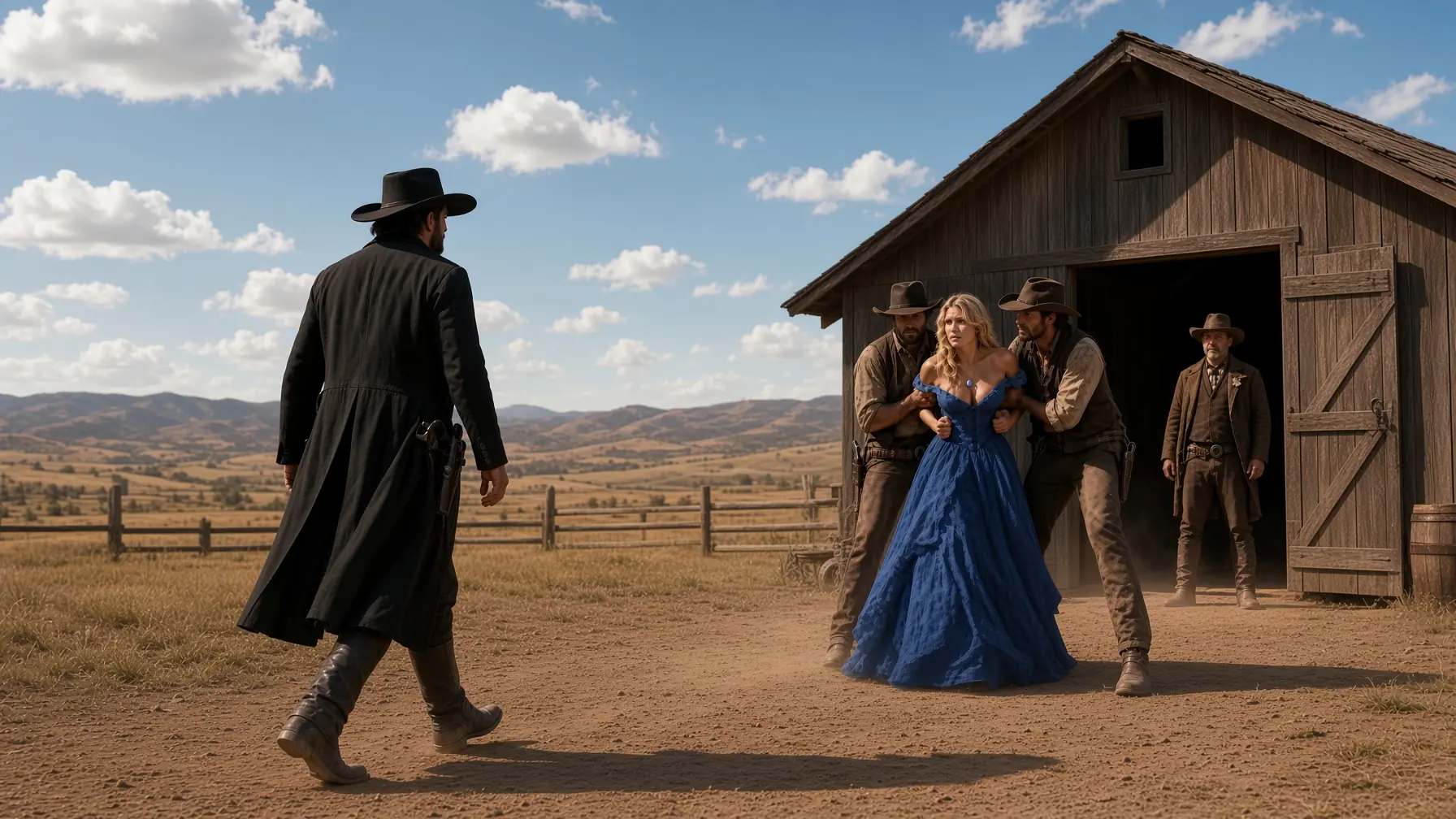
The sun hung high over Haskell County, turning the ground pale and brittle. Even the wind had given up. Dust hovered in the air like it had nowhere else to go. Clara Whitmore stood with her back near the spring, her wrist locked in a stranger's grip. His fingers pressed just hard enough to remind her who thought they held power.
She did not pull away. She did not look at the man holding her. Her eyes stayed on the one who had just spoken. He sat on a red roan mare at the edge of the yard, hat pulled low, poncho faded from years under open sky. The horse leaned its head toward the trough, thirsty, patient.
He had not drawn a weapon. He had not raised his voice. Still, something shifted. If you've ever felt the air change before a storm, you already know what stood there in that moment. The man holding Clara's wrist tightened his grip instead of letting go.
"You lost, friend?" he said, glancing over his shoulder. The rider did not answer him. He looked past him, straight to the man in charge, Willis Rand. Rand sat tall in the saddle, quiet, measuring.
His eyes moved once across the stranger, then back to Clara like the interruption meant nothing. "Private business," Rand said. The rider slid one hand along the reins as his mare stepped forward to drink. Leather creaked softly. The sound carried in the silence.
"Not anymore," he said. Behind Rand, two riders shifted in their saddles. Off to the side, Sheriff Dale Huck sat still, watching like a man who had decided not to be part of whatever came next. The preacher nearby kept his head down, fingers working the reins of his mule. Clara felt the man's grip on her wrist begin to sweat, not loosen, just change.
The rider's gaze dropped once to that hand. "Last time," he said. Clara did not breathe. Rand's mouth curved slightly like he had seen this play out before. "You're sitting on a thirsty horse in the wrong yard," he said.
The rider nodded once. "My horse's problem is simple," he replied. Then his eyes lifted again. "Yours isn't." Rand moved fast.
His hand dropped toward his gun. The sound that followed cracked the day open. Clara flinched at the force of it, not the noise, the sudden break in stillness. Rand bent forward in his saddle with a sharp, broken breath. His gun fell before it ever cleared leather, spinning into the dust.
"Anyone else?" he asked. No one answered. Rand gritted his teeth, clutching his hand against his chest. Blood slipped between his fingers, dark against the bright day.
The stranger eased the revolver back into its holster in one smooth motion. No rush, no hesitation, like it had always been decided. Clara stepped back, her arm free now. She reached behind her without looking and closed her hand around the worn wood of her father's Winchester. It felt steady, familiar.
The stranger finally looked at her, just for a second, not checking, not asking, measuring. Then he turned his attention back to Rand. "You're still breathing," he said. "That was on purpose." Rand said nothing.
His jaw worked, eyes burning through pain and something deeper. The rider shifted in his saddle, the roan lifting its head from the trough. Water dripped from its mouth, darkening the dust below. "Now," the man said quietly, "you all ride out." No one argued.
One of the riders reached for Ran's reins, guiding his horse around. The others followed, slower than they had arrived. "Careful." "Watching." Clara did not lower the rifle.
She kept it trained on them until the last shape faded over the rise. Only then did the yard breathe again. The cottonwood leaves stirred above her with a faint rustle. The stranger dismounted without a word. His boots hit the ground soft, like he had done it a thousand times in places just like this.
He led the mare back to the trough and let her drink properly. Clara watched him. "You know who that was?" she said. "I do."
"You shot his hand." "I did." She studied him, the way her father had taught her to study men. Not their words. The spaces between them.
"You got a name?" she asked. He took a moment before answering. "Cal," he said. "Cal Deveraux."
The name settled between them. It meant nothing to her. "Not yet." He nodded once toward the spring, toward the land, toward everything her father had left behind. "You're going to have more trouble," he said.
Clara tightened her grip on the rifle. "I already do." Cal glanced toward the southern trail where the riders had disappeared. "They'll come back," he said. She did not ask how he knew.
He looked at the horizon, then back at her. "And next time," he added, "they won't make the same mistake." Clara felt the weight of that settle in her chest, steady cold. "Then we won't either." she said.
Cal gave a small nod. Not agreement, recognition. The wind picked up just enough to move the dust again. Somewhere far off, a hawk cried out over the open land. And for the first time since her father died, Clara Whitmore stood in that yard and knew one thing for certain.
Whatever was coming next, it had already begun. The second time they came, they did not ride in talking. They spread out before the ranch even came into full view. Cal saw them first. He stood in the barn doorway, still as the shadow behind him, eyes fixed on the low ridge to the west.
Six riders, not bunched together like before, wide, careful, the kind of spacing that meant someone had learned something the hard way. He stepped back into the shade. "Clara." he called, low. She was already moving.
Boot steps quick across the wooden floor. No panic, just purpose. She grabbed the rifle from the table and moved toward the root cellar door without asking a single question. She already knew. Cal stepped out again, slow this time, letting them see him.
Letting them think they had time. The afternoon sun pressed down harder than the day before. Heat shimmered above the dry ground. Even the cattle in the far field had drifted into stillness. The riders closed in, not rushing, watching.
At their center rode a man Clara had never seen before, straight-backed, calm, no wasted movement. His hat sat low, shadowing his eyes. Cal studied him, different from Rand, less noise, more thought. That made him worse. "If you're still here."
Clara's voice came from below the ground, steady and clear, "then you're not as smart as you look." One of the riders shifted at that, glancing toward the root cellar. Cal did not. His attention stayed on the man in the middle. "That's him," the rider said quietly to the others.
"That's the one." The man in the center gave the smallest nod. Then he spoke. "Devereux." Cal didn't answer.
"You've caused trouble," the man continued, "more than this place is worth." Cal stepped forward into the sunlight. "Then you came too far," he said. The man tilted his head slightly, like he was considering that. "My employer is willing to be generous," he said.
"You leave, she leaves. You both walk away with more money than this land will ever see." Clara let out a short breath below. Not a laugh. Something sharper.
Cal didn't look back. "And if we don't?" he asked. The man's horse shifted beneath him. Leather creaked again, slow, measured.
"Then we finish what should have been finished yesterday." Silence stretched. Dust moved along the ground in a thin line between them. Cal's hand hung loose by his side. Not close to his gun.
Not far from it, either. "You're not Rand," Cal said. "No." "Good," Cal replied. "He made it too easy."
Something flickered in the man's posture. Not anger. Interest. Behind him, one of the riders edged his horse toward the barn side, trying to open an angle. The moment his horse crossed the dry wash, it hit the wire.
The animal jerked back hard, front legs lifting, nearly throwing the rider clean off. The sudden movement broke the line. Another horse spooked, stepping sideways. And that was enough. A rifle cracked from below ground.
The bullet struck dirt just ahead of a second rider's horse. The animal froze. "Next one goes through bone." Clara said. Her voice carried across the yard, flat and certain.
No one doubted it. The man in the center did not turn toward the cellar. He kept his eyes on Cal. "Interesting." He said quietly.
Cal's gaze did not shift. "You can still ride away." He said. The man considered that. Then his hand moved, fast.
But not fast enough. Cal's gun cleared leather in a single clean motion. The shot rang out. The man's hand snapped back, his revolver dropping into the dust before he ever fired. For a second, everything stopped again.
Same as before. But this time, the riders did not freeze from surprise. They froze from understanding. Cal did not raise his voice. "Ride out."
He said. No one argued. One by one, they turned their horses, careful again. Slower than they had come. The man in the center gripped his wrist, breathing through his teeth, eyes locked on Cal like he was memorizing something he would not forget.
Then they were gone. The sound of hooves faded into the open land. Cal stood there a moment longer, listening, waiting. Only when the last echo disappeared did he lower his gun. The cellar door creaked open.
Clara stepped out, rifle still in her hands. "You knew they'd split up." She said. "I hoped they would." Cal replied.
She looked toward the wash where the wire still trembled slightly. "That wire saved time." She said. Cal nodded once. "Time is all we needed."
She studied him again. "You didn't kill him. No. Why? Cal glanced down at the empty yard.
Because dead men don't carry messages. Clara followed his gaze. "They'll tell him." She said. They will.
And he won't stop. Cal looked toward the horizon. "No." He said. "He won't."
A quiet settled over the ranch again. Different now. Heavier. Clara rested the rifle against her shoulder. "So, what's next?"
She asked. Cal didn't answer right away. He watched the sky for a long moment, as if measuring something far beyond the land itself. Then he spoke. "Next."
He said. "We make sure he runs out of places to stand." Clara tightened her grip on the rifle. Behind them, the spring flowed steady and cold, untouched by any of it. But out beyond the ridge, something bigger had already started moving.
They did not wait for night. They came for the law instead. Three days passed with no riders on the horizon. Three days of quiet that never felt like peace. Cal stayed awake more than he slept.
Mornings found him on the barn roof, watching the land stretch out in every direction. Even the wind felt like it carried questions. Clara moved through the ranch like she always had, fixing fences, checking cattle, carrying water from the spring her father had built everything around. But now, every sound mattered. Every shadow held weight.
On the third morning, just after the sun broke over the flats, a rider appeared on the south trail. Only one. Clara saw him first from the porch. "He's not riding like them." She said.
Cal stepped out beside her. The rider did not slow until he reached the yard. His horse breathed hard, foam at its mouth, legs dusted from a hard ride. He wore a long coat despite the heat. And when he lifted his head, Cal's eyes narrowed.
"Federal," he said quietly. The rider swung down before the horse had fully stopped. He reached into his coat and pulled free a folded paper. "Cal Deveraux?" he called.
Cal didn't step forward. "Depends who's asking." The man held the paper out. "Deputy US Marshal," he said. "Name's Garza."
Clara's grip tightened slightly on the porch rail. Cal walked forward, slow, taking the paper. His eyes moved across it once, then again. The lines in his face shifted just enough to notice. "They got the letter," he said.
Garza nodded. "Came in fast. Preacher rode near dead getting it there." Clara let out a breath she hadn't realized she'd been holding. "Is he alive?"
she asked. Garza glanced at her. "He is." Cal folded the paper carefully. "What's the situation?"
he asked. Garza looked past him, scanning the ranch like a man used to reading places before speaking. "Warrant's issued," he said. "Prove it." "Sheriff Huck.
Anyone tied close enough to make it stick." Clara stepped down from the porch. "And prove it?" she asked. Garza met her eyes.
"He's not on this land anymore." Cal studied him. "Where?" "Las Cruces," Garza said, "but not for long." The air shifted again, different this time.
Not pressure, movement. Garza continued. "Two more marshals are riding in from the north. They'll meet us by sundown. We move at first light."
Cal nodded once. "And if he runs?" Garza's mouth tightened slightly. "He won't get far." Clara looked between them.
"You're going after him," she said. Cal didn't answer right away. He turned his gaze toward the open land, toward the south where everything had begun. Then he looked back at her. "Yes."
Silence stretched between them. The wind moved through the cottonwoods again, softer now, but still there. Clara stepped closer. "You could stay," she said. Not a question.
Not a plea. Just truth. Cal held her gaze, the same steady look from the first day. The same weight behind it. "You don't need me to fight your battles anymore," he said.
She almost answered. Then didn't. Because they both knew it was true. Garza cleared his throat lightly, stepping back toward his horse. "I'll water him," he said, giving them space without saying it.
Cal watched him go. Then turned back to Clara. "You'll hold this place," he said. "I always have." A faint shift touched his expression.
Not quite a smile. Something quieter. "Yeah," he said. They stood there a moment longer. No rush.
No need for more words. Because some things didn't need saying. At dawn the next morning, the marshals rode in. Three riders in total. Badges catching light as the sun climbed behind them.
They didn't waste time. Papers were shown. Plans were made. By mid-morning, they were riding south. Cal rode with them.
The roan mare steady beneath him. Clara stood in the yard, watching until the last shape disappeared into the heat. The ranch fell quiet again. But not the same quiet. This one felt earned.
Days later, word came back. Short. Clear. Garrett Pruitt was taken without a fight. Sheriff Huck was pulled from his office and placed in irons.
Men who once rode with confidence now stood with their hands bound, heads lowered under the same sun that had once watched them ride free. Clara stood at the spring when she heard it. Water moved over stone, cold and steady. She knelt beside it, letting her fingers dip beneath the surface. For a moment, she closed her eyes.
Then she stood. The work was not finished. Not here. Fences still needed mending. Cattle still needed tending.
And the land the land still needed someone who would not step back when men came asking for it. Weeks passed. Then one morning, just after sunrise, hoofbeats, slow, unhurried. Clara stepped out onto the porch. The figure on the horizon grew clearer with each step forward.
Red roan mare. Dust along the poncho. Same as before. Cal rode into the yard without a word. He swung down, tying the reins loosely.
Clara watched him. "You're back," she said. "For a while," he replied. She nodded once. That was enough.
The wind moved through the cottonwoods again, the same sound as the day everything began. But now, no riders followed. No shadows closed in. Just open land and two people standing in it.