By the time the first laugh cut across the boardroom, Caleb Mercer already knew he had made the old mistake again. He had spoken when silence would have kept him safe. He stood near the wall in a gray maintenance shirt with a damp crescent of sweat darkening his collar, one hand still on the aluminum ladder, the other holding a screwdriver he had been using to open a vent above the ceiling tiles. Beneath him, 26 executives in tailored suits sat around a table the length of a bowling lane. Their coffee cups were untouched, their legal pads were open, and their faces were turned toward him with the same startled amusement people show when a dog suddenly walks upright.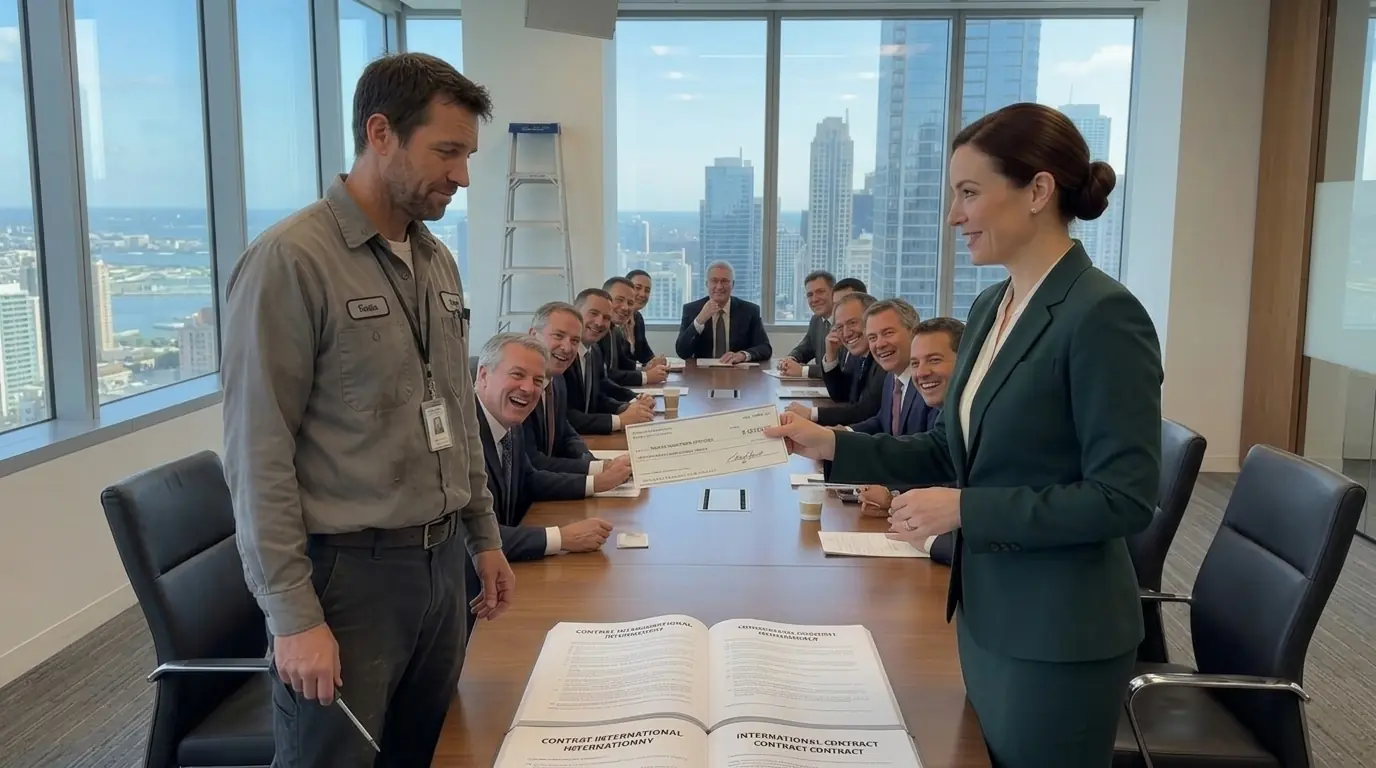
At the head of the room, Vivien Calder, chief executive of Calder Northstar Systems, lifted the thick stack of papers he had interrupted, let it drop with a hard slap against the walnut table, and smiled as if she had just found a cheap way to relieve a difficult morning. "Since our building engineer has decided to become our international counsel," she said, her voice smooth enough to make the insult sound polished. "Let's give him the floor." "Translate the whole section, mister." "What is your name again?"
Someone near the far end murmured it because Caleb's badge was turned backward on his chest. "Mercer," he said quietly. "Caleb Mercer." Vivien nodded, not because the name mattered, but because using it gave her performance shape. "Mr. Mercer, translate it properly."
"All the French, Dutch, and Spanish provisions, and I'll cut you a check for $8,000 before you leave this room." "Fail, and you apologize to every professional at this table for wasting their time." The room broke open again, louder than before, and Caleb looked past their laughter to the windows behind Vivien, where the Chicago River gleamed far below like a strip of bent steel in the noon light. He had been in the tower since before sunrise when the city was still blue and half asleep, pushing a squeaking service cart through the freight entrance while delivery trucks idled in the alley and steam rolled from a manhole near Wacker Drive. The tower belonged to Calder Northstar, a company famous for building industrial refrigeration units used in hospitals, vaccine plants, food distribution centers, and military field operations.
Caleb knew more about the company than anyone upstairs suspected, though not because he had tried to learn it. Machines tell their own stories to the men who keep them running. In 11 months, as a contract maintenance technician, he had learned which floors ran too cold, which executives complained if the air smelled faintly of coolant, which conference rooms needed extra power strips before investor calls, and which assistants stayed late enough to be worth greeting by name. He had also learned that the people on the 54th floor, where the boardroom sat behind frosted glass doors, rarely noticed the workers who arrived with tool belts and key rings. That invisibility had not offended him.
He had chosen it, or at least told himself he had. It let him finish his hours, pick up his daughter from aftercare, warm soup in their small apartment over a laundromat in Cicero, check spelling homework at a kitchen table scarred by other people's lives, and fall asleep knowing nobody expected him to board a plane before dawn, or sit between men with expensive watches, arguing over the meaning of a single word. Vivien Calder had inherited a difficult company, not a gentle one. Her father, Edmund Calder, had built Northstar with a machinist's hands and a gambler's nerves, then died three years earlier in the middle of a restructuring that left shareholders frightened and competitors circling. Vivien was 38, precise, disciplined, and possessed of a will so sharp that longtime board members spoke of it as if it were a weather condition.
She had fought bankers who called her sentimental, suppliers who called her untested, and older men who kept saying her father's name as though it were a door she had slipped through by mistake. She learned quickly that softness cost more than steel. By the time Caleb first saw her crossing the lobby in a winter coat the color of storm clouds, she had already saved three factories, closed two wasteful divisions, and fired a chief financial officer who thought she would not read footnotes. People admired her and feared her in equal measure. What they did not do was correct her in public.
She had grown so accustomed to being underestimated that she began to treat underestimation like a weapon, something she would rather swing first than feel strike her again. To her, a uniform meant function. A badge meant access. A man with a screwdriver was part of the tower's hidden circulation—necessary as wiring, but not someone whose thoughts belonged in a boardroom. She was not proud of this because she had never examined it closely enough to be ashamed.
That Thursday, the company was supposed to be preparing for the most important signing of Vivien's career, a licensing and joint development agreement with a European consortium that controlled distribution channels across Belgium, France, and Latin America. Calder Northstar's new cold chain system built around a proprietary compressor coil that could hold medical cargo at stable temperatures during grid failure had drawn attention after a brutal hurricane season exposed weaknesses in hospital logistics across the Gulf Coast. The deal could be worth half a billion dollars over 10 years, possibly more if government contracts followed. For Vivien, it was not only a transaction. It was proof that her father's company had not merely survived under her, but become essential.
The agreement had arrived in multiple languages with portions preserved in French, Dutch, and Spanish because each partner wanted original wording to control in its own jurisdiction. Outside, translators had reviewed it. A national law firm had approved it. Marcus Vale, Calder Northstar's general counsel, had summarized it that morning with the careful confidence of a man who had billed too many hours to imagine a fundamental mistake remained. Caleb had not been in the room to hear any of that.
He had been called because the boardroom ceiling vent was rattling hard enough to embarrass someone during the afternoon video call. He did what he always did when he entered executive space. He kept his eyes down, moved lightly, answered only what was asked, and made himself forgettable. The boardroom smelled of citrus polish, coffee, expensive wool, and the faint electrical dust that lived above ceiling tiles. He placed his ladder in the corner, opened the vent panel, and traced the rattle to a loose damper bracket.
Below him, papers shifted, laptops chimed. A deputy from the legal team read aloud from the English translation of a French paragraph, then explained that the consortium would gain extended distribution privileges if certain revenue targets were met. Caleb tightened one screw, paused, and listened despite himself. The French phrase he had heard did not sit right against the English explanation. He told himself to keep working.
He had a school form in his lunch bag that needed a signature. His daughter Laya had a dentist appointment next week and he needed to call the clinic before 5. Whatever happened at that table had nothing to do with him. Then the lawyer read a Dutch subclause connected to background improvements, and the outside translator standing near the credenza nodded as if the softened English phrase were harmless. Caleb's hand stopped on the bracket.
The document did not say what they thought it said. It said something more dangerous, and he understood at once that the danger was not accidental. He waited for someone else to catch it. Marcus Vale turned a page. The translator adjusted his glasses.
Do not prove anything to people who have already decided what you are. But there are mistakes a man can walk past and mistakes that reach out and take hold of his conscience. Calder Northstar's technology was not a line item to him. He had seen the testing lab on the 21st floor. He had changed filters beside young engineers sleeping at desks after overnight trials.
He had watched crates marked for children's hospitals loaded in the alley during a snowstorm. If the company signed away control, people far below the 54th floor would lose more than money. He stepped down two rungs before he could argue himself out of it. "That section doesn't mean distribution privileges," he said. His voice was not loud, but it carried into the quiet between pages.
"It's tied to ownership of improvements and maybe the underlying coil design if the thresholds are met." "You should have someone check the original before you sign." For a moment, nobody laughed because surprise arrived first. Then Preston Gable leaned back and gave a low chuckle that invited the others to join him. A few obliged immediately.
The outside translator turned red around the ears. One of the vice presidents whispered something that made the woman beside him cover her mouth. Marcus Vale looked up with the weary patience of a man interrupted by a stranger on a train. "Mr. Mercer," he said, reading the badge now. "We appreciate your dedication to the building, but this agreement has been reviewed by multilingual counsel."
"Yes, sir," Caleb said. "I'm only saying the original language is stronger than the English summary." That was when Vivien entered fully into the moment. Until then, she had been watching him from the head of the table, her expression unreadable, one finger resting against the margin of the contract. She had heard enough challenges from men who expected her to shrink, that she no longer distinguished easily between correction and threat.
A maintenance worker standing above her boardroom and telling her that her legal team had failed felt absurd. Yet the calm in his voice unsettled her more than a shouted accusation would have. She did not like being unsettled. She liked even less that several people had turned to see how she would handle it. So she handled it the way pride handles discomfort.
She turned it into a lesson for someone else. "Come down, then," Vivien said. Caleb remained on the ladder long enough that the silence tightened. "Ma'am, I didn't mean to interrupt the meeting." "You did interrupt it," she replied.
"So let's be thorough." He climbed down slowly, feeling every eye follow the worn knees of his work pants, the scuffed boots he had polished at dawn because Laya had told him they looked sad. The cheap black watch he used to time HVAC cycles and medication reminders. The ladder clicked as he folded it. He left the screwdriver on the tray and walked to the table.
Up close, the executive seemed less like a group and more like separate judgments. Preston Gable smiled openly. A marketing officer, whose name Caleb did not know, looked embarrassed on his behalf. Marcus Vale studied him with suspicion, sharpened by curiosity. Vivien placed the document in front of Caleb and tapped one manicured nail against the page.
"You heard a few words from a ladder and decided you understand an agreement my team has worked on for nine weeks." "No," Caleb said. "I heard enough to know the translation missed something important." "Then prove it." She opened a leather check holder, took out a pen, and wrote the date with deliberate calm.
"Eight thousand dollars." "That is more than fair compensation for your expertise, assuming it exists." "Read it, translate it, explain it—all of it." "And if you cannot, you will apologize plainly for implying that people who spent their lives earning their seats at this table are less competent than a man who came here to fix a vent." The sentence landed exactly where she aimed it.
Caleb felt it in his chest. Old and familiar. There are many ways to remind a man he is poor. Some people use numbers. Some use laughter.
Some simply list what he is not. He looked at Vivien's pen moving across the check, then at the contract, then at the ceiling vent still open behind him like a small square wound. He thought of Laya's backpack hanging from a hook by their apartment door, one strap repaired with gray duct tape. He thought of the envelope from the hospital still unopened on top of the microwave because he already knew what it would say. $8,000 would matter. It would matter too much.
That made the offer uglier because Vivien knew it or thought she did. He could refuse and return to the ladder, confirming their story. He could try to explain only the clause and watch them dismiss him before the next page. Or he could open the door inside himself that he had kept bolted since Norah died—the door to rooms full of simultaneous-translation headsets, treaty drafts, arbitration panels, and men who smiled while hiding knives in verbs. He had left that world to sit beside a hospital bed and raise a little girl.
He had promised himself that leaving meant peace. Yet peace purchased by pretending not to know the truth was not peace. It was fear wearing work clothes. "I won't apologize for telling you to check a document," Caleb said. The laughter thinned, uncertain now.
Vivien's pen stopped. "That is not what I asked." "I know." He placed both hands gently on the back of an empty chair. He did not sit because nobody had invited him to.
"Put the check where everyone can see it." "Not because I need a prize to read your papers, but because you made this public." "If I make a real mistake—not just use a word you don't like hearing—tear it up, and I'll finish the repair." "If I'm right, you pay it, and you listen long enough to understand how close you came to losing what your father built." Something changed in the room.
Not respect, not yet. A hesitation. People who are bluffing usually fill silence with noise. Caleb let silence stand beside him as if it were a witness. Marcus Vale leaned forward.
Vivien held his gaze and felt for the first time that morning the unpleasant possibility that she had misread not only the clause but the man. Still, retreat was not a language she spoke easily. "Sit down, Mr. Mercer," she said. "Begin at the start." "We will all learn something."
He sat, turned the first page, and did not rush toward the clause that had started the trouble. That alone irritated Preston Gable enough that he checked his watch. Caleb began with the recital, the formal declarations nobody in the room cared about, because they sounded ceremonial and harmless. He read the English line, then moved into the French definition that followed, translating not word for word, but meaning for meaning, preserving the legal force in plain American speech. His voice was low, almost gentle, with the steady cadence of someone reading to keep a child calm during a storm.
The first minute passed, then the second; nobody laughed. He explained that the French term being rendered as partner facility carried a narrower meaning connected to facilities under direct operating control which mattered because revenue thresholds from third-party sites should not count towards certain triggers. Marcus Vale began writing. Caleb moved to a Spanish schedule and corrected the difference between “best efforts” and “commercially reasonable efforts”. Not dramatically, simply by saying, "One makes them try hard."
"The other makes them prove what a reasonable company in their position would do." "Those are cousins, not twins." A young associate near the screen looked up sharply, then down at his own copy. The translator by the credenza stopped blushing and started following line by line, his face tightening each time Caleb crossed a border between languages without slowing. Vivien watched him with the concentration she usually reserved for hostile investors.
She had expected one of two outcomes, embarrassment or arrogance. Instead, he offered neither. He did not perform. He did not glance around to see whether the room admired him. He read, explained, connected provisions, and stripped away dangerous softness with the patience of a craftsman sanding old wood.
The faded collar of his maintenance shirt brushed his neck as he leaned over the pages. His hands were rough, nicked around the knuckles, one thumb marked by a half moon burn from some repair. Those hands should have made the performance feel impossible to her. But after 10 minutes, the impossibility began to move elsewhere. The impossible thing was not that he could do this.
The impossible thing was that she had seen him in elevators for nearly a year and never wondered whether there was more to him than the cart he pushed. When he reached the Dutch section on background improvements, the room had gone so quiet that the ice in a water glass cracked loudly enough to make someone flinch. Caleb read the original slowly, then gave them the approved English translation. It sounded safe. Upon meeting specified targets, the consortium would receive expanded rights to incorporate improvements into jointly commercialized systems.
Preston nodded as if relieved. Then Caleb read the Dutch again, changed three terms, and the harmless sentence opened like a trap door. "What it actually says," Caleb said, "is that when the consortium meets the investment and distribution targets, all covered improvements become assigned rights, not licensed rights." "And because “covered improvements” is defined too broadly back on page four, it reaches into the compressor-coil architecture—not just accessories, not just local modifications, but the heart of the system." Marcus Vale stopped writing.
Vivien did not move. Caleb turned two pages back without searching, found the definition, and placed it beside the Dutch trigger language. "The English translation makes it sound as if they get permission to use improvements." "The original gives them ownership of improvements once the targets are met." "And the targets are not ambitious."
"They are designed to be reached in 18 months." He looked at Vivien then, not with triumph, but with a kind of restrained sorrow that made the truth harder to bear. "You would not discover the problem when you signed." "You would discover it after they had already satisfied the condition." "By then, the argument would be about whether you had knowingly given away the design that makes your emergency cold-chain system valuable."
"You might fight it for years." "You might even win part of it, but you would bleed money, time, and trust while your competitors moved around you." He tapped the page once. "This is not a translation error." "It is too neat for that."
The words settled over the boardroom like dust after a ceiling collapse. Nobody wanted to breathe first. Preston Gable's smile had disappeared so completely that his face looked older. The outside translator whispered to the attorney beside him, but the whisper did not become a denial. Marcus Vale reached for the document with the controlled urgency of a surgeon hearing an instrument count come up wrong.
"Let me see the page." Caleb slid it over. Vivien kept her eyes on Caleb, though the contract had become the center of the room. "You are alleging intentional drafting misconduct," she said. "I am saying the other side wrote language that benefits them, and your English version hid the size of that benefit."
"Convenient distinction." "An accurate one." Her jaw tightened. "And we are supposed to accept this because you speak calmly?" "No, ma'am," Caleb said.
"You are supposed to verify it because it matters." That answer quieted her more effectively than a challenge would have. Marcus had already pulled the translator and two associates to the far corner, where they spread pages across the table and began the slow, unhappy work of checking what a man in a maintenance shirt had heard while tightening a screw. The rest of the boardroom waited in a silence too disciplined to be called panic. Outside, a tour boat moved along the river, its guide's amplified voice drifting faintly upward through glass no one usually heard.
The verification took 23 minutes. Caleb knew because his watch vibrated at 12:30, reminding him to call the pharmacy about Laya's inhaler refill. He silenced it beneath the table. No one asked why. At the far end, the translator's posture changed first, shoulders rounding as the fight went out of him.
Then one associate placed a hand over her mouth, not in theatrical shock, but in professional dread. Marcus Vale read the definition again, went back to the trigger clause, checked the Spanish schedule tied to performance milestones, and finally removed his glasses. He looked not at Caleb, but at Vivien. That was the answer. Still, Marcus was a lawyer, and lawyers believe damage should be named precisely.
"He is correct," he said. His voice was even, though the room heard the strain in it. The Dutch provision, read with the French definitions, and the Spanish milestone schedule creates a conditional assignment of rights broad enough to include core improvements. The approved English translation understated the transfer and mislabeled assignment as expanded use. The problem is not isolated.
There are related provisions that would make litigation expensive and uncertain. He glanced at Caleb then, and the suspicion in his face had changed into something more complicated. "I missed it." "The outside vendor missed it." "My team missed it."
"Mr. Mercer did not." The last sentence was the one everyone would remember. Vivien looked down at the half-written check in front of her. $8,000, an amount she had chosen because it sounded large enough to be cruel and small enough to prove the gulf between them. She had meant the money as a spotlight, a way to make him squint beneath it while everyone laughed. Now it looked like evidence.
Her father's portrait hung on the boardroom wall behind her. It showed Edmund Calder in a dark suit, one hand resting on a compressor prototype from the company's earliest days. She had spent years telling herself she was protecting his legacy from people who did not believe she could. Yet she had nearly signed away that legacy because she had confused authority with wisdom and credentials with truth. The humiliation that rose in her was sharp, but beneath it moved something worse, recognition.
Caleb had not embarrassed her. She had done that herself the moment she decided his uniform gave her permission to dismiss him. "Who are you?" she asked. It was softer than she intended and therefore more honest. "People who can do what you just did do not usually spend their mornings fixing vents."
Caleb looked at her for a long moment. The room leaned toward the answer, hungry now in the opposite direction from before. They had laughed at the idea that he might be somebody. Now they needed him to explain how they had failed to know. "I fixed the vent because it was rattling," Caleb said.
"That is the job order I was given." Preston made an impatient sound, but no one joined him. Caleb took a folded envelope from the side pocket of his cargo pants and placed it beside the check. The paper was creased from being carried all morning. Vivien noticed his name typed across the front, then the words Facilities Contractor Agreement in the corner.
"I came up here planning to finish the repair and turn this in downstairs before I left." Marcus's eyes narrowed. "A resignation?" "A non-renewal notice?" Caleb said, "My contract ends Friday."
"I decided last week not to extend." The boardroom absorbed that with a strange collective discomfort. A man they had not known existed beyond a work order had almost left the building with the one mind that had seen the hidden blade in their largest deal. Caleb rested his palm on the envelope, but did not open it. "I understand why you are asking, but I need you to understand something, too."
"An hour ago, most of you were comfortable laughing because you thought there was nothing I could be except what my shirt told you I was." "I do not owe a biography to every room that realizes late it should have been kinder early." The sentence landed without anger. That made it harder to avoid. Vivien felt the eyes of her executives on her, waiting to see whether pride would make one more bad decision.
She had built a career on never showing uncertainty, but certainty had just failed in public. The old reflex rose anyway. Minimize, redirect, thank the contractor, send him back downstairs, let Marcus clean the document, and pretend the morning was an odd footnote rather than an indictment. She could almost see the escape route. Then she saw Caleb's hands again folded over the envelope, steady but tired.
He was not trying to win. He was trying to leave with as much of himself intact as possible. That more than the translation stopped her. She rose from her chair. People straightened.
Vivien walked along the side of the table until she stood across from Caleb without the full length of walnut between them. "You are right," she said. Her voice caught slightly on the first word—not enough to break, but enough to reveal the cost. "Not just about the contract." Preston looked down.
The translator stared at his shoes. "I looked at your badge and decided the room had nothing to learn from you." "Then I turned that decision into a public joke because I wanted to feel in control." "You warned us anyway." "You may have saved this company from the worst mistake in its history."
"And I repaid you by making your paycheck part of the insult." She turned so the words reached the whole room. "That was beneath this company." "It was beneath this room." "It was beneath me."
"Mr. Mercer, I apologize." No applause followed. Applause would have cheapened it, and perhaps everyone knew that. Caleb looked at Vivien with the guarded surprise of a man who has learned not to expect repair after damage. He had known proud people who would rather lose fortunes than admit a janitor, a driver, or a mechanic had been right.
Vivien's apology did not erase what she had done, but it changed what could happen next. She returned to her chair, finished writing the check in full, signed it, and tore it free. When she handed it to him, she did not smile. "This began as mockery," she said. "It should end as payment."
"You earned it." "Whether you cash it is your business." Caleb accepted it because refusing would have turned the moment into another performance, and he was tired of performances. Vivien pointed gently toward the envelope. "I cannot ask you to stay as if nothing happened."
"I can ask you not to leave before we understand the rest of what you saw." Marcus stepped in, more formal but no less urgent. "The consortium's delegation lands Monday night." "We have four business days to rebuild the document and decide whether the drafting pattern suggests bad faith." "I can hire three more firms by dinner, but none of them will know what you noticed in passing."
"I am asking for professional help, Mr. Mercer, under terms you approve—not charity." Caleb glanced toward the windows where the city moved without caring what had happened above it. He thought of Laya, of the inhaler, of the rent, of the promise he had made himself when Norah's hand went cold in his. The world he had left was standing at the door again, but this time it was not dragging him away from his daughter. It was asking to enter on his terms.
"I have to pick up my little girl by 6," he said. The simplicity of it made several people look away. "I do not work nights." "I do not travel without notice." "I do not miss school meetings for emergency egos, and if I help, the maintenance crew downstairs is not blamed for losing me before the weekend."
Vivien nodded once. "Agreed." "And you will review the vendor's work without scapegoating some junior translator who was handed impossible timing and bad instructions." Marcus's eyebrows lifted. "That may be the most generous thing said in this room today."
"It is not generosity." "It is accuracy." "If you want accuracy from me, it goes both ways." Vivien accepted that too. Only then did Caleb open the envelope and slide the non-renewal notice back inside rather than across the table.
He did not tear it up. He simply kept it. That was the first term of their new arrangement, though nobody said it aloud. He would stay, but not because they owned him. He would help, but not because they had discovered a useful object in a uniform.
He would re-enter the kind of room he had avoided for years, but he would not surrender the life he had built in the quiet. Over the next 4 days, the 54th floor changed shape around him. Caleb arrived in his maintenance uniform the first morning because he owned no business suit that fit, and because buying one before, knowing what he was agreeing to, felt like pretending. Vivien said nothing about the shirt. Marcus placed him in a conference room with printed originals, vendor translations, redline drafts, coffee, and a legal pad.
By 10, three outside attorneys had joined by video, and by 11, two of them had stopped speaking over him. Caleb did not dominate the room. He asked people to read sections aloud in the original. He marked false friends, buried triggers, jurisdictional hooks, and phrases that seemed ordinary until connected to definitions 30 pages earlier. He found a Spanish indemnity provision that shifted product liability for modifications Calder Northstar did not control.
He found a French phrase that allowed the consortium to count affiliated distribution purchases toward market penetration benchmarks, effectively letting them manufacture success through internal transfers. He found a Dutch notice provision that would have shortened Calder's response window to a period so unreasonable it had to be deliberate. Each discovery changed the tone of the room. The work became less about saving Vivien from embarrassment and more about defending a company from a document designed to smile while stealing. At 5:30 each day, Caleb closed his folder.
The first time he did it, a senior partner from the outside firm kept talking as if time would bend for him. Caleb stood and gathered his notes. Vivien from the doorway said, "Mr. Mercer leaves at 5:30." The partner blinked. "We are in the middle of—" "We are always in the middle of something," she said.
"He leaves at 5:30." Caleb did not thank her in front of them, and she seemed to understand why. Gratitude can become another kind of debt when powerful people spend it publicly. In the service elevator alone, he leaned his head against the cool metal wall and let exhaustion pass through him. Then he drove west in his old green pickup, its heater stuck halfway on even in spring, and reached Bright Steps Aftercare with 4 minutes to spare.
Laya ran to him with a paper crown on her head and a drawing of a purple whale in her hand. "Daddy, why do you smell like offices?" she asked. He laughed for the first time that day. "Because offices smell like nervous coffee." She accepted this as wisdom.
At home, he made scrambled eggs and toast because the chicken had not thawed, listened to her read a chapter book about a brave mouse, and after she fell asleep, sat at the kitchen table with contract pages spread between a pharmacy receipt and a cracked blue mug Norah had loved. Norah had been the reason he left the old life, though not the way people always imagined sacrifice. He had not given up something pure for something tragic. His old career had been dazzling from the outside and corrosive from within. Arbitration in Zurich, emergency negotiations in Brussels, corporate rescue work in São Paulo, government procurement disputes where one mistranslated obligation could redirect millions.
He had been good, as he told Vivien later, but goodness at that level required a strange willingness to be absent. When Norah's autoimmune disease became a calendar of infusions, fevers, specialists, and careful hope, Caleb discovered that expertise could open every door except the one he needed most, more time. The night a partner called from The Hague, while Norah was too weak to lift a glass of water, Caleb looked at the phone ringing on the dresser and felt something in him divide. He did not answer. Within 3 months, he had left the firm.
Within a year, Norah was gone. People assumed grief had broken him, but that was too simple. Grief had clarified him. Laya needed a father who came home at the same time, who knew which stuffed animal belonged in the bed and which medicine tasted less awful with grape juice, who could braid badly but consistently. Maintenance work did not use all of him, but it gave him evenings.
For a long while, that had been enough. On Monday, the consortium arrived with polished shoes, diplomatic smiles, and binders full of confidence. Their lead negotiator, a Belgian attorney named Anton Desmet, greeted Vivien with old-world courtesy and Marcus with professional warmth. When he was introduced to Caleb, his eyes lingered for a fraction of a second on the maintenance shirt beneath Caleb's borrowed blazer. It was the same fraction Caleb had learned to recognize in airports, hospitals, school offices, and banks—the small pause in which a person recalculates how little respect is required.
Caleb gave him nothing to work with. He shook Anton's hand and sat beside Marcus, not at the back wall where Anton's glance had placed him. The first hour was ceremonial. The second became precise. Anton objected to revisions in the ownership language, calling them unnecessary clarifications.
Caleb opened the Dutch original and read the disputed sentence aloud with a pronunciation clean enough to make Anton's junior counsel look up too quickly. Then Caleb explained in English why the original structure could not remain if the deal was truly a license. Anton's smile did not vanish, but it hardened at the edges. Twice more over the next day, softened language reappeared in revised drafts. Twice Caleb caught it without raising his voice.
By Tuesday afternoon, the consortium understood that the company they had expected to outmaneuver had found its compass. Vivien watched those negotiations with a humility she still knew enough to feel as an ache. She had thought leadership meant always being the person with the answer. Caleb, sitting three chairs away in a blazer that pulled at the shoulders, taught her something else without intending to. He was most powerful when he did not hurry to prove power.
He let people speak until their own words created the record. He corrected only what mattered. He never used a person's mistake as decoration for his own intelligence. At one point, Anton made a cutting remark about late-stage linguistic anxiety, clearly aimed at Caleb. The old Vivien might have replied sharply.
Caleb only turned a page and said, "Good agreements survive careful reading." The sentence ended the matter more completely than anger would have. On Wednesday evening, the transfer clause was rewritten into a plain license. The milestone schedule was narrowed. Liability returned to the party controlling the modification.
Notice periods were corrected. By Thursday, the consortium signed a deal still worth hundreds of millions, but no longer built around a hidden surrender. Vivien signed last. Her hand was steady, but when she placed the pen down, she looked briefly toward Caleb, and he knew she understood what had almost happened in that same hand a week earlier. The story moved through Calder Northstar faster than any memo could have controlled.
At first, it came in distorted pieces. A maintenance guy had saved the company. Vivien had apologized in the boardroom. Legal had missed a trap. Someone had been offered eight grand to embarrass himself and walked out with the money.
By the time it reached the loading dock, one version had Caleb speaking seven languages while hanging upside down from the ceiling. He corrected none of it unless someone asked directly. What mattered to him was not legend. It was whether the men in the blue shirts downstairs were suddenly treated with theatrical respect for a week before the old habits returned. Some did, some did not.
Real change is rarely a trumpet. It is a door held open by someone who used to let it swing shut. It is an executive learning the name of the woman who empties recycling bins after 7. It is a senior manager asking an electrician what he thinks before ordering a costly retrofit. Vivien began with names.
Then she changed procedures. Maintenance reports were invited into planning meetings when equipment investments were discussed. Translation vendors were given realistic timelines and double review. Legal summaries now included a page called original language risks, a title Marcus hated and secretly admired. The building did not become kind overnight, but it became less blind.
Two weeks after the signing, Vivien asked Caleb to meet in her office. He expected final paperwork, perhaps a consulting invoice discussion. Instead, he found Laya's purple whale drawing framed on a side table. He stopped in the doorway. Vivien looked almost embarrassed.
"Your daughter left it in the small conference room yesterday when you brought her by after the dentist." "My assistant found it." "I thought it deserved better than a lost-and-found drawer." Caleb stepped inside, touched by the gesture, despite his caution. Vivien's office overlooked the river, but the view did not dominate as he expected.
On one shelf sat an old metal pressure gauge, scratched and heavy, presumably from one of her father's first machines. On her desk lay a formal offer letter: Director of Language Risk and Strategic Agreements. "The title is clumsy because Marcus and HR argued for an hour, and this was the least ridiculous option," she said. "The salary is not clumsy." "Neither are the hours."
"No mandatory travel without your written agreement." "Remote review when possible." "A 5:30 departure, protected unless you choose otherwise." "Benefits beginning immediately." Caleb read the first page, then the second.
The number attached to the position made his throat tighten because he saw at once what it could mean. Laya's medical care without negotiating payment plans, a safer apartment, a car that did not groan on cold mornings, college savings that were more than a coffee can hope. "I am not offering this because you saved my company," Vivien said. "Though you did, I am offering it because I finally understand that the company was poorer when it did not know what you knew." "That poverty was my fault."
Caleb looked up. "It was not only yours." "No," she said, "but the corner office teaches the building what it is allowed to ignore." He considered her for a long moment. A week earlier, he would have distrusted such a sentence as executive poetry, polished and hollow.
Now he heard the effort beneath it. Vivien was not suddenly gentle. She would still be demanding, exacting, and impossible in ways that made rooms sit straighter, but she had done the rarest thing pride can do. She had allowed truth to correct it in public. Caleb folded the offer letter once along the crease it already had.
"I will accept," he said, "with one condition that is not in here." Vivien waited. "If I take this office, I do not become proof that everyone you overlooked might secretly be useful to you." "That is not the lesson." "People deserve respect before they save you money, before they speak French, before they understand your contracts, before you find a reason to value them."
Vivien absorbed it and the old instinct to defend herself flickered and died. "You are right." "And if the building forgets, I will say so." "I expect you will." For the first time, he smiled a little.
"I usually try not to." "Perhaps try less." He did not move into his new office all at once. For several days, his tools remained in the maintenance shop, labeled in black marker, while HR found and IT issued equipment that seemed unnecessarily sleek. The office they gave him was modest, one floor below legal, with a window facing west toward neighborhoods that looked at sunset less like a city grid and more like a quilt of lights.
Caleb placed three things on the desk. Laya's whale drawing, Norah's cracked blue mug, and the $8,000 check uncashed in a simple frame he bought at a pharmacy. Vivien noticed it during her first visit and said nothing, which was wise. The check was not a trophy. It was a scar preserved under glass.
When people asked, Caleb told the story briefly without making Vivien a monster or himself a hero. "A room mistook a uniform for a limit," he would say. "It nearly cost them more than money." "We all learned something." That was enough.
Those who needed the sharper version could read the amount and imagine the laughter around it. Months later, on a cold morning after the first snow glazed the Riverwalk, Vivien found Caleb in the lobby kneeling beside a security guard named Alonzo, helping repair the loose wheel on a chair used at the reception desk. He was wearing a pressed shirt and tie, his badge now marked director, but his hand still knew what to do with a wrench. Two visiting investors paused near the elevators, confused by the sight. Vivien saw the pause, recognized it, and felt the old blindness trying to return through someone else's eyes.
"Gentlemen," she said, stopping beside them. "This is Caleb Mercer." "He is one of the reasons your investment is safe." Caleb looked up faintly amused, and Alonzo grinned at the wheel. The investors offered their hands.
Caleb shook them after wiping grease from his fingers with a paper towel. Nothing dramatic happened. No music rose. No one confessed a lifetime of arrogance in the marble lobby. But Vivien understood that dignity is often restored in ordinary gestures, one corrected introduction at a time.
When she stepped into the elevator, she saw Caleb return to the wheel. Not diminished by kneeling, not enlarged by a title, simply himself. At home that evening, Laya asked why the check was still at his office if it was worth real money. Caleb was making grilled cheese at the stove, pressing the sandwiches with a spatula the way Norah used to. Snow tapped softly against the kitchen window.
"Because sometimes money can remind you of something more important than spending it," he said. Laya considered this with the solemn skepticism of a seven-year-old. "Like what?" He slid a sandwich onto her plate, cut it diagonally because she believed triangles tasted better, and sat across from her. "Like not letting other people decide who you are, and not deciding too quickly who they are."
She dipped a corner of the sandwich into tomato soup. "That sounds like two things." Caleb smiled. "Most important things are." Later, after she fell asleep with a library book open on her blanket, he stood in the doorway and watched her breathe in the soft glow of the nightlight.
The life he had chosen had not disappeared because he had stepped back into a room where languages mattered. It had widened. He was still the father who packed lunches, signed permission slips, and checked the radiator when it clanged at midnight. He was also the man who could see danger hidden in a sentence and say so without apology. For years he had believed he had to bury one life to protect the other.
Now he understood that truth, like dignity, does not ask to be loud. It only asks not to be denied. Calder Northstar continued to grow, but the story of the boardroom never left it. New employees heard it during orientation, though never from Vivien's mouth unless someone asked. She did not enjoy telling it, which was part of why she kept telling it truthfully when necessary.
"I was wrong," she would say, and the room would shift, because people are more startled by a powerful person admitting fault than by almost anything else. Marcus Vale built a stronger review department and became, to his own surprise, one of Caleb's fiercest allies. Preston Gable resigned before the next annual meeting, officially for family reasons, unofficially because he never adjusted to a company where laughter at the wrong person could end a career faster than a bad quarter. The maintenance crew downstairs began receiving copies of facilities decisions before budgets were finalized. Not because every mechanic secretly spoke five languages, but because the people closest to a problem often understand it before the people farthest from the floor admit there is one.
Vivien did not become perfect. Caleb did not become polished. But the building became harder to fool and kinder in the places where kindness had once been treated as inefficient. Years later, when the framed check had faded slightly under office light, and Laya was old enough to roll her eyes when her father reminded her to be home by 10:00, a young intern stopped outside Caleb's office and stared at the strange artifact on the wall. "Did someone really pay you $8,000 for one meeting?" she asked.
Caleb looked from the check to the window where the city was turning gold in the evening. "No," he said. "Someone offered me $8,000 because she thought I would fail." The intern winced. "What happened?"
Caleb capped his pen and leaned back. He could have told the long version, the ladder, the laughter, Vivien's hard smile, the dangerous clause, the silence after Marcus confirmed it, the apology that changed more than policy. Instead, he gave the only answer that still mattered. "The words were checked," he said.
"The truth came out, and a room full of people remembered that no uniform, office, accent, paycheck, or title tells the whole story of a human being." The intern nodded, perhaps understanding only part of it, which was fine. Most lessons take years to finish arriving. After she left, Caleb turned the framed check slightly so it hung straight.
Then he picked up his daughter's latest college brochure from the desk, smiled at the impossible price printed on the back, and reached for the phone to call her. Outside his office, the tower hummed with lights, wires, vents, contracts, ambitions, and people moving through one another's days. Some wore suits, some wore uniforms, some carried tools, some carried secrets. And in that building, at least more often than before, they were seen before they had to prove they deserved to be.