The first officer found the envelope beneath Elias Mercer’s road atlas, held it up between two fingers, and smiled as though the traffic stop had finally produced the crime he had been waiting for. Ten crisp hundred-dollar bills sat inside, folded beneath a handwritten note with an address in Columbus and the words LATHE — $1,000 CASH printed across the top. Elias remained beside his dark blue Buick with both hands resting on the hood while traffic hammered past them on Interstate 70, throwing hot August wind across the shoulder. Officer Cole Vardon thumbed through the money once, then again, while his partner, Ryan Kessler, searched the center console. “That’s a lot of cash for a retired guy,” Vardon said. Elias looked at him through the reflection in the windshield and answered quietly, “A thousand dollars isn’t illegal.”
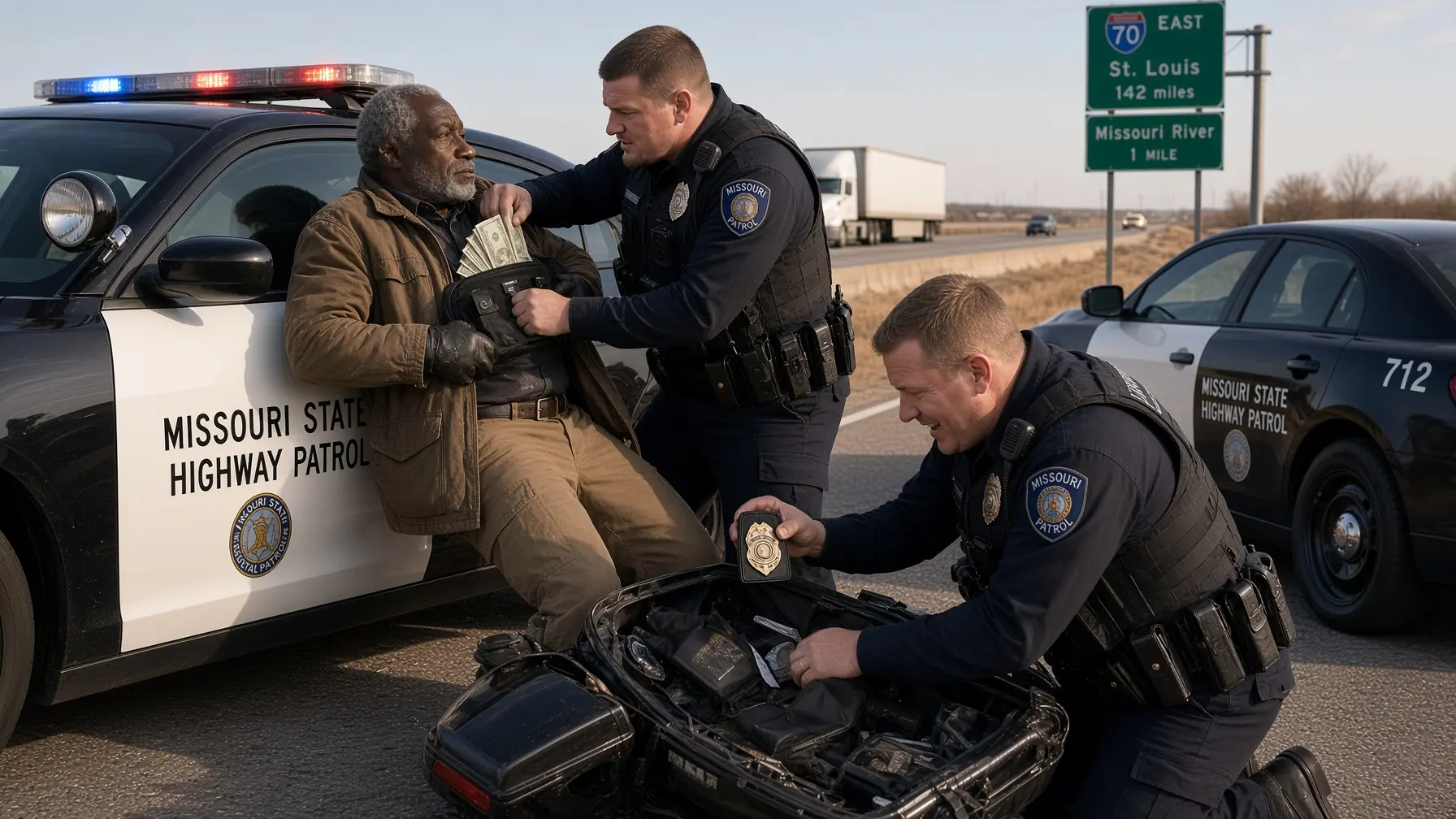
Vardon folded the envelope and slid it against his vest. “Depends where it came from.” Elias explained for the third time that he was driving east to buy a used South Bend metal lathe from a retired machinist outside Columbus, something he had wanted for years and whose seller preferred cash because both men were old enough to remember when that was normal. The seller’s name, phone number, and address were written on the paper inside the envelope. Elias even offered to let them call him. Vardon did not. Instead he said, “People moving drug money always have stories,” while Kessler continued rummaging through the Buick despite Elias having refused consent to a search nearly ten minutes earlier.
The stop had begun at 10:17 that morning near mile marker 147, on a dry stretch of interstate cutting through the fictional Ashford County jurisdiction west of Columbus. Elias had been driving sixty-eight in a seventy-mile-per-hour zone, cruise control engaged, right lane, seat belt fastened. He saw the marked Ashford County Interdiction Unit SUV pull from the median, follow him for almost two miles, then activate its lights. Elias moved onto the shoulder immediately and turned on his hazards. He had spent thirty-one years investigating crimes for the state, including twelve in the Major Integrity Section, and old habits survived retirement better than knees did. Before Vardon reached the driver’s window, Elias had already looked at the clock, noted the mile marker, put both hands on the steering wheel, and quietly said the time aloud so the dual-channel dash camera mounted beneath his mirror would capture it.
Vardon introduced himself only by last name and said Elias had been following a tractor-trailer too closely. Elias did not argue even though the truck had been several car lengths ahead. He produced his license, registration, and insurance card, then answered the ordinary questions: where he was coming from, where he was going, whether the vehicle was his. Problems began when Vardon noticed the retired state-investigator credential inside Elias’s wallet. The credential had no current police authority and Elias did not present it deliberately, but the leather fold opened enough for the old badge to become visible. Vardon picked it up, studied the worn state seal, and laughed. “You used to be somebody?” he asked. Elias answered, “I used to have a job,” which should have ended the subject.
Instead, Vardon carried the wallet back to the patrol SUV while Kessler appeared at the passenger side. Kessler was younger, perhaps thirty-two, with the restless confidence of an officer who had learned the habits of his partner faster than he had learned to question them. He asked whether Elias carried narcotics, large amounts of currency, weapons, or “anything that would make a dog interested.” Elias said no to the first three and reminded him there was no dog present for the fourth. Kessler smiled. “You know how this works, old timer.” Elias looked at the body camera centered on the man’s chest and replied, “I know how it is supposed to work.” Kessler stopped smiling for a moment.
Vardon returned with the license but not the retired credential. He leaned toward the open window and said he detected the odor of marijuana. Elias looked directly at him and asked, “Fresh or burnt?” The officer paused before answering, “Marijuana.” Elias had never smoked it, nobody else had used the Buick in months, and there was nothing inside that could reasonably smell like it. He refused consent to search. Vardon responded that consent was unnecessary because he had probable cause based on odor, ordered Elias from the vehicle, and told him to stand by the hood while Kessler began searching. Elias did not physically interfere, but he stated clearly enough for both cameras, “I do not consent to this search, and I dispute that there is any marijuana odor.”
They found no marijuana. No pills. No drug paraphernalia. No weapons. No stolen property. Kessler opened the trunk, checked beneath the spare-tire cover, and unzipped Elias’s overnight bag while Vardon questioned him beside the guardrail. Every innocent result should have reduced suspicion. Instead Vardon kept creating another reason for it to survive. The absence of drugs meant perhaps Elias had recently delivered them. The old state credential became evidence that Elias “knew how police worked.” The thousand dollars became suspicious because it was cash. Even the handwritten lathe note became suspicious because, according to Vardon, “People make receipts all the time.”
Elias watched the structure of the encounter with a familiarity that made him tired more than frightened. He had spent decades teaching younger investigators that a theory had to be allowed to die. If every fact could be interpreted only one way, then an investigator was not testing a theory anymore; he was protecting one. Elias asked the question that had ended more bad investigations than any clever interrogation technique he had ever learned. “Officer Vardon, what fact have you found during this search that makes criminal activity more likely than it was when you stopped me?” Vardon stared at him, then looked toward Kessler as though Elias had violated some unwritten rule by asking for logic.
“You’ve got unexplained currency,” Vardon finally said. Elias answered, “I explained it, gave you the seller’s information, and offered verification.” Vardon told him explanations could be false. Elias nodded and said, “Of course they can. That’s why you verify them.” Kessler emerged from the passenger side holding the white envelope. Vardon took it, counted the ten bills, then turned toward Elias with the first genuine satisfaction he had shown all morning. The search had finally produced something he could hold in his hand, and Elias could see the psychological shift immediately. Cash looked guilty in a way an empty trunk did not.
Vardon said the money would be “held pending narcotics review.” Elias asked which agency would receive it, under what statutory authority it was being seized, and whether there would be a property receipt. Kessler’s eyes moved toward his partner. Vardon answered that Elias would receive paperwork later if the money was connected to an investigation. Elias said, “Then you are taking property from me now without giving me a receipt?” Vardon’s jaw tightened. “Don't tell me how to do my job.” Elias did not raise his voice. “I’m asking you to document yours.”
That was when Vardon pulled the retired credential from his pocket. He opened the leather case, looked at the badge one more time, then tossed it onto the asphalt shoulder between Elias’s Buick and the guardrail. The metal struck the pavement, bounced once, and landed face down among gravel. “That thing doesn’t mean anything out here,” Vardon said. Kessler laughed, though less comfortably than before. Elias looked down at the badge but did not retrieve it yet because Vardon still had one hand near his holster and because pride had never been worth a sudden movement beside an armed man.
“You’re right,” Elias said. Vardon seemed surprised. Elias continued, “It doesn’t give me authority anymore.” Then he looked at the envelope disappearing into Vardon’s cargo pocket and added, “But it did teach me to count.” Kessler stopped laughing entirely. Vardon ordered Elias back into the car, told him he was receiving a warning for following too closely, and said the “currency matter” would be handled separately. No citation was issued. No property receipt appeared. No evidence bag came out. Elias watched Vardon place the envelope not in the rear evidence compartment of the SUV but inside a zippered pocket on his tactical vest.
At 10:46, twenty-nine minutes after the lights first activated, the two officers returned to their vehicle. Vardon leaned down once more and told Elias that if he was smart, he would “take the warning and enjoy retirement.” Elias answered with a polite “Drive safe.” The patrol SUV pulled into traffic and accelerated east. Only after it disappeared beyond a line of trucks did Elias step from the Buick, retrieve his retired badge from the shoulder, and inspect the fresh scrape across the state seal. He brushed gravel from it with his thumb, placed it on the passenger seat, and sat behind the wheel without starting the engine.
His hands shook.
Elias let them.
That was another old lesson. Control during an encounter did not mean fear had disappeared. Sometimes fear merely waited until the danger drove away. He took three slow breaths, checked the dash camera’s status light, then opened the recording application on his phone to confirm that both the forward camera and interior microphone had saved continuously. They had. The rear camera had also captured Vardon standing with the envelope near the passenger side, though the angle did not clearly show exactly where the money went.
Then Elias called one number.
A woman answered after the first ring.
“Keene.”
Elias said only her first name.
“Mara.”
There was a pause.
The voice changed immediately.
“Elias?”
“I need you to preserve a traffic stop before somebody decides the record should look different.”
Mara Keene had once worked for Elias in the state’s Major Integrity Section. She was now deputy director of the Attorney General’s Public Integrity Bureau, which did not give her magic authority over every police department in Ohio, but it gave her one thing Elias needed more urgently than revenge: a lawful path to preserve evidence. She asked whether he was safe. He said yes. She asked whether he had been arrested or injured. No. Then Elias gave her the department, unit number, officers’ names, mile marker, exact start and end time, and the fact that one thousand dollars had been taken without a receipt.
Mara became very quiet.
“Do you have video?”
“Yes.”
“Don't send it to me yet.”
That answer pleased Elias.
He had trained her well.
“You’re the complainant,” she continued. “I’m going to route this to someone who does not report to either of us. I’ll make preservation calls through the proper channels and notify the county prosecutor. You do not contact their chief. You do not call any old friends in Ashford. You go home and make contemporaneous notes.”
“I’m on my way to buy a lathe.”
“Elias.”
“He’s holding it for me.”
“You just had a thousand dollars stolen.”
“Which creates a second problem.”
“What?”
“I don't have the money for the lathe.”
Mara made a sound halfway between anger and laughter. “Go home.”
Elias looked at the scraped badge on the passenger seat.
“Fine.”
Before he merged back onto Interstate 70, he wrote down one more thing: Vardon had said held pending narcotics review, while Kessler had said nothing about seizure paperwork at all. Language mattered. If a formal forfeiture process existed, there would be a chain. If the chain did not exist, the missing paperwork would become the center of the case.
By noon, an evidence-preservation request had reached the Ashford County Sheriff’s Department through the county prosecutor’s office. It ordered no finding, accused no one publicly, and did not suspend anyone by itself. It simply directed the department to preserve body-camera recordings, dash-camera files, CAD entries, mobile-data-terminal activity, GPS history for unit 214, report drafts, evidence logs, property records, and communications relating to Elias’s stop. Sheriff Alan Brody received the request while eating lunch at a charity golf event. He initially assumed it concerned a use-of-force complaint until his counsel told him the complainant’s name.
“Elias Mercer?” Brody repeated.
The attorney knew the name.
Most younger deputies did not.
Fifteen years earlier, Elias had led the investigation that dismantled a regional bid-rigging network involving two county officials, a contractor, and a state purchasing supervisor. His reputation had never come from intimidation. He was feared by people with bad records because he was almost impossible to rush. He built chronologies, compared drafts, checked receipts, and treated every contradiction like a loose bolt that might either mean nothing or bring down an entire machine if ignored. One newspaper once called him “the accountant with a badge,” and Elias had framed the insult.
Brody asked whether Mercer was demanding anyone be fired.
“No,” the attorney said. “He hasn't contacted us.”
That worried the sheriff more.
At 2:03 p.m., Vardon submitted a report. He described a stop for following too closely, wrote that he smelled marijuana, and stated that Elias voluntarily permitted officers to search after “initially expressing hesitation.” He wrote that no contraband was discovered. Under property seized, Vardon entered NONE. Under currency, nothing appeared. The report concluded that Elias received a verbal warning and departed without incident.
Kessler submitted his supplement seventeen minutes later.
It also mentioned marijuana odor.
It also said consent had been given.
It also listed no seized property.
Then the preservation request reached their supervisor.
That was when their ordinary traffic stop became something else.
Captain Leah Morrison, commander of the patrol division, reviewed the officers’ body-camera uploads first. Kessler’s camera began three minutes after the vehicle stop. Vardon’s began nearly nine minutes after. Department policy required automatic or manual activation before contact unless circumstances made that impossible. Both men claimed the cameras had failed to activate when the emergency lights came on. Morrison checked the cruiser system. The emergency lights had activated correctly.
She opened the dash-camera file.
There was none.
Unit 214 showed an upload error.
Morrison called the department’s IT contractor.
“Can an officer delete a dash file?”
“Not from the car under normal permissions.”
“Can it fail?”
“Yes.”
“How often?”
“Rarely.”
“Can you recover buffer data?”
“Probably.”
She told him to try.
Then she opened Vardon’s body-camera recording. It began after Elias was already outside the vehicle. The first clear audio captured Elias saying, “I have not consented to this search.” Vardon replied, “You don't need to.” That alone contradicted the report’s claim of voluntary permission.
The recording continued through the money discovery.
Morrison watched Vardon count ten hundred-dollar bills.
She watched Elias explain the lathe purchase.
She watched him provide the seller’s name and offer verification.
She watched Vardon say the money would be held pending narcotics review.
Then she watched him place the envelope near his vest.
The camera angle shifted.
The envelope disappeared.
No property form was prepared.
No evidence bag appeared.
Morrison stopped the video.
Then she opened the evidence system.
No currency entry.
She called the property room.
Nothing.
She called narcotics.
Nothing.
At 3:41, she notified Sheriff Brody that both officers needed to be removed from field duty pending review.
Brody did not resist.
“What do we have?”
Morrison answered carefully.
“Enough to stop pretending this is just a complaint.”
Vardon and Kessler were placed on administrative leave that evening. They were not arrested. Their badges were not ripped from their shirts in front of cameras. The union was notified. Attorneys were contacted. The county prosecutor requested that the state investigative unit take the criminal side because the alleged conduct involved local officers and the department wanted distance from its own case.
Mara Keene did not lead it.
Neither did Elias.
State investigator Naomi Price, who had never worked for Elias and had no personal relationship with him, received the assignment.
Her first interview with Elias lasted ninety-four minutes.
She did not treat him as a legendary retired investigator.
She treated him as a witness.
“What did you have in the envelope?”
“One thousand dollars.”
“Denominations?”
“Ten hundreds.”
“Serial numbers?”
“No.”
“Where did the money come from?”
“My credit union.”
“Withdrawal date?”
“Yesterday at 3:17 p.m., give or take.”
“Receipt?”
“In my glove box.”
“Purpose?”
“Used lathe.”
“Seller?”
Elias gave the name.
Price verified everything.
The seller, seventy-four-year-old Harold McNally, confirmed Elias had agreed to purchase a South Bend Heavy 10 lathe for one thousand dollars cash at noon that Saturday. Their text messages showed photographs, negotiations, the address, and McNally’s request that Elias bring cash because he did not use payment applications.
The credit union provided surveillance and withdrawal records.
Ten hundred-dollar bills.
Exactly.
Price then reviewed Elias’s dash-camera footage.