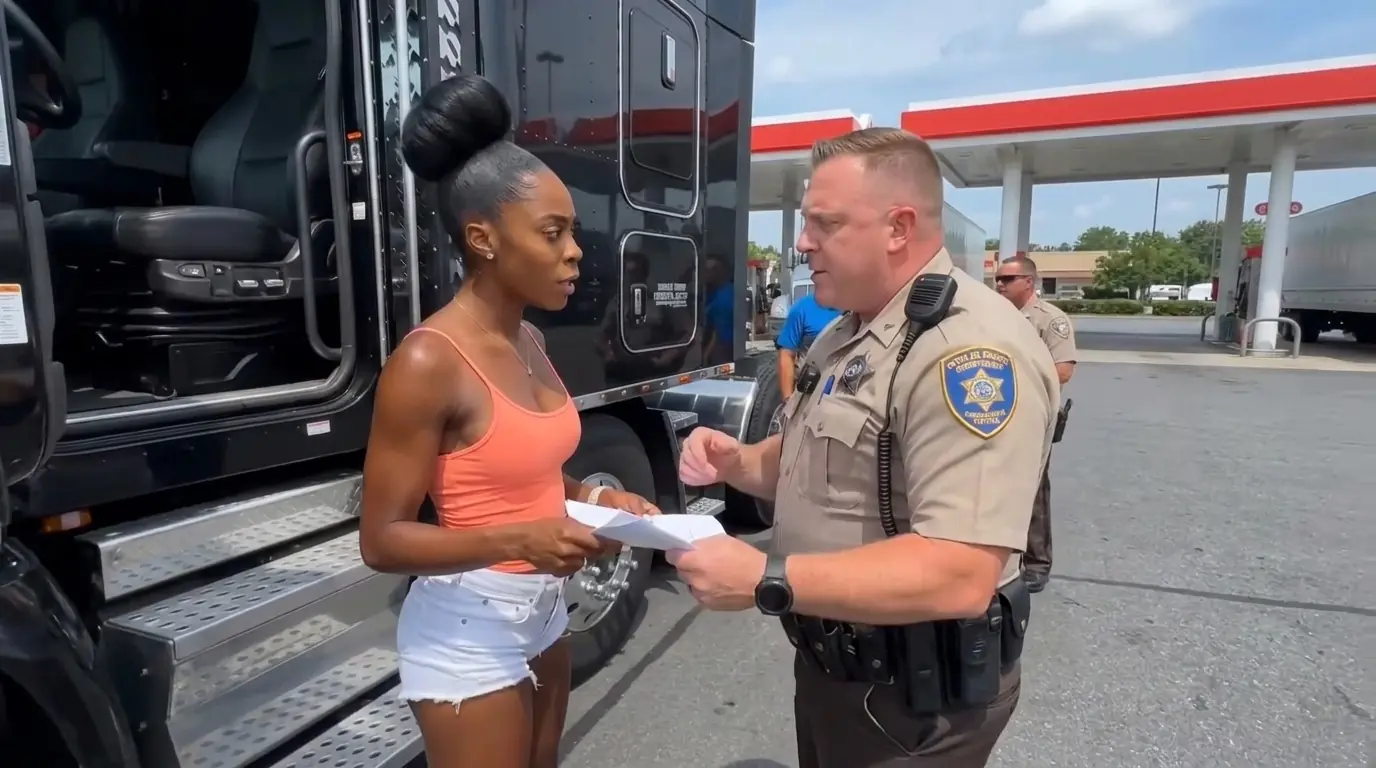
“Step out of the cab before I pull you out myself.”
Officer Travis Keene stood beneath the driver’s window of the black Kenworth with one hand resting near his duty belt and the other hooked over the open window frame. Forty-three-year-old Renee Lawson remained in the driver’s seat with both palms resting where he could see them on the steering wheel. She had already handed him her commercial license, registration, electronic log summary, federal bill of lading, insurance certificate, and the temporary security clearance authorizing her load to continue toward the Birmingham Veterans Medical Center.
Keene had looked at almost none of it. He glanced at Renee instead, then at the polished black cab, then at the refrigerated trailer carrying nearly half a million dollars in specialized rehabilitation equipment and emergency communications hardware. “You expect me to believe this rig belongs to you?” he asked. Renee answered, “The registration says it does.”
Keene laughed. “Anybody can print paperwork.” Renee looked toward the document still hanging loosely from his hand. “Then verify it.”
The afternoon heat pressed down across Sandstone Travel Center outside Huntsville, Alabama, turning the parking lot into a silver shimmer. Tractor-trailers idled near the diesel islands, and a line of drivers moved between the pumps and a low brick diner attached to the travel plaza. Renee had been waiting for final federal route clearance after an eighteen-hour driving cycle that included a mandatory rest period, two inspections, and a last-minute change to the hospital’s receiving schedule. She was tired enough to feel every mile behind her eyes, but tired and careless had never meant the same thing.
Twelve years in Army transportation taught her that. She had entered the military at nineteen, eventually becoming a Staff Sergeant supervising convoy operations, supply movements, fuel planning, and medical logistics. After leaving active duty, she drove for larger carriers before buying her first truck with savings, a veterans-business loan, and money she refused to borrow from her husband.
That last decision mattered to Renee. People regularly assumed she owned Lawson Freight because her husband had financed it. He had not.
Major General Jonathan Lawson could have written a check. Renee refused one. “I want the company to survive because I know freight,” she told him when she bought the first rig, “not because people think I married a rescue plan.”
Jonathan respected that. Eight years later, Lawson Freight operated six trucks, employed four other owner-drivers under contract, and specialized in medical, government, and high-security commercial shipments. Renee still drove because she loved it.
The road gave her a kind of clarity offices never did. Departure point, destination, load, weather, hours, fuel, responsibility. Either the freight arrived intact or it did not.
Keene had approached her truck less than five minutes after she parked. No flashing lights. No explanation.
He simply hammered on the glass until Renee lowered it halfway. Then he demanded she step down. When she asked the reason, he claimed the truck matched a stolen-vehicle bulletin.
Renee asked for the report number. Keene’s face changed.
“You planning to tell me how to do my job?” he asked. “No.”
“You asked for a report number.” “Because you said my truck matches a report.”
Keene stepped closer. “You people always need everything explained.” Renee heard the phrase exactly as he intended it.
She still kept her voice level. “Officer, either the plate, VIN, or company identifier matches an active stolen-vehicle entry or it doesn’t.”
That was when Keene first called her “girl.” Renee felt anger rise through her chest and pushed it back down.
Anger could wait. Details could not.
She slowly moved one hand toward a small switch near her dashboard communications unit. Keene’s eyes followed the motion.
“What are you reaching for?” “My truck camera system.”
“You recording me?” “The cab records automatically.”
That was not entirely true. Exterior dash cameras did run continuously while the electrical system remained on, but cabin audio required manual activation. Renee pressed the switch.
A soft green indicator appeared near the console. Keene did not notice.
Another patrol vehicle pulled into the lot. Sergeant Wade Harlan stepped out.
He was older than Keene, perhaps fifty-three, with close-cropped gray hair and the carefully measured demeanor of somebody who understood that calm authority often frightened people more than shouting. Keene immediately changed his tone. “Sergeant, possible stolen commercial vehicle, driver’s being difficult.”
Renee looked at Harlan. “I’m not being difficult.”
Harlan held up one hand. “Ma’am, let him finish.”
Keene said she had failed to cooperate with a stolen-vehicle investigation. He did not mention that she had already provided documents.
He did not mention that the VIN was visible through the windshield. He did not mention that he had never radioed dispatch with it.
Harlan approached Renee’s door. “Ma’am, step out of the truck.”
“Am I being detained?” “Temporarily.”
“For what specific reason?” Harlan’s expression remained composed.
“Vehicle verification and potential freight irregularities.” Renee looked toward Keene. “He told me this was a stolen-truck report.”
Harlan smiled slightly. “Investigations develop.”
That sentence bothered her immediately. The reason had changed before anybody checked the first reason.
Still, Renee opened the door and stepped down. She kept her hands visible and moved slowly.
The moment her boots touched pavement, Keene climbed halfway into the cab. Renee turned.
“You do not have my consent to search.” Keene ignored her.
He opened the glove compartment. Pulled at the center console.
Moved her jacket. Checked the sleeper curtain.
Harlan walked toward the trailer seal. “This seal looks disturbed.”