By the time Officer Dean Mercer realized the little red light on the supermarket camera was blinking directly at him, the eggs were already broken.
Twelve of them.
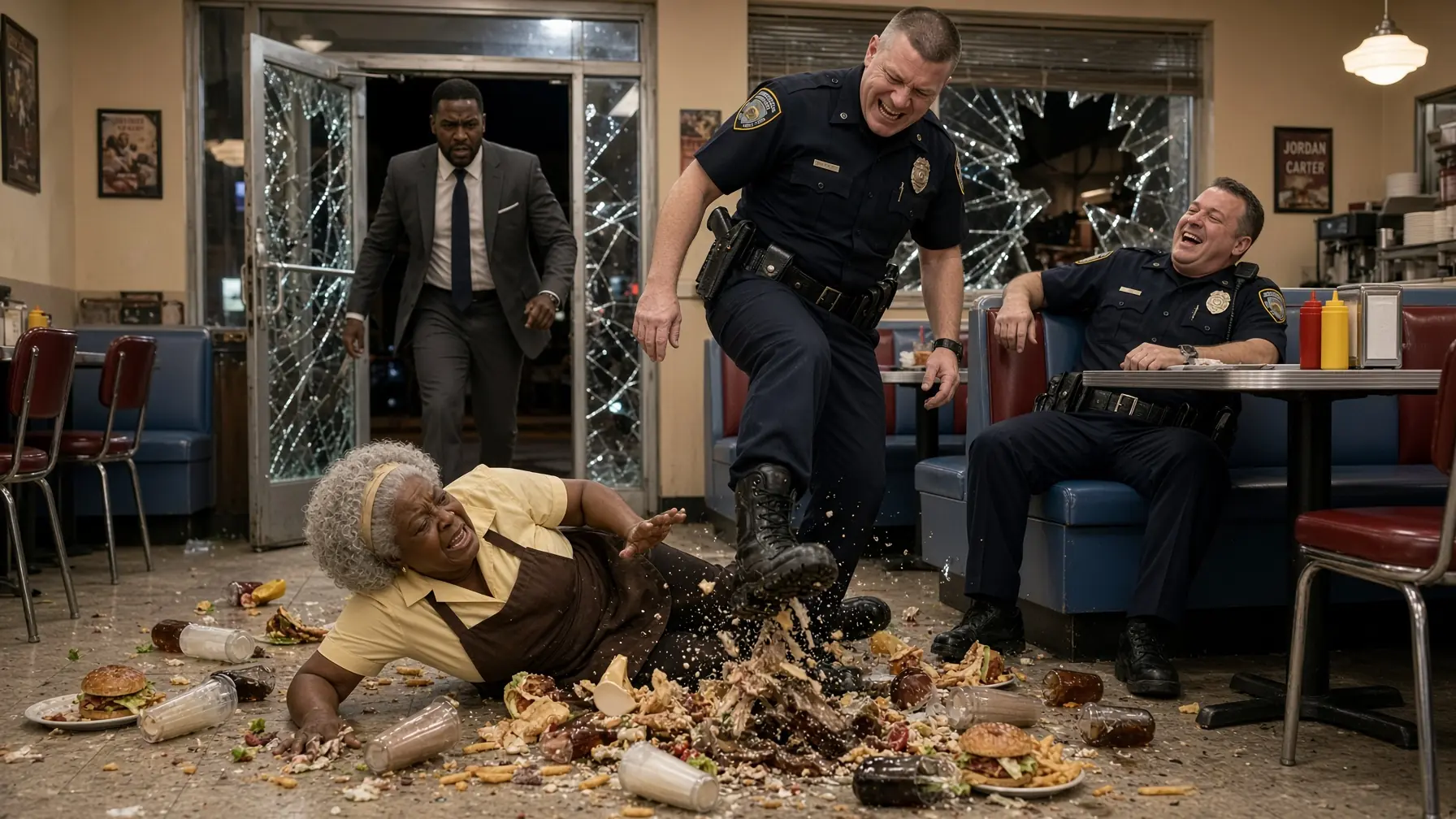
White shells crushed against wet asphalt.
Milk had spilled from a split carton and was running toward a storm drain.
A bag of flour had burst open in the rain, turning into pale paste beneath his polished black boots.
And sixty-seven-year-old Ruth Bennett was standing beside her car with one wrist locked in a handcuff.
Mercer looked at the security camera.
Then at Ruth.
Then back at the camera.
His partner, Kyle Benton, stopped smiling.
That was the first moment either of them appeared uncertain.
Ruth noticed.
She had been noticing everything.
For the last eleven minutes, that was all she had allowed herself to do.
Notice.
Remember.
Stay upright.
“Ma’am,” Mercer said, suddenly less certain than before, “if you’d just cooperated from the beginning—”
Ruth looked at the groceries scattered across the parking lot.
“My receipt is still in my purse.”
Mercer’s jaw tightened.
“We’ll get to that.”
“You’ve been saying that for ten minutes.”
Benton gave a short laugh.
“Lady, you keep arguing, this gets harder.”
Ruth turned her eyes toward him.
She did not raise her voice.
“You already made it hard.”
Then headlights appeared at the entrance to the parking lot.
A black SUV turned in slowly.
No flashing lights.
No siren.
Just dark windows and government plates.
Mercer glanced toward it.
Benton did too.
The vehicle crossed three empty parking rows and stopped twenty feet away.
The rear door opened.
A woman stepped out wearing a charcoal suit beneath a long raincoat.
She was in her early fifties, tall, silver beginning to show at her temples.
Mercer’s face changed instantly.
Benton lowered his hands.
The woman stared at the groceries.
Then at the handcuff.
Then at Ruth.
Finally, she looked at Mercer.
“Officer,” she said.
Mercer swallowed.
“Ma’am.”
Her eyes narrowed.
“Would you like to explain why the chair of the county’s new Police Accountability Commission is standing in a grocery-store parking lot in handcuffs?”
The rain kept falling.
Ruth closed her eyes for half a second.
Not because she was relieved.
Because now she knew they had finally become afraid of the right thing.
Evidence.
Three hours earlier, Ruth Bennett had been arguing with herself about tomatoes.
That was how ordinary the day had begun.
She stood in the produce aisle of Franklin Market holding one tomato in each hand.
One was beautiful.
Red, round, polished enough to appear in an advertisement.
The other was slightly crooked and almost half the price.
Ruth chose the crooked one.
“At my age,” she muttered, placing it into the cart, “I’m done paying extra for pretty.”
A young employee stocking lettuce laughed.
Ruth smiled at him.
Saturday shopping had been part of her routine for almost thirty years.
Franklin Market at ten.
Pharmacy afterward.
Home before noon.
Church choir at four if her knee behaved.
Ruth was sixty-seven, widowed, and had lived in Mayfield County most of her adult life.
For thirty-two years, she taught American history at Jefferson High School.
Later she became assistant principal.
Then principal.
Thousands of children had passed through her office.
Some frightened.
Some angry.
Some pretending they did not care.
Ruth remembered nearly all of them.
That was how people knew her around town.
Mrs. Bennett.
Principal Bennett.
The woman who could stop a cafeteria fight by walking into the room and lowering her glasses.
After retiring, she expected a quieter life.
Instead, three years later, the county executive asked her to serve on a temporary committee studying complaints against local police departments.
Ruth initially refused.
Then she read the complaints.
Traffic stops.
Searches.
Discourteous treatment.
Reports dismissed because body-camera footage had not been preserved.
Residents saying they were afraid to complain because the officers involved knew where they lived.
The problem was not that every complaint was true.
Some were not.
The problem was that there was no trusted process for finding out.
So Ruth joined the committee.
Six months later, voters approved creation of a civilian Police Accountability Commission.
Ruth was appointed its first chair.
The commission was new.
Controversial.
And not popular with everyone wearing a badge.
Ruth did not advertise the position.
She had no security detail.
No special vehicle.
No reason to announce herself every time she bought groceries.
That morning, she was simply a woman shopping for Sunday dinner.
Chicken.
Collard greens.
Milk.
Eggs.
Flour.
Coffee.
Her blood-pressure medication from the pharmacy counter.
And a chocolate cake she absolutely did not need.
At checkout, she paid $86.42.
The cashier, nineteen-year-old Maya Thompson, handed over the receipt.
“Have a nice weekend, Mrs. Bennett.”
“You too, baby.”
Ruth folded the receipt twice and put it inside her purse.
That tiny action would matter later.
Outside, rain had started.
Not heavy.
Just a cold, steady drizzle.
Ruth pulled her cardigan tighter and pushed the cart toward her blue Buick.
She was halfway through loading the trunk when she heard:
“Ma’am.”
She looked up.
Two police officers were approaching.
Dean Mercer.
Kyle Benton.
She recognized their names before they reached her.
Not personally.
From complaint files.
Mercer had been mentioned in four complaints reviewed by the temporary committee.
Benton in two.
None had resulted in formal discipline.
One complaint involving Mercer remained open.
Ruth did not let that knowledge show on her face.
Mercer stopped beside the cart.
“Can I speak with you?”
“You already are.”
Benton smirked.
Mercer did not.
“We received a report of suspected shoplifting.”
Ruth glanced at the supermarket entrance.
Then back at him.
“And?”
“And we need to determine whether merchandise was taken.”
“Then speak with the store.”
“We’re speaking with you.”
Ruth looked into her own cart.
Most of it was already inside the trunk.
“I paid.”
“We need proof.”