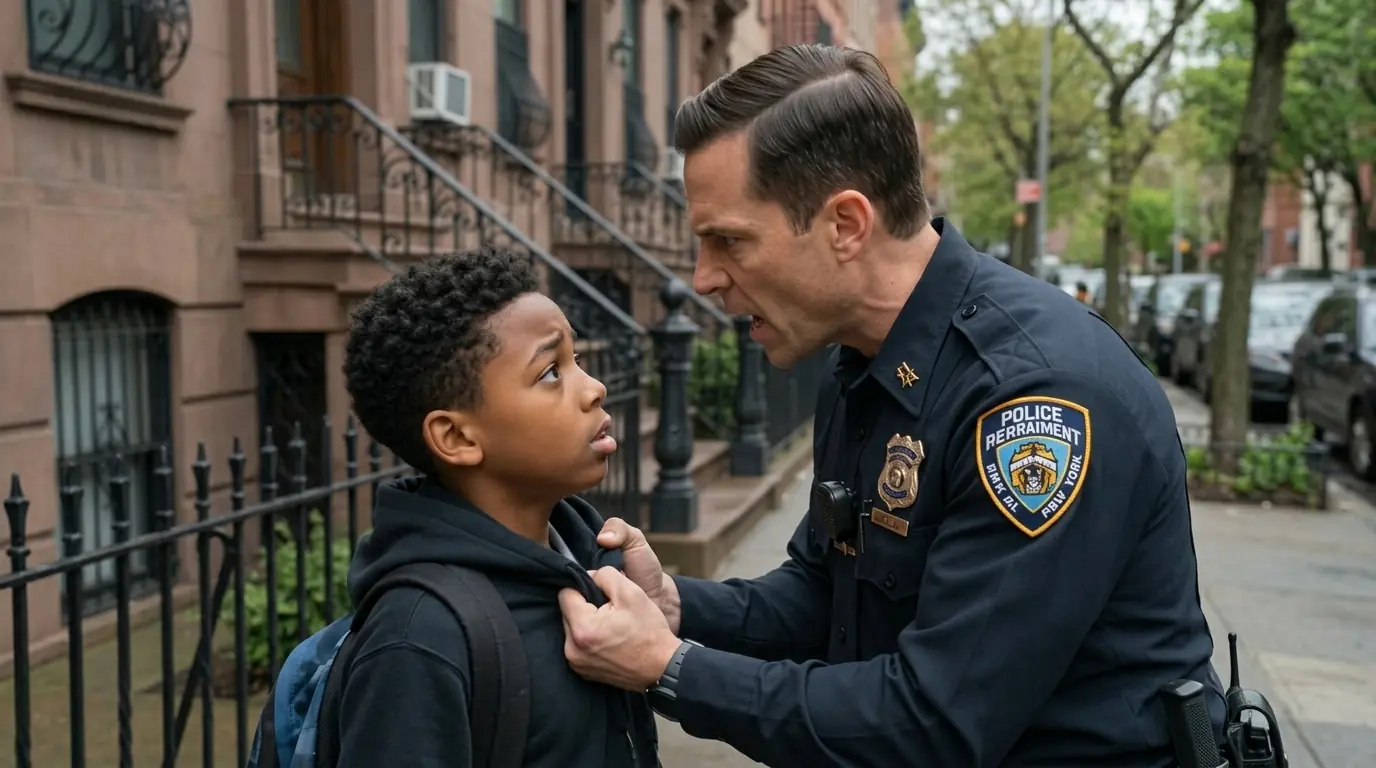
The first officer grabbed Malik Bennett by the backpack strap before the boy had even finished pulling his house key from his pocket. Malik was fourteen, still wearing his navy school hoodie, gray uniform pants, and the black backpack his mother had bought him the summer before she died. He had just climbed the three stone steps leading to his family’s brownstone on Westmore Avenue in Brooklyn when Officer Dean Hargrove yanked him backward hard enough to make one sneaker slip from the step. “Where do you think you’re going?” the officer demanded.
Malik twisted around, more startled than angry. “Home.”
Hargrove looked at the five-story brownstone behind him, then back at Malik. His partner, Officer Elliot Crane, stood near the curb beside their patrol SUV, watching with an expression that was not quite comfortable but not yet brave enough to become intervention. Hargrove gave Malik a small, humorless smile.
“Try again.”
Malik stared at him. “I live here.”
“Sure you do.”
The words were simple, but Malik understood the meaning immediately. He had heard that tone before in stores, apartment lobbies, elevators, and once at a private-school fundraiser when another parent had asked which family he was “helping.” He had learned that some adults asked questions because they wanted answers, while others asked because they had already decided the answer and wanted to see whether you would challenge them.
“I have a key,” Malik said.
Hargrove tightened his hand around the backpack strap. “Don’t reach for anything.”
“You just asked—”
“I said don’t reach.”
Malik froze. A bus groaned somewhere at the corner, brakes hissing against the late-afternoon traffic. Across the street, a woman walking a terrier slowed down.
Officer Crane stepped closer. “Dean, maybe just ask him for ID.”
Hargrove ignored him. “What are you doing around these houses?”
“I told you.”
“You told me a story.”
Malik looked toward the front door. It was less than six feet away.
His father was home.
That should have made him feel safer. Instead, Malik suddenly became afraid that any movement toward the door would make the officer angrier.
“My name is Malik Bennett.”
Hargrove laughed once. “Congratulations.”
“I live at 118 Westmore.”
“This is 118 Westmore.”
“I know.”
The officer’s expression hardened. “Watch the attitude.”
Malik’s heart began beating faster. “I’m not giving you attitude.”
Hargrove stepped closer until Malik could smell coffee on his breath. “You kids always say that after you start getting mouthy.”
Crane looked toward the brownstone. “Dean.”
“What?”
“The kid says he lives here.”
“And?”
“Maybe we verify.”
Hargrove finally released the backpack strap, but only so he could point toward the sidewalk. “Step down here.”
Malik hesitated.
“Now.”
He stepped down.
Hargrove positioned him beside the iron railing. “Hands where I can see them.”
Malik raised both hands.
The woman across the street had stopped walking entirely.
Two college-aged men farther down the block looked toward them.
Malik glanced at the front window of his house.
That was when Hargrove saw the movement.
“Eyes on me.”
Malik looked back.
“Why were you staring into that house?”
“I wasn’t.”
“I watched you.”
“It’s my house.”
Hargrove smiled again. “Right.”
Officer Crane shifted uncomfortably.
The original call had been almost nothing. A resident two blocks away reported seeing a teenager walking slowly beside parked cars while looking at houses. No theft had been reported.
No windows had been broken. No one had seen Malik touch a vehicle.
The dispatcher had coded it as a low-priority suspicious-person check.
Hargrove turned it into something else within thirty seconds.
“Empty your pockets.”
Malik swallowed. “Am I under arrest?”
Hargrove’s face changed.
Crane looked at him.
Malik wished immediately that he had not asked the question, even though he knew he had done nothing wrong.
“Who taught you to talk like that?”
“My dad.”
“Your dad a lawyer?”
“No.”
“Cop?”
Malik said nothing.
Hargrove interpreted the silence as defiance.
“Empty your pockets.”
Malik slowly removed a transit card, two folded dollar bills, wireless earbuds, and a set of keys attached to a worn brass keychain.
Hargrove took the keys.
Malik’s fear became anger. “Those are mine.”
“I’m checking something.”
“You can put the key in the door.”
Hargrove looked at him. “You telling me how to investigate now?”
“No.”
“Sounds like it.”
Crane said quietly, “Dean, if the key works, we’re done.”
Hargrove turned. “We’re done when I say we’re done.”
Crane stopped talking.
Malik saw that exchange. The second officer knew something was wrong.
That somehow frightened him more.
It meant the problem was not that nobody understood.
Someone understood and was choosing silence.
Hargrove examined the keys. “These could belong to anybody.”
“They belong to me.”
“Whose house is this?”
“My dad’s.”
“Name?”
“Charles Bennett.”
Hargrove looked toward the brownstone again.
Westmore Avenue was one of those Brooklyn blocks that made television crews show up whenever they wanted a shot representing old New York wealth. Restored stone facades, tall windows, wrought-iron railings, mature trees, and properties that had climbed into seven-figure prices decades earlier. Hargrove looked at Malik’s hoodie, backpack, and sneakers.
Then he looked at the house.
The calculation was visible.
“You expect me to believe your father owns this?”
Malik’s jaw tightened.
“He does.”
“What does he do?”
Malik stared at him.
It was the first question that made the situation completely clear.
Not where do you live.
Not do you have a key.
Not what is your name.
What does your father do?
As though home ownership required a résumé.
“He works for the city.”
Hargrove nodded slowly. “Doing what?”
Malik remembered what his father always told him.
Never use my position to win ordinary arguments.
Never use my badge to skip a line.
Never make somebody treat you differently because you can say my name.
His father had repeated some version of that lesson for years.
Malik answered, “City work.”
Hargrove laughed.
“That’s what I thought.”
He handed the keys to Crane instead of Malik.
“Run him.”
Crane frowned. “He’s fourteen.”
“Run the name.”
Malik looked between them. “I need to go inside.”
“You need to do what you’re told.”
“My dad is waiting.”
“Then maybe he can come explain why you’re hanging around expensive houses looking into windows.”
“I was walking home from school.”
Hargrove stepped closer.
“Stop talking.”
Malik did not.
“No.”
It was barely louder than the traffic.
Hargrove’s expression changed instantly.
“What did you say?”
Malik’s throat felt dry. “I said no.”
Crane said, “Dean.”
Hargrove grabbed Malik’s right wrist.
Malik jerked instinctively.
“Don’t touch me!”
That was all Hargrove needed.
“Stop resisting.”
“I’m not—”
Hargrove twisted Malik’s arm behind him and shoved him chest-first against the iron railing.
The woman across the street shouted, “He’s a child!”
Crane stepped forward.
“Dean, easy.”
Malik gasped.
The metal railing pressed against his ribs.
“My arm!”
“Stop fighting me.”
“I’m not fighting!”
Hargrove reached for handcuffs.
Crane put one hand on his forearm.
“Dean.”
Hargrove turned sharply.
“Back off.”
Crane froze.
Malik’s eyes filled with tears, not because he wanted to cry but because his shoulder hurt and fear had nowhere else to go.
Then the front door opened.
Neither officer noticed at first.
The heavy wooden door swung inward and a Black man stepped onto the top landing.
He was in his late forties, tall, broad through the chest, with closely cropped hair graying at the temples. He wore a crisp white uniform shirt, dark trousers, and a gold shield above his left pocket. Four gold stars gleamed along his collar.
His name was Chief Nathaniel Bennett.
And for the previous eleven months, he had served as Chief of Department for the New York City Police Department, the highest-ranking uniformed officer in the city.
He stood completely still.
No shouting.
No dramatic announcement.
He simply looked at his son bent against the railing.
Then at Hargrove.
Then at Crane.
“Take your hands off that boy.”
Hargrove turned.
The response came automatically. “Sir, step back.”
Nathaniel descended one step.
“That boy is my son.”
Crane’s face changed first.
He recognized him instantly.
“Chief.”
Hargrove looked toward his partner.
“What?”
Crane’s voice dropped.
“That’s Chief Bennett.”
Hargrove stared at Nathaniel.
Then at the stars.
Then at Malik.
His hand loosened.
Malik immediately pulled away.
Nathaniel descended the remaining steps.
He did not touch either officer.
He went directly to his son.
“Malik.”
“I’m okay.”
Nathaniel looked at the boy’s shoulder.
“No, you’re not.”
Hargrove began talking quickly.
“Chief, we had a burglary-pattern call involving a suspicious male checking residences—”
Nathaniel raised one hand.
“Stop.”
Hargrove stopped.
Nathaniel looked toward Crane.
“Body cameras on?”
“Yes, Chief.”
“Both?”
Crane looked toward Hargrove.
Hargrove’s face tightened.
Nathaniel saw it.
“Officer Hargrove.”
“Yes, sir.”
“Is your camera recording?”
A pause.
“It should be.”
Nathaniel’s eyes hardened.
“That was not the question.”
Hargrove touched the front of his uniform.
The body camera’s indicator light was dark.
Crane looked at him.
“Dean.”
Hargrove pressed the button.
A beep sounded.
Nathaniel watched.
Nobody on the sidewalk spoke.
“Do not say another word about what happened before that camera started recording.”
Hargrove stared.
Nathaniel continued.
“You will preserve your vehicle video.”
Another sentence.
“Dispatch audio.”
“GPS.”
“Any nearby city camera.”
“Your partner’s full recording.”
Hargrove tried again.
“Chief, I can explain—”
“No.”
Nathaniel’s voice remained quiet.
“You can explain to a supervisor who was not standing here.”
A second patrol car turned onto Westmore Avenue.
Crane had requested one minutes earlier without Hargrove noticing.
Sergeant Angela Morris stepped out.
Her eyes immediately went toward Chief Bennett.
Then she saw Malik.
Then Hargrove.
“What happened?”
Nathaniel answered carefully.
“You are the supervisor.”
Angela nodded.
“I need you to investigate that.”
She glanced at the four stars.
Nathaniel noticed.
“And Sergeant?”
“Yes, Chief?”
“Pretend you do not know who I am.”
Angela held his gaze.
“That will be difficult.”
“I know.”
Nathaniel looked toward Malik.
“But try.”