The bag split on the third punch. Not a tear along a seam, not a slow leak, a split, a clean, sudden rupture that sent a thin cloud of stuffing across the mat like a vapor trail. The chain holding the bag to the ceiling bracket shuddered and went still. The gym went still with it. Dawson Briggs stood back and looked at what he had done.
He was breathing through his nose controlled and measured the way you breathe when you are not even close to your limit. He rolled his right shoulder, then his left. He looked around at the dozen fighters who had stopped what they were doing to watch. Then he grinned. It was a good grin, wide and easy, and aware of itself.
The grin of a man who knew he was being watched and had decided to enjoy it. He pointed across the room. He pointed at the old man on the bench in the back corner. The one in the leather vest, the one with the gray beard and the cane leaning against the wall beside him, and the bad knee that he favored when he walked, which was not often because mostly he just sat there and watched and drank from a battered aluminum water bottle and did not appear to notice or care about anything happening on the rest of the floor. Dawson Briggs was 28 years old.
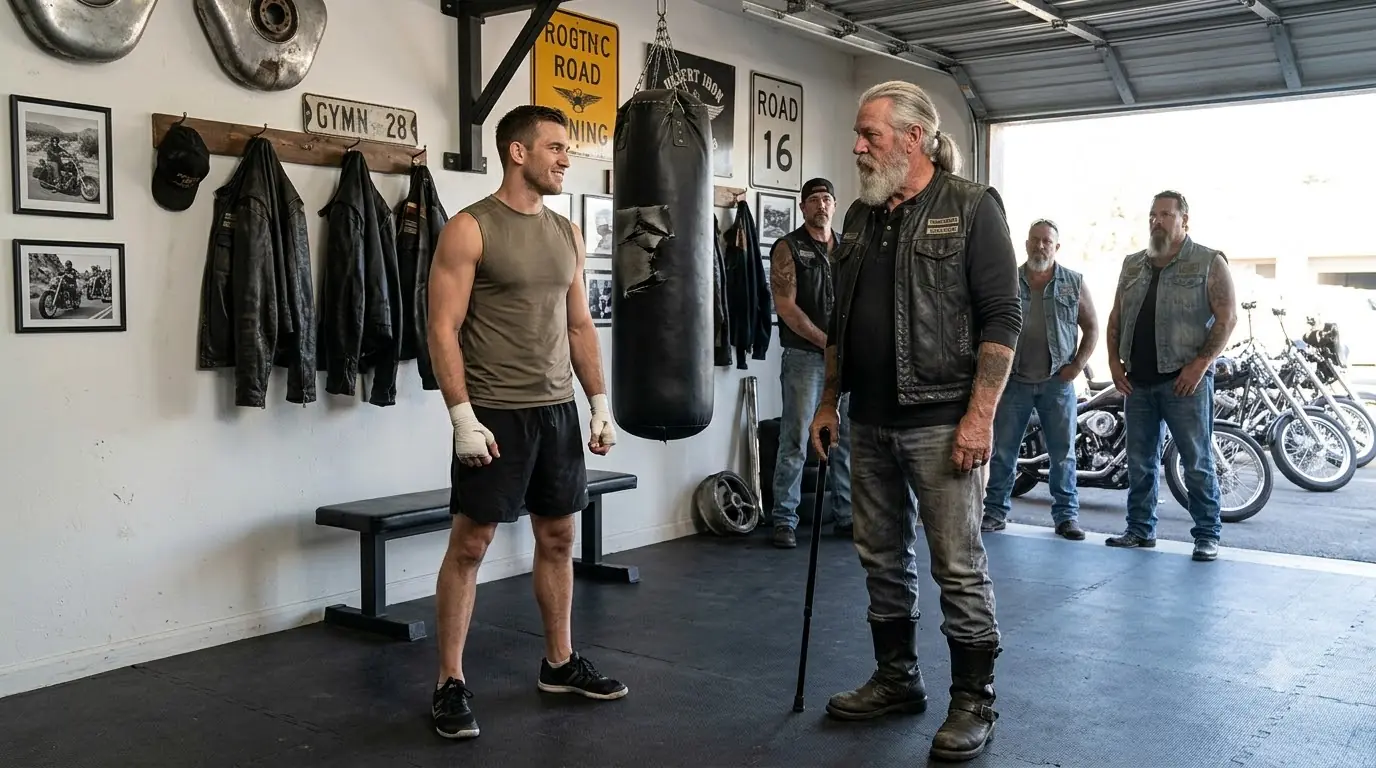
He was the welterweight champion of three regional promotions across the American Southwest. His record was 18 wins and zero losses. 12 of those wins had come before the final bell. He had a fight coming up in Las Vegas against a nationally ranked contender. And if he won that fight, he was going to be offered a contract with one of the major organizations.
He had come to Desert Iron MMA in Tucson specifically because Desert Iron was one of the best training facilities in the region. And because his head trainer, Slate Monroe, had connections there going back 15 years. He had been at Desert Iron for two and a half weeks. In that time, he had broken two heavy bags and cracked the padding on one of the practice cage fences. He had submitted four training partners in grappling rounds and knocked the headgear off a fifth with a body shot.
The man said he had felt in his back teeth. He had arrived every morning before anyone else and left every evening after the lights were on their timer. He had done everything right except for the pointing. The bench in the back corner had been the one thing at Desert Iron that Dawson had not understood from his first day. It sat against the east wall below a coat hook that had a leather vest hanging from it.
The vest was black and worn at the collar and the sleeves. It had patches on it that you could see from 10 ft away, but could not quite read unless you walked up close. And nobody at Desert Iron walked up close to look at those patches if they could help it. The man who wore the vest came in five mornings a week, sometimes 6. He arrived at 8 and left around 10:00.
And in those two hours, he stretched on the mat for 45 minutes, worked through a slow circuit of body weight movements, rode the stationary bike for 20 minutes, and then sat on the bench and drank his water and did not talk to anyone unless they talked to him first. Almost nobody talked to him first. His name was Vance Holden. He was 68 years old. He stood 6 feet and 2 in in his boots and he was broad through the chest and shoulders in the way that men get broad when they have been doing physical work their entire lives.
Not the kind of broad that comes from years of deliberate lifting, but the deeper kind, the structural kind, the kind that is built into the architecture of a man, the way steel is built into a bridge. His hair was mostly gray, pulled back in a short tail at the base of his skull. His beard was gray and reached his collarbone and was usually neatly trimmed in a way that suggested he still paid attention to things like that. His eyes were a very light gray, almost colorless in certain light, and they had the quality of resting on things rather than looking at them. The way a rock rests on the bottom of a clear stream.
He walked with a cane some days, a black aluminum cane with a rubber grip that he had bought at a pharmacy and had not yet replaced with anything better. His left knee was the problem. He had gone in for a full replacement in March, and the orthopedic surgeon at the VA had been direct about what came next: movement or stiffness, work or atrophy. The choice was his. Vance had chosen work.
He had shown up at Desert Iron on a Monday in April. He had spoken to EMTT Gallagher, who owned the gym and had run it for 22 years. And EMTT had given him a membership without asking for a credit card and without asking what he planned to do with the space. They had shaken hands in a way that suggested they had met before or that EMTT knew who he was dealing with without needing an introduction. Vance had been working the postsurgery protocol every morning since April.
It was now early October. His knee was improving. The cane was becoming more of a habit than a necessity. On most days though, he kept it close because a bad step on a wet mat could undo three months of work. And he was not a young man and he understood the math on recovery at 68.
He wore the leather vest because he had always worn the leather vest when he was not in the field or in court or somewhere formal. He had worn it for 41 years. It was as natural to him as skin. The patches on the vest told a story that Vance did not volunteer to strangers. A diamond patch on the upper left chest, a rocker at the bottom that named the Iron Piston Motorcycle Club, and below that, a second rocker that named a territory stretching from the Nevada state line down into northern Arizona.
A set of cross pistons above the diamond. Various smaller patches that meant specific things to people who knew what they meant and meant nothing to people who did not. Vance Holden had been a full patch member of Iron Piston MC for 41 years. Before that, before the club, he had been a Marine, force reconnaissance, the kind of unit that does not appear in official press releases and whose operations in certain years remain classified for reasons that have more to do with diplomacy than with danger, because the danger was not a secret to anyone who was there. Vance had done two tours.
The second one had been the longer one. He had come back with a bronze star and a collection of experiences that he kept in a part of his mind that was organized and sorted and filed away behind a door he had learned to keep closed. Not locked. Locked meant you were still fighting it. Just closed.
The way you close a door on a room that has been cleaned and put in order and does not need your attention anymore. After the Marines, he had spent six years as a hand-to-hand combat instructor for two different reconnaissance battalions. He had taught at a base in Southern California. And the curriculum he taught was not from any single martial art. It was a system assembled from pieces, from what the military had developed, from what he had learned in the field, from things he had been taught by men who had survived things that should not have been survivable, and who had figured out in real time what actually worked when the other man was not cooperating.
He had been good at teaching it. The men who had come through his curriculum had gone on to do things in the field that their unit commanders could not fully explain in their afteraction reports because the explanation would have required the commander to describe a kind of competence that did not fit into the available categories. Vance had not followed their careers. He had not needed to. He knew what he had given them and he trusted the giving.
There had been one man near the end of his time at the base, a corporal from Montana named Garrett, who had stayed after a session one evening and asked Vance how long he had been doing this. Vance had thought about the question. He had said, "I've been teaching it for 3 years. I've been using it for 12. " Garrett had looked at him and said, "Is there a difference? " Vance had looked back and said, "Yes, the teaching is what makes it real. Until you have to put it in someone else's body, you don't fully understand what you have. " He had never forgotten that conversation.
Garrett had been killed 6 months later in a place Vance could not name to anyone who asked. He was 24 years old. Vance had attended the funeral and had not said anything at the service because there was nothing to say. And he had known that and had gone anyway because presence without words is still presence. Then he had left and joined Iron Piston.
And for 41 years he had not taught it to anyone. Dawson did not know any of this. What Dawson knew was what he could see, which was a bench with a man on it and a vest on a hook and a cane leaning against the wall and a water bottle that got refilled twice in 2 hours from a small cooler the man kept beside the bench. He had observed these things with the peripheral attention of someone who has decided something is not relevant to him and is confirming that decision through casual observation. What Vance knew was considerably more because Vance had been watching Dawson with his full attention for two weeks, which was a different thing from the peripheral attention Dawson was paying him.