A billionaire disguised as a homeless man walked into a luxury restaurant and ordered the most expensive steak on the menu just to see the true faces of those in power. He was humiliated, threatened, and quietly set up for something far worse. When the steak was placed before him, a Black waitress silently slipped a small piece of paper into his hand. He read it and froze completely. Not from fear, but because for the first time that night, someone dared to tell him the truth. That note stopped him from eating and prepared him to destroy everything.
The clothes Frank Grant wore that evening were older than most of his employees, thirty-five years old to be exact. A faded jacket with holes at the elbows and pants stained with memories he had never been able to wash away. He kept them in the back of his penthouse closet, hidden behind rows of tailored suits worth more than some people earned in a year.
Tonight, for the first time in decades, he put them on again.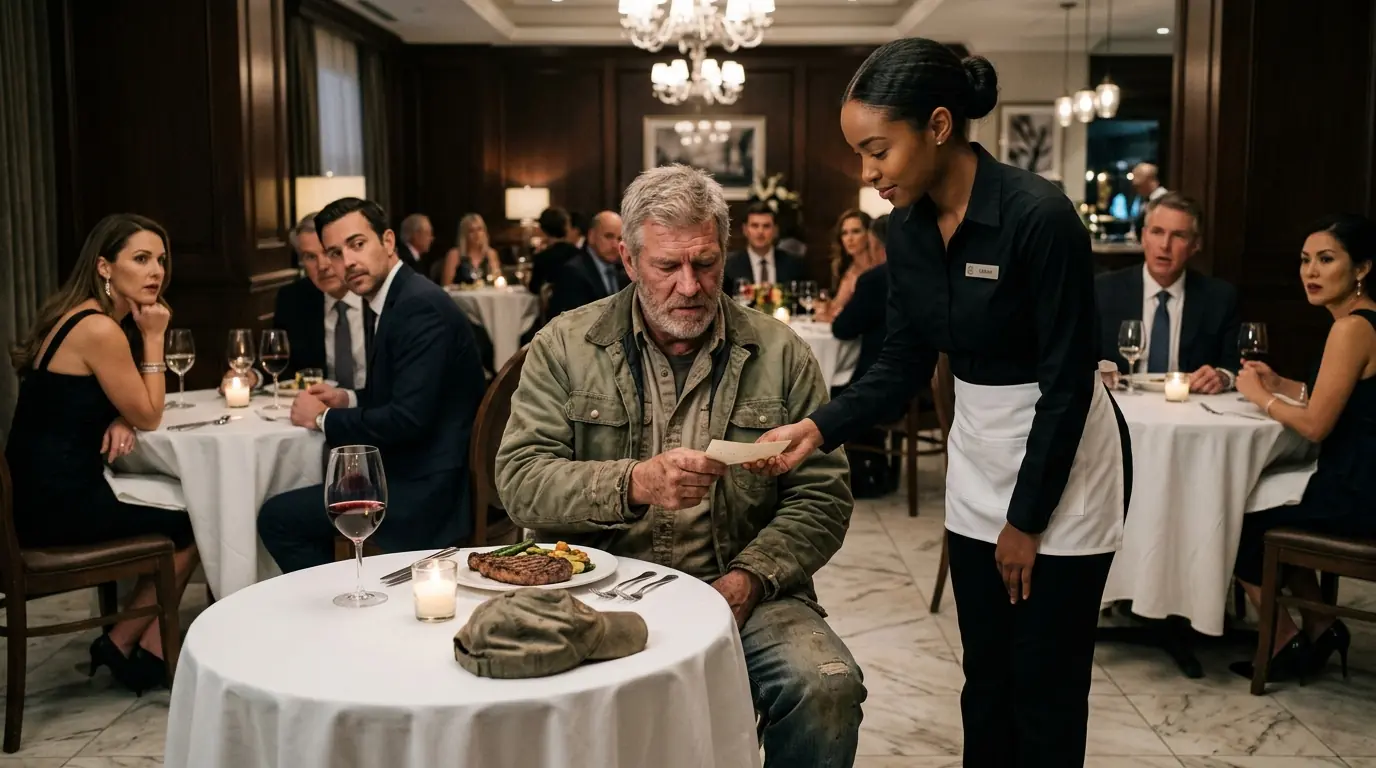
His assistant, Diana, stood near the door, watching him with open concern. She had worked beside him for twelve years and had seen him make decisions that moved markets, destroyed competitors, and changed entire industries. But this was different.
“You could send someone else,” she said. “A professional inspector. Someone trained for this.”
Frank looked at her through the mirror while rubbing dirt across his face.
“No one can see what I need to see.”
The anonymous letter had arrived a week earlier. No return address. No signature. Only a short video clip and three typed sentences on plain paper.
The video showed a ragged man being dragged out of one of his restaurants by security guards while wealthy customers laughed.
The letter said:
Laridian.
Your restaurant.
Your responsibility.
Or isn’t it?
La Meridian was the worst-performing location in his entire chain. Quarterly reports blamed the neighborhood, inflation, staffing shortages, changing demographics, and shifting dining habits. Frank believed none of it.
He had built his company on one rule.
Every person who walks through the door deserves dignity.
If that principle had died inside a restaurant carrying his name, then something larger had died with it.
He removed his Patek Philippe watch, slipped off his wedding ring, and placed both on the dresser. The only item he kept was a small phone hidden inside the sole of his shoe, capable of recording audio and placing emergency calls.
As he headed toward the door, Diana made one final attempt.
“At least take security.”
Frank stopped.
The scar on his right hand, the one he had carried since he was twenty-three years old, seemed to burn under the skin. A chef had poured boiling water on him after catching him digging through restaurant trash for food.
“Thirty-five years ago, no one protected me,” he said quietly. “And no one is protecting the people walking into that restaurant right now. That’s why I go alone.”
Diana nodded reluctantly.
“I’ll be across the street with legal and security. One signal and we’re inside in thirty seconds.”
Frank allowed himself a faint smile.
“That’s why I keep you around.”
At seven o’clock on a Saturday evening, La Meridian glowed with expensive confidence.
Crystal chandeliers reflected warm light across white tablecloths. Soft jazz floated through hidden speakers. The smell of seared beef, garlic butter, and rare wine drifted through the air.
It was full of the usual people.
Men in designer suits discussing deals.
Women wrapped in jewelry brighter than the chandeliers.
Couples paying two hundred dollars a plate for the privilege of being seen in the right room.
Sonia Williams had worked there for three years, long enough to know the polished surface hid rot underneath.
She moved between tables with practiced grace, refilling glasses and clearing plates, invisible in the way service workers were expected to be.
Her feet ached from standing since noon. But pain was background noise now.
Her seven-year-old daughter Lily had another doctor’s appointment next week. The co-pay for asthma medication had gone up again. Her younger brother’s college tuition was due at the end of the month.
She did math in her head while smiling at strangers.
That was adulthood.
She had also learned how to read people by their eyes.
It was a survival skill from childhood, from moving through rooms where she was tolerated but never welcomed.
She could tell within seconds whether someone would tip well, tip badly, or not see her as human at all.
When the front door opened and a homeless man walked in, she knew instantly something was wrong.
Not with him.
With everyone else.
His clothes were torn. His beard untrimmed. He carried the smell of someone who had not showered in days.
But his posture was wrong.
His shoulders were too straight.
His stride too steady.
His eyes too alert.
Those were not the eyes of a defeated man.
The hostess froze with a brittle smile.
The security guard moved closer, hand reaching for his radio.
Then Ricky Thornton appeared.
Ricky had managed La Meridian for five years. He wore authority like a weapon and used it mostly on people beneath him, which meant nearly everyone.
He charmed investors and corporate visitors. He insulted busboys and dishwashers when cameras were not watching.
“Sir,” Ricky said, voice dripping false courtesy. “I’m afraid you’ve made a mistake. This establishment may not suit your situation.”
The homeless man did not flinch.
Instead, he reached into his pocket and pulled out a thick wad of cash.
More money than Sonia earned in a month.
“Table seven,” he said calmly. “The Wagyu A5. Medium rare. I’ll pay in advance.”
Shock moved through the room like electricity.
Ricky’s smile twitched between greed and disgust.
He could not reject a paying customer. Hospitality rule number one.
“Of course,” Ricky said through clenched teeth. “Right this way.”
He led the man to the worst table in the building.
A corner near the kitchen doors and restroom hallway, where noise was loudest and the occasional odor drifted in from the service alley.
It was the humiliation table.
The place given to guests management wanted gone quickly.
The homeless man sat without complaint.
Ricky scanned the floor and found Sonia.
“You,” he said. “You’re always talking about helping people. Here’s your chance.”
Punishment disguised as assignment.
They both knew it.
Sonia approached with a water pitcher and poured carefully without meeting the man’s eyes.
Then she felt him watching her.
She looked up.
Their eyes met.
Something passed between them in that instant.
Recognition maybe.
Or warning.
She could not name it.
But it unsettled her deeply.
This man was not what he appeared to be.
In the kitchen, Ricky pulled aside the sous chef.
Carlos Taylor was twenty-eight, talented, exhausted, and trapped. He was good enough to run his own kitchen someday, but a pregnant wife at home and growing medical debt kept him chained where he was.
Ricky led him into a blind corner away from cameras.
“The Wagyu for the homeless guy,” Ricky said quietly. “Use the one sent back yesterday. The one that sat out two hours before we refroze it.”
Carlos stared at him.
“That steak is compromised.”
“If he eats it, what?” Ricky said softly. “He gets sick? Who believes a homeless man over a five-star restaurant?”
Carlos said nothing.
Ricky leaned closer.
“Consider it a favor. Might be the best meal of his life.”
“If he gets seriously ill—”
Ricky’s face hardened.
“Remember the two-thousand-dollar bottle you dropped last month? The one I covered so it didn’t come from your check?”
The threat hung in the air.
“Do what I tell you. Or explain unemployment to your pregnant wife.”
Carlos stood frozen.
Then slowly nodded.
“Good man,” Ricky said.
Neither noticed Sonia behind the spice rack, close enough to hear every word.
Her heart pounded so hard she thought it might expose her.
Ricky walked away.
Carlos turned and nearly collided with her.
Their eyes met.
He knew she had heard.
He shook his head once.
Don’t say anything.
Don’t do anything.
Forget it.
Then he walked off, leaving Sonia alone with a choice that could cost everything.
If she stayed silent, she kept her job.
She paid Lily’s medication.
She helped her brother finish school.
She survived.
If she spoke, Ricky would destroy her. Fire her. Blacklist her.
But if she did nothing, a man was about to eat poisoned food.
And part of that would belong to her forever.
Sonia stood motionless for three full seconds while the kitchen roared around her.
Pans clanged.
Orders were shouted.
Steam hissed from the grill.
But inside her mind everything had gone silent.
She had learned long ago that evil rarely announces itself dramatically. It usually arrived disguised as convenience.
Stay quiet.
Mind your business.
Protect your own.
That was how people survived.
That was also how harm spread.
Carlos wrapped the steak plate with trembling precision. The marbling glistened under butter. Rosemary smoked gently beside it. On appearance alone, it was perfection.
On truth, it was dangerous.
He placed the plate on the pass.
“Table seven.”
Ricky looked directly at Sonia.
“Run it.”
She stepped forward automatically, hands numb.
Then she did the only thing she could think of.
At the server station she grabbed a guest check slip, tore off the blank back corner, and wrote six words with a shaking pen.
DON’T EAT THIS. TRUST ME.
She folded the note twice, tucked it beneath the linen underliner of the plate, and lifted the tray.
Every step to table seven felt louder than the music.
The homeless man sat straight-backed, hands folded, eyes calmly scanning the room as if memorizing it.
She lowered the plate.
“Your steak, sir.”
As she set it down, her fingers slipped the folded paper into his palm beneath the edge of the table.
No one else saw.
He looked at her only once.
No nod.
No gratitude.
Just sharp understanding.
Then she walked away before her knees gave out.
Across the room, Ricky smiled to himself and poured wine for investors.
Frank Grant waited exactly thirty seconds before opening the note under the tablecloth.
DON’T EAT THIS. TRUST ME.
His jaw tightened.
So the letter had been right.
Maybe worse than right.
He picked up the steak knife, cut into the meat, lifted a slice toward his mouth, then stopped dramatically enough for nearby tables to notice.
He sniffed it once.
Then set the fork down.
“Manager,” he said loudly.
Ricky turned with polished annoyance.
“Yes, sir?”
“This steak smells spoiled.”
Laughter erupted from a nearby finance table.
One man muttered, “Imagine a bum critiquing Wagyu.”
Ricky approached slowly.
“Our standards are exceptional, sir.”
“Then taste it.”
The room quieted.
Ricky chuckled.
“That isn’t how restaurants work.”
“It is tonight.”
Phones began to rise discreetly.
Frank pushed the plate toward him.
“If I’m wrong, I’ll apologize and leave.”
Ricky’s smile hardened.
“And if you’re right?”
Frank leaned back.
“Then you have a much larger problem than me.”
Ricky did not touch the fork.
Instead he snapped toward security.
“Remove this man immediately.”
Two guards advanced.
Sonia felt panic surge through her chest.
If they dragged him out now, the poisoned plate would vanish, the truth buried again, and she would still be exposed.
Before the guards reached him, Frank stood.
He moved faster than any homeless man should.
With one hand he caught the first guard’s wrist and redirected him aside without violence. The second halted instinctively.
The room gasped.
Frank reached into his shoe, removed the hidden phone, and pressed one button.
The front doors opened.
Diana entered with three attorneys, two security professionals, and a city health inspector wearing official identification.
Behind them came cameras from the building security feed team.
Ricky went pale.
Frank straightened, removed the filthy cap from his head, and wiped a hand across his beard line, peeling away part of the disguise adhesive.
Recognition spread table by table like fire.
Someone whispered first.
Then louder.
“Frank Grant.”
“The Frank Grant?”
“Owner of the entire chain.”
Ricky staggered back.
“No…”
Frank’s voice cut through the room like steel.
“Yes.”
The investors at table three stood immediately.
Phones fully out now.
Some recording.
Some calling people who would want this gossip instantly.
Frank pointed to the steak.
“Secure that plate.”
The health inspector stepped forward with gloves and evidence bags.
Carlos dropped a pan in the kitchen.
Ricky found his voice.
“This is a misunderstanding.”
Frank turned slowly toward him.
“You seated a paying customer beside a restroom.”
Ricky swallowed.
“You ordered compromised food served.”
“I never—”
Frank held up the hidden phone.
“Audio recording from the last eighteen minutes says otherwise.”
Silence.
Then Frank looked across the room.
“How many staff here have been threatened, humiliated, underpaid, or forced to choose between ethics and survival?”
No one moved.
Then Sonia raised her hand.
Carlos followed.
Then a dishwasher.
Then two bussers.
Then three servers.
Then almost the entire floor.
Ricky’s face collapsed into something small and frightened.
Frank nodded once.
“Good. We begin there.”
The health inspector unwrapped the steak sample and sniffed.
His expression changed instantly.
“This needs immediate lab testing.”
Carlos stepped forward shaking.
“I’m sorry,” he said. “He ordered me to use returned product. I should’ve refused.”
Frank studied him.
“Why didn’t you?”
“My wife is seven months pregnant. We’re behind on rent.”
Truth landed heavier than excuses ever do.
Frank nodded again.
“Stay. We’ll talk.”
Ricky lunged suddenly toward the office hallway.
Security intercepted him before he made three steps.
The elegant dining room had become a courtroom.
One elderly woman sipping champagne raised her glass toward Frank.
“About time owners started eating their own menu.”
Even Frank laughed at that.
Then he turned to Sonia.
“You wrote the note.”
She froze.
Ricky shouted from security’s grip.
“She sabotaged service! Fire her!”
Frank ignored him.
“What’s your name?”
“Sonia Williams.”
“You understood the risk?”
“Yes.”
“Why do it?”
Her throat tightened.
“Because if I stayed quiet, I’d still need the paycheck. But I wouldn’t deserve it.”
The room fell still again.
Frank looked at Diana.
“Write that down.”
He then addressed every guest.
“Dinner tonight is complimentary. Those offended by witnessing accountability are free never to return.”
Half the room applauded.
The other half looked offended exactly as promised.
By midnight #HomelessBillionaire was the top trend in three states.
But inside a private conference room above the restaurant, Frank cared less about headlines than payroll files spread across the table.
Sonia sat across from him, exhausted and suspicious.
Carlos beside her.
Diana with laptop open.
Frank removed the last pieces of disguise and suddenly looked older.
More tired.
More human.
“How much do they pay you?” he asked Sonia.
She told him.
He stared.
“That’s below internal target.”
She almost smiled.
“Targets don’t pay rent.”
He accepted the hit.
Carlos spoke next, explaining forced off-clock prep, manipulated tip pools, spoiled inventory relabeled, harassment complaints buried.
Each sentence widened the damage.
Frank finally leaned back.
“I built this company after being thrown out of restaurants like that.”
He glanced at the stained jacket folded nearby.
“I promised myself if I ever owned one, no one would be treated as disposable.”
Sonia asked the obvious question.
“Then how did this happen?”
He met her eyes directly.
“Because success grows faster than supervision. And because I believed reports more than people.”
No one in power says that often enough.
Diana closed her laptop.
“We’ve already suspended Ricky, Patterson from two linked locations, and regional oversight pending review.”
Frank looked at Sonia.
“What does your daughter need?”
She stiffened instantly.
“I don’t need charity.”
“Good,” he said. “Neither do I.”
He slid a paper across the table.
Regional ethics director, interim. Triple current pay. Benefits effective tomorrow. Full authority to report directly to me.
She stared at it.
“I’m a waitress.”
“You’re the only person in this building who chose principle when it was expensive.”
Then he looked at Carlos.
“Kitchen operations training program. If talent matches your honesty tonight, I’ll help you open your own place one day.”
Carlos cried openly.
No one mocked him.
Some tears are earned.
tiếpPHẦN 3/3
The next morning every news channel replayed the footage.
The disguised billionaire.
The spoiled steak.
The corrupt manager dragged out in handcuffs for fraud and health violations.
But the clip people watched most was simpler.
A Black waitress slipping a folded note into a stranger’s hand while risking everything.
Commentators called it courage.
Frank called it payroll evidence that conscience still existed in his company.
By noon La Meridian was closed indefinitely.
By sunset every Grant Dining Group location received emergency inspectors, anonymous employee hotlines, wage audits, food safety reviews, and management interviews conducted by outside counsel.
Executives protested the cost.
Frank answered with one sentence.
“Cheaper than moral bankruptcy.”
Sonia spent that week in borrowed office clothes learning systems she had only ever felt from the bottom.
Complaint forms routed nowhere.
Bonuses tied to labor suppression.
Customer recovery vouchers approved faster than employee hardship requests.
Promotion tracks requiring “executive polish,” a phrase broad enough to hide bias behind grammar.
She circled items in red ink until the pages looked wounded.
Diana watched with admiration.
“You’re adjusting quickly.”
“No,” Sonia said. “I’m translating pain into paperwork.”
That line became famous internally.
Carlos entered the culinary leadership program three weeks later. He arrived early, stayed late, and cooked like a man trying to outrun old fear. His wife gave birth to twins that winter. Frank sent diapers, not flowers.
Ricky Thornton attempted the usual route.
Public statement.
Misunderstood standards.
Selective editing.
Victim of agenda politics.
Then the lab report confirmed bacterial contamination in the steak sample, and three former employees filed sworn statements about retaliation, wage theft, and discriminatory treatment.
He disappeared from television after that.
La Meridian reopened four months later.
Same chandeliers.
Same white tablecloths.
Different soul.
The restroom corner table was removed entirely and replaced with a small piano stage for local musicians.
Every employee received living-wage adjustments.
Tip transparency became mandatory.
Managers trained under independent review.
Anonymous surveys published monthly.
And near the entrance, framed in simple black wood, hung a copy of the note that changed everything.
DON’T EAT THIS. TRUST ME.
No names.
No branding.
Just six words.
Guests asked about it constantly.
Servers would smile and say, “House history.”
Sonia hated speeches but was forced into several.
Universities invited her to discuss ethics.
Hospitality groups asked her to keynote conferences.
A documentary producer offered six figures for exclusive rights.
She declined most of it.
At home, Lily only cared that her mother now attended school plays and no longer cried over bills at night.
One evening Lily asked, “Were you scared?”
Sonia answered honestly.
“Yes.”
“Then why’d you do it?”
She tucked the blanket around her daughter.
“Because brave isn’t the absence of fear. It’s deciding something else matters more.”
Lily considered that seriously.
“Like when I get shots?”
“Exactly like that.”
Frank changed too, though less publicly.
He began visiting locations unannounced, not in disguise every time, but often enough that managers feared arrogance more than audits.
He ate in staff cafeterias.
Read exit interviews personally.
Created an employee emergency fund seeded with the amount of one canceled yacht purchase.
The board hated that story leaking.
He enjoyed it leaking.
At a shareholder meeting one investor complained that compassion was hurting margins.
Frank asked him, “Compared to what?”
No answer came.
Stocks rose anyway.
Apparently consumers liked eating at places where workers looked less defeated.
A year later Carlos opened his own restaurant with Grant-backed financing.
Small place.
Thirty seats.
No chandeliers.
Reservation list three months long.
He named it Seventh Table.
When reporters asked why, he said, “Because bad tables create good memory when you survive them.”
Sonia laughed harder than anyone.
Diana eventually confessed something over coffee.
“The anonymous letter that started this? I sent it.”
Sonia nearly dropped her mug.
“You?”
“I kept hearing complaints filtered away before they reached Frank. So I forced the issue.”
“You manipulated him.”
“I introduced truth dramatically.”
That sounded like Diana.
Sonia never told Frank she knew.
Some loyalty works better unnamed.
Years later, Frank invited Sonia to dinner at La Meridian after closing.
No press.
No executives.
Just two plates and the quiet room where they first met.
He placed the old stained jacket over the chair beside him.
“I keep this visible now,” he said.
“To stay humble?”
“To stay accurate.”
They ate steak, perfectly sourced and obsessively tested.
Halfway through dinner he asked:
“What made you trust a stranger enough to pass that note?”
“I didn’t trust you,” Sonia said. “I trusted who I’d become if I acted.”
He smiled slowly.
“That’s better.”
When Frank Grant died decades later, obituaries praised the empire, acquisitions, philanthropy, and turnaround genius.
Inside the company, workers remembered something else.
That after becoming rich enough to avoid discomfort forever, he chose to walk back into it.
At the memorial, chefs, dishwashers, hosts, servers, and executives filled the hall together.
Carlos catered.
Diana organized flawlessly.
Sonia spoke last.
“A lot of people say he saved the company that night,” she said.
“They’re wrong.”
She glanced toward the framed jacket near the stage.
“He let the company be saved.”
Then she held up a folded paper, yellow with age.
The original note.
Gasps moved through the room.
“I kept this because six words can outlive buildings.”
She opened it carefully.
DON’T EAT THIS. TRUST ME.
Then added softly:
“He did.”
The audience stood for a long time.
Some fortunes are measured in assets.
The rarest ones are measured by whether truth could still reach you after success made lying convenient.
Most people remembered the disguise.
They remembered the headlines, the cameras, the dramatic reveal of a billionaire in torn clothes exposing corruption in his own restaurant.
It made a better story.
It fit television.
It fit social media.
It fit the old fantasy that justice arrives through spectacle.
But the disguise was never the most important costume in the room.
The real disguises were quieter.
Authority dressed as leadership.
Cruelty dressed as standards.
Fear dressed as practicality.
Silence dressed as professionalism.
Those were the masks that nearly caused real harm.
Frank Grant only removed one costume that night.
Sonia removed several.
She took off the belief that survival required surrender.
She took off the lesson many workers are taught: stay quiet, keep the job, let someone else suffer.
She took off the idea that powerless people cannot interrupt powerful systems.
That was the deeper reveal.
Not who the homeless man was.
Who she was.
People often imagine courage belongs to those with money, titles, lawyers, security teams, and options.
But courage is most visible when exercised by someone who has something to lose.
A paycheck.
Health insurance.
Rent money.
Reputation.
Future references.
Sonia risked all of it for a stranger she did not know.
That is why the note mattered more than the steak.
The paper was small.
The consequence was enormous.
Because once truth is handed directly to someone willing to act on it, whole structures can move.
La Meridian changed.
The company changed.
Frank changed.
Carlos changed.
Even guests changed, though more slowly.
Some began noticing servers by name.
Some asked where ingredients came from.
Some tipped differently after learning how little they had understood before.
Transformation rarely begins where speeches happen.
It begins where one person quietly refuses to cooperate with wrong.
Years later hospitality schools studied the case.
Executives discussed culture, oversight, whistleblower systems, anonymous reporting, ethics architecture.
Useful things.
Necessary things.
But Sonia always summarized it more simply.
“If a place depends on good people staying silent, it deserves to collapse.”
Students wrote that down every time.
The framed note still hangs near the entrance.
Many guests pass it without asking.
Some smile politely and move on.
A few stop long enough to feel something uncomfortable.
Those are usually the ones who know how often truth arrives folded small, easy to ignore, and handed over in ordinary moments.
And somewhere in the memory of one elegant dining room, a plate of steak still asks a permanent question:
When wrongdoing is placed directly in front of you, will you serve it, excuse it, or warn someone in time?