A man walked into a cafe. Toast and coffee, please. The manager glanced at him and leaned toward her cashier. Charge that black man double. He won't notice. The cashier froze. The manager stepped closer. Look at his clothes. People like that don't check receipts. They're just happy someone let them through the door. Two employees stared at the floor. A customer at the next table heard every word and looked away. But what the manager said next was worse. And what she didn't know about the quiet man at the window table was about to become the most expensive mistake of her career. He won't notice. She said that out loud in front of her own staff in a cafe she didn't even own. Harrison Townsend stood in the lobby of Sunrise Toastery's headquarters and straightened the framed award on the wall for the third time that week. Best workplace culture, it read, awarded by the State Chamber of Commerce. Gold lettering on cream stock. He'd hung it himself the day it arrived. 11 years ago, Harrison had sold toast from a cart with a crooked wheel on the corner of 5th and Broad. No employees, no brand, just a handwritten menu taped to a cutting board and the smell of sourdough at 6:00 in the morning. Now he had 11 stores, 86 employees, and 3,000 toasts leaving his kitchens every day. He still kept that original handwritten menu in his desk drawer, folded in quarters, the ink fading at the creases. He believed every word on that plaque.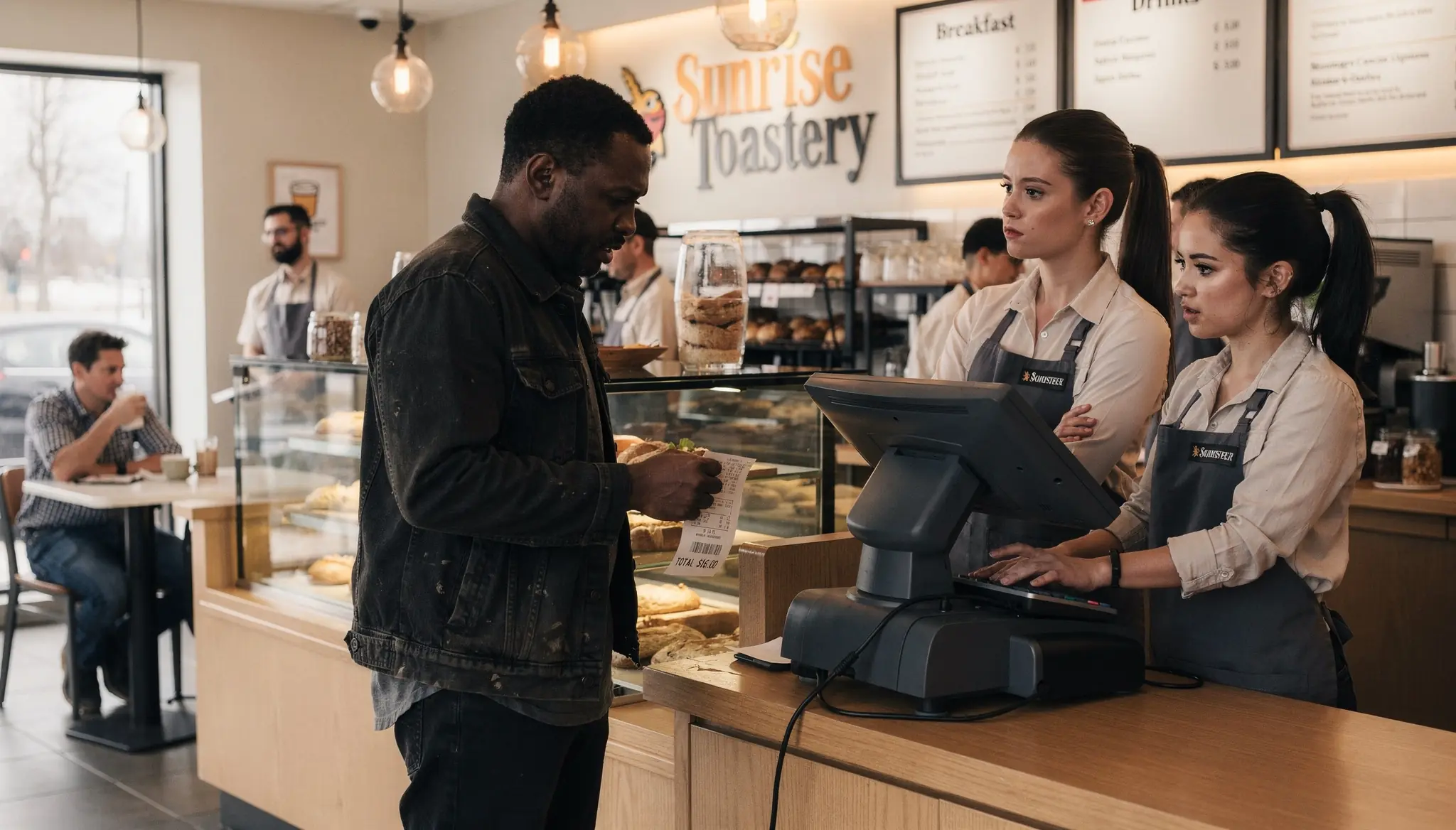
That belief lasted until 2:14 p.m. on a Monday afternoon when Lorraine Price walked into his office holding a printed email. Lorraine was his VP of HR. 15 years in hospitality, calm under fire, not the type to knock without reason. But she knocked twice. Her face was tight when she sat down. "This came through the anonymous channel," she said. She placed the paper on his desk. Subject: Two menus and two sets of rules. Elm Street. No sender name, no return address. The body was three paragraphs long, single-spaced, and specific in a way that made Harrison's chest tighten.
The email claimed that employees at the Elm Street location were being forced to charge black and Latino customers hidden surcharges on identical menu items. It claimed that anyone who refused was punished through scheduling, closing shifts, cut hours, eventual resignation. It referenced dates, dollar amounts, shift patterns, and it referenced something Harrison didn't understand. The schedule on the wall. "Could be a disgruntled employee," Lorraine said. Her voice was careful. Harrison read the second paragraph again. "Disgruntled employees exaggerate," he said. "They don't attach spreadsheets."
He pulled up Elm Street's performance dashboard on his monitor. Revenue, top three in the chain consistently. Customer satisfaction, 4.6 stars. On paper, Elm Street was a model store. But one metric screamed from the bottom of the report. Minority employee turnover was three times the chain average. Harrison scrolled through exit interviews. Every single one coded voluntary resignation. Not one complaint filed. Not one. That wasn't normal. That was silence.
He leaned back. If he investigated publicly, sent auditors, called meetings, the store manager would have time to cover tracks. If he did nothing, the pattern would continue and the award on his wall would be decoration over rot. Harrison opened the email again and reread one line near the bottom. Your audit team came 6 months ago. Paige had 2 weeks' notice. She cleaned the schedule the night before. He closed the laptop.
Harrison had grown up in a mixed-race neighborhood on the south side of Decatur. His father, Calvin Townsend, ran a barbershop on Elm Row for 22 years until the landlord doubled the rent on every black-owned business on the block and left the rest untouched. Calvin didn't fight. He packed his clippers into a duffel bag, locked the door, and drove home without saying a word. Harrison was 14. He'd sat in the passenger seat and watched his father's hands on the steering wheel, steady and silent, and made a promise to himself that he'd build something where that could never happen.
Now an anonymous email was telling him it was happening inside his own company. He called Lorraine back into his office. She stood in the doorway. "I need to see it myself," he said. She started to object. Liability, optics, the board. Harrison pulled the food cart menu from his desk drawer and set it next to the framed award. "This menu is who we were," he said. "That plaque is who we say we are. I need to find out which one is real." He told her the plan was simple. He'd drive to Elm Street tomorrow morning, walk in like any other customer, sit down, order food, and watch. "I'm not sending auditors. I'm not calling ahead. I'm going to sit down, order a toast, and watch." Lorraine didn't argue. She'd known Harrison long enough to recognize the voice. He drove home that night with the food cart menu on the passenger seat, right where his father's duffel bag used to sit.
At 9:12 on a Tuesday morning, Harrison Townsend pushed open the front door of his own store, and no one recognized him. A bell chimed. The place smelled like butter and fresh sourdough and something sweet underneath. Maple syrup, maybe, or the caramel drizzle they used on the seasonal drinks. Clean counters, chalkboard menu. A young woman steaming milk behind the espresso machine. Everything looked exactly the way it was supposed to look. And that was the first thing Harrison noted.
The smoothie blender behind the counter hummed constantly, a thick mechanical drone that swallowed conversations. Employees talked freely behind it, their voices buried under the noise. From his seat, Harrison could see the wall behind the register. A printed schedule was taped there. Names in rows, shifts in columns. Some names were highlighted yellow, others weren't. He couldn't read them from this distance, but the pattern, color, no color, color, no color, was visible even through the gap between the pastry case and the register. He ate his toast slowly, watched.
A white couple stepped up and ordered two mango smoothies, $6 each. They paid, laughed about something, and moved to the pickup counter. 3 minutes later, a black woman in hospital scrubs ordered the same smoothie. The cashier hesitated. A micro pause. Fingers hovering over the screen. Then she glanced toward Paige and tapped in the order. Mango smoothie, artisan blend, $9.50. The woman in scrubs tapped her card without looking at the total. She picked up her drink and left.
Harrison frowned. $6. $9.50. Same drink. Could be a size difference, a modification. He wasn't sure. He was sure 20 minutes later. A different employee took over the register, a woman Harrison recognized from the email's description, though he didn't know her name yet. Fast hands, confident posture, clearly the most experienced person on the floor. A black family of four walked in. The woman rang them up, menu price. Harrison saw the total on the screen from where he sat. Correct. Then Paige appeared. She materialized behind the cashier like she'd been watching on a monitor, leaned in and whispered something. The cashier's hand froze on the touchscreen, mid-tap, fingers suspended. A beat. 1 second. 2. And then she re-rang the order. The total jumped. The family paid. They didn't notice. The cashier's jaw tightened. She didn't look up.
Harrison set his toast down. He ordered a second coffee at 11:30 to justify staying. The lunch rush was building. The blender had been running all morning, that constant wall of white noise that made the counter feel like a private room. At 11:42 a.m., the blender cycle ended. 5 seconds of silence. The background music was between tracks. The espresso machine was off. For one brief window, the cafe was quiet enough to hear a whisper from the next table.
A black man in a work jacket stepped up to the counter and ordered a basic toast and coffee. A newer cashier, not the woman whose hand had frozen, took his order. Paige walked past the register. She didn't whisper. She didn't need to. She spoke into that 5-second silence without realizing it had arrived. "Charge that black man double. Artisan surcharge. He won't notice." Harrison was sitting 6 feet away. His coffee cup was halfway to his mouth. It stopped there. The register beeped. The man tapped his card. $16, exactly double. The receipt curled out. The man walked away checking his phone. He never looked at the receipt.
Harrison's hand tightened around the cup. His knuckles whitened. He wanted to stand. He wanted to say something. He couldn't. Not yet. One sentence in a cafe wasn't a case. It was a complaint.
Then the newer cashier hesitated. A visible flinch. Discomfort crossing her face like a shadow. Paige stepped closer. She was 3 feet from Harrison's table. Close enough that he could read the name tag on her apron. "And if Jada asks why the price changed, tell her the system updated it automatically. She'll stop asking." Paige's voice was calm, patient. Almost kind. The tone of a manager coaching a new hire on food safety. "They always do."
Harrison set his cup down slowly. His jaw locked. It wasn't just a woman cheating a customer. It was a woman building a machine. Training new employees to lie to their black co-workers. Manufacturing complicity. Normalizing silence. "They always do" meant this had happened before. Not once, not twice, but enough times to become a certainty in Paige Whitley's voice. Charging a man double was a crime against one customer. Training someone to lie about it and to gaslight the co-worker who might ask was the architecture of corruption. One was an act, the other was a system.
Harrison left his toast half-eaten on the table. He walked to the parking lot. He sat in his car and stared at the Elm Street sign through the windshield. His hands were shaking when he called Lorraine. Not from fear. From restraint. He sat in the driver's seat with the engine off staring at the Elm Street storefront through the windshield. The best brunch in town decal on the window caught the midday sun. Everything about the exterior looked clean. That was the problem with rot. It never showed from the parking lot.
He told her everything. The smoothie, the frozen hand, the double charge, and the words that still sat in his chest like a stone. "They always do." Lorraine listened without interrupting. When he finished, she said the words he expected. "I'm calling legal. We can have someone there by Thursday." "And what happens Thursday? Paige has 2 days to wipe the POS history, shred whatever she keeps in that desk, and coach every employee on what to say. By the time legal walks in, Elm Street will look exactly the way it looked when the audit team visited 6 months ago. Clean. Perfect. And the same people will keep getting hurt."
"Harrison, one sentence from a customer seat, that's a complaint. Not a case." "I need the transaction records. I need to see that schedule up close. I need the tip distribution numbers. I need whatever she's keeping in that back office." Silence on the line. "How?" Lorraine asked. "I apply for a job. Prep cook. Different name. I get behind that counter and I find the paper trail before she can burn it."
He could hear Lorraine breathing. She was calculating. Liability, exposure, what the board would say. But she'd also read the anonymous email. And she'd seen the turnover numbers. And she knew Harrison well enough to understand that the voice on the phone was not a voice that could be redirected. She didn't say no. She said she'd alert outside counsel to be on standby and asked him to set a deadline. "48 hours," Harrison said. "Once I'm inside. If I don't have what I need by then, we go in with what we've got."
He submitted a fake application that night from his kitchen table. Name, Hank Davis. Experience, 6 years line cooking. Available immediately. Elm Street was always short-staffed. The turnover the data had shown was real and it meant Paige was always hiring. He got a callback within 2 hours. Start tomorrow, 6:00 a.m.
The next morning Harrison walked into Elm Street for the second time in 2 days. Same bell, same butter smell. Paige greeted him at the door. Sharp ponytail, clipboard, brisk handshake. She assigned him to prep station without a second glance. She didn't recognize him. He'd been sitting at her window table 24 hours ago eating toast she'd priced at $8. And she had no memory of his face. That was how invisible customers were to Paige Whitley unless she was deciding how much to charge them.
And now Harrison was behind the counter standing 3 feet from the schedule on the wall. Seeing it up close for the first time. Under the fluorescent light, the pattern was unmistakable. Six names highlighted yellow. Five names unhighlighted. The highlighted names had morning shifts, weekend shifts, prime hours, prime tips. The unhighlighted names had the same three letters repeating like a stutter. C L O P. C L O P. C L O P. Close at 11:00, open at 5:00. Close at 11:00, open at 5:00. He found one name, Jada Williams, in the unhighlighted column. Four clopenings in a single week. He did the math. 5 hours between shifts minus commute minus eating minus existing. No one could sustain that. No one was meant to. That was the point.
Harrison pulled out his phone, pretended to check a text, and took a photo of the schedule. The schedule on the wall. He understood the anonymous email now. It wasn't a metaphor. It was a weapon taped to drywall in plain sight and no one had questioned it because it looked like furniture.
Harrison worked the prep line for 3 hours that first morning and kept a tally on a napkin hidden in his apron pocket. Every time a black or Latino customer was charged the artisan surcharge, he made a mark. By noon the count was 11. White customers charged the surcharge. Zero. Same menu, same toaster, same bread. He still had the $8 receipt from yesterday in his shirt pocket. From behind the counter he watched the same toast leave the same flat top and arrive at the register at two different prices depending on who ordered it.
At 5:02 p.m. the shift changed. Jada Williams walked in. The woman whose hand had frozen on the register. Red eyes, tight jaw. She'd closed the store at 11:00 last night and was back 5 hours later. She tied her apron without a word, checked the schedule. Her eyes didn't linger on it the way Harrison's had. She already knew what it said. And started working.
Within minutes she was training a new hire on the register while running the smoothie station by herself. Two jobs. No complaint. The most competent person in the building running on fumes. At closing time Harrison watched Paige collect the tip jar. It was a clear plastic container visibly full. Bills folded and pressed against the sides like leaves in a jar. Paige carried it to the back office. Harrison lingered near the door pretending to restock napkins. He heard counting. The rustle of bills. Then Paige emerged and distributed. $42 to each of three employees. All highlighted names, all white, all morning shift. $8 to Jada. $6 to a black employee named Terrell who'd worked the same 12-hour stretch. The jar had held at least $200. Harrison could see the residue of bills still stuck to the plastic. The math didn't add up and Paige didn't offer an explanation. And nobody asked for one.
Jada folded the $8 into her back pocket. She didn't look at it. She didn't look at anyone. She said one thing so quietly that Harrison almost missed it. "$8. 12 hours."
In the break room during day two, Harrison ate his lunch near two white employees, a college kid named Brett and a woman in her 30s who'd worked at Elm Street for 2 years. Brett mentioned casually between bites of a turkey sandwich that Paige called the unhighlighted staff the flex team. They got the leftover shifts and the leftover tips. "It's just how it works here," Brett said, the way you'd explain that the walk-in freezer sticks or the hot water takes a minute. The other employee nodded. Neither one flinched. Neither one lowered their voice.
Harrison looked around the break room. A laminated poster on the wall read, "Sunrise Toastery Values: Respect, Fairness, Community." The poster was 6 inches from the schedule. Fairness and discrimination side by side separated by a strip of drywall. The system wasn't hidden by secrecy. It was hidden by acceptance. When something wrong happens long enough, it stops looking wrong. It starts looking like furniture.
That evening Harrison found Jada restocking paper cups alone in the supply closet. Fluorescent light, the smell of cardboard and industrial cleaner. He took a risk. Kept his voice low. "Hey. Those clopening shifts, how long has it been like that?" Jada looked at him sideways. Her eyes measured him the way you measure a stranger who's standing too close, calculating the distance between curiosity and danger. Long pause. Her hands kept stacking cups one inside the other, a rhythm she could do in her sleep. "4 months," she said. "Since I told Paige I wouldn't charge the surcharge anymore." She didn't elaborate. She went back to the cups. But her hands were steadier than before. The slight tremor Harrison had noticed when she started the sentence was gone now. Someone had asked. Someone had listened without flinching. That was enough for the moment to change the rhythm of her hands.
Later, after the store was locked, the lights dimmed to security mode and the parking lot was empty except for two cars, Jada found Harrison near the dumpsters out back. The air smelled like grease and damp cardboard. She checked over both shoulders. Then she opened her phone. 4 months of photographs. Every weekly schedule date stamped, screenshotted. The color coding, the shift assignments. Her own hours highlighted with a red circle she'd drawn in a photo editor. She scrolled through them slowly, letting him see. "I didn't know who to send it to," she said. "HR came once. Paige had the schedule reorganized the day before they arrived. Everything looked clean. They left. Nothing changed."
Harrison stared at the phone. 4 months. Every week. Alone. This wasn't a woman waiting to be rescued. This was a woman who'd built a case in silence and held it until someone showed up who might care.
The next morning, day two, Harrison overheard Paige through the cracked office door. She was on the phone with another manager, laughing about something. "I keep a log," Paige said. "Anyone who pushes back, I note the date, the behavior, the write-up reason. By the time I need to let them go, I've got a file thicker than their application." She laughed again. The other voice laughed, too. Harrison's stomach turned. This wasn't reactive. It was premeditated. Paige didn't punish employees who resisted. She built paper trails that made the punishment look justified. By the time someone was fired, the file would read like a history of poor performance, not retaliation.
That night Harrison stayed late under the pretense of fixing the break room printer. Lorraine had texted him the admin login for the time clock system. What he found made him sit down on the break room floor. Ghost shifts. Paige had been logging shifts attributed to employees who weren't actually on the clock. Phantom hours that no one had worked. The ghost hours inflated the store's labor denominator, making the revenue per labor hour ratio look better on corporate dashboards. Harrison scrolled through 3 months of entries. The pattern was consistent. Every ghost shift was attributed to someone on the flex team. Every name attached to a phantom clock-in was black.
Paige wasn't just stealing from them. She was using their names, their identities to game the metrics that made her look like a star manager. Their stolen time became her performance bonus. Their invisible labor became her visible success. Harrison stared at the screen and thought about the best workplace culture award hanging in the headquarters lobby. It was built on this. Every clean dashboard, every glowing report built on a foundation of people who'd been robbed and then had their names stapled to the receipt.
Day three broke Harrison. Jada arrived for another clopening. 5:01 a.m., eyes glassed over, her sneakers dragging against the floor tiles with a sound like sandpaper. She was moving slower than the day before, slower than anyone should move at the beginning of a shift. At 7:15 she burned a piece of toast, her first mistake in 3 days. The smell of char drifted across the kitchen, bitter, acrid, a small cloud of smoke curling off the flat top. Paige appeared within seconds, materializing from the office like she'd been watching a camera feed. Her voice was calibrated. Loud enough for every employee on the floor to hear, controlled enough to sound professional. "That's a write-up, Jada. Third one this quarter."
Jada didn't argue. She nodded. She turned back to the flat top. Harrison saw her wipe her eye with the back of her hand. Quick, a motion disguised as brushing away steam. No one else caught it. He caught it. Third write-up. Third strike. Harrison now knew what that meant. Paige's notebook, the one she'd bragged about on the phone, was building toward Friday. Jada was being fired this week. Not for burning toast, but for refusing to charge the surcharge 4 months ago. Everything since then had been choreography.
That night Harrison sat in his car in the empty parking lot and laid everything out. The napkin tally, the schedule photos Jada had AirDropped him, the POS admin data, the ghost shift records. Lorraine's legal team was on standby. He had enough to act, but one piece was missing. The tip distribution records. The total. He needed the number. Not an estimate, but a figure so specific that no one could call it exaggeration. He knew Paige kept a paper tip log in her desk. He'd seen her open the drawer. Tomorrow was his last day.
Day three. Lunch rush. Paige was on the floor managing a catering order for a local office. 24 sandwiches boxed and ribboned, the kind of order that required her full attention. Harrison slipped into the back office. The desk drawer wasn't locked. Why would it be? No one had ever looked. Inside, a spiral notebook, black cover, college ruled, the words "Staff Notes" written in blue pen on the front. Harrison opened it. The first page was an index. Names listed alphabetically with page numbers, like a textbook of termination.
He flipped through. Names, dates, infractions. Some real, some invented. Marginal notes in Paige's handwriting. "Late 3 minutes. Document." "Didn't upsell. Verbal warning." "Tone with customer. Written." "Questioned tip split. Noted. Watch." Page after page of manufactured evidence. Each entry a brick in a wall Paige was building around someone's livelihood.
Harrison noticed a pattern. Every employee in the notebook was black or Latino. Every one. There were no pages for Brett. No pages for the team A cashiers who'd received $42 a night. The notebook wasn't a management tool. It was a weapon with a target demographic. Jada's section was the longest, 12 entries over 4 months. The most recent written that morning in fresh ink, the words still slightly raised on the paper. Burned toast. Write-up number three. Ready for term by Friday. There it was. The third write-up from this morning wasn't an observation. It was a deadline. Paige had manufactured the trigger and set the date on the same page.
Harrison photographed every page. Underneath the notebook, a separate sheet of paper folded in half, handwritten, two columns labeled team A and team B. Team A, all highlighted names, all white, showed weekly tip totals averaging 180 to 220 per person. Team B, all unhighlighted, all black, showed 24 to 40. And a third column, unlabeled at the top but annotated at the bottom in Paige's handwriting. House. Amounts ranging from 60 to 110 per week. House was Paige. Harrison sat down in Paige's chair and did the math on his phone. 14 months of entries. Team B, every black employee who'd worked at Elm Street had been shorted a combined total of approximately $23,400. The house column, Paige's personal cut, totaled over $6,100.
He reached into his shirt pocket and pulled out the receipt from Tuesday. $8. Basic toast and coffee. He placed it on the desk next to the POS printout showing the same toast charged at $16 to the man in the work jacket 3 hours after Harrison had ordered his. Same item, same store, same morning. Double. He texted Lorraine two words and a number. It's not a rounding error. It's wage theft. $23,400. Call counsel. Call them now.
While Harrison was in the office, Lorraine's tech team remotely pulled the Elm Street POS transaction logs. Harrison had provided the admin credentials two nights earlier. The results came back within the hour. Over 14 months, more than 2,200 transactions flagged with the artisan surcharge code. Cross-referenced with timestamps and employee logins, 94% had been rung up during shifts when Paige was on the floor. Average overcharge per transaction, $3.20. Total customer overcharges, approximately $7,040. The injustice didn't stop at the employees. It reached into the wallets of thousands of customers who'd never thought to question a receipt.
Harrison called Lorraine from the parking lot. His voice was flat, controlled. The voice of a man who had stopped being angry and started being precise. "Terminate her access tonight. Lock the POS. I want a meeting at Elm Street tomorrow morning, full staff. I'll be there as myself." He pulled off the prep cook apron, folded it, and set it on the passenger seat. He glanced at the schedule photo on his phone one last time. The yellow highlights, the clopening codes, Jada's name buried in the unhighlighted rows. Tomorrow, that schedule was coming off the wall.
7:00 a.m. Elm Street. The lights were on, but the sign still said closed. Every employee had received a corporate memo at midnight. Mandatory all-hands meeting, 7:00 a.m. sharp, no exceptions. They stood in a loose semicircle near the counter, aprons on, confused. The morning prep was half done. Bread sliced but not toasted, coffee brewed but not poured. The smoothie blender was off.
Paige Whitley arrived at 6:58. She walked through the door and saw two things that didn't belong. Lorraine Price, whom she'd met once at a regional conference, standing by the espresso machine with a manila folder, and a man in business clothes standing behind the counter, exactly where Hank, the prep cook, had stood yesterday. It took 4 seconds. Harrison watched her eyes move from his face to his clothes to his posture. The way he stood, straight-backed, hands at his sides, nothing like the slouch of a line cook wiping down a cutting board. Recognition arrived like a slow tide.
"Good morning, Paige. My name is Harrison Townsend. I own this company." The room went silent. Not the natural silence of people listening, but the airless silence of people holding their breath. Harrison didn't raise his voice. He spoke the way a person speaks when they've rehearsed nothing and prepared everything.
He placed items on the counter one by one, like a prosecutor entering exhibits. First, the printed POS transaction logs. 2,200 surcharge transactions highlighted in yellow, the same yellow as the schedule. Second, the photographs of the schedule. 4 months of color-coded discrimination printed on standard paper. Jada's name circled in every one. Third, the tip ledger. Team A, team B, house. The numbers written in Paige's handwriting. Fourth, the spiral notebook opened to Jada's page. Ready for term by Friday. Written that morning in fresh ink. Ink that was still drying when Harrison photographed it.
Then Harrison reached into his shirt pocket and pulled out a creased receipt. It had been there for 3 days, through two shifts, a parking lot, and a long night of math. $8. He placed it on the counter next to a POS printout showing $16. "On Tuesday morning, I sat at that window table and ordered a toast and coffee. $8. Here's my receipt. 3 hours later, a man walked up to the same counter and ordered the same toast and the same coffee. He paid $16. Double. Same toast, same coffee, same counter, same morning. The only difference was the color of his skin."
Paige stared at the receipt. Her face cycled through three expressions in 5 seconds. Surprise, calculation, and a rehearsed calm that arrived like a mask being pulled on. She tried deflection first. "Those surcharges are for premium ingredients. It's a quality tier." Harrison picked up the tip ledger and read it back to her. "There's no quality tier for tips, Paige. Team A averages 200 a week. Team B averages 30. Explain the quality tier in your tip jar."
She tried blaming down. "The cashiers make mistakes. You can't control every transaction." Harrison pointed to the POS logs. "94% of surcharge transactions occurred during your shifts, not the morning crews, not the evening crews. Yours." She tried threatening. "I'll call a lawyer." "Our outside counsel reviewed the data last night," Harrison said. "They've prepared a separation agreement. Your system access was revoked at midnight. Your login no longer works."
The mask cracked. Paige's eyes went to Lorraine, then to the staff, then back to Harrison. She had no audience left. Harrison turned to Jada. She was standing near the smoothie station, arms folded, watching. He addressed her in front of every employee in the building. "I've seen your schedule photos, Jada. 4 months of them. I've seen your hours. I know what you've been doing alone while everyone else looked the other way."
Jada stood still. She didn't cry. When she spoke, her voice was level. The voice of someone who had rehearsed this moment in her head a hundred times without believing it would come. "I took those pictures because I knew no one would believe me without proof. I just didn't know how to get them to someone who would care." "Did you send the anonymous email to HR?" She nodded.
The room shifted. The employees looked at Jada. Some with surprise, some with something closer to shame. The hero had been standing behind the register the entire time, serving customers, taking clopening shifts, and building a case on her phone while everyone else accepted the system as furniture.
Harrison turned back to Paige. "Your employment is terminated effective immediately. Your case has been forwarded to outside counsel for review, including potential wage theft referral to the state labor board." Paige picked up her bag. She walked toward the door. At the threshold, she stopped and turned. Silence. Then, from the back of the semicircle, the newest cashier, the one Paige had instructed to lie to Jada about the system update, spoke. Her voice was small. "I'm sorry, Jada. I should have said something." Jada looked at her. A beat. The room held its breath again. "You're saying it now."
Harrison let the silence settle for 10 seconds before he spoke again. He didn't fill it with reassurance or slogans. He let the weight of the last 5 minutes sit in the room the way it needed to sit. Heavy. Clarifying. Real.
Then he began. "Every black and Latino employee at this location will receive full back pay for stolen tips. The total is $23,400, and it will be distributed within 2 weeks." He paused. "Every customer who was overcharged through the artisan surcharge code will be contacted through our transaction records and offered a full refund and a written apology. That total is $7,040."
He watched the numbers land. Two of the team A employees, the ones who'd received $42 a night while Jada received eight, looked at the floor. They hadn't set the system up, but they'd benefited from it without asking why. The number made the silence personal.
Then Harrison walked to the wall. He reached up and peeled the schedule off the drywall. The tape pulled away with a sound like a bandage being removed. He held it in front of him for a moment. The yellow highlights, the clopening codes, the names sorted into categories that had nothing to do with skill and everything to do with skin. Then he folded it in half and set it on the counter next to the evidence.
He turned to Jada. "You've been building schedules in your head for 3 years," he said. "Now build one for real." He held out a blank scheduling template and a marker. Jada looked at the marker for 2 full seconds before she took it. Her grip was firm. "Effective immediately," Harrison said to the room, "Jada Williams is the interim store manager of this location. Salaried. Full benefits. Effective today."
Jada's reaction was not tears. It was a deep breath, the kind that fills the lungs all the way down, the kind you take when something heavy has been removed from your chest and you realize you've been breathing shallow for months. She gripped the marker. She nodded once. "You earned this before I ever walked in here," Harrison said. "The only thing that changed is someone finally noticed." Jada uncapped the marker and turned to the blank schedule. She started writing names.
Harrison addressed the room. "What happened here didn't happen because one person was corrupt. It happened because the system made corruption easy and invisible. That changes today. Not just here, but across every Sunrise Toastery location." He laid out six structural changes, and he was specific about each one, because vague promises in a cafe where $23,000 had been stolen would have been an insult.
First, the artisan surcharge code was eliminated from the POS system, effective immediately. All pricing standardized. No manual overrides without district manager approval, logged by employee ID and timestamped. Second, tip distribution would move to a digital tracking system visible to every employee in real time. No more back office counting. No more house column. Third, monthly schedule auditing, an algorithmic check. If any demographic group received disproportionate clopening shifts, the system would flag it automatically and send an alert to HR and to the affected employees simultaneously.
Fourth, a third-party anonymous reporting hotline. Not managed by internal HR, not routed through store managers. Independent. Confidential. Fifth, quarterly undercover reviews. Harrison or a senior leader would work one unannounced shift per quarter at a random location. No notice. No preparation. "If I can sit at a window table and hear what I heard," Harrison said, "then our system has a hole. We're going to keep checking for holes."
Sixth, manager performance reviews would now include an equity audit, turnover by demographic, tip distribution ratios, schedule fairness metrics. Numbers that looked too good would trigger investigation, not bonuses. "Elm Street's revenue was top three in the chain," Harrison said, "because it was built on fraud. From now on, we measure what matters, and what matters is whether everyone in this building is treated the same."
He asked Lorraine to do one more thing. Remove the best workplace culture award from the headquarters lobby. "We'll put it back when we've earned it," he said. "And we'll let the people on the floor decide when that is, not a committee."
After the all-hands meeting, Harrison held a private conversation with the two cashiers who had knowingly charged the surcharge under Paige's direction. He didn't fire them. He gave them a choice. Complete a company-paid training program on workplace ethics and equity, stay employed, and work directly under Jada, or leave with a neutral reference and no retaliation. Both chose to stay. "She'll teach you what this job is supposed to look like," Harrison said. And he meant it. Not as punishment, but as rebuilding. The machine Paige had constructed was made of people. The only way to dismantle it was to rebuild those people, not discard them.
At the end of the day, Jada finished the new schedule. She taped it to the wall. The same wall. The same spot. The same strip of drywall where the old one had hung. No yellow highlights. No flex team. No clopening stacks. Fair rotations. Equal access to weekend and morning shifts. She stepped back and looked at it. Harrison stood beside her, not in front. "It's just a schedule," Jada said. "It was never just a schedule," Harrison said.
Jada picked up her brother from school that afternoon. Elijah was 16, tall for his age, with their mother's jawline and a backpack that hung off one shoulder like it weighed nothing and everything at the same time. He climbed into the passenger seat, tossed the backpack at his feet, and asked the question he asked every day. "How was work?" Most days, Jada answered with one word. Fine. Long. Tired. Today, she pulled out her phone and showed him the photo she'd taken 30 minutes earlier. The new schedule on the wall. Her name at the top, and underneath it, in Paige's old spot, the title. Store manager.
Elijah stared at the screen for 3 full seconds. Then he looked at his sister. Really looked at her. The way he hadn't since the day they'd packed up their mother's apartment together, folding clothes into boxes without talking. "For real?" "For real." He hugged her across the center console, the awkward, angular hug of a teenager who doesn't hug often, but means it when he does. His backpack slid off the seat and thudded on the floor, and neither of them noticed. Jada held on a beat longer than usual. Her chin rested on his shoulder, and for a moment, the car was quiet in a way it hadn't been since before the funeral. "Mom would have lost it," Elijah said into her shoulder. Jada's voice was steady, the kind of steady that comes from practice. "Mom would have said, 'About time.'"
2 weeks later, the first tip distribution under the new digital system posted on the break room screen. The numbers were visible to everyone. No back office counting. No folded bills. No house column. Dominique, a barista who'd been on Paige's team B for 11 months, who'd averaged $9 in tips on nights when the jar held 200, looked at the screen and blinked. $38. She'd never seen a share that high with her own name next to it. She counted the digits twice, the way you count money you don't quite trust is yours. A co-worker, a former team A member who'd once received $42 on a night when Dominique received six, stood behind her looking at the same screen. "That's what it's supposed to look like," he said quietly, without looking away. There was something in his voice that might have been shame, or might have been relief, or might have been both.
A new hire arrived at Elm Street 3 weeks after the transition. Fresh apron, fresh orientation packet, the slight nervousness of a first day, fidgeting with the register touchscreen, asking where the napkins were kept. Jada trained her on the POS system. The new employee scrolled through the menu options and paused. "Is there a surcharge button? For, like, specialty prep or something?" Jada pressed three keys. She turned the screen so the new hire could see it. Clean, standardized, one price per item. "That code doesn't exist anymore. Every customer who walks through that door gets the same price. That's the only rule you need to remember."
The new employee nodded. She didn't know the history behind the sentence, the notebook, the tip ledger, the 4 months of schedule photos, the 5 seconds of blender silence that changed everything. She just heard a manager giving a clear instruction on her first day, and she followed it. That was how systems were supposed to work. Not through fear and whispered instructions, but through clarity and a voice you could trust.
3 weeks after the reveal, Harrison Townsend walked into the Elm Street location without calling ahead. He didn't wear an apron. He didn't introduce himself. He walked up to the counter, and for the second time in his life at this store, he ordered a toast and a black coffee. $8. Same price. Same register. Same window table.
The store ran smoothly. The register beeped at the same price for every customer. The tip jar sat on the counter, clear, visible, no longer carried to a back office. Jada moved behind the counter like someone who owned the space. Not with authority borrowed from a title, but with the quiet confidence of a person who had earned every square foot of it. Harrison finished his toast. He left a $50 bill in the tip jar, folded around a napkin. On the napkin, in his handwriting, "From a satisfied customer." Jada found it at the end of the night. She unfolded the napkin, read it, and set it on the shelf above the register, next to the schedule.
A brief update stated, without commentary, that Paige Whitley's case was referred to the State Labor Board for wage theft review. She had not been formally charged at the time of this story. The focus here is not her punishment. It's the people who stayed, and what they built after the person who broke things was gone.
6 months later, the wall behind the Elm Street counter held three things. On the left, the schedule, uncolored, fair, rotated weekly by Jada, reviewed monthly by an algorithm that didn't care about politics or power, only patterns. In the center, a framed photograph, a food cart with a crooked wheel parked on the corner of 5th and Broad, circa 11 years ago. Harrison had taken it from his desk drawer and mailed it to the store with a note, "This is where we started. Don't let us forget." On the right, a small hand-lettered sign, laminated, taped to the wall by Jada herself. "Every customer, same price, same respect. The Elm Street team."
Employee turnover at Elm Street dropped to the lowest in the chain within 3 months. Revenue dipped 8% the first month, the exact margin the surcharge fraud had been generating. Then it climbed back. Repeat customers increased. Online reviews mentioned something they hadn't mentioned before. "Everyone gets treated the same here." Word of mouth replaced fraud, and the numbers, honest now, stripped of manufactured margins, grew on their own.
The schedule on the wall, the receipt in the pocket, the tip jar on the counter. Three ordinary objects in an ordinary cafe, and every one of them had been a lie. Culture isn't a trophy on a wall. It's the schedule nobody questions, the tip jar nobody audits, the surcharge nobody notices. It's every small unfairness that everyone just accepts. One woman with a camera phone and 4 months of patience cracked a system wide open. Not a lawyer, not a corporate auditor, not a CEO, a shift lead who refused to stop noticing.
And the next time someone gets a receipt, they may look at it a little more carefully. Really look at it. You never know who might be sitting at the window table.