A Black man in a worn jacket walked up to the counter and ordered coffee. “One Founder’s Reserve, please.” The barista did not reach for a cup. She looked at his sleeves, then at his shoes, and one corner of her mouth lifted. “That’s twelve dollars, sir. The drip is three. Drip is probably more your speed.”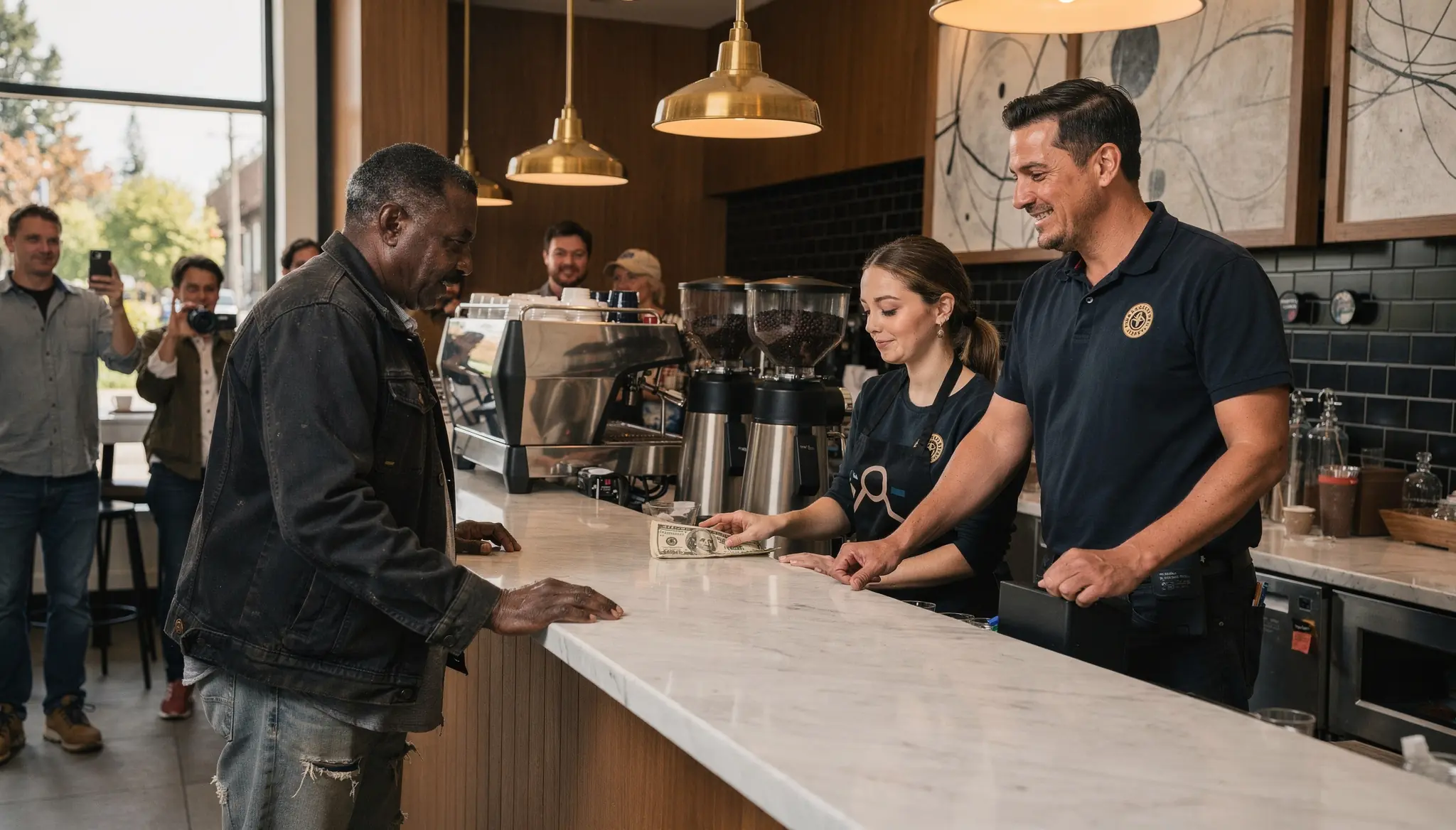
“I’ll take the Reserve.” “It’s not really for tourists,” she said.
The manager slid in beside her. His tone carried the same message more plainly: people from the man’s part of town wandered in all the time thinking every item on the menu was meant for them. He suggested a gas station on Yesler instead. Two customers laughed. A phone went up. A whisper moved through the room. Nobody stood up, and nobody looked up for long.
The man laid a fifty-dollar bill on the marble counter and asked for one sip. What nobody in that room knew was that he owned the company behind the cafe. Within ninety minutes, that single sip would begin dismantling the system that had been operating inside his flagship store.
Hannah Brennan was twenty-three years old and three minutes early. Her sneakers slapped the wet pavement on Pike Street, the laces loose because tying them took time and time was a thing she never seemed to own. The Northbrook flagship was dark behind the glass except for the back office, where a single lamp glowed yellow.
She tried the front door. Locked. She walked around to the alley. The side door was propped open with a wedge of folded cardboard. That was the first wrong thing.
The second wrong thing was the smell: sweet, plasticky, faintly chemical, the smell of beans that had sat too long in the wrong place. The third wrong thing was Brett Holloway, the store manager, standing with his back to the door and not turning when she walked past. He did not turn because he was signing a receipt that had no manifest attached to it. Hannah noticed the receipt. Hannah noticed everything.
“You’re early,” Brett said. “You said five. It’s 4:58.”
“You said five.” He turned and smiled in a way that was mostly his upper lip. “Lean and mean today, sweetheart. We’re running lean and mean.”
She knew what that meant. She walked to the prep room. By 5:14 a.m., she was in the dish pit. Her assignment for the morning had been espresso bar. She had checked the schedule app on her phone three times the night before to be sure, but the schedule app was a spreadsheet Brett controlled, and Brett could rewrite it.
She pulled on rubber gloves and did the dishes without saying anything. At 6:02 a.m., the rush started. Hayley Brooks tied on her apron at the bar, slid a cup under the espresso wand, and pulled a pretty shot. Hayley was twenty and good at her job, and she knew it. She was also fast at counting tips, fast in a particular way.
When she emptied the tip jar at the end of the lunch rush, she pinched three folded twenties and slid them into her own apron pocket before the rest went into the back-office safe. Hannah had watched her do it before. The first time Hannah said something. After that, her hours dropped from thirty-two to twenty-six. The next time, twenty-six became twenty-two. She had stopped saying things.
The walk-in cooler sounded like a small ocean. It was the only place in the store without a camera. Ellie Donovan was inside at 9:30 a.m., restacking cartons of oat milk when Hannah came in to grab a bag of espresso beans. “It’s not the hours,” Hannah said very quietly. “It’s the math.”
Ellie looked up. She was twenty-six, already carrying family responsibilities that had taught her long ago that complaint could feel like a luxury she could not afford. But she liked Hannah. She slid an almond croissant out of her apron pocket and pressed it into Hannah’s hand.
“Eat,” she said. “And don’t go where you don’t belong.” “He told me that yesterday.” “Then he’s right about one thing.”
Hannah ate the croissant in the cooler and went back to the dish pit.
At 11:50 a.m., across the street and one block down, a silver Volvo idled at the curb with the heater running low. The man inside was not waiting for anyone. He was reading a letter. It was on plain printer paper, block-printed in pencil, unsigned, and only four sentences long. He had read it eleven times since Sunday.
The fourth sentence read: “Taste the Tuesday espresso.” The man inside the Volvo was Samuel Sutton. He had founded Northbrook Coffee Roasters fifteen years earlier on a roasting drum the size of a kitchen sink. He was a certified Q Grader and had a small burn scar on the pad of his right thumb from the second batch he ever pulled. He rubbed the scar now without realizing he was doing it.
He pulled a small canvas bag from the passenger seat and lifted out an apron. The apron was older than Northbrook. Across the chest, in faded thread, was a hand-stitched name tag from a Tacoma shop he had run when he was broke and twenty-nine: Sam S. He did not put the apron on yet. He sat with it in his lap and watched the side door of the cafe across the street prop open, close, and prop open again.
“You read my mind, kid.” She pulled the shot the way her trainer had taught her two years earlier: twenty-five seconds, twenty grams in, thirty-six grams out, the crema breaking like a slow thumbprint. She slid the cup across. Walter lifted it and sipped.
He went still. He said nothing for two full seconds, which on a Tuesday at 8:13 a.m., with a line of nine people behind him, was a long time. Then he set the cup down and looked at it as if it had personally insulted him. “Hannah.”
“Yes?” “That’s not the same.” Behind her, the office door opened. Brett came out smiling.
“Walter, my man. Problem?” “This isn’t the Founder’s Reserve.” “Of course it is. I unbagged it myself.”
“It tastes different. Burnt, kind of, but not burnt. Different.” Brett’s smile widened by a single millimeter. He turned to Hannah.
“Sweetheart, did you check the bag?” “I pulled from the labeled hopper like we always—” “Did you check the bag?”
Hannah did not answer. The bag had already been in the hopper when she clocked in. Brett’s new SOP, printed two months earlier, specifically said checking bags was the manager’s job, not the baristas’.
Brett picked up Walter’s cup and looked into it. Then he frowned at the line of customers like a doctor delivering a regrettable diagnosis. He poured the coffee slowly into the bus tub on the counter. The line reacted audibly. It was performance, and Brett knew it.
“On the house, Walter,” Brett said. “And the remake fee is waived. We’ll take care of you.” “I don’t want a remake fee waived. I want my coffee.”
“Of course. Hannah’s going to pull you a fresh one. Aren’t you, Hannah?” Two seats away, a man in an off-the-rack jacket had been holding a copy of the Seattle Times for ninety seconds without turning a page. He was watching while holding his cup of plain black drip coffee very, very steady.
Hayley Brooks lifted her phone above the bar and angled it down casually. She was filming. Not technically Hannah. She was filming Walter. The video had somewhere to go.
Hannah did not see the phone. Walter did not see the phone. The man behind the newspaper did.
Hannah pulled a new shot, identical to the first, and slid it across. Walter sipped. His face did not change. He set the cup down without drinking the rest.
“Hannah,” he said. “That one was right.” He pulled a five-dollar bill from his coat pocket and laid it on the counter, weighted with a sugar packet. “For you. Not the jar.”
He walked out without finishing his coffee. Brett’s smile had slipped. He turned back to Hannah and produced a single folded sheet of paper from his polo pocket. The header read, “Performance Acknowledgement.” Underneath: “Failure to Follow Product Standards.”
“Sign,” he said. “We move on.” Hannah looked at the paper, then at Brett’s blue-ink pen on the counter. She looked at the cup of pencils beside the stir sticks, where customers borrowed pencils for the Sudoku in the free magazine. She picked up a pencil and signed lightly, clearly, unmistakably, with pressure soft enough that a thumb could erase it later.
Brett did not look at the signature. He folded the paper and walked back into the office. The man behind the newspaper turned the page for the first time in ninety seconds.
Samuel Sutton finished his drip coffee at 8:31 a.m. and walked out without looking back. He crossed Pike Street, got into the Volvo, and sat with both hands on the wheel for ninety seconds. He did not start the engine.
The letter on the passenger seat was on its twelfth read.
“Mr. Sutton, the bag and the cup don’t match anymore at the flagship. Tip jar’s getting lifted. Hours are getting cut on whoever notices. Side door props at 5:00 on Wednesdays. Taste the Tuesday espresso.”
He had memorized the four sentences. What he had not memorized was the handwriting. Whoever wrote it had used pencil, all caps, block printing that looked deliberately anonymous. Whoever wrote it had also slipped the envelope into the corporate mail room on Friday afternoon, meaning they had traveled to Northbrook headquarters in Tukwila, south of the flagship, on personal time to get a piece of paper inside a building where they did not work. Whoever wrote it knew exactly what they were risking.
Samuel started the engine. He drove to Northbrook headquarters and rode the elevator to the eighth floor without speaking to anyone.
Helen Bradley was in her office. Helen chaired Northbrook’s audit committee. She had joined the board four years earlier after twenty-eight years at a Big Four firm and had not lost an argument with Samuel since. He liked her precisely for that reason.
“You look terrible,” Helen said without standing up. “I want forty-eight hours.” “For what?” “To go into the flagship undercover. As a barista.”
She looked at him for a long moment over the top of her reading glasses. “Samuel. Tell me you are not going to put on an apron and pretend to be twenty-five.” “I am going to put on an apron and pretend to be fifty.”
“Why?” “Because if I send an audit team, Brett’s cousin the lawyer will hear about it before lunch. And because the letter says, ‘Taste the Tuesday espresso.’” Helen removed her glasses, folded the temples, and aligned them with the edge of her ledger, the neat ritual she used when calculating risk.
“Forty-eight hours,” she said. “Then I move with or without you. And Samuel, if you get spotted, the board removes you on Monday. I will vote with them.”
“I know.” “Boring lasts in court. Make it boring.” “I know.”
Samuel went to the eighth-floor storage closet where, fifteen years earlier, he had put the cardboard box containing his original founding apron. He had not opened the box in eleven years. The apron was on top. The hand-stitched Sam S. tag was still attached.
Underneath it was a small, sealed green Ethiopian burlap sack with a single-origin stamp and the original stitching pattern from the year Northbrook signed its first sourcing contract. Samuel weighed the sack in his hand, then set it back on top of the apron.
He drove home, slept four hours, set an alarm for 4:15 a.m., and woke at 4:00 anyway. By 5:55 Wednesday morning, he was parked one block south of the flagship with the apron tied beneath his jacket and the sealed green sack zipped into a canvas bag at his feet. The old roasting burn on his thumb had flared the way it did when he was thinking. He did not notice.
He got out of the car and walked toward the alley. The side door was already propped open. The wedge of cardboard beneath it was fresh, folded the night before by the look of the creases. Samuel stepped over it without touching it and entered the flagship like he had every right to be there, which technically he did.
Brett Holloway stood beside the bean storage rack with a clipboard. He looked up. “You’re new.” “Sam Sutton’s nephew told me you needed pickup shifts. Sam S.”
Samuel extended his hand. “Six o’clock start. He said—” “He said you don’t ask questions.”
Brett did not take the hand. He looked at the name tag, then the apron again. The tag was twenty years out of date in style, hand-stitched and faded. The apron was older than Brett’s entire employment history at Northbrook.
“You worked here before.” “Long time ago.” “Where else?” “Couple shops in Tacoma. Closed now.”
Brett tilted his head. He did not believe a word of it. He also did not have a barista on the schedule for the open, Hayley had called in twenty minutes earlier, and the Wednesday delivery was due shortly.
He handed Sam a clipboard. “Bag the Reserve. Two-pound increments. Go.”
Samuel took the clipboard.
By 5:14 a.m., he had bagged sixteen two-pound bags. The labels said Reserve. The beans were not Reserve. They were two grades lower, machine-roasted, a commercial blend that retailed for about nine dollars a pound at Pike Place wholesalers. The label claimed twenty-eight. The bag in his hand was forty grams light.
Forty grams across sixteen bags was roughly two-thirds of a pound. Two-thirds of a pound was about twelve dollars at retail. He did the math without thinking, the kind of math his father had taught him at thirteen in the back of a hardware store. Small thefts added up. More importantly, small thefts had to be going somewhere.
Where?
The Wednesday truck arrived at 5:02 a.m. The driver did not get out. Brett opened the side door from inside, and the driver wheeled in six unmarked cardboard boxes on a hand truck. He wheeled out four sealed green Ethiopian burlap sacks on the same hand truck. The sacks carried Northbrook’s current-year stitching pattern. The truck left at 5:09. Samuel kept bagging.
At 6:30, Brett quizzed him on the espresso machine. “Grind setting for the Founder’s Reserve?” Samuel knew the answer: fourteen and a half on the Mahlkönig EK43, a number he had set himself ten years earlier and never changed because the bean had not changed. “Fifteen,” he said.
Brett snorted. “Sixteen. We run it coarser here. Different machine model.”
The machine was the same model. Samuel nodded. “Sixteen. Got it.”
Brett walked away.
At 7:48 a.m., Sam S. stepped to the espresso bar during a lull in the morning rush and ordered a double Founder’s Reserve. Hayley Brooks was on bar. She looked at the apron, the name tag, then his old hiking boots, and one corner of her mouth lifted again.
She pulled the shot. Samuel watched the dose and the timer. Thirty-three seconds for what should have been a twenty-five-second extraction. The grind was not sixteen. It was closer to twenty. She was not pulling Reserve. She was pulling the cheaper bean from the hopper, ground slowly enough to hide some of the off notes.
She slid the cup across. “First time?” she said. “Stand back. It splashes.”
Samuel smelled the espresso first, the way he would smell wine before tasting it. Almond, hot rubber, and a faint sour note from beans that had sat too long in the wrong environment. He took one sip, said nothing, and set the cup down. Then he smiled. The smile did not reach the rest of his face.
“Could I trouble you for a glass of water?” Hayley’s smirk faltered by a millimeter. “Yeah. Sure.”
She brought the water. He drank it, carried the espresso to a corner table, and poured it slowly into the small succulent on the windowsill. At 9:14 a.m., Hannah Brennan was teaching him at the back sink. “You’re doing it wrong,” she said, not unkindly.
“How?” “You’re tamping at thirty pounds. We tamp at twenty-eight. The blend can’t take thirty. It chokes the head.”
“You measured the pressure?” “I bought a tamp gauge two months ago with my own money.” Samuel said nothing for a moment. “How long have you worked here?”
“Two years.” “You like it?”
“I liked it.” She rinsed a portafilter beneath the hot tap. “I liked it for a year and a half. Then I started counting.”
She nodded toward the prep table without appearing to nod. Four green burlap sacks sat underneath it. The seal on one had been cracked open and re-glued. “Those bags are wrong,” Hannah said.
“How do you know?” “The stitching. The stitching pattern tells you who roasted it. Last year’s pattern was a chevron. This year’s is supposed to be a single line, double-spaced.”
“Those bags?” She pointed without pointing. “Last year’s pattern on this year’s seal.” Samuel looked at the bags and saw, for the first time, exactly what the letter in his Volvo had been trying to make him see.
“You told anyone?” “I wrote a letter.” “To who?” “To a man I’ve never met who probably won’t read it.”
She finally looked at him. “Why?” “Because I tasted the espresso this morning.” She did not stop rinsing the portafilter, but the motion slowed by a fraction.
“What are you doing here?” she asked, still not looking at him. “Working a pickup shift with those shoes?” Samuel looked down at the hiking boots. He did not answer.
By 10:30 a.m., he was on break at a corner table, pretending to read his phone. Brett’s office door stood open six inches. An iPad lay face-up on the desk. From forty feet away, if you knew what you were looking for, the home screen told a story.
There were two Square Reader apps on the same iPad under different account names. One was Northbrook Flagship Pike Street. The other was Reserve Pour Company. Reserve Pour Company was not a Northbrook entity.
Brett returned to the office at 10:33. Samuel had already turned toward a bus schedule on the wall. “You looking for something, Sam?” “Bus 13. I don’t drive.”
Brett looked at the wall. The bus schedule was real. He nodded slowly, then walked over and turned the iPad face-down.
“You’re new,” he said. “Don’t be where you don’t belong. We had a guy last year who got too curious. Didn’t end well for him.”
“Got it.” “You got it.” Brett went back into the office and closed the door.
At 4:50 p.m., Samuel watched Brett count the day’s tip jar in the back office. Brett peeled six twenties from the stack and slid them into a separate envelope before carrying the rest to the safe. The envelope was plain manila. No label, except for one letter printed in Sharpie on the corner: B.
At 11:00 that night, parked again across the street, Samuel sent Helen Bradley a four-word text. Bring Theo. 5:00 a.m.
Helen Bradley pulled into the alley at 4:48 a.m. Thursday in a navy Audi with the headlights off. Theo Whitfield sat in the passenger seat with a leather notebook, a small camera, and a clipboard. Theo was sixty-three, bald, soft-spoken, and deliberately unremarkable, exactly the sort of man Helen wanted attached to a deposition record.
Samuel clocked in at 4:50 a.m. Brett yawned from the back office and asked whether anyone had made coffee. Samuel made it from a fresh bag he opened himself, pulled from an unopened Reserve hopper in the storeroom.
The coffee, when Brett tasted it, was good. Brett did not realize it was the first cup of actual Founder’s Reserve he had tasted in that building in eleven months. His palate was not trained well enough to notice. At 5:02 a.m., the side door was propped open. Theo, across the alley in an unmarked coat, lifted his camera.
Side door propped, timestamp 5:02:14. Truck plates visible, 5:02:31. Driver hand-trucking six boxes in and four sealed green sacks out, 5:04:02 through 5:08:46. Side door closed, 5:09:11. Truck gone.
Samuel continued bagging beans inside. At 5:33 a.m., during a milk-frother repair request Samuel had deliberately created, Brett had to leave his iPad on the prep counter for forty-eight seconds. Forty-eight seconds was enough.
Samuel photographed the home screen. He captured the Reserve Pour Company logo, the username, the recent transactions list, and the linked bank account display. Then he returned the iPad exactly where it had been.
Brett came back. He did not notice. Brett had never been the kind of man who imagined someone might be studying him.
At 5:49 a.m., Hannah Brennan walked in for her opening shift. She saw Sam at the prep counter with the iPad face-down beside him, exactly as Brett had left it. She saw Theo in his coat pass the front window across the street. Her expression did not change. But for one full second, her eyes found Samuel’s.
Samuel shook his head a quarter of an inch. Not yet. Hannah tied her apron and walked to the espresso bar.
At 6:14 a.m., Brett unlocked the safe in the back office and removed the manila envelope marked B. He counted the previous evening’s skim: eight twenties, three tens, and one hundred-dollar bill. Then he folded the envelope and put it back into the safe.
Theo photographed it all. The images were timestamped 6:14:18 and 6:14:33. Helen received the files in the Audi outside at 6:21. She read through them twice and sent Samuel two words.
We have enough.
Samuel read the message and slipped his phone back into his pocket. Hannah was at the back sink washing portafilters. A small notebook protruded from her apron pocket. The cover was plain. The exposed inner pages were block-printed in all caps, in pencil.
The handwriting matched the anonymous letter. Samuel stopped moving for one second. He did not approach her. He did not change his expression. He simply walked past with a clipboard, the muscles around his mouth easing almost imperceptibly.
Since the previous morning, when Hannah had pointed out the stitching pattern, he had suspected someone in this building had written the letter. Now he knew exactly who.
He filed the knowledge away and walked toward the back door. Theo nodded from across the alley. Samuel nodded back. Then he went inside, tightened his apron, and waited for 8:05 a.m.
At 8:00, the doors opened. At 8:05, Samuel Sutton tied his apron one notch tighter, picked up the canvas bag from the storeroom corner, and walked to the espresso bar. Hayley Brooks was on bar. The line was twelve people deep. Brett was at the register charming a regular about hiking trails.
Samuel pulled a shot on the proper grind, the proper dose, the twenty-five-second extraction his trainer would have taught a new hire fifteen years ago. The crema broke like a slow thumbprint. He set the cup on the counter. Beside it, he placed the small sealed green Ethiopian burlap sack from his canvas bag, the one with the original stitching pattern and the single-origin stamp.
Brett saw the sack. His face changed half a second too slowly. “Whoa. Sam, where’d you get that?”
“From my office.” The four people at the front of the line did not yet understand. Hayley looked up for the first time. Her eyes moved from the apron to the faded name tag, to the sack, and finally to Brett.
Brett walked toward the bar. His smile flickered like a bad bulb. “Sam, buddy, let’s talk in the back.” “Whatever this is, it’s not in the back.”
Samuel did not raise his voice. The front door bell rang. Helen Bradley entered with Theo Whitfield. Each carried a manila folder. Helen wore a charcoal suit that looked as if it had never once wrinkled in her career.
Brett saw Helen. The flicker stopped. The smile disappeared. Samuel untied the faded Sam S. name tag from the apron and laid it on the counter beside the green sack.
“My name is Samuel Sutton,” he said to the customers. “I founded Northbrook Coffee Roasters. I’ve been bagging beans in the back of this store for two days.” The customers nearest the front stopped checking their phones.
“This cafe is closing today. It will not reopen as Northbrook.” A small sound, half gasp and half laugh, came from the middle of the line. Hannah, still at the back sink, set down the portafilter she was washing. She did not turn around, but she listened.
Samuel continued. “For fourteen months, this location has been substituting a cheaper bean and selling it under our Reserve label. For fourteen months, tips have been skimmed from this store’s pool. For fourteen months, the schedule app has been used to retaliate against baristas who noticed.”
The line was silent. “Every receipt issued by this location in the last fourteen months will be re-audited. Every current and former barista who lost tips or hours under the current management will be paid back with six percent interest, beginning tomorrow morning with checks at a folding table in this doorway.” He paused.
“There is another Northbrook two blocks west. Customer refunds will be issued at the corner. Coffee is on me at the sister shop. I am sorry for the inconvenience.”
He did not apologize only for Brett. The brand had carried the name above the door. The company had sold the cup. The responsibility belonged to Northbrook, too.
Brett’s mouth opened. “My uncle is a lawyer.”
Samuel looked at him. “So is mine. Mine is also founder’s counsel for Northbrook Coffee Roasters, retained when we went private nine years ago and present at every quarterly board meeting since. I’m happy to introduce you.”
Brett’s phone rang. The display read Tom. Uncle. Brett moved to answer it. Samuel held out his hand.
“May I?” Dazed, Brett handed him the phone.
“Tom,” Samuel said, “this is Samuel Sutton. We have not met. I will be at a deposition Tuesday at 10:00 a.m. with our auditor. Theo has the documents. Please call him after lunch. Thank you.”
Samuel ended the call and returned the phone. Helen stepped forward and gave Brett a single sheet of paper. It was not a press release. It was a termination letter dated that morning and signed by Helen and Northbrook’s general counsel.
Brett Holloway was no longer manager. Hayley Brooks made a small swallowing sound behind the bar. Samuel turned toward her. “Hayley?”
“I—I just did what I was told. I didn’t—” “I know. So you’ll be a witness, not a defendant. Theo needs to talk to you this afternoon. Tell him everything, including who told you the Founder’s Reserve was for tourists.”
She nodded. The smirk was gone.
Samuel turned back to the customers. “Refunds at the corner. Sister shop two blocks west, open until noon. Thank you.”
He picked up the sealed green sack and carried it slowly past the line to the back sink. Hannah Brennan was standing there. She had not turned. She had not moved.
Samuel set the sack on the rim of the sink. He did not say thank you. He did not say, “I read it.” He did not say her name. Then he walked back toward the front of the store.
Hannah picked up the sack and held it in both hands. She stared at the original stitching pattern. From behind, the only visible change was in her shoulders. After two years of holding still, they dropped a quarter of an inch.
Walter Davis, waiting in line, tipped his cap. A teenager in a hooded sweatshirt had filmed the entire announcement on a phone held at chest height. He lowered it now, looked at the espresso Samuel had made and never drank, then looked at the woman standing behind him. Two strangers made eye contact for one second longer than strangers usually do.
The line began to break apart. People filed toward the door. No one ran. No one pushed. Walter was the last to leave. He tipped his cap once more on the way out.
By noon on day one, the Northbrook sign was being removed from the Pike Street masonry. The worker taking it down wore a hard hat and a paint-spattered jumpsuit. He lowered the sign to the sidewalk as carefully as if he were carrying glass.
Behind him, a one-page letter was taped to the door. Plain printer paper, eleven sentences. The first sentence read, “This cafe is closed permanently as Northbrook.” The second acknowledged that the store had sold customers a cheaper bean than the one printed on the bag. The last promised refunds and back pay beginning the next morning and ended simply: “We are sorry.”
Hannah stood across the street and watched the sign come down. She did not look away. Ellie Donovan stood beside her with coffee from the shop on the corner, one arm linked through Hannah’s. Neither woman spoke.
On day two, a folding table went up at the doorway. Theo Whitfield sat behind it with a checkbook the size of a small laptop. The line began at 8:02 a.m. and stretched to the end of the block by nine.
Every person who came to the table was a current or former Northbrook flagship barista. Each received back pay for every hour cut from their schedule, six percent interest, and reimbursement for tips skimmed from the pool over the previous fourteen months. Hannah’s check was for $4,416.
Theo handed it to her. She read the number twice. She did not cry. Ellie cried briefly when her own check arrived and then apologized for crying, which was the only thing about Ellie that had ever made Hannah angry.
On day three, Samuel Sutton sat before Northbrook’s board. Eleven people were in the room. Helen Bradley sat at the head. Two of the eleven were visibly angry, and one of them used the word “optics” three times in eight minutes.
“The optics,” Samuel said, “are that we found it ourselves and we are not keeping the room that lied.” “You are torching a flagship.” “I am closing a flagship that was already torched.” “You are setting a precedent.”
“That is the point.” Helen spoke quietly. “I move to ratify the closure and authorize the rebrand pilot.” The motion passed nine to two.
By 4:00 p.m. that same day, the chain-wide review had flagged three other Northbrook locations for the same bean-substitution pattern: the Capitol Hill store Hayley had named, a smaller cafe in Bellevue, and the recently expanded Tacoma location, the city where Samuel had run his first shop twenty-one years earlier. The pattern was consistent. The pattern had names attached to it.
By the end of the week, six of the chain’s twenty-eight locations were under district-level audit. Two managers resigned before their interviews. Northbrook’s corporate compliance hotline, which historically logged two complaints a quarter, received forty-eight separate calls in five days. None came from customers. Every one came from baristas at other stores.
The letter that had once appeared alone was beginning to multiply. On day four, Samuel walked Hannah through the empty floor of what had been the Northbrook flagship. The chairs were stacked. The espresso machine sat beneath a clean white cloth. The light through the front windows was the cleanest thing in the room.
“I want you to lead the next thing built here,” he said. “I’m twenty-three.” “I was thirty-five when I started Northbrook.” “You had ten years of training first.”
“You have two years here, a tamp gauge you bought with your own money, and a letter.” Hannah said nothing for a full minute. Samuel did not fill the silence. “What’s the next thing built here?” she finally asked.
“A separate brand under our umbrella. Not with the Northbrook name. Transparent SOPs as charter. Tamper-evident green sack tags on every bag. A real-time tip ledger on a counter tablet every barista can read. Scheduling minimums published monthly. A no-retaliation hotline reporting to the audit committee, not store management.”
“And you want me to lead it.” “Co-author the charter. Name it.” “Name it?”
“Yes.” Hannah walked the empty floor for a long time. She stopped at the prep counter where three days earlier four bags with the wrong stitching pattern had been stacked. She rested one hand on the counter.
“Stitchwork,” she said. “Stitchwork?” “Because the stitching was what told me the bags were wrong. Stitching tells you who roasted it.”
Samuel nodded. “Stitchwork Coffee,” Hannah said.
On day five, the charter was printed. Twelve pages. Hannah read it twice. She picked up a pen from the counter, not a pencil from the cup beside the stir sticks, and signed her name on the line marked co-author in clean blue ink. Samuel signed second.
The pen he handed her to keep was the same brand Brett had put in front of her with the performance acknowledgement. She kept it.
On day six, Hayley Brooks met with Theo in a conference room on the eighth floor of Northbrook headquarters. She testified for three hours. She named the second manager connected to Reserve Pour Company, the manager at the Capitol Hill Northbrook who had been pushing substituted beans through the flagship for fourteen months. He was the same man who had told her two years earlier, when she was nineteen, that Founder’s Reserve was for tourists and that pulling the cheaper shot meant more money for everyone.
She gave Theo his full name. Theo wrote it down. The chain-wide review expanded at noon. Hayley kept her job with a pay cut and a transfer to a different store under direct supervision of an assistant manager who did not control a Reserve Pour Company account.
On day seven, the renovation crew finished by dusk. The propped side door was permanently replaced with a logged, alarmed entry requiring two signatures to open. The front door got a new lock and a new key. The walls were painted soft white. The wood counter remained the same wood counter, sanded and oiled but not replaced.
A tip-ledger tablet sat at the end of the counter, glowing faintly.
Samuel walked the floor at dusk. Hannah met him at the door. He handed her a small sealed green Ethiopian burlap sack with the original stitching pattern and single-origin stamp. A small white tag stitched into the corner read H. Brennan.
She took the sack in both hands and looked at his thumb. She had never really studied his hands before. The old roasting burn was faint but still there on the pad. “You roasted, didn’t you?”
“Once. A long time ago.” “Why’d you stop?” “Because I needed to learn how to keep the people who do it now from getting cheated by the people who manage them.”
Hannah did not answer. She unlocked the front door with the new key. Stitchwork Coffee opened on a Tuesday at 8:00 a.m.
Hannah Brennan wore a clean black apron with her name stitched across the chest in single-line thread. She tied it behind her back and walked to the front of the bar. The line wrapped the block.
The first person in line was Walter Davis. He carried a folded copy of the Tuesday Times beneath his arm. He did not look at the menu.
“Founder’s Reserve. No sugar. Paper cup. Same as it ever was.”
“Same as it ever was.”
Hannah pulled the shot. Twenty-five seconds. Twenty grams in. Thirty-six grams out. The crema broke like a slow thumbprint.
She slid the cup across. Walter sipped and nodded once. Then he walked to a corner table and read the newspaper for forty-five minutes. He did not say anything else. He did not need to.
By 9:30 a.m., the five staff members were gathered at the prep counter for their huddle. Hannah did not give a speech. She read the previous practice day’s tip ledger aloud: total, split, individual share. She announced the week’s schedule aloud and pinned a printed copy to the bulletin board beside the no-retaliation hotline number, printed in inch-high type.
She ended the huddle by pulling an espresso for each staff member, on the house and off the clock. At 11:00 a.m., the first difficult customer arrived. A man in a suit ordered a flat white, drank half, then demanded a refund because the coffee was weak. Hannah refunded him without comment and pulled a fresh espresso for the next customer. She did not roll her eyes when the door closed behind him.
Ellie watched her through all of it. Ellie had not been a Northbrook employee for nine days. She was now Stitchwork’s lead trainer. “You’re getting better at it,” Ellie said when the line finally cleared at noon.
“At what?” “At not letting it get to you.” “I’m letting it get to me. I just put it where they can’t see.”
“That’s the same thing, kid.” “It’s not.” “It’s a little of the same thing.”
At 12:30 p.m., a customer at the corner table noticed the tip-ledger tablet at the end of the counter. The day’s count glowed in soft green digits beside the line showing an even split. No tape covered the jar. Nothing was hidden in a back office.
He stood, walked over, and read the screen for thirty seconds. Then he turned to Ellie. “You see this in every shop now?” Ellie shook her head. “Just this one, for now.”
The customer dropped a ten-dollar bill into the jar without asking for a receipt and walked out. Ellie watched him go for a long moment, then returned to making coffee. By 2:00 p.m., Walter returned with his daughter Margaret, who was in her first year of nursing school. Hannah recognized the textbook before she recognized the daughter: Anatomy and Physiology, Saunders, fifteenth edition, the same book Hannah carried in her own backpack.
“Dad won’t stop talking about you,” Margaret said. “He’s always been generous.” “He says you saved his Tuesdays.” “He saved his own. We just made the coffee right.”
Hannah pulled Margaret a coffee on the house and slipped a stained, dog-eared anatomy review packet she had been carrying for three weeks into the woman’s textbook. She waved both of them away without making a thing of it.
At 3:00 p.m., Samuel Sutton walked in wearing a charcoal suit. No apron. He sat at the end of the counter and read the tip ledger on the public tablet, not in the back office and not on his own iPad. He ordered a small drip coffee, paid by card, and tipped.
He did not introduce himself to the new staff. They did not recognize him.
At 4:00, Hayley Brooks walked past Stitchwork’s front window on her way to a supervised shift at the Capitol Hill location three blocks east. She slowed. She did not come in. She raised one hand.
Hannah, behind the bar, raised hers back. Forgiveness was not required. Coexistence was.
By 6:00 p.m., the line had cleared and late-afternoon light lay across the wood counter. Hannah turned the small green Ethiopian burlap sack with her name on it so the tag faced outward on the back-bar shelf. She wiped the counter, closed the till, and locked the front door. It was the only door.
Three months after opening day, on a slow Tuesday in February, Hannah stood at the prep counter with a new hire, a man in his mid-forties who had lost a job at a chain restaurant after a manager skimmed his tips for a year and a half. He was signing his SOP charter. Hannah watched him finish. Then she handed him a sealed green Ethiopian burlap sack. He took it carefully.
“The stitching,” she said, pointing without pointing. “Stitching tells you who roasted it. This year’s pattern is a single line, double-spaced. If a bag shows up here without it, you tell me.”
“How will I know?” “You’ll know. The way you know when a number doesn’t add up.” She did not tell him how she had learned. She did not need to.
Near the front door, beneath the new lighting, a small framed item hung on the wall. It was the original anonymous letter, block-printed in pencil, four sentences long. Beside it was a printed sign:
“Stitchwork was born from one barista’s letter. Northbrook published the audit of every flagship-grade store. Fourteen months. One sentence at a time.”
A regular at the counter, a woman in her fifties who had been coming for ten weeks, studied the framed letter. “How do you know when something’s wrong?” she asked Hannah. Hannah pulled a fresh shot and slid the cup across.
“You taste it,” she said. “Then you say so.” The woman drank her coffee while reading the letter on the wall. She finished both at the same time, nodded the way Walter Davis nodded, and left a tip in the jar. The jar had no tape across the slot.
Outside on the sidewalk, two women walked past carrying takeout cups from another shop. One was talking about her boss skimming overtime. She stopped in front of Stitchwork’s window and read the framed letter through the glass. She did not go inside.
She pulled out her phone, typed something quickly into a notes app, and walked on. Nobody inside the building heard what she wrote. The next morning, on Hannah’s counter, a folded sheet of plain printer paper sat beneath the corner of the tip jar. Block-printed. Pencil.
Four sentences.